

ISO/FDIS 19870-4
(Main)Hydrogen technologies — Methodology for determining the greenhouse gas emissions associated with the hydrogen supply chain — Part 4: Emissions associated with the storage, transport and release of hydrogen via LOHC
- Abstract
The scope of this proposal is to establish a methodology and analytical framework to determine the GHG emissions related to a unit of hydrogen converted and transported via liquid organic hydrogen carriers up to the consumption gate.
- Status
- Not Published
- Technical Committee
- ISO/TC 197/SC 1 - ISO/TC 197/SC 1
- Drafting Committee
- ISO/TC 197/SC 1 - ISO/TC 197/SC 1
- Current Stage
- 5000 - FDIS registered for formal approval
- Start Date
- 27-Aug-2026
- Completion Date
- 17-Jul-2026
Buy Documents
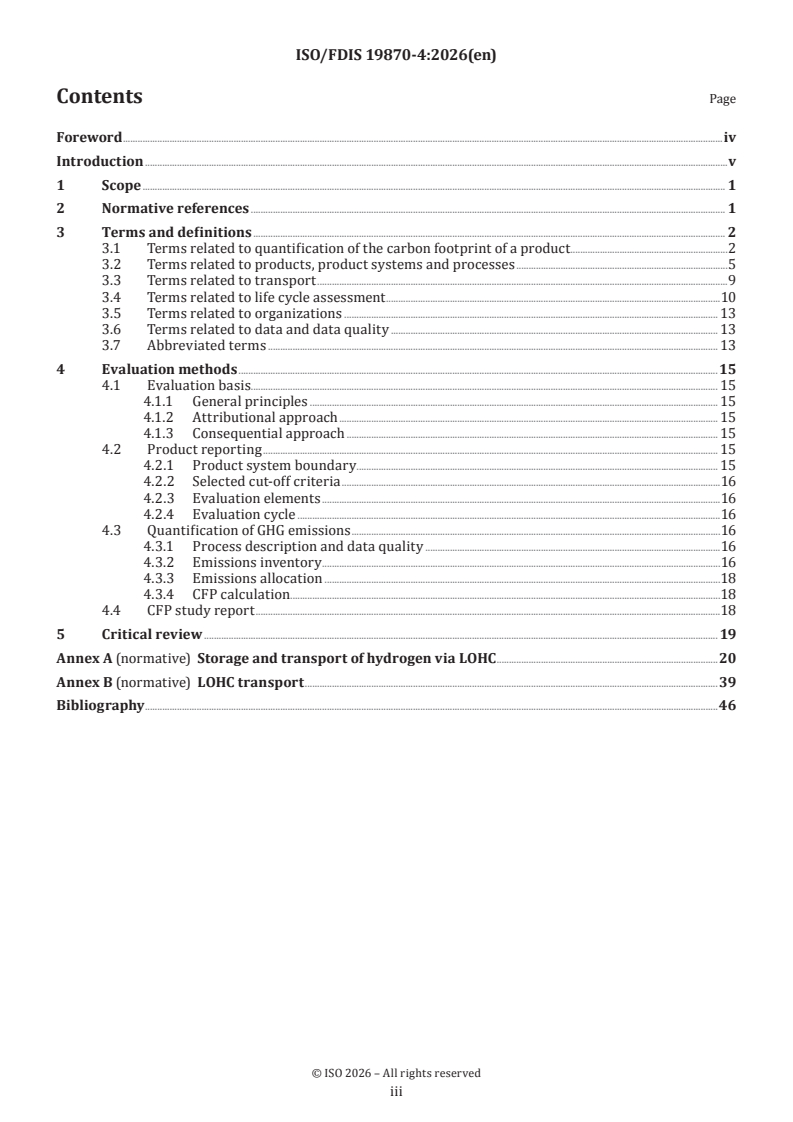
ISO/FDIS 19870-4 - Hydrogen technologies — Methodology for determining the greenhouse gas emissions associated with the hydrogen supply chain — Part 4: Emissions associated with the storage, transport and release of hydrogen via LOHC
REDLINE ISO/FDIS 19870-4 - Hydrogen technologies — Methodology for determining the greenhouse gas emissions associated with the hydrogen supply chain — Part 4: Emissions associated with the storage, transport and release of hydrogen via LOHC
ISO/FDIS 19870-4 is an ISO document for quantifying greenhouse gas emissions in the hydrogen supply chain when hydrogen is stored, transported and released via liquid organic hydrogen carriers (LOHC). It specifies a methodology for partial carbon footprint of a product (CFP) studies from the hydrogen production gate to the consumption gate, for organizations that need to account for the emissions of this LOHC pathway.
What does ISO/FDIS 19870-4 specify?
ISO/FDIS 19870-4 specifies a methodology and analytical framework for determining GHG emissions associated with storing, transporting and releasing hydrogen via LOHC. It is written for the LOHC part of the hydrogen supply chain and is applied as a partial CFP approach.
The document is organized into Clause 1 Scope, Clause 2 Normative references, Clause 3 Terms and definitions, Clause 4 Evaluation methods, Clause 5 Critical review, Annex A and Annex B, followed by a Bibliography. Clause 3 groups terms by topic, and Clause 4 covers the calculation and reporting logic used in the study.
| Annex | What it covers |
|---|---|
| Annex A | Storage and transport of hydrogen via LOHC, including hydrogenation, direct electrochemical hydrogenation, dehydrogenation, emission sources, allocation and reporting |
| Annex B | LOHC transport by ship, road and rail, including transport-chain structure, emission sources, allocation and reporting |
What are the key requirements of ISO/FDIS 19870-4?
ISO/FDIS 19870-4 sets the rules for defining the study boundary, collecting data, calculating emissions and reporting the partial CFP for LOHC-based hydrogen. In practice, it tells users what to include, how to split emissions between products, and how to document the result.
System boundary and reporting basis
Clause 4.2.1 defines the study boundary as the path from hydrogen production gate to consumption gate, divided into hydrogen production, conditioning/conversion and transport. For this document, the LOHC-specific work is the storage, transport and release of hydrogen via LOHC, and the functional unit is 1 kg of hydrogen at the pressure and purity needed by the next stage.
That matters because the result must match the actual handover point in the supply chain. The reporting metric is either kg CO2e/kg hydrogen or kg CO2e/MJ for hydrogen at the consumption gate, and the pressure and purity of the hydrogen used in the study shall be specified.
Cut-off, impact category and LCA basis
Clause 4.2.2 applies cut-off criteria of 0.05 kg CO2e/kg hydrogen to the scope under the control of the reporting entity. Clause 4.2.3 selects climate change as the environmental impact category, and Clause 4.2.4 applies the evaluation cycle defined in ISO 19870-1:2026 within this document’s boundary.
In practice, this keeps the study focused on climate impacts and gives users a clear threshold for minor flows. The document also states that carbon offsetting shall not be included in the partial CFP of conversion and transport of LOHC.
Data quality and emission inventory
Clause 4.3.1 refers users to ISO 14067:2018, Clause 5, and ISO 14083:2023, Clause 5, for the process, methods and data-quality requirements. Clause 4.3.2 distinguishes process emissions, energy and feedstock supply, and other process inputs.
The standard gives users two ways to account for energy and feedstocks: a location-based approach or a market-based approach. That matters because the chosen electricity or fuel accounting method changes the emission factor used in the calculation.
Transport-chain treatment for LOHC
Clause 4.3.2.5 requires the LOHC transport chain to be broken into discrete transport chain elements that reflect vehicle types, pipelines, hubs or hub services. The calculation is then done in three steps: identify the transport chain elements, calculate emissions for each one, and sum the results.
For LOHC transport, Annex B limits the modes considered here to ship, road and rail. If LOHC is transported together with other freight, emissions are allocated by mass. This avoids mixing unrelated freight emissions into the hydrogen result.
Allocation and calculation of the partial CFP
Clause 4.3.3 refers allocation back to ISO 19870-1:2026, and Clause 4.3.4 states that the CFP for hydrogen stored and transported via LOHC is calculated by dividing the total GHG emissions allocated to the hydrogen product delivered at the consumption gate by the mass of that hydrogen.
That is the core calculation logic. It means the study must identify which emissions belong to the hydrogen product, especially when the process also produces co-products or waste streams.
Reporting and review
Clause 4.4 requires a CFP study report in accordance with ISO 14067, and Clause 5 says that any critical review shall follow ISO 14071. In practice, the study is not complete until the results are documented clearly enough for review and external use.
What terms does ISO/FDIS 19870-4 define?
ISO/FDIS 19870-4 defines the terms needed to describe LOHC pathways, carbon footprint studies and transport chains. These are some of the most important ones:
- Partial CFP - the sum of GHG emissions and removals for selected processes in a product system, expressed as CO2 equivalent and limited to the selected life cycle stages.
- LOHC - a liquid material that can store hydrogen reversibly through hydrogenation and dehydrogenation.
- Hydrogenation - the process step that bonds hydrogen to the LOHC carrier molecule by chemical reaction.
- Dehydrogenation - the process step that opens the bond and releases gaseous hydrogen from the LOHC.
- Functional unit - the quantified performance reference used for the product system; here it anchors the hydrogen result to a defined amount and condition.
- Transport chain element (TCE) - one section of a transport chain carried by a single vehicle or transiting through a single hub.
- Allocation - the partitioning of input or output flows between the product system under study and one or more other product systems.
- Primary data - a quantified value obtained from direct measurement or from calculation based on direct measurements.
Who uses ISO/FDIS 19870-4?
ISO/FDIS 19870-4 is used by organizations that need to quantify and report GHG emissions for hydrogen moved through LOHC. Typical users include hydrogen producers, LOHC hydrogenation and dehydrogenation facility operators, transport operators, sustainability and LCA teams, and reviewers of CFP studies.
It is also relevant for buyers, suppliers and scheme operators that need a common way to compare LOHC pathways and document the emissions of a hydrogen product at the consumption gate. The document is especially useful where hydrogen is moved long distances and where storage, transport and release are part of the emissions claim.
What changed in ISO/FDIS 19870-4 from the previous edition?
ISO/FDIS 19870-4 is the first edition of Part 4. The foreword states that, together with ISO 19870-1, ISO 19870-2 and ISO 19870-3, it cancels and replaces ISO/TS 19870:2023 and that the series has been technically revised.
Which standards are used with ISO/FDIS 19870-4?
ISO/FDIS 19870-4 relies on a small set of companion standards that provide the broader CFP, transport and review rules:
- ISO 14067:2018 - provides the general requirements and guidelines for carbon footprint of products.
- ISO 14071 - provides the critical review process and reviewer competence rules.
- ISO 14083:2023 - provides the transport-chain emission quantification and reporting method used for LOHC transport.
- ISO 19870-1:2026 - provides the hydrogen-production part of the same hydrogen supply chain methodology.
- ISO/DIS 19870-2 - provides the conditioning and transport methodology for gaseous and liquid hydrogen up to the consumption gate.
What does the ISO/FDIS 19870-4 document contain?
ISO/FDIS 19870-4 contains the LOHC-specific methods, formulas, process descriptions and reporting structures needed for a partial CFP study. Annex A gives the process logic for storage, hydrogenation, direct electrochemical hydrogenation and dehydrogenation, together with the allocation approach and reporting tables for facility and batch data.
Annex A also includes figures for the LOHC pathways and formulas for makeup LOHC, emissions allocation and hydrogen CFP calculation. Annex B covers ship, road and rail transport, step-by-step transport sequences, transport emission sources, allocation by freight mass and a reporting table for transport data.
Clause 4 provides the evaluation basis, product reporting rules, emission inventory treatment and CFP calculation method. Clause 5 then points users to critical review under ISO 14071, which is important when the study is intended for external reporting or comparison.
Relations
- Effective Date
- 16-Dec-2023
Buy Documents
ISO/FDIS 19870-4 - Hydrogen technologies — Methodology for determining the greenhouse gas emissions associated with the hydrogen supply chain — Part 4: Emissions associated with the storage, transport and release of hydrogen via LOHC
REDLINE ISO/FDIS 19870-4 - Hydrogen technologies — Methodology for determining the greenhouse gas emissions associated with the hydrogen supply chain — Part 4: Emissions associated with the storage, transport and release of hydrogen via LOHC
Get Certified
Connect with accredited certification bodies for this standard

DNV
DNV is an independent assurance and risk management provider.

BSI Group
BSI (British Standards Institution) is the business standards company that helps organizations make excellence a habit.

Bureau Veritas
Bureau Veritas is a world leader in laboratory testing, inspection and certification services.
Sponsored listings
Frequently Asked Questions
ISO/FDIS 19870-4 is a draft published by the International Organization for Standardization (ISO). Its full title is "Hydrogen technologies — Methodology for determining the greenhouse gas emissions associated with the hydrogen supply chain — Part 4: Emissions associated with the storage, transport and release of hydrogen via LOHC". This standard covers: The scope of this proposal is to establish a methodology and analytical framework to determine the GHG emissions related to a unit of hydrogen converted and transported via liquid organic hydrogen carriers up to the consumption gate.
The scope of this proposal is to establish a methodology and analytical framework to determine the GHG emissions related to a unit of hydrogen converted and transported via liquid organic hydrogen carriers up to the consumption gate.
ISO/FDIS 19870-4 is classified under the following ICS (International Classification for Standards) categories: 13.020.40 - Pollution, pollution control and conservation; 27.075 - Hydrogen technologies. The ICS classification helps identify the subject area and facilitates finding related standards.
ISO/FDIS 19870-4 has the following relationships with other standards: It is inter standard links to ISO/TS 19870:2023. Understanding these relationships helps ensure you are using the most current and applicable version of the standard.
ISO/FDIS 19870-4 is available in PDF format for immediate download after purchase. The document can be added to your cart and obtained through the secure checkout process. Digital delivery ensures instant access to the complete standard document.
Standards Content (Sample)
FINAL DRAFT
International
Standard
ISO/TC 197/SC 1
Hydrogen technologies —
Secretariat: SCC
Methodology for determining
Voting begins on:
the greenhouse gas emissions
2026-11-03
associated with the hydrogen
Voting terminates on:
supply chain —
2026-12-15
Part 4:
Emissions associated with the
storage, transport and release of
hydrogen via LOHC
RECIPIENTS OF THIS DRAFT ARE INVITED TO SUBMIT,
WITH THEIR COMMENTS, NOTIFICATION OF ANY
RELEVANT PATENT RIGHTS OF WHICH THEY ARE AWARE
AND TO PROVIDE SUPPOR TING DOCUMENTATION.
IN ADDITION TO THEIR EVALUATION AS
BEING ACCEPTABLE FOR INDUSTRIAL, TECHNO-
LOGICAL, COMMERCIAL AND USER PURPOSES, DRAFT
INTERNATIONAL STANDARDS MAY ON OCCASION HAVE
TO BE CONSIDERED IN THE LIGHT OF THEIR POTENTIAL
TO BECOME STAN DARDS TO WHICH REFERENCE MAY BE
MADE IN NATIONAL REGULATIONS.
Reference number
FINAL DRAFT
International
Standard
ISO/TC 197/SC 1
Hydrogen technologies —
Secretariat: SCC
Methodology for determining
Voting begins on:
the greenhouse gas emissions
associated with the hydrogen
Voting terminates on:
supply chain —
Part 4:
Emissions associated with the
storage, transport and release of
hydrogen via LOHC
© ISO 2026
All rights reserved.
RECIPIENTS OF THIS DRAFT ARE INVITED TO SUBMIT,
WITH THEIR COMMENTS, NOTIFICATION OF ANY
This ISO publication is protected by copyright and is owned by ISO and/or its licensors.
RELEVANT PATENT RIGHTS OF WHICH THEY ARE AWARE
The content of this ISO publication is provided under licence, not sold. Use is subject to the applicable licence terms issued by ISO,
AND TO PROVIDE SUPPOR TING DOCUMENTATION.
an ISO member body, or an authorized third-party distributor.
IN ADDITION TO THEIR EVALUATION AS
BEING ACCEPTABLE FOR INDUSTRIAL, TECHNO-
Except as required for implementation or expressly permitted by a separate licence, no part of this ISO publication may be
LOGICAL, COMMERCIAL AND USER PURPOSES, DRAFT
reproduced, distributed, modified, used, or made available in any form or by any means – electronic or mechanical, including
INTERNATIONAL STANDARDS MAY ON OCCASION HAVE
photocopying, scanning, recording, or posting on internal or external digital platforms. TO BE CONSIDERED IN THE LIGHT OF THEIR POTENTIAL
TO BECOME STAN DARDS TO WHICH REFERENCE MAY BE
Any use beyond the scope of the granted rights is prohibited and may result in legal action.
MADE IN NATIONAL REGULATIONS.
ISO copyright office
CP 401 • CH-1214 Vernier, Geneva
Phone: +41 22 749 01 11
Email: copyright@iso.org
Website: www.iso.org
Published in Switzerland
Reference number
ii
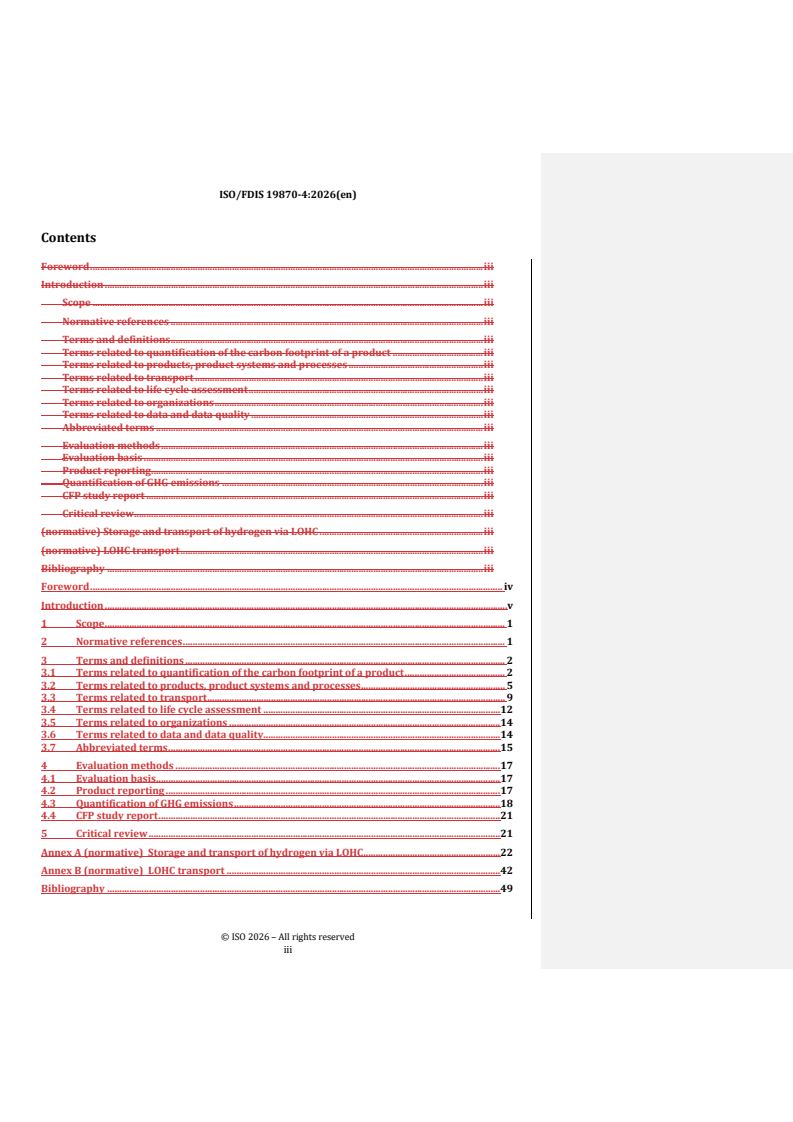
Contents Page
Foreword .iv
Introduction .v
1 Scope . 1
2 Normative references . 1
3 Terms and definitions . 2
3.1 Terms related to quantification of the carbon footprint of a product .2
3.2 Terms related to products, product systems and processes .5
3.3 Terms related to transport .9
3.4 Terms related to life cycle assessment .10
3.5 Terms related to organizations . 13
3.6 Terms related to data and data quality . 13
3.7 Abbreviated terms . 13
4 Evaluation methods .15
4.1 Evaluation basis. 15
4.1.1 General principles . 15
4.1.2 Attributional approach . 15
4.1.3 Consequential approach . 15
4.2 Product reporting . 15
4.2.1 Product system boundary. 15
4.2.2 Selected cut-off criteria .16
4.2.3 Evaluation elements .16
4.2.4 Evaluation cycle .16
4.3 Quantification of GHG emissions .16
4.3.1 Process description and data quality .16
4.3.2 Emissions inventory .16
4.3.3 Emissions allocation .18
4.3.4 CFP calculation.18
4.4 CFP study report .18
5 Critical review . 19
Annex A (normative) Storage and transport of hydrogen via LOHC .20
Annex B (normative) LOHC transport .39
Bibliography .46
iii
Foreword
ISO (the International Organization for Standardization) is a worldwide federation of national standards
bodies (ISO member bodies). The work of preparing International Standards is normally carried out through
ISO technical committees. Each member body interested in a subject for which a technical committee
has been established has the right to be represented on that committee. International organizations,
governmental and non-governmental, in liaison with ISO, also take part in the work. ISO collaborates closely
with the International Electrotechnical Commission (IEC) on all matters of electrotechnical standardization.
The procedures used to develop this document and those intended for its further maintenance are described
in the ISO/IEC Directives, Part 1. In particular, the different approval criteria needed for the different types
of ISO document should be noted. This document was drafted in accordance with the editorial rules of the
ISO/IEC Directives, Part 2 (see www.iso.org/directives).
ISO draws attention to the possibility that the implementation of this document may involve the use of (a)
patent(s). ISO takes no position concerning the evidence, validity or applicability of any claimed patent
rights in respect thereof. As of the date of publication of this document, ISO had not received notice of (a)
patent(s) which may be required to implement this document. However, implementers are cautioned that
this may not represent the latest information, which may be obtained from the patent database available at
www.iso.org/patents. ISO shall not be held responsible for identifying any or all such patent rights.
Any trade name used in this document is information given for the convenience of users and does not
constitute an endorsement.
For an explanation of the voluntary nature of standards, the meaning of ISO specific terms and expressions
related to conformity assessment, as well as information about ISO's adherence to the World Trade
Organization (WTO) principles in the Technical Barriers to Trade (TBT), see www.iso.org/iso/foreword.html.
This document was prepared by Technical Committee ISO/TC 197, Hydrogen technologies, Subcommittee SC
1, Hydrogen at scale and horizontal energy systems.
This first edition of ISO 19870-4, together with ISO 19870-1, ISO 19870-2 and ISO 19870-3, cancels and
replaces ISO/TS 19870:2023, which has been technically revised.
A list of all parts in the ISO 19870 series can be found on the ISO website.
Any feedback or questions on this document should be directed to the user’s national standards body. A
complete listing of these bodies can be found at www.iso.org/members.html.
iv
Introduction
The Paris Agreement was adopted at the UN Climate Change conference (COP21) with the aims of:
strengthening the global response to the threat of climate change, restricting global temperature rise to
below 2 °C above pre-industrial levels and pursuing efforts to limit the temperature increase to 1.5 °C above
pre-industrial levels. To meet these goals, greenhouse gas (GHG) emissions need to be reduced by about 45
[1] [2]
% from 2010 levels by 2030, reaching net zero in 2050 (IPCC, 2018 ; UNFCCC, 2021 ).
Initiatives on GHG mitigation rely on the quantification, monitoring, reporting and verification of GHG
emissions and/or removals. International Standards that support the transfer of scientific knowledge into
tools can help in reaching the targets of the Paris Agreement to address climate change.
[3]
ISO 14044 defines the principles, requirements and guidelines identified in existing International
Standards on life cycle assessment (LCA). The ISO 14060 series provides clarity and consistency for
quantifying, monitoring, reporting and validating or verifying GHG emissions and removals to support
sustainable development through a low-carbon economy. It also benefits organizations, project proponents
and stakeholders worldwide by providing clarity and consistency on quantifying, monitoring, reporting and
validating or verifying GHG emissions and removals.
[4]
ISO 14067 is based on the principles, requirements and guidelines on LCA identified in ISO 14044
[3]
and aims to set specific requirements for the quantification of a carbon footprint (CFP) and a partial
[4]
CFP. ISO 14067 defines the principles, requirements and guidelines for the quantification of the carbon
footprint of products. Its aim is to quantify GHG emissions associated with the life cycle stages of a product,
beginning with resource extraction and raw material sourcing and extending through the production, use
and end-of-life stages of the product.
[4]
Figure 1 illustrates the relationship between ISO 14067 and other ISO documents on LCA.
Key
PCR product category rule
Figure 1 — Relationship between standards beyond the GHG management family of standards
[5]
(source: ISO 14067:2018 )
Hydrogen can be produced from diverse sources including renewable, nuclear and fossil fuels, with or
without carbon capture, utilization and storage (CCUS). Hydrogen can be used to decarbonize numerous
sectors.
v
A particular challenge is that identical hydrogen molecules can be produced and combined from sources
that have different GHG intensities. Similarly, hydrogen-based fuels and derivatives will be indistinguishable
and can be produced from hydrogen combined with a range of fossil and non-fossil inputs. Indeed, some of
the products made from hydrogen (e.g. electricity) can themselves be used in the production of hydrogen.
Accounting standards for different sources of hydrogen along the supply chain (see Figure 2) will be
fundamental to create a market for low-carbon hydrogen, and these standards need to be agreed upon
internationally. Additionally, there is the possibility that consumption gates are not located in proximity
[6]
to hydrogen production gates, requiring hydrogen transport. ISO 14083 gives guidelines for the
quantification and reporting of GHG emissions arising from transport chain operations.
A mutually recognized international framework that is robust, avoids miscounting or double counting of
environmental impacts is needed. Such a framework will provide a mutually agreed approach to “guarantees"
or “certificates” of origin, and cover greenhouse gas inputs used for hydrogen production, conditioning,
conversion and transport.
[4]
The ISO 19870 series specifies methodologies applied, in line with ISO 14067 , to the specific case of the
hydrogen supply chain, covering different production processes and other parts of the supply chain, such as
conditioning hydrogen in different physical states, conversion of hydrogen into different hydrogen carriers
and the subsequent transport up to the consumption gate.
The parts of the ISO 19870 series are:
— ISO 19870-1 on emissions associated with the production of hydrogen to production gate;
— ISO 19870-2 on emissions associated with the conditioning and transport of gaseous and liquid hydrogen
up to consumption gate;
— ISO 19870-3 on emissions associated with the production, storage and transport of ammonia up to
delivery gate and the conversion of ammonia into hydrogen;
— ISO 19870-4 on emissions associated with the storage and transport of hydrogen via liquid organic
hydrogen carriers (LOHC).
This document, ISO 19870-4, addresses the steps from the storage of hydrogen in the carrier LOHC (liquid
organic hydrogen carriers), transport via LOHC, to the release of hydrogen from the LOHC.
Figure 2 — Examples of hydrogen supply chain and coverage of ISO 19870 series with the possible
delivery gates
vi
FINAL DRAFT International Standard ISO/FDIS 19870-4:2026(en)
Hydrogen technologies — Methodology for determining the
greenhouse gas emissions associated with the hydrogen
supply chain —
Part 4:
Emissions associated with the storage, transport and release
of hydrogen via LOHC
1 Scope
This document specifies methodologies for determining the GHG emissions associated with the storage,
transport, and release of hydrogen via LOHC. This document applies to and includes every step within
the scope of storing, transporting, and releasing hydrogen via LOHC within a hydrogen supply chain (see
Figure 2 in the Introduction).
[3]
ISO 14044 requires the goal and scope of a life cycle assessment (LCA) be clearly defined and be consistent
with the intended application. Due to the iterative nature of LCA, it is possible that the LCA scope needs to
[7]
be refined during the study. According to ISO 14040:2006 , A.2, the goals and scope of LCAs correspond to
one of the following two approaches.
a) An approach that assigns elementary flows and potential environmental impacts to a specific product
system, typically as an account of the history of the product , (see 4.1.2).
b) An approach that studies the environmental consequences of possible (future) changes between
alternative product systems. See 4.1.3.
In this document, approach a) is referred to as an attributional approach, while approach b) is referred to as
[8]
consequential approach. Complementary information is accessible in the ILCD handbook .
[4]
The carbon footprint of a product (CFP) or partial CFP as defined by ISO 14067 can be estimated using
either the attributional or the consequential approach, the latter corresponding to the use of “system
expansion via substitution” to avoid allocation when a unit process yields multiple co-products. This
document applies to the partial CFP for the storage, transport, and release of hydrogen via LOHC.
This document considers the GHG emissions associated with the storage, transport, and release of hydrogen
via LOHC.
2 Normative references
The following documents are referred to in the text in such a way that some or all of their content constitutes
requirements of this document. For dated references, only the edition cited applies. For undated references,
the latest edition of the referenced document (including any amendments) applies.
ISO 14067:2018, Greenhouse gases — Carbon footprint of products — Requirements and guidelines for
quantification
ISO 14067, Greenhouse gases — Carbon footprint of products — Requirements and guidelines for quantification
ISO 14071, Environmental management — Life cycle assessment — Critical review processes and reviewer
competencies
ISO 14083:2023, Greenhouse gases — Quantification and reporting of greenhouse gas emissions arising from
transport chain operations
ISO/DIS 19870-1, Hydrogen technologies — Methodology for determining the greenhouse gas emissions
associated with the hydrogen supply chain — Part 1: Emissions associated with the production of hydrogen to
production gate
ISO 19870-1, Hydrogen technologies — Methodology for determining the greenhouse gas emissions associated
with the hydrogen supply chain — Part 1: Emissions associated with the production of hydrogen up to the
production gate
ISO 19870-1:2026, Hydrogen technologies — Methodology for determining the greenhouse gas emissions
associated with the hydrogen supply chain — Part 1: Emissions associated with the production of hydrogen up to
the production gate
ISO/DIS 19870-2, Hydrogen technologies — Methodology for determining the greenhouse gas emissions
associated with the hydrogen supply chain — Part 2: Emissions associated with the conditioning and transport
of gaseous and liquid hydrogen up to consumption gate
3 Terms and definitions
For the purpose of this document, the following terms and definitions apply.
ISO and IEC maintain terminology databases for use in standardization at the following addresses:
— IEC Electropedia: available at http:// www .electropedia .org/
— ISO Online browsing platform: available at http:// www .iso .org/ obp
3.1 Terms related to quantification of the carbon footprint of a product
3.1.1
allocation
partitioning the input (3.2.7) or output (3.2.9) flows of a process (3.2.12) or a product system (3.2.3) between
the product system under study and one or more other product systems
[9]
[SOURCE: ISO 19870-1:2026 , 3.1.1]
3.1.2
carbon footprint of a product
CFP
sum of greenhouse gas emissions (3.1.11) and greenhouse gas removal (3.1.4) in a product system (3.2.3),
expressed as carbon dioxide equivalent (3.1.9) and based on a life cycle assessment (3.4.5) using the single
impact category of climate change
Note 1 to entry: A CFP can be disaggregated into a set of figures identifying specific GHG emissions and also be
disaggregated into the stages of the life cycle (3.4.4).
Note 2 to entry: The results of the quantification of CFP (3.1.7) are documented in the CFP study (3.1.5) report expressed
in mass of CO2e (3.1.9) per functional unit (3.2.13).
[9]
[SOURCE: ISO 19870-1:2026 , 3.1.2]
3.1.3
partial CFP
sum of greenhouse gas emissions (3.1.11) and greenhouse gas removals (3.1.4) of one or more selected
process(es) in a product system (3.2.3) expressed as CO equivalent and based on the selected stages or
processes within the life cycle (3.4.4)
Note 1 to entry: A partial CFP (3.1.3) is based on or compiled from data related to (a) specific process(es) or footprint
[10]
information modules (defined in ISO 14026:2017 , 3.1.4), which is (are) part of a product system (3.2.3) and can form
the basis for quantification of a carbon footprint of a product (3.1.2) (CFP). More detailed information on information
[11]
modules is given in ISO 14025:2006 , 5.4.
Note 2 to entry: The results of the quantification of the partial CFP (3.1.3) are documented in the CFP study (3.1.5)
report expressed in mass of CO2e (3.1.9) per declared unit.
Note 3 to entry: In this document, partial CFP of hydrogen extends from raw material extraction up to the production
gate.
[9]
[SOURCE: ISO 19870-1:2026 , 3.1.3]
3.1.4
greenhouse gas removal
GHG removal
withdrawal of a greenhouse gas (3.1.8) from the atmosphere
[9]
[SOURCE: ISO 19870-1:2026 , 3.1.4]
3.1.5
CFP study
all activities that are necessary to quantify and report the carbon footprint of a product (3.1.2) or a partial
CFP (3.1.3)
[9]
[SOURCE: ISO 19870-1:2026 , 3.1.5]
3.1.6
product category
group of products that can fulfil equivalent functions
[9]
[SOURCE: ISO 19870-1:2026 , 3.1.6]
3.1.7
quantification of CFP
activities that result in the determination of the carbon footprint of a product (3.1.2) or a partial CFP (3.1.3)
Note 1 to entry: Quantification of the CFP or the partial CFP is part of the CFP study (3.1.5).
[9]
[SOURCE: ISO 19870-1:2026 , 3.1.8]
3.1.8
greenhouse gas
GHG
gaseous constituent of the atmosphere, both natural and anthropogenic, that absorbs and emits radiation
at specific wavelengths within the spectrum of infrared radiation emitted by the Earth’s surface, the
atmosphere and clouds
Note 1 to entry: For a list of greenhouse gases, see the latest IPCC Assessment Report.
Note 2 to entry: Water vapour and ozone, which are anthropogenic as well as natural greenhouse gases , are not
included in the carbon footprint of a product (3.1.2).
Note 3 to entry: The focus of this document is limited to long-lived GHGs and it therefore excludes climate effects due
to changes in surface reflectivity (albedo) and short-lived radiative forcing agents (e.g. black carbon and aerosols).
[9]
[SOURCE: ISO 19870-1:2026 , 3.1.9]
3.1.9
carbon dioxide equivalent
CO e
CO equivalent
unit for comparing the radiative forcing of a greenhouse gas (3.1.8) to that of carbon dioxide
Note 1 to entry: Mass of a greenhouse gas (3.1.8) is converted into CO equivalents by multiplying the mass of the
greenhouse gas by the corresponding global warming potential (3.1.10) or global temperature change potential (GTP)
of that gas.
Note 2 to entry: In the case of GTP, CO equivalent is the unit for comparing the change in global mean surface
temperature caused by a greenhouse gas to the temperature change caused by carbon dioxide.
[9]
[SOURCE: ISO 19870-1:2026 , 3.1.10]
3.1.10
global warming potential
GWP
index, based on radiative properties of greenhouse gases (3.1.8) (GHG) measuring the radiative forcing
following a pulse emission of a unit mass of a given GHG in the present-day atmosphere integrated over a
chosen time horizon, relative to that of carbon dioxide (CO )
[7]
Note 1 to entry: “Index” as used in this document is a “characterization factor” as defined in ISO 14040:2006 , 3.37.
Note 2 to entry: A “pulse emission” is an emission at one point in time.
[9]
[SOURCE: ISO 19870-1:2026 , 3.1.11]
3.1.11
greenhouse gas emission
GHG emission
release of a greenhouse gas (3.1.8) into the atmosphere
[9]
[SOURCE: ISO 19870-1:2026 , 3.1.12]
3.1.12
greenhouse gas emission factor
GHG emission factor
coefficient relating activity data with the greenhouse gas emission (3.1.11)
[9]
[SOURCE: ISO 19870-1:2026 , 3.1.13]
3.1.13
capital goods emission
CAPEX emission
GHG emissions (3.1.11) related to the manufacturing of capital goods
[9]
[SOURCE: ISO 19870-1:2026 , 3.1.14]
3.1.14
subdivision
virtual subdivision
decomposition of the analysed unit process into physically or virtually distinguishable sub-process steps
with the possibility to collect data exclusively for those sub-processes
[9]
[SOURCE: ISO 19870-1:2026 , 3.1.15]
3.1.15
hydrogen
gas mainly composed of hydrogen molecules
Note 1 to entry: A hydrogen molecule is referred to as H .
[9]
[SOURCE: ISO 19870-1:2026 , 3.1.16]
3.2 Terms related to products, product systems and processes
3.2.1
product
any goods or service
Note 1 to entry: The product can be categorized as follows:
— services (e.g. transport);
— software (e.g. computer program, dictionary);
— hardware (e.g. engine mechanical part);
— processed materials (e.g. lubricant).
[9]
[SOURCE: ISO 19870-1:2026 , 3.2.1]
3.2.2
product flow
products (3.2.1) entering from or leaving to another product system (3.2.3)
[9]
[SOURCE: ISO 19870-1:2026 , 3.2.2]
3.2.3
product system
collection of unit processes with elementary flows (3.2.14) and product flows (3.2.2), performing one or more
defined functions and which models the life cycle (3.4.4) of a product (3.2.1)
[9]
[SOURCE: ISO 19870-1:2026 , 3.2.3]
3.2.4
co-product
one of two or more products (3.2.1) coming from the same unit process or product system (3.2.3) that is not
considered waste (3.4.14)
[9]
[SOURCE: ISO 19870-1:2026 , 3.2.4]
3.2.5
conditioning
changing the physical conditions (e.g. temperature, pressure) of hydrogen or LOHC for the purpose of its
storage or transport
Note 1 to entry: In this document, examples are changing the temperature or pressure of gaseous hydrogen or the
temperature or pressure of liquid or gaseous LOHC (3.2.20) or condensing/vaporizing LOHC.
[9]
[SOURCE: ISO 19870-1:2026 , 3.2.5]
3.2.6
conversion
changing an input characterized by specific physical and chemical characteristics in an output characterized
by different physical and chemical characteristics
Note 1 to entry: If the chemical characteristics are unchanged there is no conversion.
[9]
[SOURCE: ISO 19870-1:2026 , 3.2.6]
3.2.7
input
product (3.2.1), material or energy flow (3.2.15) that enters a unit process
Note 1 to entry: Products and materials include raw materials, intermediate products (3.2.8) and co- products (3.2.4).
[9]
[SOURCE: ISO 19870-1:2026 , 3.2.7]
3.2.8
intermediate product
output from a unit process that is input to other unit processes that require further transformation within
the system
[9]
[SOURCE: ISO 19870-1:2026 , 3.2.8]
3.2.9
output
product (3.2.1), material or energy flow (3.2.15) that leaves a unit process (3.2.12)
Note 1 to entry: Products, and materials include raw materials, intermediate products (3.2.8), co-products (3.2.4) and
releases (3.4.10).
[9]
[SOURCE: ISO 19870-1:2026 , 3.2.9]
3.2.10
system boundary
boundary based on a set of criteria representing which unit processes (3.2.12) are a part of the system under
study
[9]
[SOURCE: ISO 19870-1:2026 , 3.2.10]
3.2.11
system expansion
concept of expanding the product system (3.2.3) to include additional functions related to the co- products
(3.2.4)
Note 1 to entry: The product system that is substituted by the co-product is integrated in the product system under
study. In practice, the co-products are compared to other substitutable products, and the environmental burdens
associated with the substituted product(s) are subtracted from the product system under study. The identification of
this substituted system is done in the same way as the identification of the upstream system for intermediate product
[12]
(3.2.8) inputs (3.2.7). See also ISO/TR 14049:2012 , 6.4.
Note 2 to entry: The application of system expansion involves an understanding of the market for the co- products.
Decisions about system expansion can be improved through understanding the way co- products compete with other
products, as well as the effects of any product substitution upon production practices in the industries impacted by
the co-products.
Note 3 to entry: Can be referred to as system expansion and also as expanding the system boundary (3.2.10).
[9]
[SOURCE: ISO 19870-1:2026 , 3.211]
3.2.12
process
set of interrelated or interacting activities that transforms inputs (3.2.7) into outputs (3.2.9)
[9]
[SOURCE: ISO 19870-1:2026 , 3.2.12]
3.2.13
functional unit
quantified performance of a product system (3.2.3) for use as a reference unit
Note 1 to entry: As the carbon footprint of a product treats information on a product basis, an additional calculation
based on a declared unit can be presented.
[9]
[SOURCE: ISO 19870-1:2026 , 3.2.13]
3.2.14
elementary flow
material or energy entering the system being studied that has been drawn from the environment without
previous human transformation, or material or energy leaving the system being studied that is released into
the environment without subsequent human transformation
[9]
[SOURCE: ISO 19870-1:2026 , 3.2.14]
3.2.15
energy flow
input (3.2.7) to or output (3.2.9) from a unit process or product system (3.2.3), quantified in energy units
Note 1 to entry: Energy flow that is an input can be called an energy input; energy flow that is an output can be called
an energy output.
[9]
[SOURCE: ISO 19870-1:2026 , 3.2.15]
3.2.16
feedstock
any material input to the hydrogen plant that is not generated at the hydrogen plant itself
Note 1 to entry: In many European countries, methane sourced from the degradation of biomass under anaerobic
conditions is referred to as “biomethane”. In the United States, it is referred to as “Renewable Natural Gas” or “RNG”.
— natural gas (e.g. for steam methane reforming);
— biomethane/renewable natural gas (e.g. for steam methane reforming).
biomass;
— coal (e.g. for gasification);
— liquid hydrocarbons (e.g. for catalytic reforming of naphtha);
— biogenic waste (e.g. for gasification);
— non-biogenic waste (e.g. for gasification);
— oxygen (e.g. for autothermal reforming);
— nitrogen— water (e.g. for water electrolysis);
— steam.
Note 2 to entry: If a hydrogen plant both generates and utilizes a material (e.g. steam), only the portion that is received
by the hydrogen plant from an external source is considered to be a feedstock. For example, steam generated within
the hydrogen plant system boundary for use at the hydrogen plant is not considered to be a feedstock.
[9]
[SOURCE: ISO 19870-1:2026 , 3.2.16]
3.2.17
production gate
location of the end-outlet of the product that leaves the production system boundary (3.2.10)
[9]
[SOURCE: ISO 19870-1:2026 , 3.2.17]
3.2.18
delivery gate
any location where the product (3.2.1) is transferred from one operator to another
[9]
[SOURCE: ISO 19870-1:2026 , 3.2.18]
3.2.19
consumption gate
location of the final delivery of the product (3.2.1) to its end-use
[9]
[SOURCE: ISO 19870-1:2026 , 3.2.19]
3.2.20
liquid organic hydrogen carrier
LOHC
liquid material that can store hydrogen reversibly via hydrogenation and dehydrogenation
Note 1 to entry: Also referred to as carrier material.
3.2.21
initial LOHC
LOHC material entering the LOHC cycle (3.2.27) from outside the system boundary (3.2.10) and that has not
yet been subject to hydrogenation (3.2.25)
3.2.22
makeup LOHC
amount of initial LOHC (3.2.21) that is added to the working LOHC material (3.2.28) to compensate for
degradation or losses of LOHC during the LOHC cycle (3.2.27), or for dehydrogenated LOHC that is sold and
removed from the LOHC cycle
3.2.23
hydrogenated LOHC
LOHC (3.2.20) material exiting the hydrogenation process, i.e. after storing of hydrogen
3.2.24
dehydrogenated LOHC
LOHC (3.2.20) material exiting the dehydrogenation process, i.e. after release of hydrogen
3.2.25
hydrogenation
process step to hydrogenate LOHC (3.2.20) via a chemical reaction that induces a chemical bond between
hydrogen and the carrier molecule
3.2.26
dehydrogenation
process step to dehydrogenate LOHC (3.2.20) via a chemical reaction that opens up the chemical bond
between hydrogen and the carrier molecule and releases gaseous hydrogen
3.2.27
LOHC cycle
sequence that includes a hydrogenation (3.2.25) and a dehydrogenation (3.2.26) step
3.2.28
working LOHC material
LOHC (3.2.20) material that is used in the LOHC cycle (3.2.27)
3.2.29
LOHC co-products
chemical components (benzene, dimers, etc.) extracted from dehydrogenated LOHC (3.2.24) as LOHC
impurity and/or dehydrogenated LOHC (3.2.24) that are valorized
3.2.30
LOHC waste
chemical components (benzene, dimers, etc.) extracted from dehydrogenated LOHC (3.2.24) as LOHC
impurity and/or dehydrogenated LOHC (3.2.24) that the holder intends or is required to dispose of
3.3 Terms related to transport
[6]
NOTE ISO 14083 covers GHG emissions from both passenger and freight transport. In this document, ISO 14083
[6]
is used to assess emissions from freight transport.
3.3.1
freight
goods, materials, commodities, parcels, etc. being transported from one location to another
[13]
[SOURCE: ISO 14083:2023 , 3.1.7]
3.3.2
means of transport
modes of transport such as seaway, inland waterway, pipeline, rail and road that are used for the transport
of freight
3.3.3
transport
movement of passengers and/or freight (3.3.1) from one location to another performed by modes of transport
[13]
[SOURCE: ISO 14083:2023 , 3.1.23, modified — "such as air, cable car, inland waterway, pipeline, rail, road
and sea" deleted.]
3.3.4
vehicle
any means of transport (3.3.2)
Note 1 to entry: In this document, this definition includes vessels (watercraft like a ship or boat), trains and trucks.
Pipelines are not considered a vehicle.
[13]
[SOURCE: ISO 14083:2023 , 3.1.35, modified — Note 1 to entry amended.]
3.3.5
hub
location where passengers transfer and/or freight (3.3.1) is transferred from one vehicle (3.3.4) or mode of
transport to another before, after or between different elements of a transport chain (3.3.9)
Note 1 to entry: Hubs include, but are not limited to, rail/road terminals, cross-docking sites, airport terminals,
terminals at seaports and distribution centres.
[13]
[SOURCE: ISO 14083:2023 , 3.1.8]
3.3.6
hub operation
operation in order to transfer freight (3.3.1) or passengers through a hub (3.3.5)
[13]
[SOURCE: ISO 14083:2023 , 3.1.11]
3.3.7
hub operation category
HOC
group of hub operations (3.3.6) that share similar characteristics
[13]
Note 1 to entry: ISO 14083:2023 , Annex H contains examples of HOCs.
[13]
[SOURCE: ISO 14083:2023 , 3.1.12]
3.3.8
hub service
service provided within a hub transport chain element
[13]
[SOURCE: ISO 14083:2023 , 3.1.14]
3.3.9
transport chain
sequence of elements related to freight (3.3.1) or a (group of) passenger(s) that, when taken together,
constitutes its movement from an origin to a destination
Note 1 to entry: A passenger or a group of passengers can include their luggage and, if any, their vehicles.
Note 2 to entry: Where there are two or more elements, in the majority of cases, one of them implies that the freight
(3.3.1) or passengers use a hub (3.3.5).
[13]
[SOURCE: ISO 14083:2023 , 3.1.25]
3.3.10
transport chain element
TCE
section of a transport chain within which the freight (3.3.1) or a (group of) passenger(s) is carried by a
single vehicle (3.3.4) or transits through a single hub (3.3.5)
EXAMPLE If a multimodal trip of a passenger includes taking a bus from stop “L4” to stop “L7” of bus line “L”, then
one TCE is the trip of the passenger from “L4” to “L7”.
[13]
[SOURCE: ISO 14083:2023 , 3.1.26, modified — Note 1 to entry deleted.]
3.3.11
transport operation
operation of a vehicle (3.3.4) in order to transport passengers and/or freight (3.3.1)
EXAMPLE If a multimodal trip of a passenger includes taking a bus from stop “L4” to stop “L7” of bus line “L”, this
requires a transport operation being the operation of this bus on line “L”, from the first stop “L1” to the last stop of this
bus line.
Note 1 to entry: It includes cases where the destination is the same as the origin passing through other locations on
the way.
[13]
[SOURCE: ISO 14083:2023 , 3.1.28]
3.3.12
transport operation category
TOC
group of transport operations (3.3.11) that share similar characteristics
[13]
Note 1 to entry: ISO 14083:2023 , Annexes A-G contain recommendations for the characteristics used to specify the
TOCs for each transport mode.
[13]
[SOURCE: ISO 14083:2023 , 3.1.29]
3.3.13
transport service
service provided to a user for the transport of freight (3.3.1) from an origin to a destination
[13]
[SOURCE: ISO 14083:2023 , 3.1.31, modified — Note 1 to entry deleted]
3.4 Terms related to life cycle assessment
3.4.1
cut-off criteria
specification of the amount of material or energy flow (3.2.15) or the level of significance of greenhouse gas
emissions (3.1.11) associated with unit processes or the product system (3.2.3) to be excluded from a CFP
study
[9]
[SOURCE: ISO 19870-1:2026 , 3.3.1]
3.4.2
evaluation
element within the life cycle interpretation phase intended to establish confidence in the results of the life
cycle assessment (3.4.5)
Note 1 to entry: Evaluation includes completeness check, sensitivity check, consistency check, and any other validation
that may be required according to the goal and scope definition of the study.
[9]
[SOURCE: ISO 19870-1:2026 , 3.3.2]
3.4.3
fugitive emissions
emissions that are not physically controlled but result from the intentional or unintentional releases (3.4.10)
of GHGs (3.1.8)
Note 1 to entry: They commonly arise from the production, processing, transmission, storage, and use of fuels and
other chemicals, often through joints, seals, packing, gaskets, etc.
[9]
[SOURCE: ISO 19870-1:2026 , 3.3.3]
3.4.4
life cycle
consecutive and interlinked stages related to a product, from raw material acquisition or generation from
natural resources to end-of-life treatment
[7]
Note 1 to entry: “Raw material” is defined in ISO 14040:2006 , 3.15.
Note 2 to entry: Stages of a life cycle related to a product include raw material acquisition, production, distribution,
use and end-of-life treatment.
[9]
[SOURCE: ISO 19870-1:2026 , 3.3.4]
3.4.5
life cycle assessment
LCA
compilation and evaluation of the inputs (3.2.7), outputs (3.2.9) and the potential environmental impacts of a
product (3.2.1) throughout its life cycle (3.4.4)
[14]
Note 1 to entry: “Environmental impact” is defined in ISO 14001:2015 , 3.2.4.
[9]
[SOURCE: ISO 19870-1:2026 , 3.3.5]
3.4.6
life cycle inventory analysis
LCI
phase of life cycle assessment (3.4.5) involving the compilation and quantification of inputs (3.2.7) and outputs
(3.2.9) for a product throughout its life cycle (3.4.4)
[9]
[SOURCE: ISO 19870-1:2026 , 3.3.6]
3.4.7
location-based approach
approach using the average GHG emissions intensity of energy and feedstocks (e.g. electricity) supplied for
utilization within a specific region
Note 1 to entry: This uses mostly grid-average emission factors in the location in which energy consumption occurs.
[5]
Note 2 to entry: This definition is derived from ISO 14067:2018 , 6.4.9.4.4.
[9]
[SOURCE: ISO 19870-1:2026 , 3.3.7]
3.4.8
market-based approach
approach to assign the attributes of the product produced by a specific producer to the product consumed by
or delivered to a specific user while the product is physically distributed through a common infrastructure
Note 1 to entry: These choices (purchasing energy certificates or differentiated electricity product) may be reflected
through contractual arrangements between the user and the producer.
[9]
[SOURCE: ISO 19870-1:2026 , 3.3.8]
3.4.9
process emissions
direct, including fugitive, emissions within the system boundary, including emissions associated with waste
treatment and disposal, such as, but not limited to, emissions resulting from chemical conversions and
combustion of solid, liquid and/or gaseous fuels or feedstock’s
[9]
[SOURCE: ISO 19870-1:2026 , 3.3.9]
3.4.10
releases
emissions to air and discharges to water and soil
[9]
[SOURCE: ISO 19870-1:2026 , 3.3.10]
3.4.11
sensitivity analysis
systematic procedures for estimating the effects of the choices made regarding methods and data on the
outcome of a CFP study (3.1.5)
[9]
[SOURCE: ISO 19870-1:2026 , 3.3.11]
3.4.12
sensitivity check
process to determine whether the information obtained from a sensitivity analysis (3.4.11) is relevant for
reaching the conclusions and for giving recommendations
[9]
[SOURCE: ISO 19870-1:2026 , 3.3.12]
3.4.13
uncertainty analysis
systematic procedure to quantify the uncertainty introduced in the results of a life cycle inventory analysis
(3.4.6) due to the cumulative effects of model imprecision, input uncertainty and data variability
Note 1 to entry: Either ranges or probability distributions are used to determine uncertainty in the results.
[9]
[SOURCE: ISO 19870-1:2026 , 3.3.14]
3.4.14
waste
substances or objects that the holder intends or is required to dispose of
Note 1 to entry: This definition is taken from the Basel Convention on the Control of Transboundary Movements of
...
ISO/TC 197/SC 1
Secretariat: SCC
Date: 2026-09-0410-19
Hydrogen technologies — Methodology for determining the
greenhouse gas emissions associated with the hydrogen supply
chain —
Part 4:
Emissions associated with the storage and, transport and release of
hydrogen via LOHC
FDIS stage
© ISO 2026
All rights reserved. Unless otherwise specified,
This ISO publication is protected by copyright and is owned by ISO and/or its licensors.
The content of this ISO publication is provided under licence, not sold. Use is subject to the applicable licence terms issued
by ISO, an ISO member body, or an authorized third-party distributor.
Except as required in the context of its for implementation or expressly permitted by a separate licence, no part of this
ISO publication may be reproduced or utilized otherwise, distributed, modified, used, or made available in any form or
by any means, – electronic or mechanical, including photocopying, scanning, recording, or posting on internal or external
digital platforms.
Any use beyond the internet or an intranet, without prior written permission. Permission can be requested from either
ISO at the address below or ISO’s member body in the countryscope of the requestergranted rights is prohibited and may
result in legal action.
ISO copyright office
CP 401 • Ch. de Blandonnet 8
CH-1214 Vernier, Geneva
Phone: + 41 22 749 01 11
E-mailEmail: copyright@iso.org
Website: www.iso.org
Published in Switzerland
ii
Contents
Foreword . iii
Introduction . iii
Scope . iii
Normative references . iii
Terms and definitions . iii
Terms related to quantification of the carbon footprint of a product . iii
Terms related to products, product systems and processes . iii
Terms related to transport . iii
Terms related to life cycle assessment . iii
Terms related to organizations . iii
Terms related to data and data quality . iii
Abbreviated terms . iii
Evaluation methods . iii
Evaluation basis . iii
Product reporting . iii
Quantification of GHG emissions . iii
CFP study report . iii
Critical review. iii
(normative) Storage and transport of hydrogen via LOHC . iii
(normative) LOHC transport . iii
Bibliography . iii
Foreword . iv
Introduction . v
1 Scope . 1
2 Normative references . 1
3 Terms and definitions . 2
3.1 Terms related to quantification of the carbon footprint of a product . 2
3.2 Terms related to products, product systems and processes . 5
3.3 Terms related to transport . 9
3.4 Terms related to life cycle assessment . 12
3.5 Terms related to organizations . 14
3.6 Terms related to data and data quality. 14
3.7 Abbreviated terms . 15
4 Evaluation methods . 17
4.1 Evaluation basis . 17
4.2 Product reporting . 17
4.3 Quantification of GHG emissions . 18
4.4 CFP study report . 21
5 Critical review . 21
Annex A (normative) Storage and transport of hydrogen via LOHC . 22
Annex B (normative) LOHC transport . 42
Bibliography . 49
iii
Foreword
ISO (the International Organization for Standardization) is a worldwide federation of national standards
bodies (ISO member bodies). The work of preparing International Standards is normally carried out through
ISO technical committees. Each member body interested in a subject for which a technical committee has been
established has the right to be represented on that committee. International organizations, governmental and
non-governmental, in liaison with ISO, also take part in the work. ISO collaborates closely with the
International Electrotechnical Commission (IEC) on all matters of electrotechnical standardization.
The procedures used to develop this document and those intended for its further maintenance are described
in the ISO/IEC Directives, Part 1. In particular, the different approval criteria needed for the different types of
ISO document should be noted. This document was drafted in accordance with the editorial rules of the
ISO/IEC Directives, Part 2 (see www.iso.org/directives).
ISO draws attention to the possibility that the implementation of this document may involve the use of (a)
patent(s). ISO takes no position concerning the evidence, validity or applicability of any claimed patent rights
in respect thereof. As of the date of publication of this document, ISO had not received notice of (a) patent(s)
which may be required to implement this document. However, implementers are cautioned that this may not
represent the latest information, which may be obtained from the patent database available at
www.iso.org/patents. ISO shall not be held responsible for identifying any or all such patent rights.
Any trade name used in this document is information given for the convenience of users and does not
constitute an endorsement.
For an explanation of the voluntary nature of standards, the meaning of ISO specific terms and expressions
related to conformity assessment, as well as information about ISO's adherence to the World Trade
Organization (WTO) principles in the Technical Barriers to Trade (TBT), see www.iso.org/iso/foreword.html.
This document was prepared by Technical Committee ISO/TC 197, Hydrogen technologies, Subcommittee SC
1, Hydrogen at scale and horizontal energy systems, in collaboration with the European Committee for
Standardization (CEN) Technical Committee CEN/CLC/JTC 6, Hydrogen in energy systems, in accordance with
the Agreement on technical cooperation between ISO and CEN (Vienna Agreement).
This first edition of ISO 19870-4, together with ISO 19870-1, ISO 19870-2 and ISO 19870-3, cancels and
replaces ISO/TS 19870:2023, which has been technically revised.
A list of all parts in the ISO 19870 series can be found on the ISO website.
Any feedback or questions on this document should be directed to the user’s national standards body. A
complete listing of these bodies can be found at www.iso.org/members.html.
iv
Introduction
The Paris Agreement was adopted at the UN Climate Change conference (COP21) with the aims of:
strengthening the global response to the threat of climate change, restricting global temperature rise to below
2 °C above pre-industrial levels and pursuing efforts to limit the temperature increase to 1.5 °C above pre-
industrial levels. To meet these goals, greenhouse gas (GHG) emissions need to be reduced by about 45 % from
2010 levels by 2030, reaching net zero in 2050 (IPCC, 2018 [1]; UNFCCC, 2021 [2]).
Initiatives on GHG mitigation rely on the quantification, monitoring, reporting and verification of GHG
emissions and/or removals. International Standards that support the transfer of scientific knowledge into
tools can help in reaching the targets of the Paris Agreement to address climate change.
[3] defines the principles, requirements and guidelines identified in existing International Standards on life
cycle assessment (LCA). The ISO 14060 series provides clarity and consistency for quantifying, monitoring,
reporting and validating or verifying GHG emissions and removals to support sustainable development
through a low-carbon economy. It also benefits organizations, project proponents and stakeholders
worldwide by providing clarity and consistency on quantifying, monitoring, reporting and validating or
verifying GHG emissions and removals.
[5] is based on the principles, requirements and guidelines on LCA identified in [3] and aims to set specific
requirements for the quantification of a carbon footprint (CFP) and a partial CFP. [5] defines the principles,
requirements and guidelines for the quantification of the carbon footprint of products. Its aim is to quantify
GHG emissions associated with the life cycle stages of a product, beginning with resource extraction and raw
material sourcing and extending through the production, use and end-of-life stages of the product.
Figure 1 illustrates the relationship between [5] and other ISO documents on LCA.
Key
PCR product category rule
Figure 1 — Relationship between standards beyond the GHG management family of standards
(source: [5])
Hydrogen can be produced from diverse sources including renewable, nuclear and fossil fuels, with or without
carbon capture, utilization and storage (CCUS). Hydrogen can be used to decarbonize numerous sectors.
v
A particular challenge is that identical hydrogen molecules can be produced and combined from sources that
have different GHG intensities. Similarly, hydrogen-based fuels and derivatives will be indistinguishable and
can be produced from hydrogen combined with a range of fossil and non-fossil inputs. Indeed, some of the
products made from hydrogen (e.g. electricity) can themselves be used in the production of hydrogen.
Accounting standards for different sources of hydrogen along the supply chain (see Figure 2 ) will be
fundamental to create a market for low-carbon hydrogen, and these standards need to be agreed upon
internationally. Additionally, there is the possibility that consumption gates are not located in proximity to
hydrogen production gates, requiring hydrogen transport. [13] gives guidelines for the quantification and
reporting of GHG emissions arising from transport chain operations.
A mutually recognized international framework that is robust, avoids miscounting or double counting of
environmental impacts is needed. Such a framework will provide a mutually agreed approach to “guarantees"
or “certificates” of origin, and cover greenhouse gas inputs used for hydrogen production, conditioning,
conversion and transport.
The ISO 19870 series specifies methodologies applied, in line with [5], to the specific case of the hydrogen
supply chain, covering different production processes and other parts of the supply chain, such as conditioning
hydrogen in different physical states, conversion of hydrogen into different hydrogen carriers and the
subsequent transport up to the consumption gate.
The parts of the ISO 19870 series are:
— ISO 19870-1 on emissions associated with the production of hydrogen to production gate;
— ISO 19870-2 on emissions associated with the conditioning and transport of gaseous and liquid hydrogen
up to consumption gate;
— ISO 19870-3 on emissions associated with the production, storage and transport of ammonia up to
delivery gate and the conversion of ammonia into hydrogen;
— ISO 19870-4 on emissions associated with the storage and transport of hydrogen via liquid organic
hydrogen carriers (LOHC).
This document, ISO 19870-4, addresses the steps from the storage of hydrogen in the carrier LOHC (liquid
organic hydrogen carriers), transport via LOHC, to the release of hydrogen from the LOHC.
vi
Figure 2 — Examples of hydrogen supply chain and coverage of ISO 19870 series with the possible
delivery gates
vii
Hydrogen technologies — Methodology for determining the
greenhouse gas emissions associated with the hydrogen supply
chain —
Part 4:
Emissions associated with the storage and, transport and release of
hydrogen via LOHC
1 Scope
This document specifies methodologies for determining the GHG emissions associated with the storage,
transport , and release of hydrogen via LOHC . This document applies to and includes every step within the
scope of storing, transporting, and releasing hydrogen via LOHC within a hydrogen supply chain (see Figure 2
in the Introduction).
[3] requires the goal and scope of a life cycle assessment (LCA) be clearly defined and be consistent with the
intended application. Due to the iterative nature of LCA, it is possible that the LCA scope needs to be refined
during the study. According to [7], Annex A.2, the goals and scope of LCAs correspond to one of the following
two approaches:.
a) An approach that assigns elementary flows and potential environmental impacts to a specific product
system, typically as an account of the history of the product. See , (see 4.1.2.).
b) An approach that studies the environmental consequences of possible (future) changes between
alternative product systems. See 4.1.3.
In this document, approach a) is referred to as an attributional approach, while approach b) is referred to as
consequential approach. Complementary information is accessible in the ILCD handbook [8].
The carbon footprint of a product (CFP) or partial CFP as defined by [5]can be estimated using either the
attributional or the consequential approach, the latter corresponding to the use of “system expansion via
substitution” to avoid allocation when a unit process yields multiple co-products. This document applies to
the partial CFP for the storage, transport, and release of hydrogen via LOHC.
This document considers the GHG emissions associated with the storage, transport, and release of hydrogen
via LOHC.
2 Normative references
The following documents are referred to in the text in such a way that some or all of their content constitutes
requirements of this document. For dated references, only the edition cited applies. For undated references,
the latest edition of the referenced document (including any amendments) applies.
ISO 14067:2018, Greenhouse gases — Carbon footprint of products — Requirements and guidelines for
quantification
ISO 14067, Greenhouse gases — Carbon footprint of products — Requirements and guidelines for quantification
ISO 14071, Environmental management — Life cycle assessment — Critical review processes and reviewer
competencies
ISO 14083:2023, Greenhouse gases — Quantification and reporting of greenhouse gas emissions arising from
transport chain operations
ISO/DIS 19870-1, Hydrogen technologies — Methodology for determining the greenhouse gas emissions
associated with the hydrogen supply chain — Part 1: Emissions associated with the production of hydrogen to
production gate
ISO 19870-1, Hydrogen technologies — Methodology for determining the greenhouse gas emissions associated
with the hydrogen supply chain — Part 1: Emissions associated with the production of hydrogen up to the
production gate
ISO 19870-1:2026, Hydrogen technologies — Methodology for determining the greenhouse gas emissions
associated with the hydrogen supply chain — Part 1: Emissions associated with the production of hydrogen up
to the production gate
ISO/DIS 19870-2, Hydrogen technologies — Methodology for determining the greenhouse gas emissions
associated with the hydrogen supply chain — Part 2: Emissions associated with the conditioning and transport
of gaseous and liquid hydrogen up to consumption gate
3 Terms and definitions
For the purpose of this document, the following terms and definitions apply.
ISO and IEC maintain terminology databases for use in standardization at the following addresses:
— IEC Electropedia: available at http://www.electropedia.org/
— ISO Online browsing platform: available at http://www.iso.org/obp
3.1 Terms related to quantification of the carbon footprint of a product
3.1.1
allocation
partitioning the input (3.2.7) or output (3.2.9) flows of a process (3.2.12) or a product system (3.2.3) between
the product system under study and one or more other product systems
[SOURCE: [9], 3.1.1]
3.1.2
carbon footprint of a product, noun
CFP, noun
sum of greenhouse gas emissions (3.1.11) and greenhouse gas removal (3.1.4) in a product system (3.2.3),
expressed as carbon dioxide equivalent (3.1.9) and based on a life cycle assessment (3.4.5) using the single
impact category of climate change
Note 1 to entry: A CFP can be disaggregated into a set of figures identifying specific GHG emissions and also be
disaggregated into the stages of the life cycle (3.4.4).
Note 2 to entry: The results of the quantification of CFP (3.1.7) are documented in the CFP study (3.1.5) report expressed
in mass of CO2e (3.1.9) per functional unit (3.2.13).
[SOURCE: [9], 3.1.2]
3.1.3
partial CFP
sum of greenhouse gas emissions (3.1.11) and greenhouse gas removals (3.1.4) of one or more selected
process(es) in a product system (3.2.3) expressed as CO2 equivalent and based on the selected stages or
processes within the life cycle (3.4.4)
Note 1 to entry: A partial CFP (3.1.3) is based on or compiled from data related to (a) specific process(es) or footprint
information modules (defined in ISO 14026:2017 [10], 3.1.4), which is (are) part of a product system (3.2.3) and can form
the basis for quantification of a carbon footprint of a product (3.1.2) (CFP). More detailed information on information
modules is given in ISO 14025:2006 [11], 5.4.
Note 2 to entry: The results of the quantification of the partial CFP (3.1.3) are documented in the CFP study (3.1.5) report
expressed in mass of CO2e (3.1.9) per declared unit.
Note 3 to entry: In this document, partial CFP of hydrogen extends from raw material extraction up to the production
gate.
[SOURCE: [9], 3.1.3]
3.1.4
greenhouse gas removal
GHG removal, noun
withdrawal of a greenhouse gas (3.1.8) from the atmosphere
[SOURCE: [9], 3.1.4]
3.1.5
CFP study
all activities that are necessary to quantify and report the carbon footprint of a product (3.1.2) or a partial CFP
(3.1.3)
[SOURCE: [9], 3.1.5]
3.1.6
product category
group of products that can fulfil equivalent functions
[SOURCE: [9], 3.1.6]
3.1.7
quantification of CFP
activities that result in the determination of the carbon footprint of a product (3.1.2) or a partial CFP (3.1.3)
Note 1 to entry: Quantification of the CFP or the partial CFP is part of the CFP study (3.1.5).
[SOURCE: [9], 3.1.8]
3.1.8
greenhouse gas
GHG, noun
gaseous constituent of the atmosphere, both natural and anthropogenic, that absorbs and emits radiation at
specific wavelengths within the spectrum of infrared radiation emitted by the Earth’s surface, the atmosphere
and clouds
Note 1 to entry: For a list of greenhouse gases, see the latest IPCC Assessment Report.
Note 2 to entry: Water vapour and ozone, which are anthropogenic as well as natural greenhouse gases , are not included
in the carbon footprint of a product (3.1.2).
Note 3 to entry: The focus of this document is limited to long-lived GHGs and it therefore excludes climate effects due to
changes in surface reflectivity (albedo) and short-lived radiative forcing agents (e.g. black carbon and aerosols).
[SOURCE: [9], 3.1.9]
3.1.9
carbon dioxide equivalent
CO e, noun
CO2 equivalent, noun
unit for comparing the radiative forcing of a greenhouse gas (3.1.8) to that of carbon dioxide
Note 1 to entry: Mass of a greenhouse gas (3.1.8) is converted into CO2 equivalents by multiplying the mass of the
greenhouse gas by the corresponding global warming potential (3.1.10) or global temperature change potential (GTP) of
that gas.
Note 2 to entry: In the case of GTP, CO equivalent is the unit for comparing the change in global mean surface
temperature caused by a greenhouse gas to the temperature change caused by carbon dioxide.
[SOURCE: [9], 3.1.10]
3.1.10
global warming potential
GWP, noun
index, based on radiative properties of greenhouse gases (3.1.8) (GHG) measuring the radiative forcing
following a pulse emission of a unit mass of a given GHG in the present-day atmosphere integrated over a
chosen time horizon, relative to that of carbon dioxide (CO2)
Note 1 to entry: “Index” as used in this document is a “characterization factor” as defined in ISO 14040:2006 [7], 3.37.
Note 2 to entry: A “pulse emission” is an emission at one point in time.
[SOURCE: [9], 3.1.11]
3.1.11
greenhouse gas emission
GHG emission, noun
release of a greenhouse gas (3.1.8) into the atmosphere
[SOURCE: [9], 3.1.12]
3.1.12
greenhouse gas emission factor
GHG emission factor, noun
coefficient relating activity data with the greenhouse gas emission (3.1.11)
[SOURCE: [9], 3.1.13]
3.1.13
capital goods emission
CAPEX emission, noun
GHG emissions (3.1.11) related to the manufacturing of capital goods
[SOURCE: [9], 3.1.14]
3.1.14
subdivision
virtual subdivision, noun
decomposition of the analysed unit process into physically or virtually distinguishable sub-process steps with
the possibility to collect data exclusively for those sub-processes
[SOURCE: [9], 3.1.15]
3.1.15
hydrogen
gas mainly composed of hydrogen molecules
Note 1 to entry: A hydrogen molecule is referred to as H .
[SOURCE: [9], 3.1.16]
3.1.16
physical relationship
relation between co-products (3.2.4) based on a chosen physical characteristic (e.g. mass, energy content,
volume)
Note 1 to entry: A physical relationship can be used to:
a) allocate input flows to co-products based on the specific function the inputs perform in relation to the individual co-
products; and/or
b) to allocate greenhouse gas emission (3.1.11) to the individual co-products.
[9]
[SOURCE: ISO 19870-1:2026 , 3.1.17]
3.2 Terms related to products, product systems and processes
3.2.1
product
any goods or service
Note 1 to entry: The product can be categorized as follows:
— services (e.g. transport);
— software (e.g. computer program, dictionary);
— hardware (e.g. engine mechanical part);
— processed materials (e.g. lubricant).
[SOURCE: [9], 3.2.1]
3.2.2
product flow
products (3.2.1) entering from or leaving to another product system (3.2.3)
[SOURCE: [9], 3.2.2]
3.2.3
product system
collection of unit processes with elementary flows (3.2.14) and product flows (3.2.2), performing one or more
defined functions and which models the life cycle (3.4.4) of a product (3.2.1)
[SOURCE: [9], 3.2.3]
3.2.4
co-product
one of two or more products (3.2.1) coming from the same unit process or product system (3.2.3) that is not
considered waste (3.4.14)
Field Code Changed
[SOURCE: [9], 3.2.4]
3.2.5
conditioning
changing the physical conditions (e.g. temperature, pressure) of hydrogen or LOHC for the purpose of its
storage or transport
Note 1 to entry: In this document, examples are changing the temperature or pressure of gaseous hydrogen or the
temperature or pressure of liquid or gaseous LOHC (3.2.20) or condensing/vaporizing LOHC.
[SOURCE: [9], 3.2.5]
3.2.6
conversion
changing an input characterized by specific physical and chemical characteristics in an output characterized
by different physical and chemical characteristics
Note 1 to entry: If the chemical characteristics are unchanged there is no conversion.
[SOURCE: [9], 3.2.6]
3.2.7
input
product (3.2.1), material or energy flow (3.2.15) that enters a unit process
Note 1 to entry: Products and materials include raw materials, intermediate products (3.2.8) and co- products (3.2.4).
[SOURCE: [9], 3.2.7]
3.2.8
intermediate product
output from a unit process that is input to other unit processes that require further transformation within the
system
[SOURCE: [9], 3.2.8]
3.2.9
output
product (3.2.1), material or energy flow (3.2.15) that leaves a unit process (3.2.12)
Note 1 to entry: Products, and materials include raw materials, intermediate products (3.2.8), co-products (3.2.4) and
releases (3.4.10).
[SOURCE: [9], 3.2.9]
3.2.10
system boundary
boundary based on a set of criteria representing which unit processes (3.2.12) are a part of the system under
study
[SOURCE: [9], 3.2.10]
3.2.11
system expansion
concept of expanding the product system (3.2.3) to include additional functions related to the co- products
(3.2.4)
Note 1 to entry: The product system that is substituted by the co-product is integrated in the product system under study.
In practice, the co-products are compared to other substitutable products, and the environmental burdens associated
with the substituted product(s) are subtracted from the product system under study. The identification of this substituted
system is done in the same way as the identification of the upstream system for intermediate product (3.2.8)inputs (3.2.7).
See also ISO/TR 14049:2012 [12], 6.4.
Note 2 to entry: The application of system expansion involves an understanding of the market for the co- products.
Decisions about system expansion can be improved through understanding the way co- products compete with other
products, as well as the effects of any product substitution upon production practices in the industries impacted by the
co-products.
Note 3 to entry: Can be referred to as system expansion and also as expanding the system boundary (3.2.10).
[SOURCE: [9], 3.211]
3.2.12
process
set of interrelated or interacting activities that transforms inputs (3.2.7) into outputs (3.2.9)
[SOURCE: [9], 3.2.12]
3.2.13
functional unit
quantified performance of a product system (3.2.3) for use as a reference unit
Note 1 to entry: As the carbon footprint of a product treats information on a product basis, an additional calculation based
on a declared unit can be presented.
[SOURCE: [9], 3.2.13]
3.2.14
elementary flow
material or energy entering the system being studied that has been drawn from the environment without
previous human transformation, or material or energy leaving the system being studied that is released into
the environment without subsequent human transformation
[SOURCE: [9], 3.2.14]
3.2.15
energy flow
input (3.2.7) to or output (3.2.9) from a unit process or product system (3.2.3), quantified in energy units
Note 1 to entry: Energy flow that is an input can be called an energy input; energy flow that is an output can be called an
energy output.
[SOURCE: [9], 3.2.15]
3.2.16
feedstock
any material input to the hydrogen plant that is not generated at the hydrogen plant itself
Note 1 to entry: In many European countries, methane sourced from the degradation of biomass under anaerobic
conditions is referred to as “biomethane”. In the United States, it is referred to as “Renewable Natural Gas” or “RNG”.
— natural gas (e.g. for steam methane reforming);
— biomethane/renewable natural gas (e.g. for steam methane reforming).
— biomass;
— coal (e.g. for gasification);
— liquid hydrocarbons (e.g. for catalytic reforming of naphtha);
— biogenic waste (e.g. for gasification);
— non-biogenic waste (e.g. for gasification);
— oxygen (e.g. for autothermal reforming);
— nitrogen— water (e.g. for water electrolysis);
— steam.
Note 2 to entry: If a hydrogen plant both generates and utilizes a material (e.g. steam), only the portion that is received
by the hydrogen plant from an external source is considered to be a feedstock. For example, steam generated within the
hydrogen plant system boundary for use at the hydrogen plant is not considered to be a feedstock.
[SOURCE: [9], 3.2.16]
3.2.17
production gate
location of the end-outlet of the product that leaves the production system boundary (3.2.10)
[SOURCE: [9], 3.2.17]
3.2.18
delivery gate
any location where the product (3.2.1) is transferred from one operator to another
[SOURCE: [9], 3.2.18]
3.2.19
consumption gate
location of the final delivery of the product (3.2.1) to its end-use
[SOURCE: [9], 3.2.19]
3.2.20
liquid organic hydrogen carrierscarrier
LOHC, noun
liquid material that can store hydrogen reversibly via hydrogenation and dehydrogenation
Note 1 to entry: Also referred to as carrier material.
3.2.21
initial LOHC
LOHC material entering the LOHC cycle (3.2.27) from outside the system boundary (3.2.10) and that has not
yet been subject to hydrogenation (3.2.25)
3.2.22
makeup LOHC
amount of initial LOHC (3.2.21) that is added to the working LOHC material (3.2.28) to compensate for
degradation or losses of LOHC during the LOHC cycle (3.2.27), or for dehydrogenated LOHC that is sold and
removed from the LOHC cycle
3.2.23
hydrogenated LOHC
LOHC (3.2.20) material exiting the hydrogenation process, i.e. after storing of hydrogen
3.2.24
dehydrogenated LOHC
LOHC (3.2.20) material exiting the dehydrogenation process, i.e. after release of hydrogen
3.2.25
hydrogenation
process step to hydrogenate LOHC (3.2.20) via a chemical reaction that induces a chemical bond between
hydrogen and the carrier molecule
3.2.26
dehydrogenation
process step to dehydrogenate LOHC (3.2.20) via a chemical reaction that opens up the chemical bond between
hydrogen and the carrier molecule and releases gaseous hydrogen
3.2.27
LOHC cycle
sequence that includes a hydrogenation (3.2.25) and a dehydrogenation (3.2.26) step
3.2.28
working LOHC material
LOHC (3.2.20) material that is used in the LOHC cycle (3.2.27)
3.2.29
LOHC co-products
chemical components (benzene, dimers, etc.) extracted from dehydrogenated LOHC (3.2.24) as LOHC impurity
and/or dehydrogenated LOHC (3.2.24) that are valorized
3.2.30
LOHC waste
chemical components (benzene, dimers, etc.) extracted from dehydrogenated LOHC (3.2.24) as LOHC impurity
and/or dehydrogenated LOHC (3.2.24) that the holder intends or is required to dispose of
3.3 Terms related to transport
NOTE ISO 14083[13] covers GHG emissions from both passenger and freight transport. In this document, ISO 14083
shall be[13] is used to assess emissions from freight transport.
3.3.1
freight
goods, materials, commodities, parcels, etc. being transported from one location to another
[SOURCE: [13], 3.1.7]
3.3.2
means of transport
modes of transport such as seaway, inland waterway, pipeline, rail and road that are used for the transport of
freight
3.3.3
transport
movement of passengers and/or freight (3.3.1) from one location to another performed by modes of transport
[SOURCE: [13], 3.1.23, modified — "such as air, cable car, inland waterway, pipeline, rail, road and sea"
deleted.]
3.3.4
vehicle
any means of transport (3.3.2)
Note 1 to entry: WithinIn this standarddocument, this definition includes vessels (watercraft like a ship or boat), trains
and trucks. Pipelines are not considered a vehicle.
[SOURCE: [13], 3.1.35, modified — Note 1 to entry amended.]
3.3.5
hub
location where passengers transfer and/or freight (3.3.1) is transferred from one vehicle (3.3.4) or mode of
transport to another before, after or between different elements of a transport chain (3.3.9)
Note 1 to entry: Hubs include, but are not limited to, rail/road terminals, cross-docking sites, airport terminals, terminals
at seaports and distribution centres.
[SOURCE: [13], 3.1.8]
3.3.6
hub operation
operation in order to transfer freight (3.3.1) or passengers through a hub (3.3.5)
[SOURCE: [13], 3.1.11]
3.3.7
hub operation category
HOC, noun
group of hub operations (3.3.6) that share similar characteristics
Note 1 to entry: ISO 14083:2023 [13], Annex H contains examples of HOCs.
[SOURCE: [13], 3.1.12]
3.3.8
hub service
service provided within a hub transport chain element
[SOURCE: [13], 3.1.14]
3.3.9
transport chain
sequence of elements related to freight (3.3.1) or a (group of) passenger(s) that, when taken together,
constitutes its movement from an origin to a destination
Note 1 to entry: A passenger or a group of passengers can include their luggage and, if any, their vehicles.
Note 2 to entry: Where there are two or more elements, in the majority of cases, one of them implies that the freight
(3.3.1) or passengers use a hub (3.3.5).
[SOURCE: [13], 3.1.25]
3.3.10
transport chain element
TCE, noun
section of a transport chain within which the freight (3.3.1) or a (group of) passenger(s) is carried by a single
vehicle (3.3.4) or transits through a single hub (3.3.5)
EXAMPLE If a multimodal trip of a passenger includes taking a bus from stop “L4” to stop “L7” of bus line “L”, then
one TCE is the trip of the passenger from “L4” to “L7”.
[SOURCE: [13], 3.1.26, modified — Note 1 to entry deleted.]
3.3.11
transport operation
operation of a vehicle (3.3.4) in order to transport passengers and/or freight (3.3.1)
EXAMPLE If a multimodal trip of a passenger includes taking a bus from stop “L4” to stop “L7” of bus line “L”, this
requires a transport operation being the operation of this bus on line “L”, from the first stop “L1” to the last stop of this
bus line.
Note 1 to entry: It includes cases where the destination is the same as the origin passing through other locations on the
way.
[SOURCE: [13], 3.1.28]
3.3.12
transport operation category
TOC, noun
group of transport operations (3.3.11) that share similar characteristics
Note 1 to entry: ISO 14083:2023 [13], Annexes A-G contain recommendations for the characteristics used to specify the
TOCs for each transport mode.
[SOURCE: [13], 3.1.29]
3.3.13
transport service
service provided to a user for the transport of freight (3.3.1) from an origin to a destination
[SOURCE: [13], 3.1.31, modified — Note 1 to entry deleted]
3.4 Terms related to life cycle assessment
3.4.1
cut-off criteria
specification of the amount of material or energy flow (3.2.15) or the level of significance of greenhouse gas
emissions (3.1.11) associated with unit processes or the product system (3.2.3) to be excluded from a CFP study
[SOURCE: [9], 3.3.1]
3.4.2
evaluation
element within the life cycle interpretation phase intended to establish confidence in the results of the life
cycle assessment (3.4.5)
Note 1 to entry: Evaluation includes completeness check, sensitivity check, consistency check, and any other validation
that may be required according to the goal and scope definition of the study.
[SOURCE: [9], 3.3.2]
3.4.3
fugitive emissions
emissions that are not physically controlled but result from the intentional or unintentional releases (3.4.10)
of GHGs (3.1.8)
Note 1 to entry: They commonly arise from the production, processing, transmission, storage, and use of fuels and other
chemicals, often through joints, seals, packing, gaskets, etc.
[SOURCE: [9], 3.3.3]
3.4.4
life cycle
consecutive and interlinked stages related to a product, from raw material acquisition or generation from
natural resources to end-of-life treatment
Note 1 to entry: “Raw material” is defined in ISO 14040:2006 [7], 3.15.
Note 2 to entry: Stages of a life cycle related to a product include raw material acquisition, production, distribution, use
and end-of-life treatment.
[SOURCE: [9], 3.3.4]
3.4.5
life cycle assessment
LCA, noun
compilation and evaluation of the inputs (3.2.7), outputs (3.2.9) and the potential environmental impacts of a
product (3.2.1) throughout its life cycle (3.4.4)
Note 1 to entry: “Environmental impact” is defined in ISO 14001:2015 [14], 3.2.4.
[SOURCE: [9], 3.3.5]
3.4.6
life cycle inventory analysis
LCI, noun
phase of life cycle assessment (3.4.5) involving the compilation and quantification of inputs (3.2.7) and outputs
(3.2.9) for a product throughout its life cycle (3.4.4)
[SOURCE: [9], 3.3.6]
3.4.7
location-based approach
approach using the average GHG emissions intensity of energy and feedstocks (e.g. electricity) supplied for
utilization within a specific region
Note 1 to entry: This uses mostly grid-average emission factors in the location in which energy consumption occurs.
Note 2 to entry: This definition is derived from ISO 14067:2018 [5], 6.4.9.4.4.
[SOURCE: [9], 3.3.7]
3.4.8
market-based approach
approach to assign the attributes of the product produced by a specific producer to the product consumed by
or delivered to a specific user while the product is physically distributed through a common infrastructure
Note 1 to entry: These choices (purchasing energy certificates or differentiated electricity product) may be reflected
through contractual arrangements between the user and the producer.
[SOURCE: [9], 3.3.8]
3.4.9
process emissions
direct, including fugitive, emissions within the system boundary, including emissions associated with waste
treatment and disposal, such as, but not limited to, emissions resulting from chemical conversions and
combustion of solid, liquid and/or gaseous fuels or feedstock’s
[SOURCE: [9], 3.3.9]
3.4.10
releases
emissions to air and discharges to water and soil
[SOURCE: [9], 3.3.10]
3.4.11
sensitivity analysis
systematic procedures for estimating the effects of the choices made regarding methods and data on the
outcome of a CFP study (3.1.5)
[SOURCE: [9], 3.3.11]
3.4.12
sensitivity check
process to determine whether the information obtained from a sensitivity analysis (3.4.11) is relevant for
reaching the conclusions and for giving recommendations
[SOURCE: [9], 3.3.12]
3.4.13
transparency
open, comprehensive and understandable presentation of information
[9]
[SOURCE: ISO 19870-1:2026 , 3.3.13]
3.4.143.4.13
uncertainty analysis
systematic procedure to quantify the uncertainty introduced in the results of a life cycle inventory analysis
(3.4.6) due to the cumulative effects of model imprecision, input uncertainty and data variability
Note 1 to entry: Either ranges or probability distributions are used to determine uncertainty in the results.
[SOURCE: [9], 3.3.14]
3.4.153.4.14
waste
substances or objects that the holder intends or is required to dispose of
Note 1 to entry: This definition is taken from the Basel Convention on the Control of Transboundary Movements of
Hazardous Wastes and Their Disposal (22 March 1989), but is not confined in this document to hazardous waste.
[SOURCE: [9], 3.3.15]
3.5 Terms related to organizations
3.5.1
organization
person or group of people that has its own functions with responsibilities, authorities and relationships to
achieve its objectives
Note 1 to entry: The concept of organization includes, but is not limited to, sole-trader, company, corporation, firm,
enterprise, authori
...