


ISO 664:1990
(Main)Oilseeds — Reduction of laboratory sample to test sample
Oilseeds — Reduction of laboratory sample to test sample
The principle of the method consists in dividing of the contract sample (see ISO 542) by suitable means, if necessary after removal of impurities of large size, using one or other of the dividing instruments specified and taking care that the final analysis sample thruly represents the bulk of the contract for sample. A table gives the minimum mass of each analysis sample for 17 species of seed.
Graines oléagineuses — Réduction de l'échantillon pour laboratoire en échantillon pour essai
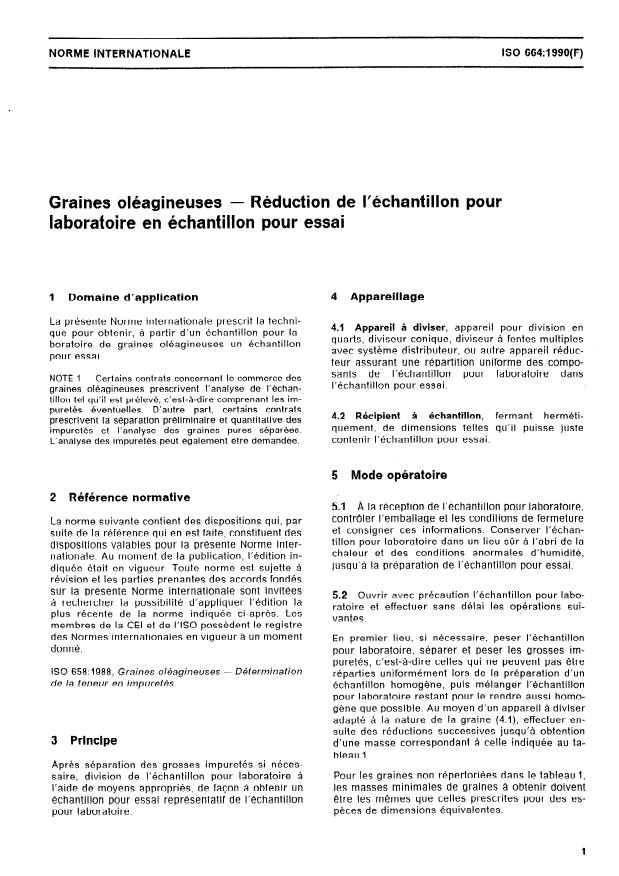
La présente Norme internationale prescrit la technique pour obtenir, à partir d'un échantillon pour laboratoire de graines oléagineuses un échantillon pour essai. NOTE 1 Certains contrats concernant le commerce des graines oléagineuses prescrivent l'analyse de l'échantillon tel qu'il est prélevé, c'est-à-dire comprenant les impuretés éventuelles. D'autre part, certains contrats prescrivent la séparation préliminaire et quantitative des impuretés et l'analyse des graines pures séparées. L'analyse des impuretés peut également être demandée.
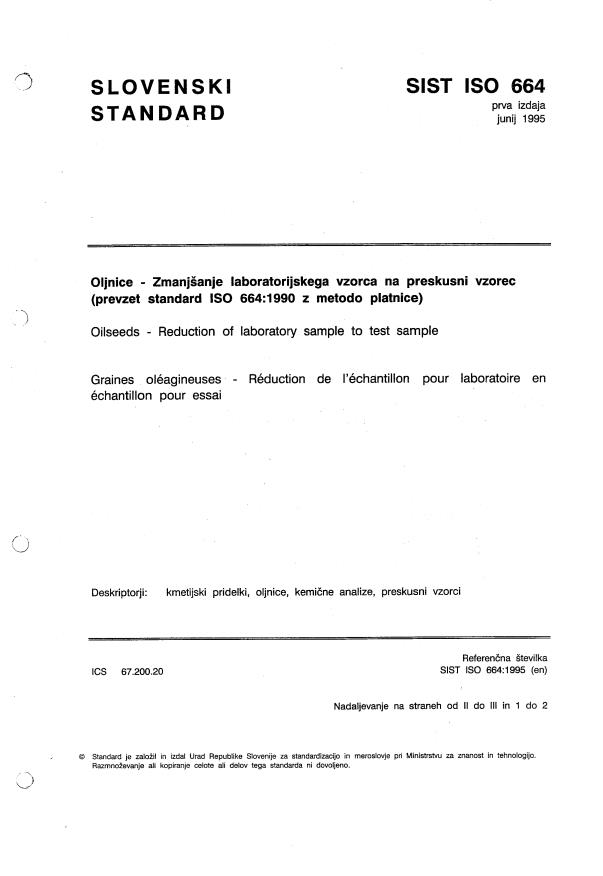
Oljnice - Zmanjšanje laboratorijskega vzorca na preskusni vzorec
General Information
- Status
- Withdrawn
- Publication Date
- 19-Jun-1990
- Withdrawal Date
- 19-Jun-1990
- Technical Committee
- ISO/TC 34/SC 2 - Oleaginous seeds and fruits and oilseed meals
- Drafting Committee
- ISO/TC 34/SC 2 - Oleaginous seeds and fruits and oilseed meals
- Current Stage
- 9599 - Withdrawal of International Standard
- Start Date
- 21-May-2008
- Completion Date
- 12-Feb-2026
Relations
- Effective Date
- 15-Apr-2008
- Effective Date
- 15-Apr-2008
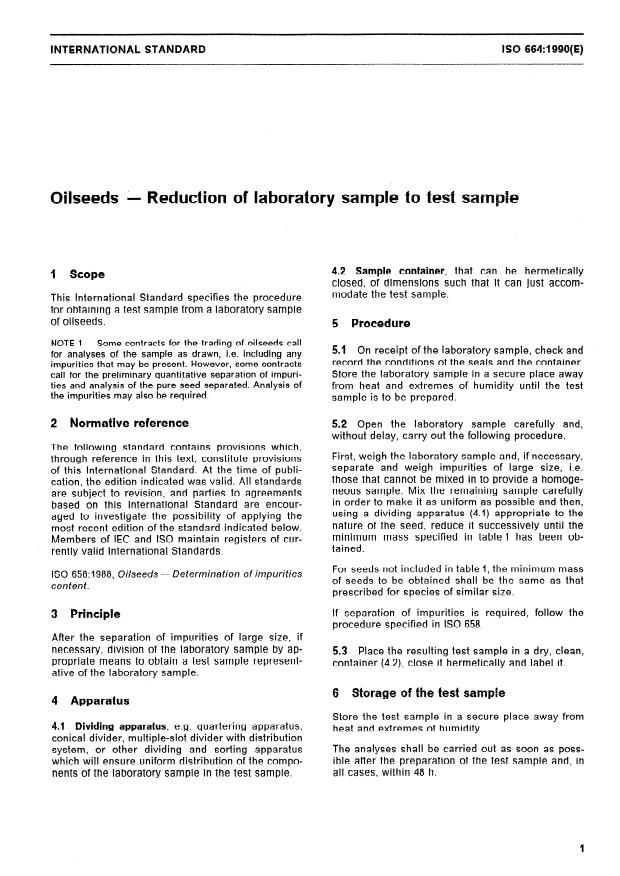

ISO 664:1990 - Oilseeds -- Reduction of laboratory sample to test sample
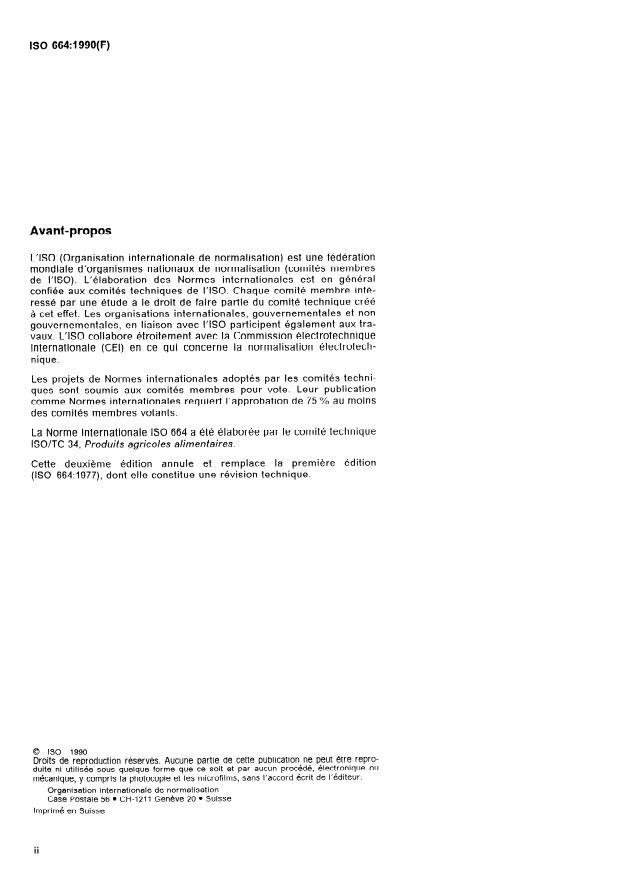
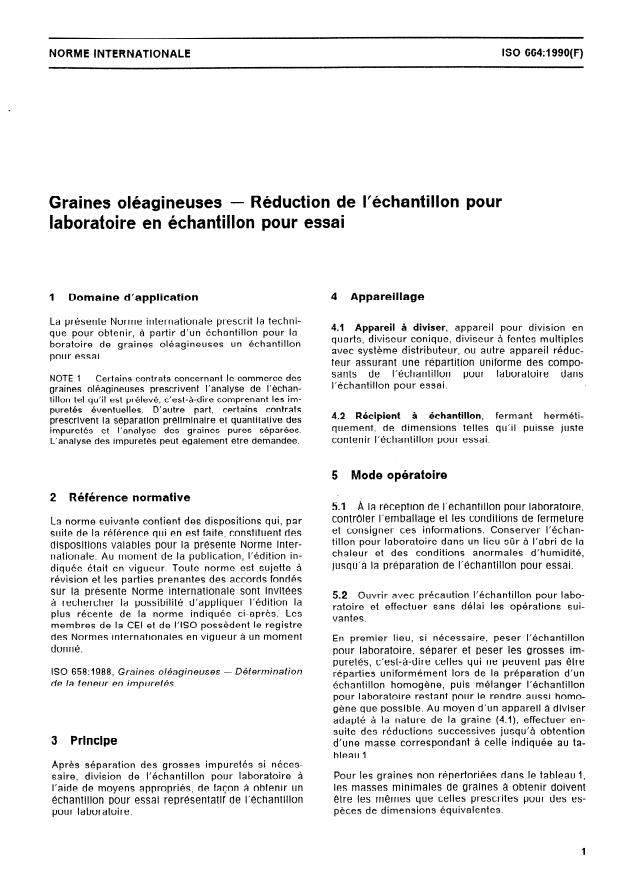

ISO 664:1990 - Graines oléagineuses -- Réduction de l'échantillon pour laboratoire en échantillon pour essai
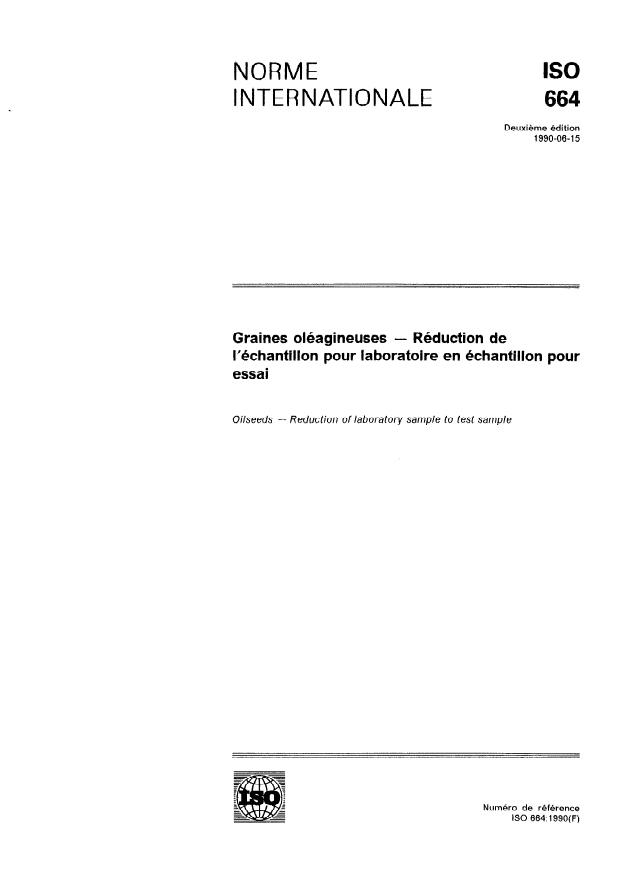
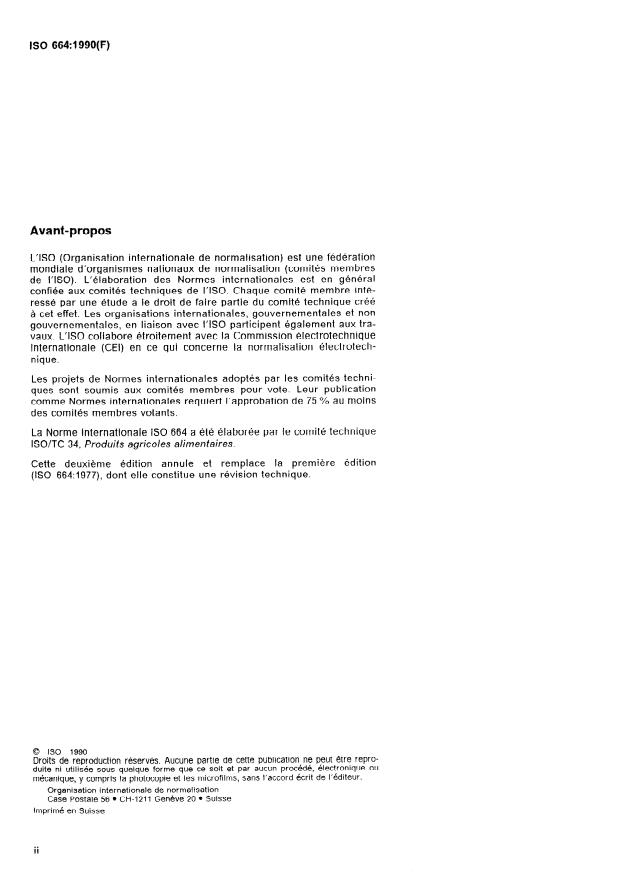

ISO 664:1990 - Graines oléagineuses -- Réduction de l'échantillon pour laboratoire en échantillon pour essai

ISO 664:1995
Get Certified
Connect with accredited certification bodies for this standard

BSI Group
BSI (British Standards Institution) is the business standards company that helps organizations make excellence a habit.

Bureau Veritas
Bureau Veritas is a world leader in laboratory testing, inspection and certification services.

DNV
DNV is an independent assurance and risk management provider.
Sponsored listings
Frequently Asked Questions
ISO 664:1990 is a standard published by the International Organization for Standardization (ISO). Its full title is "Oilseeds — Reduction of laboratory sample to test sample". This standard covers: The principle of the method consists in dividing of the contract sample (see ISO 542) by suitable means, if necessary after removal of impurities of large size, using one or other of the dividing instruments specified and taking care that the final analysis sample thruly represents the bulk of the contract for sample. A table gives the minimum mass of each analysis sample for 17 species of seed.
The principle of the method consists in dividing of the contract sample (see ISO 542) by suitable means, if necessary after removal of impurities of large size, using one or other of the dividing instruments specified and taking care that the final analysis sample thruly represents the bulk of the contract for sample. A table gives the minimum mass of each analysis sample for 17 species of seed.
ISO 664:1990 is classified under the following ICS (International Classification for Standards) categories: 67.200.20 - Oilseeds. The ICS classification helps identify the subject area and facilitates finding related standards.
ISO 664:1990 has the following relationships with other standards: It is inter standard links to ISO 664:2008, ISO 664:1977. Understanding these relationships helps ensure you are using the most current and applicable version of the standard.
ISO 664:1990 is available in PDF format for immediate download after purchase. The document can be added to your cart and obtained through the secure checkout process. Digital delivery ensures instant access to the complete standard document.
Standards Content (Sample)
INTERNATIONAL
STANDARD
Second edi tion
1990-06-15
Oilseeds
- Reduction of laboratory Sample to
test Sample
Graines olbagineuses - Reduction de I’&hantiUon pour laboratoire en
echantillon pour essai
Reference number
ISO 664: 199O(E)
ISO 664:i 990(E)
Foreword
ISO (the International Organization for Standardization) is a worldwide
federation of national Standards bodies (ISO member bodies). The work
of preparing International Standards is normally carried out through ISO
technical committees. Esch member body ‘interested in a subject for
which a technical committee has been estabiished has the right to be
represented on that committee. International organizations, govern-
mental and non-governmental, in liaison with ISO, also take part in the
work. ISO collaborates closely with the International Electrotechnical
Commission (IEC) on all matters of electrotechnical standardization.
Draft International Standards adopted by the technical committees are
circulated to the member bodies for voting. Publication as an Interna-
tional Standard requires approval by at least 75 % of the member bodies
casting a vote.
International Standard ISO 664 was prepared by Technicai Committee
ISO/TC 34, Agricultural food products.
This second edition cancels and replaces the first edition
(ISO 664:1977), of which it constitutes a technical revision.
0 ISO 1990
All rights reserved. No part of this publication may be reproduced or utilized in any form
or by any means, electronie or mechanical, including photocopying and microfilm, without
Permission in writing from the publisher.
international Organization for Standardization
Case Postale 56 + CH-1211 Geneve 20 l Switzerland
Printed in Switzerland
ii
INTERNATIONAL STANDARD ISO 664:1990(E)
Oilseeds 1 Reduction of laboratory Sample to test sam
4.2 Sample Container, that tan be hermetically
1 Scope
closed, of dimensions such that it tan just accom-
modate the test Sample.
This International Standard specifies the procedure
for obtaining a test Sample from a laboratory Sample
of oilseeds.
5 Procedure
Some contracts for the trading of oilseeds cal1
NOTE 1
5.1 On receipt of the laboratory Sample, check and
for analyses of the Sample as drawn, i.e. including any
record the conditions of the Seals and the Container.
impurities that may be present. However, some contracts
call for the preliminary quantitative Separation of impuri- Store the laboratory Sample in a secure place away
ties and analysis of the pure seed separated. Analysis of
from heat and extremes of humidity until the test
the impurities may also be required.
Sample is to be prepared.
2 Normative reference 5.2 Open the laboratory Sample carefuily and,
without delay, carry out the following procedure.
The following Standard contains provisions which,
First, weigh the laboratory Sample and, if necessary,
through reference in this text, constitute provisions
separate and weigh impurities of large size, i.e.
of this International Standard. At the time of publi-
those that cannot be mixed in to provide a homoge-
...
ISO
NORME
INTERNATIONALE
Deuxième édition
1990-06-l 5
Graines oléagineuses - Réduction de
l’échantillon pour laboratoire en échantillon pour
essai
Oilseeds - Reduction of laboratory sample to test sample
Numéro de référence
ISO 664: 1990(F)
Avant-propos
L’lSO (Organisation internationale de normalisation) est une fédération
mondiale d’organismes nationaux de normalisation (comités membres
de l’lS0). L’élaboration des Normes internationales est en général
confiée aux comités techniques de I’ISO. Chaque comité membre inté-
ressé par une étude a le droit de faire partie du comité technique créé
à cet effet. Les organisations internationales, gouvernementales et non
gouvernementales, en liaison avec I’ISO participent également aux tra-
vaux. L’ISO collabore étroitement avec la Commission électrotechnique
internationale (CH) en ce qui concerne la normalisation électrotech-
nique.
Les projets de Normes internationales adoptés par les comités techni-
ques sont soumis aux comités membres pour vote. Leur publication
comme Normes internationales requiert l’approbation de 75 % au moins
des comités membres votants.
La Norme internationale ISO 664 a été élaborée par le comité technique
ISO/TC 34, Produits agricoles alimentaires.
Cette deuxième édition annule et remplace la première édition
(ISO 664:1977), dont elle constitue une révision technique.
0 ISO 1990
Droits de reproduction réservés. Aucune partie de cette publication ne peut être repro-
duite ni utilisée sous quelque forme que ce soit et par aucun procédé, électronique OU
mécanique, y compris la photocopie et les microfilms, sans l’accord écrit de l’éditeur.
Organisation internationale de normalisation
Case Postale 56 l CH-1211 Genève 20 0 Suisse
Imprimé en Suisse
ii
NORME INTERNATIONALE
Graines oléagineuses - Réduction de l’échantillon pour
laboratoire en échantillon pour essai
4 Appareillage
1 Domaine d’application
La présente Norme internationale prescrit la techni-
4.1 Appareil à diviser, appareil pour division en
que pour obtenir, à partir d’un échantillon pour la-
quarts, diviseur conique, diviseur à fentes multiples
boratoire de graines oléagineuses un échantillon
avec système distributeur, ou autre appareil réduc-
pour essai.
teur assurant une répartition uniforme des compo-
sants de l’échantillon pour laboratoire dans
NOTE 1 Certains contrats concernant le commerce des
l’échantillon pour essai.
graines oléagineuses prescrivent l’analyse de I’échan-
tillon tel qu’il‘est prélevé, c’est-à-dire comprenant les im-
D’autre part, certains contrats
puretés éventuelles.
4.2 Récipient à échantillon, fermant herméti-
prescrivent la séparation préliminaire et quantitative des
quement, de dimensions telles qu’il puisse juste
impuretés et l’analyse des graines pures séparées.
contenir l’échantillon pour essai.
L’analyse des impuretés peut également être demandée.
5 Mode opératoire
2 Référence normative
5.1 À la réception de l’échantillon pour laboratoire,
contrôler l’emballage et les conditions de fermeture
La norme suivante contient des dispositions qui, par
et consigner ces informations. Conserver I’échan-
suite de la référence qui en est faite, constituent des
tillon pour laboratoire dans un lieu sûr à l’abri de la
dispositions valables pour la présente Norme inter-
chaleur et des conditions anormales d’humidité,
nationale. Au moment de la publication, l’édition in-
jusqu’à la préparation de l’échantillon pour essai.
d
...
ISO
NORME
INTERNATIONALE
Deuxième édition
1990-06-l 5
Graines oléagineuses - Réduction de
l’échantillon pour laboratoire en échantillon pour
essai
Oilseeds - Reduction of laboratory sample to test sample
Numéro de référence
ISO 664: 1990(F)
Avant-propos
L’lSO (Organisation internationale de normalisation) est une fédération
mondiale d’organismes nationaux de normalisation (comités membres
de l’lS0). L’élaboration des Normes internationales est en général
confiée aux comités techniques de I’ISO. Chaque comité membre inté-
ressé par une étude a le droit de faire partie du comité technique créé
à cet effet. Les organisations internationales, gouvernementales et non
gouvernementales, en liaison avec I’ISO participent également aux tra-
vaux. L’ISO collabore étroitement avec la Commission électrotechnique
internationale (CH) en ce qui concerne la normalisation électrotech-
nique.
Les projets de Normes internationales adoptés par les comités techni-
ques sont soumis aux comités membres pour vote. Leur publication
comme Normes internationales requiert l’approbation de 75 % au moins
des comités membres votants.
La Norme internationale ISO 664 a été élaborée par le comité technique
ISO/TC 34, Produits agricoles alimentaires.
Cette deuxième édition annule et remplace la première édition
(ISO 664:1977), dont elle constitue une révision technique.
0 ISO 1990
Droits de reproduction réservés. Aucune partie de cette publication ne peut être repro-
duite ni utilisée sous quelque forme que ce soit et par aucun procédé, électronique OU
mécanique, y compris la photocopie et les microfilms, sans l’accord écrit de l’éditeur.
Organisation internationale de normalisation
Case Postale 56 l CH-1211 Genève 20 0 Suisse
Imprimé en Suisse
ii
NORME INTERNATIONALE
Graines oléagineuses - Réduction de l’échantillon pour
laboratoire en échantillon pour essai
4 Appareillage
1 Domaine d’application
La présente Norme internationale prescrit la techni-
4.1 Appareil à diviser, appareil pour division en
que pour obtenir, à partir d’un échantillon pour la-
quarts, diviseur conique, diviseur à fentes multiples
boratoire de graines oléagineuses un échantillon
avec système distributeur, ou autre appareil réduc-
pour essai.
teur assurant une répartition uniforme des compo-
sants de l’échantillon pour laboratoire dans
NOTE 1 Certains contrats concernant le commerce des
l’échantillon pour essai.
graines oléagineuses prescrivent l’analyse de I’échan-
tillon tel qu’il‘est prélevé, c’est-à-dire comprenant les im-
D’autre part, certains contrats
puretés éventuelles.
4.2 Récipient à échantillon, fermant herméti-
prescrivent la séparation préliminaire et quantitative des
quement, de dimensions telles qu’il puisse juste
impuretés et l’analyse des graines pures séparées.
contenir l’échantillon pour essai.
L’analyse des impuretés peut également être demandée.
5 Mode opératoire
2 Référence normative
5.1 À la réception de l’échantillon pour laboratoire,
contrôler l’emballage et les conditions de fermeture
La norme suivante contient des dispositions qui, par
et consigner ces informations. Conserver I’échan-
suite de la référence qui en est faite, constituent des
tillon pour laboratoire dans un lieu sûr à l’abri de la
dispositions valables pour la présente Norme inter-
chaleur et des conditions anormales d’humidité,
nationale. Au moment de la publication, l’édition in-
jusqu’à la préparation de l’échantillon pour essai.
d
...
Questions, Comments and Discussion
Ask us and Technical Secretary will try to provide an answer. You can facilitate discussion about the standard in here.
Loading comments...