

ISO 30401:2018/Amd 1:2022
(Amendment)Knowledge management systems — Requirements — Amendment 1
General Information
- Abstract
- Status
- Published
- Publication Date
- 05-Apr-2022
- Technical Committee
- ISO/TC 260 - Human resource management
- Drafting Committee
- ISO/TC 260/WG 6 - Knowledge Management
- Current Stage
- 6060 - International Standard published
- Start Date
- 06-Apr-2022
- Due Date
- 16-Sep-2022
- Completion Date
- 06-Apr-2022
Buy Documents


ISO 30401:2018/Amd 1:2022 - Knowledge management systems — Requirements — Amendment 1 Released:4/6/2022

ISO 30401:2018/Amd 1:2022 - Systèmes de management des connaissances — Exigences — Amendement 1/15/2024

REDLINE ISO 30401:2018/Amd 1:2022 - Systèmes de management des connaissances — Exigences — Amendement 1/15/2024
Overview
ISO 30401:2018/Amd 1:2022 is an important amendment to the international standard ISO 30401:2018, titled Knowledge Management Systems - Requirements. Published by the International Organization for Standardization (ISO), this amendment refines and expands the requirements and terminology surrounding knowledge management systems (KMS) within organizations. It promotes a structured approach to managing organizational knowledge, enhancing the value derived from knowledge assets, and improving overall organizational performance.
This amendment plays a crucial role in harmonizing knowledge management practices globally by updating definitions and concepts essential for establishing effective knowledge management systems aligned with ISO's broader management system standards.
Key Topics
The amendment introduces and clarifies key terms and concepts integral to knowledge management systems, including:
Interested Party (Stakeholder): Persons or organizations that can affect or be affected by decisions or activities within the knowledge management framework, such as customers, owners, suppliers, and partners.
Management System: A set of interrelated or interacting elements (organizational structure, roles, planning, and operation) dedicated to achieving specified policies and objectives within knowledge management.
Collaboration: Joint efforts by two or more individuals across different organizational or geographic boundaries to achieve common knowledge management goals based on trust and shared knowledge.
Knowledge: Defined as a human or organizational asset enabling effective decisions and actions in context, encompassing insights, know-how, and codified knowledge.
Knowledge Management: A holistic, cross-functional discipline involving the creation, acquisition, application, sharing, and protection of knowledge aimed at enhancing organizational value.
Knowledge Management System: The component of a management system specifically focused on knowledge, including the organizational culture related to managing knowledge.
Organizational Culture: Values, beliefs, and practices influencing behavior and conduct within an organization, impacting how knowledge is managed.
Key Practices and Concepts:
- Before Action Review (BAR): Risk and opportunity assessment before task execution, integrating lessons learned.
- Codified Knowledge: Knowledge represented through words, numbers, images, or symbols, useful for sharing and documentation.
- Community of Practice: Networks fostering shared knowledge in specific domains with active practitioner interaction.
- Critical Knowledge: Knowledge with significant impact on organizational performance, guiding KMS priorities.
- Knowledge Cafe: Structured social interactions designed to generate insights and dialogue on shared interests.
- Knowledge Creation: Generation of new knowledge through research, innovation, discussion, or reflection.
- Knowledge Work: Tasks where knowledge is a significant input and output.
- Lessons Learned: Behavioral changes and recommendations derived from experience and reflection.
Applications
ISO 30401:2018/Amd 1:2022 supports organizations in:
- Establishing or enhancing knowledge management systems that align with international best practices.
- Defining clear roles and responsibilities for knowledge management to improve decision-making and innovation.
- Fostering collaboration and culture that encourage knowledge sharing and continuous learning.
- Identifying and prioritizing critical knowledge assets for protection and effective utilization.
- Implementing structured processes like Before Action Review and Knowledge Cafe to manage risks and generate organizational insights.
- Integrating knowledge management into broader organizational management systems for cohesive improvement efforts.
The amendment is applicable across diverse industries, public and private sectors, and organizations of different sizes seeking to capitalize on knowledge as a strategic asset.
Related Standards
- ISO 30400:2016 - Knowledge Management Terminology: Provides foundational terms used within ISO 30401 and its amendments.
- ISO 9000:2015 - Quality Management Systems - Fundamentals and Vocabulary: Offers definitions that complement knowledge management terminology, such as "correction".
- ISO/IEC Directives - Procedures and editorial rules relevant for development and maintenance of ISO documents.
- Other Human Resource Management Standards - Developed by ISO/TC 260, guiding the broader context in which knowledge management systems operate.
By aligning with ISO 30401:2018/Amd 1:2022, organizations improve their capacity to leverage knowledge systematically, leading to enhanced innovation, competitive advantage, and sustainable performance improvements.
Relations
- Effective Date
- 31-Jul-2021
Buy Documents
ISO 30401:2018/Amd 1:2022 - Knowledge management systems — Requirements — Amendment 1 Released:4/6/2022
ISO 30401:2018/Amd 1:2022 - Systèmes de management des connaissances — Exigences — Amendement 1/15/2024
REDLINE ISO 30401:2018/Amd 1:2022 - Systèmes de management des connaissances — Exigences — Amendement 1/15/2024
Get Certified
Connect with accredited certification bodies for this standard

BSI Group
BSI (British Standards Institution) is the business standards company that helps organizations make excellence a habit.

Bureau Veritas
Bureau Veritas is a world leader in laboratory testing, inspection and certification services.

DNV
DNV is an independent assurance and risk management provider.
Sponsored listings
Frequently Asked Questions
ISO 30401:2018/Amd 1:2022 is a standard published by the International Organization for Standardization (ISO). Its full title is "Knowledge management systems — Requirements — Amendment 1". This standard covers: Knowledge management systems — Requirements — Amendment 1
Knowledge management systems — Requirements — Amendment 1
ISO 30401:2018/Amd 1:2022 is classified under the following ICS (International Classification for Standards) categories: 03.100.30 - Management of human resources. The ICS classification helps identify the subject area and facilitates finding related standards.
ISO 30401:2018/Amd 1:2022 has the following relationships with other standards: It is inter standard links to ISO 30401:2018. Understanding these relationships helps ensure you are using the most current and applicable version of the standard.
ISO 30401:2018/Amd 1:2022 is available in PDF format for immediate download after purchase. The document can be added to your cart and obtained through the secure checkout process. Digital delivery ensures instant access to the complete standard document.
Standards Content (Sample)
INTERNATIONAL ISO
STANDARD 30401
First edition
2018-11
AMENDMENT 1
2022-04
Knowledge management systems —
Requirements
AMENDMENT 1
Systèmes de management des connaissances — Exigences
AMENDEMENT 1
Reference number
ISO 30401:2018/Amd.1:2022(E)
ISO 30401:2018/Amd.1:2022(E)
© ISO 2022
All rights reserved. Unless otherwise specified, or required in the context of its implementation, no part of this publication may
be reproduced or utilized otherwise in any form or by any means, electronic or mechanical, including photocopying, or posting on
the internet or an intranet, without prior written permission. Permission can be requested from either ISO at the address below
or ISO’s member body in the country of the requester.
ISO copyright office
CP 401 • Ch. de Blandonnet 8
CH-1214 Vernier, Geneva
Phone: +41 22 749 01 11
Email: copyright@iso.org
Website: www.iso.org
Published in Switzerland
ii
ISO 30401:2018/Amd.1:2022(E)
Foreword
ISO (the International Organization for Standardization) is a worldwide federation of national standards
bodies (ISO member bodies). The work of preparing International Standards is normally carried out
through ISO technical committees. Each member body interested in a subject for which a technical
committee has been established has the right to be represented on that committee. International
organizations, governmental and non-governmental, in liaison with ISO, also take part in the work.
ISO collaborates closely with the International Electrotechnical Commission (IEC) on all matters of
electrotechnical standardization.
The procedures used to develop this document and those intended for its further maintenance are
described in the ISO/IEC Directives, Part 1. In particular, the different approval criteria needed for the
different types of ISO documents should be noted. This document was drafted in accordance with the
editorial rules of the ISO/IEC Directives, Part 2 (see www.iso.org/directives).
Attention is drawn to the possibility that some of the elements of this document may be the subject of
patent rights. ISO shall not be held responsible for identifying any or all such patent rights. Details of
any patent rights identified during the development of the document will be in the Introduction and/or
on the ISO list of patent declarations received (see www.iso.org/patents).
Any trade name used in this document is information given for the convenience of users and does not
constitute an endorsement.
For an explanation of the voluntary nature of standards, the meaning of ISO specific terms and
expressions related to conformity assessment, as well as information about ISO's adherence to
the World Trade Organization (WTO) principles in the Technical Barriers to Trade (TBT), see
www.iso.org/iso/foreword.html.
This document was prepared by Technical Committee ISO/TC 260, Human resource management.
Any feedback or questions on this document should be directed to the user’s national standards body. A
complete listing of these bodies can be found at www.iso.org/members.html.
iii
ISO 30401:2018/Amd.1:2022(E)
Knowledge management systems — Requirements
AMENDMENT 1
Add or replace the following entries in Clause 3.
3.2
interested party (preferred term)
stakeholder (admitted term)
person or organization that can affect, be affected by, or perceive itself to be affected by a decision or
activity
EXAMPLE Customers, owners, people in an organization, suppliers, bankers, unions, work councils, partners
or societies that can include competitive or pressure groups.
3.4
management system
set of interrelated or interacting elements of an organization to establish policies and objectives and
processes to achieve those objectives
Note 1 to entry: A management system can address a single discipline or several disciplines.
Note 2 to entry: The system elements include the organization’s structure, roles and responsibilities, planning
and operation.
Note 3 to entry: The scope of a management system can include the whole of the organization, specific and
identified functions of the organization, specific and identified sections of the organization, or one or more
functions across a group of organizations.
Note 4 to entry: A system can include human and group dynamics and behaviours.
3.20
correction
action to eliminate a detected nonconformity
[SOURCE: ISO 9000:2015, 3.12.3, modified — Notes to entry deleted.]
3.23
collaboration
two or more people working together with an agreed common purpose
Note 1 to entry: Collaboration often takes place across funct
...
NORME ISO
INTERNATIONALE 30401
Première édition
2018-11
AMENDEMENT 1
2022-04
Systèmes de management des
connaissances — Exigences
AMENDEMENT 1
Knowledge management systems — Requirements
AMENDMENT 1
Numéro de référence
ISO 30401:2018/Amd.1:2022(F)
ISO 30401:2018/Amd.1:2022(F)
DOCUMENT PROTÉGÉ PAR COPYRIGHT
© ISO 2022
Tous droits réservés. Sauf prescription différente ou nécessité dans le contexte de sa mise en œuvre, aucune partie de cette
publication ne peut être reproduite ni utilisée sous quelque forme que ce soit et par aucun procédé, électronique ou mécanique,
y compris la photocopie, ou la diffusion sur l’internet ou sur un intranet, sans autorisation écrite préalable. Une autorisation peut
être demandée à l’ISO à l’adresse ci-après ou au comité membre de l’ISO dans le pays du demandeur.
ISO copyright office
Case postale 401 • Ch. de Blandonnet 8
CH-1214 Vernier, Genève
Tél.: +41 22 749 01 11
E-mail: copyright@iso.org
Web: www.iso.org
Publié en Suisse
ii
ISO 30401:2018/Amd.1:2022(F)
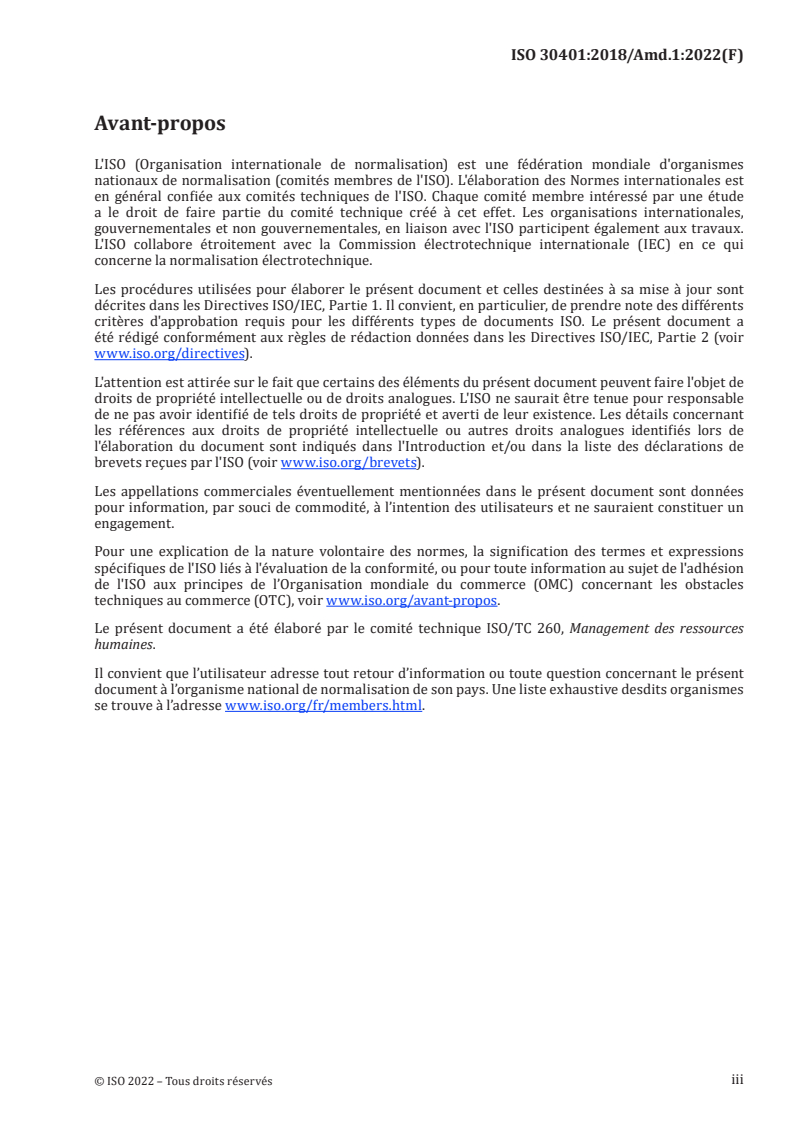
Avant-propos
L'ISO (Organisation internationale de normalisation) est une fédération mondiale d'organismes
nationaux de normalisation (comités membres de l'ISO). L'élaboration des Normes internationales est
en général confiée aux comités techniques de l'ISO. Chaque comité membre intéressé par une étude
a le droit de faire partie du comité technique créé à cet effet. Les organisations internationales,
gouvernementales et non gouvernementales, en liaison avec l'ISO participent également aux travaux.
L'ISO collabore étroitement avec la Commission électrotechnique internationale (IEC) en ce qui
concerne la normalisation électrotechnique.
Les procédures utilisées pour élaborer le présent document et celles destinées à sa mise à jour sont
décrites dans les Directives ISO/IEC, Partie 1. Il convient, en particulier, de prendre note des différents
critères d'approbation requis pour les différents types de documents ISO. Le présent document a
été rédigé conformément aux règles de rédaction données dans les Directives ISO/IEC, Partie 2 (voir
www.iso.org/directives).
L'attention est attirée sur le fait que certains des éléments du présent document peuvent faire l'objet de
droits de propriété intellectuelle ou de droits analogues. L'ISO ne saurait être tenue pour responsable
de ne pas avoir identifié de tels droits de propriété et averti de leur existence. Les détails concernant
les références aux droits de propriété intellectuelle ou autres droits analogues identifiés lors de
l'élaboration du document sont indiqués dans l'Introduction et/ou dans la liste des déclarations de
brevets reçues par l'ISO (voir www.iso.org/brevets).
Les appellations commerciales éventuellement mentionnées dans le présent document sont données
pour information, par souci de commodité, à l’intention des utilisateurs et ne sauraient constituer un
engagement.
Pour une explication de la nature volontaire des normes, la signification des termes et expressions
spécifiques de l'ISO liés à l'évaluation de la conformité, ou pour toute information au sujet de l'adhésion
de l'ISO aux principes de l’Organisation mondiale du commerce (OMC) concernant les obstacles
techniques au commerce (OTC), voir www.iso.org/avant-propos.
Le présent document a été élaboré par le comité technique ISO/TC 260, Management des ressources
humaines.
Il convient que l’utilisateur adresse tout retour d’information ou toute question concernant le présent
document à l’organisme national de normalisation de son pays. Une liste exhaustive desdits organismes
se trouve à l’adresse www.iso.org/fr/members.html.
iii
ISO 30401:2018/Amd.1:2022(F)
Systèmes de management des connaissances — Exigences
AMENDEMENT 1
Ajouter ou remplacer les articles terminologiques suivants à l’Article 3
3.2
partie intéressée (terme recommandé)
partie prenante (terme admis)
personne ou organisme qui peut soit influer sur une décision ou une activité, soit être influencé ou
s’estimer influencé par une décision ou une activité
EXEMPLE Clients, propriétaires, membres d’un organisme, fournisseurs, banquiers, syndicats, comités
d’entreprise, partenaires ou sociétés pouvant comprendre des réseaux concurrentiels ainsi que des groupes de
pression.
3.4
système de management
ensemble d’éléments corrélés ou en interaction d’un organisme, utilisés pour établir des politiques, des
objectifs et des processus de façon à atteindre lesdits objectifs
Note 1 à l'article: Un système de management peut traiter d’un seul ou de plusieurs domaines.
Note 2 à l'article: Les éléments du système comprennent la structure, les rôles et responsabilités, la planification
et le fonctionnement de l’organisme.
Note 3 à l'article: Le périmètre d’un système de management peut comprendre l’ensemble de l’organisme, des
fonctions ou des sections spécifiques et identifiées de l’organisme, ou une ou plusieurs fonctions dans un groupe
d’organismes
Note 4 à l'article: Un système peut inclure la dynamique de groupe et les comportements individuels et collectifs.
3.20
action corrective
action visant à éliminer la ou les causes d'une non-conformité et à éviter qu’elle ne réapparaisse
3.23
collaboration
deux personnes ou plus travaillant ensemble, sur un objectif commun et concerté
Note 1 à l'article: La collaboration s’exprime souvent dans des limites fonctionnelles, organisationnelles,
géographiques ou d’autres types.
Note 2 à l'article: La collaboration implique la confiance, des interactions sociales ainsi que le partage de
connaissances.
3.25
connaissance
capital personnel ou organ
...
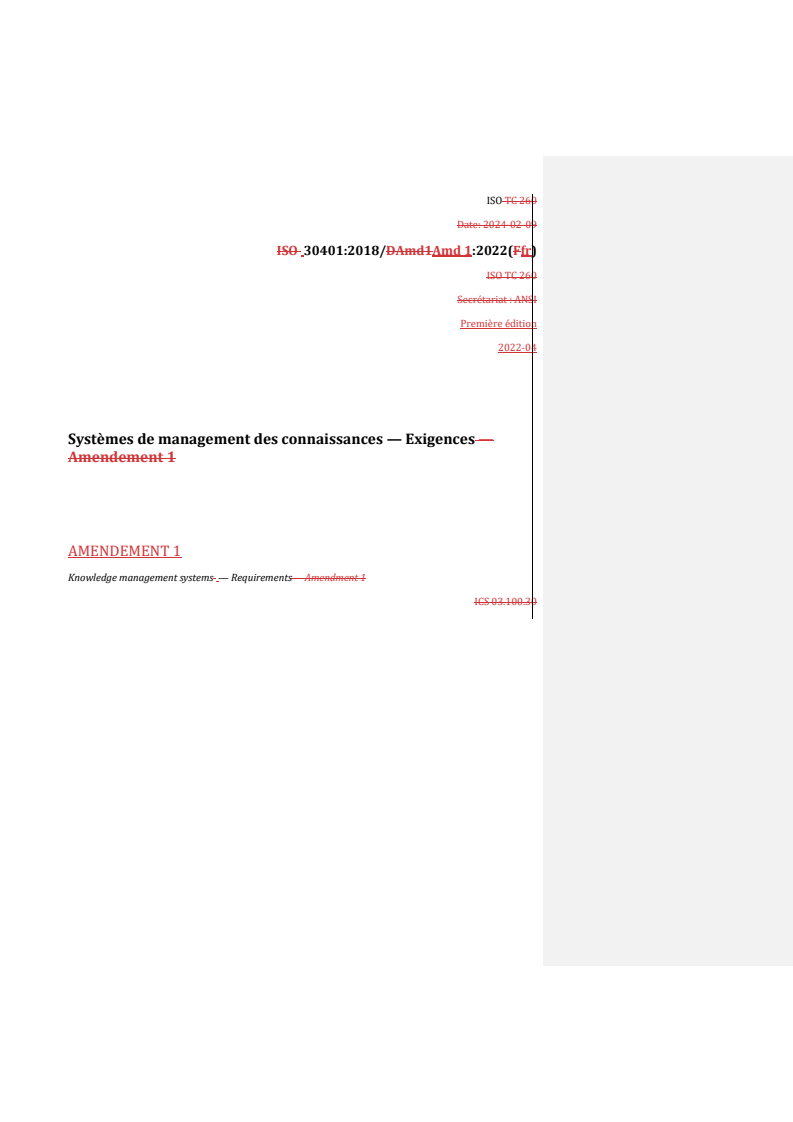
ISO TC 260
Date: 2024-02-09
ISO 30401:2018/DAmd1Amd 1:2022(Ffr)
ISO TC 260
Secrétariat : ANSI
Première édition
2022-04
Systèmes de management des connaissances — Exigences —
Amendement 1
AMENDEMENT 1
Knowledge management systems — Requirements— Amendment 1
ICS 03.100.30
DOCUMENT PROTÉGÉ PAR COPYRIGHT
AMENDMENT 1
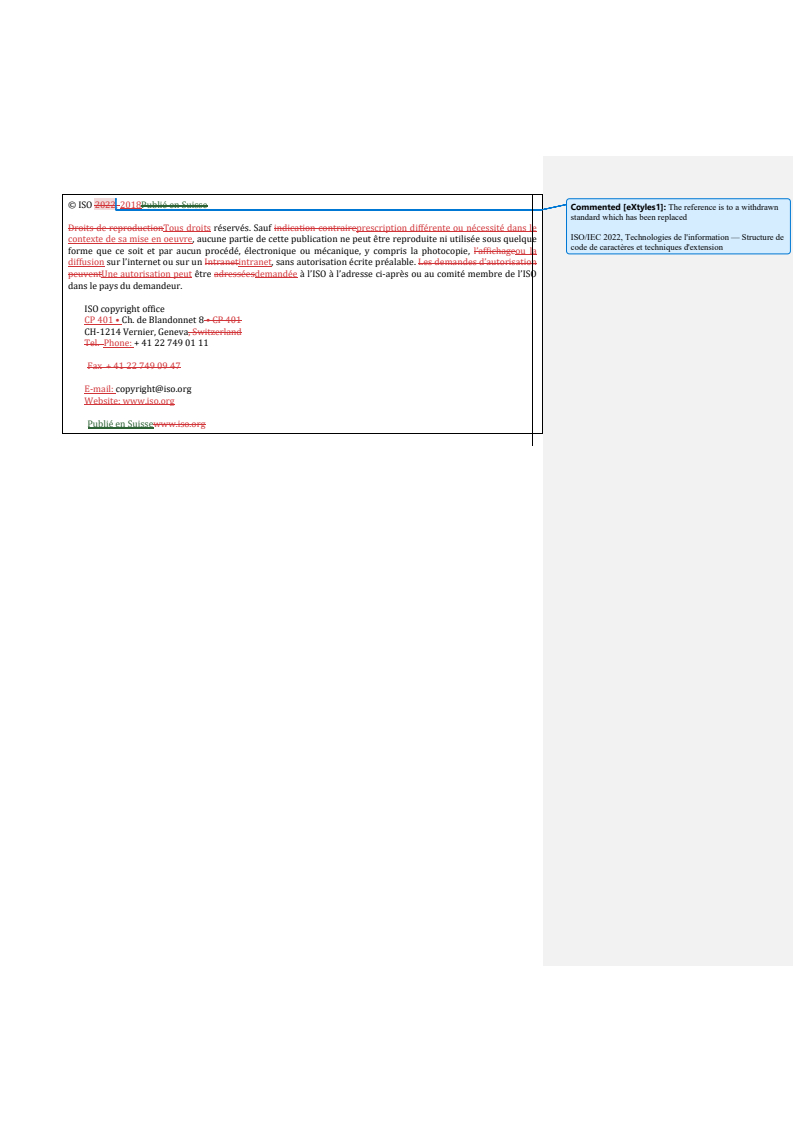
Commented [eXtyles1]: The reference is to a withdrawn
standard which has been replaced
Droits de reproductionTous droits réservés. Sauf indication contraireprescription différente ou nécessité dans le
ISO/IEC 2022, Technologies de l'information — Structure de
contexte de sa mise en oeuvre, aucune partie de cette publication ne peut être reproduite ni utilisée sous quelque
code de caractères et techniques d'extension
forme que ce soit et par aucun procédé, électronique ou mécanique, y compris la photocopie, l’affichageou la
diffusion sur l’internet ou sur un Intranetintranet, sans autorisation écrite préalable. Les demandes d’autorisation
peuventUne autorisation peut être adresséesdemandée à l’ISO à l’adresse ci-après ou au comité membre de l’ISO
dans le pays du demandeur.
ISO copyright office
CP 401 • Ch. de Blandonnet 8 • CP 401
CH-1214 Vernier, Geneva, Switzerland
Tel. Phone: + 41 22 749 01 11
Fax + 41 22 749 09 47
E-mail: copyright@iso.org
Website: www.iso.org
Publié en Suissewww.iso.org
ISO 30401:2018/Amd.1:2022(F)
Systèmes de management des connaissances — Exigences
AMENDEMENT 1
Ajouter ou remplacer les articles terminologiques suivants à l’Article 3
Commented [eXtyles2]: No section matches the in-text
citation "l’Article 3". Please supply the missing section or
3.2
delete the citation.
partie intéressée (terme recommandé)
partie prenante (terme admis)
personne ou organisme qui peut soit influer sur une décision ou une activité, soit être influencé ou s’estimer
influencé par une décision ou une activité
EXEMPLESEXEMPLE Clients, propriétaires, membres d’un organisme, fournisseurs, banquiers, syndicats, comités
d’entreprise, partenaires ou sociétés pouvant comprendre des réseaux concurrentiels ainsi que des groupes de pression.
3.4
système de management
ensemble d’éléments corrélés ou en interaction d’un organisme, utilisés pour établir des politiques, des
objectifs et des processus de façon à atteindre lesdits objectifs
Note 1 à l’article: l'article: Un système de management peut traiter d’un seul ou de plusieurs domaines.
Note 2 à l’article: l'article: Les éléments du système comprennent la structure, les rôles et responsabilités, la
planification et le fonctionnement de l’organisme.
Note 3 à l’article: l'article: Le périmètre d’un système de management peut comprendre l’ensemble de
l’organisme, des fonctions ou des sections spécifiques et identifiées de l’organisme, ou une ou plusieurs fonctions dans
un groupe d’organismes
Note 4 à l’article: l'article: Un système peut inclure la dynamique de groupe et les comportements individuels et
collectifs.
3.20
action corrective
action visant à éliminer la ou les causes d'une non-conformité et à éviter qu’elle ne réapparaisse
3.23
collaboration
deux personnes ou plus travaillant ensemble, sur un objectif commun et concerté
Note 1 à l’article: l'article: La collaboration s’exprime souvent dans des limites fonctionnelles, organisationnelles,
géographiques ou d’autres types.
Note 2 à l’article: l'article: La collaboration implique la confiance, des interactions sociales ainsi que le partage de
connaissances.
3.25
connaissance
capital personnel ou organisationnel permettant des décisions et une action efficaces en contexte
ISO 30401:2018/Amd. 1:2022(Ffr)
EXEMPLESEXEMPLE Savoirs, savoir-faire et connaissance codifiée.
Note 1 à l’article: l'article: Les connaissances peuvent être individuelles ou collectives.
Note 2 à l’article: l'article: Les nombreux types et formes de connaissances sont pertinents en fonction des
différents objectifs et différents contextes.
Note 3 à l’article: l'article: Les connaissances s’acquièrent par l’apprentissage ou l’expérience.
3.26
management des connaissances
discipline et ensemble de pratiques holistiques et transversales, axés sur la connaissance, afin d’améliorer les
performances organisationnelles
Note 1 à l’article : l'article: Le management des connaissances comprend, mais sans s’y limiter, la création,
l’acquisition, l’application, la maintenance, le partage et la protection de connaissances dans le but de créer une valeur
organisationnelle.
3.28
système de management des connaissances
partie d’un système de management relatif aux connaissances
Note 1 à l’article: l'article: Les éléments du système incluent la culture de management des connaissances de
l’organisme.
3.29
culture organisationnelle
...