

ISO 30201:2026
(Main)Human resources management systems — Requirements
- Abstract
This document specifies requirements for a human resource (HR) management system, which enables an organization to: create stakeholder value through effective application and continual improvement of the HR management system, which includes the attraction, development and deployment of workers; integrate the HR management system into the organization’s overall management system, including risk management; demonstrate its ability to consistently manage its workers in a way that contributes to meeting stakeholder needs, including the achievement of organizational objectives and consideration of the needs of workers and employers; positively influence human capital (the collective knowledge, skills and abilities of the organization’s workforce). This document is applicable to organizations of all sizes, growth phases and sectors, whether public or private, for profit or not for profit. This document does not determine the organization’s strategies and objectives. This document does not serve to replace the instruments of agreed collective codetermination, most prominently that of collective bargaining, as established in many countries and practised by, for example, employers, workers unions, employee representatives and their respective associations.
- Status
- Published
- Publication Date
- 21-Jun-2026
- Technical Committee
- ISO/TC 260 - Human resource management
- Drafting Committee
- ISO/TC 260/WG 13 - HRMS Requirements
- Current Stage
- 6060 - International Standard published - 60 Publication
- Start Date
- 22-Jun-2026
- Due Date
- 14-Jan-2027
- Completion Date
- 14-Jan-2027
Buy Documents

ISO 30201:2026 - Human resources management systems — Requirements

ISO 30201:2026 - Systèmes de management des ressources humaines — Exigences
ISO 30201:2026 is an International Standard from ISO for human resources management systems. ISO 30201:2026 specifies requirements for an HR management system that helps an organization attract, develop and deploy workers, integrate HR into the wider management system, and improve human capital. It is written for organizations of all sizes, growth phases and sectors, in public or private organizations and whether for profit or not for profit.
What does ISO 30201:2026 specify?
ISO 30201:2026 specifies the requirements for building and running an HR management system (HRMS) and for showing that it works in practice. The standard frames HR management as part of organizational management, not as a separate administrative function.
The scope allows an organization to use the HRMS to create stakeholder value, manage workers consistently, and connect HR work to risk management and organizational objectives. ISO 30201:2026 leaves the organization’s strategies and objectives to the organization itself, and it is intended to sit alongside agreed collective codetermination arrangements such as collective bargaining.
The document is organized into the usual management-system structure:
- Clause 1 Scope
- Clause 2 Normative references
- Clause 3 Terms and definitions
- Clause 4 Context of the organization
- Clause 5 Leadership
- Clause 6 Planning
- Clause 7 Support
- Clause 8 Operation
- Clause 9 Performance evaluation
- Clause 10 Improvement
| Annex | What it covers |
|---|---|
| Annex A | Examples of external and internal issues, plus other HR activities to consider |
| Annex B | Information, consultation and participation of workers |
| Annex C | Conformity checklist with suggested evidence |
What are the key requirements of ISO 30201:2026?
ISO 30201:2026 requires an organization to treat HR management as a planned, documented and continually improved management system. The most important requirements follow the PDCA logic used throughout the standard: plan the system, do the work, check results, and act on improvements.
Context, stakeholders and scope
Clause 4 requires the organization to identify external and internal issues that affect the HRMS, including whether climate change is a relevant issue. In practice, this means looking at the business and operating context before setting HR processes.
Clause 4 also requires the organization to identify workers, employers and other stakeholders, determine their relevant requirements, and decide which requirements the HRMS will address. The organization then defines the HRMS scope as documented information, so the boundaries of the system are clear to managers, workers and auditors.
Leadership, policy and worker involvement
Clause 5 puts top management at the center of the HRMS. ISO 30201:2026 requires top management to establish the HR policy and HR objectives, align them with strategic direction, provide resources, communicate the importance of effective HR management, and support continual improvement.
The same clause requires defined roles, responsibilities and authorities, including responsibility for conformity and for reporting HRMS performance to top management. It also requires processes for consultation and participation of workers, and where they exist, workers’ representatives. In practice, this means the organization must have a real channel for worker input when designing and improving HR processes.
Planning, support and control of information
Clause 6 requires the organization to plan actions for risks and opportunities, set measurable HR objectives, and manage changes in a planned way. This means HR decisions should be tied to risks, expected results and follow-up, not handled ad hoc.
Clause 7 requires resources, competence, awareness, communication and control of documented information. The standard expects the organization to decide what competence is needed, make sure people are competent, and keep evidence of that competence. It also requires controlled documents and records so the HRMS can be operated, reviewed and audited reliably.
Operating the HR management life cycle
Clause 8 is the operational core. ISO 30201:2026 requires planned control of HR processes and also control of relevant outsourced or externally provided processes, products or services.
The standard identifies the HR management life cycle processes that the organization includes when applicable:
- workforce planning and allocation
- remuneration, rewards and recognition
- recruitment and onboarding
- learning and development
- knowledge management
- talent management
- performance management
- succession planning
- workforce mobility
- exit from employment, including retirement
- human capital reporting
These processes matter because the standard treats attraction, development and deployment of talent as linked activities across the worker life cycle. In practice, the organization needs consistent processes from hiring through exit, with links between capability, performance, mobility and reporting.
Monitoring, audit and improvement
Clause 9 requires the organization to monitor and measure what matters, analyze the results, conduct internal audits, and perform management review. This gives top management evidence about whether the HRMS is functioning and where it needs adjustment.
Clause 10 requires continual improvement and corrective action when nonconformities occur. In practice, the organization needs to correct immediate issues, find root causes, prevent recurrence and update the HRMS where needed.
What terms does ISO 30201:2026 define?
- Human resource management system (HRMS) - the management system used for human resources, covering how the organization manages people through policies, processes and controls.
- Stakeholder - a person or organization that can affect, be affected by, or see itself as affected by a decision or activity.
- Top management - the person or group that directs and controls the organization at the highest level.
- Worker - a person who performs work for the organization, including employees, self-employed people and others working under the organization’s control.
- Human capital - the value of the collective knowledge, skills and abilities of the organization’s people.
- Performance management - management of the performance of people, groups and organizations, often including feedback, coaching and review for improvement.
- Knowledge management (KM) - the discipline and set of practices that support knowledge creation and application to improve organizational performance.
- Consultation - seeking views before making a decision.
Who uses ISO 30201:2026?
ISO 30201:2026 is for organizations that want a structured HR management system, regardless of size, sector, ownership or growth stage. It is especially relevant where HR decisions affect service quality, operational performance, workforce capability, retention or organizational risk.
Typical users include:
- top management setting HR policy and objectives
- HR leaders and HR managers designing and running HR processes
- line managers involved in workforce planning, performance and development
- internal auditors and management system auditors checking conformity and effectiveness
- quality, compliance and governance teams linking HR with wider management systems
- worker representatives involved in consultation and participation
- employers in public, private, for-profit and not-for-profit organizations
Which standards are used with ISO 30201:2026?
| Standard | What it contributes |
|---|---|
| ISO 19011 | Guidance for auditing management systems, used for internal audit practice |
| ISO 30400:2022 | Core HR terminology used across the definitions |
| ISO 9000:2026 | Source of the definition of knowledge |
| ISO 45001:2018 | Source of the definition of consultation |
| ISO 30401 | Knowledge management systems requirements |
| ISO 30405 | Recruitment guidance |
| ISO 30408 | Human governance guidance, including talent strategy and workforce mobility |
| ISO 30409 | Workforce planning guidance |
| ISO 30414 | Human capital reporting and disclosure |
| ISO 30415 | Diversity and inclusion guidance |
| ISO/TS 30421 | Turnover and retention metrics |
| ISO/TS 30425 | Workforce availability metrics |
| ISO/TS 30432 | Workforce productivity metrics |
| ISO/TS 30433 | Succession planning metrics |
What does the ISO 30201:2026 document contain?
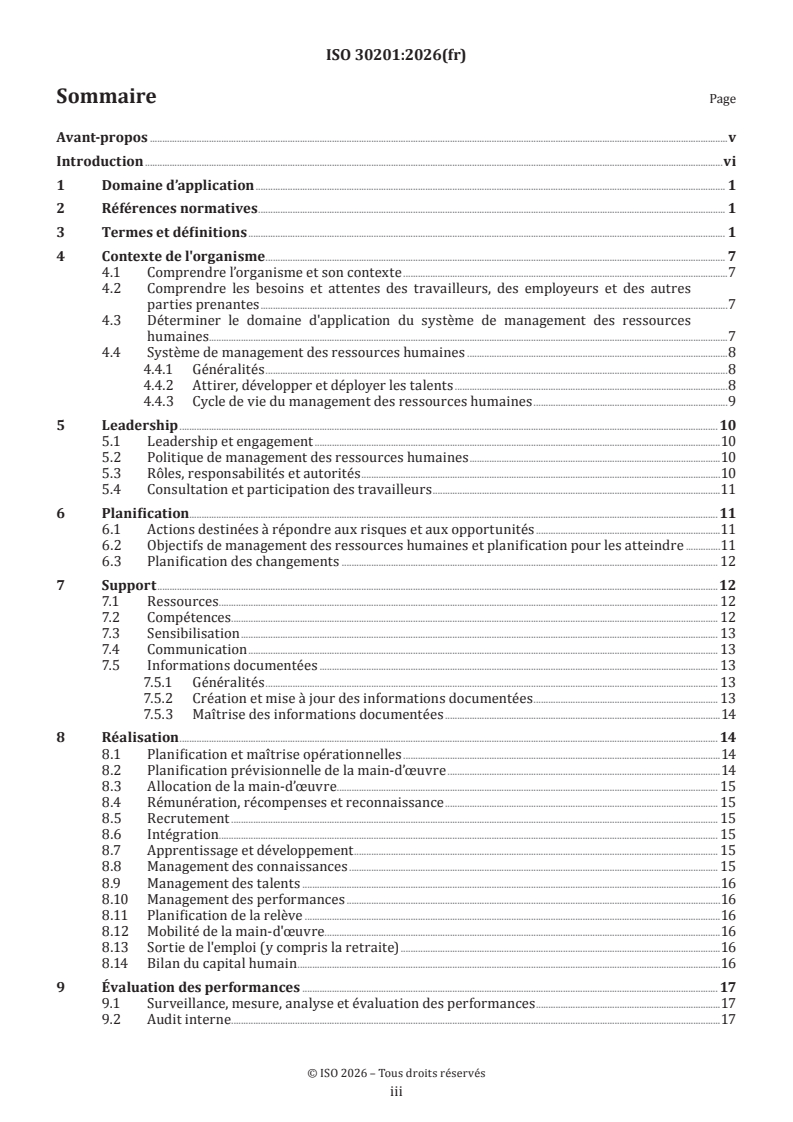
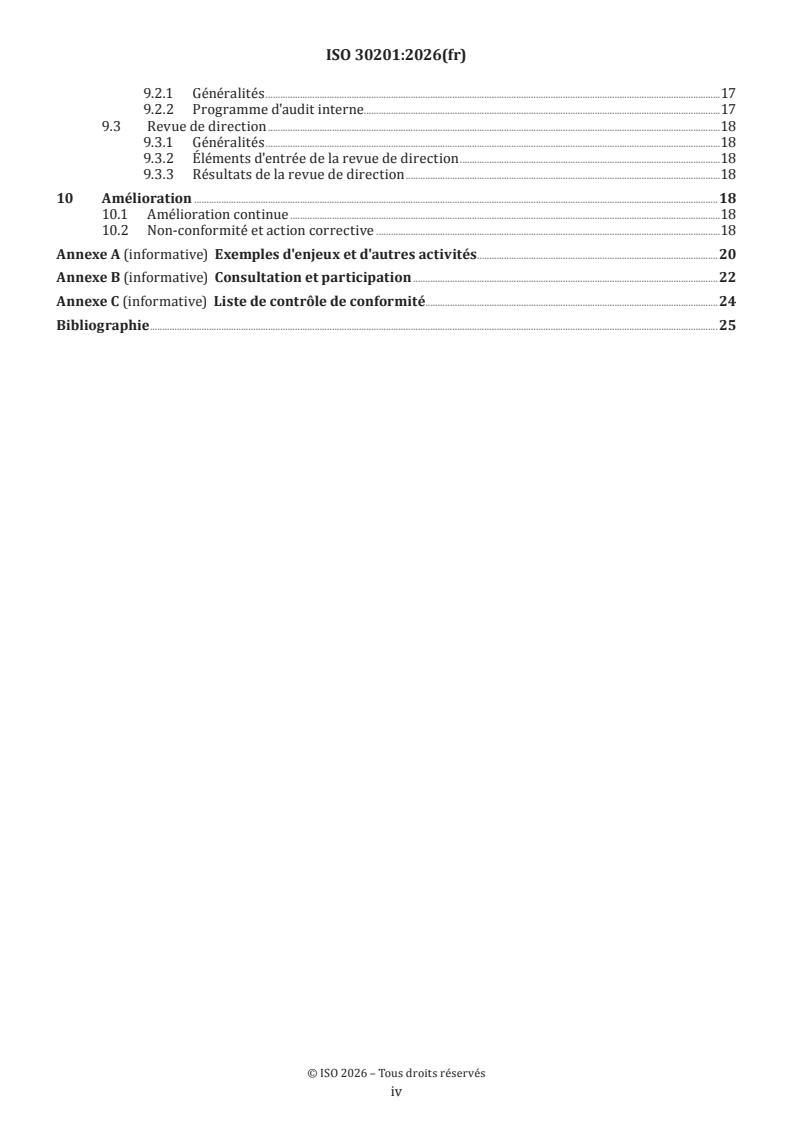
ISO 30201:2026 contains a management-system model for HR built around PDCA, shown in Figure 1, and a process view of the HR management life cycle in Figure 2. It also contains the main requirements clauses for context, leadership, planning, support, operation, performance evaluation and improvement.
Annex A gives examples of external and internal issues, including political, economic, social, technological, environmental and legal factors, plus internal matters such as governance, workforce characteristics, work location and data security. Annex B lists topics that can be covered in information, consultation and participation of workers and workers’ representatives.
Annex C provides a conformity checklist in Table C.1. That checklist ties each clause to example evidence such as context analysis, stakeholder analysis, documented scope, policy records, process maps, training logs, KPI reports, audit reports and management review minutes.
Buy Documents
ISO 30201:2026 - Human resources management systems — Requirements
ISO 30201:2026 - Systèmes de management des ressources humaines — Exigences
Get Certified
Connect with accredited certification bodies for this standard

BSI Group
BSI (British Standards Institution) is the business standards company that helps organizations make excellence a habit.

Bureau Veritas
Bureau Veritas is a world leader in laboratory testing, inspection and certification services.

DNV
DNV is an independent assurance and risk management provider.
Sponsored listings
Frequently Asked Questions
ISO 30201:2026 is a standard published by the International Organization for Standardization (ISO). Its full title is "Human resources management systems — Requirements". This standard covers: This document specifies requirements for a human resource (HR) management system, which enables an organization to: create stakeholder value through effective application and continual improvement of the HR management system, which includes the attraction, development and deployment of workers; integrate the HR management system into the organization’s overall management system, including risk management; demonstrate its ability to consistently manage its workers in a way that contributes to meeting stakeholder needs, including the achievement of organizational objectives and consideration of the needs of workers and employers; positively influence human capital (the collective knowledge, skills and abilities of the organization’s workforce). This document is applicable to organizations of all sizes, growth phases and sectors, whether public or private, for profit or not for profit. This document does not determine the organization’s strategies and objectives. This document does not serve to replace the instruments of agreed collective codetermination, most prominently that of collective bargaining, as established in many countries and practised by, for example, employers, workers unions, employee representatives and their respective associations.
This document specifies requirements for a human resource (HR) management system, which enables an organization to: create stakeholder value through effective application and continual improvement of the HR management system, which includes the attraction, development and deployment of workers; integrate the HR management system into the organization’s overall management system, including risk management; demonstrate its ability to consistently manage its workers in a way that contributes to meeting stakeholder needs, including the achievement of organizational objectives and consideration of the needs of workers and employers; positively influence human capital (the collective knowledge, skills and abilities of the organization’s workforce). This document is applicable to organizations of all sizes, growth phases and sectors, whether public or private, for profit or not for profit. This document does not determine the organization’s strategies and objectives. This document does not serve to replace the instruments of agreed collective codetermination, most prominently that of collective bargaining, as established in many countries and practised by, for example, employers, workers unions, employee representatives and their respective associations.
ISO 30201:2026 is classified under the following ICS (International Classification for Standards) categories: 03.100.30 - Management of human resources; 03.100.70 - Management systems. The ICS classification helps identify the subject area and facilitates finding related standards.
ISO 30201:2026 is available in PDF format for immediate download after purchase. The document can be added to your cart and obtained through the secure checkout process. Digital delivery ensures instant access to the complete standard document.
Standards Content (Sample)
Contents
- Introduction
- 0.1 Benefits of human resource management systems
- 0.2 HRMS and management systems standards
- 0.3 Continual improvement and the PDCA cycle
- 0.4 Guiding principles of HR management
- 1 Scope
- 2 Normative references
- 3 Terms and definitions
- 3.1 organization
- 3.2 stakeholder
- 3.3 top management
- 3.4 management system
- 3.5 human resource management system
- 3.6 policy
- 3.7 objective
- 3.8 risk
- 3.9 process
- 3.10 competence
- 3.11 documented information
- 3.12 performance
- 3.13 continual improvement
- 3.14 effectiveness
- 3.15 requirement
- 3.16 conformity
- 3.17 nonconformity
- 3.18 corrective action
- 3.19 audit
- 3.20 measurement
- 3.21 monitoring
- 3.22 human resources
- 3.23 human resource management
- 3.24 human capital
- 3.25 talent
- 3.26 worker
- 3.27 employee representative
- 3.28 employ
- 3.29 employer
- 3.30 organizational governance
- 3.31 organizational culture
- 3.32 performance management
- 3.33 management
- 3.34 knowledge
- 3.35 knowledge management
- 3.36 collaboration
- 3.37 consultation
- 3.38 collective bargaining
- 4 Context of the organization
- 4.1 Understanding the organization and its context
- 4.2 Understanding the needs and expectations of workers, employers and other
- 4.3 Determining the scope of the HR management system
- 4.4 HR management system
- 5 Leadership
- 5.1 Leadership and commitment
- 5.2 Human resource management policy
- 5.3 Roles, responsibilities and authorities
- 5.4 Consultation and participation of workers
- 6 Planning
- 6.1 Actions to address risks and opportunities
- 6.2 HR management objectives and planning to achieve them
- 6.3 Planning of changes
- 7 Support
- 7.1 Resources
- 7.2 Competence
- 7.3 Awareness
- 7.4 Communication
- 7.5 Documented information
- 8 Operation
- 8.1 Operational planning and control
- 8.2 Workforce planning
- 8.3 Workforce allocation
- 8.4 Remuneration, rewards and recognition
- 8.5 Recruitment
- 8.6 Onboarding
- 8.7 Learning and development
- 8.8 Knowledge management
- 8.9 Talent management
- 8.10 Performance management
- 8.11 Succession planning
- 8.12 Workforce mobility
- 8.13 Exit from employment (including retirement)
Introduction
0.1 Benefits of human resource management systems
An effective human resource (HR) management system is fundamental to achieving the organization’s optimal performance through utilizing the full potential of its workforce. Workers are a key resource for all organizations and their effective management is necessary to meet organizational objectives. This document presents high-level HR management principles, specifies the requirements for an HR management system (HRMS) and provides examples of how the principles and requirements can be used. An effective HRMS provides sustainable benefits for workers, organizations and the communities in which they operate.
The potential benefits of an effective HRMS to an organization include:
- achievement of organizational objectives;
- improved risk management and protection of people and the environment;
- more efficient use of resources and improved organizational performance;
- increased capability to deliver consistent and improved services and products;
- creation of value for stakeholders, including workers;
- continual improvement of HR management;
- better co-ordination and integration of HR management with other organizational functions;
- strategic alignment and reciprocity between the needs of workers and employers;
- enhanced worker experience and well-being at work;
- enhanced reputation of the organization as an employer.
The HRMS specified in this document contributes to the following United Nations (UN) Sustainable Development Goals (SDGs):
- SDG3: Good health and well-being;
- SDG4: Quality education;
- SDG5: Gender equality;
- SDG8: Decent work and economic growth;
- SDG 9: Industry, innovation and infrastructure;
- SDG10: Reduced inequalities.
0.2 HRMS and management systems standards
This document is a requirements-based management system standard (MSS) focused on HR management. By using this document, organizations can develop, improve and implement their own HR management system and demonstrate conformity with its requirements. An organization can integrate its HR management system into its overall management system.
This MSS does not dictate the organization’s strategies and objectives, nor does it address its relationships with trade unions and other representative bodies.
This document provides an overarching framework for HR management activities and other TC 260 documents (see Clause 8).
The term "HR management system" does not refer to a computer system or software application.
ISO 30201:2026(en)
0.3 Continual improvement and the PDCA cycle
The HR management system specified in this document is founded on the Plan-Do-Check-Act (PDCA) cycle. Figure 1 shows the relationship between the PDCA cycle and the structure of this document. Figure 1 — Structure of this document The PDCA cycle is an iterative process underpinned by organizational enablers (such as leadership and support) to achieve continual improvement. In this document, the PDCA cycle is used as follows:
- Plan: analyse the context of the organization; determine and assess HR management risks and opportunities; determine HR management policy; and establish HR management objectives and processes.
- Do: implement the processes as planned.
- Check: monitor and measure activities and processes with regard to the HR management policy and HR management objectives and report the results.
- Act: take actions to continually improve HR management performance to achieve the intended outcomes.
0.4 Guiding principles of HR management
Management of people in organizations should be guided by the following high-level principles, which serve as a foundation for effective HR management and can contribute to a positive and productive organizational culture:
- Reciprocity. HR management creates strategic alignment and promotes reciprocity between the organization’s needs and its workers’ needs.
- Value. People are a source of value for organizations. The value of people is in their contributions to the organization.
- Adaptability. HR management adjusts to fit specific organizational and external environmental contexts.
- Synergy. HR management enables people in the organization to collaborate in ways that result in the whole of the contributions being greater than the sum of their individual ones.
- Responsibility. HR management is responsible for the attraction, development and deployment of people to meet organizational needs.
ISO 30201:2026(en) - Organizational culture. HR management shapes the desired values, beliefs and practices that influence the conduct and behaviour of people and the organization.
- Work environment. HR management promotes a physical and virtual work environment that contributes to the well-being of workers and performance of the organization.
- Society. HR management supports the organization's strategic objectives and role in society, which includes social, economic and environmental responsibilities.
These principles can also be applied when establishing the organization’s HR management system, considering factors such as sector, size and organizational values (taking account of the organization’s specific context and needs).
For the convenience of users, a conformity checklist summarizing the requirements and suggested evidence is provided in Annex C.
International Standard ISO 30201:2026(en) Human resources management systems — Requirements
1 Scope
This document specifies requirements for a human resource (HR) management system, which enables an organization to:
- create stakeholder value through effective application and continual improvement of the HR management system, which includes the attraction, development and deployment of workers;
- integrate the HR management system into the organization’s overall management system, including risk management;
- demonstrate its ability to consistently manage its workers in a way that contributes to meeting stakeholder needs, including the achievement of organizational objectives and consideration of the needs of workers and employers;
- positively influence human capital (the collective knowledge, skills and abilities of the organization’s workforce).
This document is applicable to organizations of all sizes, growth phases and sectors, whether public or private, for profit or not for profit. This document does not determine the organization’s strategies and objectives.
This document does not serve to replace the instruments of agreed collective codetermination, most prominently that of collective bargaining, as established in many countries and practised by, for example, employers, workers unions, employee representatives and their respective associations.
2 Normative references
There are no normative references in this document.
3 Terms and definitions
For the purposes of this document, the following terms and definitions apply. ISO and IEC maintain terminology databases for use in standardization at the following addresses:
- ISO Online browsing platform: available at https:// www .iso .org/ obp
- IEC Electropedia: available at https:// www .electropedia .org/
3.1 organization
person or group of people that has its own functions with responsibilities, authorities and relationships to achieve its objectives (3.7) Note 1 to entry: The concept of organization includes, but is not limited to, sole trader, company, corporation, firm, enterprise, authority, partnership, charity or institution, or part or combination thereof, whether incorporated or not, public or private.
Note 2 to entry: If the organization is part of a larger entity, the term “organization” refers only to the part of the larger entity that is within the scope of the HR management system (3.5).
ISO 30201:2026(en)
3.2 stakeholder
interested party person or organization (3.1) that can affect, be affected by, or perceive itself to be affected by a decision or activity EXAMPLE Customers, owners, people in an organization, suppliers, bankers, unions, work councils, partners or societies, including competitive or pressure groups.
3.3 top management
person or group of people who directs and controls an organization (3.1) at the highest level Note 1 to entry: Top management has the power to delegate authority and provide resources within the organization. Note 2 to entry: If the scope of the management system (3.4) covers only part of an organization, then top management refers to those who direct and control that part of the organization.
3.4 management system
set of interrelated or interacting elements of an organization (3.1) to establish policies (3.6) and objectives (3.7), as well as processes (3.9) to achieve those objectives Note 1 to entry: A management system can address a single discipline or several disciplines. Note 2 to entry: The management system elements include the organization’s structure, roles and responsibilities, planning and operation.
3.5 human resource management system
HR management system HRMS management system (3.4) with regard to human resources (3.22)
3.6 policy
intentions and direction of an organization (3.1) as formally expressed by its top management (3.3)
3.7 objective
result to be achieved Note 1 to entry: An objective can be strategic, tactical or operational. Note 2 to entry: Objectives can relate to different disciplines (such as finance, health and safety, and environment). They can be, for example, organization-wide or specific to a project, product, service or process (3.9). Note 3 to entry: An objective can be expressed in other ways, e.g. as an intended result, as a purpose, as an operational criterion, as an HR management objective or by the use of other words with similar meaning (e.g. aim, goal, or target). Note 4 to entry: In the context of HR management systems (3.5), HR management objectives are set by the organization (3.1), consistent with the HR management policy (3.6), to achieve specific results.
3.8 risk
effect of uncertainty Note 1 to entry: An effect is a deviation from the expected – positive or negative. Note 2 to entry: Uncertainty is the state, even partial, of deficiency of information related to, understanding or knowledge (3.34) of, an event, its consequence, or likelihood. Note 3 to entry: Risk is often characterized by reference to potential events and consequences, or a combination of these.
ISO 30201:2026(en) Note 4 to entry: Risk is often expressed in terms of a combination of the consequences of an event (including changes in circumstances) and the associated likelihood of occurrence.
3.9 process
set of interrelated or interacting activities that uses or transforms inputs to deliver a result Note 1 to entry: Whether the result of a process is called an output, a product or a service depends on the context of the reference.
3.10 competence
ability to apply knowledge (3.34) and skills to achieve intended results
3.11 documented information
information required to be controlled and maintained by an organization (3.1) and the medium on which it is contained Note 1 to entry: Documented information can be in any format and media and from any source. Note 2 to entry: Documented information can refer to:
- the management system (3.4), including related processes (3.9);
- information created in order for the organization to operate (documentation);
- evidence of results achieved (records).
3.12 performance
measurable result Note 1 to entry: Performance can relate either to quantitative or qualitative findings. Note 2 to entry: Performance can relate to managing activities, processes (3.9), products, services, systems or organizations (3.1).
3.13 continual improvement
recurring activity to enhance performance (3.12)
3.14 effectiveness
extent to which planned activities are realized and planned results are achieved
3.15 requirement
need or expectation that is stated, generally implied or obligatory Note 1 to entry: “Generally implied” means that it is custom or common practice for the organization (3.1) and stakeholders (3.2) that the need or expectation under consideration is implied. Note 2 to entry: A specified requirement is one that is stated, e.g. in documented information (3.11).
3.16 conformity
fulfilment of a requirement (3.15)
3.17 nonconformity
non-fulfilment of a requirement (3.15)
ISO 30201:2026(en)
3.18 corrective action
action to eliminate the cause(s) of a nonconformity (3.17) and to prevent recurrence
3.19 audit
systematic and independent process (3.9) for obtaining evidence and evaluating it objectively to determine the extent to which the audit criteria are fulfilled Note 1 to entry: An audit can be an internal audit (first party) or an external audit (second party or third party), and it can be a combined audit (combining two or more disciplines).
Note 2 to entry: An internal audit is conducted by the organization (3.1) itself, or by an external party on its behalf. Note 3 to entry: “Audit evidence” and “audit criteria” are defined in ISO 19011.
3.20 measurement
process (3.9) to determine a value
3.21 monitoring
determining the status of a system, a process (3.9) or an activity Note 1 to entry: To determine the status, there can be a need to check, supervise or critically observe.
3.22 human resources
HR people working within or contributing to the organization (3.1) [SOURCE: ISO 30400:2022, 3.2.2]
3.23 human resource management
HRM management (3.33) of people in organizations (3.1) [SOURCE: ISO 30400:2022, 3.2.6, modified — Notes to entry have been removed.]
3.24 human capital
value of the collective knowledge (3.34), skills and abilities of an organization’s (3.1) people [SOURCE: ISO 30400:2022, 3.2.1]
3.25 talent
person who has or can develop the knowledge (3.34), skills, abilities and other characteristics to perform a function, job or role, as required [SOURCE: ISO 30400:2022, 3.11.1]
3.26 worker
person or individual who performs work, whether an employee or someone who is self-employed or who conducts activities on behalf and under the control of the organization (3.1) in some form of contractual or non-contractual capacity Note 1 to entry: Workers can be represented by employee representatives (3.27). [SOURCE: ISO 30400:2022, 3.13.4, modified — The words "and under the control" have been added; Note 1 to entry has been replaced with a new note to entry.]
ISO 30201:2026(en)
3.27 employee representative
person elected or appointed to act on behalf of the workforce in interactions with the organization (3.1) EXAMPLE An employee representative can be:
a) an individual elected by the workforce; b) an individual appointed by a trade union; c) a member of a works council.
Note 1 to entry: Policies (3.6), processes (3.9) and practices vary between jurisdictions. [SOURCE: ISO 30400:2022, 3.3.12]
3.28 employ
engage the services of a person or put a person to work [SOURCE: ISO 30400:2022, 3.9.12]
3.29 employer
person or group of people who employ (3.28) workers (3.26) and are responsible for organizational and worker outcomes with the authority to enter into an agreement and manage work Note 1 to entry: Employers represent the organization (3.1).
3.30 organizational governance
system by which an organization (3.1) makes and implements decisions in pursuit of its objectives (3.7) Note 1 to entry: This concerns the way a whole organization is led, directed, controlled and held accountable. [SOURCE: ISO 30400:2022, 3.1.2]
3.31 organizational culture
values, beliefs and practices that influence the conduct and behaviour of people and organizations (3.1) [SOURCE: ISO 30400:2022, 3.1.3]
3.32 performance management
management (3.33) of the performance (3.12) of people, groups and organizations (3.1) Note 1 to entry: Performance management can include feedback, coaching, mentoring, reviewing and evaluation activities with the aim of continual improvement (3.13).
[SOURCE: ISO 30400:2022, 3.1.13]
3.33 management
coordinated activities to direct and control an organization (3.1) Note 1 to entry: Management can include establishing policies (3.6) and objectives (3.7) and processes (3.9) to achieve these objectives.
Note 2 to entry: Management includes the processes (3.9) of planning, organizing, directing and controlling the outcomes of people, groups or organizations (3.1).
[SOURCE: ISO 30400:2022, 3.1.11]
ISO 30201:2026(en)
3.34 knowledge
understanding that enables effective context-specific decisions and action EXAMPLE Insights, know-how, good practices.
Note 1 to entry: Knowledge exists within and between individuals, teams and organizations (3.1). [SOURCE: ISO 9000:2026, 3.10.4]
3.35 knowledge management
KM discipline and set of practices that facilitate knowledge (3.34) creation and application to improve organizational performance Note 1 to entry: Knowledge management is a cross-cutting and holistic discipline that applies within and between organizational functions and roles.
3.36 collaboration
people working together with an agreed common purpose Note 1 to entry: Collaboration often takes place across functional, organizational, geographic or other boundaries. Note 2 to entry: Collaboration involves trust, social interaction and the sharing of knowledge (3.34). [SOURCE: ISO 30400:2022, 3.3.2, modified — “two or more” has been removed.]
3.37 consultation
seeking views before making a decision [SOURCE: ISO 45001:2018, 3.5, modified — Note 1 to entry has been removed.]
3.38 collective bargaining
negotiations between employer(s) (3.29) and workers’ organization(s) (3.1) aiming at agreement on mutually relevant issues Note 1 to entry: Collective bargaining can be used to determine working conditions and terms of employment and to regulate the relationship between the organization and the workforce. [SOURCE: ISO 30400:2022, 3.1.33, modified — the definition has been simplified to remove repetition of the term “organization”.]
...
Contents
- Introduction
- 0.1 Avantages des systèmes de management des ressources humaines
- 0.2 SMRH et normes de systèmes de management
- 0.3 Amélioration continue et cycle PDCA
- 0.4 Principes directeurs du management des ressources humaines
- 1 Domaine d’application
- 2 Références normatives
- 3 Termes et définitions
- 3.1 organisme
- 3.2 partie prenante
- 3.3 direction
- 3.4 système de management
- 3.5 système de management des ressources humaines
- 3.6 politique
- 3.7 objectif
- 3.8 risque
- 3.9 processus
- 3.10 compétence
- 3.11 information documentée
- 3.12 performance
- 3.13 amélioration continue
- 3.14 efficacité
- 3.15 exigence
- 3.16 conformité
- 3.17 non-conformité
- 3.18 action corrective
- 3.19 audit
- 3.20 mesure
- 3.21 surveillance
- 3.22 ressources humaines
- 3.23 management des ressources humaines
- 3.24 capital humain
- 3.25 talent
- 3.26 travailleur
- 3.27 représentant des employés
- 3.28 employer
- 3.29 employeur
- 3.30 gouvernance de l’organisme
- 3.31 culture organisationnelle
- 3.32 management des performances
- 3.33 management
- 3.34 connaissance
- 3.35 management des connaissances
- 3.36 collaboration
- 3.37 consultation
- 3.38 négociation collective
- 4 Contexte de l'organisme
- 4.1 Comprendre l’organisme et son contexte
- 4.2 Comprendre les besoins et attentes des travailleurs, des employeurs et des autres
- 4.3 Déterminer le domaine d'application du système de management des ressources
- 4.4 Système de management des ressources humaines
- 5 Leadership
- 5.1 Leadership et engagement
- 5.2 Politique de management des ressources humaines
- 5.3 Rôles, responsabilités et autorités
- 5.4 Consultation et participation des travailleurs
- 6 Planification
- 6.1 Actions destinées à répondre aux risques et aux opportunités
- 6.2 Objectifs de management des ressources humaines et planification pour les atteindre
- 6.3 Planification des changements
- 7 Support
- 7.1 Ressources
- 7.2 Compétences
- 7.3 Sensibilisation
- 7.4 Communication
- 7.5 Informations documentées
- 8 Réalisation
- 8.1 Planification et maîtrise opérationnelles
- 8.2 Planification prévisionnelle de la main-d’œuvre
- 8.3 Allocation de la main-d’œuvre
- 8.4 Rémunération, récompenses et reconnaissance
- 8.5 Recrutement
- 8.6 Intégration
- 8.7 Apprentissage et développement
- 8.8 Management des connaissances
- 8.9 Management des talents
- 8.10 Management des performances
- 8.11 Planification de la relève
- 8.12 Mobilité de la main-d'œuvre
- 8.13 Sortie de l'emploi (y compris la retraite)
Introduction
0.1 Avantages des systèmes de management des ressources humaines
Un système de management des ressources humaines (RH) efficace est fondamental pour obtenir les performances optimales de l'organisme en utilisant tout le potentiel de son personnel. Les personnes sont une ressource clé pour tous les organismes et leur management efficace est nécessaire pour atteindre les objectifs de l'organisme.
Le présent document présente des principes de haut niveau en matière de management des ressources humaines, spécifie les exigences relatives à un système de management des ressources humaines (SMRH) et fournit des exemples de la manière dont ces principes et exigences peuvent être utilisés. Un SMRH efficace offre des avantages durables aux travailleurs, aux organismes et aux communautés au sein desquelles ils opèrent.
Les avantages potentiels d'un SMRH efficace pour un organisme comprennent:
- la réalisation des objectifs de l'organisme;
- l'amélioration du management des risques et de la protection des personnes et de l'environnement;
- une utilisation plus efficace des ressources et une amélioration des performances de l'organisme;
- une capacité accrue à fournir des services et des produits cohérents et améliorés;
- la création de valeur pour les parties prenantes, y compris les travailleurs;
- l'amélioration continue du management des ressources humaines;
- une meilleure coordination et intégration du management des ressources humaines avec les autres fonctions de l'organisme;
- l'alignement stratégique et la réciprocité entre les besoins des travailleurs et des employeurs;
- l'amélioration de l'expérience et du bien-être des travailleurs au travail;
- l'amélioration de la réputation de l'organisme en tant qu'employeur. Le SMRH spécifié dans le présent document contribue à la réalisation des objectifs de développement durable (ODD) suivants des Nations unies:
- ODD3: Bonne santé et bien-être;
- ODD4: Éducation de qualité;
- ODD5: Égalité entre les sexes;
- ODD8: Travail décent et croissance économique;
- ODD9: Industrie, innovation et infrastructure;
- ODD10: Inégalités réduites.
0.2 SMRH et normes de systèmes de management
Le présent document est une norme de système de management (NSM) basée sur les exigences et axée sur le management des RH. En utilisant le présent document, les organismes peuvent développer, améliorer et mettre en œuvre leur propre SMRH et démontrer la conformité à ses exigences. Un organisme peut intégrer son SMRH dans son système de management global.
La présente NSM ne dicte pas les stratégies et les objectifs de l'organisme, ni ne traite de ses relations avec les syndicats et autres organismes représentatifs.
ISO 30201:2026(fr) Le présent document fournit un cadre général pour les activités de management des RH et d'autres documents du TC 260 (voir Article 8).
Le terme “système de management des ressources humaines” ne fait pas référence à un système informatique ou à une application logicielle.
0.3 Amélioration continue et cycle PDCA
Le système de management des ressources humaines spécifié dans le présent document est fondé sur le cycle Planifier-Réaliser-Vérifier-Agir (PDCA). La Figure 1 représente la relation entre le cycle PDCA et la structure du présent document.
Figure 1 — Structure du présent document Le cycle PDCA est un processus itératif soutenu par des facilitateurs organisationnels (tels que le leadership et le support) pour atteindre une amélioration continue. Dans le présent document, le cycle PDCA est utilisé comme suit:
- Planifier: analyser le contexte de l'organisme; déterminer et évaluer les risques et les opportunités en matière de management des RH; déterminer la politique de management des RH; et établir les objectifs et les processus de management des RH.
- Réaliser: mettre en œuvre les processus tels qu'ils ont été planifiés.
- Vérifier: surveiller et mesurer les activités et les processus au regard de la politique de management des RH et les objectifs de management des RH, et rendre compte des résultats.
- Agir: prendre des mesures pour améliorer en permanence les performances du management des RH afin d'atteindre les résultats escomptés.
0.4 Principes directeurs du management des ressources humaines
Il convient que le management des personnes dans les organismes soit guidé par les principes de haut niveau suivants, qui servent de base à un management efficace des ressources humaines et peuvent contribuer à une culture organisationnelle positive et productive:
- Réciprocité. Le management des RH crée un alignement stratégique et favorise la réciprocité entre les besoins de l'organisme et ceux des travailleurs.
- Valeur. Les personnes sont une source de valeur pour les organismes. La valeur des personnes réside dans leurs contributions à l'organisme.
ISO 30201:2026(fr) - Adaptabilité. Le management des RH s'adapte à des contextes organisationnels et environnementaux externes spécifiques.
- Synergie. Le management des RH permet aux membres de l'organisme de collaborer de manière à ce que l'ensemble des contributions soit supérieur à la somme de leurs contributions individuelles.
- Responsabilité. Le management des RH est responsable de l'attraction, du développement et du déploiement des personnes pour répondre aux besoins de l'organisme.
- Culture organisationnelle. Le management des RH façonne les valeurs, croyances et pratiques souhaitées qui influencent la conduite et le comportement des personnes et de l'organisme.
- Environnement de travail. Le management des RH favorise un environnement de travail physique et en distanciel qui contribue au bien-être des travailleurs et aux performances de l'organisme.
- Société. Le management des RH soutient les objectifs stratégiques de l'organisme et son rôle dans la société, qui comprend des responsabilités sociales, économiques et environnementales. Ces principes peuvent également être appliqués lors de l'établissement du système de management des RH de l'organisme, en tenant compte de facteurs tels que le secteur, la taille et les valeurs de l'organisme (en tenant compte du contexte et des besoins spécifiques de l'organisme). Une liste de contrôle de conformité résumant les exigences et les preuves suggérées est fournie à l'Annexe C à l'attention des utilisateurs.
Norme internationale ISO 30201:2026(fr) Systèmes de management des ressources humaines — Exigences
1 Domaine d’application
Le présent document spécifie les exigences relatives à un système de management des ressources humaines (RH) qui permet à un organisme:
- de créer de la valeur pour les parties prenantes grâce à une application efficace et une amélioration continue du SMRH, ce qui comprend l'attraction, le développement et le déploiement des travailleurs;
- d'intégrer le SMRH dans le système de management global de l'organisme, y compris le management des risques;
- de démontrer sa capacité à gérer ses travailleurs de manière cohérente afin de répondre aux besoins des parties prenantes, y compris la réalisation des objectifs de l'organisme et la prise en compte des besoins des travailleurs et des employeurs;
- d'influer positivement sur le capital humain (les connaissances, savoir-faire et aptitudes collectifs du personnel de l'organisme).
Le présent document est applicable aux organismes de toutes tailles, de toutes phases de croissance et de tous secteurs, qu'ils soient publics ou privés, à but lucratif ou non. Le présent document ne détermine pas les stratégies et les objectifs de l'organisme.
Le présent document ne vise pas à remplacer les instruments de codétermination collective convenue, en particulier la négociation collective, telle qu'elle est établie dans de nombreux pays et mise en œuvre par les partenaires sociaux, par exemple les syndicats d'employeurs et de travailleurs, les représentants des employés et leurs associations respectives.
2 Références normatives
Le présent document ne contient aucune référence normative.
3 Termes et définitions
Pour les besoins du présent document, les termes et définitions suivants s'appliquent. L'ISO et l'IEC tiennent à jour des bases de données terminologiques destinées à être utilisées en normalisation, consultables aux adresses suivantes:
- ISO Online browsing platform: disponible à l’adresse https:// www .iso .org/ obp
- IEC Electropedia: disponible à l'adresse https:// www .electropedia .org/
3.1 organisme
personne ou groupe de personnes ayant ses propres fonctions, avec des responsabilités, des autorités et des relations lui permettant d'atteindre ses objectifs (3.7) Note 1 à l'article: Le concept d'organisme englobe, sans s'y limiter, les travailleurs indépendants, les compagnies, les sociétés, les firmes, les entreprises, les administrations, les partenariats, les organisations caritatives ou les institutions, ou bien une partie ou une combinaison des entités précédemment mentionnées de droit public ou privé.
ISO 30201:2026(fr) Note 2 à l'article: Si l'organisme fait partie d'une plus grande entité, le terme “organisme” fait uniquement référence à la partie de cette entité qui est comprise dans le domaine d'application du système de management des RH (3.5).
3.2 partie prenante
partie intéressée personne ou organisme (3.1) qui peut soit influer sur une décision ou une activité, soit être influencé(e) ou se sentir influencé(e) par une décision ou une activité EXEMPLE Clients, propriétaires, personnel d'un organisme, fournisseurs, établissements financiers, syndicats, comités d'entreprise, partenaires ou sociétés, y compris les groupes de pression ou les concurrents.
3.3 direction
personne ou groupe de personnes qui oriente et dirige un organisme (3.1) au plus haut niveau Note 1 à l'article: La direction a le pouvoir de déléguer son autorité et de fournir des ressources au sein de l'organisme. Note 2 à l'article: Si le domaine d'application du système de management (3.4) ne couvre qu’une partie de l’organisme, alors “direction” fait référence à ceux qui orientent et dirigent cette partie de l’organisme.
3.4 système de management
ensemble d'éléments corrélés ou en interaction d'un organisme (3.1) utilisés pour établir des politiques (3.6) et des objectifs (3.7), ainsi que des processus (3.9) de façon à atteindre ces objectifs Note 1 à l'article: Un système de management peut aborder un seul ou plusieurs domaines. Note 2 à l'article: Les éléments du système de management comprennent la structure, les rôles et responsabilités, la planification et le fonctionnement de l'organisme.
3.5 système de management des ressources humaines
système de management des RH SMRH système de management (3.4) relatif aux ressources humaines (3.22)
3.6 politique
intentions et orientations d'un organisme (3.1) telles qu'elles sont officiellement formulées par sa direction (3.3)
3.7 objectif
résultat à atteindre Note 1 à l'article: Un objectif peut être stratégique, tactique ou opérationnel. Note 2 à l'article: Les objectifs peuvent se rapporter à plusieurs domaines (tels que la finance, la santé et la sécurité, et l'environnement). Ils peuvent, par exemple, concerner tout l'organisme ou être propres à un projet, un produit, un service ou un processus (3.9).
Note 3 à l'article: Il est possible qu’un objectif soit exprimé de différentes manières, par exemple par un résultat attendu, une finalité, un critère opérationnel, un objectif des ressources humaines, ou par l’utilisation d’autres termes ayant la même signification (par exemple ambition, but ou cible). Note 4 à l'article: Dans le contexte des systèmes de management des RH (3.5), les objectifs de management des RH sont fixés par l'organisme (3.1), en cohérence avec la politique (3.6) de management des RH, en vue d'obtenir des résultats précis.
ISO 30201:2026(fr)
3.8 risque
effet de l'incertitude Note 1 à l'article: Un effet est un écart, positif ou négatif, par rapport à une attente. Note 2 à l'article: L’incertitude est l’état, même partiel, de manque d’information, de compréhension ou de connaissance (3.34) relative à un événement, à ses conséquences ou à sa vraisemblance. Note 3 à l'article: Le risque est souvent caractérisé par référence à des événements et à des conséquences potentiels, ou par une combinaison de ceux-ci.
Note 4 à l'article: Un risque est souvent exprimé en termes de combinaison des conséquences d'un événement (y compris une variation des circonstances) et de la vraisemblance de son occurrence.
3.9 processus
ensemble d'activités corrélées ou en interaction qui utilise ou transforme des éléments d'entrée pour produire un résultat Note 1 à l'article: La désignation du résultat d’un processus comme “élément de sortie”, “produit” ou “service” dépend du contexte de la référence.
3.10 compétence
aptitude à mettre en pratique des connaissances (3.34) et des savoir-faire pour obtenir les résultats attendus
3.11 information documentée
information devant être maîtrisée et tenue à jour par un organisme (3.1), ainsi que le support sur lequel elle est disponible Note 1 à l'article: Les informations documentées peuvent se présenter sous n’importe quels format et support et peuvent provenir de n’importe quelle source.
Note 2 à l'article: “L'Information documentée” peut renvoyer:
- au système de management (3.4), y compris les processus (3.9) connexes;
- aux informations créées en vue du fonctionnement de l’organisme (documentation);
- aux preuves des résultats atteints (enregistrements).
3.12 performance
résultat mesurable Note 1 à l'article: Les performances peuvent se rapporter à des résultats quantitatifs ou qualitatifs. Note 2 à l'article: Les performances peuvent concerner le management d'activités, de processus (3.9), de produits, de services, de systèmes ou d'organismes (3.1).
3.13 amélioration continue
activité récurrente menée pour améliorer les performances (3.12)
3.14 efficacité
niveau de réalisation des activités planifiées et des résultats attendus
ISO 30201:2026(fr)
3.15 exigence
besoin ou attente, formulé(e), généralement implicite ou obligatoire Note 1 à l'article: “Généralement implicite” signifie qu’il est habituel ou courant, pour l’organisme (3.1) et les parties prenantes (3.2) que le besoin ou l’attente en question soit implicite. Note 2 à l'article: Une exigence spécifiée est une exigence qui est formulée, par exemple dans des informations documentées (3.11).
3.16 conformité
satisfaction d'une exigence (3.15)
3.17 non-conformité
non-satisfaction d'une exigence (3.15)
3.18 action corrective
action visant à éliminer la ou les causes d'une non-conformité (3.17) et à prévenir sa récurrence
3.19 audit
processus (3.9) systématique et indépendant visant à obtenir des preuves et à les évaluer de manière objective pour déterminer dans quelle mesure les critères d’audit sont satisfaits Note 1 à l'article: Un audit peut être interne (de première partie) ou externe (de seconde ou tierce partie), et il peut être un audit combiné (s'il combine au moins deux domaines).
Note 2 à l'article: Un audit interne est réalisé par l'organisme (3.1) lui-même ou par une partie externe pour le compte de celui-ci.
Note 3 à l'article: Les termes “preuves d'audit” et “critères d'audit” sont définis dans l'ISO 19011.
3.20 mesure
mesurage processus (3.9) visant à déterminer une valeur
3.21 surveillance
détermination de l'état d'un système, d'un processus (3.9) ou d'une activité Note 1 à l'article: Pour déterminer cet état, il peut être nécessaire de vérifier, de superviser ou d’observer d’un point de vue critique.
3.22 ressources humaines
RH personnes qui travaillent au sein de l'organisme (3.1) ou qui y contribuent [SOURCE: ISO 30400:2022, 3.2.2 — modifié “organisation” a été remplacé par “organisme”.]
3.23 management des ressources humaines
MRH management (3.33) des personnes dans les organismes (3.1) [SOURCE: ISO 30400:2022, 3.2.6, modifié — “gestion” a été remplacé par “management” Les notes à l’article ont été supprimées.]
ISO 30201:2026(fr)
3.24 capital humain
valeur des connaissances (3.34), des savoir-faire et des aptitudes collectifs des personnes d'un organisme (3.1) [SOURCE: ISO 30400:2022, 3.2.1]
3.25 talent
personne possédant ou pouvant acquérir les connaissances (3.34), les savoir-faire, les aptitudes et autres caractéristiques nécessaires pour exercer une fonction, un travail ou un rôle, suivant le cas [SOURCE: ISO 30400:2022, 3.11.1]
3.26 travailleur
personne ou individu qui effectue un travail, en tant qu'employé ou personne travaillant en indépendant, ou qui réalise des activités au nom de l'organisme (3.1) et sous le contrôle de celui-ci, de manière contractuelle ou non contractuelle Note 1 à l'article: Les travailleurs peuvent être représentés par des représentants des employés (3.27). [SOURCE: ISO 30400:2022, 3.13.4, modifié — Les termes “et sous le contrôle de celui-ci” ont été ajoutés; la note 1 à l'article a été remplacée par une nouvelle note à l'article.]
3.27 représentant des employés
personne élue ou nommée pour représenter et agir au nom de la main-d’œuvre d'interactions dans les interactions avec l'organisme (3.1) EXEMPLE Un représentant des employés peut être:
a) une personne élue par la main-d’œuvre; b) une personne nommée par un syndicat; c) un membre d'un comité d'entreprise.
Note 1 à l'article: Les politiques (3.6), les processus (3.9) et les pratiques varient selon les juridictions. [SOURCE: ISO 30400:2022, 3.3.12 modifié — “organisation” a été remplacé par “organisme”.]
3.28 employer
engager les services d’une personne ou mettre cette personne à l’œuvre [SOURCE: ISO 30400:2022, 3.9.12]
3.29 employeur
personne ou groupe de personnes qui emploient (3.28) des travailleurs (3.26) et sont responsables des résultats de l'organisme et des travailleurs avec l'autorité de conclure un accord et de gérer le travail Note 1 à l'article: Les employeurs représentent l'organisme (3.1).
3.30 gouvernance de l’organisme
système au moyen duquel un organisme (3.1) prend et applique des décisions dans le but d’atteindre ses objectifs (3.7) Note 1 à l'article: Cela concerne la manière dont l’ensemble d’un organisme est dirigé, administré, contrôlé et tenu responsable.
[SOURCE: ISO 30400:2022, 3.1.2, modifié — “organisation” a été remplacé par “organisme”.]
ISO 30201:2026(fr)
3.31 culture organisationnelle
valeurs, convictions et pratiques qui influencent la conduite et le comportement des personnes et des organismes (3.1) [SOURCE: ISO 30400:2022, 3.1.3 modifié — “organisations” a été remplacé par “organismes”.]
3.32 management des performances
management (3.33) de la performance (3.12) des personnes, des groupes et des organismes (3.1) Note 1 à l'article: Le management des performances peut inclure des activités de retour d’information, d’accompagnement rapproché “coaching”, de mentorat, de revue et d’appréciation dans le but de réaliser une amélioration continue (3.13).
[SOURCE: ISO 30400:2022, 3.1.13 modifié — “organisations” a été remplacé par “organismes”.]
3.33 management
activités coordonnées pour diriger et diriger un organisme (3.1) Note 1 à l'article: Le management peut inclure l'établissement de politiques (3.6) et d'objectifs (3.7) et de processus (3.9) pour atteindre ces objectifs.
Note 2 à l'article: Le management inclut les processus (3.9) de planification, d'organisation, de direction et de contrôle des résultats des personnes, des groupes ou des organismes (3.1). [SOURCE: ISO 30400:2022, 3.1.11, modifié — “organisations” a été remplacé par “organismes”.]
3.34 connaissance
compréhension permettant des décisions et une action efficace en contexte EXEMPLE Savoirs, savoir-faire, bonnes pratiques.
Note 1 à l'article: Les connaissances peuvent être individuelles, collectives ou organisationnelles. [SOURCE: ISO 9000:2026, 3.10.4]
...