

ISO/FDIS 30441
(Main)Human resource management — Workforce well-being — Guidelines for thriving workplaces
- Abstract
This standard provides guidance for organizations to develop and maintain organizational conditions and practices that support and promote workforce wellbeing, thereby contributing to HRM outcomes and the strategic goals of the organization. This document is applicable to organizations of all sizes, growth phases, and sectors, whether public or private, for profit or not for profit.
- Status
- Not Published
- Technical Committee
- ISO/TC 260 - Human resource management
- Drafting Committee
- ISO/TC 260 - Human resource management
- Current Stage
- 5020 - FDIS ballot initiated: 2 months. Proof sent to secretariat
- Start Date
- 08-Oct-2026
- Completion Date
- 08-Oct-2026
Buy Documents
ISO/FDIS 30441 - Human resource management — Workforce well-being — Guidelines for thriving workplaces
REDLINE ISO/FDIS 30441 - Human resource management — Workforce well-being — Guidelines for thriving workplaces
ISO/FDIS 30441, published by ISO, gives guidelines for workforce well-being in human resource management. It specifies how organizations can develop and maintain conditions and practices that support well-being at work and contribute to HRM outcomes and strategic goals. The document is intended for organizations of all sizes, growth phases and sectors, public or private, for profit or not for profit.
What does ISO/FDIS 30441 specify?
ISO/FDIS 30441 provides guidance for a workforce well-being approach built around a continuous improvement process (CIP). The standard is organized into eight clauses and seven informative annexes, so readers can move from general relevance to governance, determinants, planning, deployment, monitoring and improvement.
| Annex | What it covers |
|---|---|
| Annex A | Additional resources |
| Annex B | Interested parties |
| Annex C | Gathering data for assessing the context |
| Annex D | Details and examples of initiatives |
| Annex E | Measuring the CIP and its initiatives |
| Annex F | Roles and responsibilities |
| Annex G | Example of initiative documentation |
Clauses 4 to 8 present the core method: why well-being at work matters, the principles of the CIP, the enablers needed to run it, the main determinants to address, and the steps for planning, doing, checking and acting.
What are the key requirements of ISO/FDIS 30441?
ISO/FDIS 30441 is a guideline, so its main value is the process it asks organizations to put in place: leadership commitment, shared involvement, data-driven planning and regular review. In practice, that means organizations should build well-being into management routines, not treat it as a one-off initiative.
Governance and commitment
- Clause 6 says top management should visibly lead the well-being at work CIP, communicate a commitment statement, establish a policy, assign resources and keep accountability for the process. In practice, this matters because the document treats well-being as a leadership issue, not only an HR activity.
- Clause 6 also requires a clear governance structure. The standard describes roles such as a leader, a coordinator and, in larger organizations, a steering team. This helps readers define who decides, who coordinates and who follows up.
Culture, consultation and roles
- Clause 5 and Clause 6 emphasize shared commitment from top management, managers, workers and their representatives. The point is to make well-being part of day-to-day practice, with consultation and involvement at several levels.
- Clause 6 calls for a well-being at work culture supported by communication, voluntary channels for suggestions and regular measurement of initiative outcomes. In practice, organizations need ways for workers to speak up and for managers to act on what they hear.
- Annex F gives example roles and responsibilities for the leader and coordinator. This is useful when organizations need to write down who prepares the roadmap, who facilitates meetings and who reports progress.
The determinants to address
- Clause 7 identifies five determinants used to design initiatives: work organization and management practices, connection and community, work-life balance, physical environment, and resources to help improve individual well-being. This matters because the standard tells organizations where to look for causes and improvements.
- Clause 7 links these determinants to practical issues such as workload, staffing, respectful relationships, flexible scheduling, ergonomics and access to personal resources. The reader can use these categories to structure surveys, action plans and internal reviews.
Planning, deploying, checking and improving
- Clause 8 starts with engaging interested parties, gathering data and analyzing the current state. The standard expects organizations to review available organizational data and worker perceptions, then identify gaps and priorities. That means decisions should be based on evidence, not assumptions.
- Clause 8 then asks for a vision and a roadmap with measurable objectives, indicators, timelines, responsibilities and communication plans. It also says initiatives should cover promotion, prevention and early support, and should be balanced across organizational, manager, team and individual levels.
- Clause 8 requires ongoing monitoring at least annually, using both qualitative and quantitative information, followed by an annual summary report and adaptation of the roadmap. This creates the CIP cycle: plan, do, check and act.
- Annex E supports that review with example questions and an evaluation table, while Annex G shows how to document an initiative. In practice, these annexes help organizations track participation, satisfaction, impact and effectiveness in a consistent way.
What terms does ISO/FDIS 30441 define?
- Well-being at work - The document defines this as fulfilment of the physical, mental, social and cognitive needs and expectations of a worker.
- Continuous improvement process (CIP) - In this document, CIP is the ongoing cycle used to plan, deploy, measure and improve well-being at work.
- Human resources management (HRM) - HRM is the organizational field to which the standard contributes through workforce well-being outcomes.
- Top management - Top management is the group that sets commitment, allocates resources and keeps accountability for the well-being at work CIP.
- Interested parties - Interested parties are the people or functions that influence, support, use or are affected by the CIP, such as workers, managers, representatives and external providers.
- Worker - The document uses worker as the person at work, including employees or contractors as defined in ISO 30400.
- Leader - The leader is the person responsible for establishing and maintaining the well-being at work CIP.
- Coordinator - The coordinator supports the leader and helps carry out the CIP and its follow-up.
Who uses ISO/FDIS 30441?
ISO/FDIS 30441 is used by organizations that want to structure well-being at work as part of HRM and organizational strategy. It is relevant to executives, HR teams, managers, worker representatives, occupational safety and health functions, communication specialists, finance, procurement and external advisers.
The document is practical for anyone who has to define policy, run consultations, gather data, set targets, monitor results or document initiatives. It also fits organizations that need a shared framework across public or private operations, including smaller organizations that may use one person to cover the leadership and coordination roles.
Which standards are used with ISO/FDIS 30441?
- ISO 30400 - This is the normative reference and provides the HR vocabulary used by the document.
- ISO 45003 - The definition of well-being at work is taken from ISO 45003 and modified, and the document says it is aligned with, but not dependent on, that standard.
- ISO 30414 - Annex C uses it as a main reference for several example human capital metrics and reporting-related data points.
- ISO 30415 - The document points to ISO 30415 when it discusses equity, diversity, inclusion and accessibility in connection and community.
What does the ISO/FDIS 30441 document contain?
The document contains a clause-by-clause framework for building a well-being at work CIP, plus informative annexes that give examples and working tools. Clause 4 explains why workforce well-being matters for organizations, managers, teams and individuals. Clause 5 sets out the principles of a holistic, integrated, shared approach based on PDCA.
Clause 6 describes the enablers: top management commitment, culture and governance. Clause 7 groups the main determinants that can be addressed through initiatives. Clause 8 turns the approach into an operating cycle, from engaging interested parties and collecting data to action planning, deployment, monitoring, reporting and improvement.
The annexes add practical material rather than extra requirements. Annex C brings example HR metrics, context information and worker perception topics; Annex D gives initiative examples by determinant; Annex E gives example monitoring questions and an evaluation table; and Annex G gives a filled-in example of an initiative record.
Relations
- Effective Date
- 08-Jul-2024
Buy Documents
ISO/FDIS 30441 - Human resource management — Workforce well-being — Guidelines for thriving workplaces
REDLINE ISO/FDIS 30441 - Human resource management — Workforce well-being — Guidelines for thriving workplaces
Get Certified
Connect with accredited certification bodies for this standard

BSI Group
BSI (British Standards Institution) is the business standards company that helps organizations make excellence a habit.

Bureau Veritas
Bureau Veritas is a world leader in laboratory testing, inspection and certification services.

DNV
DNV is an independent assurance and risk management provider.
Sponsored listings
Frequently Asked Questions
ISO/FDIS 30441 is a draft published by the International Organization for Standardization (ISO). Its full title is "Human resource management — Workforce well-being — Guidelines for thriving workplaces". This standard covers: This standard provides guidance for organizations to develop and maintain organizational conditions and practices that support and promote workforce wellbeing, thereby contributing to HRM outcomes and the strategic goals of the organization. This document is applicable to organizations of all sizes, growth phases, and sectors, whether public or private, for profit or not for profit.
This standard provides guidance for organizations to develop and maintain organizational conditions and practices that support and promote workforce wellbeing, thereby contributing to HRM outcomes and the strategic goals of the organization. This document is applicable to organizations of all sizes, growth phases, and sectors, whether public or private, for profit or not for profit.
ISO/FDIS 30441 is classified under the following ICS (International Classification for Standards) categories: 03.100.30 - Management of human resources. The ICS classification helps identify the subject area and facilitates finding related standards.
ISO/FDIS 30441 has the following relationships with other standards: It is inter standard links to ISO 16283-2:2020. Understanding these relationships helps ensure you are using the most current and applicable version of the standard.
ISO/FDIS 30441 is available in PDF format for immediate download after purchase. The document can be added to your cart and obtained through the secure checkout process. Digital delivery ensures instant access to the complete standard document.
Standards Content (Sample)
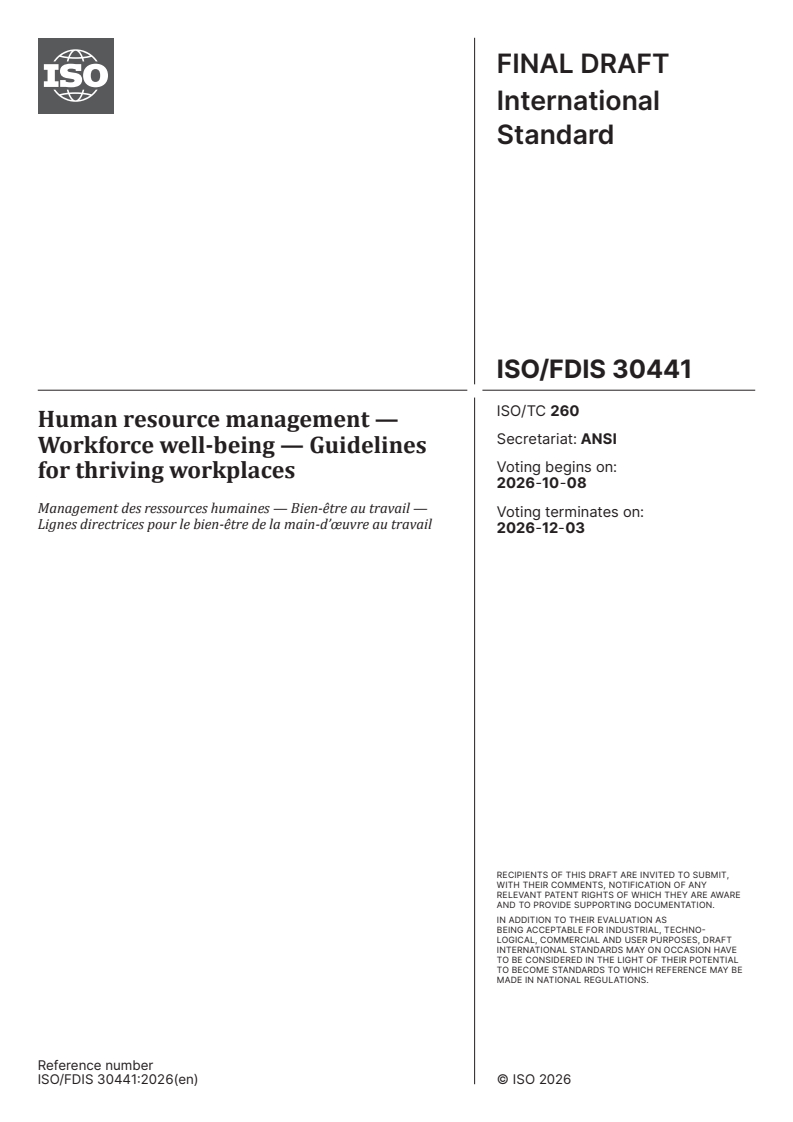
FINAL DRAFT
International
Standard
ISO/TC 260
Human resource management —
Secretariat: ANSI
Workforce well-being — Guidelines
Voting begins on:
for thriving workplaces
2026-10-08
Management des ressources humaines — Bien-être au travail —
Voting terminates on:
Lignes directrices pour le bien-être de la main-d’œuvre au travail
2026-12-03
RECIPIENTS OF THIS DRAFT ARE INVITED TO SUBMIT,
WITH THEIR COMMENTS, NOTIFICATION OF ANY
RELEVANT PATENT RIGHTS OF WHICH THEY ARE AWARE
AND TO PROVIDE SUPPOR TING DOCUMENTATION.
IN ADDITION TO THEIR EVALUATION AS
BEING ACCEPTABLE FOR INDUSTRIAL, TECHNO
LOGICAL, COMMERCIAL AND USER PURPOSES, DRAFT
INTERNATIONAL STANDARDS MAY ON OCCASION HAVE
TO BE CONSIDERED IN THE LIGHT OF THEIR POTENTIAL
TO BECOME STAN DARDS TO WHICH REFERENCE MAY BE
MADE IN NATIONAL REGULATIONS.
Reference number
FINAL DRAFT
International
Standard
ISO/TC 260
Human resource management —
Secretariat: ANSI
Workforce well-being — Guidelines
Voting begins on:
for thriving workplaces
Management des ressources humaines — Bien-être au travail —
Voting terminates on:
Lignes directrices pour le bien-être de la main-d’œuvre au travail
© ISO 2026
All rights reserved.
RECIPIENTS OF THIS DRAFT ARE INVITED TO SUBMIT,
WITH THEIR COMMENTS, NOTIFICATION OF ANY
This ISO publication is protected by copyright and is owned by ISO and/or its licensors.
RELEVANT PATENT RIGHTS OF WHICH THEY ARE AWARE
The content of this ISO publication is provided under licence, not sold. Use is subject to the applicable licence terms issued by ISO,
AND TO PROVIDE SUPPOR TING DOCUMENTATION.
an ISO member body, or an authorized third-party distributor.
IN ADDITION TO THEIR EVALUATION AS
BEING ACCEPTABLE FOR INDUSTRIAL, TECHNO
Except as required for implementation or expressly permitted by a separate licence, no part of this ISO publication may be
LOGICAL, COMMERCIAL AND USER PURPOSES, DRAFT
reproduced, distributed, modified, used, or made available in any form or by any means – electronic or mechanical, including
INTERNATIONAL STANDARDS MAY ON OCCASION HAVE
photocopying, scanning, recording, or posting on internal or external digital platforms. TO BE CONSIDERED IN THE LIGHT OF THEIR POTENTIAL
TO BECOME STAN DARDS TO WHICH REFERENCE MAY BE
Any use beyond the scope of the granted rights is prohibited and may result in legal action.
MADE IN NATIONAL REGULATIONS.
ISO copyright office
CP 401 • CH-1214 Vernier, Geneva
Phone: +41 22 749 01 11
Email: copyright@iso.org
Website: www.iso.org
Published in Switzerland
Reference number
ii
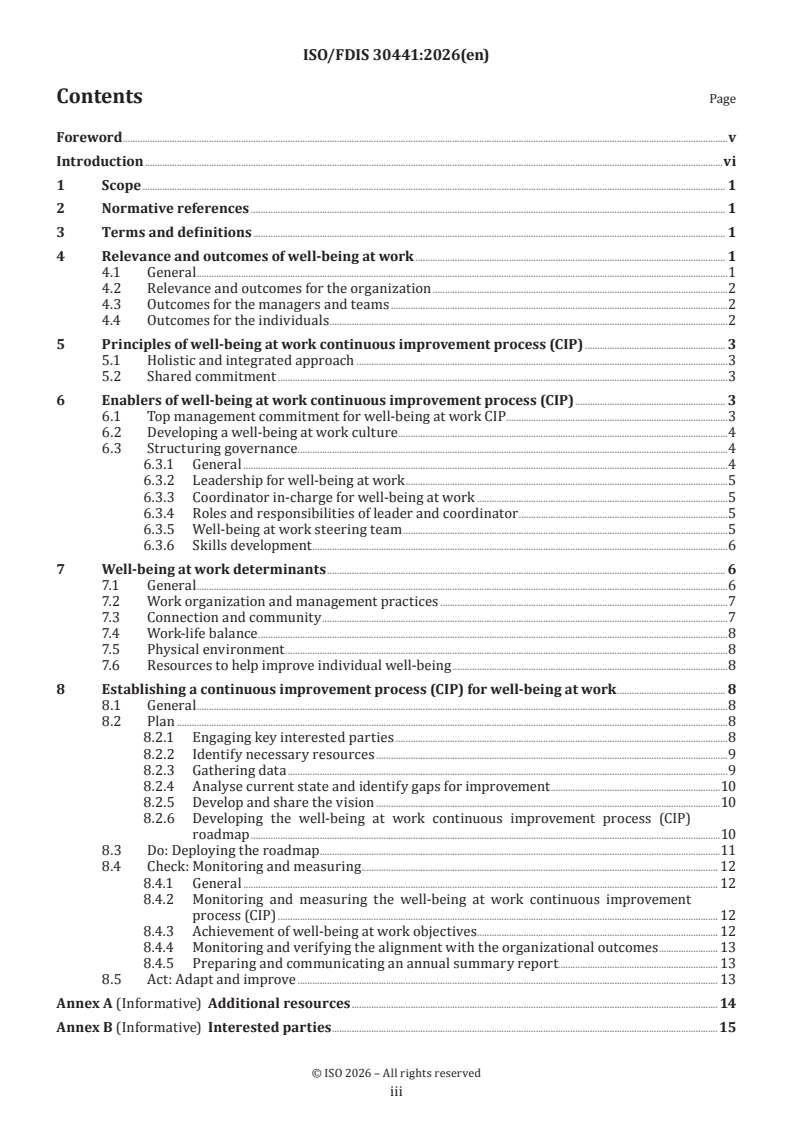
Contents Page
Foreword .v
Introduction .vi
1 Scope . 1
2 Normative references . 1
3 Terms and definitions . 1
4 Relevance and outcomes of well-being at work . 1
4.1 General .1
4.2 Relevance and outcomes for the organization .2
4.3 Outcomes for the managers and teams .2
4.4 Outcomes for the individuals . .2
5 Principles of well-being at work continuous improvement process (CIP) . 3
5.1 Holistic and integrated approach .3
5.2 Shared commitment .3
6 Enablers of well-being at work continuous improvement process (CIP) . 3
6.1 Top management commitment for well-being at work CIP .3
6.2 Developing a well-being at work culture .4
6.3 Structuring governance.4
6.3.1 General .4
6.3.2 Leadership for well-being at work .5
6.3.3 Coordinator in-charge for well-being at work .5
6.3.4 Roles and responsibilities of leader and coordinator .5
6.3.5 Well-being at work steering team .5
6.3.6 Skills development .6
7 Well-being at work determinants . 6
7.1 General .6
7.2 Work organization and management practices .7
7.3 Connection and community .7
7.4 Work-life balance .8
7.5 Physical environment .8
7.6 Resources to help improve individual well-being .8
8 Establishing a continuous improvement process (CIP) for well-being at work . 8
8.1 General .8
8.2 Plan .8
8.2.1 Engaging key interested parties .8
8.2.2 Identify necessary resources .9
8.2.3 Gathering data .9
8.2.4 Analyse current state and identify gaps for improvement .10
8.2.5 Develop and share the vision .10
8.2.6 Developing the well-being at work continuous improvement process (CIP)
roadmap .10
8.3 Do: Deploying the roadmap.11
8.4 Check: Monitoring and measuring . 12
8.4.1 General . 12
8.4.2 Monitoring and measuring the well-being at work continuous improvement
process (CIP) . 12
8.4.3 Achievement of well-being at work objectives. 12
8.4.4 Monitoring and verifying the alignment with the organizational outcomes . 13
8.4.5 Preparing and communicating an annual summary report. 13
8.5 Act: Adapt and improve . 13
Annex A (Informative) Additional resources . 14
Annex B (Informative) Interested parties .15
iii
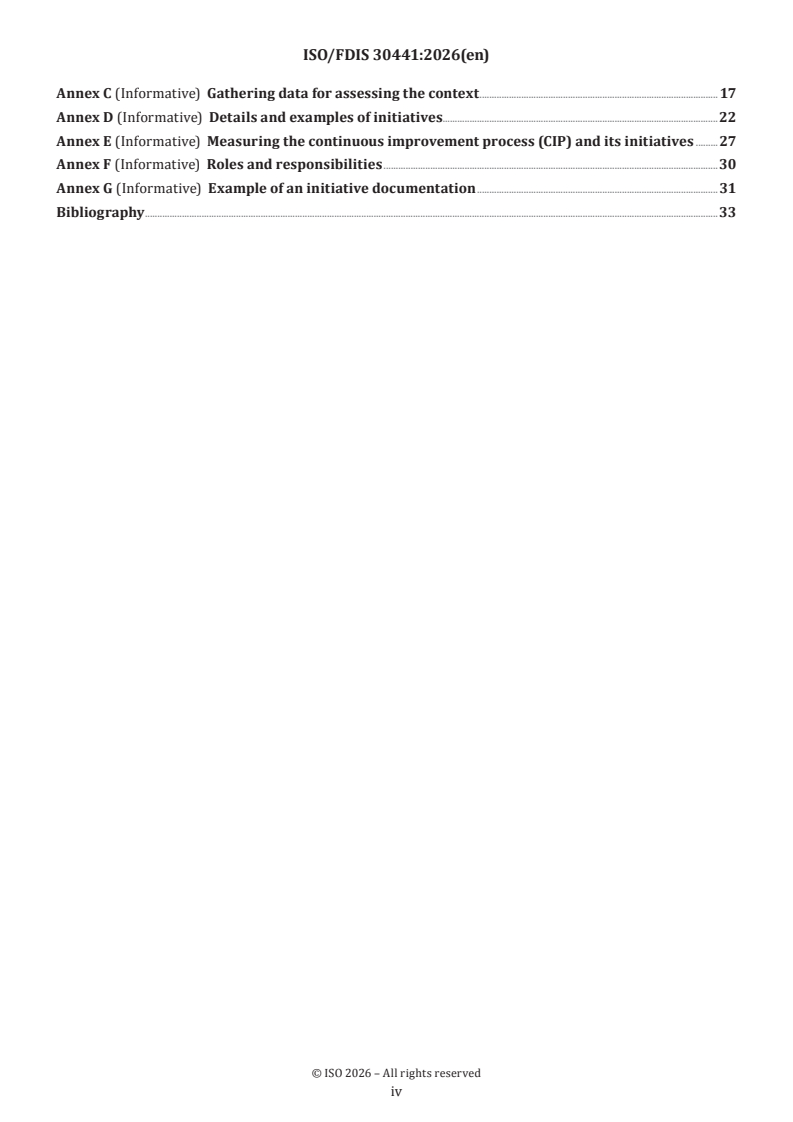
Annex C (Informative) Gathering data for assessing the context . 17
Annex D (Informative) Details and examples of initiatives.22
Annex E (Informative) Measuring the continuous improvement process (CIP) and its initiatives .27
Annex F (Informative) Roles and responsibilities .30
Annex G (Informative) Example of an initiative documentation .31
Bibliography .33
iv
Foreword
ISO (the International Organization for Standardization) is a worldwide federation of national standards
bodies (ISO member bodies). The work of preparing International Standards is normally carried out through
ISO technical committees. Each member body interested in a subject for which a technical committee
has been established has the right to be represented on that committee. International organizations,
governmental and non-governmental, in liaison with ISO, also take part in the work. ISO collaborates closely
with the International Electrotechnical Commission (IEC) on all matters of electrotechnical standardization.
The procedures used to develop this document and those intended for its further maintenance are described
in the ISO/IEC Directives, Part 1. In particular, the different approval criteria needed for the different types
of ISO documents should be noted. This document was drafted in accordance with the editorial rules of the
ISO/IEC Directives, Part 2 (see https://www.iso.org/directives-and-policies.html).
ISO draws attention to the possibility that the implementation of this document may involve the use of (a)
patent(s). ISO takes no position concerning the evidence, validity or applicability of any claimed patent
rights in respect thereof. As of the date of publication of this document, ISO had not received notice of (a)
patent(s) which may be required to implement this document. However, implementers are cautioned that
this may not represent the latest information, which may be obtained from the patent database available at
https://www.iso.org/iso-standards-and-patents.html. ISO shall not be held responsible for identifying any
or all such patent rights.
Any trade name used in this document is information given for the convenience of users and does not
constitute an endorsement.
For an explanation of the voluntary nature of standards, the meaning of ISO specific terms and expressions
related to conformity assessment, as well as information about ISO's adherence to the World Trade
Organization (WTO) principles in the Technical Barriers to Trade (TBT), see www.iso.org/iso/foreword.html.
This document was prepared by Technical Committee ISO/TC 260, Human Resource management.
Any feedback or questions on this document should be directed to the user’s national standards body. A
complete listing of these bodies can be found at www.iso.org/members.html.
v
Introduction
The greatest resource of an organization is the people who work for it. As part of a well-trained and
motivated workforce, workers who are healthy, productive and innovative enable an organization to grow
and prosper in an increasingly competitive environment. Workforce well-being, or well-being at work,
could be a strategic organizational asset contributing to sustainable value creation, workforce engagement,
retention and responsible management practices.
By advancing a supportive work environment and implementing good measures for well-being at work,
1)
organizations can support a more engaged and productive workforce, better equip workers to manage
stress, maintain positive relationships and achieve professional and personal growth. Through the
implementation of sound measures, organizations can support workers to experience:
— Mental well-being: greater fulfilment and resilience as well as self-regulation of emotions, with reduced
anxiety and burnout;
— Cognitive well-being: improved concentration, learning, memory, creative thinking, decision-making
and problem-solving;
— Physical well-being: healthier habits, better overall health and fewer illnesses;
— Social well-being: stronger relationships, active engagement and quality interactions.
Organizations should view well-being at work as an opportunity to foster a culture of health, to improve
overall productivity and to maintain a thriving workforce. According to the World Economic Forum,
investing in workforce well-being can add up to USD 11.7 trillion to the global economy, highlighting the
strong link between well-being, productivity and sustainable growth (see Reference [1]). By adopting and
integrating a continuous improvement process (CIP) for well-being at work, organizations could achieve
measurable returns on investment, such as:
— Productivity: optimized use of resources and sustainable value creation;
— Organizational capacities: reinforced innovation, creativity, learning, talent attraction and talent
retention;
— Work environment: stronger cohesion, improved organizational climate and better collaboration;
— Performance: reduced turnover, absenteeism, presentism, incidents and insurance claim costs.
This document provides guidance to support organizations in adopting a holistic and integrated approach
to well-being at work that benefits organizations, teams and individuals. In a rapidly evolving and complex
work environment, marked by multiple and simultaneous transformations, prioritizing well-being has
become a cornerstone of resilience, adaptability, innovation and sustainable success. Besides controlling
risks, organizations are expected to consider the conditions and practices that promote a healthy and
supportive work environment. The World Health Organization and the International Labour Organization
emphasize that workplace well-being should involve organizational interventions that are different to risk
controls, by addressing working conditions and fostering supportive environments for mental, physical and
social health (see Reference [2]).
This document establishes a comprehensive framework, underpinned by a CIP roadmap, which in turn can
foster a positive and productive workplace culture. The CIP cycle of planning, implementing, measuring and
acting upon results enables incremental improvements over time. This structured approach can be applied
at both strategic and operational levels, supporting human resources (HR) departments in developing,
implementing or enhancing initiatives that address the key determinants of workforce well-being.
1) The term worker refers to the individual at work, whether they are employees or contractors as defined in ISO 30400.
Organizations should ensure, so far as reasonably practicable, that well-being protections extend to contractors, agency
workers or other contingent workers whose work they control or influence.
vi
These initiatives align with the three levels of the well-being continuum: promotion, prevention and early
support.
— Promotion: Create an environment conducive to behaviours that promote the well-being of all workers,
offering tools and resources to support healthy lifestyles and work habits.
— Prevention: Analyse risks in collaboration with HR and health and safety teams to implement protective
factors, reduce or eliminate risks, and target specific groups who may need additional support.
— Early support: Provide timely and effective support to workers in distress or those at risk of absenteeism,
offering early intervention to prevent absence and long-term issues.
The CIP is aimed for organizations to regularly assess the effectiveness of their well-being practices through
feedback, data analysis and performance metrics. This dynamic process ensures that strategies evolve with
changing needs, technological advances and shifts in worker needs. By fostering a culture of continuous
improvement for well-being at work, organizations can ensure that their well-being investments in the
workforce remain relevant, impactful, and aligned with both organizational outcomes and workers’ needs.
Clauses 6 to 8 are presented in a specific order of action, but an organization can begin at any one of these,
depending on its current state.
The approach and initiatives should be adapted according to the country’s culture, socio-administrative
context, regulatory and legal frameworks, existing standards, insurance mechanisms, etc. The proposed
approach allows for the adaptation of the strategy based on the organization's identity and alignment with
its values, objectives and mission.
This document provides a structured, step-by-step framework. It is intended to enhance the existing
HR standards by moving beyond the identification of well-being initiatives to provide an integrated,
evidence-based approach that systematically addresses any determinants of well-being at work, including
organizational and workplace determinants, while engaging all relevant interested parties, including
workers and their representatives, as active contributors at each stage of the process. It is also aligned with,
[ ]
but not dependent on, other International Standards on occupational health and safety, such as ISO 45003. 3
This document does not diminish or replace any obligations of the organization.
It is intended for use by organizations committed to placing workers at their core by ensuring values and
practices that uphold human dignity are aligned to the organization’s strategic objectives.
This document adopts a positive and proactive approach aimed at fostering well-being at work within an
organization through a structured governance approach for a thriving workforce.
This document is structured to guide organizations in understanding and implementing well-being at work,
following a progressive and coherent approach:
— Clause 4 describes the relevance of well-being at work and the expected outcomes for the organization,
managers, teams and individuals.
— Clause 5 presents the general principles of the CIP dedicated to well-being at work.
— Clause 6 outlines the implementation of the CIP, including top management commitment, well-being at
work culture and governance structure.
— Clause 7 identifies the main determinants of well-being at work, serving as a reference for organizational
analysis and actions.
— Clause 8 describes the CIP applied to well-being at work.
— The annexes (Annex A through Annex G) provide examples, tools and additional information to facilitate
understanding and application of the guidelines described in this document.
vii
FINAL DRAFT International Standard ISO/FDIS 30441:2026(en)
Human resource management — Workforce well-being —
Guidelines for thriving workplaces
1 Scope
This document provides guidance for organizations to develop and maintain organizational conditions
and practices that support and promote workforce well-being, thereby contributing to human resources
management (HRM) outcomes and the strategic goals of the organization.
This document is applicable to organizations of all sizes, growth phases and sectors, whether public or
private, for profit or not for profit.
2 Normative references
The following documents are referred to in the text in such a way that some or all of their content constitutes
requirements of this document. For dated references, only the edition cited applies. For undated references,
the latest edition of the referenced document (including any amendments) applies.
ISO 30400, Human resource management — Vocabulary
3 Terms and definitions
For the purposes of this document, the terms and definitions given in ISO 30400 and the following apply.
ISO and IEC maintain terminology databases for use in standardization at the following addresses:
— ISO Online browsing platform: available at https:// www .iso .org/ obp
— IEC Electropedia: available at https:// www .electropedia .org/
3.1
well-being at work
fulfilment of the physical, mental, social and cognitive needs and expectations of a worker
Note 1 to entry: Well-being at work includes physical, mental, social and cognitive aspects. It can influence, or be
influenced by, both work life and life outside of work.
Note 2 to entry: Well-being at work is supported by health and quality of life policies. This includes promotion,
prevention, and early support.
Note 3 to entry: Effective well-being at work strategies improve individual and collective experiences and support
sustainable organizational performance, creating a thriving workplace, enhanced individual well-being and success
for all.
[SOURCE: ISO 45003, 3.2:2021, modified — The definition has been revised and Notes to entry have been
added.]
4 Relevance and outcomes of well-being at work
4.1 General
Implementing a well-being at work CIP results in four levels of benefits: for the organization, managers,
teams and individuals.
4.2 Relevance and outcomes for the organization
Organizations that are committed to a well-being at work CIP experience cascading results that drive both
current and future value of the organization. Current mid to long-term value is realized when organizations
experience reduced operational expenses due to worker turnover, absenteeism, presenteeism and lower
salary continuance, or group insurance costs. Future value is realized through the enhancement of the
organization's credibility and reputation with all interested parties, including workers, shareholders,
financial partners, business collaborators and consumers. The organization’s commitment to a well-being
at work CIP is a powerful differentiator for an organization’s employer brand, which significantly boosts the
organization’s ability to attract and retain top talent.
Research and experience indicate that organizations adopting a structured approach such as a well-being at
work CIP see a positive value on their investments after a few years (see References [6] to [11]).
4.3 Outcomes for the managers and teams
A well-being at work CIP can have positive impacts on managers and teams. Some of these impacts can
include:
— Workforce satisfaction and engagement: By fostering a culture where well-being at work needs are met,
this translates into higher levels of engagement and a stronger commitment to the organization's success.
— Stress reduction: When workers feel supported and their well-being is prioritized, they can better
manage stress and are better able to think clearly, avoid mistakes and make better decisions.
— Enhanced organizational climate: A well-being at work CIP fosters an environment of care and support,
building trust and stronger relationships between team members and managers.
— Increased retention: When workers feel valued and supported by their manager and top management,
they are more likely to stay, reducing the time and effort managers spend on recruitment and training
new hires.
— Increased productivity: Workers are less likely to take sick days. This results in fewer disruptions (e.g.
scheduling, overtime, workflow impacts) for managers and teams. In addition, workers are likely to
expend discretionary effort resulting in enhanced innovation and problem-solving capabilities.
These benefits enable managers to focus on strategic initiatives and less on workers’ crises, resulting from
stress, burnout, or mental health issues.
4.4 Outcomes for the individuals
At the individual level, well-being at work CIP leads to positive impacts on mental, cognitive, physical and
social well-being.
— Mental well-being:
— increased fulfilment, resilience, coping capacities, self-regulation of emotions, etc.;
— decreased anxiety, burnout symptoms, adjustment difficulties, depressive symptoms, etc.;
— Cognitive well-being: improved concentration, learning abilities, memory, decision-making, problem-
solving skills, creative thinking;
— Physical well-being: healthier lifestyle habits, leading to overall improvements in general well-being
reduction in certain illnesses;
— Social well-being: stronger ability for workers and teams to establish and maintain harmonious
relationships, while actively engaging in organizational and community life. This includes enhanced
quality of interactions and greater capacity to fulfil various social roles.
5 Principles of well-being at work continuous improvement process (CIP)
5.1 Holistic and integrated approach
The well-being at work CIP encompasses various fundamental elements that should be simultaneously
considered.
The cycle contains four steps: Plan-Do-Check-Act (PDCA). The cycle is customized to an organization’s needs
and work environment.
This ongoing assessment reinforces the well-being continuum by integrating promotion, prevention and
early support initiatives at the organizational, team, manager and individual levels.
It operates within a broader macro-process initiated by top management and governance.
Central to well-being at work is continuous evaluation against defined objectives, with regular reporting
and adjustments as necessary.
5.2 Shared commitment
A shared commitment among all relevant interested parties, including top management, managers, workers
2)
and their representatives is pivotal to the success of designing, implementing and evaluating a well-being at
work CIP. When all relevant interested parties at all levels of the organization actively engage in preventing,
promoting and supporting well-being, it fosters a culture of accountability, trust and collaboration.
Shared commitment ensures that well-being initiatives are successfully integrated into processes and
practices across the organization.
6 Enablers of well-being at work continuous improvement process (CIP)
6.1 Top management commitment for well-being at work CIP
Top management commitment is a basic tenet of a CIP to ensure workers experience well-being at work.
Organizations whose managers, at all levels and across all functions, take effective measures to improve
well-being at work set the tone for the entire organization and demonstrate its priority. This active
endorsement fosters trust among workers, empowering them to openly engage with well-being resources
and discussions. Commitment is demonstrated through allocating adequate resources and integrating well-
being into strategic decision-making.
More specifically, top management should incorporate leadership and commitment with respect to well-
being at work by:
— Drafting and communicating an official statement affirming its commitment to well-being at work CIP.
— Establishing and integrating a specific well-being at work policy.
— Taking responsibility for the well-being at work CIP.
— Developing a comprehensive strategic communication plan [should include personal communications
from top management. The communication plan should include dissemination of commitments, policy
and related measures to all interested parties and workers (see 8.2.6)].
— Establishing and implementing a process where workers and their representatives are consulted and
involved.
— Appointing a leader responsible for the well-being at work CIP who is a member of the executive team,
and, where applicable, a coordinator (see 6.3).
2) Worker representatives: for easier reading, "worker representatives" includes trade unions where they exist.
— Providing a description of key managerial roles and responsibilities (see 6.3).
— Taking executive ownership of the responsibility and accountability for the prevention, promotion and
early support of well-being at work CIP.
— Assigning and ensuring the availability of the resources necessary to establish, maintain and improve
the well-being at work approach.
— Leading by example, fostering a culture in the organization that supports well-being at work.
— Communicating expectations that reinforce and promote the well-being at work.
— Ensuring well-being at work initiatives achieve the intended results and foster continuous improvement
for key objectives.
These tasks provide the foundation for sustaining a committed well-being at work CIP.
NOTE The commitment of top management is essential to the success of a well-being at work CIP. The more visible,
ongoing and concrete the commitment, the more tangible the impact on well-being at work.
Top management and managers should recognize that their daily decisions influence workers’ perception
of the importance and priority of the approach. Decisions that contradict the principles of the well-being at
work CIP can lead to worker disengagement.
Accountability for well-being at work remains with top management.
6.2 Developing a well-being at work culture
A culture of well-being at work is shaped by top management's commitment and evolving actions.
Managers are instrumental in cultivating a working environment where workers experience positive
physical, mental, social and cognitive well-being. This culture is further reinforced by the entire
organization's commitment to well-being, as well as the genuine, lived experiences of everyone working for,
or on behalf of, the organization.
The top management and managers should:
— prioritize and promote well-being at work through communications, engagement and outreach activities,
processes and practices, and fostering relationships with all internal interested parties;
— provide different voluntary mechanisms (including anonymous) for any worker to communicate their
opinions or make suggestions for change about well-being at work, and thus fostering dialogue and
debate;
— encourage people to contribute and participate in determining their needs;
— communicate expectations that foster well-being behaviours;
— measure outcomes of well-being at work initiatives to gain insight into the outcomes of well-being at
work (see 4.3 and 4.4).
6.3 Structuring governance
6.3.1 General
Governance ensures oversight of the well-being at work CIP and is responsible for the planning,
implementation, monitoring and improvement for establishing and fostering well-being at work.
The governance structure is contingent on an organization’s size. For very small organizations, the
responsibility may be assigned to one person (as leader or coordinator). For other organizations, a separate
leader and a coordinator may be required to carry out the tasks and responsibilities. In larger, more complex
organizations, a structured governance would include a leader, coordinator and steering team to ensure
well-being at work is integrated across levels and functions.
Top management should allocate sufficient time and resources (e.g. human, material, financial) to both
roles. Top management should ensure the leader and coordinator roles, as well as members of the steering
team (see 6.3.5), can perform their activities during regular working hours. The roles of the leader and the
coordinator should be appointed by top management while informing the workers’ representatives. It is
important that anyone fulfilling any of the roles has a strong interest in ensuring the success of well-being at
work CIP.
6.3.2 Leadership for well-being at work
The leader is the person who is assigned with the responsibility, authority and accountability of ensuring
that the well-being at work CIP is established and maintained. Top management should make this
appointment based on the capacity of the individual who has current responsibilities that crosscut functions
and positions within an organization. Normally, a representative from the HR department can be appointed
as leader. The HR department is already at the core of several organizational strategies involving different
sectors that contribute to cross-cutting initiatives affecting all workers (e.g. organizational development
and training, finance and benefits, occupational health and medical office) and already facilitates alignment
among interested parties on the topic, encouraging dialogue, convergence and coherence of orientations and
actions. For other organizations, it may be appropriate for other departments to lead (e.g. in high hazard
engineering, it may be more appropriate for operational safety to lead).
The criteria taken into consideration when choosing the leader should refer to their commitment to well-
being at work, credibility, integrity, responsibility and competencies based on appropriate education,
training or experience. Consideration should also be given to the ability of the individual to perform or
assign the various responsibilities of the position.
The leadership role for well-being at work ensures the following responsibilities are fulfilled by either their
initiatives or in conjunction with the assistance of a coordinator or steering team (see Annex F).
6.3.3 Coordinator in-charge for well-being at work
A coordinator in-charge can share responsibility with and assists the leader in carrying out the
responsibilities to ensure a well-being at work CIP is successful. This position is an appointed position by the
top management, and it is based on the recommendation of the leader for well-being at work. The individual
appointed should be committed to well-being at work and should be in a position that provides direct access
to the organization's strategic direction and HR processes.
6.3.4 Roles and responsibilities of leader and coordinator
Top management should clearly define in writing the roles, responsibilities and tasks of the leader and the
coordinator concerning the implementation of the well-being at work CIP (see Annex F for an example of
roles and responsibilities for these two positions). This applies even if only one person covers both roles.
6.3.5 Well-being at work steering team
6.3.5.1 General
Top management should establish a well-being at work steering team tasked with ensuring the planning,
implementation, monitoring and improvement of the well-being at work CIP.
A well-being at work steering team may be integrated into an existing committee, if well-being at work
remains a priority and is not overshadowed by other committee responsibilities.
In very small organizations, this steering team’s responsibilities may be assigned to the leader or coordinator.
The top management should ensure that those responsible for implementing the well-being at work CIP
have the autonomy and flexibility to carry out their mandate. Top management should assign worker
representatives and interested parties as members of the steering team.
6.3.5.2 Organization and composition
After top management has selected the leader and coordinator, they can recruit members of the steering
team in line with their defined roles and responsibilities and commitment to well-being at work. It is
important that the different levels, job categories and functions are considered to be represented in this
team as much as possible.
Recruiting for the team should be open, transparent and equitable, where all have knowledge of the
opportunity, and can apply for consideration, but it can also be based on nominations from managers or top
management. The number of team members should be contingent on the challenges of the well-being at work
CIP and complexity of the organization. The goal is to ensure all levels and crosscutting functions within the
organization have representation and a voice, while making sure the team remains efficient.
Once the team is selected, the list of team members should be communicated to all workers and interested
parties.
The steering team should hold multiple meetings per year and maintain records of these meetings.
Collaboration should be established between the steering team and other teams responsible for well-being
at work-related initiatives (e.g. occupational safety and health, workers' committees).
6.3.5.3 Mandate and objectives
The steering team should have a mandate and objectives aligned with the well-being at work CIP. These
should be defined in collaboration with the leader, coordinator and members of the steering team. Once the
strategic outcomes and vision are defined, the steering team's objectives should be set (see 8.2.5 and 8.2.6).
These objectives should be reviewed regularly. The team should contribute to:
— developing and deploying measures to improve the well-being at work CIP (see 8.5);
— identifying resources;
— gathering data, reviewing evidence and launching initiatives for continual improvement;
— co-ordinating various interested parties, service providers and initiatives;
— establishing metrics to evaluate the objectives and outcomes of the CIP;
— establishing and implementing a process where workers and interested parties are consulted and
involved.
6.3.6 Skills development
The steering team can develop and hone their skill sets to advocate, design and promote well-being at
work initiatives. The leader should identify skills development needs in accordance with the roles and
responsibilities of the leader, coordinator and steering team members. If necessary, the top management
should provide training and development activities during regular working hours, as a lack of knowledge
can be a significant barrier to an effective well-being at work CIP.
7 Well-being at work determinants
7.1 General
Several factors determine the extent to which workers experience well-being at work. In the holistic context
outlined in this document, factors inherent to the work environment and the individual and social lives of
the workers should be considered.
When seeking to improve well-being at work, organizations should consider factors relating to work
organization, management practices, workload, staffing, working conditions and the working environment,
while recognizing that well-being may also be influenced by factors outside work. Organizations should give
particular consideration to factors that fall within their sphere of influence and responsibility.
Therefore, five key determinants have been selected to design initiatives for the well-being at work CIP. See
Annex D for examples of initiatives.
7.2 Work organization and management practices
Work organization is how work, responsibilities, coordination tasks (rules, processes, methods, etc.) are
structured which in turn allow workers to achieve organizational and individual objectives in a balanced
way.
Management practices are the combination of effective tools, methods and leadership behaviours
translating into a culture of well-being at work, leading to a thriving workforce. Examples of elements in
work organization and management practices include, among other things:
— decision-making autonomy;
— adequate workload, staffing levels and allocation of working time;
— clear roles and responsibilities;
— career development and talent management;
— recognition and appreciation of contribution;
— ethical practices;
— organizational integrity, structure and governance;
— prevention of adverse social behaviours, including incivilities, bull
...
ISO/TC 260
Secretariat: ANSI
Human resource management — Workforce well-being — Guidelines
for thriving workplaces
Management des ressources humaines — Bien-être au travail — Lignes directrices pour le bien-être de la main-
d’œuvre au travail
FDIS stage
All rights reserved.
This ISO publication is protected by copyright and is owned by ISO and/or its licensors.
The content of this ISO publication is provided under licence, not sold. Use is subject to the applicable licence terms issued
by ISO, an ISO member body, or an authorized third-party distributor.
Except as required for implementation or expressly permitted by a separate licence, no part of this ISO publication may
be reproduced, distributed, modified, used, or made available in any form or by any means – electronic or mechanical,
including photocopying, scanning, recording, or posting on internal or external digital platforms.
Any use beyond the scope of the granted rights is prohibited and may result in legal action.
ISO copyright office
CP 401 • CH-1214 Vernier, Geneva
Phone: + 41 22 749 01 11
Email: copyright@iso.org
Website: www.iso.org
Published in Switzerland
ii
Contents
Foreword . iv
Introduction . v
1 Scope . 1
2 Normative references . 1
3 Terms and definitions . 1
4 Relevance and outcomes of well-being at work. 1
4.1 General . 1
4.2 Relevance and outcomes for the organization . 2
4.3 Outcomes for the managers and teams . 2
4.4 Outcomes for the individuals . 2
5 Principles of well-being at work continuous improvement process (CIP) . 3
5.1 Holistic and integrated approach . 3
5.2 Shared commitment . 3
6 Enablers of well-being at work continuous improvement process (CIP) . 3
6.1 Top management commitment for well-being at work CIP . 3
6.2 Developing a well-being at work culture . 4
6.3 Structuring governance . 5
7 Well-being at work determinants . 7
7.1 General . 7
7.2 Work organization and management practices . 7
7.3 Connection and community . 8
7.4 Work-life balance . 8
7.5 Physical environment . 8
7.6 Resources to help improve individual well-being . 9
8 Establishing a continuous improvement process (CIP) for well-being at work. 9
8.1 General . 9
8.2 Plan . 9
8.3 Do: Deploying the roadmap . 12
8.4 Check: Monitoring and measuring . 13
8.5 Act: Adapt and improve . 14
Annex A (Informative) Additional resources . 16
Annex B (Informative) Interested parties . 18
Annex C (Informative) Gathering data for assessing the context . 20
Annex D (Informative) Details and examples of initiatives . 25
Annex E (Informative) Measuring the continuous improvement process (CIP) and its initiatives31
Annex F (Informative) Roles and responsibilities . 34
Annex G (Informative) Example of an initiative documentation . 36
Bibliography . 38
iii
Foreword
ISO (the International Organization for Standardization) is a worldwide federation of national standards
bodies (ISO member bodies). The work of preparing International Standards is normally carried out through
ISO technical committees. Each member body interested in a subject for which a technical committee has been
established has the right to be represented on that committee. International organizations, governmental and
non-governmental, in liaison with ISO, also take part in the work. ISO collaborates closely with the
International Electrotechnical Commission (IEC) on all matters of electrotechnical standardization.
The procedures used to develop this document and those intended for its further maintenance are described
in the ISO/IEC Directives, Part 1. In particular, the different approval criteria needed for the different types of
ISO documents should be noted. This document was drafted in accordance with the editorial rules of the
ISO/IEC Directives, Part 2 (see https://www.iso.org/directives-and-policies.html).
ISO draws attention to the possibility that the implementation of this document may involve the use of (a)
patent(s). ISO takes no position concerning the evidence, validity or applicability of any claimed patent rights
in respect thereof. As of the date of publication of this document, ISO had not received notice of (a) patent(s)
which may be required to implement this document. However, implementers are cautioned that this may not
represent the latest information, which may be obtained from the patent database available at
https://www.iso.org/iso-standards-and-patents.html. ISO shall not be held responsible for identifying any or
all such patent rights.
Any trade name used in this document is information given for the convenience of users and does not
constitute an endorsement.
For an explanation of the voluntary nature of standards, the meaning of ISO specific terms and expressions
related to conformity assessment, as well as information about ISO's adherence to the World Trade
Organization (WTO) principles in the Technical Barriers to Trade (TBT), see www.iso.org/iso/foreword.html.
This document was prepared by Technical Committee ISO/TC 260, Human Resource management.
-
Any feedback or questions on this document should be directed to the user’s national standards body. A
complete listing of these bodies can be found at www.iso.org/members.html.
iv
Introduction
The greatest resource of an organization is the people who work for it. As part of a well-trained and motivated
workforce, workers who are healthy, productive and innovative enable an organization to grow and prosper
in an increasingly competitive environment. Workforce well-being, or well-being at work, could be a strategic
organizational asset contributing to sustainable value creation, workforce engagement, retention and
responsible management practices.
By advancing a supportive work environment and implementing good measures for well-being at work,
11)
organizations can support a more engaged and productive workforce, better equip workers to manage
stress, maintain positive relationships and achieve professional and personal growth. Through the
implementation of sound measures, organizations can support workers to experience:
— — Mental well-being: greater fulfilment and resilience as well as self-regulation of emotions, with
reduced anxiety and burnout;
— — Cognitive well-being: improved concentration, learning, memory, creative thinking, decision-making
and problem-solving;
— — Physical well-being: healthier habits, better overall health and fewer illnesses;
— — Social well-being: stronger relationships, active engagement and quality interactions.
Organizations should view well-being at work as an opportunity to foster a culture of health, to improve
overall productivity and to maintain a thriving workforce. According to the World Economic Forum, investing
in workforce well-being can add up to USD 11.7 trillion to the global economy, highlighting the strong link
[1]
between well-being, productivity and sustainable growth (see Reference [1]).). By adopting and integrating
a continuous improvement process (CIP) for well-being at work, organizations could achieve measurable
returns on investment, such as:
— — Productivity: optimized use of resources and sustainable value creation;
— — Organizational capacities: reinforced innovation, creativity, learning, talent attraction and talent
retention;
— — Work environment: stronger cohesion, improved organizational climate and better collaboration;
— — Performance: reduced turnover, absenteeism, presentism, incidents and insurance claim costs.
This document provides guidance to support organizations in adopting a holistic and integrated approach to
well-being at work that benefits organizations, teams and individuals. In a rapidly evolving and complex work
environment, marked by multiple and simultaneous transformations, prioritizing well-being has become a
cornerstone of resilience, adaptability, innovation and sustainable success. Besides controlling risks,
organizations are expected to consider the conditions and practices that promote a healthy and supportive
work environment. The World Health Organization and the International Labour Organization emphasize that
workplace well-being should involve organizational interventions that are different to risk controls, by
The term worker refers to the individual at work, whether they are employees or contractors as defined in ISO 30400.
Organizations should ensure, so far as reasonably practicable, that well-being protections extend to contractors, agency
workers or other contingent workers whose work they control or influence.
1)
The term worker refers to the individual at work, whether they are employees or contractors as defined in ISO 30400.
Organizations should ensure, so far as reasonably practicable, that well-being protections extend to contractors, agency
workers or other contingent workers whose work they control or influence.
v
addressing working conditions and fostering supportive environments for mental, physical and social health
[2]
(see Reference [2]).).
This document establishes a comprehensive framework, underpinned by a CIP roadmap, which in turn can
foster a positive and productive workplace culture. The CIP cycle of planning, implementing, measuring and
acting upon results enables incremental improvements over time. This structured approach can be applied at
both strategic and operational levels, supporting human resources (HR) departments in developing,
implementing, or enhancing initiatives that address the key determinants of workforce well-being.
These initiatives align with the three levels of the well-being continuum: promotion, prevention and early
support.
— — Promotion: Create an environment conducive to behaviours that promote the well-being of all
workers, offering tools and resources to support healthy lifestyles and work habits.
— — Prevention: Analyse risks in collaboration with HR and health and safety teams to implement
protective factors, reduce or eliminate risks, and target specific groups who may need additional support.
— — Early Supportsupport: Provide timely and effective support to workers in distress or those at risk of
absenteeism, offering early intervention to prevent absence and long-term issues.
The CIP is aimed for organizations to regularly assess the effectiveness of their well-being practices through
feedback, data analysis and performance metrics. This dynamic process ensures that strategies evolve with
changing needs, technological advances and shifts in worker needs. By fostering a culture of continuous
improvement for well-being at work, organizations can ensure that their well-being investments in the
workforce remain relevant, impactful, and aligned with both organizational outcomes and worker’sworkers’
needs.
Clauses 6Clauses 6 to 88 are presented in a specific order of action, but an organization can begin at any one
of these, depending on its current state.
The approach and initiatives should be adapted according to the country’s culture, socio-administrative
context, regulatory and legal frameworkframeworks, existing standards, insurance mechanisms, etc. The
proposed approach allows for the adaptation of the strategy based on the organization's identity and
alignment with its values, objectives, and mission.
This document provides a structured, step-by-step framework. It is intended to enhance the existing HR
standards by moving beyond the identification of well-being initiatives to provide an integrated, evidence-
based approach that systematically addresses any determinants of well-being at work, including
organizational and workplace determinants, while engaging all relevant interested parties, including workers
and their representatives, as active contributors at each stage of the process. It is also aligned with, but not
dependent on, other standardsInternational Standards on occupational health and safety, such as
[3] [3]]
ISO 45003. . This document does not diminish or replace any obligations of the organization.
It is intended for use by organizations committed to placing workers at thetheir core by ensuring values and
practices that uphold human dignity are aligned to the organization’s strategic objectives.
This document adopts a positive and proactive approach aimed at fostering well-being at work within an
organization through a structured governance approach for a thriving workforce.
This document is structured to guide organizations in understanding and implementing well-being at work,
following a progressive and coherent approach:
— Clause 4— Clause 4 describes the relevance of well-being at work and the expected outcomes for the
organization, managers, teams, and individuals.
vi
— Clause 5— Clause 5 presents the general principles of the continuous improvement process (CIP)
dedicated to well-being at work.
— Clause 6— Clause 6 outlines the implementation of the CIP, including top management commitment, well-
being at work culture and governance structure.
— Clause 7— Clause 7 identifies the main determinants of well-being at work, serving as a reference for
organizational analysis and actions.
— Clause 8— Clause 8 describes the continuous improvement processCIP applied to well-being at work.
— — The annexes (Annex A through Annex G) provide examples, tools and additional information to
facilitate understanding and application of the guidelines described in this document.
vii
Human resource management — Workforce well-being — Guidelines
for thriving workplaces
1 Scope
This document provides guidance for organizations to develop and maintain organizational conditions and
practices that support and promote workforce well-being, thereby contributing to HRMhuman resources
management (HRM) outcomes and the strategic goals of the organization.
This document is applicable to organizations of all sizes, growth phases, and sectors, whether public or private,
for profit or not for profit.
2 Normative references
The following documents are referred to in the text in such a way that some or all of their content constitutes
requirements of this document. For dated references, only the edition cited applies. For undated references,
the latest edition of the referenced document (including any amendments) applies.
ISO 30400, Human resource management — Vocabulary
3 Terms and definitions
For the purposes of this document, the terms and definitions given in ISO 30400 and the following apply.
ISO and IEC maintain terminology databases for use in standardization at the following addresses:
— — ISO Online browsing platform: available at https://www.iso.org/obp
— — IEC Electropedia: available at https://www.electropedia.org/
3.1 3.1
well-being at work
fulfilment of the physical, mental, social and cognitive needs and expectations of a worker
Note 1 to entry: Well-being at work includes physical, mental, social and cognitive aspects. It can influence, or be
influenced by, both work life and life outside of work.
Note 2 to entry: Well-being at work is supported by health and quality of life policies. This includes promotion,
prevention, and early support.
Note 3 to entry: Effective well-being at work strategies improve individual and collective experiences and support
sustainable organizational performance, creating a thriving workplace, enhanced individual well-being and success for
all.
[SOURCE: ISO 45003, 3.2:2021 — Definition, modified — The definition has been revised and notesNotes to
entry have been added.]
4 Relevance and outcomes of well-being at work
4.1 General
Implementing a well-being at work CIP results in four levels of benefits: for the organization, managers, teams
and individuals.
4.14.2 Relevance and outcomes for the organization
Organizations that are committed to a well-being at work CIP experience cascading results that drive both
current and future value of the organization. Current mid to long-term value is realized when organizations
experience reduced operational expenses due to worker turnover, absenteeism, presenteeism and lower
salary continuance, or group insurance costs. Future value is realized through the enhancement of the
organization's credibility and reputation with all interested parties, including workers, shareholders, financial
partners, business collaborators and consumers. The organization’s commitment to a well-being at work CIP
is a powerful differentiator for an organization’s employer brand, which significantly boosts the organization’s
ability to attract and retain top talent.
Research and experience indicate that organizations adopting a structured approach such as a well-being at
[6] [11]
work CIP see a positive value on their investments after a few years (see References [6] to [11]).).
4.24.3 Outcomes for the managers and teams
A well-being at work CIP can have positive impacts on managers and teams. Some of these impacts can include:
— — Workforce satisfaction and engagement: By fostering a culture where well-being at work needs are
met, this translates into higher levels of engagement and a stronger commitment to the organization's
success.
— — Stress reduction: When workers feel supported and their well-being is prioritized, they can better
manage stress, and are better able to think clearly, avoid mistakes and make better decisions.
— — Enhanced organizational climate: A well-being at work CIP fosters an environment of care and
support, building trust and stronger relationships between team members and managers.
— — Increased retention: When workers feel valued and supported by their manager and top management,
they are more likely to stay, reducing the time and effort managers spend on recruitment and training new
hires.
— — Increased productivity: Workers are less likely to take sick days. This results in fewer disruptions (e.g.
scheduling, overtime, workflow impacts) for managers and teams. In addition, workers are likely to
expend discretionary effort resulting in enhanced innovation and problem-solving capabilities.
These benefits enable managers to focus on strategic initiatives and less on worker crisisworkers’ crises,
resulting from stress, burnout, or mental health issues.
4.34.4 Outcomes for the individuals
At the individual level, well-being at work CIP leads to positive impacts on mental, cognitive, physical and
social well-being.
— — Mental well-being:
— — increaseincreased fulfilment, resilience, coping capacities, self-regulation of emotions, etc.;
— — decreasedecreased anxiety, burnout symptoms, adjustment difficulties, depressive symptoms,
etc.;
— — Cognitive well-being: improved concentration, learning abilities, memory, decision-making, problem-
solving skills, creative thinking;
— — Physical well-being: healthier lifestyle habits, leading to overall improvements in general well-being
reduction in certain illnesses;
— — Social well-being: stronger ability for workers and teams to establish and maintain harmonious
relationships, while actively engaging in organizational and community life. This includes enhanced
quality of interactions and greater capacity to fulfil various social roles.
5 Principles of well-being at work continuous improvement process (CIP)
5.1 Holistic and integrated approach
The well-being at work CIP encompasses various fundamental elements that should be simultaneously
considered.
The cycle contains four steps: plan, do, check, actPlan-Do-Check-Act (PDCA). The cycle is customized to an
organization’s needs and work environment.
This ongoing assessment reinforces the well-being continuum by integrating promotion, prevention and early
support initiatives at the organizational, team, manager and individual levels.
It operates within a broader macro-process initiated by top management and governance.
Central to well-being at work is continuous evaluation against defined objectives, with regular reporting and
adjustments as necessary.
5.2 Shared commitment
A shared commitment among all relevant interested parties, including top management, managers, workers
22)
and their representatives is pivotal to the success of designing, implementing and evaluating a well-being
at work CIP. When all relevant interested parties at all levels of the organization actively engage in preventing,
promoting and supporting well-being, it fosters a culture of accountability, trust and collaboration.
Shared commitment ensures that well-being initiatives are successfully integrated into processes and
practices across the organization.
6 Enablers of well-being at work continuous improvement process (CIP)
6.1 Top management commitment for well-being at work CIP
Top management commitment is a basic tenet of a CIP to ensure workers experience well-being at work.
Organizations whose managers, at all levels and across all functions, take effective measures to improve well-
being at work, set the tone for the entire organization and demonstrate its priority. This active endorsement
fosters trust among workers, empowering them to openly engage with well-being resources and discussions.
Commitment is demonstrated through allocating adequate resources and integrating well-being into strategic
decision-making.
More specifically, top management should incorporate leadership and commitment with respect to well-being
at work by:
— — Drafting and communicating an official statement affirming its commitment to well-being at work CIP.
— — Establishing and integrating a specific well-being at work policy.
— — Taking responsibility for the well-being at work CIP.
Worker representatives: for easier reading, ‘worker representatives’ includes trade union where they exists.
2)
Worker representatives: for easier reading, "worker representatives" includes trade unions where they exist.
— — Developing a comprehensive strategic communication plan ([should include personal
communications from top management. The communication plan should include dissemination of
commitments, policy and related measures to all interested parties and workers (see 8.2.68.1.6)).)].
— — Establishing and implementing a process where workers and their representatives are consulted and
involved.
— — Appointing a leader responsible for the well-being at work CIP who is a member of the executive team,
and, where applicable, a coordinator (see 6.36.3).).
— — Providing a description of key managerial roles and responsibilities (see 6.36.3).).
— — Taking executive ownership of the responsibility and accountability for the prevention, promotion and
early support of well-being at work CIP.
— — Assigning and ensuring the availability of the resources necessary to establish, maintain and improve
the well-being at work approach.
— — Leading by example, fostering a culture in the organization that supports well-being at work.
— — Communicating expectations that reinforce and promote the well-being at work.
— — Ensuring well-being at work initiatives achieve the intended results and foster continuous
improvement for key objectives.
These tasks provide the foundation for sustaining a committed well-being at work CIP.
Note: NOTE The commitment of top management, is essential to the success of a well-being at work CIP. The more
visible, on-goingongoing and concrete the commitment, the more tangible the impact on well-being at work.
Top management and managers should recognize that their daily decisions influence workers’ perception of
the importance and priority of the approach. Decisions that contradict the principles of the well-being at work
CIP can lead to worker disengagement.
Accountability for well-being at work remains with top management.
6.2 Developing a well-being at work culture
A culture of well-being at work is shaped by top managementmanagement's commitment and evolving
actions.
Managers are instrumental in cultivating a working environment where workers experience positive physical,
mental, social and cognitive well-being. This culture is further reinforced by the entire organization's
commitment to well-being, as well as the genuine, lived experiences of everyone working for, or on behalf of,
the organization.
The top management and managers should:
— — prioritize and promote well-being at work through communications, engagement and outreach
activities, processes and practices, and fostering relationships with all internal interested parties;
— — provide different voluntary mechanisms (including anonymous) for any worker to communicate their
opinions or make suggestions for change about well-being at work, and thus fostering dialogue and debate;
— — encourage people to contribute and participate in determining their needs;
— — communicate expectations that foster well-being behaviours;
— — measure outcomes of well-being at work initiatives to gain insight into the outcomes of well-being at
work (see 4.34.2 and 4.44.3).).
6.3 Structuring governance
6.3.1 General
Governance ensures oversight of the well-being at work CIP and is responsible for the planning,
implementation, monitoring and improvement for establishing and fostering well-being at work.
The governance structure is contingent on an organization’s size. For very small organizations, the
responsibility may be assigned to one person (as leader or coordinator). For other organizations, a separate
leader and a coordinator may be required to carry out the tasks and responsibilities. In larger, more complex
organizations, a structured governance would include a leader, coordinator and steering team to ensure well-
being at work is integrated across levels and functions.
Top management should allocate sufficient time and resources (e.g. human, material, financial) to both roles.
Top management should ensure the leader and coordinator roles, as well as members of the steering team
(see 6.3.56.3.5),), can perform their activities during regular working hours. The roles of the leader and the
coordinator should be appointed by top management while informing the workers’ representatives. It is
important that anyone fulfilling any of the roles has a strong interest in ensuring the success of well-being at
work CIP.
6.3.2 Leadership for well-being at work
The leader is the person who is assigned with the responsibility, authority and accountability of ensuring that
the well-being at work CIP is established and maintained. Top management should make this appointment
based on the capacity of the individual thatwho has current responsibilities that crosscut functions and
positions within an organization. Normally, a representative from the HR department can be appointed as
leader. The HR department is already at the core of several organizational strategies involving different
sectors that contribute to cross-cutting initiatives affecting all workers (e.g. organizational development and
training, finance and benefits, occupational health and medical office) and already facilitates alignment among
interested parties on the topic, encouraging dialogue, convergence and coherence of orientations and actions.
For other organizations, it may be appropriate for other departments to lead (e.g. in high hazard engineering,
it may be more appropriate for operational safety to lead).
The criteria taken into consideration when choosing the leader should refer to their commitment to well-being
at work, credibility, integrity, responsibility and competencies based on appropriate education, training or
experience. Consideration should also be given to the ability of the individual to perform or assign the various
responsibilities of the position.
The leadership role for well-being at work ensures the following responsibilities are fulfilled by either their
initiatives or in conjunction with the assistance of a coordinator or steering team (see Annex FAnnex F).).
6.3.3 Coordinator in-charge for well-being at work
A coordinator in-charge can share responsibility with and assists the leader in carrying out the responsibilities
to ensure a well-being at work CIP is successful. This position is an appointed position by the top management,
and it is based on the recommendation of the leader for well-being at work. The individual appointed should
be committed to well-being at work and should be in a position that provides direct access to the
organization's strategic direction and HR processes.
6.3.4 Roles and responsibilities of leader and coordinator
Top management should clearly define in writing the roles, responsibilities and tasks of the leader and the
coordinator concerning the implementation of the well-being at work CIP (see Annex FAnnex F for an example
of roles and responsibilities for these two positions). This applies even if only one person covers both roles.
6.3.5 Well-being at work steering team
6.3.5.1 General
Top management should establish a well-being at work steering team that will be tasked to ensurewith
ensuring the planning, implementation, monitoring and improvement of the well-being at work CIP.
A well-being at work steering team may be integrated into an existing committee, if well-being at work
remains a priority and is not overshadowed by other committee responsibilities.
In very small organizations, this steering teamteam’s responsibilities may be assigned to the leader or
coordinator.
The top management should ensure that those responsible for implementing the well-being at work CIP have
the autonomy and flexibility to carry out their mandate. Top management should assign worker
representatives and interested parties as members of the steering team.
6.3.5.16.3.5.2 Organization and composition
After top management has selected the leader and coordinator, they can recruit members of the steering team
in line with their defined roles and responsibilities and commitment to well-being at work. It is important that
the different levels, job categories and functions are considered to be represented in this team as much as
possible.
Recruiting for the team should be open, transparent and equitable, where all have knowledge of the
opportunity, and can apply for consideration, but it can also be based on nominations from managers or top
management. The number of team members should be contingent on the challenges of the well-being at work
CIP and complexity of the organization. The goal is to ensure all levels and crosscutting functions within the
organization have representation and a voice, while making sure the team remains efficient.
Once the team is selected, the list of team members should be communicated to all workers and interested
parties.
The steering team should hold multiple meetings per year and maintain records of these meetings.
Collaboration should be established between the steering team and other teams responsible for well-being at
work-related initiatives (e.g. occupational safety and health, workersworkers' committees).
6.3.5.26.3.5.3 Mandate and objectives
The steering team should have a mandate and objectives aligned with the well-being at work CIP. These should
be defined, in collaboration with the leader, coordinator and members of the steering team. Once the strategic
outcomes and vision are defined, the steering team's objectives should be set (see 8.2.58.1.5 and 8.2.68.1.6).).
These objectives should be reviewed regularly. The team should contribute to:
— — developing and deploying measures to improve the well-being at work CIP (see 8.58.3.1););
— — identifying resources;
— — gathering data, reviewing evidence and launching initiatives for continual improvement;
— — co-ordinating various interested parties, service providers and initiatives;
— — establishing metrics to evaluate the objectives and outcomes of the CIP;
— — establishing and implementing a process where workers and interested parties are consulted and
involved.
6.3.6 Skills Developmentdevelopment
The steering team can develop and hone their skill sets to advocate, design and promote well-being at work
initiatives. The leader should identify skills development needs in accordance with the roles and
responsibilities of the leader, coordinator and steering team members. If necessary, the top management
should provide training and development activities during regular working hours, as a lack of knowledge can
be a significant barrier to an effective well-being at work CIP.
7 Well-being at work determinants
7.1 General
Several factors determine the extent to which workers experience well-being at work. In the holistic context
outlined in this document, factors inherent to the work environment and the individual and social lives of the
workers should be considered.
When seeking to improve well-being at work, organizations should consider factors relating to work
organization, management practices, workload, staffing, working conditions and the working environment,
while recognizing that well-being may also be influenced by factors outside work. Organizations should give
particular consideration to factors that fall within their sphere of influence and responsibility.
Therefore, five key determinants have been selected to design initiatives for the well-being at work CIP. See
Annex DAnnex D for examples of initiatives.
7.17.2 Work organization and management practices
Work organization is how work, responsibilities, coordination tasks (rules, processes, methods, etc.),.) are
structured which in turn allow workers to achieve organizational and individual objectives in a balanced way.
Management practices are the combination of effective tools, methods and leadership behaviours translating
into a culture of well-being at work, leading to a thriving workforce. Examples of elements in work
organization and management practices include, among other things:
— — decision-making autonomy;
— — adequate workload, staffing levels and allocation of working time;
— — clear roles and responsibilities;
— — career development and talent management;
— — recognition and appreciation of contribution;
— — ethical practices;
— — organizational integrity, structure and governance;
— — prevention of adverse social behaviours, including incivilities, bullying, harassment and violence;
— — worker voice and protection mechanisms (e.g. anonymous hotlines, collective worker representation,
union access).
7.27.3 Connection and community
Meaningful connections at work allow workers to feel a deep sense of belonging and mutual support that
enriches their professional and personal lives. Examples of elements in connection and community include,
among other things:
— — support from managers and co-workers;
— — respectful work environment;
— — harassment-free and violence-free at work;
— — collaboration;
— — teamwork;
— — opportunities to develop social relations with colleagues;
— — equity, diversity, inclusion, and accessibility.
7.37.4 Work-life balance
Work-life balance is the ability to manage roles and responsibilities in all areas of life in a harmonious way,
while also growing and enriching each area. Examples of elements in work-life balance include, among other
things:
— — scheduling and allocation management;
— — work time flexibility;
— — workplace flexibility;
— — digital health (e.g. right to disconnect);
— — daily life responsibilities.
7.5 Physical environment
A.1 Physical environment
A supportive physical environment can facilitate healthy practices, creativity, positive interactions, and the
physical, emotional and cognitive comfort of workers. Examples of elements in the physical environment
include, among other things:
— — ergonomics;
— — healthy food accessibility;
— — space for active life;
— — human centeredcentred workplace design.
7.47.6 Resources to help improve individual well-being
Having easy access to relevant personal resources (internal and external) helps workers maintain and achieve
their optimal, sustainable level of functioning, which in turn allows them to face professional and individual
challenges. Examples of resources to help improve individual well-being include, among other things:
— — individual mental health resources (e.g. stress management);
— — opportunities for healthy lifestyle habits;
— — financial resources;
— — recovery process (e.g. rest period, to detach from work mentally and physically).
8 Establishing a continuous improvement process (CIP) for well-being at work
8.1 General
The implementation of a CIP ensures there are consistent positive incremental changes that result in
significant benefits. Clauses 8.2Clauses 8.1 to 8.58.4 are listed in a specific order of action. An organization can
begin at any one of these, depending on its current state.
8.18.2 Plan
8.1.18.2.1 Engaging Key Interestedkey interested parties
Successfully developing and sustaining a well-being at work CIP requires early and ongoing involvement from
top management, the steering team and key interested parties.
Their engagement helps define priorities, secure resource,resources and support implementation.
Interested parties may contribute to data collection and analysis, decision-making and the development and
rollout of initiatives.
The steering team should identify both internal (e.g. top management, managers, workers, worker
representatives) and external (e.g. service providers, insurers) key interested parties.
Top management should establish formal cross-functional workflows between HR and OSHoccupational
safety and health, when both are in place, to ensure risk data isare shared bi-directionally.
It is important to obtain their input, so they can contribute to the development of the well-being at work CIP,
understand their concerns and objectives, clarify their roles in the process and take appropriate time to have
the conversation with them.
See Annex BAnnex B for additional information and a description of the steps involved.
8.1.28.2.2 Identify necessary resources
Implementing a well-being at work CIP requires various resources, including:
— — time;
— — people;
— — material;
— — technology;
— — communication tools;
— — financial support;
— — contribution from various organizational sectors.
Top management should ensure these resources are available in the short, medium and long term.
See Annex AAnnex A for specific examples of resources.
An initial budget should be allocated to support the first phase of the roadmap. Financial needs should be
reviewed regularly, ideally in line with the organization’s budget cycle.
NOTE 1 A well-being at work CIP is considered a best practice,; the costs associated are long-term investments,
offering both financial returns and broader benefits like improved productivity, health, engagement and organizational
reputation.
8.1.38.2.3 Gathering data
Prior to analysing the current state, the steering team should gather data points currently
...