

ISO 21033:2026
(Main)Animal and vegetable fats and oils — Determination of trace elements by inductively coupled plasma optical emission spectroscopy (ICP-OES)
- Abstract
This document specifies an inductively coupled plasma optical emission spectroscopic method (ICP-OES) for the determination of trace elements present in a solubilized form in most types of vegetable fats and oils. Depending on the dilution solvent used, most types of vegetable oils can be analysed (crude, degummed, refined, bleached, deodorized and hardened oils) and nearly all types of lecithins and phosphatides. Elements present in fine particles, such as bleaching earth, metal particles and rust, can result in poor recovery of the trace elements present as nebulization and atomization problems affect the ICP-OES analysis. This document does not apply to milk and milk products (including fat coming from milk and milk products). NOTE The only suitable non-ashing direct method for samples containing fine particles is graphite furnace atomic absorption spectrometry.
- Status
- Published
- Publication Date
- 12-Nov-2026
- Technical Committee
- ISO/TC 34/SC 11 - Animal and vegetable fats and oils
- Drafting Committee
- ISO/TC 34/SC 11 - Animal and vegetable fats and oils
- Current Stage
- 6060 - International Standard published
- Start Date
- 13-Nov-2026
- Completion Date
- 13-Nov-2026
Buy Documents


ISO 21033:2026 - Animal and vegetable fats and oils — Determination of trace elements by inductively coupled plasma optical emission spectroscopy (ICP-OES)
ISO 21033:2026 - Corps gras d'origines animale et végétale — Détermination des éléments traces par spectrométrie d'émission optique à plasma induit par haute fréquence (ICP-OES)
ISO 21033 is an International Standard from ISO for determining trace elements in animal and vegetable fats and oils by inductively coupled plasma optical emission spectroscopy (ICP-OES). It specifies a direct ICP-OES method for solvent-diluted samples, intended for laboratories working with most vegetable oils, lecithins and phosphatides. Milk and milk products, including fat from them, are outside its scope.
What does ISO 21033 specify?
ISO 21033 specifies how to measure trace elements in fats and oils when the elements are present in a solubilized form. The method is suited to crude, degummed, refined, bleached, deodorized and hardened vegetable oils, and to nearly all lecithins and phosphatides, depending on the dilution solvent used.
The standard is organized into clauses on scope, normative references, terms and definitions, principle, reagents, apparatus, sampling, test sample preparation, procedure, calculation and test report. It also includes two informative annexes on precision data from interlaboratory studies.
A key practical limit is that fine particles such as bleaching earth, metal particles and rust can reduce recovery because they interfere with nebulization and atomization. In other words, the method works best on clear solutions, not on samples carrying suspended solids.
| Annex | What it covers |
|---|---|
| Annex A | Precision data from interlaboratory studies on several trace elements in oils |
| Annex B | Additional interlaboratory phosphorus data taken from ISO 10540-3 studies |
What are the key requirements of ISO 21033?
ISO 21033 is built around solvent dilution, direct aspiration into an ICP-OES instrument, wavelength selection for each element, and comparison with prepared standards. In practice, the user has to keep samples in solution, calibrate carefully, and control contamination and drift.
Sample suitability and preparation
Clause 7 says sampling is not part of the method, and it points to ISO 5555 for a recommended sampling approach. Clause 8 requires test sample preparation in accordance with ISO 661, except that samples should not be clarified. This matters because clarification would remove material that can affect the measured trace element content.
Reagents and blank materials
Clause 5 requires reagents from ISO 6353-2 and ISO 6353-3 where listed, or analytical-grade reagents otherwise. The method uses 1-butanol, kerosene or xylene, standard element solutions, base oil and blank oil. The blank oil and base oil are used to verify that the background materials themselves are free of trace elements, which protects the calibration from contamination.
Instrument setup and measurement
Clause 4 states that the diluted sample is nebulized and carried into the excitation source by a gas stream, and the atoms are measured through their emission lines. Clause 9 requires the instrument to be warmed up, profiled and standardized, and samples to be scanned in triplicate. The standard also notes that other wavelengths may be chosen to reduce spectral interferences and improve recovery.
Dilution rules and solvent choice
Clause 9.1 requires all samples, standards and blanks to be diluted equally by mass. 1-butanol is preferred because it tolerates moisture better and supports higher flow rates without extinguishing the torch; kerosene or xylene can be used, but then all operating conditions must be matched to that solvent. This is important because solvent changes affect calibration and result comparability.
Standards, calibration and drift control
Clause 9.2 calls for standards prepared from organic-soluble single-element materials, with multi-level standards preferred for linearity and accuracy. Clause 9.3 recommends a narrow standardization range and periodic rerunning of standards and blanks, roughly every 10 samples depending on stability. That helps control instrument drift, which the standard notes can occur.
Calculation and performance statements
Clause 10 states that concentrations are calculated by linear regression from the instrument response, and the dilution factor must be included. Annex A and Annex B provide repeatability and reproducibility data from interlaboratory studies. These annexes are used to judge method precision in routine work and to compare results between laboratories.
Test report
Clause 11 lists the minimum report content, including sample identification, sampling method if known, reference to ISO 21033, any optional operating details, results, final quoted result after repeatability checks if applicable, and the test date.
What terms does ISO 21033 define?
ISO 21033 defines trace element as an element present at mg/kg concentrations, with content expressed as mass fraction in milligrams per kilogram. The standard uses this term for the analytes measured by the method.
ICP-OES means inductively coupled plasma optical emission spectroscopy, the measurement technique used in this document. The sample is atomized in a plasma and the emitted light from specific wavelengths is measured.
A blank oil is a refined and bleached oil shown to be free of trace elements, used as the blank matrix. It helps confirm that the method is not picking up contamination from the diluent or background oil.
A base oil is a reference oil used to check the blank oil and to dilute standards when needed. It helps maintain a stable calibration matrix.
Repeatability is the closeness of two results obtained in the same laboratory under the same conditions. Reproducibility is the closeness of results obtained in different laboratories under different conditions.
Who uses ISO 21033?
ISO 21033 is used by analytical laboratories, quality control teams and method developers working with animal and vegetable fats and oils. It is especially relevant in vegetable oil processing and in the testing of lecithins and phosphatides.
In practice, users apply the standard to check trace element content, compare batches, investigate contamination, and support product release or supplier verification. It is also used where a laboratory needs a repeatable ICP-OES procedure with defined precision data.
What changed in ISO 21033 from the previous edition?
ISO 21033 is the second edition and it cancels and replaces ISO 21033:2016. The foreword states that Table 1 has been revised for phosphorus to include an additional emission line already listed in ISO 10540-3 and used in the collaborative study reported by AOCS/FOSFA International.
The foreword also states that additional elements and emission lines have been added to Table 1. These changes expand the set of wavelengths available for identification, calibration and interference control.
Which standards are used with ISO 21033?
ISO 21033 relies on ISO 661 for preparing the test sample. That gives the sample handling basis before dilution and measurement.
It uses ISO 6353-2 and ISO 6353-3 for reagent specifications. These standards support the quality of the chemicals used in calibration and dilution.
The document points to ISO 5555 for sampling guidance. That helps laboratories obtain a representative sample before any measurement begins.
It also refers to EN 14538 and ISO 10540-3 for additional emission lines and instrument set-up guidance, and Annex B uses ISO 10540-3 phosphorus data. For precision analysis, Annex A cites ISO 5725-1 and ISO 5725-2, while Annex B compares its phosphorus results with ISO 10540-1 and ISO 10540-2.
What does the ISO 21033 document contain?
ISO 21033 contains one main measurement table, Table 1, with major emission lines and stated limits of detection for several elements. It also contains the procedural sections needed to run the method: standards preparation, standardization, sample preparation, calculation and reporting.
The document includes detailed interlaboratory precision tables in Annex A for multiple elements and in Annex B for phosphorus. Those annexes support method validation, precision checks and comparison of laboratory performance.
Clause 9 also provides practical operating details such as solvent choice, dilution approach, use of internal standards, triplicate scanning and rerun frequency for standards and blanks. In routine work, these are the parts a laboratory uses to set up the ICP-OES run correctly.
Relations
- Effective Date
- 07-Jun-2025
Buy Documents
ISO 21033:2026 - Animal and vegetable fats and oils — Determination of trace elements by inductively coupled plasma optical emission spectroscopy (ICP-OES)
ISO 21033:2026 - Corps gras d'origines animale et végétale — Détermination des éléments traces par spectrométrie d'émission optique à plasma induit par haute fréquence (ICP-OES)
Get Certified
Connect with accredited certification bodies for this standard

BSI Group
BSI (British Standards Institution) is the business standards company that helps organizations make excellence a habit.

Bureau Veritas
Bureau Veritas is a world leader in laboratory testing, inspection and certification services.

DNV
DNV is an independent assurance and risk management provider.
Sponsored listings
Frequently Asked Questions
ISO 21033:2026 is a standard published by the International Organization for Standardization (ISO). Its full title is "Animal and vegetable fats and oils — Determination of trace elements by inductively coupled plasma optical emission spectroscopy (ICP-OES)". This standard covers: This document specifies an inductively coupled plasma optical emission spectroscopic method (ICP-OES) for the determination of trace elements present in a solubilized form in most types of vegetable fats and oils. Depending on the dilution solvent used, most types of vegetable oils can be analysed (crude, degummed, refined, bleached, deodorized and hardened oils) and nearly all types of lecithins and phosphatides. Elements present in fine particles, such as bleaching earth, metal particles and rust, can result in poor recovery of the trace elements present as nebulization and atomization problems affect the ICP-OES analysis. This document does not apply to milk and milk products (including fat coming from milk and milk products). NOTE The only suitable non-ashing direct method for samples containing fine particles is graphite furnace atomic absorption spectrometry.
This document specifies an inductively coupled plasma optical emission spectroscopic method (ICP-OES) for the determination of trace elements present in a solubilized form in most types of vegetable fats and oils. Depending on the dilution solvent used, most types of vegetable oils can be analysed (crude, degummed, refined, bleached, deodorized and hardened oils) and nearly all types of lecithins and phosphatides. Elements present in fine particles, such as bleaching earth, metal particles and rust, can result in poor recovery of the trace elements present as nebulization and atomization problems affect the ICP-OES analysis. This document does not apply to milk and milk products (including fat coming from milk and milk products). NOTE The only suitable non-ashing direct method for samples containing fine particles is graphite furnace atomic absorption spectrometry.
ISO 21033:2026 is classified under the following ICS (International Classification for Standards) categories: 67.200.10 - Animal and vegetable fats and oils. The ICS classification helps identify the subject area and facilitates finding related standards.
ISO 21033:2026 has the following relationships with other standards: It is inter standard links to ISO 21033:2016. Understanding these relationships helps ensure you are using the most current and applicable version of the standard.
ISO 21033:2026 is available in PDF format for immediate download after purchase. The document can be added to your cart and obtained through the secure checkout process. Digital delivery ensures instant access to the complete standard document.
Standards Content (Sample)
International
Standard
ISO 21033
Second edition
Animal and vegetable fats
2026-11
and oils — Determination of
trace elements by inductively
coupled plasma optical emission
spectroscopy (ICP-OES)
Corps gras d'origines animale et végétale — Détermination des
éléments traces par spectrométrie d'émission optique à plasma
induit par haute fréquence (ICP-OES)
Reference number
© ISO 2026
All rights reserved.
This ISO publication is protected by copyright and is owned by ISO and/or its licensors.
The content of this ISO publication is provided under licence, not sold. Use is subject to the applicable licence terms issued by ISO,
an ISO member body, or an authorized third-party distributor.
Except as required for implementation or expressly permitted by a separate licence, no part of this ISO publication may be
reproduced, distributed, modified, used, or made available in any form or by any means – electronic or mechanical, including
photocopying, scanning, recording, or posting on internal or external digital platforms.
Any use beyond the scope of the granted rights is prohibited and may result in legal action.
ISO copyright office
CP 401 • CH-1214 Vernier, Geneva
Phone: +41 22 749 01 11
Email: copyright@iso.org
Website: www.iso.org
Published in Switzerland
ii
Contents Page
Foreword .iv
Introduction .v
1 Scope . 1
2 Normative references . 1
3 Terms and definitions . 1
4 Principle . 1
5 Reagents . 2
6 Apparatus . 2
7 Sampling . 2
8 Preparation of test sample . 3
9 Procedure . 3
9.1 General .3
9.2 Preparation of standards .4
9.2.1 Blank .4
9.2.2 Standards .4
9.3 Standardization .4
9.4 Preparation of samples .5
10 Calculation . 5
10.1 General .5
10.2 Interlaboratory test . .5
10.3 Repeatability .5
10.4 Reproducibility . .5
11 Test report . 6
Annex A (informative) Results of interlaboratory studies . 7
Annex B (informative) Results of interlaboratory tests from ISO 10540-3 .11
Bibliography . 14
iii
Foreword
ISO (the International Organization for Standardization) is a worldwide federation of national standards
bodies (ISO member bodies). The work of preparing International Standards is normally carried out through
ISO technical committees. Each member body interested in a subject for which a technical committee
has been established has the right to be represented on that committee. International organizations,
governmental and non-governmental, in liaison with ISO, also take part in the work. ISO collaborates closely
with the International Electrotechnical Commission (IEC) on all matters of electrotechnical standardization.
The procedures used to develop this document and those intended for its further maintenance are described
in the ISO/IEC Directives, Part 1. In particular, the different approval criteria needed for the different types
of ISO document should be noted. This document was drafted in accordance with the editorial rules of the
ISO/IEC Directives, Part 2 (see www.iso.org/directives).
ISO draws attention to the possibility that the implementation of this document may involve the use of (a)
patent(s). ISO takes no position concerning the evidence, validity or applicability of any claimed patent
rights in respect thereof. As of the date of publication of this document, ISO had not received notice of (a)
patent(s) which may be required to implement this document. However, implementers are cautioned that
this may not represent the latest information, which may be obtained from the patent database available at
www.iso.org/patents. ISO shall not be held responsible for identifying any or all such patent rights.
Any trade name used in this document is information given for the convenience of users and does not
constitute an endorsement.
For an explanation of the voluntary nature of standards, the meaning of ISO specific terms and expressions
related to conformity assessment, as well as information about ISO’s adherence to the World Trade
Organization (WTO) principles in the Technical Barriers to Trade (TBT), see www.iso.org/iso/foreword.html.
This document was prepared by Technical Committee ISO/TC 34, Food products, Subcommittee SC 11, Animal
and vegetable fats and oils.
This second edition cancels and replaces the first edition (ISO 21033:2016), which has been technically
revised.
The main changes are as follows:
— Table 1 has been revised for phosphorus to include an additional emission line also listed in ISO 10540-3
and used in the collaborative study reported by AOCS/FOSFA International (1998/1999), see Tables B.1
and B.2;
— additional elements and emission lines have been added to Table 1 (elements not subjected to the
collaborative study are indicated in Table 1).
Any feedback or questions on this document should be directed to the user’s national standards body. A
complete listing of these bodies can be found at www.iso.org/members.html.
iv
Introduction
[1]
This document is based on AOCS Official Method Ca 17a-18 .
v
International Standard ISO 21033:2026(en)
Animal and vegetable fats and oils — Determination of trace
elements by inductively coupled plasma optical emission
spectroscopy (ICP-OES)
1 Scope
This document specifies an inductively coupled plasma optical emission spectroscopic method (ICP-OES)
for the determination of trace elements present in a solubilized form in most types of vegetable fats and oils.
Depending on the dilution solvent used, most types of vegetable oils can be analysed (crude, degummed,
refined, bleached, deodorized and hardened oils) and nearly all types of lecithins and phosphatides.
Elements present in fine particles, such as bleaching earth, metal particles and rust, can result in poor
recovery of the trace elements present as nebulization and atomization problems affect the ICP-OES analysis.
This document does not apply to milk and milk products (including fat coming from milk and milk products).
NOTE The only suitable non-ashing direct method for samples containing fine particles is graphite furnace atomic
absorption spectrometry.
2 Normative references
The following documents are referred to in the text in such a way that some or all of their content constitutes
requirements of this document. For dated references, only the edition cited applies. For undated references,
the latest edition of the referenced document (including any amendments) applies.
ISO 661, Animal and vegetable fats and oils — Preparation of test sample
ISO 6353-2, Reagents for chemical analysis — Part 2: Specifications — First series
ISO 6353-3, Reagents for chemical analysis — Part 3: Specifications — Second series
3 Terms and definitions
For the purposes of this document, the following terms and definitions apply.
ISO and IEC maintain terminology databases for use in standardization at the following addresses:
— ISO Online browsing platform: available at https:// www .iso .org/ obp
— IEC Electropedia: available at https:// www .electropedia .org/
3.1
trace element
element present in mg/kg concentrations
Note 1 to entry: Trace element content is expressed as a mass fraction in milligrams per kilogram.
4 Principle
Solvent-diluted vegetable oils are analysed for trace elements by direct aspiration. Liquid samples are
nebulized and carried into the excitation source by a flowing gas. Atoms are quantified by measuring the
specific emission lines produced by atoms decaying from high energy levels.
5 Reagents
WARNING — Attention is drawn to national regulations that specify the handling of hazardous
substances and users’ obligations thereunder. Technical, organizational and personal safety
measures shall be followed.
Unless stated otherwise, use reagents specified in ISO 6353-2 and ISO 6353-3, if listed there; if not, then use
reagents of recognized analytical grade.
5.1 1-Butanol, ISO 6353-3.
5.2 Kerosene.
5.3 Xylene, ISO 6353-3.
1)
5.4 Standard elements, present in solution as an organic soluble material. Multi-element standards
may be used.
2)
5.5 Base oil, may be used to check the blank oil used and for the dilution of the standard solutions
as needed. Other commercially available solvents, petroleum distillates or organic solvents may be used
according to instrument manufacturers’ instructions, if they are free from trace elements and can create
stable dilutions.
5.6 Blank oil, typically, refined and bleached soya bean or other oil, which has been shown to be free of
trace elements.
5.7 Mixture of the blank oil (5.6) with 1-butanol (5.1), mass fraction w = 50 g/100 g.
(blank oil)
6 Apparatus
Usual laboratory equipment and, in particular, the following shall be used.
6.1 Inductively coupled plasma optical emission spectrometer.
6.2 Analytical balance, readability 0,000 1 g, weighing precision 0,001 g.
6.3 Oven, capable of maintaining a temperature of 60 °C ± 2 °C.
6.4 Tilt table mixer.
7 Sampling
Sampling is not part of the method specified in this document. A recommended sampling method is given in
[2]
ISO 5555 .
It is important that the laboratory receive a truly representative sample which has not been damaged or
changed during transport or storage.
1) SPEX products are examples of suitable products available commercially. This information is given for the convenience
of users of this document and does not constitute an endorsement by ISO of these products.
2) Base 20 Oil or Base 75 Oil from Accu-Standard are examples of suitable products available commercially. This
information is given for the convenience of users of this document and does not constitute an endorsement by ISO of
these products.
8 Preparation of test sample
Prepare the test samples in accordance with ISO 661, except that the samples should not be clarified.
9 Procedure
9.1 General
9.1.1 Melt solid samples at approximately 10 °C above their melting point and homogenize prior to dilution.
Keep the diluted sample warm and monitor throughout the analysis to ensure it remains in solution. The
maximum temperature for the analysis of hardened fats is 60 °C.
9.1.2 All samples, standards and blanks are diluted (equal mass fractions) with 1-butanol (kerosene or
xylene) to reduce the viscosity of the oil for better nebulization. Some samples are more soluble in 1-butanol
than others.
1-Butanol is preferred because it has better moisture tolerance and allows a higher flow rate with higher
pressure than kerosene without extinguishing the torch. The increased moisture tolerance permits the
analysis of crude oils and lecithins without phase separation. The higher flow rate provides for improved
detection limits.
If kerosene or xylene is used, all instrumental operating conditions, e.g. pump flow rate, change from
those set for 1-butanol. Therefore, the analysis shall be standardized and all analyses shall be run with all
standards, blank and samples dissolved in the same solvent.
Dilutions should be chosen taking into account solvent type, sample composition and instrument
configuration and the manufacturer’s instructions.
9.1.3 The instrument is ignited and allowed to warm. Profile the instrument according to the
manufacturer’s instructions. Elements can be detected at the major emission lines (see Table 1). Further
[5] [6]
emission lines and equipment set-up instructions are given in EN 14538 and ISO 10540-3 . Spectral
[7]
emission lines are also listed by NIST . In some instances, interference between different elements can
occur at certain wavelengths. Other wavelengths can be chosen to reduce these effects and increase
recovery.
Table 1 — Major emission lines and limits of detection
Element Current limits of Major emission line(s)
detection
mg/kg nm
a
Aluminium — 167,078 308,215 396,152
b a
Arsenic — 188,980 234,984
b a
Barium — 455,404
b a
Boron — 249,773
a
Cadmium — 226,502 214,441 228,802
Calcium 0,05 315,887 393,366 317,933
a
Chromium — 267,716 284,325 283,563
Copper 0,05 324,754 327,396
Iron 0,05 259,940 238,204 261,187
a
Lead — 220,353 283,305
Magnesium 0,05 285,213 279,553 280,270
a
Not reported at the time of publication.
b
Not included in the reported collaborative studies (see Annex A). Wavelengths included to allow identification of potential
interference or unknown elements.
TTabablele 1 1 ((ccoonnttiinnueuedd))
Element Current limits of Major emission line(s)
detection
mg/kg nm
a
Manganese — 257,611 259,373
b a
Mercury — 184,887 194,164
a
Molybdenum — 281,615 202,095
Nickel 0,05 231,604 221,648 341,476 216,555 227,021
Phosphorus 0,05 213,618 178,287 177,495 214,914
b a
Potassium — 766,491 769,897
Silicon 0,1 251,611 288,158 250,690
a
Silver — 328,068
Sodium 0,1 588,995 589,592
b
Sulfur 1 180,731
b a
Tin — 242,949 189,925 283,998
a
Titanium — 334,941 323,452 336,121
a
Vanadium — 309,311 311,071
a
Zinc — 202,613 213,856
a
Not reported at the time of publication.
b
Not included in the reported collaborative studies (see Annex A). Wavelengths included to allow identification of potential
interference or unknown elements.
9.1.4 Standardize the instrument as specified in 9.3 and scan all the samples in triplicate.
NOTE Calibration drift has been noted. It can result from carbon build-up on the injector tip.
9.2 Preparation of standards
9.2.1 Blank
Typically, refined and bleached soya bean or other oil, which has been shown to be free of trace elements, is
used. Blank oil is diluted (1:1) as described in the sampling procedure. Base oil (5.5) is used as an absolute
reference blank to determine that the blank oil is free of trace elements.
9.2.2 Standards
The standard is prepared from commercially available single element organic-based standards. Weigh
accurately the standard and add enough solvent and blank oil to obtain a 1:1 dilution. For example, use
50,00 g blank oil and 50,00 g of solvent (1-butanol, kerosene or xylene).
One standard concentration works; however, multi-level, multi-element standards provide a better
calibration for linearity and accuracy. Levels should include 2,5 mg/kg, 5 mg/kg and 10 mg/kg standards
depending on the range of values expected.
Instruments that are capable of simultaneous detection of multiple elements can achieve improved precision
and accuracy by the inclusion of an internal standard in the analysis. If an internal standard is used, it should
be incorporated as part of the dilution step. For examp
...
Norme
internationale
ISO 21033
Deuxième édition
Corps gras d'origines animale et
2026-11
végétale — Détermination des
éléments traces par spectrométrie
d'émission optique à plasma induit
par haute fréquence (ICP-OES)
Animal and vegetable fats and oils — Determination of trace
elements by inductively coupled plasma optical emission
spectroscopy (ICP-OES)
Numéro de référence
DOCUMENT PROTÉGÉ PAR COPYRIGHT
© ISO 2026
Tous droits réservés.
La présente publication de l’ISO est protégée par le droit d’auteur et demeure la propriété de l’ISO et/ou de ses concédants de
licence.
Le contenu de la présente publication de l’ISO est fourni sous licence, et n’est pas vendu. Son utilisation est soumise aux conditions
de licence applicables définies par l’ISO, un organisme membre de l’ISO, ou un distributeur tiers agréé.
Sous réserve des besoins liés à sa mise en œuvre ou d’une autorisation expresse prévue aux termes d’une licence distincte, aucune
partie de la présente publication de l’ISO ne peut être reproduite, distribuée, modifiée, utilisée ou mise à disposition sous quelque
forme ou par quelque moyen que ce soit – électronique ou mécanique, y compris la photocopie, la numérisation, l’enregistrement
ou la publication sur des plateformes numériques internes ou externes.
Toute utilisation hors du champ d’application des droits accordés est interdite et peut donner lieu à des poursuites judiciaires.
ISO copyright office
Case postale 401 • CH-1214 Vernier, Genève
Tél.: +41 22 749 01 11
E-mail: copyright@iso.org
Web: www.iso.org
Publié en Suisse
ii
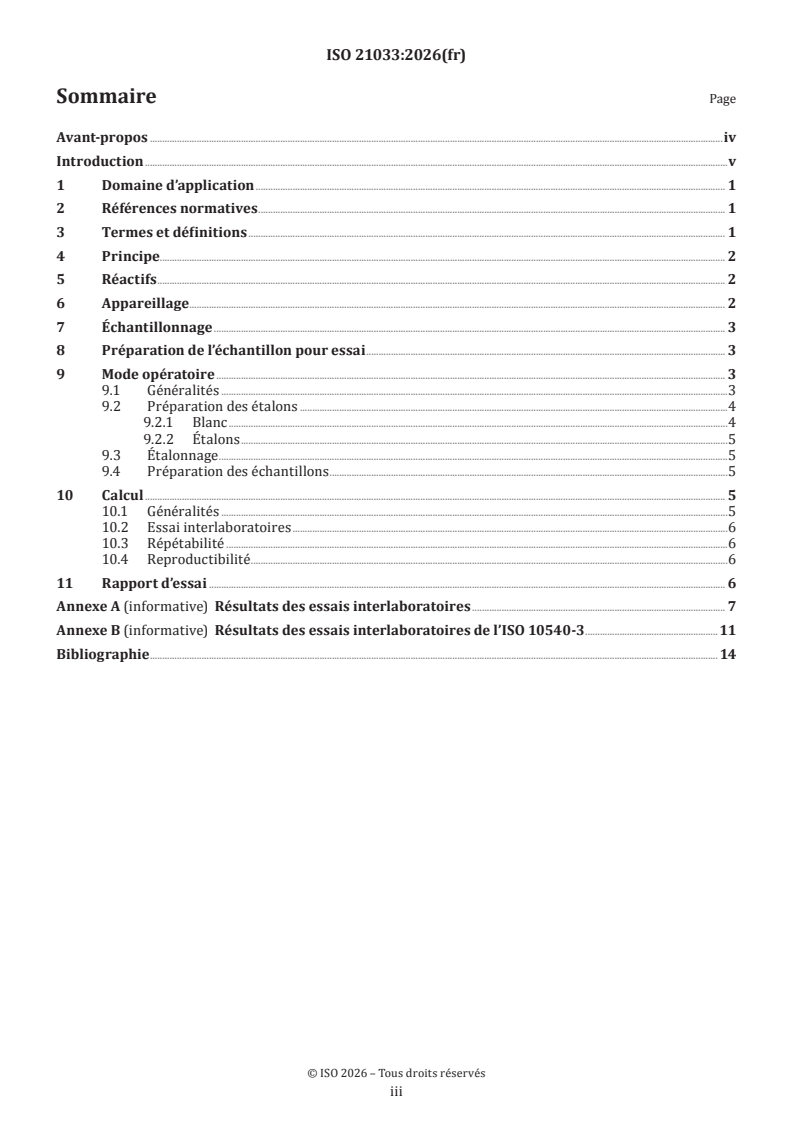
Sommaire Page
Avant-propos .iv
Introduction .v
1 Domaine d’application . 1
2 Références normatives . 1
3 Termes et définitions . 1
4 Principe. 2
5 Réactifs . 2
6 Appareillage . 2
7 Échantillonnage . 3
8 Préparation de l’échantillon pour essai . 3
9 Mode opératoire . 3
9.1 Généralités .3
9.2 Préparation des étalons .4
9.2.1 Blanc .4
9.2.2 Étalons .5
9.3 Étalonnage .5
9.4 Préparation des échantillons .5
10 Calcul . 5
10.1 Généralités .5
10.2 Essai interlaboratoires .6
10.3 Répétabilité .6
10.4 Reproductibilité . .6
11 Rapport d’essai . 6
Annexe A (informative) Résultats des essais interlaboratoires . 7
Annexe B (informative) Résultats des essais interlaboratoires de l’ISO 10540-3 .11
Bibliographie . 14
iii
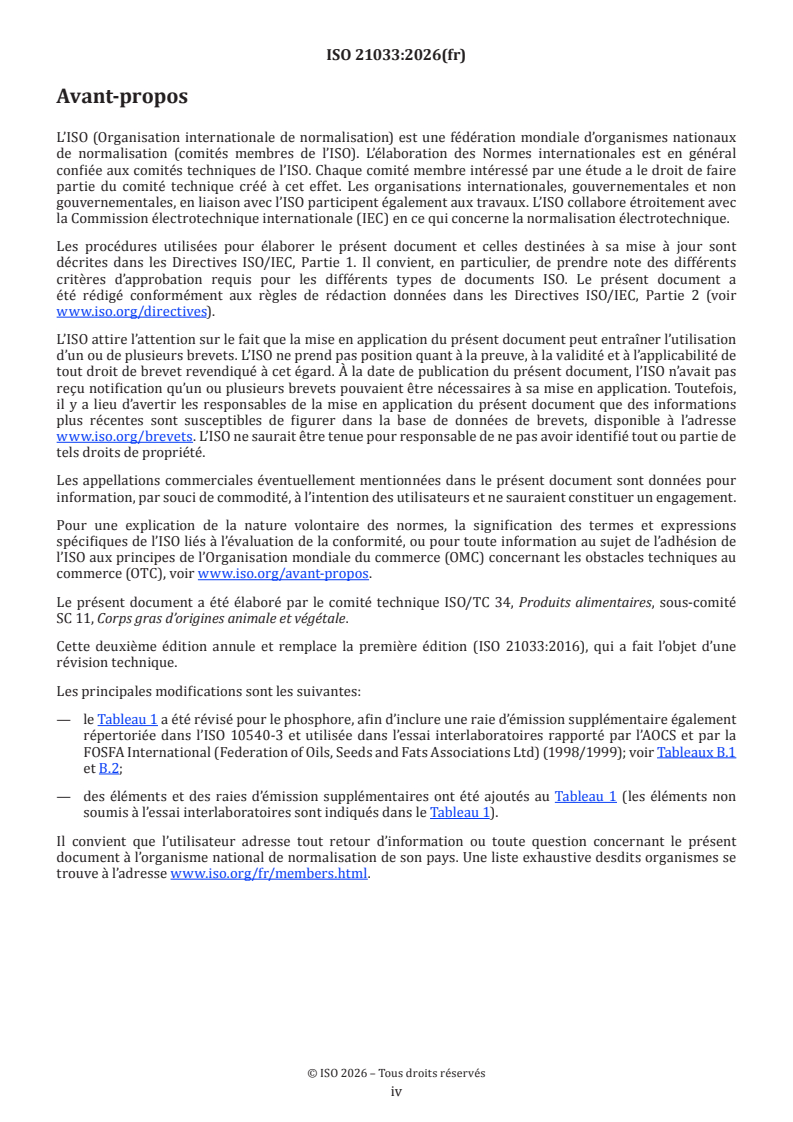
Avant-propos
L’ISO (Organisation internationale de normalisation) est une fédération mondiale d’organismes nationaux
de normalisation (comités membres de l’ISO). L’élaboration des Normes internationales est en général
confiée aux comités techniques de l’ISO. Chaque comité membre intéressé par une étude a le droit de faire
partie du comité technique créé à cet effet. Les organisations internationales, gouvernementales et non
gouvernementales, en liaison avec l’ISO participent également aux travaux. L’ISO collabore étroitement avec
la Commission électrotechnique internationale (IEC) en ce qui concerne la normalisation électrotechnique.
Les procédures utilisées pour élaborer le présent document et celles destinées à sa mise à jour sont
décrites dans les Directives ISO/IEC, Partie 1. Il convient, en particulier, de prendre note des différents
critères d’approbation requis pour les différents types de documents ISO. Le présent document a
été rédigé conformément aux règles de rédaction données dans les Directives ISO/IEC, Partie 2 (voir
www.iso.org/directives).
L’ISO attire l’attention sur le fait que la mise en application du présent document peut entraîner l’utilisation
d’un ou de plusieurs brevets. L’ISO ne prend pas position quant à la preuve, à la validité et à l’applicabilité de
tout droit de brevet revendiqué à cet égard. À la date de publication du présent document, l’ISO n’avait pas
reçu notification qu’un ou plusieurs brevets pouvaient être nécessaires à sa mise en application. Toutefois,
il y a lieu d’avertir les responsables de la mise en application du présent document que des informations
plus récentes sont susceptibles de figurer dans la base de données de brevets, disponible à l’adresse
www.iso.org/brevets. L’ISO ne saurait être tenue pour responsable de ne pas avoir identifié tout ou partie de
tels droits de propriété.
Les appellations commerciales éventuellement mentionnées dans le présent document sont données pour
information, par souci de commodité, à l’intention des utilisateurs et ne sauraient constituer un engagement.
Pour une explication de la nature volontaire des normes, la signification des termes et expressions
spécifiques de l’ISO liés à l’évaluation de la conformité, ou pour toute information au sujet de l’adhésion de
l’ISO aux principes de l’Organisation mondiale du commerce (OMC) concernant les obstacles techniques au
commerce (OTC), voir www.iso.org/avant-propos.
Le présent document a été élaboré par le comité technique ISO/TC 34, Produits alimentaires, sous-comité
SC 11, Corps gras d’origines animale et végétale.
Cette deuxième édition annule et remplace la première édition (ISO 21033:2016), qui a fait l’objet d’une
révision technique.
Les principales modifications sont les suivantes:
— le Tableau 1 a été révisé pour le phosphore, afin d’inclure une raie d’émission supplémentaire également
répertoriée dans l’ISO 10540-3 et utilisée dans l’essai interlaboratoires rapporté par l’AOCS et par la
FOSFA International (Federation of Oils, Seeds and Fats Associations Ltd) (1998/1999); voir Tableaux B.1
et B.2;
— des éléments et des raies d’émission supplémentaires ont été ajoutés au Tableau 1 (les éléments non
soumis à l’essai interlaboratoires sont indiqués dans le Tableau 1).
Il convient que l’utilisateur adresse tout retour d’information ou toute question concernant le présent
document à l’organisme national de normalisation de son pays. Une liste exhaustive desdits organismes se
trouve à l’adresse www.iso.org/fr/members.html.
iv
Introduction
[1]
Le présent document est fondé sur la méthode officielle Ca 17a-18 de l’AOCS .
v
Norme internationale ISO 21033:2026(fr)
Corps gras d'origines animale et végétale — Détermination
des éléments traces par spectrométrie d'émission optique à
plasma induit par haute fréquence (ICP-OES)
1 Domaine d’application
Le présent document spécifie une méthode d’analyse par spectrométrie d’émission optique avec source à
plasma induit par haute fréquence (ICP-OES) pour déterminer la teneur en éléments traces présents sous
forme solubilisée dans la plupart des types de corps gras d’origine végétale. Selon le solvant de dilution
utilisé, la plupart des types d’huiles végétales peuvent être analysés (huiles brutes, dégommées, raffinées,
décolorées, désodorisées et hydrogénées) et presque tous les types de lécithines et de phospholipides.
Les éléments présents dans les particules fines comme la terre décolorante, les particules métalliques et la
rouille peuvent donner un faible taux de récupération des éléments traces présents, car l’analyse par ICP-
OES est affectée par des problèmes liés à la nébulisation et à l’atomisation.
Le présent document ne s’applique pas au lait et aux produits laitiers (y compris les corps gras extraits du
lait et des produits laitiers).
NOTE La seule méthode directe sans calcination préalable appropriée aux échantillons contenant de fines
particules est la spectrométrie d’absorption atomique utilisant un four en graphite.
2 Références normatives
Les documents suivants sont cités dans le texte de sorte qu’ils constituent, pour tout ou partie de leur
contenu, des exigences du présent document. Pour les références datées, seule l’édition citée s’applique. Pour
les références non datées, la dernière édition du document de référence s’applique (y compris les éventuels
amendements).
ISO 661, Corps gras d’origines animale et végétale — Préparation de l’échantillon pour essai
ISO 6353-2, Réactifs pour analyse chimique — Partie 2: Spécifications — Première série
ISO 6353-3, Réactifs pour analyse chimique — Partie 3: Spécifications — Deuxième série
3 Termes et définitions
Pour les besoins du présent document, les termes et définitions suivants s’appliquent.
L’ISO et l’IEC tiennent à jour des bases de données terminologiques destinées à être utilisées en normalisation,
consultables aux adresses suivantes:
— ISO Online browsing platform: disponible à l’adresse https:// www .iso .org/ obp
— IEC Electropedia: disponible à l’adresse https:// www .electropedia .org/
3.1
élément trace
élément présent en concentrations en mg/kg
Note 1 à l'article: La teneur en éléments traces est exprimée en fraction massique en milligrammes par kilogramme.
4 Principe
Des huiles végétales diluées dans un solvant sont analysées afin de déterminer leur teneur en éléments traces
par aspiration directe. Les échantillons liquides sont nébulisés et transportés jusqu’à la source d’excitation
par un courant gazeux. Les atomes sont quantifiés par mesurage des raies d’émission spécifiques produites
par le retour à l’état fondamental d’atomes de niveaux d’énergie élevés.
5 Réactifs
AVERTISSEMENT — L’attention est attirée sur les réglementations nationales traitant de la
manipulation des substances dangereuses ainsi que sur les obligations y afférentes de l’utilisateur.
Les mesures de sécurité sur les plans technique, organisationnel et du personnel doivent être suivies.
Sauf indication contraire, utiliser des réactifs spécifiés dans l’ISO 6353-2 et l’ISO 6353-3, le cas échéant,
sinon utiliser des réactifs de qualité analytique reconnue.
5.1 1-Butanol, ISO 6353-3.
5.2 Kérosène.
5.3 Xylène, ISO 6353-3.
1)
5.4 Éléments étalons, présents en solution sous forme de matériau organique soluble. Des étalons
multi-éléments peuvent être utilisés.
2)
5.5 Huile de base, utilisable pour contrôler l’huile à blanc utilisée et diluer les solutions étalons en cas
de besoin. D’autres solvants disponibles sur le marché, distillats de pétrole ou solvants organiques peuvent
être utilisés selon les instructions du fabricant de l’instrument, s’ils sont exempts d’éléments traces et
peuvent créer des dilutions stables.
5.6 Huile à blanc, en général, une huile de soja raffinée et décolorée ou toute autre huile, dont l’absence
d’éléments traces a été vérifiée.
5.7 Mélange d’huile à blanc (5.6) et de 1-butanol (5.1), fraction massique w = 50 g/100 g.
(huile à blanc)
6 Appareillage
Utiliser le matériel courant de laboratoire et, en particulier, ce qui suit.
6.1 Spectromètre d’émission optique à plasma induit par haute fréquence.
6.2 Balance analytique, lisibilité 0,000 1 g, précision de pesage 0,001 g.
6.3 Four, pouvant être maintenu à une température de 60 °C ± 2 °C.
6.4 Agitateur-mélangeur inclinable.
1) Les produits SPEX sont des exemples de produits appropriés disponibles sur le marché. Cette information est donnée
à l’intention des utilisateurs du présent document et ne signifie nullement que l’ISO approuve ou recommande l’emploi
exclusif des produits ainsi désignés.
2) L’huile de base 20 ou l’huile de base 75 de la société Accu-Standard sont des exemples de produits appropriés
disponibles sur le marché. Cette information est donnée à l’intention des utilisateurs du présent document et ne signifie
nullement que l’ISO approuve ou recommande l’emploi exclusif des produits ainsi désignés.
7 Échantillonnage
L’échantillonnage ne fait pas partie de la méthode spécifiée dans le présent document. Une méthode
[2]
d’échantillonnage recommandée est donnée dans l’ISO 5555 .
Il est important que le laboratoire reçoive un échantillon réellement représentatif, n’ayant pas été
endommagé ou modifié pendant le transport ou l’entreposage.
8 Préparation de l’échantillon pour essai
Préparer les échantillons pour essai conformément à l’ISO 661, mais il convient de ne pas clarifier les
échantillons.
9 Mode opératoire
9.1 Généralités
9.1.1 Faire fondre les échantillons solides à environ 10 °C au-dessus de leur point de fusion et les
homogénéiser avant dilution. Maintenir au chaud l’échantillon dilué et veiller à ce qu’il reste en solution
pendant toute l’analyse. Pour l’analyse des corps gras hydrogénés, la température maximale est de 60 °C.
9.1.2 Tous les échantillons, étalons et blancs sont dilués (fractions massiques égales) avec du 1-butanol
(kérosène ou xylène) pour réduire la viscosité de l’huile en vue de faciliter la nébulisation. Certains
échantillons sont plus solubles dans le 1-butanol que d’autres.
Le 1-butanol est préférable au kérosène, car il présente une meilleure tolérance à l’humidité et permet
d’obtenir un débit supérieur avec une pression plus importante sans éteindre la torche. Cette tolérance
accrue à l’humidité permet d’analyser des huiles brutes et des lécithines sans séparation des phases. Un
débit accru permet d’améliorer les limites de détection.
Si l’on utilise du kérosène ou du xylène, toutes les conditions de fonctionnement de l’instrument, par exemple
le débit de la pompe, sont modifiées par rapport à celles fixées pour le 1-butanol. Par conséquent, l’analyse
doit être standardisée et toutes les analyses doivent être réalisées en dissolvant tous les étalons, blancs et
échantillons dans le même solvant.
Il convient de choisir les dilutions en tenant compte du type de solvant, de la composition de l’échantillon et
de la configuration de l’instrument, ainsi que des instructions du fabricant.
9.1.3 Allumer la torche à plasma et la laisser chauffer. Configurer l’instrument conformément aux
instructions du fabricant. Les éléments peuvent être détectés aux raies d’émission principales (voir
Tableau 1). D’autres raies d’émission et des instructions relatives au réglage des instruments sont données
[5] [6]
dans l’EN 14538 et dans l’ISO 10540-3. Les raies d’émission spectrales sont également répertoriées par
[7]
le NIST. Dans certains cas, des interférences entre différents éléments peuvent se produire à certaines
longueurs d’onde. D’autres longueurs d’onde peuvent être choisies pour réduire ces effets et augmenter le
taux de récupération.
Tableau 1 — Principales raies d’émission et limites de détection
Élément Limites de détec- Raie(s) d’émission principale
tion courantes
mg/kg nm
a
Aluminium — 167,078 308,215 396,152
b a
Arsenic — 188,980 234,984
b a
Baryum — 455,404
b a
Bore — 249,773
a
Cadmium — 226,502 214,441 228,802
Calcium 0,05 315,887 393,366 317,933
a
Chrome — 267,716 284,325 283,563
Cuivre 0,05 324,754 327,396
Fer 0,05 259,940 238,204 261,187
a
Plomb — 220,353 283,305
Magnésium 0,05 285,213 279,553 280,270
a
Manganèse — 257,611 259,373
b a
Mercure — 184,887 194,164
a
Molybdène — 281,615 202,095
Nickel 0,05 231,604 221,648 341,476 216,555 227,021
Phosphore 0,05 213,618 178,287 177,495 214,914
b a
Potassium — 766,491 769,897
Silicium 0,1 251,611 288,158 250,690
a
Argent — 328,068
Sodium 0,1 588,995 589,592
b
Soufre 1 180,731
b a
Étain — 242,949 189,925 283,998
a
Titane — 334,941 323,452 336,121
a
Vanadium — 309,311 311,071
a
Zinc — 202,613 213,856
a
Non rapporté à la date de publication.
b
Non inclus dans les essais interlaboratoires rapportés (voir Annexe A). Longueurs d’onde incluses pour permettre
l’identification d’interférences potentielles ou d’éléments inconnus.
9.1.4 Étalonner l’instrument comme spécifié au 9.3 et analyser tous les échantillons en triple.
NOTE Une dérive d’étalonnage a été relevée. Elle peut être due à l’accumulation de carbone sur l’embout de
l’injecteur.
9.2 Préparation des étalons
9.2.1 Blanc
En général, on utilise de l’huile de soja raffinée et décolorée ou toute autre huile, dont l’absence d’éléments
traces a été vérifiée. L’huile à blanc est diluée selon un rapport de (1:1) comme décrit dans le mode opératoire
d’échantillonnage. Une huile de base (5.5) est utilisée comme blanc de référence absolu afin de démontrer
que l’huile à blanc est dépourvue d’éléments traces.
9.2.2 Étalons
L’étalon est préparé à partir d’étalons organiques mono-éléments, disponibles dans le commerce. Peser
l’étalon avec exactitude et ajouter suffisamment de solvant et d’huile à blanc pour obtenir une dilution de
1:1. Par exemple, utiliser 50,00 g d’huile à blanc et 50,00 g de solvant (1-butanol, kérosène ou xylène).
Une seule concentration étalon suffit, mais les étalons multi-éléments et multi-niveaux permettent d’obtenir
un meilleur étalonnage pour la linéarité et l’exactitude. Il convient que les différents niveaux comprennent
des étalons à 2,5 mg/kg, 5 mg/kg et 10 mg/kg selon la gamme de valeurs attendues.
Les instruments capables de détecter simultanément plusieurs éléments peuvent atteindre un niveau plus
élevé de fidélité et d’exactitude par l’inclusion d’un étalon interne dans l’analyse. Si l’on utilise un étalon
interne, il convient de l’incorporer lors de l’étape de dilution. P
...