

ISO 15710:2002
(Main)Paints and varnishes — Corrosion testing by alternate immersion in and removal from a buffered sodium chloride solution
General Information
- Abstract
This International Standard describes a test procedure for assessing the protection offered by coatings of paints or varnishes on aluminium and aluminium alloys against corrosion arising from a scribe mark cut through the coating, when the coated panel is subjected to a test regime of alternate immersion in and removal from a dilute salt solution.
- Status
- Published
- Publication Date
- 02-Oct-2002
- Technical Committee
- ISO/TC 35/SC 9 - General test methods for paints and varnishes
- Drafting Committee
- ISO/TC 35/SC 9 - General test methods for paints and varnishes
- Current Stage
- 9093 - International Standard confirmed
- Start Date
- 08-Aug-2023
- Completion Date
- 29-Aug-2026
Buy Documents
ISO 15710:2002 - Paints and varnishes — Corrosion testing by alternate immersion in and removal from a buffered sodium chloride solution Released:10/3/2002
ISO 15710:2002 - Peintures et vernis — Essais de corrosion par immersions-émersions alternées dans une solution tamponnée de chlorure de sodium Released:10/3/2002
Overview
ISO 15710:2002 is an international standard developed by the International Organization for Standardization (ISO) that specifies a test method for evaluating the corrosion resistance of paints and varnishes applied to aluminum and its alloys. The standard focuses on corrosion testing by subjecting coated panels, featuring a deliberate scribe mark cutting through the coating, to alternate immersion in and removal from a buffered sodium chloride (salt) solution. This method simulates the aggressive environmental conditions that coatings may encounter, especially in aerospace applications, and helps determine their protective performance against corrosion initiated at coating breaches.
Key Topics
Scope and Purpose
The standard defines a practical and reproducible laboratory procedure to assess how effectively coatings protect aluminum substrates from corrosion at scribed locations during cycling between immersion in saline solution and exposure to high humidity air.Test Solution and Conditions
The test solution consists of sodium chloride buffered with phosphate disodium and boric acid at a precise pH of 8±0.2. The test panels undergo alternating 2-hour cycles of immersion in this solution at 35°C followed by 2 hours of exposure to greater than 80% relative humidity.Test Panels and Preparation
Aluminum test panels are prepared and coated per related ISO standards, with edges and backs coated with an inert or equivalent protective layer. Two perpendicular scribe marks are made on each panel to expose the bare metal. The depth and width of the scribe are controlled to ensure consistency.Testing Apparatus
Equipment includes an enclosure that controls temperature and humidity and supports automated vertical cycling of panels into and out of saline solution baths, ensuring uniform and repeatable exposure.Evaluation and Reporting
Corrosion around the scribe is periodically assessed according to ISO degradation criteria. After test completion, panels are rinsed and dried before final examination. The test report must include product identification, reference to ISO 15710, test conditions, solution preparation details, scribing method, and corrosion observations.
Applications
ISO 15710:2002 is highly applicable for:
Aerospace Industry
Aircraft coatings often face rapidly changing environmental conditions, including salt exposure and humidity fluctuations at altitude. This standard’s test method provides valuable insight into the durability and corrosion resistance of aerospace-grade paints and varnishes.Quality Control and Product Development
Manufacturers of protective coatings can utilize this standard to verify coating performance consistency, compare new formulations, and support certification processes.Research and Comparative Studies
Allows controlled laboratory simulation of complex environmental stresses with reproducible parameters, facilitating comparative corrosion resistance studies of different coating systems under saline mist and immersion cycling.
Related Standards
The ISO 15710:2002 procedure references and complements several other ISO standards, including but not limited to:
- ISO 1513 – Sample preparation and examination for paint and varnish testing
- ISO 1514 – Standard test panels for paints and varnishes
- ISO 2808 – Measurement of dry film thickness of coatings
- ISO 3270 – Conditioning and testing temperature and humidity requirements
- ISO 3696 – Specifies analytical grade water quality required for test solutions
- ISO 4628-1 & ISO 4628-8 – Evaluation and classification of coating degradation and corrosion around scratches
- ISO 15528 – Sampling procedures for coatings and related materials
These related standards define essential preparatory and evaluative methods ensuring consistent implementation of the corrosion test.
ISO 15710:2002 establishes a standardized and reliable alternate immersion corrosion test that safeguards coating performance in saline environments, proving indispensable for industries demanding high corrosion resistance, such as aerospace and automotive coatings. Its controlled laboratory approach aids manufacturers, researchers, and engineers in the development, validation, and quality assurance of protective paint and varnish systems on aluminum substrates.
Relations
- Effective Date
- 25-Aug-2026
- Effective Date
- 25-Aug-2026
Buy Documents
ISO 15710:2002 - Paints and varnishes — Corrosion testing by alternate immersion in and removal from a buffered sodium chloride solution Released:10/3/2002
ISO 15710:2002 - Peintures et vernis — Essais de corrosion par immersions-émersions alternées dans une solution tamponnée de chlorure de sodium Released:10/3/2002
Frequently Asked Questions
ISO 15710:2002 is a standard published by the International Organization for Standardization (ISO). Its full title is "Paints and varnishes — Corrosion testing by alternate immersion in and removal from a buffered sodium chloride solution". This standard covers: This International Standard describes a test procedure for assessing the protection offered by coatings of paints or varnishes on aluminium and aluminium alloys against corrosion arising from a scribe mark cut through the coating, when the coated panel is subjected to a test regime of alternate immersion in and removal from a dilute salt solution.
This International Standard describes a test procedure for assessing the protection offered by coatings of paints or varnishes on aluminium and aluminium alloys against corrosion arising from a scribe mark cut through the coating, when the coated panel is subjected to a test regime of alternate immersion in and removal from a dilute salt solution.
ISO 15710:2002 is classified under the following ICS (International Classification for Standards) categories: 87.040 - Paints and varnishes. The ICS classification helps identify the subject area and facilitates finding related standards.
ISO 15710:2002 has the following relationships with other standards: It is inter standard links to EN 2434-005:2006, EN 3840:2007. Understanding these relationships helps ensure you are using the most current and applicable version of the standard.
ISO 15710:2002 is available in PDF format for immediate download after purchase. The document can be added to your cart and obtained through the secure checkout process. Digital delivery ensures instant access to the complete standard document.
Standards Content (Sample)
INTERNATIONAL ISO
STANDARD 15710
First edition
2002-10-01
Paints and varnishes — Corrosion testing
by alternate immersion in and removal from
a buffered sodium chloride solution
Peintures et vernis — Essais de corrosion par immersions-émersions
alternées dans une solution tamponnée de chlorure de sodium
Reference number
PDF disclaimer
This PDF file may contain embedded typefaces. In accordance with Adobe's licensing policy, this file may be printed or viewed but shall not be
edited unless the typefaces which are embedded are licensed to and installed on the computer performing the editing. In downloading this file,
parties accept therein the responsibility of not infringing Adobe's licensing policy. The ISO Central Secretariat accepts no liability in this area.
Adobe is a trademark of Adobe Systems Incorporated.
Details of the software products used to create this PDF file can be found in the General Info relative to the file; the PDF-creation parameters
were optimized for printing. Every care has been taken to ensure that the file is suitable for use by ISO member bodies. In the unlikely event
that a problem relating to it is found, please inform the Central Secretariat at the address given below.
All rights reserved. Unless otherwise specified, no part of this publication may be reproduced or utilized in any form or by any means,
electronic or mechanical, including photocopying and microfilm, without permission in writing from either ISO at the address below or ISO's
member body in the country of the requester.
ISO copyright office
Case postale 56 CH-1211 Geneva 20
Tel. + 41 22 749 01 11
Fax + 41 22 749 09 47
E-mail copyright@iso.ch
Web www.iso.ch
Printed in Switzerland
©
ii ISO 2002 – All rights reserved
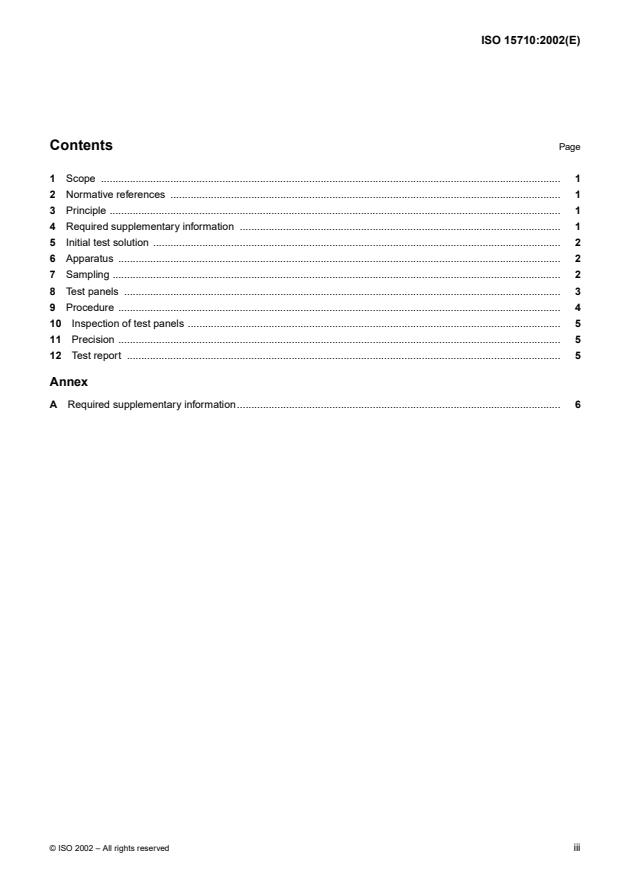
Contents Page
1 Scope . 1
2 Normative references . 1
3 Principle . 1
4 Required supplementary information . 1
5 Initial test solution . 2
6 Apparatus . 2
7 Sampling . 2
8 Test panels . 3
9 Procedure . 4
10 Inspection of test panels . 5
11 Precision . 5
12 Test report . 5
Annex
A Required supplementary information. 6
©
ISO 2002 – All rights reserved iii
Foreword
ISO (the International Organization for Standardization) is a worldwide federation of national standards bodies (ISO
member bodies). The work of preparing International Standards is normally carried out through ISO technical
committees. Each member body interested in a subject for which a technical committee has been established has
the right to be represented on that committee. International organizations, governmental and non-governmental, in
liaison with ISO, also take part in the work. ISO collaborates closely with the International Electrotechnical
Commission (IEC) on all matters of electrotechnical standardization.
International Standards are drafted in accordance with the rules given in the ISO/IEC Directives, Part 3.
Draft International Standards adopted by the technical committees are circulated to the member bodies for voting.
Publication as an International Standard requires approval by at least 75 % of the member bodies casting a vote.
Attention is drawn to the possibility that some of the elements of this International Standard may be the subject of
patent rights. ISO shall not be held responsible for identifying any or all such patent rights.
International Standard ISO15710 was prepared by Technical Committee ISO/TC35, Paints and varnishes,
Subcommittee SC 9, General test methods for paints and varnishes.
Annex A forms a normative part of this International Standard.
©
iv ISO 2002 – All rights reserved
Introduction
Coatings of paints, varnishes and similar materials are exposed to alternating wet and dry (humid) cyclic conditions
using a specified salt solution in a cabinet in order to simulate, in the laboratory, processes occurring in aggressive
outdoor conditions. Generally, correlations between such outdoor weathering and laboratory testing cannot be
expected because of the large number of factors influencing the breakdown process. Correlation can only be
expected if the effect on the coating of important parameters (e.g. nature of the salt, spectral distribution of the
incident radiation in the relevant photochemical region, temperature of the specimen, type and cycle of wetting and
relative humidity) is known. In contrast to outdoor weathering, laboratory testing in a cabinet is performed under a
reduced number of variables which can be controlled and therefore the effects are more reproducible. The method
may also give a means of checking that the quality of a paint or paint system is being maintained.
The method has been found to be useful in comparing the alternate immersion/emersion salt solution resistance of
different coatings. It is most useful in providing relevant ratings for a series of coated panels exhibiting significant
differences in alternate immersion/emersion salt solution resistance.
This method is intended principally for testing paints used in aerospace applications. The types of conditions
specified may occur as an aircraft flies through a variety of environments including sudden changes in temperature
and pressure. The results of the test specified in this International Standard will give an indication of the ability of a
paint system to withstand these corrosive atmospheres.
©
ISO 2002 – All rights reserved v
INTERNATIONAL STANDARD ISO 15710:2002(E)
Paints and varnishes — Corrosion testing by alternate immersion in
and removal from a buffered sodium chloride solution
1 Scope
This International Standard describes a test procedure for assessing the protection offered by coatings of paints or
varnishes on aluminium and aluminium alloys against corrosion arising against a scribe mark cut through the
coating, when the coated panel is subjected to a test regime of alternate immersion in and removal from a dilute salt
solution.
2 Normative references
The following normative documents contain provisions which, through reference in this text, constitute provisions of
this International Standard. For dated references, subsequent amendments to, or revisions of, any of these
publications do not apply. However, parties to agreements based on this International Standard are encouraged to
investigate the possibility of applying the most recent editions of the normative documents indicated below. For
undated references, the latest edition of the normative document referred to applies. Members of ISO and IEC
maintain registers of currently valid International Standards.
ISO 1513, Paints and varnishes — Examination and preparation of samples for testing
ISO 1514, Paints and varnishes — Standard panels for testing
ISO 2808, Paints and varnishes — Determination of film thickness
ISO 3270, Paints and varnishes and their raw materials — Temperatures and humidities for conditioning and testing
ISO 3696, Water for analytical laboratory use — Specification and test methods
ISO 4628-1, Paints and varnishes — Evaluation of degradation of coatings — Designation of intensity, quantity and
size of common types of defect — Part 1: General introduction and designation system
ISO 4628-8, Paints and varnishes — Evaluation of degradation of coatings — Designation of intensity, quantity and
size of common types of defect — Part 8: Evaluation of corrosion around a scribe
ISO 15528, Paints, varnishes and raw materials for paints and varnishes — Sampling
3 Principle
◦
A coated test panel is scribed in a defined way. The panel is then exposed in a test chamber at 35 C, where it is
alternately immersed in salt solution and then removed and exposed at a relative humidity greater than 80 %. The
effects of this test being then evaluated by criteria agreed in advance between the interested parties, these criteria
usually being of a subjective nature.
4 Required supplementary information
For any particular application, the test method specified in this International Standard needs to be completed by
supplementary information. The items of supplementary information are given in annex A.
©
ISO 2002 – All rights reserved 1
---------------------- Pag
...
NORME ISO
INTERNATIONALE 15710
Première édition
2002-10-01
Peintures et vernis — Essais de corrosion
par immersions-émersions alternées dans
une solution tamponnée de chlorure de
sodium
Paints and varnishes — Corrosion testing by alternate immersion in and
removal from a buffered sodium chloride solution
Numéro de référence
PDF — Exonération de responsabilité
Le présent fichier PDF peut contenir des polices de caractères intégrées. Conformément aux conditions de licence d'Adobe, ce fichier peut
être imprimé ou visualisé, mais ne doit pas être modifié à moins que l'ordinateur employé à cet effet ne bénéficie d'une licence autorisant
l'utilisation de ces polices et que celles-ci y soient installées. Lors du téléchargement de ce fichier, les parties concernées acceptent de fait la
responsabilité de ne pas enfreindre les conditions de licence d'Adobe. Le Secrétariat central de l'ISO décline toute responsabilité en la
matière.
Adobe est une marque déposée d'Adobe Systems Incorporated.
Les détails relatifs aux produits logiciels utilisés pour la création du présent fichier PDF sont disponibles dans la rubrique General Info du
fichier; les paramètres de création PDF ont été optimisés pour l'impression. Toutes les mesures ont été prises pour garantir l'exploitation de
ce fichier par les comités membres de l'ISO. Dans le cas peu probable où surviendrait un problème d'utilisation, veuillez en informer le
Secrétariat central à l'adresse donnée ci-dessous.
Droits de reproduction réservés. Sauf prescription différente, aucune partie de cette publication ne peut être reproduite ni utilisée sous
quelque forme que ce soit et par aucun procédé, électronique ou mécanique, y compris la photocopie et les microfilms, sans l'accord écrit de
l'ISO à l'adresse ci-après ou au comité membre de l'ISO dans le pays du demandeur.
ISO copyright office
Case postale 56 CH-1211 Geneva 20
Tel. + 41 22 749 01 11
Fax + 41 22 749 09 47
E-mail copyright@iso.ch
Web www.iso.ch
Imprimé en Suisse
©
ii ISO 2002 – Tous droits réservés
Sommaire Page
1 Domaine d'application . 1
2 Références normatives . 1
3 Principe . 1
4 Informations complémentaires requises . 2
5 Solution d'essai initiale . 2
6 Appareillage . 2
7 Échantillonnage . 2
8 Panneaux d'essai . 3
9 Mode opératoire . 4
10 Contrôle des panneaux d'essai . 5
11 Fidélité . 5
12 Rapport d'essai . 5
Annexe
A Informations complémentaires requises . 6
©
ISO 2002 – Tous droits réservés iii
Avant-propos
L'ISO (Organisation internationale de normalisation) est une fédération mondiale d'organismes nationaux de
normalisation (comités membres de l'ISO). L'élaboration des Normes internationales est en général confiée aux
comités techniques de l'ISO. Chaque comité membre intéressé par une étude a le droit de faire partie du comité
technique créé à cet effet. Les organisations internationales, gouvernementales et non gouvernementales, en liaison
avec l'ISO participent également aux travaux. L'ISO collabore étroitement avec la Commission électrotechnique
internationale (CEI) en ce qui concerne la normalisation électrotechnique.
Les Normes internationales sont rédigées conformément aux règles données dans les Directives ISO/CEI, Partie 3.
Les projets de Normes internationales adoptés par les comités techniques sont soumis aux comités membres pour
vote. Leur publication comme Normes internationales requiert l'approbation de 75 % au moins des comités membres
votants.
L'attention est appelée sur le fait que certains des éléments de la présente Norme internationale peuvent faire l'objet
de droits de propriété intellectuelle ou de droits analogues. L'ISO ne saurait être tenue pour responsable de ne pas
avoir identifié de tels droits de propriété et averti de leur existence.
La Norme internationale ISO 15710 a été élaborée par le comité technique ISO/TC 35, Peintures et vernis, sous-
comité SC 9, Méthodes générales d'essais des peintures et vernis.
L'annexe A constitue un élément normatif de la présente Norme internationale.
©
iv ISO 2002 – Tous droits réservés
Introduction
Les revêtements de peintures, vernis et produits similaires sont exposés dans une enceinte à des cycles de
sécheresse et d'humidité dans un brouillard salin, en alternance, pour simuler en laboratoire les processus qui se
produisent lorsque les conditions extérieures sont agressives. Il n'est généralement pas possible d'établir une
corrélation entre le vieillissement en extérieur et les essais en laboratoire, en raison du nombre important de facteurs
influant sur le processus de dégradation. Il n'est possible d'établir une corrélation que si l'effet sur le revêtement de
paramètres importants (nature du sel, répartition spectrale de la radiation incidente dans la zone photochimique
correspondante, température de l'éprouvette, type et cycle d'humidité et d'humidité relative) est connu.
Contrairement au vieillissement en extérieur, les essais en laboratoire s'effectuent avec un nombre réduit de
variables qui peuvent être contrôlées, et par conséquent les effets sont plus reproductibles. La méthode peut
également permettre d'assurer le suivi de qualité d'une peinture ou d'un système de peinture.
La méthode s'est avérée utile pour comparer la résistance de différents revêtements à des immersions-émersions
alternées dans une solution saline. Elle est très utile pour obtenir les caractéristiques d'une série de panneaux
revêtus présentant des différences importantes de résistance à des immersions-émersions alternées dans une
solution saline.
Cette méthode est principalement destinée aux essais de peintures dans le cadre des applications aérospatiales.
Les types de conditions spécifiées peuvent se produire, car un avion en vol traverse différents environnements, avec
des changements brutaux de température et de pression. Les résultats des essais spécifiés dans la présente Norme
internationale donneront une indication de la capacité d'un système de peinture à résister à ces atmosphères
corrosives.
©
ISO 2002 – Tous droits réservés v
NORME INTERNATIONALE ISO 15710:2002(F)
Peintures et vernis — Essais de corrosion par immersions-
émersions alternées dans une solution tamponnée de chlorure de
sodium
1 Domaine d'application
La présente Norme internationale décrit un mode opératoire d'essai permettant d'évaluer la protection procurée par
des revêtements de peintures ou vernis, appliqués sur l'aluminium et les alliages d'aluminium, contre la corrosion
due à une rayure dans le revêtement, lorsque le panneau revêtu est soumis à un essai d'immersions-émersions
alternées dans une solution saline diluée.
2Références normatives
Les documents normatifs suivants contiennent des dispositions qui, par suite de la référence qui y est faite,
constituent des dispositions valables pour la présente Norme internationale. Pour les références datées, les
amendements ultérieurs ou les révisions de ces publications ne s'appliquent pas. Toutefois, les parties prenantes
aux accords fondés sur la présente Norme internationale sont invitées à rechercher la possibilité d'appliquer les
éditions les plus récentes des documents normatifs indiqués ci-après. Pour les références non datées, la dernière
édition du document normatif en référence s'applique. Les membres de l'ISO et de la CEI possèdent le registre des
Normes internationales en vigueur.
ISO 1513, Peintures et vernis — Examen et préparation des échantillons pour essais
ISO 1514, Peintures et vernis — Panneaux normalisés pour essais
ISO 2808, Peintures et vernis — Détermination de l'épaisseur du feuil
ISO 3270, Peintures et vernis et leurs matières premières — Températures et humidités pour le conditionnement et
l'essai
ISO 3696, Eau pour laboratoire à usage analytique — Spécification et méthodes d'essai
ISO 4628-1, Peintures et vernis — Évaluation de la dégradation des revêtements — Désignation de l'intensité, de la
quantité et de la dimension des types courants de défauts — Partie1: Introduction générale et système de
désignation
ISO 4628-8, Peintures et vernis — Évaluation de la dégradation des revêtements — Désignation de l'intensité, de la
quantité et de la dimension des types courants de défauts — Partie 8: Évaluation de la corrosion autour d'une rayure
ISO 15528, Peintures, vernis et matières premières pour peintures et vernis — Échantillonnage
3Principe
Un panneau d'essai revêtu est rayé d'une certaine manière. Il est ensuite exposé dans une enceinte d'essai à une
◦
température de 35 C, où il est alternativement immergé dans une solution saline et émergé puis exposé à une
humidité relative supérieure à 80 %. Les effets sont ensuite évalués selon des critères convenus à l'avance entre les
parties, ces critères étant généralement de nature subjective.
©
ISO 2002 – Tous droits réservés 1
4 Informations complémentaires requises
Pour toute application particulière, la méthode d'essai spécifiée dans la présente Norme internationale doit être
...