

ISO 22785-2:2026
(Main)Paints and varnishes — Coatings on plastics and composites — Part 2: Weathering and irradiation testing
- Abstract
This document specifies the weathering and irradiation testing of coatings on plastics, plastics composites and similar substrates, hereinafter collectively referred to as plastics. This document shows the potential effect of plastics on the behaviour of the coating during weathering and irradiation testing.
- Status
- Published
- Publication Date
- 02-Aug-2026
- Technical Committee
- ISO/TC 35/SC 9 - General test methods for paints and varnishes
- Drafting Committee
- ISO/TC 35/SC 9/WG 31 - Properties after application
- Current Stage
- 6060 - International Standard published
- Start Date
- 03-Aug-2026
- Due Date
- 06-May-2027
- Completion Date
- 03-Aug-2026
ISO 22785-2:2026 is an International Standard from ISO for weathering and irradiation testing of coatings on plastics, plastics composites and similar substrates. It explains how the substrate can change coating behaviour during exposure, and it gives the test methods and practical adjustments that matter for coated plastics and composites.
What does ISO 22785-2:2026 specify?
ISO 22785-2:2026 specifies weathering and irradiation testing for coatings on plastics, plastics composites and similar substrates, which the standard treats collectively as plastics. The document is meant to help users judge how the substrate itself can affect coating behaviour during exposure.
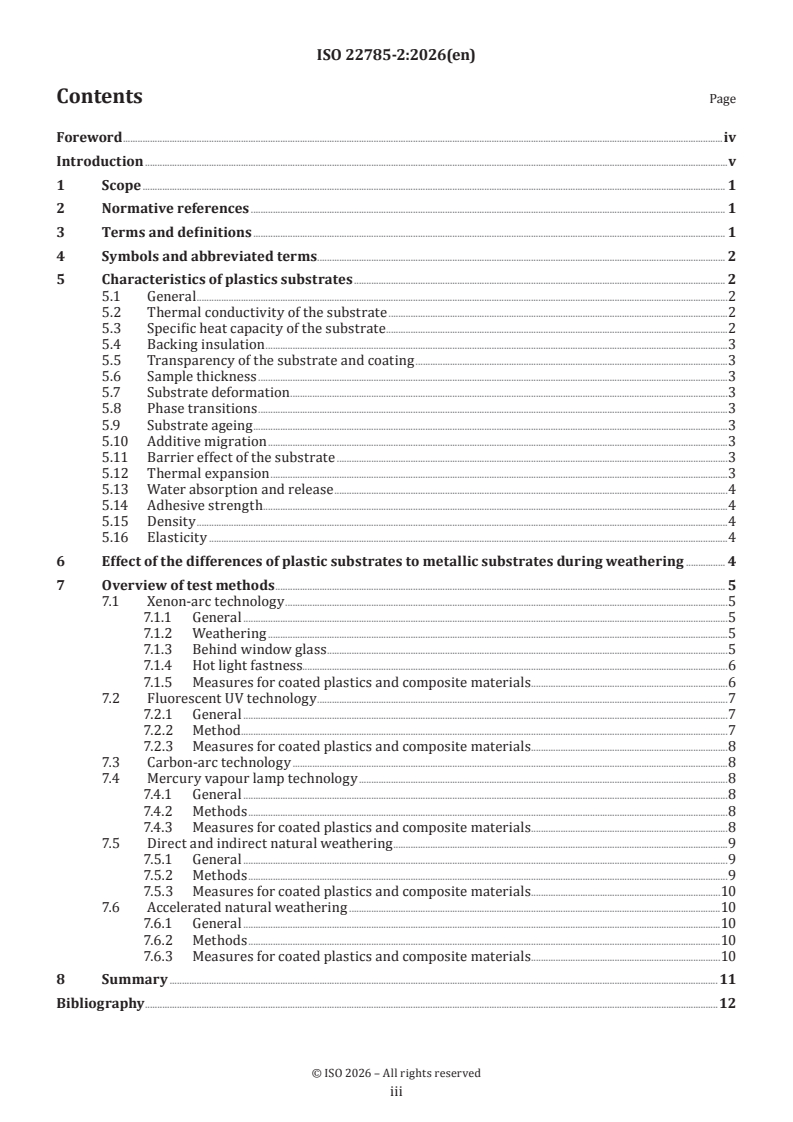
The document is organized into:
- Clause 1: Scope
- Clause 2: Normative references
- Clause 3: Terms and definitions
- Clause 4: Symbols and abbreviated terms
- Clause 5: Characteristics of plastics substrates
- Clause 6: Effect of the differences of plastic substrates to metallic substrates during weathering
- Clause 7: Overview of test methods
- Clause 8: Summary
Clause 7 is the main technical part. It reviews xenon-arc, fluorescent UV, carbon-arc, mercury vapour lamp, direct and indirect natural weathering, and accelerated natural weathering, so a reader can match the method to the intended use and the expected service conditions.
What are the key requirements of ISO 22785-2:2026?
ISO 22785-2:2026 is mainly a guidance document for choosing and adapting weathering tests so coated plastics are assessed under conditions that reflect how they behave in service. The most important technical point is that plastics often heat up, dry, age, and deform differently from metals, so test conditions that work for metal coatings may need adjustment.
Plastic substrate properties matter in the test setup
Clause 5 lists the substrate characteristics that can change test behaviour, including thermal conductivity, specific heat capacity, backing insulation, transparency, sample thickness, phase transitions, ageing, additive migration, barrier effect, thermal expansion, water absorption and release, adhesive strength, density, and elasticity. In practice, these properties can change surface temperature, moisture balance, and mechanical stress on the coating.
Temperature control is a recurring issue
Clause 6 explains that plastics can reach higher surface temperatures than comparable metal substrates because they absorb radiation and conduct heat less well. The document points to lower test temperatures, lower irradiance, avoiding backing, and increased cooling as practical ways to limit unrealistic overheating.
Xenon-arc testing covers several exposure types
Clause 7.1 distinguishes xenon-arc weathering, behind-window-glass exposure, and hot light fastness. It describes the common use of daylight or window-glass filters and notes that typical practice uses controlled irradiance, chamber air temperature, black-standard temperature, relative humidity, and wet/dry cycling. For coated plastics, the practical message is to watch surface temperature closely and, where needed, use lower-temperature cycles or better temperature measurement.
Fluorescent UV testing needs attention to wetting and cooling
Clause 7.2 describes fluorescent UV technology, including UVA-340, UVB-313 and UVA-351 lamp use. The standard notes that these devices give little visible or infrared heating, but plastics can still run hotter because backside cooling is less effective. If condensation is weak, spray phases may be needed to achieve sufficient wetting.
Natural weathering depends on exposure geometry
Clause 7.5 covers direct and indirect natural weathering, including black-box exposure, behind-glass exposure, and outdoor glass-covered exposure with air circulation. The practical effect is that rack orientation, backing, shading, and sun tracking can all change the result, so the exposure has to reflect the intended service environment.
Accelerated natural weathering can overheat plastics
Clause 7.6 explains that concentrated sunlight methods can raise temperatures too far for plastics and temperature-sensitive coatings. The document describes ways to control this, including fan adjustment, fewer mirrors, and cool or selective mirrors, so the test temperature stays closer to real use.
What terms does ISO 22785-2:2026 define?
- Weathering - stress caused by natural or simulated environmental influences, especially solar radiation, heat and humidity.
- Natural weathering - exposure to weather outdoors.
- Artificial accelerated weathering - laboratory exposure to cyclic or intensified conditions that aim to reproduce outdoor ageing faster.
- Exposure - stress caused by radiation, whether from natural solar radiation, simulated solar radiation or artificial light sources.
- Black-standard temperature (BST) - a temperature measurement used in weathering tests to represent specimen heating.
- Black-panel temperature (BPT) - a related temperature measurement used to control or monitor weathering devices.
- Relative humidity (RH) - the humidity level in the test chamber.
- Original equipment manufacturer (OEM) - a manufacturer whose specifications are used in several of the weathering methods cited by the standard.
Who uses ISO 22785-2:2026?
ISO 22785-2:2026 is used by coating laboratories, plastics and composites manufacturers, paint and varnish developers, test houses, and quality managers who need to select or interpret weathering tests for coated plastics. It is also relevant to automotive users and OEMs because several clauses address exterior materials, interior trim, and under-glass exposure.
In practice, users apply it when they need to choose between xenon-arc, fluorescent UV, natural weathering, or concentrated solar exposure, and when they need to decide whether a plastics-specific temperature adjustment is needed.
Which standards are used with ISO 22785-2:2026?
ISO 22785-2:2026 is built on ISO 4618 for vocabulary and ISO 22785-1 for the general introduction to coatings on plastics and composites. Its method overview also relies on related exposure standards such as ISO 16474-1, ISO 16474-2, ISO 16474-3, ISO 16474-4, ISO 4892-2, ISO 4892-3, ISO 2810, ISO 877-1, ISO 877-2 and ISO 877-3.
These standards contribute the general guidance, laboratory exposure methods, and natural weathering methods that ISO 22785-2:2026 references when it explains how plastics may behave differently from metals.
What does the ISO 22785-2:2026 document contain?
The document contains Table 1 with symbols and abbreviated terms, followed by a clause-by-clause discussion of plastic substrate behaviour and how that affects coating weathering. Clause 7 is the core of the document and gives an overview of the main weathering technologies, the usual exposure conditions, and the practical measures used for coated plastics and composites.
It also names common related standards for each technology, so users can link the overview to the detailed method they actually plan to use. The document ends with a short summary and a bibliography of supporting standards and technical references.
Get Certified
Connect with accredited certification bodies for this standard

DIN CERTCO
DIN Group product certification.

Smithers Quality Assessments
US management systems and product certification.
Sponsored listings
Frequently Asked Questions
ISO 22785-2:2026 is a standard published by the International Organization for Standardization (ISO). Its full title is "Paints and varnishes — Coatings on plastics and composites — Part 2: Weathering and irradiation testing". This standard covers: This document specifies the weathering and irradiation testing of coatings on plastics, plastics composites and similar substrates, hereinafter collectively referred to as plastics. This document shows the potential effect of plastics on the behaviour of the coating during weathering and irradiation testing.
This document specifies the weathering and irradiation testing of coatings on plastics, plastics composites and similar substrates, hereinafter collectively referred to as plastics. This document shows the potential effect of plastics on the behaviour of the coating during weathering and irradiation testing.
ISO 22785-2:2026 is classified under the following ICS (International Classification for Standards) categories: 83.080.01 - Plastics in general; 83.120 - Reinforced plastics; 87.040 - Paints and varnishes. The ICS classification helps identify the subject area and facilitates finding related standards.
ISO 22785-2:2026 is available in PDF format for immediate download after purchase. The document can be added to your cart and obtained through the secure checkout process. Digital delivery ensures instant access to the complete standard document.
Standards Content (Sample)
International
Standard
ISO 22785-2
First edition
Paints and varnishes — Coatings on
2026-08
plastics and composites —
Part 2:
Weathering and irradiation testing
Peintures et vernis — Revêtements sur plastiques et
composites —
Partie 2: Essais de vieillissement et d'irradiation
Reference number
© ISO 2026
All rights reserved. Unless otherwise specified, or required in the context of its implementation, no part of this publication may
be reproduced or utilized otherwise in any form or by any means, electronic or mechanical, including photocopying, or posting on
the internet or an intranet, without prior written permission. Permission can be requested from either ISO at the address below
or ISO’s member body in the country of the requester.
ISO copyright office
CP 401 • Ch. de Blandonnet 8
CH-1214 Vernier, Geneva
Phone: +41 22 749 01 11
Email: copyright@iso.org
Website: www.iso.org
Published in Switzerland
ii
Contents Page
Foreword .iv
Introduction .v
1 Scope . 1
2 Normative references . 1
3 Terms and definitions . 1
4 Symbols and abbreviated terms. 2
5 Characteristics of plastics substrates . 2
5.1 General .2
5.2 Thermal conductivity of the substrate .2
5.3 Specific heat capacity of the substrate .2
5.4 Backing insulation .3
5.5 Transparency of the substrate and coating .3
5.6 Sample thickness .3
5.7 Substrate deformation .3
5.8 Phase transitions .3
5.9 Substrate ageing .3
5.10 Additive migration .3
5.11 Barrier effect of the substrate .3
5.12 Thermal expansion .3
5.13 Water absorption and release .4
5.14 Adhesive strength . .4
5.15 Density .4
5.16 Elasticity .4
6 Effect of the differences of plastic substrates to metallic substrates during weathering . 4
7 Overview of test methods . 5
7.1 Xenon-arc technology .5
7.1.1 General .5
7.1.2 Weathering .5
7.1.3 Behind window glass .5
7.1.4 Hot light fastness.6
7.1.5 Measures for coated plastics and composite materials .6
7.2 Fluorescent UV technology .7
7.2.1 General .7
7.2.2 Method . .7
7.2.3 Measures for coated plastics and composite materials .8
7.3 Carbon-arc technology .8
7.4 Mercury vapour lamp technology .8
7.4.1 General .8
7.4.2 Methods .8
7.4.3 Measures for coated plastics and composite materials .8
7.5 Direct and indirect natural weathering .9
7.5.1 General .9
7.5.2 Methods .9
7.5.3 Measures for coated plastics and composite materials .10
7.6 Accelerated natural weathering .10
7.6.1 General .10
7.6.2 Methods .10
7.6.3 Measures for coated plastics and composite materials .10
8 Summary .11
Bibliography .12
iii
Foreword
ISO (the International Organization for Standardization) is a worldwide federation of national standards
bodies (ISO member bodies). The work of preparing International Standards is normally carried out through
ISO technical committees. Each member body interested in a subject for which a technical committee
has been established has the right to be represented on that committee. International organizations,
governmental and non-governmental, in liaison with ISO, also take part in the work. ISO collaborates closely
with the International Electrotechnical Commission (IEC) on all matters of electrotechnical standardization.
The procedures used to develop this document and those intended for its further maintenance are described
in the ISO/IEC Directives, Part 1. In particular, the different approval criteria needed for the different types
of ISO document should be noted. This document was drafted in accordance with the editorial rules of the
ISO/IEC Directives, Part 2 (see www.iso.org/directives).
ISO draws attention to the possibility that the implementation of this document may involve the use of (a)
patent(s). ISO takes no position concerning the evidence, validity or applicability of any claimed patent
rights in respect thereof. As of the date of publication of this document, ISO had not received notice of (a)
patent(s) which may be required to implement this document. However, implementers are cautioned that
this may not represent the latest information, which may be obtained from the patent database available at
www.iso.org/patents. ISO shall not be held responsible for identifying any or all such patent rights.
Any trade name used in this document is information given for the convenience of users and does not
constitute an endorsement.
For an explanation of the voluntary nature of standards, the meaning of ISO specific terms and expressions
related to conformity assessment, as well as information about ISO's adherence to the World Trade
Organization (WTO) principles in the Technical Barriers to Trade (TBT), see www.iso.org/iso/foreword.html.
This document was prepared by Technical Committee ISO/TC 35, Paints and varnishes, Subcommittee SC 9,
General test methods for paints and varnishes.
A list of all parts in the ISO 22785 series can be found on the ISO website.
Any feedback or questions on this document should be directed to the user’s national standards body. A
complete listing of these bodies can be found at www.iso.org/members.html.
iv
Introduction
The ISO 22785 series explains the characteristics of plastics and the differences between plastics substrates
and metallic substrates.
This document gives an overview of the common weathering test methods used to test the durability of
coatings on plastics. Many of the existing test methods have been developed for coatings on metals. This
document specifies the test methods that can lead to a deviating behaviour of the coating on plastics
substrates and the measures that can be taken to correct that behaviour, where appropriate. It is possible
that the substrate has an effect on the behaviour of the coating during the test. At times, it can be useful
to select test conditions which are based on standards from the plastics sector and not on standards from
the coating sector, in order to take into account the thermal conductivity of a plastics substrate, which is
normally lower.
The methods listed in this document refer to simple, flat test specimens for material ageing. For three-
dimensional samples, deviations in the homogeneity of irradiance and surface temperature can occur during
artificial weathering. This is taken into account during the testing of three-dimensional samples.
v
International Standard ISO 22785-2:2026(en)
Paints and varnishes — Coatings on plastics and
composites —
Part 2:
Weathering and irradiation testing
1 Scope
This document specifies the weathering and irradiation testing of coatings on plastics, plastics composites
and similar substrates, hereinafter collectively referred to as plastics.
This document shows the potential effect of plastics on the behaviour of the coating during weathering and
irradiation testing.
2 Normative references
The following documents are referred to in the text in such a way that some or all of their content constitutes
requirements of this document. For dated references, only the edition cited applies. For undated references,
the latest edition of the referenced document (including any amendments) applies.
ISO 4618, Paints and varnishes — Vocabulary
ISO 22785-1, Paints and varnishes — Coatings on plastics and composites — Part 1: General introduction
3 Terms and definitions
For the purposes of this document, the terms and definitions given in ISO 4618, ISO 22785-1 and the
following apply.
ISO and IEC maintain terminology databases for use in standardization at the following addresses:
— ISO Online browsing platform: available at https:// www .iso .org/ obp
— IEC Electropedia: available at https:// www .electropedia .org/
3.1
weathering
stress due to natural or simulated environmental influences to which a material is exposed, in particular
solar radiation (natural or artificial), heat and humidity
3.1.1
natural weathering
stress to which a material is exposed when outdoors
3.1.2
artificial accelerated weathering
exposure (3.2) of a material in a laboratory weathering (3.1) device to conditions which can be cyclic and
intensified compared with those encountered in outdoor or in-service exposure
Note 1 to entry: This involves a laboratory radiation source, heat and moisture (in the form of relative humidity and/
or water spray, condensation or immersion) in an attempt to produce more rapidly the same changes that occur in
long-term outdoor exposure.
Note 2 to entry: The device can include means for control and/or monitoring of the light source and other weathering
parameters. It can also include exposure to special conditions, such as acid spray to simulate the effect of industrial
gases.
[SOURCE: ISO 16474-1:2013, 3.2, modified — “may” has been changed to “can” in note 2 to entry.]
3.2
exposure
stress of a material due to radiation
Note 1 to entry: Sources of radiation can be: natural or simulated solar radiation or artificial light sources.
Note 2 to entry: Normally, coatings for indoor use are tested by glass-filtered radiation.
4 Symbols and abbreviated terms
The symbols and abbreviations used in this document are summarized in Table 1.
Table 1 — Symbols and abbreviated terms
Meaning Symbol/abbreviated term Unit
Irradiance E W/m
Glass transition temperature T °C
g
Chamber air temperature CAT °C
Infrared IR
Original equipment manufacturer OEM
Relative humidity RH %
Black-standard temperature BST °C
Black-panel temperature BPT °C
White-standard temperature WST °C
White-panel temperature WPT °C
5 Characteristics of plastics substrates
5.1 General
An overview of the most important plastics substrates can be found in Reference [51].
5.2 Thermal conductivity of the substrate
The surface temperature depends on the thermal conductivity of the substrate. The thermal conductivity of
plastics is generally significantly lower than that of corresponding metal substrates. Higher temperatures
are therefore possible under solar radiation. Since photodegradation processes can also be temperature-
dependent, faster ageing of the same coatings on plastics substrates is possible compared to metals.
Higher temperature can easily result in an exceedance of the glass transition temperature (T ) or thermal
g
degradation processes.
5.3 Specific heat capacity of the substrate
[51]
The specific heat capacity of solid substrates depends on the type of material. Therefore, under solar
radiation, different temperatures are possible for different substrates (see 5.2). Examples of substrate
material include: iron (Fe) 0,45 KJ/(kg K), polycarbonate (PC) 1,17 KJ/(kg K), water (H O) 4,184 KJ/(kg K).
5.4 Backing insulation
The surface temperature of the samples can be reduced by weathering without backing panels, lower
irradiation values, lower chamber air temperature and black-standard temperature/black-panel
temperature (see ISO 16474-1).
Black-standard sensors correspond more closely with the coated plastics regarding structure and are
preferred over black-panel sensors, if appropriate.
5.5 Transparency of the substrate and coating
Plastics substrates can be transparent or opaque/coloured. For transparent coatings, the colour of the
substrate affects the surface temperature. The higher the absorption of radiation, the higher the surface
temperature.
5.6 Sample thickness
The thickness of the substrate affects the insulating effect and therefore the surface temperature and ageing.
5.7 Substrate deformation
(Permanent) deformation of the substrate is an effect which can occur due to either high temperatures or
ageing, or both, and is more likely to occur with plastics than with metallic substrates.
5.8 Phase transitions
Softening points and melting temperatures of plastics are significantly lower than of metals. Another
typical characteristic is the glass transition temperature (T ), at which plastics change from a solid glass-
g
like structure to a flexible elastic structure. For some common plastics – such as polymethyl methacrylate
(PMMA), polyurethanes (PUR) and polyamides (PA) – the glass transition temperature can be in the range
of temperatures which can occur during use of the plastic, but also during the weathering test. Water
absorption can change the glass transition temperature of plastics. Above and below T , diffusion and
g
degradation processes differ; the same applies to the ageing behaviour. This can also influence the ageing of
the coating.
5.9 Substrate ageing
In contrast to metals, plastics themselves are sensitive to weathering/radiation. This particularly applies to
transparent coatings. Some substrates are difficult to stabilize directly and possibly also age faster than the
coating. An important additional characteristic of coatings can therefore be UV protection.
5.10 Additive migration
Both plastics and the coatings can contain additives. Migration of the additives between the materials is
possible and can affect results regarding weathering.
5.11 Barrier effect of the substrate
Unlike metals, plastics do not form a barrier to moisture and oxygen diffusion.
5.12 Thermal expansion
The coefficient of linear thermal expansion of plastics is generally lower than that of metals and closer to
the coefficient of linear thermal expansion of the coating. Lower stresses can therefore be expected with
temperature changes.
5.13 Water absorption and release
In contrast to metals, organic materials (plastics substrate or coating) swell or shrink by water absorption
or by water release to various degrees. If the swelling behaviour of the substrate and the coating differ,
mechanical stresses can occur. The water content also affects the glass transition temperature (see 5.8).
5.14 Adhesive strength
The polarity of plastics influences the adhesivity of coatings. Pre-treatment methods (flame treatment,
coupling agent, etc.) are used to increase the polarity and thus for improvement of the adhesivity.
5.15 Density
3 3
The density of non-porous plastics ranges from 0,9 g/cm (polyolefins) to 1,4 g/cm (polyvinyl chloride,
PVC). In exceptional cases, e.g. for halogenated polymers, the density can be up to approximately 1,8 g/cm .
In contrast, the density of metals is normally significantly higher. The density of steel is approximately 7,8 g/
3 3 3
cm . The density of the light metals aluminium (2,7 g/cm ) and magnesium (1,8 g/cm ) and their alloys is
only slightly higher than that of plastics.
5.16 Elasticity
Plastics are normally more elastic than metals. High mechanical load can lead to partly permanent
deformation of metallic materials. Depending on the alloy, fracture often only occurs at very high load. The
fracture strength of plastics strongly depends on the phase. Above T the elasticity is higher, below T plastics
g g
are more brittle. Due to the covalent bonds, in particular for plastics with low elasticity, a mechanical load is
more likely to cause the material to break than to deform it permanently.
The overall elasticity is also influenced by the coating with the same substrate.
6 Effect of the differences of plastic substrates to metallic substrates during
weathering
The degree of the form of the characteristics described in Clause 5 can differ for different plastics. Not
only the composition of the plastics (polymer, admixtures/additives/composites, thermal conductivity,
glass transition temperature, etc.) is relevant, but also their more wide-ranging field of application (e.g.
transparent, pigmented, coloured materials).
In general, higher temperatures are expected on plastics substrates rather than on corresponding metal
substrates due to the absorption of radiation by the plastic itself (see 5.5), but also due to the limited thermal
conductivity. High temperatures typically accelerate photochemical degradation processes but can also
cause thermal ageing. In addition, the temperature has an effect on the moisture balance. Due to the higher
temperatures, the surfaces dry more quickly. Processes such as condensation, which require low surface
temperatures, are mitigated.
In addition, ageing of the plastics substrate itself can also occur.
The extent of the effects also depends on the weathering method and is discussed in Clause 6 according to
the methods.
The surface temperature of the samples can be reduced by weathering without backing panels, lower
irradiation values, lower chamber air temperature and black-standard temperature/black-panel
temperature (see ISO 16474-1). During weathering tests, black-standard sensors correspond more closely
with the characteristics of coated plastics regarding structure and thermal conductivity and are preferred
over black-panel sensors, whenever applicable.
NOTE Depending on the weathering method, measures to reduce the sample temperature when testing coated
plastics can include lower test temperatures (test chamber temperature, black-standard or black-panel temperature
for tests with irradiation), lower irradiance, and/or avoiding sample isolation (e.g. testing without backing panels
during weathering) or increased cooling of the samples, compared to coatings on metals.
7 Overview of test methods
7.1 Xenon-arc technology
7.1.1 General
Xenon arc devices are described in ISO 16474-1 and ISO 16474-2 or ASTM G155.
Weathering with xenon-arc radiation simulates the entire solar spectrum. For this purpose, xenon arc
radiation is adapted to the solar radiation outdoors or indoors (behind window glass) by means of
appropriate filter (systems). The absorption of visible and IR radiation increases the surface temperature
of coatings on the test specimens. Sample co
...