

ISO 25014:2026
(Main)Paints and varnishes — Coatings on concrete — Determination of film thickness on cross section
- Abstract
This document specifies methods for determining the film thickness of a coating on concrete substrate by cross-section method.
- Status
- Published
- Publication Date
- 26-May-2026
- Technical Committee
- ISO/TC 35/SC 9 - General test methods for paints and varnishes
- Drafting Committee
- ISO/TC 35/SC 9/WG 31 - Properties after application
- Current Stage
- 6060 - International Standard published
- Start Date
- 27-May-2026
- Due Date
- 30-Apr-2027
- Completion Date
- 27-May-2026


ISO 25014:2026 is an ISO International Standard for determining the film thickness of a coating on a concrete substrate by a cross-section method. It is intended for measuring cured coating build-ups, especially in flooring systems, and it combines sample preparation, microscopic measurement and reporting rules.
What does ISO 25014:2026 specify?
ISO 25014:2026 specifies methods for determining the film thickness of a coating on concrete substrate by cross-section method. In practice, it tells the user how to take a concrete core, prepare a cross-section, measure the coating layers and report the results.
The document is organized into:
- Scope
- Normative references
- Terms and definitions
- Principle
- Apparatus
- Test specimen
- Procedure
- Precision
- Test report
What are the key requirements of ISO 25014:2026?
ISO 25014:2026 focuses on how to prepare a coated concrete sample so that the coating layers can be measured reliably under a microscope. The main practical point is that the thickness is not measured on the surface, but on a prepared cross-section.
Sampling and specimen preparation
The document calls for drill cores from coated concrete structures, taken perpendicular to the surface and in a way that avoids damage. If reinforcement is encountered, drilling is stopped and the core is removed. The core is marked, its location and direction are recorded, and it is cut open centrally and perpendicular to its surface.
For the specimen size, drill cores with a diameter of 5 cm and a maximum depth of 2 cm are described as sufficient for film thickness measurement. The cores are then separated, embedded, ground and polished so that the individual layers can be clearly distinguished optically.
Measurement setup
ISO 25014:2026 uses a cross-section machine, embedding moulds, grinding and polishing equipment, and an optical microscope with thickness measuring software. The practical meaning is that the method depends on sample preparation quality as much as on the microscope itself: poor cutting, embedding or polishing can blur layer boundaries and affect the reading.
The document also recommends photographic documentation of the whole cross-section. The image resolution should be fine enough that the pixel size is at least 10 times smaller than the thickness being measured, so the layer edges can be identified with usable precision.
Method A and Method B
ISO 25014:2026 provides two ways to evaluate thickness.
- Method A: Minimum/maximum method - additional images are taken at three spots, two minimum and two maximum values are determined for each layer, and the average is calculated from 12 individual measurements. The minimum and maximum thicknesses are also reported. This is useful when a layer shows visible variation and the reader needs both average and spread.
- Method B: Average method - thickness is measured over a defined 5 cm distance with equidistant points. At least 10 measurements are required, and up to 100 are recommended for automated image analysis. This suits users who want a more direct average over a longer section.
For multilayer structures, both methods are applied to each layer, and the total film thickness may also be determined.
Number of specimens, precision and reporting
The number of drill cores is agreed between the interested parties, so the sampling plan is not fixed by the standard. The precision clause states that precision data are currently not available, which matters when comparing results between laboratories or contracts.
The test report must identify the specimen, cite ISO 25014:2026, state the method used, identify the microscope and software, and give the results. It also records deviations from the method, unusual features observed during testing, and the test date.
What terms does ISO 25014:2026 define?
ISO 25014:2026 uses the terms and definitions from ISO 4618. Key terms used in this document include:
- Film thickness - the thickness of the coating layer measured on the prepared cross-section.
- Coating - the material layer applied to the concrete substrate and examined in cross section.
- Concrete substrate - the concrete base that carries the coating.
- Drill core - the cylindrical sample removed from the coated concrete for examination.
- Cross-section - the cut face prepared through the sample so the layers can be seen and measured.
- Embedding - enclosing the cut specimen in a solid medium, typically epoxy resin, to support grinding and polishing.
- Optical microscope - the instrument used, with thickness measuring software, to read layer thicknesses.
Who uses ISO 25014:2026?
ISO 25014:2026 is used by laboratories, coating manufacturers, flooring applicators, and technical staff who evaluate coated concrete systems. The introduction links it to product development, application assessment, and the evaluation of claims.
It is especially relevant for cured flooring system build-ups, where quartz sand-filled systems can be difficult to measure by other means. Quality managers and buyers may use it to agree how coating thickness will be checked and reported.
Which standards are used with ISO 25014:2026?
- ISO 4618, Paints and varnishes - Vocabulary - provides the terms and definitions used in ISO 25014:2026.
What does the ISO 25014:2026 document contain?
ISO 25014:2026 contains the apparatus needed for cross-section preparation, including the cross-section machine, embedding moulds, grinding and polishing equipment, and an optical microscope with software. It also includes specimen preparation guidance for drilling, marking, embedding, grinding and polishing.
The procedure section presents two measurement approaches, Method A and Method B, and explains how many readings to take and how to treat multilayer structures. The document also gives a reporting list for test results and observations, and a precision clause stating that precision data are currently not available.
The contents also include practical guidance on image documentation and measurement point spacing, which helps laboratories set up a repeatable workflow for thickness measurement on coated concrete.
Frequently Asked Questions
ISO 25014:2026 is a standard published by the International Organization for Standardization (ISO). Its full title is "Paints and varnishes — Coatings on concrete — Determination of film thickness on cross section". This standard covers: This document specifies methods for determining the film thickness of a coating on concrete substrate by cross-section method.
This document specifies methods for determining the film thickness of a coating on concrete substrate by cross-section method.
ISO 25014:2026 is classified under the following ICS (International Classification for Standards) categories: 87.040 - Paints and varnishes. The ICS classification helps identify the subject area and facilitates finding related standards.
ISO 25014:2026 is available in PDF format for immediate download after purchase. The document can be added to your cart and obtained through the secure checkout process. Digital delivery ensures instant access to the complete standard document.
Standards Content (Sample)
International
Standard
ISO 25014
First edition
Paints and varnishes — Coatings on
2026-05
concrete — Determination of film
thickness on cross section
Peintures et vernis — Revêtements sur béton — Détermination de
l'épaisseur du feuil sur la section transversale
Reference number
© ISO 2026
All rights reserved. Unless otherwise specified, or required in the context of its implementation, no part of this publication may
be reproduced or utilized otherwise in any form or by any means, electronic or mechanical, including photocopying, or posting on
the internet or an intranet, without prior written permission. Permission can be requested from either ISO at the address below
or ISO’s member body in the country of the requester.
ISO copyright office
CP 401 • Ch. de Blandonnet 8
CH-1214 Vernier, Geneva
Phone: +41 22 749 01 11
Email: copyright@iso.org
Website: www.iso.org
Published in Switzerland
ii
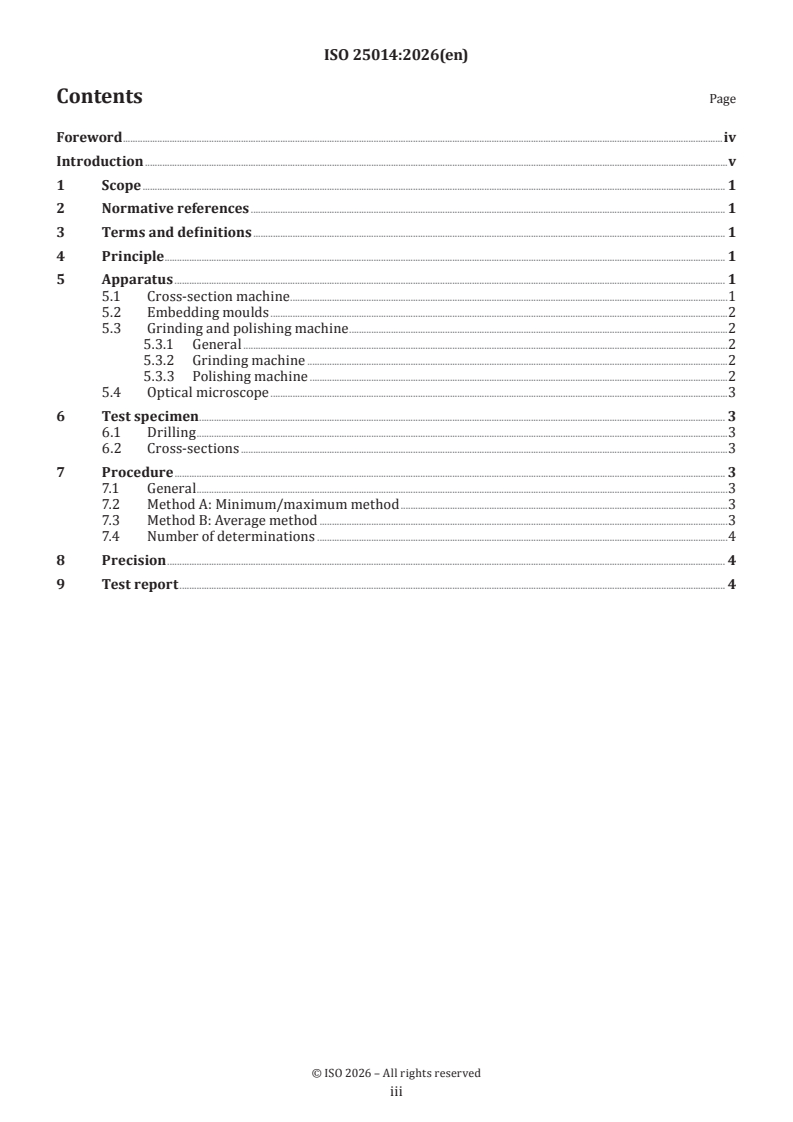
Contents Page
Foreword .iv
Introduction .v
1 Scope . 1
2 Normative references . 1
3 Terms and definitions . 1
4 Principle . 1
5 Apparatus . 1
5.1 Cross-section machine .1
5.2 Embedding moulds .2
5.3 Grinding and polishing machine .2
5.3.1 General .2
5.3.2 Grinding machine .2
5.3.3 Polishing machine .2
5.4 Optical microscope .3
6 Test specimen . 3
6.1 Drilling .3
6.2 Cross-sections .3
7 Procedure . 3
7.1 General .3
7.2 Method A: Minimum/maximum method .3
7.3 Method B: Average method .3
7.4 Number of determinations .4
8 Precision . 4
9 Test report . 4
iii
Foreword
ISO (the International Organization for Standardization) is a worldwide federation of national standards
bodies (ISO member bodies). The work of preparing International Standards is normally carried out through
ISO technical committees. Each member body interested in a subject for which a technical committee
has been established has the right to be represented on that committee. International organizations,
governmental and non-governmental, in liaison with ISO, also take part in the work. ISO collaborates closely
with the International Electrotechnical Commission (IEC) on all matters of electrotechnical standardization.
The procedures used to develop this document and those intended for its further maintenance are described
in the ISO/IEC Directives, Part 1. In particular, the different approval criteria needed for the different types
of ISO document should be noted. This document was drafted in accordance with the editorial rules of the
ISO/IEC Directives, Part 2 (see www.iso.org/directives).
ISO draws attention to the possibility that the implementation of this document may involve the use of (a)
patent(s). ISO takes no position concerning the evidence, validity or applicability of any claimed patent
rights in respect thereof. As of the date of publication of this document, ISO had not received notice of (a)
patent(s) which may be required to implement this document. However, implementers are cautioned that
this may not represent the latest information, which may be obtained from the patent database available at
www.iso.org/patents. ISO shall not be held responsible for identifying any or all such patent rights.
Any trade name used in this document is information given for the convenience of users and does not
constitute an endorsement.
For an explanation of the voluntary nature of standards, the meaning of ISO specific terms and expressions
related to conformity assessment, as well as information about ISO's adherence to the World Trade
Organization (WTO) principles in the Technical Barriers to Trade (TBT), see www.iso.org/iso/foreword.html.
This document was prepared by Technical Committee ISO/TC 35, Paints and varnishes, Subcommittee SC 9,
General test methods for paints and varnishes.
Any feedback or questions on this document should be directed to the user’s national standards body. A
complete listing of these bodies can be found at www.iso.org/members.html.
iv
Introduction
Physical properties of coatings depend strongly on the film thickness. Hence, the knowledge of the film
thickness in a coating system is important for the product development as well as for the application and
evaluation of claims. Determining the film thickness of systems filled with quartz sand can be particularly
difficult. The method specified in this document can help to determine the film thickness of these systems.
The method described in this document is especially used for measuring the film thickness in cured flooring
system build-ups.
v
---------------------- Page
...