

ISO 22785-1:2026
(Main)Paints and varnishes — Coatings on plastics and composites — Part 1: General introduction
- Abstract
This document specifies the applicability of general test methods for coatings resulting from paints and varnishes (hereinafter referred to as “coatings”) on plastics, plastics composites and similar substrates, hereinafter collectively referred to under the term “plastics”. It provides a general introduction to the particularities of coatings on plastics.
- Status
- Published
- Publication Date
- 02-Aug-2026
- Technical Committee
- ISO/TC 35/SC 9 - General test methods for paints and varnishes
- Drafting Committee
- ISO/TC 35/SC 9/WG 31 - Properties after application
- Current Stage
- 6060 - International Standard published
- Start Date
- 03-Aug-2026
- Due Date
- 06-May-2027
- Completion Date
- 03-Aug-2026
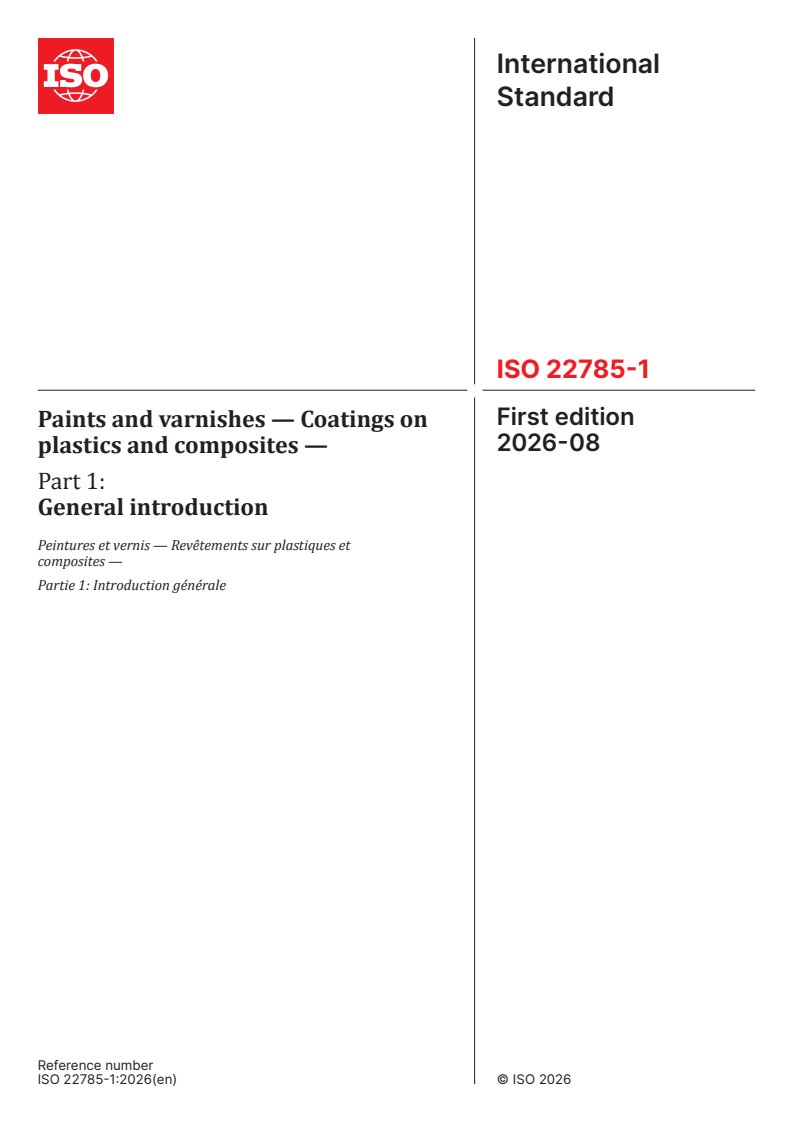
ISO 22785-1:2026 is an International Standard from ISO for paints and varnishes. It gives a general introduction to coatings on plastics and composites, and it explains when general test methods are applicable to those coated plastics and why results can differ from tests on metallic substrates. It is written for people who select, prepare, condition, or interpret tests for coated plastics.
What does ISO 22785-1:2026 specify?
ISO 22785-1:2026 specifies the applicability of general test methods for coatings on plastics, plastics composites, and similar substrates, which the document groups under the term “plastics”. It also explains the particularities of coatings on plastics so users can judge whether a test condition or evaluation approach is suitable.
The document is organized into these main parts:
- Clause 1 Scope
- Clause 2 Normative references
- Clause 3 Terms and definitions
- Clause 4 Plastics substrates
- Clause 5 Function of coatings on plastics substrates
- Clause 6 Characteristics of plastics substrates
- Clause 7 Conditioning after coating
- Clause 8 Effect of the differences to metallic substrates
- Annex A, informative, overview of typical plastics and their characteristics
Annex A gives extract information on typical plastics, copolymers, and composites, including their usual characteristics, uses, and chemical resistance.
What are the key requirements of ISO 22785-1:2026?
ISO 22785-1:2026 is mainly a guidance document, but it sets out the material and test factors that must be considered when testing coatings on plastics. In practice, it tells users what can influence the test result and therefore what should be controlled, documented, or interpreted with care.
Plastics substrates used in the series
Clause 4 states that the substrates covered by the ISO 22785 series are homopolymers, copolymers, composites, and recyclates made from these materials. This matters because recycled material and mixtures can behave differently from virgin plastics, so the coating process and test result may change.
Coating functions on plastics
Clause 5 lists typical coating functions such as decorative effects, thermal functions, mechanical protection, adhesive strength, UV protection, sealing or barrier effect, wettability, and burning behaviour. It also explains that coatings on plastics can behave differently from coatings on metals, especially when one coating must meet several functions at once.
Substrate characteristics that affect test behaviour
Clause 6 explains the substrate properties that can influence coating performance and test outcomes, including thermal conductivity, specific heat capacity, transparency, sample thickness, deformation, phase transitions, ageing, additive migration, barrier effect, thermal expansion, water absorption and release, adhesive strength, density, elasticity, and electrical and magnetic properties. For users, this means the same coating can show different scratch, ageing, adhesion, or weathering behaviour depending on the plastic underneath.
Conditioning after coating
Clause 7 says conditioning is used to improve repeatability and reproducibility. It notes that coated plastics are often conditioned at lower temperatures and for longer times than coated metals, and that the values and times depend on the material and the relevant test method.
Differences from metallic substrates
Clause 8 explains that the chemical and physical differences between plastics and metals affect pretreatment, coating application, and the coating tests themselves. It also points users to the individual parts of the ISO 22785 series for the relevant effects and evaluation methods before and after stressing.
What terms does ISO 22785-1:2026 define?
- Transparency - a material or coating property that lets radiation pass with little scattering or absorption so the substrate can be seen clearly.
- Opaque - a quality meaning the material or coating is impenetrable.
- Plastic - a material with a high polymer as an essential ingredient that can be shaped by flow during processing.
- Homopolymer - a polymer made from one kind of monomer.
- Copolymer - a polymer made from more than one kind of monomer.
- Composite - a solid product with two or more distinct phases, including a matrix and particulate or fibrous material.
- Recyclate - plastics material obtained by recycling plastics waste.
- Conditioning - measures that bring a test specimen to a uniform equilibrium state of temperature and humidity.
Who uses ISO 22785-1:2026?
ISO 22785-1:2026 is used by coating laboratories, paint and varnish developers, quality managers, test engineers, and buyers who need to specify or interpret tests on coated plastics. It is also relevant to organizations working with automotive parts, electrical housings, packaging, glazing, and other technical plastic parts where coatings have decorative, protective, or functional roles.
Which standards are used with ISO 22785-1:2026?
The document refers to ISO 4618 for the vocabulary of paints and varnishes. It also points to the rest of the series, where:
- ISO 22785-2 covers weathering and irradiation testing
- ISO 22785-3 covers constant climate and alternating climate testing
- ISO 22785-4 covers abrasion and scratch testing
- ISO 22785-5 covers chemical resistance testing
- ISO 22785-6 covers stone-chip resistance testing
- ISO 22785-7 covers adhesion
- ISO 22785-8 covers film thickness
For related conditioning and specimen practice, the document names ISO 291 for standard atmospheres for conditioning and testing plastics, ISO 1514 for standard panels for testing, and ISO 3270 for temperatures and humidities for conditioning and testing.
What does the ISO 22785-1:2026 document contain?
ISO 22785-1:2026 contains explanatory text on how plastics differ from metals in ways that matter for coating tests. Clause 6 is the main technical part, with separate subsections on thermal, mechanical, moisture-related, and electrical characteristics of plastics substrates. Annex A adds tables of typical plastics, copolymers, and composites with their usual characteristics, uses, and chemical resistance. The bibliography points to plastics and coating standards plus reference literature and online material databases used to understand substrate behaviour.
Get Certified
Connect with accredited certification bodies for this standard

DIN CERTCO
DIN Group product certification.

Smithers Quality Assessments
US management systems and product certification.
Sponsored listings
Frequently Asked Questions
ISO 22785-1:2026 is a standard published by the International Organization for Standardization (ISO). Its full title is "Paints and varnishes — Coatings on plastics and composites — Part 1: General introduction". This standard covers: This document specifies the applicability of general test methods for coatings resulting from paints and varnishes (hereinafter referred to as “coatings”) on plastics, plastics composites and similar substrates, hereinafter collectively referred to under the term “plastics”. It provides a general introduction to the particularities of coatings on plastics.
This document specifies the applicability of general test methods for coatings resulting from paints and varnishes (hereinafter referred to as “coatings”) on plastics, plastics composites and similar substrates, hereinafter collectively referred to under the term “plastics”. It provides a general introduction to the particularities of coatings on plastics.
ISO 22785-1:2026 is classified under the following ICS (International Classification for Standards) categories: 83.080.01 - Plastics in general; 83.120 - Reinforced plastics; 87.040 - Paints and varnishes. The ICS classification helps identify the subject area and facilitates finding related standards.
ISO 22785-1:2026 is available in PDF format for immediate download after purchase. The document can be added to your cart and obtained through the secure checkout process. Digital delivery ensures instant access to the complete standard document.
Standards Content (Sample)
International
Standard
ISO 22785-1
First edition
Paints and varnishes — Coatings on
2026-08
plastics and composites —
Part 1:
General introduction
Peintures et vernis — Revêtements sur plastiques et
composites —
Partie 1: Introduction générale
Reference number
© ISO 2026
All rights reserved. Unless otherwise specified, or required in the context of its implementation, no part of this publication may
be reproduced or utilized otherwise in any form or by any means, electronic or mechanical, including photocopying, or posting on
the internet or an intranet, without prior written permission. Permission can be requested from either ISO at the address below
or ISO’s member body in the country of the requester.
ISO copyright office
CP 401 • Ch. de Blandonnet 8
CH-1214 Vernier, Geneva
Phone: +41 22 749 01 11
Email: copyright@iso.org
Website: www.iso.org
Published in Switzerland
ii
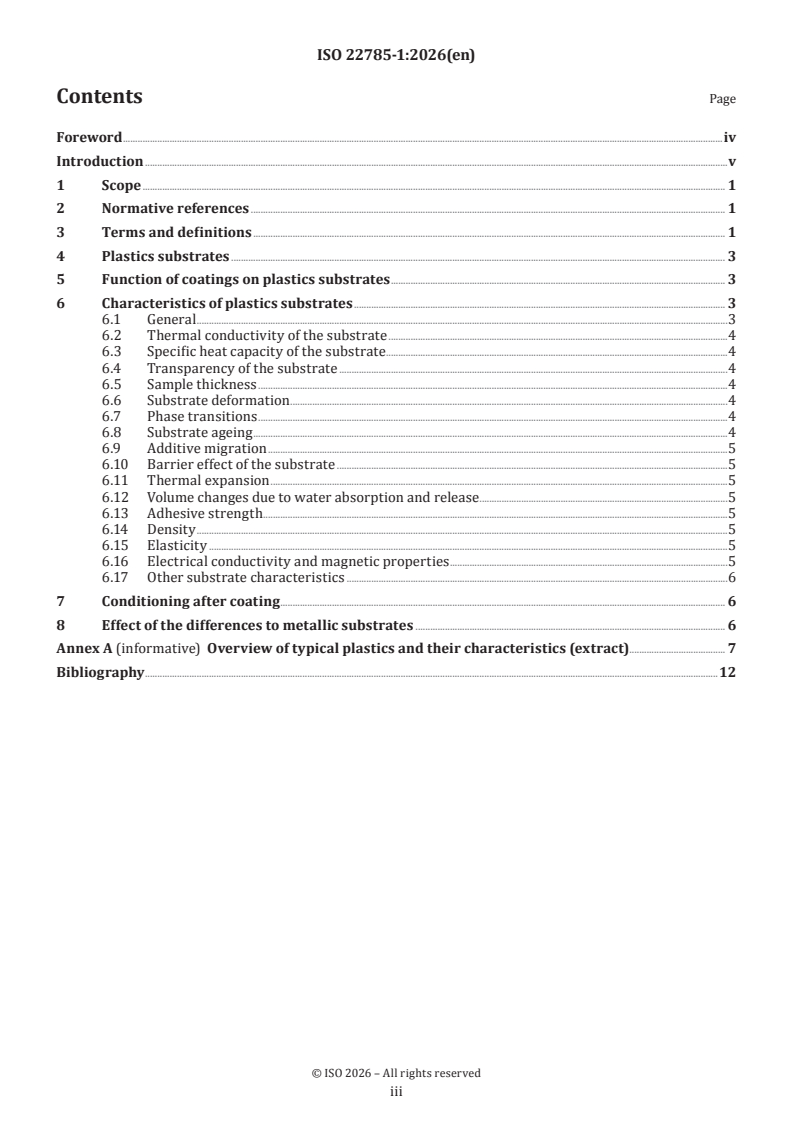
Contents Page
Foreword .iv
Introduction .v
1 Scope . 1
2 Normative references . 1
3 Terms and definitions . 1
4 Plastics substrates . 3
5 Function of coatings on plastics substrates . 3
6 Characteristics of plastics substrates . 3
6.1 General .3
6.2 Thermal conductivity of the substrate .4
6.3 Specific heat capacity of the substrate .4
6.4 Transparency of the substrate .4
6.5 Sample thickness .4
6.6 Substrate deformation .4
6.7 Phase transitions .4
6.8 Substrate ageing .4
6.9 Additive migration .5
6.10 Barrier effect of the substrate .5
6.11 Thermal expansion .5
6.12 Volume changes due to water absorption and release .5
6.13 Adhesive strength . .5
6.14 Density .5
6.15 Elasticity .5
6.16 Electrical conductivity and magnetic properties .5
6.17 Other substrate characteristics .6
7 Conditioning after coating . 6
8 Effect of the differences to metallic substrates . 6
Annex A (informative) Overview of typical plastics and their characteristics (extract) . 7
Bibliography .12
iii
Foreword
ISO (the International Organization for Standardization) is a worldwide federation of national standards
bodies (ISO member bodies). The work of preparing International Standards is normally carried out through
ISO technical committees. Each member body interested in a subject for which a technical committee
has been established has the right to be represented on that committee. International organizations,
governmental and non-governmental, in liaison with ISO, also take part in the work. ISO collaborates closely
with the International Electrotechnical Commission (IEC) on all matters of electrotechnical standardization.
The procedures used to develop this document and those intended for its further maintenance are described
in the ISO/IEC Directives, Part 1. In particular, the different approval criteria needed for the different types
of ISO document should be noted. This document was drafted in accordance with the editorial rules of the
ISO/IEC Directives, Part 2 (see www.iso.org/directives).
ISO draws attention to the possibility that the implementation of this document may involve the use of (a)
patent(s). ISO takes no position concerning the evidence, validity or applicability of any claimed patent
rights in respect thereof. As of the date of publication of this document, ISO had not received notice of (a)
patent(s) which may be required to implement this document. However, implementers are cautioned that
this may not represent the latest information, which may be obtained from the patent database available at
www.iso.org/patents. ISO shall not be held responsible for identifying any or all such patent rights.
Any trade name used in this document is information given for the convenience of users and does not
constitute an endorsement.
For an explanation of the voluntary nature of standards, the meaning of ISO specific terms and expressions
related to conformity assessment, as well as information about ISO's adherence to the World Trade
Organization (WTO) principles in the Technical Barriers to Trade (TBT), see www.iso.org/iso/foreword.html.
This document was prepared by Technical Committee ISO/TC 35, Paints and varnishes, Subcommittee SC 9,
General test methods for paints and varnishes.
A list of all parts in the ISO 22785 series can be found on the ISO website.
Any feedback or questions on this document should be directed to the user’s national standards body. A
complete listing of these bodies can be found at www.iso.org/members.html.
iv
Introduction
Many of the existing test methods for coatings resulting from paints and varnishes have been developed for
metallic substrates and were often applied to plastics substrates in the past.
This document explains characteristics of and differences between plastics and metallic substrates and
shows their possible effect on the behaviour of the coating in various test methods.
It is possible that the substrate has an effect on the behaviour of the coating during tests. Therefore, it can be
useful to select test conditions which are based, for example, on standards from the plastics sector and not
on standards from the coating sector, in order to take into account influencing factors such as the thermal
conductivity of the substrate.
This document provides a general introduction to the particularities and terms and definitions of coatings
on plastics and composites. The test methods for which deviating behaviour of the coating can occur on
plastics substrates and which measures can possibly be taken are dealt with in the other parts of the
ISO 22785 series. The structure of the ISO 22785 series is as follows:
— ISO 22785-2 on weathering and irradiation testing
— ISO 22785-3 on constant climate and alternating climate testing
— ISO 22785-4 on abrasion and scratch testing
— ISO 22785-5 on chemical resistance testing
— ISO 22785-6 on stone-chip resistance testing
— ISO 22785-7 on adhesion
— ISO 22785-8 on film thickness
v
International Standard ISO 22785-1:2026(en)
Paints and varnishes — Coatings on plastics and
composites —
Part 1:
General introduction
1 Scope
This document specifies the applicability of general test methods for coatings resulting from paints and
varnishes (hereinafter referred to as “coatings”) on plastics, plastics composites and similar substrates,
hereinafter collectively referred to under the term “plastics”. It provides a general introduction to the
particularities of coatings on plastics.
2 Normative references
The following documents are referred to in the text in such a way that some or all of their content constitutes
requirements of this document. For dated references, only the edition cited applies. For undated references,
the latest edition of the referenced document (including any amendments) applies.
ISO 4618, Paints and varnishes — Vocabulary
3 Terms and definitions
For the purposes of this document, the terms and definitions given in ISO 4618 and the following apply.
ISO and IEC maintain terminology databases for use in standardization at the following addresses:
— ISO Online browsing platform: available at https:// www .iso .org/ obp
— IEC Electropedia: available at https:// www .electropedia .org/
3.1
transparency
property of a material or coating by which a negligible portion of the transmitted radiation undergoes
scattering or absorption, thereby enabling objects or the substrate to be distinguished clearly through the
material
[SOURCE: ISO 472:2013, 2.1200, modified — definition extended to coatings; “light” replaced by “radiation”;
"or absorption" added; "or the substrate" added.]
3.2
opaque
quality whereby materials or coatings are impenetrable
Note 1 to entry: Depending on the thickness, most real materials and paints and varnishes are neither completely
opaque nor completely transparent.
3.3
plastic
material which contains as an essential ingredient a high polymer and which, at some stage in its processing
into finished products, can be shaped by flow
Note 1 to entry: Elastomeric materials, which are also shaped by flow, are not considered to be plastics.
Note 2 to entry: In some countries, particularly the United Kingdom, the term “plastics” is used as the singular form as
well as the plural form.
[SOURCE: ISO 472:2013, 2.702]
3.4
homopolymer
polymer derived from a single species of monomer
[SOURCE: ISO 472:2013, 2.465]
3.5
copolymer
polymer derived from more than one species of monomer
[SOURCE: ISO 472:2013, 2.212]
3.6
composite
solid product consisting of two or more distinct phases, including a binding material (matrix) and a
particulate or fibrous material
[SOURCE: ISO 472:2013, 2.182.1, modified — example omitted]
3.7
recyclate
plastics (3.3) material resulting from the recycling of plastics waste
Note 1 to entry: The terms “secondary raw material”, “recycled plastics” and “regenerate” are sometimes used
synonymously with “recyclate”.
Note 2 to entry: As soon as the used plastics material is treated in such a way that it is ready to replace virgin product,
material or substance in a production process, it loses its characteristics as waste.
[SOURCE: ISO 472:2013, 2.1705]
3.8
ageing
entirety of all irreversible chemical and physical processes occurring in a material in the course of time
Note 1 to entry: For testing purposes, ageing is often artificially induced.
Note 2 to entry: In literature, the term “physical ageing” can also be found, which sometimes refers only to a (thermo-)
reversible change of polymeric materials.
3.9
conditioning
measures which bring the test specimen to a uniform state and thus to a state of equilibrium (temperature
and humidity) within a specified period of time
Note 1 to entry: The conditioning of plastics (3.3) and its coating can have an influence on the result of a test. Therefore,
it is important to indicate how the object to be tested was conditioned before exposure. This can include storage of
the test specimen under standard conditions (see ISO 3270 for coatings and ISO 291 for uncoated plastics) or forced
conditioning. The aim of conditioning is to create the same conditions for all test specimens. Particularly moisture-
sensitive materials, e.g. polyamides (PA), are usually force-dried.
4 Plastics substrates
The plastics substrates used in the test methods of the ISO 22785 series are: homopolymers, copolymers,
composites and recyclates from these materials.
5 Function of coatings on plastics substrates
Coatings on plastics can differ in composition, adhesive strength, pretreatment and other aspects from
coatings on metals. Also, the required functionalities can differ compared to metal substrates. Often, it is
expected that several requirements are met simultaneously, such as for the automotive sector. Depending on
the functionality or functionalities, fulfilling multiple requirements at the same time can affect the ageing
behaviour.
Typical functionalities on plastics substrates are:
a) decorative: colour, gloss, reflection and other optical effects;
b) thermal: thermal insulation and infrared (IR) reflection;
c) mechanical: scratch protection, hardness;
d) adhesive strength;
e) light/ultraviolet (UV) protection;
f) sealing/barrier effect/insulation;
g) adhesion characteristics/wettability (hydrophobic, etc.);
h) burning behaviour.
Major differences between metal and plastics substrates can be found in the thermal characteristics,
the hardness and the proportion of water absorption and release. The influence o
...