


ISO 2718:1974
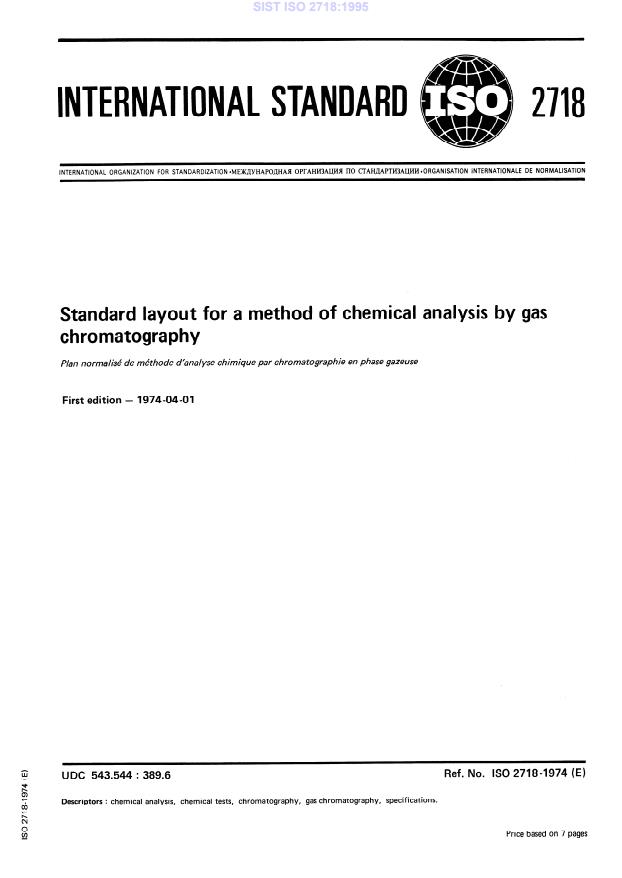
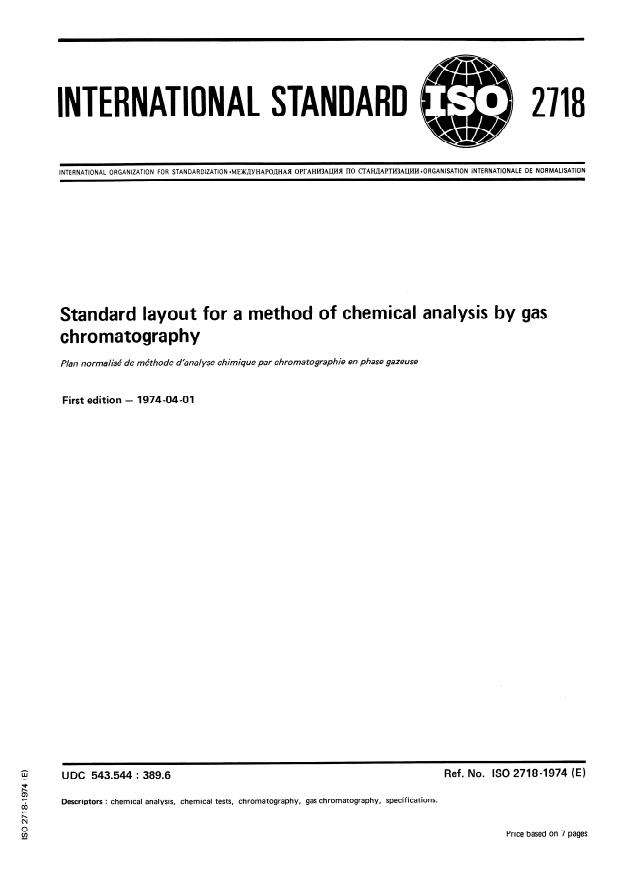
(Main)Standard layout for a method of chemical analysis by gas chromatography
Standard layout for a method of chemical analysis by gas chromatography
Gives detailed notes on the application of the layout. Deals with the titel of the publication, the scope and field of application, describes the details of the subject of the investigation. Specifies the materials, apparatus and characteristics which are to be used. Describes the details of the sample and procedure. Specifies the expression of results particularly those which are to be observed in the test report, and that all hazards are to be grouped. They shall be given under an appropriate heading. The annex contains calculation formulae.
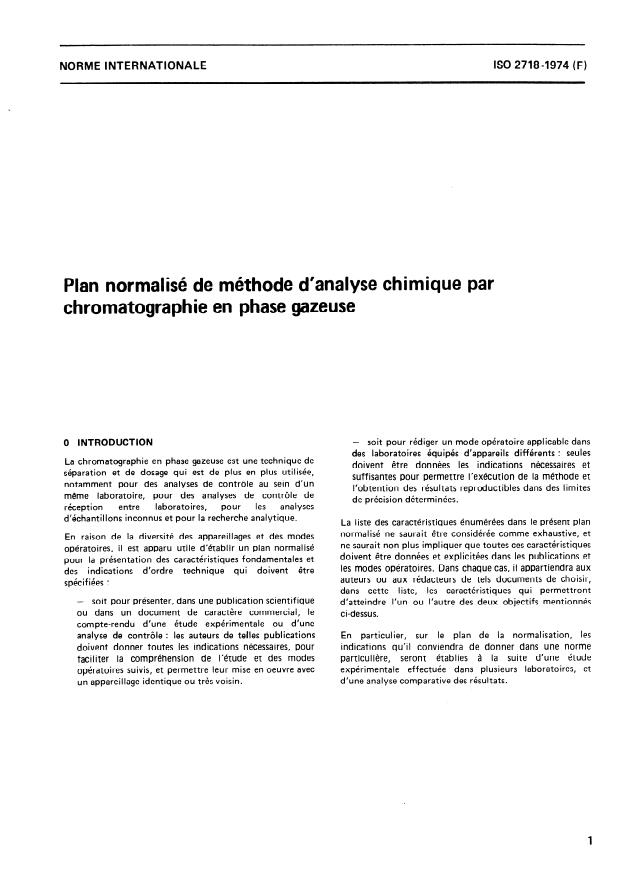
Plan normalisé de méthode d'analyse chimique par chromatographie en phase gazeuse
Priprava standarda za kemijsko analizo z metodo plinske kromatografije
General Information
- Status
- Withdrawn
- Publication Date
- 31-Mar-1974
- Withdrawal Date
- 31-Mar-1974
- Technical Committee
- ISO/TC 47 - Chemistry
- Drafting Committee
- ISO/TC 47 - Chemistry
- Current Stage
- 9599 - Withdrawal of International Standard
- Start Date
- 03-Oct-2016
- Completion Date
- 14-Feb-2026
Buy Documents


ISO 2718:1974 - Standard layout for a method of chemical analysis by gas chromatography
ISO 2718:1974 - Plan normalisé de méthode d'analyse chimique par chromatographie en phase gazeuse
ISO 2718:1974 - Plan normalisé de méthode d'analyse chimique par chromatographie en phase gazeuse
Get Certified
Connect with accredited certification bodies for this standard

ECOCERT
Organic and sustainability certification.

Eurofins Food Testing Global
Global leader in food, environment, and pharmaceutical product testing.

Intertek Bangladesh
Intertek certification and testing services in Bangladesh.
Sponsored listings
Frequently Asked Questions
ISO 2718:1974 is a standard published by the International Organization for Standardization (ISO). Its full title is "Standard layout for a method of chemical analysis by gas chromatography". This standard covers: Gives detailed notes on the application of the layout. Deals with the titel of the publication, the scope and field of application, describes the details of the subject of the investigation. Specifies the materials, apparatus and characteristics which are to be used. Describes the details of the sample and procedure. Specifies the expression of results particularly those which are to be observed in the test report, and that all hazards are to be grouped. They shall be given under an appropriate heading. The annex contains calculation formulae.
Gives detailed notes on the application of the layout. Deals with the titel of the publication, the scope and field of application, describes the details of the subject of the investigation. Specifies the materials, apparatus and characteristics which are to be used. Describes the details of the sample and procedure. Specifies the expression of results particularly those which are to be observed in the test report, and that all hazards are to be grouped. They shall be given under an appropriate heading. The annex contains calculation formulae.
ISO 2718:1974 is classified under the following ICS (International Classification for Standards) categories: 71.040.40 - Chemical analysis. The ICS classification helps identify the subject area and facilitates finding related standards.
ISO 2718:1974 is available in PDF format for immediate download after purchase. The document can be added to your cart and obtained through the secure checkout process. Digital delivery ensures instant access to the complete standard document.
Standards Content (Sample)
SLOVENSKI STANDARD
01-avgust-1995
Priprava standarda za kemijsko analizo z metodo plinske kromatografije
Standard layout for a method of chemical analysis by gas chromatography
Plan normalisé de méthode d'analyse chimique par chromatographie en phase gazeuse
Ta slovenski standard je istoveten z: ISO 2718:1974
ICS:
71.040.40 Kemijska analiza Chemical analysis
2003-01.Slovenski inštitut za standardizacijo. Razmnoževanje celote ali delov tega standarda ni dovoljeno.
INTERNATIONAL STANDARD
INTERNATIONAL ORGANIZATION FOR STANDARDIZATION l MEXJIJYHAPOjIJHAfl OPI-AHW3ALU-W l-IO CTAHflAPTki3ALJWW .ORGANISATION [NTERNATIONALE DE NORMALISATION
Standard layout for a method of Chemical analysis by gas
chromatography
Plan normalis4 de methode d’analyse chimique par Chromatographie en Phase gazeuse
First edition - 1974-04-01
w
UDC 543.544 : 389.6 Ref. No. ISO 2718-1974 (E)
-
Descriptors : Chemical analysis, Chemical tests, chromatography, gas chromatography, specifications.
P-
Price based on 7 pages
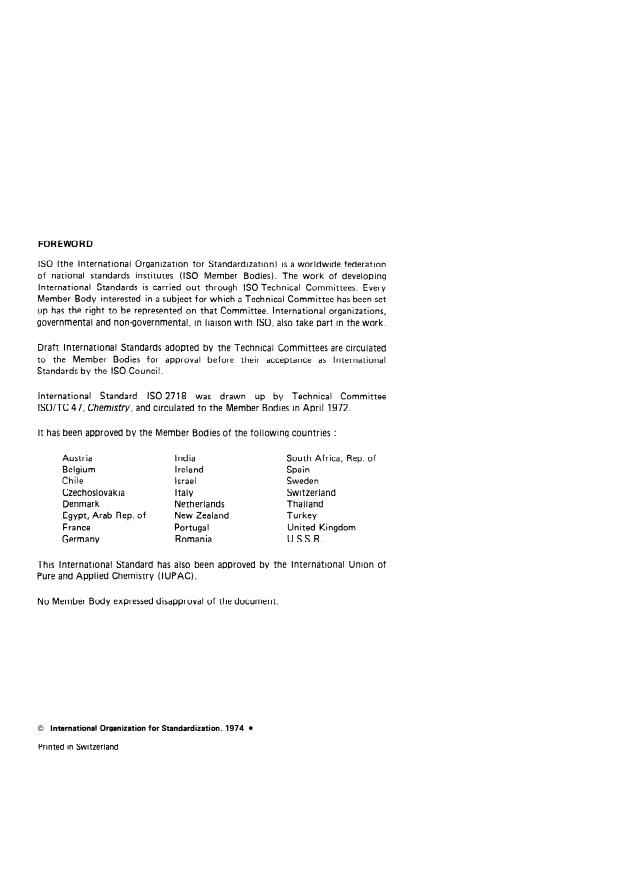
FOREWORD
ISO (the International Organization for Standardization) is a woridwide federation
of national Standards institutes (ISO Member Bodies). The work of deveioping
International Standards is carried out through ISO Technical Committees. Every
Member Body interested in a subject for which a Technicai Committee has been set
up has the right to be represented on that Committee. International organizations,
governmentai and non-governmentai, in liaison with ISO, also take part in the work.
Draft International Standards adopted by the Technicai Committees are circuiated
to the Member Bodies for approval before their acceptance as International
Standards by the ISO Council.
International Standard ISO 2718 was drawn up by Technical Committee
ISO/TC 47, Chemistry, and circuiated to the Member Bodies in April 1972.
lt has been approved by the Member Bodies of the foliowing countries :
Austria India South Africa, .Rep. of
Beigium Ireiand Spain
Chile Israel Sweden
Czechosiovakia I taiy Swi tzeriand
Denmark Netherlands Thailand
Egypt, Arab Rep. of New Zeaiand Turkey
France Portuga i United Kingdom
Germany Romania U.S.S.R.
This International Standard has also been approved by the International Union of
Pure and Applied Chemistry (IUPAC).
No Member Body expressed disapprovai of the document.
0 International Organkation for Standardkation, 1974 l
Printed in Switzerland
--~~_~~ ~- ~~
ISO 27184974 (E)
INTERNATIONAL STANDARD
Standard layout for a method of Chemical analysis by gas
chromatography
-
to draw up procedures capable of appiication in
0 INTRODUCTION
iaboratories equipped with different apparatus. Oniy
Gas chromatography is a separatory and analyticai
those detaiis that are sufficient to allow the method to
technique which is being utiiized increasingiy, particuiariy
be put into practice and reproducible results to be
for check anaiyses within the same iaboratory, for check
obtained, within determined iimits of precision, should
anaiyses for acceptance between laboratories, for analyses
be given.
of unknown sampies, and for anaiyticai research.
The iist of characteristics enumerated in this Standard
Because of the diversity of apparatus and working methods,
layout should not be regarded as exhaustive, nor is there
it seems desirable to establish a Standard iayout for the
any intention to impiy that all these characteristics should
basic characteristics and instructions of a technicai nature
be given and explained in publications and procedures.
which shouid be specified for either of the foiiowing
The authors or editors of such documents should select
purposes :
from this list the characteristics necessary to achieve one or
--
to present a report of an experimental investigation other of the two objectives mentioned above.
or of a check anaiysis in a scientific pubiication or in a
In particular, from the Point of view of standardization, the
document of a commerciai nature. The authors of such
detaiis given in a particuiar Standard should be decided at
pubiications shouid give all the necessary instructions to
the conclusion of an experimental investigation carried out
enabie the document to be understood and the
in severai laboratories and after a comparative analysis of
procedure to be foliowed with the aid of identicai or
the results.
cioseiy reiated equipment.
ISO 2718-1974 (E)
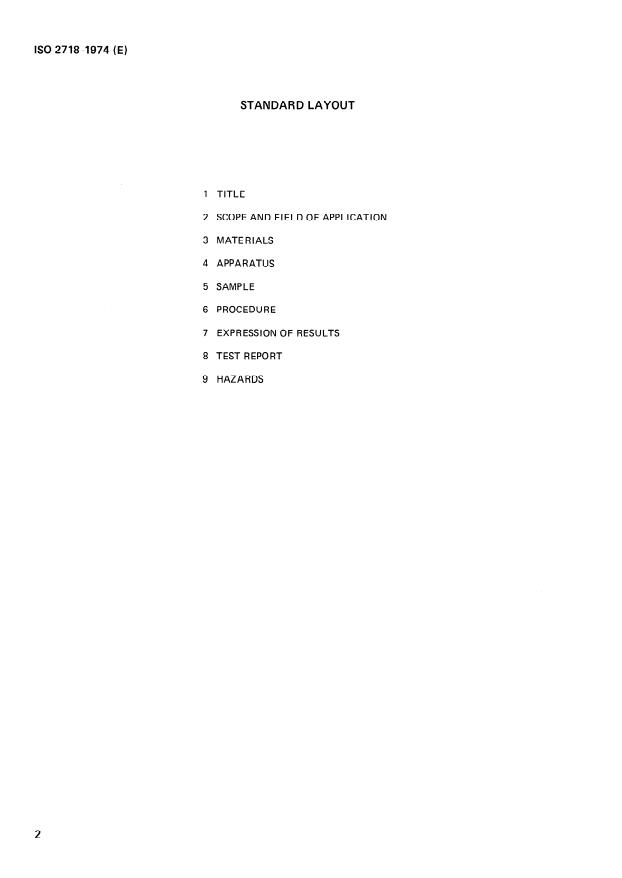
STANDARD LAYOUT
TITLE
SCOPE AND FIELD OF APPLICATION
MATERIALS
APPARATUS
SAMPLE
PROCEDURE
EXPRESSION OF RESULTS
TEST REPORT
HAZARDS
ISO 27184974 (E)
NOTES ON THE APPLICATION OF THE STANDARD LAYOUT
4.3 Columns (and pre-column)
1 TITLE
The title of the pubiication or Standard shali express its
4.3.1 Number
contents without any ambiguity, mentioning briefiy the
products concerned and the nature of the analysis. -
Grouping and switching of the columns.
4.3.2 Column
-
Nature of the column (material and treatment).
2 SCOPE AND FIELD OF APPLICATION
- Length and packed iength.
This ciause shall contain precise details of the subject of the
- lnternal and external diameters.
investigation or Standard, and particularly of the fieid of
appiication of the method described. lt shall inciude a brief
- Form (U, W or helical . . .).
summary of the investigation or Standard which shali be
suitabie for use as an abstract.
- Radius of any curve.
4.3.3 Packing
4.3.3.1 Support
3 MATERIALS
- Nature (description, batch . . .).
Mention any hazard present and Cross-refer to clause 9,
- Particle size.
“Hazards”.
- Treatment, if any.
3.1 Carrier gas and auxiliary gases
4.3.3.2 Stationary Phase
-
Nature and commerciai description.
- Chemical nature.
-
Content of impurities and method of purification.
without
- Degree of impregnation : indicate,
ambiguity, the proportions of stationary Phase and
3.2 Materials for the preparation of calibration samples.
support (for example, in grams of stationary Phase per
100 g of support, or as the percentage by mass of
stationary Phase in relation to the total of
3.3 Cross-refer to 4.3 for coiumn details, including
support + Phase).
packing and preparation.
4.3.3.3 Active adsorbent
- Nature.
4 APPARATUS
- Particie size and/or other physical characteristics.
- Activation.
4.1 Type of apparatus
4.3.3.4 Other packing
4.1 .l Characteristics of the assembiy (oven, temperature
- Modified adsorbents.
.), special devices.
reguiation . .
- Porous Polymers.
4.1.2 Devices for the control of pressure, or of the flow of
carrier gas and auxiliary gases.
4.3.3.5 Method of packing and mass introduced.
4.2 I njection device 4.3.4 Efficiency and resolution
- Type.
4.3.4.1 Efficiency under given conditions.
- Material.
4.3.4.2 Resolution under given conditions.
- Characteristics.
- Miscellaneous accessories. 4.4 Flow Splitter
ISO 2718-1974 (E)
4.5 Detector 6.1.2.2 Flow of carrier gas
- Type. - Isobaric conditions :
- Characteristics. rate of flow;
- Associated electronie device (characteristics of the pressures at iniet and outlet of the column.
electrometer).
- Programmed conditions :
4.6 Recorder and/or integrator
initial period and initial flow rate;
- Type.
Programme of flow Variation;
- Sensitivity.
back flushing.
- Impedance.
6.1.3 Flow Splitter
- Response time.
- Split ratio.
Electronie data processing System
4.7
6.1.4 Detector
4.8 Accessories
- Temperature and permitted iimits.
-
Electrical control S.
5 SAMPLE
- Regulation of auxiliary gases.
- Nature :
6.1.5 Recorder
name;
- Chart Speed.
description;
- Initial attenuation.
supposed composition.
- Method of sampling and storage.
6.1.6 lntegrator
- Special considerations that may be involved during
6.2 Calibration
the analysis (volatility, stability, explosivity, toxicity,
etc. with reference to clause 9 “Hazards”, as
appropriate). 6.2.1 Methods of calibration
- Preliminary treatment (distillation, dissolution The following are the most generally used methods of
?
methylation or any other treatment). cal ibration :
6.2.1.1 lnternai n
...
INTERNATIONAL STANDARD
INTERNATIONAL ORGANIZATION FOR STANDARDIZATION l MEXJIJYHAPOjIJHAfl OPI-AHW3ALU-W l-IO CTAHflAPTki3ALJWW .ORGANISATION [NTERNATIONALE DE NORMALISATION
Standard layout for a method of Chemical analysis by gas
chromatography
Plan normalis4 de methode d’analyse chimique par Chromatographie en Phase gazeuse
First edition - 1974-04-01
w
UDC 543.544 : 389.6 Ref. No. ISO 2718-1974 (E)
-
Descriptors : Chemical analysis, Chemical tests, chromatography, gas chromatography, specifications.
P-
Price based on 7 pages
FOREWORD
ISO (the International Organization for Standardization) is a woridwide federation
of national Standards institutes (ISO Member Bodies). The work of deveioping
International Standards is carried out through ISO Technical Committees. Every
Member Body interested in a subject for which a Technicai Committee has been set
up has the right to be represented on that Committee. International organizations,
governmentai and non-governmentai, in liaison with ISO, also take part in the work.
Draft International Standards adopted by the Technicai Committees are circuiated
to the Member Bodies for approval before their acceptance as International
Standards by the ISO Council.
International Standard ISO 2718 was drawn up by Technical Committee
ISO/TC 47, Chemistry, and circuiated to the Member Bodies in April 1972.
lt has been approved by the Member Bodies of the foliowing countries :
Austria India South Africa, .Rep. of
Beigium Ireiand Spain
Chile Israel Sweden
Czechosiovakia I taiy Swi tzeriand
Denmark Netherlands Thailand
Egypt, Arab Rep. of New Zeaiand Turkey
France Portuga i United Kingdom
Germany Romania U.S.S.R.
This International Standard has also been approved by the International Union of
Pure and Applied Chemistry (IUPAC).
No Member Body expressed disapprovai of the document.
0 International Organkation for Standardkation, 1974 l
Printed in Switzerland
--~~_~~ ~- ~~
ISO 27184974 (E)
INTERNATIONAL STANDARD
Standard layout for a method of Chemical analysis by gas
chromatography
-
to draw up procedures capable of appiication in
0 INTRODUCTION
iaboratories equipped with different apparatus. Oniy
Gas chromatography is a separatory and analyticai
those detaiis that are sufficient to allow the method to
technique which is being utiiized increasingiy, particuiariy
be put into practice and reproducible results to be
for check anaiyses within the same iaboratory, for check
obtained, within determined iimits of precision, should
anaiyses for acceptance between laboratories, for analyses
be given.
of unknown sampies, and for anaiyticai research.
The iist of characteristics enumerated in this Standard
Because of the diversity of apparatus and working methods,
layout should not be regarded as exhaustive, nor is there
it seems desirable to establish a Standard iayout for the
any intention to impiy that all these characteristics should
basic characteristics and instructions of a technicai nature
be given and explained in publications and procedures.
which shouid be specified for either of the foiiowing
The authors or editors of such documents should select
purposes :
from this list the characteristics necessary to achieve one or
--
to present a report of an experimental investigation other of the two objectives mentioned above.
or of a check anaiysis in a scientific pubiication or in a
In particular, from the Point of view of standardization, the
document of a commerciai nature. The authors of such
detaiis given in a particuiar Standard should be decided at
pubiications shouid give all the necessary instructions to
the conclusion of an experimental investigation carried out
enabie the document to be understood and the
in severai laboratories and after a comparative analysis of
procedure to be foliowed with the aid of identicai or
the results.
cioseiy reiated equipment.
ISO 2718-1974 (E)
STANDARD LAYOUT
TITLE
SCOPE AND FIELD OF APPLICATION
MATERIALS
APPARATUS
SAMPLE
PROCEDURE
EXPRESSION OF RESULTS
TEST REPORT
HAZARDS
ISO 27184974 (E)
NOTES ON THE APPLICATION OF THE STANDARD LAYOUT
4.3 Columns (and pre-column)
1 TITLE
The title of the pubiication or Standard shali express its
4.3.1 Number
contents without any ambiguity, mentioning briefiy the
products concerned and the nature of the analysis. -
Grouping and switching of the columns.
4.3.2 Column
-
Nature of the column (material and treatment).
2 SCOPE AND FIELD OF APPLICATION
- Length and packed iength.
This ciause shall contain precise details of the subject of the
- lnternal and external diameters.
investigation or Standard, and particularly of the fieid of
appiication of the method described. lt shall inciude a brief
- Form (U, W or helical . . .).
summary of the investigation or Standard which shali be
suitabie for use as an abstract.
- Radius of any curve.
4.3.3 Packing
4.3.3.1 Support
3 MATERIALS
- Nature (description, batch . . .).
Mention any hazard present and Cross-refer to clause 9,
- Particle size.
“Hazards”.
- Treatment, if any.
3.1 Carrier gas and auxiliary gases
4.3.3.2 Stationary Phase
-
Nature and commerciai description.
- Chemical nature.
-
Content of impurities and method of purification.
without
- Degree of impregnation : indicate,
ambiguity, the proportions of stationary Phase and
3.2 Materials for the preparation of calibration samples.
support (for example, in grams of stationary Phase per
100 g of support, or as the percentage by mass of
stationary Phase in relation to the total of
3.3 Cross-refer to 4.3 for coiumn details, including
support + Phase).
packing and preparation.
4.3.3.3 Active adsorbent
- Nature.
4 APPARATUS
- Particie size and/or other physical characteristics.
- Activation.
4.1 Type of apparatus
4.3.3.4 Other packing
4.1 .l Characteristics of the assembiy (oven, temperature
- Modified adsorbents.
.), special devices.
reguiation . .
- Porous Polymers.
4.1.2 Devices for the control of pressure, or of the flow of
carrier gas and auxiliary gases.
4.3.3.5 Method of packing and mass introduced.
4.2 I njection device 4.3.4 Efficiency and resolution
- Type.
4.3.4.1 Efficiency under given conditions.
- Material.
4.3.4.2 Resolution under given conditions.
- Characteristics.
- Miscellaneous accessories. 4.4 Flow Splitter
ISO 2718-1974 (E)
4.5 Detector 6.1.2.2 Flow of carrier gas
- Type. - Isobaric conditions :
- Characteristics. rate of flow;
- Associated electronie device (characteristics of the pressures at iniet and outlet of the column.
electrometer).
- Programmed conditions :
4.6 Recorder and/or integrator
initial period and initial flow rate;
- Type.
Programme of flow Variation;
- Sensitivity.
back flushing.
- Impedance.
6.1.3 Flow Splitter
- Response time.
- Split ratio.
Electronie data processing System
4.7
6.1.4 Detector
4.8 Accessories
- Temperature and permitted iimits.
-
Electrical control S.
5 SAMPLE
- Regulation of auxiliary gases.
- Nature :
6.1.5 Recorder
name;
- Chart Speed.
description;
- Initial attenuation.
supposed composition.
- Method of sampling and storage.
6.1.6 lntegrator
- Special considerations that may be involved during
6.2 Calibration
the analysis (volatility, stability, explosivity, toxicity,
etc. with reference to clause 9 “Hazards”, as
appropriate). 6.2.1 Methods of calibration
- Preliminary treatment (distillation, dissolution The following are the most generally used methods of
?
methylation or any other treatment). cal ibration :
6.2.1.1 lnternai normalization method
6 PROCEDURE
All the constituents are eluted and all the peaks measured.
The measurements are normaiized to 100, with the
6.1 Setting up the apparatus
calibration factor determined either by caiculation (see
6.2.3) or by measurement at each anaiysis (see 6.2.2.1).
6.1 .l lnjector
- Temperature and permitted limits.
6.2.1.2 lnternal Standard method
A known quantity of a known substance, whose peak does
6.1.2 Oven and column
not interfere with any other peaks,
...
NORME INTERNATIONALE
INTERNATIONAL ORGANIZATION FOR STANDARDIZATION l MEX~YHAPO~HAII OPl-AHH3ALW’l I-i0 ~AHP(APTH3A~L~ORGANISATION INTERNATIONALE DE NORMALISATION
Plan normalisé de méthode d’analyse chimique par
chromatographie en phase gazeuse
Standard la yout for a method of chemical analysis b y gas chromatograph y
Première édition - 1974-04-01
CDU 543.544 : 389.6 Réf. No : ISO 2718-1974 (F)
Descripteurs : analyse chimique, essai chimique, chromatographie, chromatographie en phase gazeuse, spécification.
Prix basé sur 7 pages
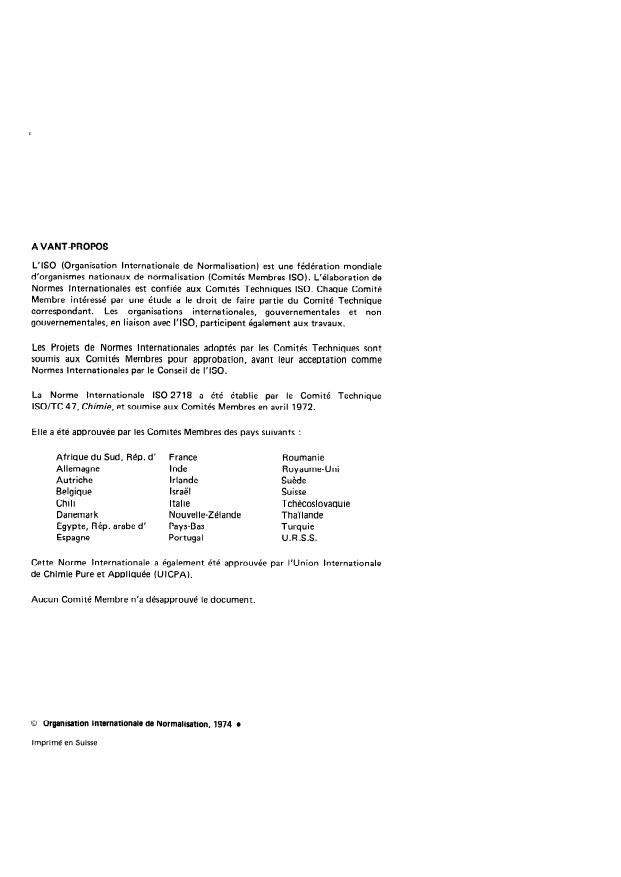
AVANT-PROPOS
L’ISO (Organisation Internationale de Normalisation) est une fédération mondiale
d’organismes nationaux de normalisation (Comités Membres KO). L’élaboration de
Normes Internationales est confiée aux Comités Techniques ISO. Chaque Comité
Membre intéressé par une étude a le droit de faire partie du Comité Technique
correspondant. Les organisations internationales, gouvernementales et non
gouvernementales, en liaison avec I’ISO, participent également aux travaux.
Les Projets de Normes Internationales adoptés par les Comités Techniques sont
soumis aux Comités Membres pour approbation, avant leur acceptation comme
Normes Internationales par le Conseil de I’ISO.
La Norme Internationale ISO 2718 a été établie par le Comité Technique
ISO/TC 47, Chimie, et soumise aux Comités Membres en avril 1972.
Elle a été approuvée par les Comités Membres des pays suivants :
Afrique du Sud, Rép. d’ France Roumanie
Allemagne Inde Royaume-Uni
Autriche Irlande Suède
Belgique Israël Suisse
Chili Italie Tchécoslovaquie
Nouvelle-Zélande Thaïlande
Danemark
Turquie
Egypte, Rép. arabe d’ Pays-Bas
Espagne Portugal U.R.S.S.
Cette Norme Internationale a également été approuvée par l’Union Internationale
de Chimie Pure et Appliquée (UICPA).
Aucun Comité Membre n’a désapprouvé le document.
0 Organisation Internationale de Normalisation, 1974 l
Imprimé en Suisse
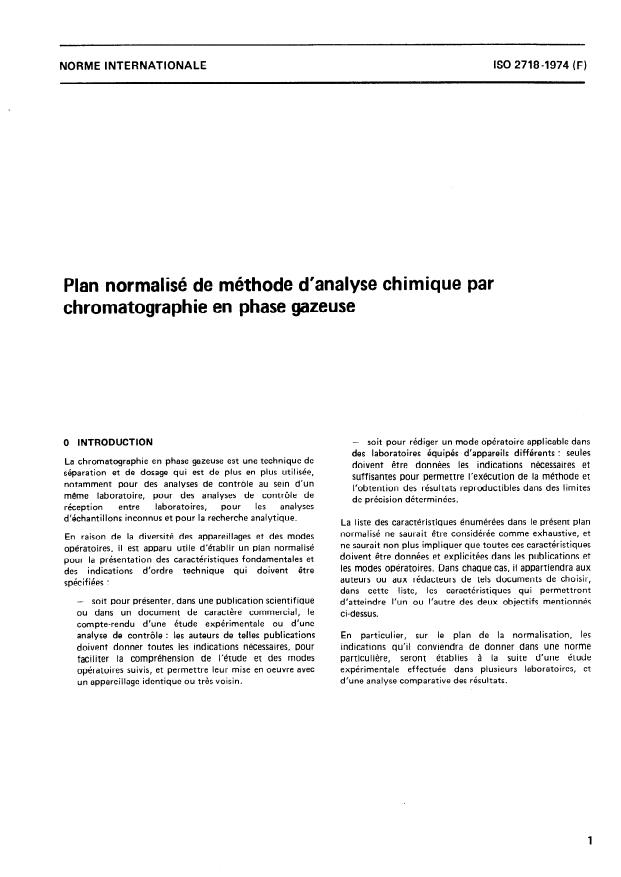
NORME INTERNATIONALE
ISO 2718-1974 (F)
Plan normalisé de méthode d’analyse chimique par
chromatographie en phase gazeuse
-
0 INTRODUCTION soit pour rédiger un mode opératoire applicable dans
des laboratoires équipés d’appareils différents : seules
La chromatographie en phase gazeuse est une technique de
doivent être données les indications nécessaires et
séparation et de dosage qui est de plus en plus utilisée,
suffisantes pour permettre l’exécution de la méthode et
notamment pour des analyses de contrôle au sein d’un
l’obtention des résultats reproductibles dans des limites
même laboratoire, pour des analyses de contrôle de
de précision déterminées.
réception entre laboratoires, pour les analyses
d’échantillons inconnus et pour la recherche analytique.
La liste des caractéristiques énumérées dans le présent plan
normalisé ne saurait être considérée comme exhaustive, et
En raison de la diversité des appareillages et des modes
ne saurait non plus impliquer que toutes ces caractéristiques
opératoires, il est apparu utile d’établir un plan normalisé
doivent être données et explicitées dans les publications et
pour la présentation des caractéristiques fondamentales et
les modes opératoires. Dans chaque cas, il appartiendra aux
des indications d’ordre technique qui doivent être
auteurs ou aux rédacteurs de tels documents de choisir,
spécifiées :
dans cette liste, les caractéristiques qui permettront
-
soit pour présenter, dans une publication scientifique
d’atteindre l’un ou l’autre des deux objectifs mentionnés
ou dans un document de caractère commercial, le
ci-dessus.
compte-rendu d’une étude expérimentale ou d’une
analyse de contrôle : les auteurs de telles publications En particulier, sur le plan de la normalisation, les
doivent donner toutes les indications nécessaires, pour indications qu’il conviendra de donner dans une norme
faciliter la compréhension de l’étude et des modes particu I ière, seront établies à la suite d’une étude
opératoires suivis, et permettre leur mise en oeuvre avec expérimentale effectuée dans plusieurs laboratoires, et
un appareillage identique ou très voisin. d’une analyse comparative des résultats.
ISO 2718-1974 (F)
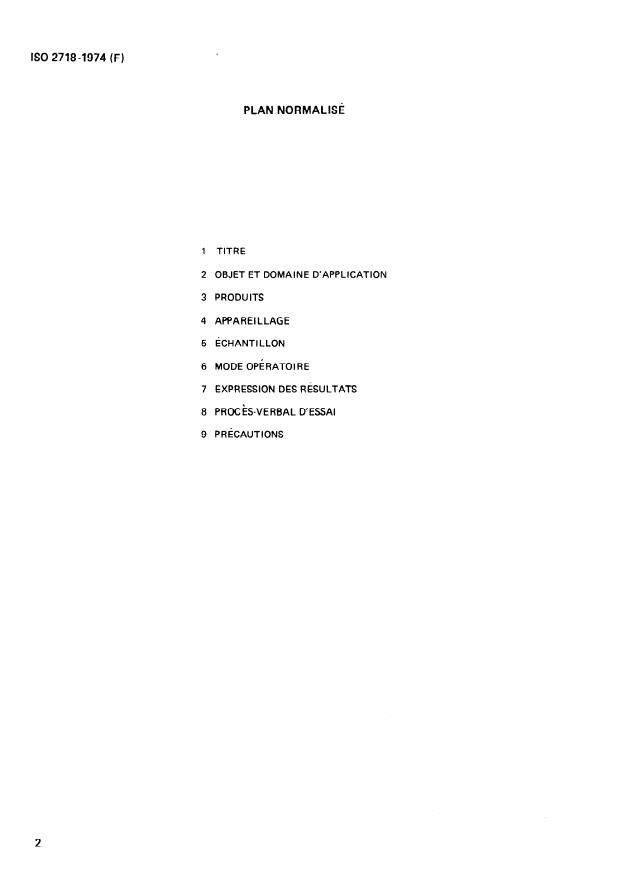
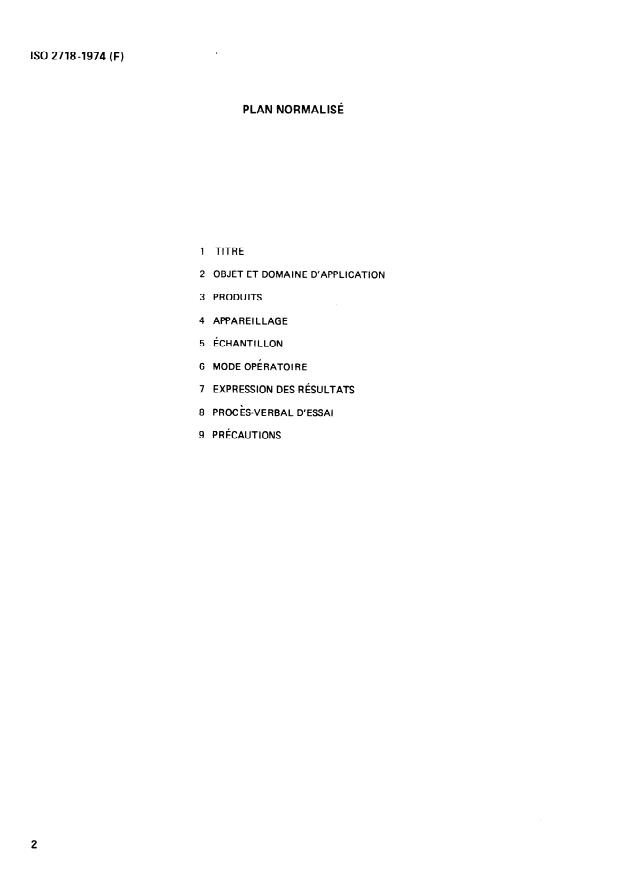
PLAN NORMALISÉ
1 TITRE
2 OBJET ET DOMAINE D’APPLICATION
3 PRODUITS
4 APPAREILLAGE
5 ÉCHANTi LLON
6 MODE OPÉRATOIRE
7 EXPRESSION DES RÉSULTATS
8 PROCÈS-VERBAL D’ESSAI
9 PRÉCAUTIONS
ISO 2718-1974 (F)
COMMENTAIRES RELATIFS À LA MISE EN APPLICATION DU PLAN NORMALISÉ
Tube
4.3.2
1 TITRE
-
Nature du tube (matériau et traitement).
Le titre de la publication ou de la norme doit exprimer,
sans aucune ambiguïté, son contenu, en rappelant
-
Longueur et longueur de remplissage.
brièvement les produits qu’elle concerne et la nature de
l’analyse. -
Diamètres intérieur et extérieur.
--
Forme (en U, W, spirale . . .).
-
Rayon de courbure éventuel.
2 OBJET ET DOMAINE D’APPLICATION
Ce chapitre doit contenir des indications précises sur l’objet
de l’étude ou de la norme, et notamment sur le domaine Remplissage
4.3.3
d’application de la méthode décrite. II doit comprendre un
court exposé, susceptible d’être utilisé comme (( Résumé)).
4.3.3.1 Support
- Nature (désignation, lot . . .).
3 PRODUITS
- Granulométrie.
Mentionner tous dangers éventuels et faire référence à leur
- Traitement éventuel.
propos au chapitre 9, «Précautions».
4.3.3.2 Phase stationnaire
3.1 Gaz vecteur et gaz auxiliaires
- Nature chimique
- Nature et référence commerciale.
- Taux d’imprégnation : indiquer, sans ambigu’ité, les
-
Teneur en impuretés et mode de purification.
proportions de phase stationnaire et de support (par
exemple, en grammes de phase stationnaire pour 100 g
3.2 Produits pour préparation des étalons
de support, ou en pourcentage en masse de phase
stationnaire par rapport à la somme support + phase).
3.3 Faire référence à 4.3 pour ce qui concerne la colonne
et notamment son remplissage et sa préparation.
4.3.3.3 Adsorbant
- Nature.
4 APPAREILLAGE
- Granulométrie et/ou autres caractéristiques
physiques.
4.1 Type de l’appareillage
- Activation.
4.1.1 Caractéristique du montage (four, régulation de
.), dispositifs spéciaux.
température . .
4.3.3.4 Autres remplissages
41.2 Dispositif de réglage de la pression, ou du débit du
- Adsorbants modifiés.
gaz vecteur et des gaz auxiliaires.
- Polymères poreux.
4.2 Dispositif d’injection
4.3.3.5 Méthode de remplissage et masse introduite.
- Type.
-
Matériau.
4.3.4 Efficacité ou résolution
- Caractéristiques.
-
Accessoires divers.
Efficacité dans des conditions données.
4.3.4.1
4.3 Colonnes (et pré-colonne)
4.3.4.2 Résolution dans des conditions données.
4.3.1 Nombre
- 4.4 Diviseur de flux
Combinaison et commutation des colonnes.
ISO 27184974 (F)
température et période initiales;
4.5 Détecteur
programme de montée en température;
- Type.
- Caractéristiques. température et période finales.
-
Dispositif électronique associé (caractéristiques de
6.1.2.2 Débit du gaz vecteur
I’électromètre).
-
Conditions isobares :
4.6 Enregistreur et/ou intégrateur
valeur du débit;
- Type.
pressions d’entrée et de sortie de la colonne.
- Sensibilité. -
Conditions programmées :
-
Impédance.
débit et période initiaux;
- Temps de réponse.
programme de variation du débit;
contre courant.
4.7 Système électronique d’exploitation des résultats
6.1.3 Diviseur de flux
4.8 Accessoires
-
Rapport entre les flux divisés.
6.1.4 Détecteur
ÉCHANTILLON
-
Température et intervalle maximal admissible.
Nature :
-
Réglages électriques.
nom;
-
Réglage des gaz auxiliaires.
description;
6.1.5 Enregistreur
composition présumée.
-
- Vitesse de déroulement du papier.
Modalité d’échantillonnage et de conservation.
-
Atténuation initiale.
-
Conditions particulières pouvant intervenir lors de
l’analyse (volatilité, stabilité, explosibilité, toxicité, etc.
nécessa i re, au chapitre 9,
avec référence si
6.1.6 Intégra teur
((Précautions)).
préalable (distillation, d issolu tion,
- Traitement
6.2 Étalonnage
méthylation, ou a utre traitem ent).
6.2.1 Méthodes d’étalonnage
Les différentes méthodes d’étalonnage suivantes sont les
MODE OPÉRATOIRE
plus couramment utilisées :
6.1 Réglage de l’appareillage
6.2.1 .l Normalisation interne
Tous les constituants sont élués, tous les pics sont mes
...
NORME INTERNATIONALE
INTERNATIONAL ORGANIZATION FOR STANDARDIZATION l MEX~YHAPO~HAII OPl-AHH3ALW’l I-i0 ~AHP(APTH3A~L~ORGANISATION INTERNATIONALE DE NORMALISATION
Plan normalisé de méthode d’analyse chimique par
chromatographie en phase gazeuse
Standard la yout for a method of chemical analysis b y gas chromatograph y
Première édition - 1974-04-01
CDU 543.544 : 389.6 Réf. No : ISO 2718-1974 (F)
Descripteurs : analyse chimique, essai chimique, chromatographie, chromatographie en phase gazeuse, spécification.
Prix basé sur 7 pages
AVANT-PROPOS
L’ISO (Organisation Internationale de Normalisation) est une fédération mondiale
d’organismes nationaux de normalisation (Comités Membres KO). L’élaboration de
Normes Internationales est confiée aux Comités Techniques ISO. Chaque Comité
Membre intéressé par une étude a le droit de faire partie du Comité Technique
correspondant. Les organisations internationales, gouvernementales et non
gouvernementales, en liaison avec I’ISO, participent également aux travaux.
Les Projets de Normes Internationales adoptés par les Comités Techniques sont
soumis aux Comités Membres pour approbation, avant leur acceptation comme
Normes Internationales par le Conseil de I’ISO.
La Norme Internationale ISO 2718 a été établie par le Comité Technique
ISO/TC 47, Chimie, et soumise aux Comités Membres en avril 1972.
Elle a été approuvée par les Comités Membres des pays suivants :
Afrique du Sud, Rép. d’ France Roumanie
Allemagne Inde Royaume-Uni
Autriche Irlande Suède
Belgique Israël Suisse
Chili Italie Tchécoslovaquie
Nouvelle-Zélande Thaïlande
Danemark
Turquie
Egypte, Rép. arabe d’ Pays-Bas
Espagne Portugal U.R.S.S.
Cette Norme Internationale a également été approuvée par l’Union Internationale
de Chimie Pure et Appliquée (UICPA).
Aucun Comité Membre n’a désapprouvé le document.
0 Organisation Internationale de Normalisation, 1974 l
Imprimé en Suisse
NORME INTERNATIONALE
ISO 2718-1974 (F)
Plan normalisé de méthode d’analyse chimique par
chromatographie en phase gazeuse
-
0 INTRODUCTION soit pour rédiger un mode opératoire applicable dans
des laboratoires équipés d’appareils différents : seules
La chromatographie en phase gazeuse est une technique de
doivent être données les indications nécessaires et
séparation et de dosage qui est de plus en plus utilisée,
suffisantes pour permettre l’exécution de la méthode et
notamment pour des analyses de contrôle au sein d’un
l’obtention des résultats reproductibles dans des limites
même laboratoire, pour des analyses de contrôle de
de précision déterminées.
réception entre laboratoires, pour les analyses
d’échantillons inconnus et pour la recherche analytique.
La liste des caractéristiques énumérées dans le présent plan
normalisé ne saurait être considérée comme exhaustive, et
En raison de la diversité des appareillages et des modes
ne saurait non plus impliquer que toutes ces caractéristiques
opératoires, il est apparu utile d’établir un plan normalisé
doivent être données et explicitées dans les publications et
pour la présentation des caractéristiques fondamentales et
les modes opératoires. Dans chaque cas, il appartiendra aux
des indications d’ordre technique qui doivent être
auteurs ou aux rédacteurs de tels documents de choisir,
spécifiées :
dans cette liste, les caractéristiques qui permettront
-
soit pour présenter, dans une publication scientifique
d’atteindre l’un ou l’autre des deux objectifs mentionnés
ou dans un document de caractère commercial, le
ci-dessus.
compte-rendu d’une étude expérimentale ou d’une
analyse de contrôle : les auteurs de telles publications En particulier, sur le plan de la normalisation, les
doivent donner toutes les indications nécessaires, pour indications qu’il conviendra de donner dans une norme
faciliter la compréhension de l’étude et des modes particu I ière, seront établies à la suite d’une étude
opératoires suivis, et permettre leur mise en oeuvre avec expérimentale effectuée dans plusieurs laboratoires, et
un appareillage identique ou très voisin. d’une analyse comparative des résultats.
ISO 2718-1974 (F)
PLAN NORMALISÉ
1 TITRE
2 OBJET ET DOMAINE D’APPLICATION
3 PRODUITS
4 APPAREILLAGE
5 ÉWIWTI LLON
6 MODE OPÉRATOIRE
7 EXPRESSION DES RÉSULTATS
8 PROCÈS-VERBAL D’ESSAI
9 PRÉCAUTIONS
ISO 2718-1974 (F)
COMMENTAIRES RELATIFS À LA MISE EN APPLICATION DU PLAN NORMALISÉ
4.3.2 Tube
1 TITRE
- Nature du tube (matériau et traitement).
Le titre de la publication ou de la norme doit exprimer,
sans aucune ambiguïté, son contenu, en rappelant
- Longueur et longueur de remplissage.
brièvement les produits qu’elle concerne et la nature de
l’analyse.
- Diamètres intérieur et extérieur.
-- Forme (en U, W, spirale . . .).
- Rayon de courbure éventuel.
2 OBJET ET DOMAINE D’APPLICATION
Ce chapitre doit contenir des indications précises sur l’objet
de l’étude ou de la norme, et notamment sur le domaine 4.3.3 Remplissage
d’application de la méthode décrite. II doit comprendre un
court exposé, susceptible d’être utilisé comme (( Résumé)).
4.3.3.1 Support
- Nature (désignation, lot . . .).
3 PRODUITS
- Granulométrie.
Mentionner tous dangers éventuels et faire référence à leur
- Traitement éventuel.
propos au chapitre 9, «Précautions».
4.3.3.2 Phase stationnaire
3.1 Gaz vecteur et gaz auxiliaires
- Nature chimique
- Nature et référence commerciale.
- Taux d’imprégnation : indiquer, sans ambigu’ité, les
-
Teneur en impuretés et mode de purification.
proportions de phase stationnaire et de support (par
exemple, en grammes de phase stationnaire pour 100 g
3.2 Produits pour préparation des étalons
de support, ou en pourcentage en masse de phase
stationnaire par rapport à la somme support + phase).
3.3 Faire référence à 4.3 pour ce qui concerne la colonne
et notamment son remplissage et sa préparation.
4.3.3.3 Adsorbant
- Nature.
4 APPAREILLAGE
- Granulométrie et/ou autres caractéristiques
physiques.
4.1 Type de l’appareillage
- Activation.
4.1.1 Caractéristique du montage (four, régulation de
.), dispositifs spéciaux.
température . .
4.3.3.4 Autres remplissages
41.2 Dispositif de réglage de la pression, ou du débit du
- Adsorbants modifiés.
gaz vecteur et des gaz auxiliaires.
- Polymères poreux.
4.2 Dispositif d’injection
4.3.3.5 Méthode de remplissage et masse introduite.
- Type.
-
Matériau.
4.3.4 Efficacité ou résolution
- Caractéristiques.
-
Accessoires divers.
Efficacité dans des conditions données.
4.3.4.1
4.3 Colonnes (et pré-colonne)
4.3.4.2 Résolution dans des conditions données.
4.3.1 Nombre
- 4.4 Diviseur de flux
Combinaison et commutation des colonnes.
ISO 27184974 (F)
température et période initiales;
4.5 Détecteur
- Type. programme de montée en température;
- Caractéristiques. température et période finales.
- Dispositif électronique associé (caractéristiques de
6.1.2.2 Débit du gaz vecteur
I’électromètre),
-
Conditions isobares :
4.6 Enregistreur et/ou intégrateur
valeur du débit;
- Type.
pressions d’entrée et de sortie de la colonne.
- Sensibilité.
-
Conditions programmées :
- Impédance.
débit et période initiaux;
- Temps de réponse.
programme de variation du débit;
contre courant.
4.7 Système électronique d’exploitation des résultats
6.1.3 Diviseur de flux
4.8 Accessoires
-
Rapport entre les flux divisés.
6.1.4 Détecteur
5 ÉCHANTILLON
-
Température et intervalle maximal admissible.
- Nature :
-
Réglages électriques.
nom;
-
Réglage des gaz auxiliaires.
description;
6.1.5 Enregistreur
composition présumée.
-
Vitesse de déroulement du papier.
- Modalité d’échantillonnage et de conservation.
-
Atténuation initiale.
- Conditions particulières pouvant intervenir lors de
l’analyse (volatilité, stabilité, explosibilité, toxicité, etc.
nécessa i re, au chapitre 9,
avec référence si
Intégra teur
6.1.6
((Précautions)).
- Traitement préalable (distillation, d issolu tion,
6.2 Étalonnage
méthylation, ou autre traitement).
6.2.1 Méthodes d’étalonnage
Les différentes méthodes d’étalonnage suivantes sont les
6 MODE OPÉRATOIRE
plus couramment utilisées :
6.1 Réglage de l’appareillage
6.2.1 .l Normalisation interne
Tous les constituants sont élués, tous les pics sont mesurés.
6.1.1 Injecte
...
Questions, Comments and Discussion
Ask us and Technical Secretary will try to provide an answer. You can facilitate discussion about the standard in here.
Loading comments...