

ISO 7378:1983
(Main)Fasteners — Bolts, screws and studs — Split pin holes and wire holes
General Information
- Abstract
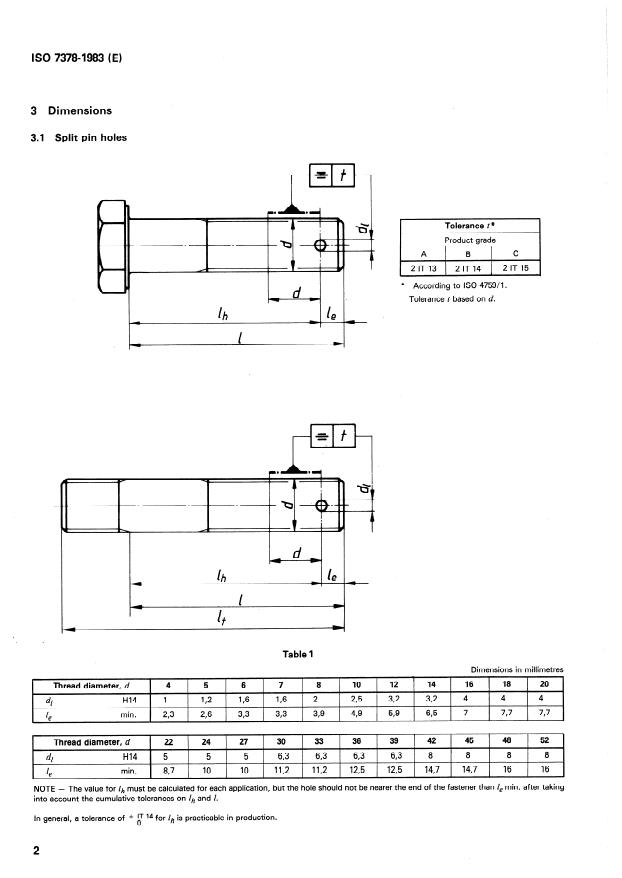
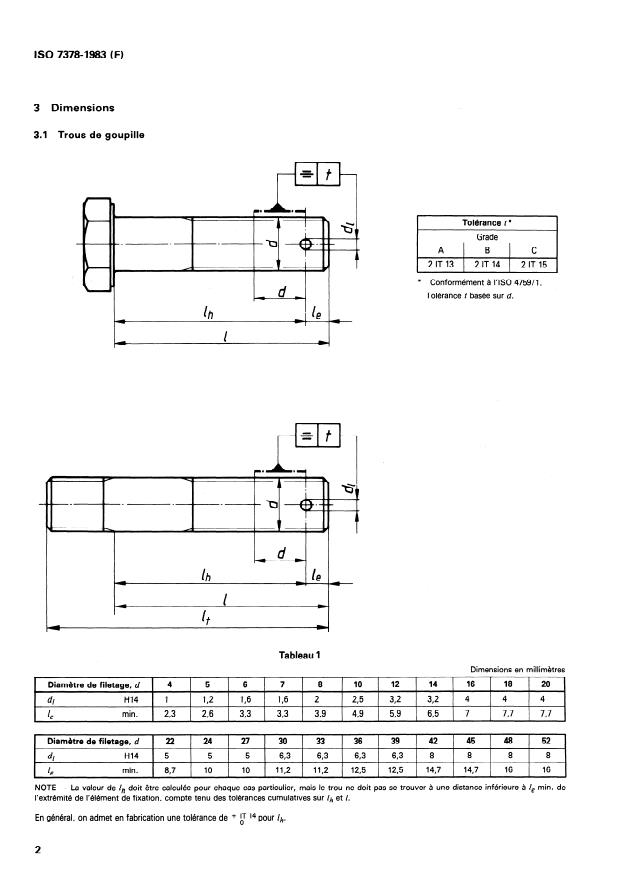
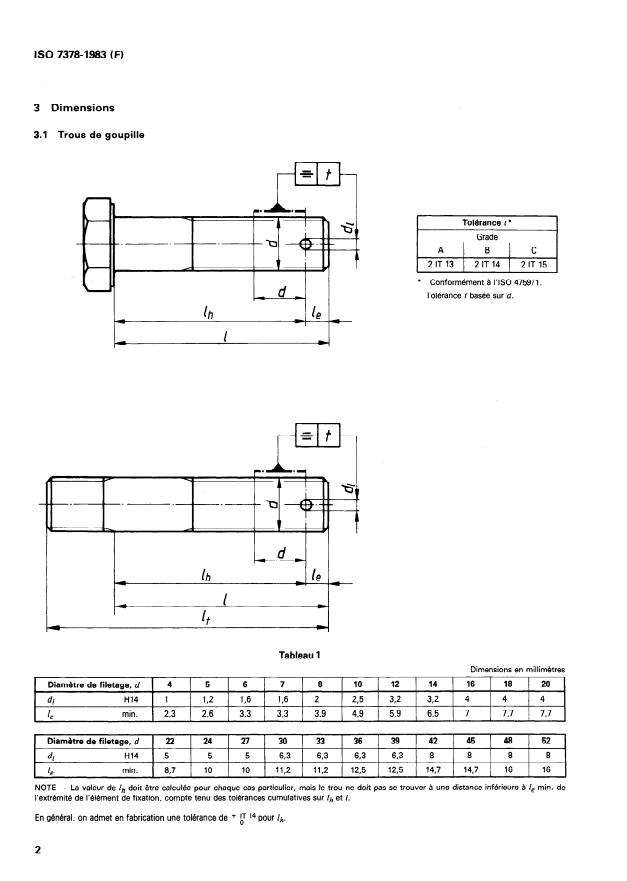
Lays down the dimensions and position of holes for products, recommended for use; tabulates dimensions for thread diameters from 4 mm up to and including 52 mm; gives tolerances for the product grades A, B and C
- Status
- Published
- Publication Date
- 31-Jan-1983
- Technical Committee
- ISO/TC 2/SC 7 - Reference standards
- Drafting Committee
- ISO/TC 2/SC 7 - Reference standards
- Current Stage
- 9093 - International Standard confirmed
- Start Date
- 21-Jun-2023
- Completion Date
- 29-Aug-2026
Buy Documents

ISO 7378:1983 - Fasteners — Bolts, screws and studs — Split pin holes and wire holes Released:2/1/1983
ISO 7378:1983 - Éléments de fixation — Boulons, vis et goujons — Trous de goupille et trous de fil a freiner Released:2/1/1983
ISO 7378:1983 - Éléments de fixation — Boulons, vis et goujons — Trous de goupille et trous de fil a freiner Released:2/1/1983
Overview
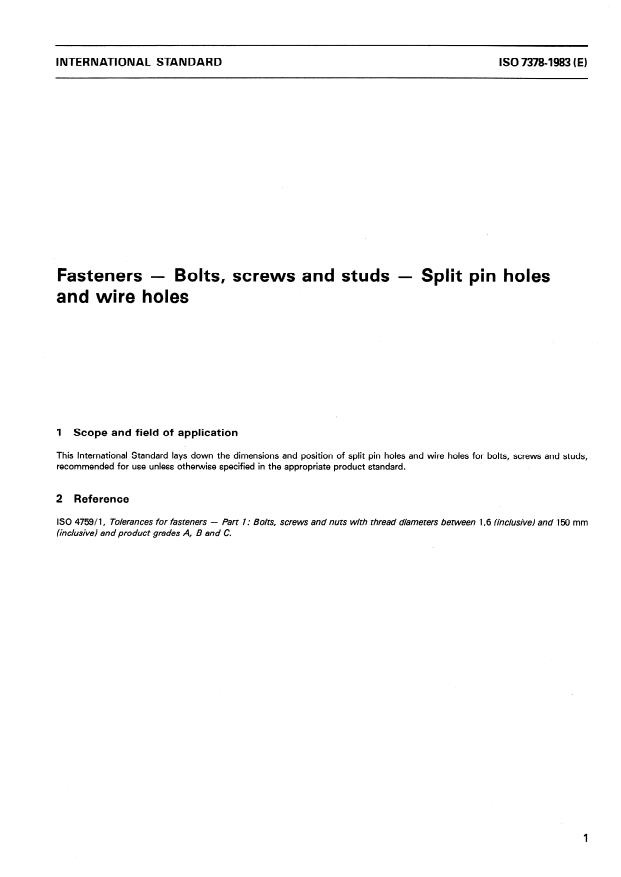
ISO 7378:1983 is an international standard published by the International Organization for Standardization (ISO) that defines the dimensions and positioning of split pin holes and wire holes for fasteners such as bolts, screws, and studs. The standard covers thread diameters ranging from 4 mm up to 52 mm and specifies the tolerances applicable to different product grades-A, B, and C. It is intended to ensure consistency and interchangeability in the manufacturing and application of fasteners requiring secure locking mechanisms via split pins or safety wire.
This standard supports engineering, manufacturing, and quality assurance processes by providing clear guidance on the hole sizes and positions necessary for effective mechanical locking. By adhering to ISO 7378, design and production teams can maintain high safety standards and enhance fastener reliability.
Key Topics
Scope and Application
ISO 7378:1983 applies to bolts, screws, and studs that require holes for split pins or wire locking. The standard is recommended for use in conjunction with specific product standards unless otherwise specified.Hole Dimensions and Positions
The standard tabulates precise dimensions for split pin holes and wire holes. These dimensions correspond to a range of thread diameters from 4 mm to 52 mm, facilitating selection for various fastener sizes.Tolerance Grades
ISO 7378 specifies three product grades (A, B, and C) with distinct tolerances aligned with ISO 4759/1. These grades determine acceptable manufacturing variations in hole size and positioning to suit different application requirements.Manufacturing Guidance
The standard includes notes on tolerance accumulation and minimum distances from hole centers to fastener ends, ensuring the mechanical integrity and optimal placement of locking features.
Applications
ISO 7378:1983 is essential in industries and sectors that rely on secure fastening systems with mechanical locking methods, including:
Aerospace and Aviation
Used for critical applications where safety wire locking prevents fastener loosening under vibration or stress.Automotive and Transportation
Ensures reliable locking of bolts and studs in engines, transmissions, and chassis.Construction and Heavy Machinery
Applied to fasteners in heavy-duty equipment requiring secured mechanical joints.Machinery and Equipment Manufacturing
Supports standardized component design to maintain interchangeability and assembly efficiency.Maintenance and Repair Operations
Guides inspection and replacement of fasteners with split pin or wire locking features to meet safety standards.
By following ISO 7378, manufacturers and engineers improve product reliability and safety while facilitating international trade through adherence to recognized global standards.
Related Standards
ISO 4759-1: Tolerances for Fasteners
Provides the detailed tolerance classifications (grades A, B, and C) referenced for split pin and wire hole precision.ISO 898-1: Mechanical Properties of Fasteners
Defines mechanical strength grades for bolts and screws related to their performance when combined with locking mechanisms.ISO 4014 / ISO 4017: Hexagon Head Bolts
Covers dimensions and tolerances of hex bolts for which ISO 7378 hole specifications may apply.ISO 2320: Prevailing Torque Type Locknuts
Addresses locking nut design, complementing systems using split pin or wire locking fasteners.
Implementing ISO 7378 alongside these standards ensures a comprehensive approach to fastener design, manufacturing, and quality control, enhancing mechanical joint security and safety.
Keywords: ISO 7378, fasteners, bolts, screws, studs, split pin holes, wire holes, mechanical locking, fastening standards, thread diameter, hole tolerances, safety wire locking, international standards, manufacturing guidelines, product grades, ISO certification.
Buy Documents
ISO 7378:1983 - Fasteners — Bolts, screws and studs — Split pin holes and wire holes Released:2/1/1983
ISO 7378:1983 - Éléments de fixation — Boulons, vis et goujons — Trous de goupille et trous de fil a freiner Released:2/1/1983
ISO 7378:1983 - Éléments de fixation — Boulons, vis et goujons — Trous de goupille et trous de fil a freiner Released:2/1/1983
Frequently Asked Questions
ISO 7378:1983 is a standard published by the International Organization for Standardization (ISO). Its full title is "Fasteners — Bolts, screws and studs — Split pin holes and wire holes". This standard covers: Lays down the dimensions and position of holes for products, recommended for use; tabulates dimensions for thread diameters from 4 mm up to and including 52 mm; gives tolerances for the product grades A, B and C
Lays down the dimensions and position of holes for products, recommended for use; tabulates dimensions for thread diameters from 4 mm up to and including 52 mm; gives tolerances for the product grades A, B and C
ISO 7378:1983 is classified under the following ICS (International Classification for Standards) categories: 21.060.10 - Bolts, screws, studs. The ICS classification helps identify the subject area and facilitates finding related standards.
ISO 7378:1983 is available in PDF format for immediate download after purchase. The document can be added to your cart and obtained through the secure checkout process. Digital delivery ensures instant access to the complete standard document.
Standards Content (Sample)
SLOVENSKI STANDARD
01-april-1996
Mehanski vezni elementi - Vijaki - Luknje za razcepke in varovanja
Fasteners -- Bolts, screws and studs -- Split pin holes and wire holes
Éléments de fixation -- Boulons, vis et goujons -- Trous de goupille et trous de fil à freiner
Ta slovenski standard je istoveten z: ISO 7378:1983
ICS:
21.060.10 Sorniki, vijaki, stebelni vijaki Bolts, screws, studs
2003-01.Slovenski inštitut za standardizacijo. Razmnoževanje celote ali delov tega standarda ni dovoljeno.
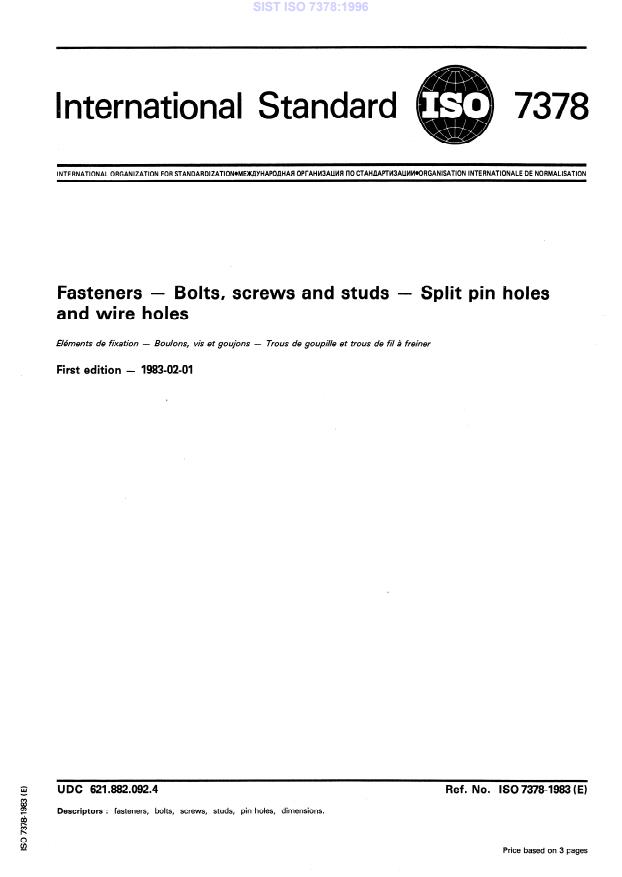
International Standard
INTERNATIONAL ORGANIZATION FOR STANDARDIZATION.MEIKAYHAPO~HAfI OPrAHM3Al.lMR fl0 CTAH&WTH3ALWl@ORGANISATION INTERNATIONALE DE NORMALISATION
Fasteners - Bolts, screws and studs - Split pin holes
and wire holes
&Smen ts de fixation - Boulons, WS et goujons - Trous de goupille et trous de fil a) freiner
First edition - 1983-02-01
Ref. No. ISO 7378-1983 (E)
U DC 621.882.092.4
fasteners, bolts, screws, studs, pin holes, dimensions.
Descriptors :
Price based on 3 pages
Foreword
ISO (the International Organization for Standardization) is a worldwide federation of
national Standards bodies (ISO member bodies). The work of developing International
Standards is carried out through ISO technical committees. Every member body
interested in a subject for which a technical committee has been authorized has the
right to be represented on that committee. International organizations, governmental
and non-governmental, in liaison with ISO, also take part in the work.
Draft International Standards adopted by the technical committees are circulated to
the member bodies for approval before their acceptance as International Standards by
the ISO Council.
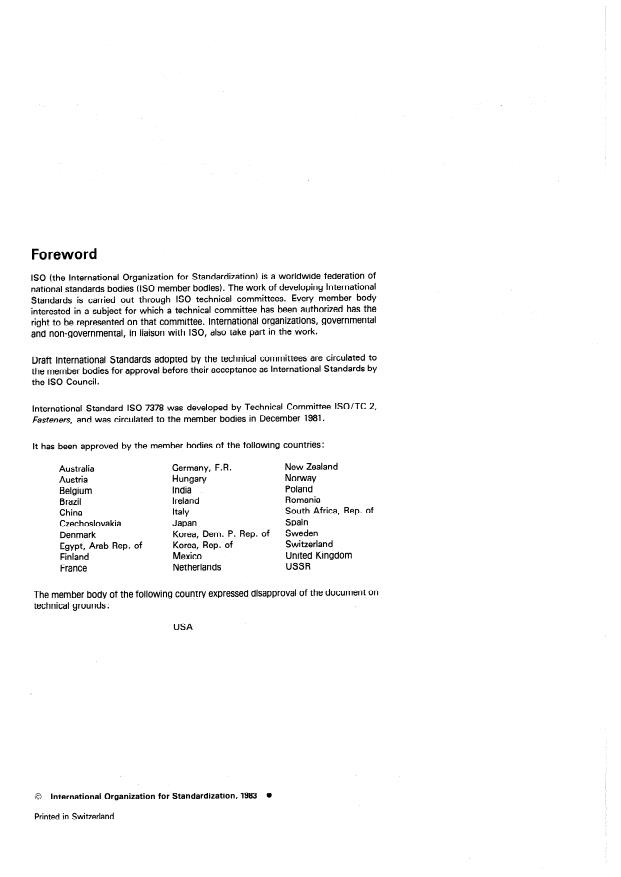
International Standard ISO 7378 was developed by Technical Committee ISO/TC 2,
Fasteners, and was circulated to the member bodies in December 1981.
lt has been approved by the member bodies of the following countries:
New Zealand
Australia Germany, F.R.
Notway
Austria Hungary
Poland
India
Belgium
Ireland Romania
Brazil
South Africa, Rep. of
Italy
China
Spain
Czechoslovakia Ja
...
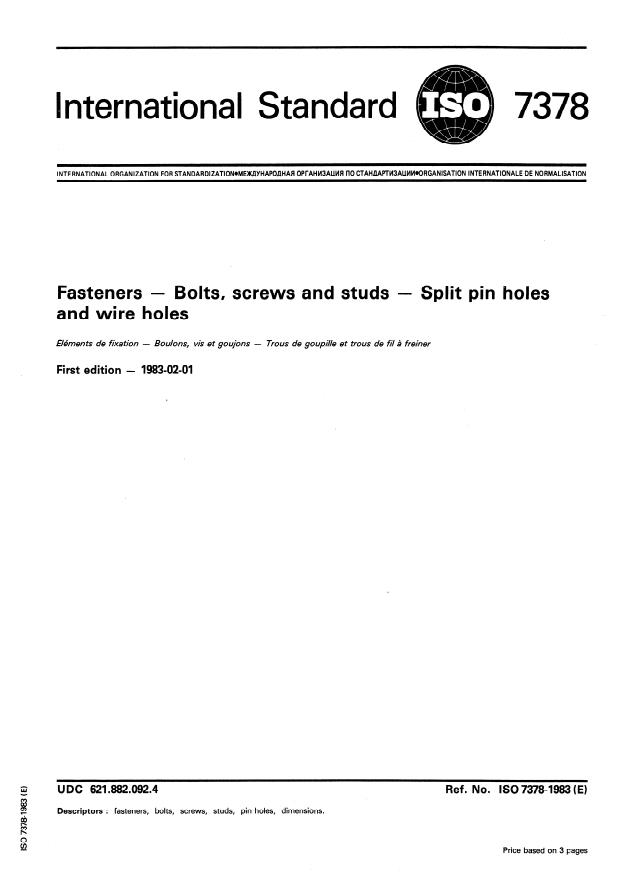
International Standard
INTERNATIONAL ORGANIZATION FOR STANDARDIZATION.MEIKAYHAPO~HAfI OPrAHM3Al.lMR fl0 CTAH&WTH3ALWl@ORGANISATION INTERNATIONALE DE NORMALISATION
Fasteners - Bolts, screws and studs - Split pin holes
and wire holes
&Smen ts de fixation - Boulons, WS et goujons - Trous de goupille et trous de fil a) freiner
First edition - 1983-02-01
Ref. No. ISO 7378-1983 (E)
U DC 621.882.092.4
fasteners, bolts, screws, studs, pin holes, dimensions.
Descriptors :
Price based on 3 pages
Foreword
ISO (the International Organization for Standardization) is a worldwide federation of
national Standards bodies (ISO member bodies). The work of developing International
Standards is carried out through ISO technical committees. Every member body
interested in a subject for which a technical committee has been authorized has the
right to be represented on that committee. International organizations, governmental
and non-governmental, in liaison with ISO, also take part in the work.
Draft International Standards adopted by the technical committees are circulated to
the member bodies for approval before their acceptance as International Standards by
the ISO Council.
International Standard ISO 7378 was developed by Technical Committee ISO/TC 2,
Fasteners, and was circulated to the member bodies in December 1981.
lt has been approved by the member bodies of the following countries:
New Zealand
Australia Germany, F.R.
Notway
Austria Hungary
Poland
India
Belgium
Ireland Romania
Brazil
South Africa, Rep. of
Italy
China
Spain
Czechoslovakia Japan
Korea, Dem. P. Rep. of Sweden
Denmark
Switzerland
Korea, Rep. of
Egypt, Arab Rep. of
United Kingdom
Finland Mexico
Netherlands USSR
France
expressed disapproval document
The member body of the followi country
w
technical grounds :
USA
International Organkation for Standardkation, 1983
Printed in Switzerland
ISO 73784983 (EI
INTERNATIONAL STANDARD
Fasteners - Bolts, screws and studs
...
Norme internationale
INTERNATIONAL ORGANIZATION FOR STANDARDIZATIONaME)((CIYHAPO~HAR OPrAHH3AqMR IlO CTAH~APTbl3AlU’lt’l.ORGANISATION INTERNATIONALE DE NORMALISATION
- Boulons, vis et goujons - Trous
Éléments de fixation
de goupille et trous de fil à freiner
Bolts, screws and studs - Split pin holes and wire holes
Fasteners -
Première édition - 1983-02-01
Réf. no : ISO 7378-1983 (FI
CDU 621 m882.092.4
Descripteurs : élément de fixation, boulon, vis, goujon, trou de goupille, dimension.
Prix basé sur 3 pages
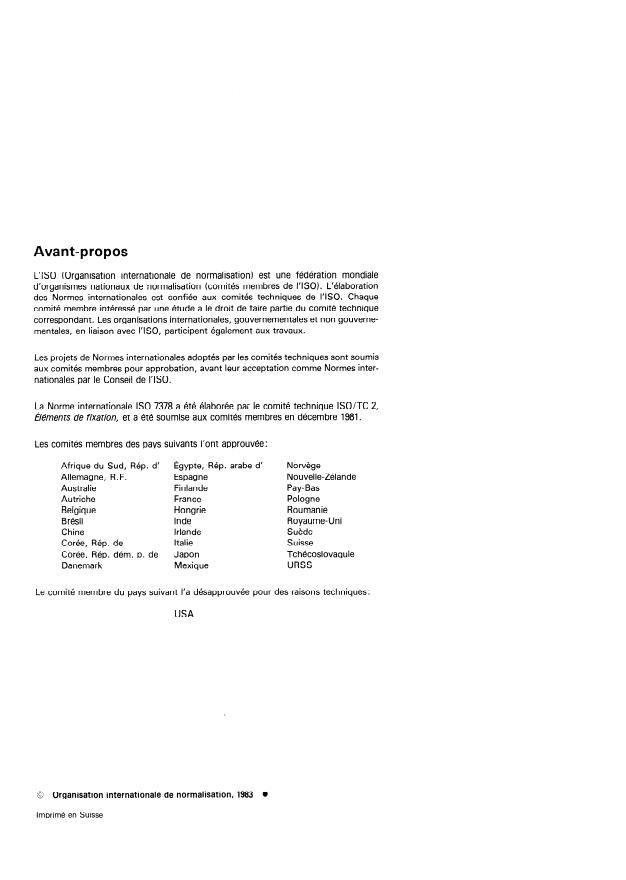
Avant-propos
L’lSO (Organisation internationale de normalisation) est une fedération mondiale
d’organismes nationaux de normalisation (comités membres de I’ISO). L’élaboration
des Normes internationales est confiée aux comités techniques de I’ISO. Chaque
comité membre intéressé par une étude a le droit de faire partie du comité technique
correspondant. Les organisations internationales, gouvernementales et non gouverne-
mentales, en liaison avec I’ISO, participent également aux travaux.
Les projets de Normes internationales adoptés par les comités techniques sont soumis
aux comités membres pour approbation, avant leur acceptation comme Normes inter-
nationales par le Conseil de I’ISO.
La Norme internationale ISO 7378 a été élaborée par le comité technique ISO/TC 2,
&ments de fixation, et a été soumise aux comités membres en décembre 1981.
Les comités membres des pays suivants l’ont approuvée:
Afrique du Sud, Rép. d’ Égypte, Rép. arabe d’ Norvège
Allemagne, R.F. Espagne Nouvelle-Zélande
Australie Finlande Pay-Bas
Autriche France Pologne
Belgique Hongrie Roumanie
Brésil Inde Royaume-Uni
Irlande Suède
Chine
Corée, Rép. de Italie Suisse
Corée, Rép. dém. p. de Japon Tchécoslovaquie
Danemark Mexique URSS
Le comité membre du pays suivant l’a désapprouvée pour des raisons techniques:
USA
G Organisation internationale de normalisation, 1983
Imprimé en Suisse
ISO 73784983 (FI
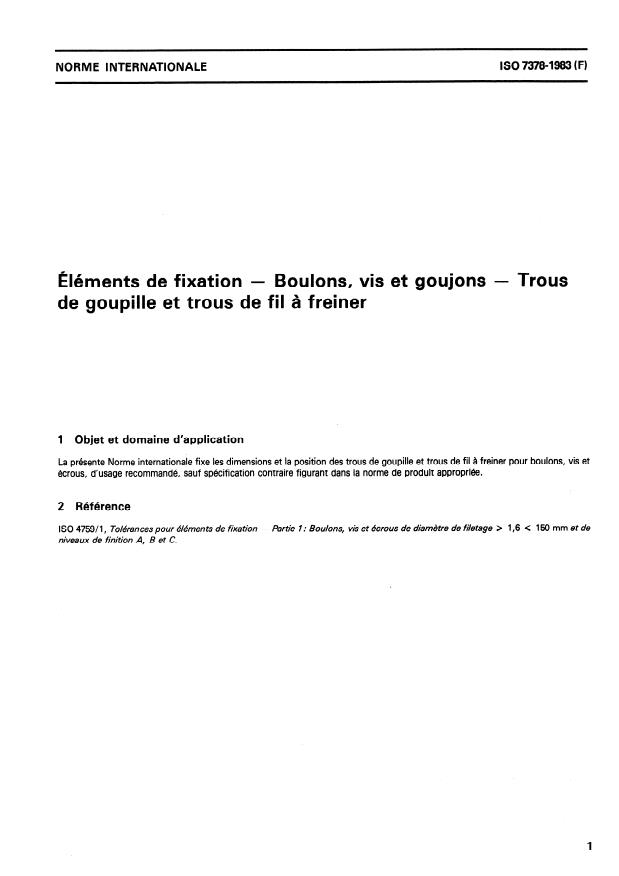
NORME INTERNATIONALE
Éléme
...
Norme internationale
INTERNATIONAL ORGANIZATION FOR STANDARDIZATIONaME)((CIYHAPO~HAR OPrAHH3AqMR IlO CTAH~APTbl3AlU’lt’l.ORGANISATION INTERNATIONALE DE NORMALISATION
- Boulons, vis et goujons - Trous
Éléments de fixation
de goupille et trous de fil à freiner
Bolts, screws and studs - Split pin holes and wire holes
Fasteners -
Première édition - 1983-02-01
Réf. no : ISO 7378-1983 (FI
CDU 621 m882.092.4
Descripteurs : élément de fixation, boulon, vis, goujon, trou de goupille, dimension.
Prix basé sur 3 pages
Avant-propos
L’lSO (Organisation internationale de normalisation) est une fedération mondiale
d’organismes nationaux de normalisation (comités membres de I’ISO). L’élaboration
des Normes internationales est confiée aux comités techniques de I’ISO. Chaque
comité membre intéressé par une étude a le droit de faire partie du comité technique
correspondant. Les organisations internationales, gouvernementales et non gouverne-
mentales, en liaison avec I’ISO, participent également aux travaux.
Les projets de Normes internationales adoptés par les comités techniques sont soumis
aux comités membres pour approbation, avant leur acceptation comme Normes inter-
nationales par le Conseil de I’ISO.
La Norme internationale ISO 7378 a été élaborée par le comité technique ISO/TC 2,
&ments de fixation, et a été soumise aux comités membres en décembre 1981.
Les comités membres des pays suivants l’ont approuvée:
Afrique du Sud, Rép. d’ Égypte, Rép. arabe d’ Norvège
Allemagne, R.F. Espagne Nouvelle-Zélande
Australie Finlande Pay-Bas
Autriche France Pologne
Belgique Hongrie Roumanie
Brésil Inde Royaume-Uni
Irlande Suède
Chine
Corée, Rép. de Italie Suisse
Corée, Rép. dém. p. de Japon Tchécoslovaquie
Danemark Mexique URSS
Le comité membre du pays suivant l’a désapprouvée pour des raisons techniques:
USA
G Organisation internationale de normalisation, 1983
Imprimé en Suisse
ISO 73784983 (FI
NORME INTERNATIONALE
Éléme
...