

ISO 13391-3:2025
(Main)Wood and wood-based products — Greenhouse gas dynamics — Part 3: Displacement of greenhouse gas emissions
General Information
- Abstract
This document provides a methodology for determining the greenhouse gas emissions from alternative products (or a representative mix of alternative products). It also provides a methodology for calculating the displacement potential for wood and wood-based products. NOTE "Emissions from alternative products" is a term defined in ISO 13391-1. This document also deals with situations that do not lead to displacement. This document is intended to be used by organizations seeking to understand, commit to or contribute to climate change mitigation. These organizations can be either private or public, regardless of type or size, and located in any jurisdiction or any position within a specific value chain.
- Status
- Published
- Publication Date
- 28-Apr-2025
- Technical Committee
- ISO/TC 287 - Sustainable processes for wood and wood-based products
- Drafting Committee
- ISO/TC 287 - Sustainable processes for wood and wood-based products
- Current Stage
- 6060 - International Standard published
- Start Date
- 29-Apr-2025
- Due Date
- 16-Feb-2025
- Completion Date
- 29-Apr-2025

Overview
ISO 13391-3:2025 - "Wood and wood-based products - Greenhouse gas dynamics - Part 3: Displacement of greenhouse gas emissions" (First edition, 2025) provides a standardized methodology to quantify greenhouse gas (GHG) emissions from alternative products and to calculate the displacement potential of wood and wood-based products. The standard supports organizations that want to understand, commit to, or contribute to climate change mitigation by assessing how using wood-based products can avoid GHG emissions outside the wood value chain.
Key topics and requirements
The standard sets out core technical elements required for robust displacement assessments:
- Methodology for emissions from alternative products - approaches to determine counterfactual GHG emissions for products that would fulfil the same function as the wood-based product.
- Displacement factor - methods to calculate the displacement factor, including specific guidance for wood-based products.
- Displacement potential - aggregation rules for calculating avoided emissions across volumes of wood-based products.
- System boundaries - requirements for defining temporal, geographic and life-cycle boundaries.
- Functional unit and final use - guidance on choosing comparable functional units and accounting for end-use variations.
- Data quality and reporting - minimum expectations for data sources, transparency and reporting of assumptions and results.
- Situations without displacement - treatment of cases where substitution does not lead to net avoided emissions.
- Annex A (informative) - indicative displacement factors to support application (non-normative).
The standard emphasizes that displacement assessments are informed by life cycle assessment (LCA) comparisons and are distinct from direct value-chain emissions; counterfactual emissions are not part of organizational GHG inventory reporting.
Applications and users
ISO 13391-3 is intended for a wide range of users:
- Manufacturers and product developers evaluating material choices (e.g., wood vs. steel/concrete) to optimize climate outcomes.
- Procurement and sustainability teams seeking to include displacement potential in procurement criteria and low-carbon purchasing.
- Policy makers and public authorities assessing the climate contribution of forest-based industries and material substitution strategies.
- Consultants, LCA practitioners and certification bodies performing comparative LCAs or advising on climate claims and product environmental footprints.
- Forest sector organizations integrating displacement into broader greenhouse gas dynamics (complementary to ISO 13391-1 and ISO 13391-2).
Related standards
- ISO 13391-1 (terms/overview) and ISO 13391-2 (value-chain GHG dynamics) - complementary parts of the ISO 13391 series.
- Life cycle assessment (LCA) standards and GHG accounting guidance used to inform displacement calculations.
Keywords: ISO 13391-3:2025, greenhouse gas dynamics, displacement potential, wood-based products, LCA, displacement factor, greenhouse gas emissions.
Get Certified
Connect with accredited certification bodies for this standard

BSI Group
BSI (British Standards Institution) is the business standards company that helps organizations make excellence a habit.

Bureau Veritas
Bureau Veritas is a world leader in laboratory testing, inspection and certification services.

DNV
DNV is an independent assurance and risk management provider.
Sponsored listings
Frequently Asked Questions
ISO 13391-3:2025 is a standard published by the International Organization for Standardization (ISO). Its full title is "Wood and wood-based products — Greenhouse gas dynamics — Part 3: Displacement of greenhouse gas emissions". This standard covers: This document provides a methodology for determining the greenhouse gas emissions from alternative products (or a representative mix of alternative products). It also provides a methodology for calculating the displacement potential for wood and wood-based products. NOTE "Emissions from alternative products" is a term defined in ISO 13391-1. This document also deals with situations that do not lead to displacement. This document is intended to be used by organizations seeking to understand, commit to or contribute to climate change mitigation. These organizations can be either private or public, regardless of type or size, and located in any jurisdiction or any position within a specific value chain.
This document provides a methodology for determining the greenhouse gas emissions from alternative products (or a representative mix of alternative products). It also provides a methodology for calculating the displacement potential for wood and wood-based products. NOTE "Emissions from alternative products" is a term defined in ISO 13391-1. This document also deals with situations that do not lead to displacement. This document is intended to be used by organizations seeking to understand, commit to or contribute to climate change mitigation. These organizations can be either private or public, regardless of type or size, and located in any jurisdiction or any position within a specific value chain.
ISO 13391-3:2025 is classified under the following ICS (International Classification for Standards) categories: 13.020.40 - Pollution, pollution control and conservation; 79.020 - Wood technology processes. The ICS classification helps identify the subject area and facilitates finding related standards.
ISO 13391-3:2025 is available in PDF format for immediate download after purchase. The document can be added to your cart and obtained through the secure checkout process. Digital delivery ensures instant access to the complete standard document.
Standards Content (Sample)
International
Standard
ISO 13391-3
First edition
Wood and wood-based products —
2025-04
Greenhouse gas dynamics —
Part 3:
Displacement of greenhouse gas
emissions
Produits en bois et dérivés du bois — Dynamique des gaz à effet
de serre —
Partie 3: Déplacement des émissions de gaz à effet de serre
Reference number
All rights reserved.
ISO publications, in their entirety or in fragments, are owned by ISO. They are licensed, not sold, and are subject to the terms and
conditions set forth in the ISO End Customer License Agreement, the License Agreement of the relevant ISO member body, or
those of authorized third-party distributors.
Unless otherwise specified or required for its implementation, no part of this ISO publication may be reproduced, distributed,
modified, or used in any form or by any means, electronic or mechanical, including photocopying, scanning, recording, or posting
on any intranet, internet, or other digital platforms, without the prior written permission of ISO, the relevant ISO member body
or an authorized third-party distributor.
This publication shall not be disclosed to third parties, and its use is strictly limited to the license type and purpose specified in
the applicable license grant. Unauthorized reproduction, distribution, or use beyond the granted license is prohibited and may
result in legal action.
ISO copyright office
CP 401 • Ch. de Blandonnet 8
CH-1214 Vernier, Geneva
Phone: +41 22 749 01 11
Email: copyright@iso.org
Website: www.iso.org
Published in Switzerland
ii
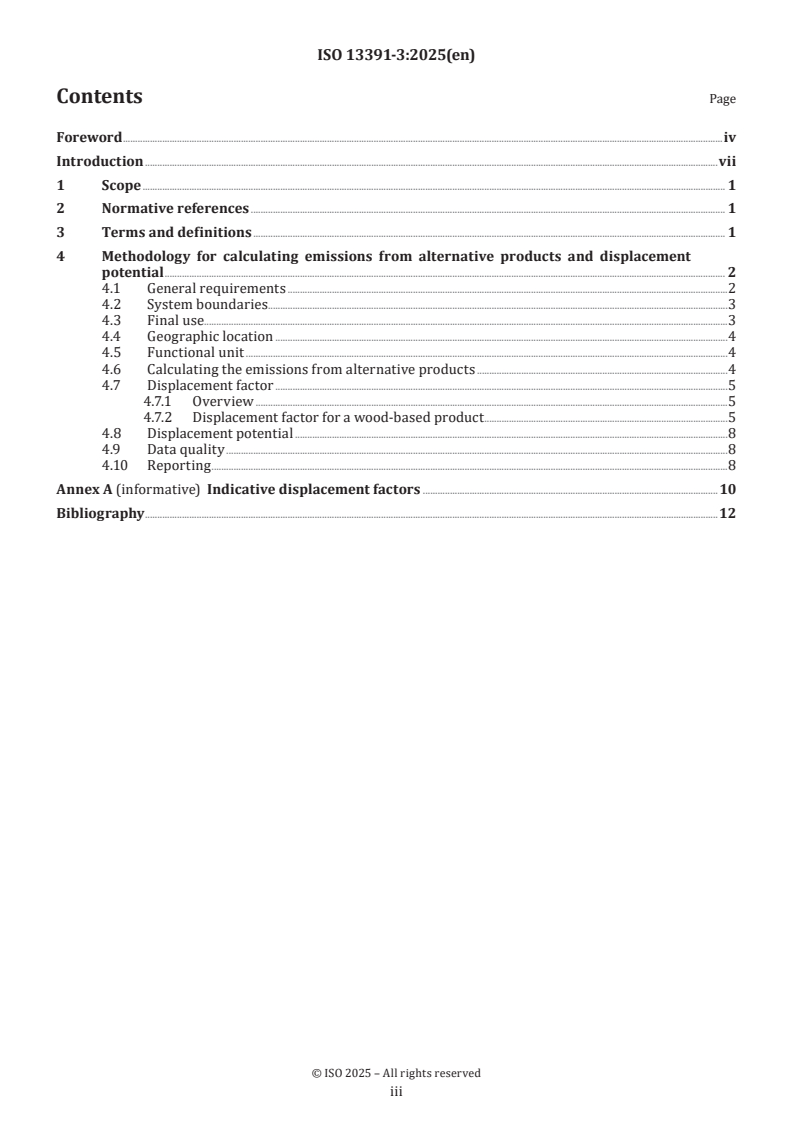
Contents Page
Foreword .iv
Introduction .vii
1 Scope . 1
2 Normative references . 1
3 Terms and definitions . 1
4 Methodology for calculating emissions from alternative products and displacement
potential . 2
4.1 General requirements .2
4.2 System boundaries . .3
4.3 Final use.3
4.4 Geographic location .4
4.5 Functional unit .4
4.6 Calculating the emissions from alternative products .4
4.7 Displacement factor .5
4.7.1 Overview .5
4.7.2 Displacement factor for a wood-based product .5
4.8 Displacement potential .8
4.9 Data quality .8
4.10 Reporting .8
Annex A (informative) Indicative displacement factors . 10
Bibliography .12
iii
Foreword
ISO (the International Organization for Standardization) is a worldwide federation of national standards
bodies (ISO member bodies). The work of preparing International Standards is normally carried out through
ISO technical committees. Each member body interested in a subject for which a technical committee
has been established has the right to be represented on that committee. International organizations,
governmental and non-governmental, in liaison with ISO, also take part in the work. ISO collaborates closely
with the International Electrotechnical Commission (IEC) on all matters of electrotechnical standardization.
The procedures used to develop this document and those intended for its further maintenance are described
in the ISO/IEC Directives, Part 1. In particular, the different approval criteria needed for the different types
of ISO document should be noted. This document was drafted in accordance with the editorial rules of the
ISO/IEC Directives, Part 2 (see www.iso.org/directives).
ISO draws attention to the possibility that the implementation of this document may involve the use of (a)
patent(s). ISO takes no position concerning the evidence, validity or applicability of any claimed patent
rights in respect thereof. As of the date of publication of this document, ISO had not received notice of (a)
patent(s) which may be required to implement this document. However, implementers are cautioned that
this may not represent the latest information, which may be obtained from the patent database available at
www.iso.org/patents. ISO shall not be held responsible for identifying any or all such patent rights.
Any trade name used in this document is information given for the convenience of users and does not
constitute an endorsement.
For an explanation of the voluntary nature of standards, the meaning of ISO specific terms and expressions
related to conformity assessment, as well as information about ISO's adherence to the World Trade
Organization (WTO) principles in the Technical Barriers to Trade (TBT), see www.iso.org/iso/foreword.html.
This document was prepared by Technical Committee ISO/TC 287, Sustainable processes for wood and wood-
based products.
A list of all parts in the ISO 13391 series can be found on the ISO website.
Any feedback or questions on this document should be directed to the user’s national standards body. A
complete listing of these bodies can be found at www.iso.org/members.html.
Licensing and use terms
The ISO publications, as well as any updates and/or corrections, and any intellectual property or other rights
pertaining thereto, are owned by ISO. ISO publications are licensed, not sold. Nothing in this document shall
operate to assign or transfer any intellectual property rights from ISO to the user. The ISO publications are
protected by copyright law, database law, trademark law, unfair competition law, trade secrecy law, or any
other applicable law, as the case may be. Users acknowledge and agree to respect ISO’s intellectual property
rights in the ISO publications.
The use of ISO publications is subject to the terms and conditions of the applicable licensing agreement.
ISO publications are provided under different licensing agreement types (“License Type”) allowing a non-
exclusive, non-transferable, limited, revocable right to use/access the ISO publications for one or more of the
following purposes described below (“Purpose”), which may be internal or external in scope. The applicable
Purpose(s) must be captured in the licensing agreement.
a) License Type:
i. a single registered end-user license (watermarked in the user’s name) for the specified Purpose.
Under this license the user cannot share the ISO Publication with anyone, including on a network;
iv
ii. a network license for the specified Purpose. The network license may be assigned to either unnamed
concurrent end-users or named concurrent end-users within the same organization.
b) Purpose:
i. Internal Purpose: internal use only within user’s organization, including but not limited to own
implementation (“Internal Purpose”).
The scope of permitted internal use is specified at the time of purchase or through subsequent
agreement with ISO, the ISO member body in the user’s country, any other ISO member body or an
authorized third-party distributor, including any applicable internal reproduction rights (such as
internal meetings, internal training programs, preparation of certification services, integration or
illustration in internal manuals, internal training materials, and internal guidance documents). Each
internal use must be explicitly specified in the purchase order, and specific fees and requirements will
apply to each permitted use.
ii. External Purpose: external use, including but not limited to:
— testing services
— inspection services
— certification services
— auditing services
— consulting services
— training services
— software development and other digital platform or software-enabled digital services; and
any other services or activities conducted by the user or users’ organization to third parties, whether
for commercial or non-commercial purposes (“External Purpose”).
The scope of permitted external use is specified at the time of purchase or through subsequent agreement
with ISO, the ISO member body in user’s country, any other ISO member body or an authorized third-
party distributor, including any applicable external reproduction rights (e.g. in publications, products, or
services marketed and sold by user/user’s organization). Each external use must be explicitly specified
in the purchase order, and specific fees and requirements will apply to each permitted use.
Unless users have been granted reproduction rights according to the above provisions, they are not granted
the right to share or sub-license the ISO publications in- or outside their organization for either Purpose. If
users wish to obtain additional reproduction rights for ISO publications or their content, users may contact
ISO or the ISO member body in their country to explore their options.
In case the user or the user’s organization is granted a license for the External Purpose of providing any of
the following services to third parties:
— testing services
— inspection services
— certification services
— auditing services
— consulting services
the user or user’s organization agrees to verify that the third party receiving such services has obtained
a license for its own implementation of the ISO Standard being used from the ISO member body in their
country, any other ISO member body, ISO or an authorized third-party distributor. This verification
obligation shall be included in the applicable license agreement obtained by the user or user’s organization.
v
The ISO publications shall not be disclosed to third parties, and Users shall use them solely for the purpose
specified in the purchase order and/or applicable licensing agreement. Unauthorized disclosure or use of
ISO publications beyond the licensed purpose is prohibited and may result in legal action.
Use restrictions
Except as provided for in the applicable License Agreement and subject to a separate license by ISO, the ISO
member body in user’s country, any other ISO member body or an authorized third-party distributor, users
are not granted the right to:
— use the ISO Publications for any purpose other than the Purpose;
— grant use or access rights to the ISO Publications beyond the License Type;
— disclose the ISO Publications beyond the intended Purpose and/or License Type;
— sell, lend, lease, reproduce, distribute, import/export or otherwise commercially exploit ISO Publication(s).
In the case of joint standards (such as ISO/IEC standards), this clause shall apply to the respective joint
copyright ownership;
— assign or otherwise transfer ownership of the ISO Publications, in whole or in fragments, to any third party.
Regardless of the License Type or Purpose for which users are granted access and use rights for ISO
publications, users are not permitted to access or use any ISO publications, in whole or in fragments, for
any machine learning and/or artificial intelligence and/or similar purposes, including but not limited to
accessing or using them (i) as training data for large language or similar models, or (ii) for prompting or
otherwise enabling artificial intelligence or similar tools to generate responses. Such use is only permitted
if expressly authorized through a specific license agreement by the ISO member body in the requester’s
country, another ISO member body, or ISO. Requests for such authorization may be considered on a case-
by-case basis to ensure compliance with intellectual property rights. For the avoidance of doubt, you
cannot claim the benefit of copyright exception of Article 4 of the Directive (EU) 2019/790 of the European
Parliament and of the Council of 17 April 2019 on copyright and related rights in the Digital Single Market,
for the purpose of text and data mining on ISO Publications, as ISO hereby opts out of this exception.
If ISO, or the ISO member body in the user’s country, has reasonable doubt that users are not compliant with
these terms, it may request in writing to perform an audit, or have an audit performed by a third-party
auditor, during business hours at user’s premises or via remote access.
vi
Introduction
0.1 Overview
[2]
The United Nations Framework Convention on Climate Change (UNFCCC) names two overarching goals
for climate change mitigation:
— “[.] control, reduce or prevent anthropogenic emissions and of greenhouse gases in all relevant sectors
[…]”; and
— “[…] conservation and enhancement, as appropriate, of sinks and reservoirs of all greenhouse gases
including biomass, forests and oceans as well as other terrestrial, coastal and marine ecosystems”.
Wood-based products often have lower value chain greenhouse gas emissions than alternative materials or
systems, which provides an advantage in achieving climate goals and commitments.
Forest and climate policy efforts that solely focus on the forest carbon balance under the second goal miss
out on an equally important task that the forest sector has, which is to reduce greenhouse gas emissions in
other sectors through displacement.
However, displacement benefits from the use of harvested wood products (HWPs) cannot be attributed
directly to the forest sector, even though wood-based products play a role in achieving reductions in
greenhouse gas emissions. This reduction is observed in the decrease of greenhouse gas emissions in the
relevant industrial sector for the displaced material(s). The calculation of displacement potential offers an
opportunity for quantifying this information to better observe the impact of wood-based products.
Calculation of displacement potentials refers to comparing wood-based products with alternative non-wood-
based and wood-based products that would fulfil the same functions in society. The displacement potential
can be a useful way for organizations to highlight greenhouse gas emissions avoided outside of the wood-
based value chain through the use of wood-based products when the alternative products have higher fossil
fuel-based greenhouse gas emissions. The aim of this document is to specify overarching requirements on
how to make relevant assumptions, not to establish product specific data.
Assessment of the displacement potential of wood-based products is informed by life cycle assessments
(LCA) to compare greenhouse gas emissions between different wood-based and alternative product choices
fulfilling the same function. The displacement potential represents the difference between greenhouse gas
emissions for the wood-based product(s) and prevented greenhouse gas emissions from the alternative
product(s). As this document aims to provide results at the organizational or other aggregated level,
displacement potentials are calculated for the entire volume of wood-based products considered when
calculating the overall greenhouse gas dynamics of wood-based products.
Displacement potentials are calculated to contribute to a fuller picture of the greenhouse gas dynamics of
using wood-based products. This complements the components described in ISO 13391-1 and ISO 13391-2,
relating to the value chain greenhouse gas emissions (embodied carbon) of wood-based products, storage of
carbon in wood-based products and the carbon balance within the forest. Displacement potentials include
the assessment of greenhouse gas emissions from alternative products. These counterfactual emissions are
distinct from the direct or indirect emissions caused within the wood-based value chain and are therefore
not part of greenhouse gas inventory reporting methodology at the organizational level.
0.2 Key considerations and limitations
Calculating the displacement potential adds a useful dimension when assessing the climate impact of the
forest-based sector. However, it is a relatively new field. It is essential for any assessment of the displacement
potential based on this document to recognize the limitations created by the system boundaries set to
conduct the calculations, which exclude the broader market effects of placing wood and wood-based
products on the market. This document does not allow its users to claim to what extent the displacement
potential and the associated climate change mitigation will actually be realized.
Displacement potential calculations are based on a counterfactual scenario about what other materials
would have been used in the absence of wood. This requires a technical assessment informed by life cycle
assessment data for wood-based products and the alternative products they potentially displace in each
vii
context (e.g. buildings, packaging, energy). While the greenhouse gas emissions prevented by using a wood-
based product instead of its alternative can be assessed, it is not, on a product level, possible to verify
whether this change takes place.
Many factors influence the realization of a displacement potential, as complex market dynamics and a
growing world economy do not necessarily lead to less production of alternative products. Effects of market
dynamics and changing consumption patterns are not addressed in the methodology proposed by this
document.
In contexts external to this document, displacement potential would be used to evaluate the additional
benefit of wood-based products displacing alternative products, especially in the case where new
displacement occurs, or a shift in consumption patterns is observed. However, such analysis requires
a large amount of data about the wood-based products’ markets, with a level of detail which is often not
available. It also requires data for all markets of alternative product(s), current market shares and relevant
environmental product declarations (EPDs) or life cycle assessments (LCAs). This is not practicable at an
organizational level at this time.
The displacement potential that an organization reports using this document reflects all the wood-based
products they placed on the market, regardless of whether they enter pre-existing wood-dominated markets
or not. Comparing subsequent reports, the difference between reports will reflect increases or decreases of
volumes of different products sold, shifts in the market which have occurred relative to alternative products,
alterations in the EPD values of the wood-based products and their alternative products, etc. Therefore,
it is possible to build a trend of displacement potential achieved over time. Such information is of wider
application outside this document, for example in tracking organizational contribution to climate change
mitigation. Further insights can follow from a wider market analysis, investigating the extent to which
the wood-based product category increases its market share over time, at the expense of the alternative
products.
Data availability and assumptions made to realize the calculations of the displacement potential can lead to
bias and have an impact on the result, impacting the estimation of the displacement potential.
viii
International Standard ISO 13391-3:2025(en)
Wood and wood-based products — Greenhouse gas
dynamics —
Part 3:
Displacement of greenhouse gas emissions
1 Scope
This document provides a methodology for determining the greenhouse gas emissions from alternative
products (or a representative mix of alternative products). It also provides a methodology for calculating the
displacement potential for wood and wood-based products.
NOTE "Emissions from alternative products" is a term defined in ISO 13391-1.
This document also deals with situations that do not lead to displacement.
This document is intended to be used by organizations seeking to understand, commit to or contribute to
climate change mitigation. These organizations can be either private or public, regardless of type or size,
and located in any jurisdiction or any position within a specific value chain.
2 Normative references
The following documents are referred to in the text in such a way that some or all of their content constitutes
requirements of this document. For dated references, only the edition cited applies. For undated references,
the latest edition of the referenced document (including any amendments) applies.
ISO 13391-1, Wood and wood-based products — Greenhouse gas dynamics — Part 1: Framework for value chain
calculations
ISO 14025, Environmental labels and declarations — Type III environmental declarations — Principles and
procedures
3 Terms and definitions
For the purposes of this document, the terms and definitions given in ISO 13391-1 and the following apply.
ISO and IEC maintain terminology databases for use in standardization at the following addresses:
— ISO Online browsing platform: available at https:// www .iso .org/ obp
— IEC Electropedia: available at https:// www .electropedia .org/
3.1
displacement factor
quantity of potentially avoided greenhouse gas emissions due to displacement relative to the quantity of
biogenic carbon within the wood-based product which is displacing the alternative product(s)
Note 1 to entry: Measured in quantity of avoided greenhouse gas emissions per quantity of biogenic carbon (expressed
in t CO e/t CO e).
2 2
Note 2 to entry: “Displacement”, “wood-based product” and “greenhouse gas” are defined in ISO 13391-1:2025, 3.3,
3.23 and 3.7.
4 Methodology for calculating emissions from alternative products and
displacement potential
4.1 General requirements
This document covers aspects of the greenhouse gas emissions reduction performance of specific wood-
based products, and of the overall carbon impact of organizations delivering wood-based products.
This document builds on the framework for calculations of greenhouse gas dynamics for wood and wood-
based products established in ISO 13391-1. As specified by the ISO 13391-1 framework, the displacement
potential is calculated based on the two components addressing:
— value chain greenhouse gas emissions for wood-based products; and
— emissions from alternative products.
The calculation also uses information about the biogenic carbon of both products or product systems where
appropriate.
This document covers the calculation of emissions from alternative products, and the calculation of
displacement potentials, but does not cover the effects of carbon storage in the wood-based product, which
is included in ISO 13391-1.
Data that support calculation of avoided greenhouse gas emissions from displacement shall be sourced
from life cycle assessments (LCAs), environmental product declarations (EPDs) or peer-reviewed or
published research. Quantities of biogenic carbon in the wood-based product or represented in the wood-
based product (for example in the case of so
...