

SIST EN 589:2019/oprA1:2020
(Amendment)Automotive fuels - LPG - Requirements and test methods
- Abstract
This document specifies requirements and test methods for marketed and delivered automotive liquefied petroleum gas (LPG), with LPG defined as low pressure liquefied gas composed of one or more light hydrocarbons which are assigned to UN 1011, 1075, 1965, 1969 or 1978 only and which consists mainly of propane, propene, butane, butane isomers, butenes with traces of other hydrocarbon gases.
This standard is applicable to automotive LPG for use in LPG engine vehicles designed to run on automotive LPG.
NOTE For the purposes of this European Standard, the terms "% (m/m)" and "% (V/V)" are used to represent respectively the mass fraction, µ, and the volume fraction, φ.
WARNING - Attention is drawn to the risk of fire and explosion when handling LPG and to the hazard to health arising through inhalation of excessive amounts of LPG.
LPG is a highly volatile hydrocarbon liquid which is normally stored under pressure. If the pressure is released large volumes of gas will be produced which form flammable mixtures with air over the range of approximately 2 % (V/V) to 10 % (V/V). This European Standard involves the sampling, handling and testing of LPG. Naked flames, unprotected electrical equipment electrostatic hazards etc. are sources of ignition for LPG.
LPG in liquid form can cause cold burns to the skin. The national health and safety regulations apply.
LPG is heavier than air and accumulates in cavities. There is a danger of suffocation when inhaling high concentrations of LPG.
CAUTION - One of the tests described in this European Standard involves the operator inhaling a mixture of air and LPG vapour. Particular attention is drawn to the cautionary statement provided in A.1, where this method is referred to.
- Status
- Not Published
- Public Enquiry End Date
- 03-Nov-2020
- Technical Committee
- NAD - Petroleum products, lubricants and related products
- Current Stage
- 98 - Abandoned project (Adopted Project)
- Start Date
- 10-Mar-2022
- Due Date
- 15-Mar-2022
- Completion Date
- 10-Mar-2022

Overview
EN 589:2018/prA1 - Automotive fuels - LPG - Requirements and test methods (CEN) specifies quality, sampling and laboratory test methods for automotive liquefied petroleum gas (LPG). It covers LPG composed mainly of propane, propene, butane and butene isomers (UN 1011, 1075, 1965, 1969 or 1978) intended for use in vehicles designed to run on automotive LPG. The amendment A1 updates and clarifies test methods and reporting formats to align with current standards.
Key topics and requirements
- Scope and definitions
- Applies to marketed and delivered automotive LPG for engine vehicles.
- Uses % (m/m) for mass fraction and % (V/V) for volume fraction.
- Safety warnings
- LPG is highly volatile and flammable (flammable air mixtures roughly 2 % (V/V) to 10 % (V/V)).
- Risks include fire/explosion, cold burns from liquid LPG, asphyxiation (LPG is heavier than air), and inhalation hazards.
- One specified test involves controlled inhalation of an LPG/air mixture (see caution in A.1).
- Quality limits and test methods (selected highlights from amendment A1)
- Total sulfur: limit 30 mg/kg; reference method EN 17178 (practical dispute resolution uses EN 17178).
- After odorization, ASTM D6667 is also referenced.
- Vapour pressure (gauge): reported per EN ISO 8973 and Annex C with temperature points for grades A–E:
- Grade A: −10 °C; B: −5 °C; C: 0 °C; D: +10 °C; E: +20 °C.
- Vapour pressure reporting format adjusted to match test-method requirements.
- New or revised test-method references introduced:
- DIN 51619 for 1,3-butadiene and hydrocarbon composition
- EN 17178 for low-level total sulfur by UV fluorescence
- EN 16423 for evaporation residue
- Total sulfur: limit 30 mg/kg; reference method EN 17178 (practical dispute resolution uses EN 17178).
- Sampling, handling and laboratory procedures: detailed to ensure representative testing and to minimize ignition/health hazards.
Applications
- Establishing fuel specifications for LPG producers, distributors and retailers
- Quality control and certification by fuel testing laboratories
- Vehicle fuel system design and validation by automotive manufacturers
- Procurement specifications and regulatory compliance checks by fleet operators and regulators
- Safety officers and HSE professionals assessing LPG handling risks
Related standards
- EN ISO 8973 (vapour pressure test method)
- EN 17178 (total volatile sulfur in LPG)
- EN 16423 (evaporation residue)
- DIN 51619 (1,3-butadiene/hydrocarbon composition)
- ASTM D6667 (odorization considerations)
EN 589:2018/prA1 is essential for anyone needing authoritative, test-method-aligned requirements for automotive LPG quality, safety and compliance across the CEN member states.
Relations
- Effective Date
- 01-May-2022
- Effective Date
- 01-Oct-2020
Get Certified
Connect with accredited certification bodies for this standard

Element Materials Technology
Materials testing and product certification.

ABS Group Brazil
ABS Group certification services in Brazil.

ABS Quality Evaluations Inc.
American Bureau of Shipping quality certification.
Sponsored listings
Frequently Asked Questions
SIST EN 589:2019/oprA1:2020 is a draft published by the Slovenian Institute for Standardization (SIST). Its full title is "Automotive fuels - LPG - Requirements and test methods". This standard covers: This document specifies requirements and test methods for marketed and delivered automotive liquefied petroleum gas (LPG), with LPG defined as low pressure liquefied gas composed of one or more light hydrocarbons which are assigned to UN 1011, 1075, 1965, 1969 or 1978 only and which consists mainly of propane, propene, butane, butane isomers, butenes with traces of other hydrocarbon gases. This standard is applicable to automotive LPG for use in LPG engine vehicles designed to run on automotive LPG. NOTE For the purposes of this European Standard, the terms "% (m/m)" and "% (V/V)" are used to represent respectively the mass fraction, µ, and the volume fraction, φ. WARNING - Attention is drawn to the risk of fire and explosion when handling LPG and to the hazard to health arising through inhalation of excessive amounts of LPG. LPG is a highly volatile hydrocarbon liquid which is normally stored under pressure. If the pressure is released large volumes of gas will be produced which form flammable mixtures with air over the range of approximately 2 % (V/V) to 10 % (V/V). This European Standard involves the sampling, handling and testing of LPG. Naked flames, unprotected electrical equipment electrostatic hazards etc. are sources of ignition for LPG. LPG in liquid form can cause cold burns to the skin. The national health and safety regulations apply. LPG is heavier than air and accumulates in cavities. There is a danger of suffocation when inhaling high concentrations of LPG. CAUTION - One of the tests described in this European Standard involves the operator inhaling a mixture of air and LPG vapour. Particular attention is drawn to the cautionary statement provided in A.1, where this method is referred to.
This document specifies requirements and test methods for marketed and delivered automotive liquefied petroleum gas (LPG), with LPG defined as low pressure liquefied gas composed of one or more light hydrocarbons which are assigned to UN 1011, 1075, 1965, 1969 or 1978 only and which consists mainly of propane, propene, butane, butane isomers, butenes with traces of other hydrocarbon gases. This standard is applicable to automotive LPG for use in LPG engine vehicles designed to run on automotive LPG. NOTE For the purposes of this European Standard, the terms "% (m/m)" and "% (V/V)" are used to represent respectively the mass fraction, µ, and the volume fraction, φ. WARNING - Attention is drawn to the risk of fire and explosion when handling LPG and to the hazard to health arising through inhalation of excessive amounts of LPG. LPG is a highly volatile hydrocarbon liquid which is normally stored under pressure. If the pressure is released large volumes of gas will be produced which form flammable mixtures with air over the range of approximately 2 % (V/V) to 10 % (V/V). This European Standard involves the sampling, handling and testing of LPG. Naked flames, unprotected electrical equipment electrostatic hazards etc. are sources of ignition for LPG. LPG in liquid form can cause cold burns to the skin. The national health and safety regulations apply. LPG is heavier than air and accumulates in cavities. There is a danger of suffocation when inhaling high concentrations of LPG. CAUTION - One of the tests described in this European Standard involves the operator inhaling a mixture of air and LPG vapour. Particular attention is drawn to the cautionary statement provided in A.1, where this method is referred to.
SIST EN 589:2019/oprA1:2020 is classified under the following ICS (International Classification for Standards) categories: 75.160.20 - Liquid fuels. The ICS classification helps identify the subject area and facilitates finding related standards.
SIST EN 589:2019/oprA1:2020 has the following relationships with other standards: It is inter standard links to SIST EN 589:2019+A1:2022, SIST EN 589:2019. Understanding these relationships helps ensure you are using the most current and applicable version of the standard.
SIST EN 589:2019/oprA1:2020 is associated with the following European legislation: EU Directives/Regulations: 98/70/EC. When a standard is cited in the Official Journal of the European Union, products manufactured in conformity with it benefit from a presumption of conformity with the essential requirements of the corresponding EU directive or regulation.
SIST EN 589:2019/oprA1:2020 is available in PDF format for immediate download after purchase. The document can be added to your cart and obtained through the secure checkout process. Digital delivery ensures instant access to the complete standard document.
Standards Content (Sample)
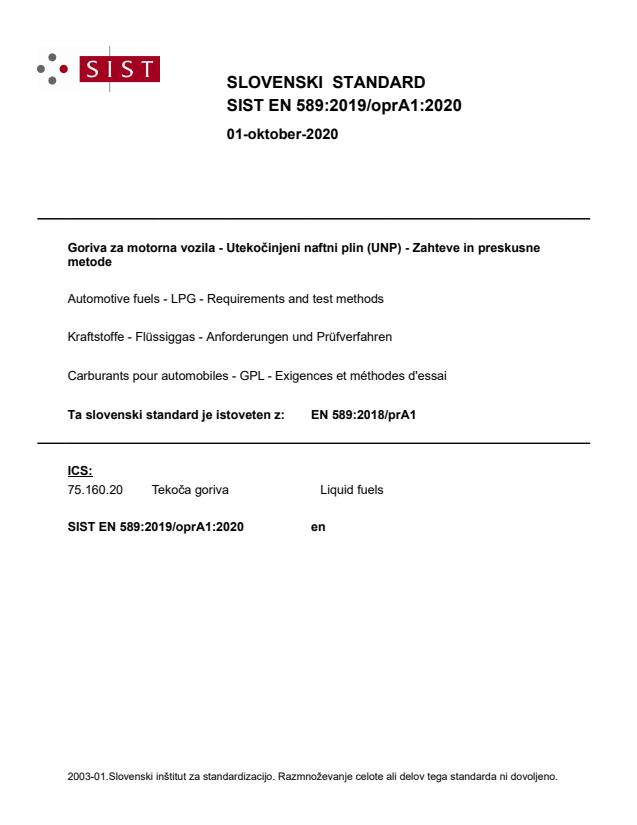
SLOVENSKI STANDARD
01-oktober-2020
Goriva za motorna vozila - Utekočinjeni naftni plin (UNP) - Zahteve in preskusne
metode
Automotive fuels - LPG - Requirements and test methods
Kraftstoffe - Flüssiggas - Anforderungen und Prüfverfahren
Carburants pour automobiles - GPL - Exigences et méthodes d'essai
Ta slovenski standard je istoveten z: EN 589:2018/prA1
ICS:
75.160.20 Tekoča goriva Liquid fuels
2003-01.Slovenski inštitut za standardizacijo. Razmnoževanje celote ali delov tega standarda ni dovoljeno.
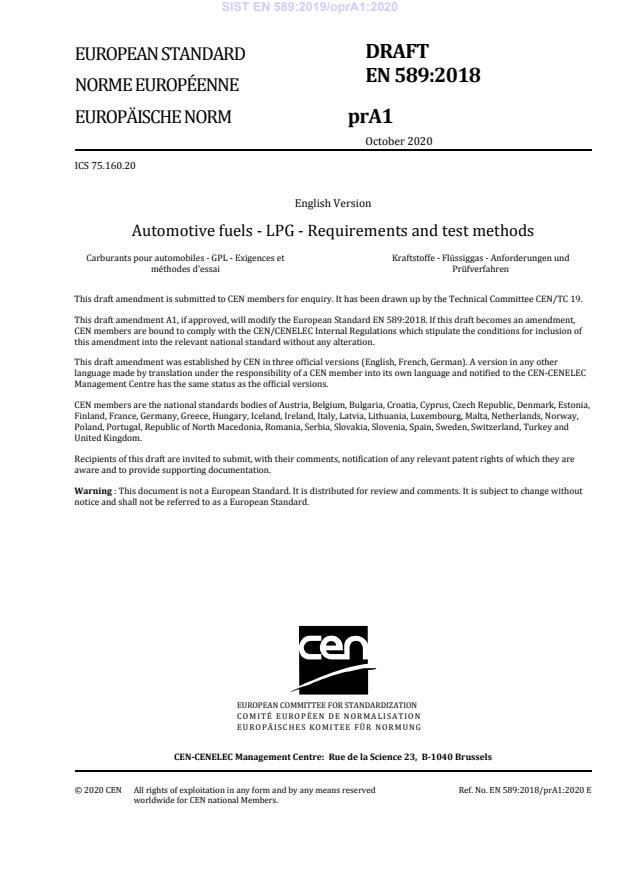
DRAFT
EUROPEAN STANDARD
EN 589:2018
NORME EUROPÉENNE
EUROPÄISCHE NORM
prA1
October 2020
ICS 75.160.20
English Version
Automotive fuels - LPG - Requirements and test methods
Carburants pour automobiles - GPL - Exigences et Kraftstoffe - Flüssiggas - Anforderungen und
méthodes d'essai Prüfverfahren
This draft amendment is submitted to CEN members for enquiry. It has been drawn up by the Technical Committee CEN/TC 19.
This draft amendment A1, if approved, will modify the European Standard EN 589:2018. If this draft becomes an amendment,
CEN members are bound to comply with the CEN/CENELEC Internal Regulations which stipulate the conditions for inclusion of
this amendment into the relevant national standard without any alteration.
This draft amendment was established by CEN in three official versions (English, French, German). A version in any other
language made by translation under the responsibility of a CEN member into its own language and notified to the CEN-CENELEC
Management Centre has the same status as the official versions.
CEN members are the national standards bodies of Austria, Belgium, Bulgaria, Croatia, Cyprus, Czech Republic, Denmark, Estonia,
Finland, France, Germany, Greece, Hungary, Iceland, Ireland, Italy, Latvia, Lithuania, Luxembourg, Malta, Netherlands, Norway,
Poland, Portugal, Republic of North Macedonia, Romania, Serbia, Slovakia, Slovenia, Spain, Sweden, Switzerland, Turkey and
United Kingdom.
Recipients of this draft are invited to submit, with their comments, notification of any relevant patent rights of which they are
aware and to provide supporting documentation.
Warning : This document is not a European Standard. It is distributed for review and comments. It is subject to change without
notice and shall not be referred to as a European Standard.
EUROPEAN COMMITTEE FOR STANDARDIZATION
COMITÉ EUROPÉEN DE NORMALISATION
EUROPÄISCHES KOMITEE FÜR NORMUNG
CEN-CENELEC Management Centre: Rue de la Science 23, B-1040 Brussels
© 2020 CEN All rights of exploitation in any form and by any means reserved Ref. No. EN 589:2018/prA1:2020 E
worldwide for CEN national Members.
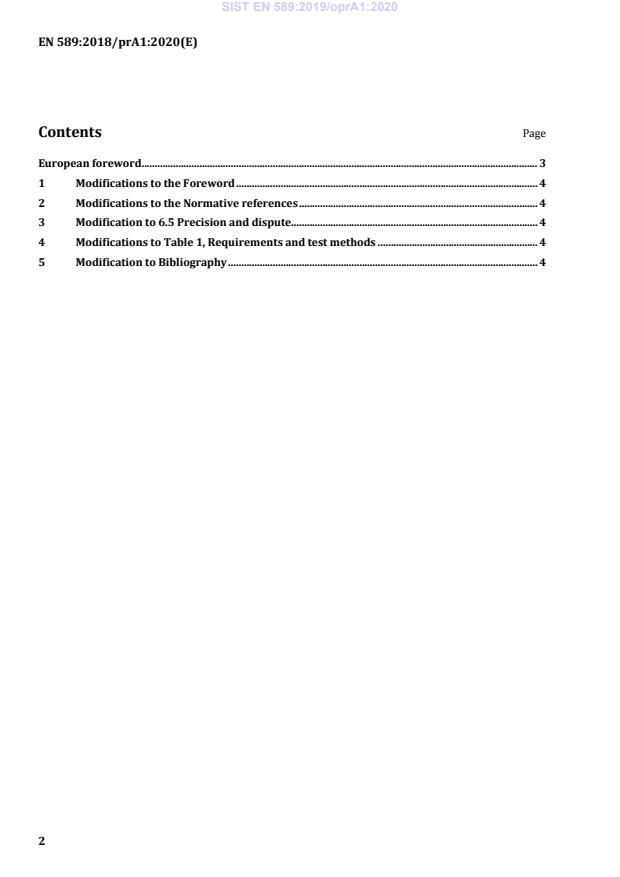
Contents Page
European foreword . 3
1 Modifications to the Foreword . 4
2 Modifications to the Normative references . 4
3 Modification to 6.5 Precision and dispute. 4
4 Modifications to Table 1, Requirements and test methods . 4
5 Mo
...