

SIST EN 1991-4:2026/oprA1:2026
(Amendment)Eurocode 1 - Actions on structures - Part 4: Silos and tanks
- Abstract
1.1 Scope of EN 1991-4
(1) This document provides rules for calculating actions for the structural design of silos and tanks.
NOTE 1 Silos are used for the storage of particulate solids. Tanks are used for the storage of liquids.
NOTE 2 For limitations on rules for silos given in this document, see 1.3.
NOTE 3 For limitations on rules for tanks given in this document, see 1.4.
(2) This document includes some provisions for actions on silo and tank structures that are not only associated with the stored particulate solids or liquids (e.g. the effects of thermal differentials) but substantially affected by them.
NOTE Liquid loads on tanks are very precisely defined. Many loads on silos are not known with great precision. This document provides guidance for many practical situations for which very limited certain knowledge is available, and the information is derived from the limited experimental and analytical information available, coupled with conclusions drawn from failure investigations. The information is not based on a sound statistical treatment of experimental data.
(3) This document is intended for use with concrete, steel, aluminium, timber and FRP storage structures.
NOTE FRP is the standard acronym for fibre reinforced polymer materials.
(4) This document is also applicable for the structural assessment of existing silos and tanks, unless otherwise specified by the relevant authority or, if not specified, agreed between the relevant parties for the specific project.
NOTE 1 Changes in filling or discharge arrangements, changes in the wall friction of inner surfaces, or in the use of the silo, including storage of different particulate solids, can be reasons for assessing existing silos.
NOTE 2 Differentiation of the liquid stored can be a reason for assessing existing tanks.
1.2 Assumptions
(1) The assumptions of EN 1990-1 apply.
(2) This document is intended to be used in conjunction with EN 1990 1, with the other parts of EN 1991, EN 1992, EN 1993, EN 1995, EN 1997, EN 1998 and EN 1999 where relevant to the design of silos and tanks.
1.3 Limitations on silos
1.3.1 Geometrical limitations
(1) The following geometrical limitations apply to the design rules for silos and silo batteries (see 3.2.59 and 3.2.60) covered by this document:
- the silo planform cross-section shapes are limited to those shown in Figure 1.1c.
NOTE 1 Further information concerning planform cross-section geometries is given in Clause 7.
NOTE 2 For the determination of the effective diameter dc of the silo see Figure 1.1c;
- the following dimensional limitations on the aspect ratio for free-standing single cell silos hc/dc, the overall height hb and the effective diameter dc apply (see Figure 1.1):
hc/dc < 10 (1.1)
hb < 100 m (1.2)
dc < 60 m (1.3)
NOTE 3 See Figure 1.1 for hc, dc and hb.
- the structural transition lies in a single horizontal plane (see Figure 1.1a).
[Figure 1.1 - Silo forms showing dimensions and pressure notation]
(2) Only hoppers that are conical (i.e. axisymmetric), rectangular pyramidal with a/b ≤ 1,5, wedge-shaped (i.e. with two vertical end walls on opposite sides) or oblique are covered by this document. Other hopper shapes and hoppers with internal structures require special considerations.
(3) Silos with an oblique conical hopper used to achieve an eccentric outlet are covered by this document.
(4) Silos with an oblique hopper are covered, but generally silos with a systematically non-symmetric geometry are not specifically covered by this document. These situations include a chisel hopper (i.e. a wedge hopper beneath a circular cylinder) and hoppers with an elongated outlet other than wedge shaped.
1.3.2 Limitations on the stored particulate solids
(1) The following limitations on the stored particulate solids apply to the design rules for silos contained in this document:
...
- Status
- Not Published
- Public Enquiry End Date
- 27-Sep-2026
- Technical Committee
- KON - Structures
- Current Stage
- 4020 - Public enquire (PE) (Adopted Project)
- Start Date
- 29-Jul-2026
- Due Date
- 16-Dec-2026

SIST EN 1991-4:2026/oprA1:2026 is a CEN draft amendment to EN 1991-4:2026 on Eurocode 1 actions on structures for silos and tanks. It updates the scope for silo design and makes a targeted change to informative Annex B on actions and combinations of actions on tanks. The document is submitted for enquiry and comment, so it presents proposed changes to the base standard rather than a finalized consolidated text.
What does SIST EN 1991-4:2026/oprA1:2026 specify?
SIST EN 1991-4:2026/oprA1:2026 specifies amendment text for EN 1991-4:2026. The underlying standard gives rules for calculating actions for the structural design of silos and tanks, including actions that are not only associated with stored particulate solids or liquids but are also affected by them, such as thermal differentials.
It is intended for concrete, steel, aluminium, timber and FRP (fibre reinforced polymer) storage structures. It is also applicable to the structural assessment of existing silos and tanks when the relevant authority, or the relevant parties for the project, agree to use it.
| Part | What it covers |
|---|---|
| Clause 1 | Modifications to the scope, including silo limits and exclusions |
| Annex B (informative) | Modification to actions and combinations of actions on tanks |
The scope for silos is limited to the planform cross-section shapes shown in Figure 1.1c, to the listed height and diameter limits, and to structures whose transition lies in a single horizontal plane. The document also limits the hopper shapes it covers, and it points readers to Figure 1.1 for dimensions, pressure notation and the effective diameter.
What are the key requirements of SIST EN 1991-4:2026/oprA1:2026?
SIST EN 1991-4:2026/oprA1:2026 changes the scope for silos and the treatment of certain tank actions. In practice, the main point is that the document is for structural action assessment, not for flow-performance design, and that some special loads need separate attention.
- Clause 1.3.1 sets geometric limits for silos and silo batteries. The planform shape is limited, the aspect ratio for free-standing single cell silos must stay below the stated limit, and the overall height and effective diameter are also bounded. For a project team, this means checking the silo geometry before using the action rules.
- Clause 1.3.1 also limits the hopper forms covered to conical, rectangular pyramidal with a/b ≤ 1,5, wedge-shaped with two vertical end walls on opposite sides, or oblique hoppers. If the hopper shape is more unusual or systemically non-symmetric, the document signals that special consideration is needed.
- Clause 1.3.3(5) states that the functional design of silos, meaning quality of flow, is outside the scope. In practice, structural design and flow design need to be treated as separate tasks.
- The added note after Clause 1.3.3(5) highlights blockage risk when particle sizes exceed d_o/8 or when cohesion strongly affects gravity flow. This gives a practical check on whether the outlet size and stored material are compatible.
- Clause 1.3.3(6) says loads from silo quaking, shocks, honking, pounding and silo music are not defined here, and classifies that part of design as Action Assessment Class AAC4. That means these dynamic effects need to be handled as a separate action-assessment issue.
- Annex B, B.4.1 adds insulation to the listed equipment for tanks. It also adds a rule for granular materials usually filled into annular spaces for insulation: the actions are taken from Clause 7 with the load modifying factor κ_ar set to 1,1 and the other load modifying factors set to 1. For designers, this tells you which action model to use for insulated tank details.
What terms does SIST EN 1991-4:2026/oprA1:2026 define?
SIST EN 1991-4:2026/oprA1:2026 uses a small set of project-critical terms that matter in design and assessment.
- Silos - storage structures used for particulate solids.
- Tanks - storage structures used for liquids.
- FRP - fibre reinforced polymer materials, one of the storage-structure materials named in the scope.
- Action Assessment Class AAC4 - the classification used for silo quaking, shocks, honking, pounding and silo music.
- National Annexes - the national documents through which Member States set values related to regulatory safety matters.
- Annular spaces - ring-shaped spaces in tanks, here mentioned as spaces that may be filled with granular materials for insulation.
Who uses SIST EN 1991-4:2026/oprA1:2026?
SIST EN 1991-4:2026/oprA1:2026 is used by structural engineers and designers working on silos and tanks, especially where stored solids or liquids govern the design actions. It also matters to owners, operators, checking engineers and assessors of existing storage structures.
The document is relevant across concrete, steel, aluminium, timber and FRP storage structures. It is particularly useful when filling or discharge arrangements change, wall friction changes, the stored particulate solid changes, or the stored liquid is differentiated and the existing structure needs reassessment.
What changed in SIST EN 1991-4:2026/oprA1:2026 from the previous edition?
SIST EN 1991-4:2026/oprA1:2026 modifies EN 1991-4:2026. The foreword notes that some modifications are purely editorial corrections, and the technical changes are concentrated in Clause 1 and Annex B.
The stated changes are:
- Clause 1.3.3 now says functional design of silos, meaning quality of flow, is outside the scope.
- Clause 1.3.3 adds a note on possible outlet blockage related to particle size and cohesion.
- Clause 1.3.3(6) now classifies silo quaking, shocks, honking, pounding and silo music as Action Assessment Class AAC4.
- Annex B, B.4.1 adds insulation to the tank equipment list.
- Annex B adds a paragraph for granular materials used in annular spaces for insulation, with specified load-modifying factors.
Which standards are used with SIST EN 1991-4:2026/oprA1:2026?
SIST EN 1991-4:2026/oprA1:2026 is used with EN 1990-1 and, where relevant, with the other Eurocode parts named in the scope.
| Standard or part | Contribution |
|---|---|
| EN 1990-1 | Its assumptions apply to this document |
| Other parts of EN 1991 | Provide additional action rules where relevant |
| EN 1992 | Used with this document where relevant to design |
| EN 1993 | Used with this document where relevant to design |
| EN 1995 | Used with this document where relevant to design |
| EN 1997 | Used with this document where relevant to design |
| EN 1998 | Used with this document where relevant to design |
| EN 1999 | Used with this document where relevant to design |
What does the SIST EN 1991-4:2026/oprA1:2026 document contain?
SIST EN 1991-4:2026/oprA1:2026 contains a European foreword, a contents list, modifications to Clause 1 on Scope, and a modification to informative Annex B on actions and combinations of actions on tanks. The main technical material is amendment text, not a full reprint of the standard.
Clause 1 refers to Figure 1.1 for silo forms, dimensions and pressure notation, and to Figure 1.1c for planform shape limits and the effective diameter. Annex B is the place where the tank-action change for insulation and granular materials in annular spaces is made, so the document is aimed at design checking rather than general description.
Relations
- Effective Date
- 29-Apr-2026
Get Certified
Connect with accredited certification bodies for this standard

DIBt (Deutsches Institut für Bautechnik)
German Institute for Building Technology.
DIN CERTCO
DIN Group product certification.

Aboma Certification B.V.
Specialized in construction, metal, and transport sectors.
Sponsored listings
Frequently Asked Questions
SIST EN 1991-4:2026/oprA1:2026 is a draft published by the Slovenian Institute for Standardization (SIST). Its full title is "Eurocode 1 - Actions on structures - Part 4: Silos and tanks". This standard covers: 1.1 Scope of EN 1991-4 (1) This document provides rules for calculating actions for the structural design of silos and tanks. NOTE 1 Silos are used for the storage of particulate solids. Tanks are used for the storage of liquids. NOTE 2 For limitations on rules for silos given in this document, see 1.3. NOTE 3 For limitations on rules for tanks given in this document, see 1.4. (2) This document includes some provisions for actions on silo and tank structures that are not only associated with the stored particulate solids or liquids (e.g. the effects of thermal differentials) but substantially affected by them. NOTE Liquid loads on tanks are very precisely defined. Many loads on silos are not known with great precision. This document provides guidance for many practical situations for which very limited certain knowledge is available, and the information is derived from the limited experimental and analytical information available, coupled with conclusions drawn from failure investigations. The information is not based on a sound statistical treatment of experimental data. (3) This document is intended for use with concrete, steel, aluminium, timber and FRP storage structures. NOTE FRP is the standard acronym for fibre reinforced polymer materials. (4) This document is also applicable for the structural assessment of existing silos and tanks, unless otherwise specified by the relevant authority or, if not specified, agreed between the relevant parties for the specific project. NOTE 1 Changes in filling or discharge arrangements, changes in the wall friction of inner surfaces, or in the use of the silo, including storage of different particulate solids, can be reasons for assessing existing silos. NOTE 2 Differentiation of the liquid stored can be a reason for assessing existing tanks. 1.2 Assumptions (1) The assumptions of EN 1990-1 apply. (2) This document is intended to be used in conjunction with EN 1990 1, with the other parts of EN 1991, EN 1992, EN 1993, EN 1995, EN 1997, EN 1998 and EN 1999 where relevant to the design of silos and tanks. 1.3 Limitations on silos 1.3.1 Geometrical limitations (1) The following geometrical limitations apply to the design rules for silos and silo batteries (see 3.2.59 and 3.2.60) covered by this document: - the silo planform cross-section shapes are limited to those shown in Figure 1.1c. NOTE 1 Further information concerning planform cross-section geometries is given in Clause 7. NOTE 2 For the determination of the effective diameter dc of the silo see Figure 1.1c; - the following dimensional limitations on the aspect ratio for free-standing single cell silos hc/dc, the overall height hb and the effective diameter dc apply (see Figure 1.1): hc/dc < 10 (1.1) hb < 100 m (1.2) dc < 60 m (1.3) NOTE 3 See Figure 1.1 for hc, dc and hb. - the structural transition lies in a single horizontal plane (see Figure 1.1a). [Figure 1.1 - Silo forms showing dimensions and pressure notation] (2) Only hoppers that are conical (i.e. axisymmetric), rectangular pyramidal with a/b ≤ 1,5, wedge-shaped (i.e. with two vertical end walls on opposite sides) or oblique are covered by this document. Other hopper shapes and hoppers with internal structures require special considerations. (3) Silos with an oblique conical hopper used to achieve an eccentric outlet are covered by this document. (4) Silos with an oblique hopper are covered, but generally silos with a systematically non-symmetric geometry are not specifically covered by this document. These situations include a chisel hopper (i.e. a wedge hopper beneath a circular cylinder) and hoppers with an elongated outlet other than wedge shaped. 1.3.2 Limitations on the stored particulate solids (1) The following limitations on the stored particulate solids apply to the design rules for silos contained in this document: ...
1.1 Scope of EN 1991-4 (1) This document provides rules for calculating actions for the structural design of silos and tanks. NOTE 1 Silos are used for the storage of particulate solids. Tanks are used for the storage of liquids. NOTE 2 For limitations on rules for silos given in this document, see 1.3. NOTE 3 For limitations on rules for tanks given in this document, see 1.4. (2) This document includes some provisions for actions on silo and tank structures that are not only associated with the stored particulate solids or liquids (e.g. the effects of thermal differentials) but substantially affected by them. NOTE Liquid loads on tanks are very precisely defined. Many loads on silos are not known with great precision. This document provides guidance for many practical situations for which very limited certain knowledge is available, and the information is derived from the limited experimental and analytical information available, coupled with conclusions drawn from failure investigations. The information is not based on a sound statistical treatment of experimental data. (3) This document is intended for use with concrete, steel, aluminium, timber and FRP storage structures. NOTE FRP is the standard acronym for fibre reinforced polymer materials. (4) This document is also applicable for the structural assessment of existing silos and tanks, unless otherwise specified by the relevant authority or, if not specified, agreed between the relevant parties for the specific project. NOTE 1 Changes in filling or discharge arrangements, changes in the wall friction of inner surfaces, or in the use of the silo, including storage of different particulate solids, can be reasons for assessing existing silos. NOTE 2 Differentiation of the liquid stored can be a reason for assessing existing tanks. 1.2 Assumptions (1) The assumptions of EN 1990-1 apply. (2) This document is intended to be used in conjunction with EN 1990 1, with the other parts of EN 1991, EN 1992, EN 1993, EN 1995, EN 1997, EN 1998 and EN 1999 where relevant to the design of silos and tanks. 1.3 Limitations on silos 1.3.1 Geometrical limitations (1) The following geometrical limitations apply to the design rules for silos and silo batteries (see 3.2.59 and 3.2.60) covered by this document: - the silo planform cross-section shapes are limited to those shown in Figure 1.1c. NOTE 1 Further information concerning planform cross-section geometries is given in Clause 7. NOTE 2 For the determination of the effective diameter dc of the silo see Figure 1.1c; - the following dimensional limitations on the aspect ratio for free-standing single cell silos hc/dc, the overall height hb and the effective diameter dc apply (see Figure 1.1): hc/dc < 10 (1.1) hb < 100 m (1.2) dc < 60 m (1.3) NOTE 3 See Figure 1.1 for hc, dc and hb. - the structural transition lies in a single horizontal plane (see Figure 1.1a). [Figure 1.1 - Silo forms showing dimensions and pressure notation] (2) Only hoppers that are conical (i.e. axisymmetric), rectangular pyramidal with a/b ≤ 1,5, wedge-shaped (i.e. with two vertical end walls on opposite sides) or oblique are covered by this document. Other hopper shapes and hoppers with internal structures require special considerations. (3) Silos with an oblique conical hopper used to achieve an eccentric outlet are covered by this document. (4) Silos with an oblique hopper are covered, but generally silos with a systematically non-symmetric geometry are not specifically covered by this document. These situations include a chisel hopper (i.e. a wedge hopper beneath a circular cylinder) and hoppers with an elongated outlet other than wedge shaped. 1.3.2 Limitations on the stored particulate solids (1) The following limitations on the stored particulate solids apply to the design rules for silos contained in this document: ...
SIST EN 1991-4:2026/oprA1:2026 is classified under the following ICS (International Classification for Standards) categories: 23.020.10 - Stationary containers and tanks; 91.040.01 - Buildings in general. The ICS classification helps identify the subject area and facilitates finding related standards.
SIST EN 1991-4:2026/oprA1:2026 has the following relationships with other standards: It is inter standard links to kSIST FprEN 1991-4:2025. Understanding these relationships helps ensure you are using the most current and applicable version of the standard.
SIST EN 1991-4:2026/oprA1:2026 is available in PDF format for immediate download after purchase. The document can be added to your cart and obtained through the secure checkout process. Digital delivery ensures instant access to the complete standard document.
Standards Content (Sample)
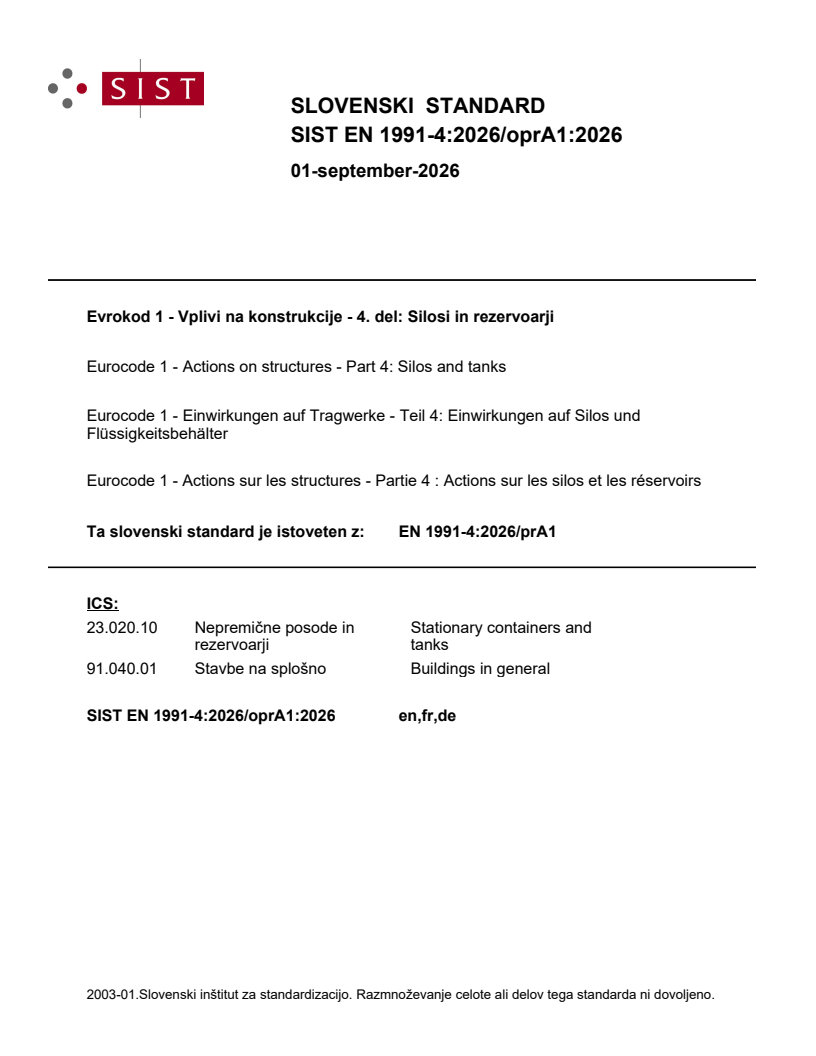
SLOVENSKI STANDARD
01-september-2026
Evrokod 1 - Vplivi na konstrukcije - 4. del: Silosi in rezervoarji
Eurocode 1 - Actions on structures - Part 4: Silos and tanks
Eurocode 1 - Einwirkungen auf Tragwerke - Teil 4: Einwirkungen auf Silos und
Flüssigkeitsbehälter
Eurocode 1 - Actions sur les structures - Partie 4 : Actions sur les silos et les réservoirs
Ta slovenski standard je istoveten z: EN 1991-4:2026/prA1
ICS:
23.020.10 Nepremične posode in Stationary containers and
rezervoarji tanks
91.040.01 Stavbe na splošno Buildings in general
2003-01.Slovenski inštitut za standardizacijo. Razmnoževanje celote ali delov tega standarda ni dovoljeno.
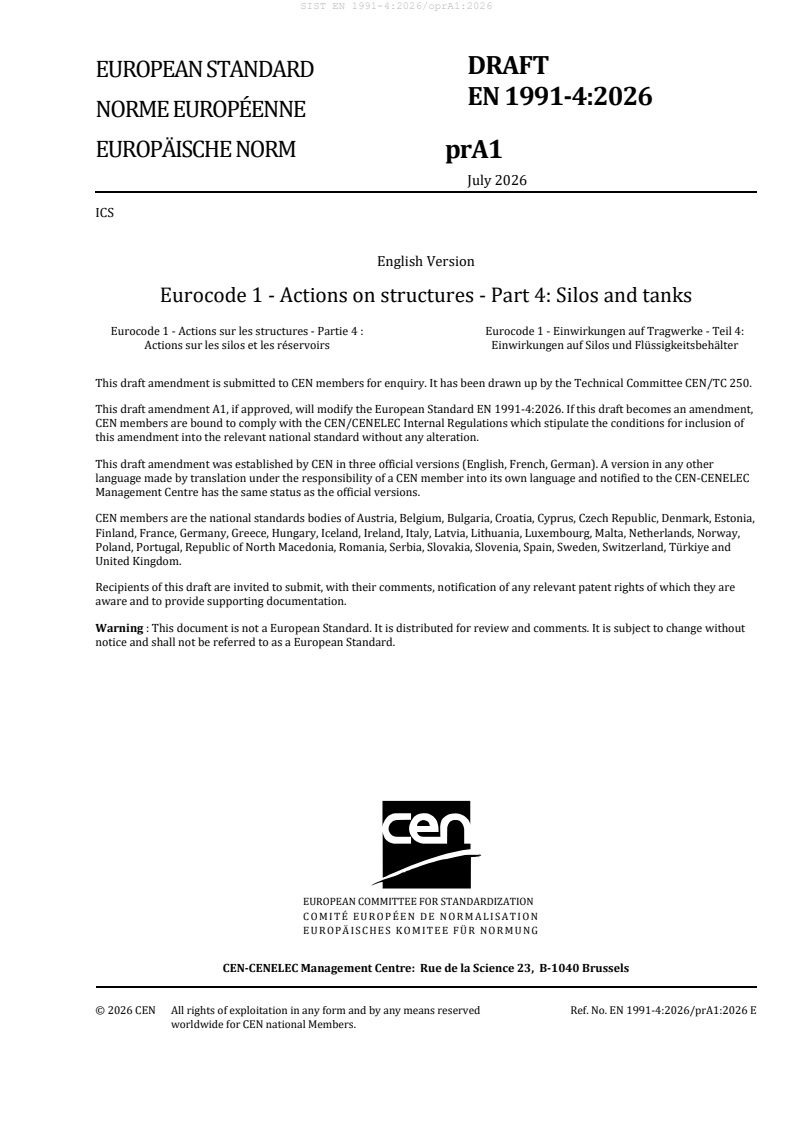
DRAFT
EUROPEAN STANDARD
EN 1991-4:2026
NORME EUROPÉENNE
EUROPÄISCHE NORM
prA1
July 2026
ICS
English Version
Eurocode 1 - Actions on structures - Part 4: Silos and tanks
Eurocode 1 - Actions sur les structures - Partie 4 : Eurocode 1 - Einwirkungen auf Tragwerke - Teil 4:
Actions sur les silos et les réservoirs Einwirkungen auf Silos und Flüssigkeitsbehälter
This draft amendment is submitted to CEN members for enquiry. It has been drawn up by the Technical Committee CEN/TC 250.
This draft amendment A1, if approved, will modify the European Standard EN 1991-4:2026. If this draft becomes an amendment,
CEN members are bound to comply with the CEN/CENELEC Internal Regulations which stipulate the conditions for inclusion of
this amendment into the relevant national standard without any alteration.
This draft amendment was established by CEN in three official versions (English, French, German). A version in any other
language made by translation under the responsibility of a CEN member into its own language and notified to the CEN-CENELEC
Management Centre has the same status as the official versions.
CEN members are the national standards bodies of Austria, Belgium, Bulgaria, Croatia, Cyprus, Czech Republic, Denmark, Estonia,
Finland, France, Germany, Greece, Hungary, Iceland, Ireland, Italy, Latvia, Lithuania, Luxembourg, Malta, Netherlands, Norway,
Poland, Portugal, Republic of North Macedonia, Romania, Serbia, Slovakia, Slovenia, Spain, Sweden, Switzerland, Türkiye and
United Kingdom.
Recipients of this draft are invited to submit, with their comments, notification of any relevant patent rights of which they are
aware and to provide supporting documentation.
Warning : This document is not a European Standard. It is distributed for review and comments. It is subject to change without
notice and shall not be referred to as a European Standard.
EUROPEAN COMMITTEE FOR STANDARDIZATION
COMITÉ EUROPÉEN DE NORMALISATION
EUROPÄISCHES KOMITEE FÜR NORMUNG
CEN-CENELEC Management Centre: Rue de la Science 23, B-1040 Brussels
© 2026 CEN All rights of exploitation in any form and by any means reserved Ref. No. EN 1991-4:2026/prA1:2026 E
worldwide for CEN national Members.
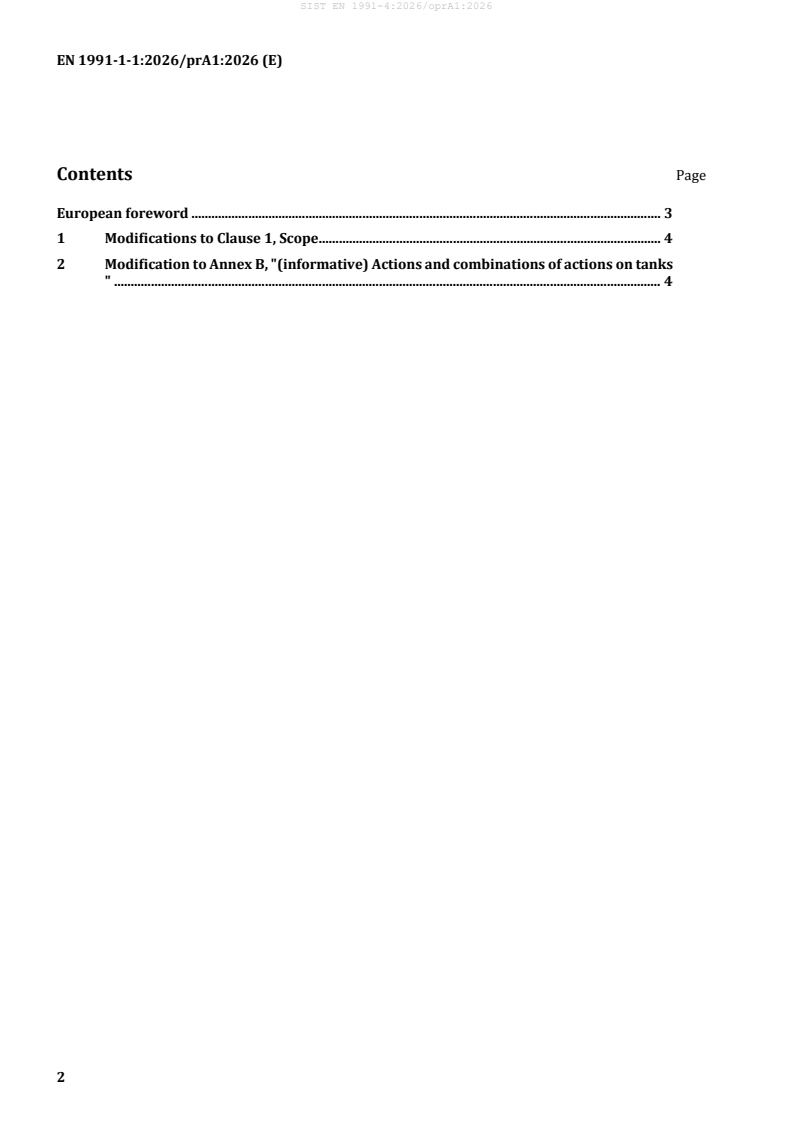
EN 1991-1-1:2026/prA1:2026 (E)
Contents Page
European foreword .
...