

SIST EN 50483-6:2026
(Main)Test requirements for low voltage aerial bundled cable accessories - Part 6: Environmental testing
General Information
- Abstract
The EN 50483 series applies to overhead line fittings for tensioning, supporting and connecting aerial bundled cables (ABC) of rated voltage U0/U (Um): 0,6/1 (1,2) kV.
This document defines the environmental tests in particular the climatic and corrosion ageing tests. The objective of these tests is to predict the behaviour of ABC accessories when subjected to sun radiation, to weather conditions (humidity, spraying water, heat, cold) and pollution. EN 50483-1, EN 50483-2, EN 50483-3 and EN 50483-4 specify which type tests included in this part of the standard are needed.
- Status
- Published
- Public Enquiry End Date
- 31-Dec-2024
- Publication Date
- 16-Apr-2026
- Technical Committee
- IEKA - Electric cables
- Current Stage
- 6060 - National Implementation/Publication (Adopted Project)
- Start Date
- 09-Apr-2026
- Due Date
- 14-Jun-2026
- Completion Date
- 17-Apr-2026

Overview
SIST EN 50483-6:2026, developed by CLC, is a European Standard focused on the environmental testing of low voltage aerial bundled cable (ABC) accessories used in overhead power distribution lines. As Part 6 in the EN 50483 series, this standard defines a framework for evaluating how ABC accessories, such as connectors, clamps, fittings, and brackets for rated voltage 0.6/1 (1.2) kV cables, perform under various environmental stressors. The goal is to predict the service life and reliability of accessories when exposed to sun radiation, weather variations (humidity, water spray, heat, cold), and industrial or natural pollution.
The standard specifies climatic ageing tests and corrosion tests, essential for manufacturers, suppliers, and utilities to ensure the consistent quality and durability of overhead line fittings in diverse geographic regions.
Key Topics
Scope and Coverage
SIST EN 50483-6:2026 applies to overhead line fittings designed to tension, support, and connect ABC systems. It covers environmental testing methods to assess resistance to climate and pollutant exposure.Climatic and Corrosion Ageing Tests
The standard prescribes:- Salt mist testing to simulate coastal or saline conditions.
- Gas atmosphere testing, including sulfur dioxide exposure to replicate industrial pollution.
- Controlled climatic ageing cycles with ultraviolet radiation, humidity variation, water spraying, and temperature extremes.
Testing Methodologies
- Defines test equipment specifications, sample arrangement, and cleaning procedures.
- Specifies weekly and cyclic procedures for climate simulation.
- Includes optional immersion tests for regions with severe saline or corrosive atmospheres.
Type Test Requirements
Outlines how accessories must be type-tested before introduction into the market, ensuring performance under environmental stress.Alignment with Other EN 50483 Parts
References the integration of test outcomes with general requirements and other test categories as defined in EN 50483-1–4.
Applications
SIST EN 50483-6:2026 is relevant for:
Manufacturers of Cable Accessories
Guiding the development and quality assurance of ABC connectors, tension and suspension clamps, fittings, and brackets.Utilities and Grid Operators Facilitating the procurement and acceptance of reliable and long-lasting ABC system accessories for urban, rural, coastal, and industrial environments.
Testing Laboratories and Certification Bodies Providing standardized methods for laboratory assessment of environmental resistance in low voltage cable accessories.
Designers and Project Engineers Assisting in the specification of components suitable for harsh climates or polluted sites, reducing maintenance needs and minimizing service interruptions.
Related Standards
SIST EN 50483-6:2026 is one part of a modular testing and requirements system for low voltage ABC accessories. Other relevant standards include:
- EN 50483-1:2026 – Generalities and definitions for ABC accessories.
- EN 50483-2:2026 – Mechanical tests for tension and suspension components.
- EN 50483-3:2026 – Type tests specific to neutral messenger systems.
- EN 50483-4:2026 – Connector-specific tests.
- EN 50483-5:2026 – Electrical ageing tests.
- EN IEC 60068-2-11:2021 – Environmental salt mist test procedures.
- EN ISO 22479 – Sulfur dioxide corrosion testing.
- IEC 60050-461 – Electrotechnical vocabulary for cables.
For those involved in the design, specification, or testing of accessories for low voltage ABC systems, compliance with SIST EN 50483-6:2026 ensures robust performance and safety in varied environmental conditions, supporting the reliability and longevity of overhead distribution lines.
Relations
- Effective Date
- 01-Jun-2026
Get Certified
Connect with accredited certification bodies for this standard

IMQ S.p.A. (Certification)
Italian electrical product certification.

SLG Prüf- und Zertifizierungs GmbH
German testing and certification body.

UL Solutions
Global safety science company with testing, inspection and certification.
Sponsored listings
Frequently Asked Questions
SIST EN 50483-6:2026 is a standard published by the Slovenian Institute for Standardization (SIST). Its full title is "Test requirements for low voltage aerial bundled cable accessories - Part 6: Environmental testing". This standard covers: The EN 50483 series applies to overhead line fittings for tensioning, supporting and connecting aerial bundled cables (ABC) of rated voltage U0/U (Um): 0,6/1 (1,2) kV. This document defines the environmental tests in particular the climatic and corrosion ageing tests. The objective of these tests is to predict the behaviour of ABC accessories when subjected to sun radiation, to weather conditions (humidity, spraying water, heat, cold) and pollution. EN 50483-1, EN 50483-2, EN 50483-3 and EN 50483-4 specify which type tests included in this part of the standard are needed.
The EN 50483 series applies to overhead line fittings for tensioning, supporting and connecting aerial bundled cables (ABC) of rated voltage U0/U (Um): 0,6/1 (1,2) kV. This document defines the environmental tests in particular the climatic and corrosion ageing tests. The objective of these tests is to predict the behaviour of ABC accessories when subjected to sun radiation, to weather conditions (humidity, spraying water, heat, cold) and pollution. EN 50483-1, EN 50483-2, EN 50483-3 and EN 50483-4 specify which type tests included in this part of the standard are needed.
SIST EN 50483-6:2026 is classified under the following ICS (International Classification for Standards) categories: 29.240.20 - Power transmission and distribution lines. The ICS classification helps identify the subject area and facilitates finding related standards.
SIST EN 50483-6:2026 has the following relationships with other standards: It is inter standard links to SIST EN 50483-6:2009. Understanding these relationships helps ensure you are using the most current and applicable version of the standard.
SIST EN 50483-6:2026 is available in PDF format for immediate download after purchase. The document can be added to your cart and obtained through the secure checkout process. Digital delivery ensures instant access to the complete standard document.
Standards Content (Sample)
SLOVENSKI STANDARD
01-junij-2026
Nadomešča:
SIST EN 50483-6:2009
Zahteve za preskušanje pribora za nizkonapetostne izolirane nadzemne kable - 6.
del: Okoljsko preskušanje
Test requirements for low voltage aerial bundled cable accessories - Part 6:
Environmental testing
Prüfanforderungen für Bauteile für isolierte Niederspannungsfreileitungen - Teil 6:
Umweltprüfungen
Prescriptions relatives aux essais des accessoires pour réseaux aériens basse tension
torsadés - Partie 6: Essais d’environnement
Ta slovenski standard je istoveten z: EN 50483-6:2026
ICS:
29.240.20 Daljnovodi Power transmission and
distribution lines
2003-01.Slovenski inštitut za standardizacijo. Razmnoževanje celote ali delov tega standarda ni dovoljeno.
EUROPEAN STANDARD EN 50483-6
NORME EUROPÉENNE
EUROPÄISCHE NORM April 2026
ICS 29.240.20 Supersedes EN 50483-6:2009
English Version
Test requirements for low voltage aerial bundled cable
accessories - Part 6: Environmental testing
Prescriptions relatives aux essais des accessoires pour Prüfanforderungen für Bauteile für isolierte
réseaux aériens basse tension torsadés - Partie 6: Essais Niederspannungsfreileitungen - Teil 6: Umweltprüfungen
d'environnement
This European Standard was approved by CENELEC on 2026-03-09. CENELEC members are bound to comply with the CEN/CENELEC
Internal Regulations which stipulate the conditions for giving this European Standard the status of a national standard without any alteration.
Up-to-date lists and bibliographical references concerning such national standards may be obtained on application to the CEN-CENELEC
Management Centre or to any CENELEC member.
This European Standard exists in three official versions (English, French, German). A version in any other language made by translation
under the responsibility of a CENELEC member into its own language and notified to the CEN-CENELEC Management Centre has the
same status as the official versions.
CENELEC members are the national electrotechnical committees of Austria, Belgium, Bulgaria, Croatia, Cyprus, the Czech Republic,
Denmark, Estonia, Finland, France, Germany, Greece, Hungary, Iceland, Ireland, Italy, Latvia, Lithuania, Luxembourg, Malta, the
Netherlands, Norway, Poland, Portugal, Republic of North Macedonia, Romania, Serbia, Slovakia, Slovenia, Spain, Sweden, Switzerland,
Türkiye and the United Kingdom.
European Committee for Electrotechnical Standardization
Comité Européen de Normalisation Electrotechnique
Europäisches Komitee für Elektrotechnische Normung
CEN-CENELEC Management Centre: Rue de la Science 23, B-1040 Brussels
© 2026 CENELEC All rights of exploitation in any form and by any means reserved worldwide for CENELEC Members.
Ref. No. EN 50483-6:2026 E
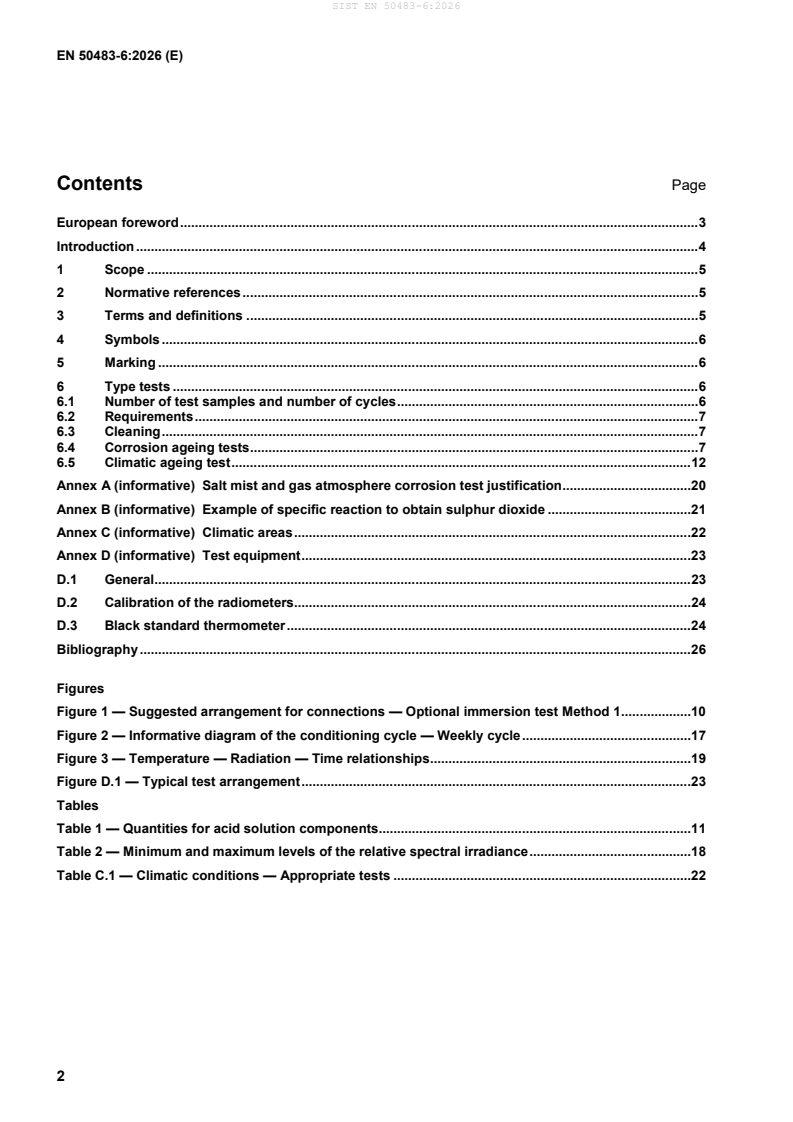
Contents Page
European foreword . 3
Introduction . 4
1 Scope . 5
2 Normative references . 5
3 Terms and definitions . 5
4 Symbols . 6
5 Marking . 6
6 Type tests . 6
6.1 Number of test samples and number of cycles . 6
6.2 Requirements . 7
6.3 Cleaning . 7
6.4 Corrosion ageing tests . 7
6.5 Climatic ageing test . 12
Annex A (informative) Salt mist and gas atmosphere corrosion test justification . 20
Annex B (informative) Example of specific reaction to obtain sulphur dioxide . 21
Annex C (informative) Climatic areas . 22
Annex D (informative) Test equipment . 23
D.1 General . 23
D.2 Calibration of the radiometers. 24
D.3 Black standard thermometer . 24
Bibliography . 26
Figures
Figure 1 — Suggested arrangement for connections — Optional immersion test Method 1 . 10
Figure 2 — Informative diagram of the conditioning cycle — Weekly cycle . 17
Figure 3 — Temperature — Radiation — Time relationships . 19
Figure D.1 — Typical test arrangement . 23
Tables
Table 1 — Quantities for acid solution components. 11
Table 2 — Minimum and maximum levels of the relative spectral irradiance . 18
Table C.1 — Climatic conditions — Appropriate tests . 22
European foreword
This document (EN 50483-6:2026) has been prepared by CLC/TC 20, “Electric cables”.
The following dates are fixed:
• latest date by which this document has to be (dop) 2027-04-30
implemented at national level by publication of
an identical national standard or by
endorsement
• latest date by which the national standards (dow) 2029-04-30
conflicting with this document have to be
withdrawn
This document supersedes EN 50483-6:2009 and all of its amendments and corrigenda (if any).
— Scope was extended to brackets.
This is Part 6 of the EN 50483 series “Test requirements for low voltage aerial bundled cable accessories”,
which has six parts:
— Part 1: Generalities;
— Part 2: Tension and suspension clamps, fittings and brackets for self-supporting system;
— Part 3: Tension and suspension clamps, fittings and brackets for neutral messenger system;
— Part 4: Connectors;
— Part 5: Electrical ageing test;
— Part 6: Environmental testing.
Attention is drawn to the possibility that some of the elements of this document may be the subject of patent
rights. CENELEC shall not be held responsible for identifying any or all such patent rights.
Any feedback and questions on this document should be directed to the users’ national committee. A
complete listing of these bodies can be found on the CENELEC website.
Introduction
The objective of the EN 50483 series is to provide a method of testing the suitability of accessories when used
under normal operating conditions with low voltage aerial bundled cables (ABC) complying with HD 626 S2.
Climate differs across Europe and in order to meet the differing geographic climatic conditions it is necessary
to provide a range of tests to meet these variations. A range of optional, additional tests is provided to meet
the varying climatic needs and these should be agreed between the customer and the manufacturer and/or
the supplier (see Annex C).
This document does not invalidate existing approvals of products achieved on the basis of national standards
and specifications and/or the demonstration of satisfactory service performance. However, products approved
according to such national standards or specifications cannot directly claim approval to this document. It might
be possible, subject to agreement between the customer and the manufacturer and/or the supplier, and/or the
relevant conformity assessment body, to demonstrate that conformity to the earlier standard can be used to
claim conformity to this document, provided an assessment is made of any additional type testing that might
need to be carried out. Any such additional testing that is part of a sequence of testing cannot be done
separately.
1 Scope
The EN 50483 series applies to overhead line fittings for tensioning, supporting and connecting aerial bundled
cables (ABC) of rated voltage U /U (U ): 0,6/1 (1,2) kV.
0 m
This document defines the environmental tests in particular the climatic and corrosion ageing tests. The
objective of these tests is to predict the behaviour of ABC accessories when subjected to sun radiation, to
weather conditions (humidity, spraying water, heat, cold) and pollution. EN 50483-1, EN 50483-2, EN 50483-3
and EN 50483-4 specify which type tests included in this part of the standard are needed.
2 Normative references
The following documents are referred to in the text in such a way that some or all of their content constitutes
requirements of this document. For dated references, only the edition cited applies. For undated references,
the latest edition of the referenced document (including any amendments) applies.
EN 50483 (all parts), Test requirements for low voltage aerial bundled cable accessories
EN 50483-1:2026, Test requirements for low voltage aerial bundled cable accessories – Part 1: Generalities
EN 50483-5:2026, Test requirements for low voltage aerial bundled cable accessories - Part 5: Electrical
ageing test
EN IEC 60068-2-11:2021, Environmental testing - Part 2-11: Tests - Test Ka: Salt mist (IEC 60068-2-11:2021)
EN ISO 22479, Corrosion of metals and alloys - Sulfur dioxide test in a humid atmosphere (fixed gas method)
(ISO 22479)
IEC 60050-461, International Electrotechnical Vocabulary (IEV) – Part 461: Electric cables
3 Terms and definitions
For the purposes of this document, the terms and definitions given in IEC 60050-461 and the following apply.
ISO and IEC maintain terminology databases for use in standardization at the following addresses:
— ISO Online browsing platform: available at https://www.iso.org/obp/
— IEC Electropedia: available at https://www.electropedia.org/
3.1
aerial bundled cable
ABC
aerial cable consisting of a group of insulated conductors which are twisted together including, or not, a non-
insulated conductor
Note 1 to entry: The terms bundled conductors, bundled cables, bundled cores, conductor bundles and bundle could be
used as equivalent to the term aerial bundled cable (ABC).
[SOURCE: IEV 461-08-02, modified]
3.2
aerial-insulated cable
insulated cable designed to be suspended overhead and outdoors
[SOURCE: IEV 461-08-01]
3.3
conductor
part of a cable which has the specific function of carrying current
[SOURCE: IEV 461-01-01]
3.4
core
assembly comprising conductor and its own insulation
[SOURCE: IEV 461-04-04, modified]
3.5
fixture
fitting
device for attaching ABC tension or/and suspension clamps to a pole or to a wall
3.6
insulation
insulating materials incorporated in a cable with the specific function of withstanding voltage
[SOURCE: IEV 461-02-01]
3.7
type test
test required to be made before supplying a type of material covered by this document on a general
commercial basis, in order to demonstrate satisfactory performance characteristics to meet the intended
application
Note 1 to entry: These tests are of such a nature that, after they have been made, they need not be repeated unless
changes are made to the accessory materials, design or type of manufacturing process which might change the
performance characteristics.
4 Symbols
λ and λ wavelength of UV light source
1 2
E mean energy received by the samples
m
E radiated energy of the lamp
n number of cycles (defined in appropriate part of this standard)
θ temperature measured by the black standard thermometer
θ temperature of the chamber
E
5 Marking
Marking shall be according to Clause 6 of EN 50483-1:2026.
6 Type tests
6.1 Number of test samples and number of cycles
The number of samples and number of cycles for each of the following tests are included in each relevant part
of the EN 50483 series.
6.2 Requirements
The requirements for the following tests shall be as given in the relevant parts of the EN 50483 series.
6.3 Cleaning
On completion of the environmental tests, and between different environmental tests when carried out as a
sequence, the samples shall, unless otherwise specified, be cleaned using running tap water for 5 min to
10 min and then by using demineralized water for the same period. The temperature of the water shall not
exceed 35 °C. The samples shall be dried either by shaking by hand or using air blast to remove droplets of
water.
6.4 Corrosion ageing tests
6.4.1 General
These tests shall be carried out when the products contain metallic parts (or parts protected with a metallic
coating), which are exposed to the atmosphere.
A justification of the tests is given in Annex A.
6.4.2 Salt mist test
6.4.2.1 Principle
This test exposes samples to a neutral salt spray (concentration of NaCl: 5 %).
6.4.2.2 Test equipment
The test equipment is defined in Clause 6 of EN IEC 60068-2-11:2021.
6.4.2.3 Test arrangement
The preparation and use of the salt solution are defined in Clause 5 of EN IEC 60068-2-11:2021.
6.4.2.4 Procedure
The test procedure is defined in Clause 11 of EN IEC 60068-2-11:2021.
The connectors or accessories shall be installed as defined in the relevant parts of the EN 50483 series.
The cycle duration prescribed, in accordance with EN IEC 60068-2-11:2021, 12.1 shall be 7 days.
No cleaning of the samples shall be carried out between cycles.
6.4.2.5 Test reports
The test report shall include the duration of exposure and the concentration and pH of the salt solution.
6.4.3 Gas atmosphere tests
6.4.3.1 General
Two methods of testing are provided to meet the requirements of the gas atmosphere test. A justification of
the tests for the first method is given in Annex A.
NOTE 1 Method 1 is based on the test procedure that has been used for many years in some countries. These
countries have gained experience of both the procedures and outcomes of the test. Method 2 is provided as an alternative
as it requires a less complicated test environment and is based on ASTM G85.
NOTE 2 This test can be necessary for accessories that are used in areas subjected to heavy industrial pollution.
6.4.3.2 Gas atmosphere test (Method 1)
6.4.3.2.1 Principle
This test exposes samples to a humidity-saturated atmosphere rich with sulphur dioxide (initial concentration
SO : 0,066 7 % (667 parts per million by volume)) with defined conditions of temperature and pressure.
6.4.3.2.2 Test equipment
The samples and supports shall be installed in a hermetic test chamber, with a humidity-saturated atmosphere
in the presence of sulphur dioxide.
This test chamber shall be made of inert material. The test shall be made in accordance with EN ISO 22479.
6.4.3.2.3 Preparation of SO atmosphere
After closing the chamber, sulphur dioxide (concentration = 0,066 7 %) shall be introduced from either a gas
bottle or using a specific reaction in the chamber as described in Annex B.
6.4.3.2.4 Procedure
Each period, or basic module, shall comprise a weekly sequence.
7 cycles of 24 h (168 h total), each cycle includes an 8 h exposure with saturated humidity and high sulphur
dioxide atmosphere (a total exposure of 56 h), and a 16 h exposure at the laboratory atmosphere (a total
exposure of 112 h).
NOTE Exposure to laboratory atmosphere can be achieved by opening the chamber door. It is the intention of this
phase to allow clean air to circulate around the test samples.
During the 8 h period, the temperature is raised to (40 ± 3) °C. During the 16 h period the chamber remains at
ambient temperature and finally the water and sulphur dioxide atmosphere is renewed to the concentration as
specified in 6.4.3.2.3.
6.4.3.2.5 Cleaning
When the specimens are exposed successively to a neutral salt spray and then to a humidity saturated
atmosphere with sulphur dioxide, the procedure shall be
— 7 cycles of 24 h in salt,
— no cleaning,
— 7 cycles of 24 h in sulphur dioxide,
— cleaning in accordance with 6.3.
6.4.3.3 Gas atmosphere test (Method 2)
6.4.3.3.1 Procedure
The test samples shall be subjected to a cyclic corrosion test consisting of 1 h period of drying and 1 h period
of fog. The test shall consist of 500 cycles (1 000 h). The fog period shall be at ambient temperature, while the
drying time shall be at a higher temperature.
NOTE Experience indicates that longer cycle times can produce slower degradation.
6.4.3.3.2 Test equipment
The apparatus for salt spray (fog) testing consists of a fog chamber, a salt solution reservoir, a supply of
suitable conditioned compressed air, one or more atomising nozzles, specimen supports, provision for heating
the chamber, and necessary means of control. The size and detailed construction of the cabinet are optional,
provided the conditions obtained meet the requirements of this standard. The material of construction shall be
such that it will not be affected by the corrosiveness of the fog. The chamber shall be designed so that drops
of solution that accumulate on the ceiling or cover of the chamber do not fall on the specimen being tested.
The nozzle or nozzles shall be directed so that none of the spray can impinge directly on the test specimen.
The solution shall not be recycled.
6.4.3.3.3 Atomisation and quantity of fog
At least two clean fog collectors shall be placed within the exposure zone so that drops of solution from the
test specimen or any other source are not collected. The collectors shall be positioned in the proximity of the
specimens, one near to a nozzle and the other, as far as possible from all nozzles. It shall be secured so that,
for each 80 cm of horizontal collecting area, fog accumulates in each collector at a rate between 1,0 ml to
2,0 ml of solution per hour, based on an average run of at least 16 h continuous spray.
NOTE Suitable collecting devices are glass funnels with the stems inserted through stoppers into graduated cylinders
or crystallizing dishes. Funnels and dishes with a diameter of 100 mm have an area of about 80 cm .
6.4.3.3.4 Salt solution
The salt solution shall consist of 0,05 % sodium chloride (NaCl) and 0,35 % ammonium sulphate (NH ) (SO )
4 2 4
by mass. The water shall be distilled or de-ionized water. The sodium chloride shall be substantially free of
nickel and copper and shall contain, on the dry basis, not more than 0,1 % of sodium iodide and not more than
0,3 % of total impurities. The ammonium sulphate shall contain not more than 0,3 % total impurities. Some
salts contain additives that may act as corrosion inhibitors; careful attention shall be given to the chemical
content of the salt.
The pH of the collected solution shall be between 5,0 and 5,4.
6.4.3.3.5 Air supply
The compressed air supply to the nozzle or nozzles, for atomising the salt solution, shall be free of oil and dirt
and maintain the air supply between 70 kPa and 170 kPa.
6.4.3.3.6 Procedure
The test shall consist of cycles of a 1 h drying period and a 1 h fog period. The electrolyte shall be a solution
of sodium chloride and ammonium sulphate. The fog period shall be performed at ambient temperature, while
the drying-off shall be at higher temperature. The solution atomising air shall not be saturated with water.
During the fog period, no heating shall be applied to the cabinet. The fog exposure shall be at (24 ± 3) °C.
During the drying-off period the temperature throughout the exposure zone shall reach and remain at
(35 ± 2) °C within 45 min of switching from the fog period to the dry period. The drying-off shall be achieved by
purging the chamber with fresh air so that within 45 min all visible moisture shall be dried off the specimen.
Humidified air shall not be used for drying.
NOTE As the specimen cycles from wet to dry it is subjected to a range of solution concentration varying from dilute
during the fog period to very concentrated just before the water dries off completely.
6.4.3.3.7 Cleaning
There shall be no cleaning of the test samples between the test cycles.
At completion of the test the samples shall be cleaned in accordance with 6.3.
6.4.4 Immersion tests (optional)
6.4.4.1 General
NOTE Two test methods are provided to allow for the different climatic conditions encountered in service. Method 1
is provided to cater for severe salt pollution e.g. western coast of UK. Method 2 simulates a severely corrosive atmosphere
e.g. near heavy industry.
6.4.4.2 Immersion test (Method 1)
6.4.4.2.1 Principle
For saline polluted areas an optional additional test shall be carried out when this is agreed between the
customer and the manufacturer and/or the supplier. In order to minimize testing, when agreed, this test shall
be carried out during the mandatory heat cycle tests as provided in EN 50483-5.
6.4.4.2.2 Test arrangement
This shall be, generally, in accordance with EN 50483-5:2026, 5.2 but in particular the test circuit, as
described in EN 50483-5:2026, 5.2.1, shall be modified to allow the samples to be fully immersed in a saline
solution during the heat cycle.
The saline solution shall be maintained at 29,22 g/l (approximately 3 % of mass) concentration of NaCl
throughout the test.
NOTE A practical arrangement is to place the test samples in a tank and pump the saline solution from a reservoir
below. The tank can then be drained back into the reservoir after the required immersion period.
The test loop may be arranged so that the samples, but not the measurement points, are immersed in the
saline solution. Figure 1 shows a typical arrangement.
Key
1 potential points
2 cable core
3 connector
4 salt water
Figure 1 — Suggested arrangement for connections —
Optional immersion test Method 1
6.4.4.2.3 Procedure
The procedure shall, generally, be in accordance with EN 50483-5:2026, 5.2, 5.3, 5.4 and 5.5. However, in
particular, the subsequent heat cycles defined in EN 50483-5:2026, 5.5.2 shall be modified to include the
immersion of the samples.
Immersion of the test samples shall occur on completion of period t and they shall be fully immersed for a
minimum period of 5 min. The time of immersion shall be considered part of the cooling period t . Periods, t
2 1
and t , are shown in EN 50483-5:2026, Figure 3.
6.4.4.2.4 Assessment of results
The assessment, of the samples, shall be carried out in accordance with EN 50483-5:2026, 5.5.4.
6.4.4.2.5 Requirements
The samples shall meet the requirements of EN 50483-5:2026, 5.6.
6.4.4.3 Immersion test (Method 2)
6.4.4.3.1 Principle
This test reproduces the stresses on organic materials due to corrosive environments.
This test shall be carried out within the climatic ageing test (Method 1) of 6.5.2, after the completion of Period
C and before Period D.
6.4.4.3.2 Test arrangement
The samples shall be those tested in Period C of climatic ageing tests.
The acid solution for the test shall contain H SO , HNO and HCl dissolved in distilled water in order to obtain
2 4 3
a pH value equal to 2 as nominal. The following Table 1 reports the quantities of the above components.
Table 1 — Quantities for acid solution components
a b
Acid Quantity
mg (nominal)
H SO at 98 % 245
2 4
HNO at 90 % 315
HCl at 37 % 50
a
% in mass.
b
Mass per litre of distilled water.
The temperature of the acid solution shall be (45 ± 3) °C.
6.4.4.3.3 Procedure
The acidity of the solution shall be checked before the immersion of the samples.
The tests samples shall be completely immersed in the acid solution for a duration time of 23 h.
The solution shall be changed if the pH is greater than or equal to 2,5.
6.4.4.3.4 Requirements
This test has no specific requirements as it forms a part of climatic test Method 1, 6.5.2.
6.5 Climatic ageing test
6.5.1 General
Method 1 or Method 2 shall be used.
NOTE Two methods of testing are provided to meet the requirements of the climatic ageing test and provide for the
use of available test equipment. Method 1 is based on the test procedure, which has been used in some countries, for a
number of years, and experience has been gained of both the procedures and outcomes of the test. This is based on a
test method included in HD 626 S2. Method 2 has also been used in some countries with similarly successful experience
and is provided as an alternative. It is ba
...