

SIST EN 50483-4:2026
(Main)Test requirements for low voltage aerial bundled cable accessories - Part 4: Connectors
General Information
- Abstract
The EN 50483 series applies to overhead line fittings for tensioning, supporting and connecting aerial bundled cables (ABC) of rated voltage U0/U (Um): 0,6/1 (1,2) kV.
This document applies to connectors used for the electrical connection of ABC.
The connectors are designed to be installed where either the main and/or branch cable is ABC as defined by HD 626 S2.
Tests described in this document are type tests.
- Status
- Published
- Public Enquiry End Date
- 31-Dec-2024
- Publication Date
- 16-Apr-2026
- Technical Committee
- IEKA - Electric cables
- Current Stage
- 6060 - National Implementation/Publication (Adopted Project)
- Start Date
- 09-Apr-2026
- Due Date
- 14-Jun-2026
- Completion Date
- 17-Apr-2026

Overview
SIST EN 50483-4:2026 is a European standard developed by the European Committee for Electrotechnical Standardization (CENELEC) under CLC/TC 20. This part of the EN 50483 series specifies the type test requirements for connectors used in low voltage aerial bundled cable (ABC) systems with rated voltages of 0.6/1 (1.2) kV. These connectors are essential for ensuring reliable electrical connections in ABC installations where the main and/or branch cable is defined as ABC by HD 626 S2. The document sets out both mechanical and electrical type testing procedures, supporting manufacturers, installers, and utilities in achieving compliance, quality assurance, and long-term operational reliability.
Key Topics
- Scope and Applicability: The standard covers connectors used for the electrical connection of aerial bundled cables (ABC), specifically those rated up to 1.2 kV. It encompasses installation where either the main or branch cable is ABC.
- Type Tests: EN 50483-4 defines a comprehensive suite of type tests, including mechanical, electrical, environmental, and operational assessments. These include:
- Mechanical strength and damage testing
- Branch cable pull-out tests
- Connector bolt tightening and shear head functionality
- Low temperature and impact resistance
- Dielectrical voltage and water tightness
- Electrical ageing, endurance testing, and environmental simulation
- Installation Requirements: The standard provides instructions and guidelines for proper connector installation, including use of torque meters and procedures for various cable cross-sections.
- Marking and Identification: Guidance on marking requirements is referenced, ensuring traceability and correct use in the field.
Applications
SIST EN 50483-4:2026 delivers practical value across the electrical power distribution sector:
- Power Utilities & Distribution Networks: The standard ensures that connectors in ABC systems deliver reliable, safe, and long-lasting performance under typical operating and environmental conditions. Adhering to these standardized tests helps utilities minimize losses due to connection failures and improves system life cycle.
- Manufacturers of ABC Accessories: Clear requirements support the development, production, and certification of connectors compatible with harmonized European and international markets. Compliance demonstrates product quality and facilitates market entry.
- Installers and Contractors: Installation guidelines and test requirements enhance safety, reduce installation errors, and support efficient maintenance practices.
- Conformity Assessment and Regulation: EN 50483-4 facilitates product certification, procurement specification, and regulatory compliance, supporting quality assurance and procurement processes.
Related Standards
SIST EN 50483-4:2026 is part of a series of standards, and effective use may require reference to associated documents:
- EN 50483-1:2026 - Generalities and common requirements for low voltage ABC accessories
- EN 50483-2:2026 - Tension and suspension clamps, fittings, and brackets for self-supporting systems
- EN 50483-3:2026 - Tension and suspension clamps, fittings, and brackets for neutral messenger systems
- EN 50483-5:2026 - Electrical ageing test procedures
- EN 50483-6:2026 - Environmental testing protocols
- HD 626 S2 - Overhead distribution cables definitions and performance standards
- EN 50182 - Specifications for overhead line conductors
- EN 60529 - Degrees of protection provided by enclosures (IP Code)
- IEC 60050-461 - International Electrotechnical Vocabulary for electric cables
Summary
SIST EN 50483-4:2026 sets critical performance benchmarks for ABC connectors serving low voltage overhead power lines. Following these test requirements improves the safety, reliability, and longevity of power distribution networks. The standard is vital for manufacturers, installers, and utilities aiming for regulatory compliance and dependable infrastructure performance in European and international applications. For optimal implementation, this standard should be used in conjunction with other parts of the EN 50483 series and relevant cable and conductor standards.
Relations
- Effective Date
- 01-Jun-2026
Get Certified
Connect with accredited certification bodies for this standard

IMQ S.p.A. (Certification)
Italian electrical product certification.

SLG Prüf- und Zertifizierungs GmbH
German testing and certification body.

UL Solutions
Global safety science company with testing, inspection and certification.
Sponsored listings
Frequently Asked Questions
SIST EN 50483-4:2026 is a standard published by the Slovenian Institute for Standardization (SIST). Its full title is "Test requirements for low voltage aerial bundled cable accessories - Part 4: Connectors". This standard covers: The EN 50483 series applies to overhead line fittings for tensioning, supporting and connecting aerial bundled cables (ABC) of rated voltage U0/U (Um): 0,6/1 (1,2) kV. This document applies to connectors used for the electrical connection of ABC. The connectors are designed to be installed where either the main and/or branch cable is ABC as defined by HD 626 S2. Tests described in this document are type tests.
The EN 50483 series applies to overhead line fittings for tensioning, supporting and connecting aerial bundled cables (ABC) of rated voltage U0/U (Um): 0,6/1 (1,2) kV. This document applies to connectors used for the electrical connection of ABC. The connectors are designed to be installed where either the main and/or branch cable is ABC as defined by HD 626 S2. Tests described in this document are type tests.
SIST EN 50483-4:2026 is classified under the following ICS (International Classification for Standards) categories: 29.240.20 - Power transmission and distribution lines. The ICS classification helps identify the subject area and facilitates finding related standards.
SIST EN 50483-4:2026 has the following relationships with other standards: It is inter standard links to SIST EN 50483-4:2009. Understanding these relationships helps ensure you are using the most current and applicable version of the standard.
SIST EN 50483-4:2026 is available in PDF format for immediate download after purchase. The document can be added to your cart and obtained through the secure checkout process. Digital delivery ensures instant access to the complete standard document.
Standards Content (Sample)
SLOVENSKI STANDARD
01-junij-2026
Nadomešča:
SIST EN 50483-4:2009
Zahteve za preskušanje pribora za nizkonapetostne izolirane nadzemne kable - 4.
del: Spojke
Test requirements for low voltage aerial bundled cable accessories - Part 4: Connectors
Prüfanforderungen für Bauteile für isolierte Niederspannungsfreileitungen - Teil 4:
Verbinder
Prescriptions relatives aux essais des accessoires pour réseaux aériens basse tension
torsadés - Partie 4: Connecteurs
Ta slovenski standard je istoveten z: EN 50483-4:2026
ICS:
29.240.20 Daljnovodi Power transmission and
distribution lines
2003-01.Slovenski inštitut za standardizacijo. Razmnoževanje celote ali delov tega standarda ni dovoljeno.
EUROPEAN STANDARD EN 50483-4
NORME EUROPÉENNE
EUROPÄISCHE NORM April 2026
ICS 29.240.20 Supersedes EN 50483-4:2009
English Version
Test requirements for low voltage aerial bundled cable
accessories - Part 4: Connectors
Prescriptions relatives aux essais des accessoires pour Prüfanforderungen für Bauteile für isolierte
réseaux aériens basse tension torsadés - Partie 4: Niederspannungsfreileitungen - Teil 4: Verbinder
Connecteurs
This European Standard was approved by CENELEC on 2026-03-09. CENELEC members are bound to comply with the CEN/CENELEC
Internal Regulations which stipulate the conditions for giving this European Standard the status of a national standard without any alteration.
Up-to-date lists and bibliographical references concerning such national standards may be obtained on application to the CEN-CENELEC
Management Centre or to any CENELEC member.
This European Standard exists in three official versions (English, French, German). A version in any other language made by translation
under the responsibility of a CENELEC member into its own language and notified to the CEN-CENELEC Management Centre has the
same status as the official versions.
CENELEC members are the national electrotechnical committees of Austria, Belgium, Bulgaria, Croatia, Cyprus, the Czech Republic,
Denmark, Estonia, Finland, France, Germany, Greece, Hungary, Iceland, Ireland, Italy, Latvia, Lithuania, Luxembourg, Malta, the
Netherlands, Norway, Poland, Portugal, Republic of North Macedonia, Romania, Serbia, Slovakia, Slovenia, Spain, Sweden, Switzerland,
Türkiye and the United Kingdom.
European Committee for Electrotechnical Standardization
Comité Européen de Normalisation Electrotechnique
Europäisches Komitee für Elektrotechnische Normung
CEN-CENELEC Management Centre: Rue de la Science 23, B-1040 Brussels
© 2026 CENELEC All rights of exploitation in any form and by any means reserved worldwide for CENELEC Members.
Ref. No. EN 50483-4:2026 E
EN 50483-4:2025 (E)
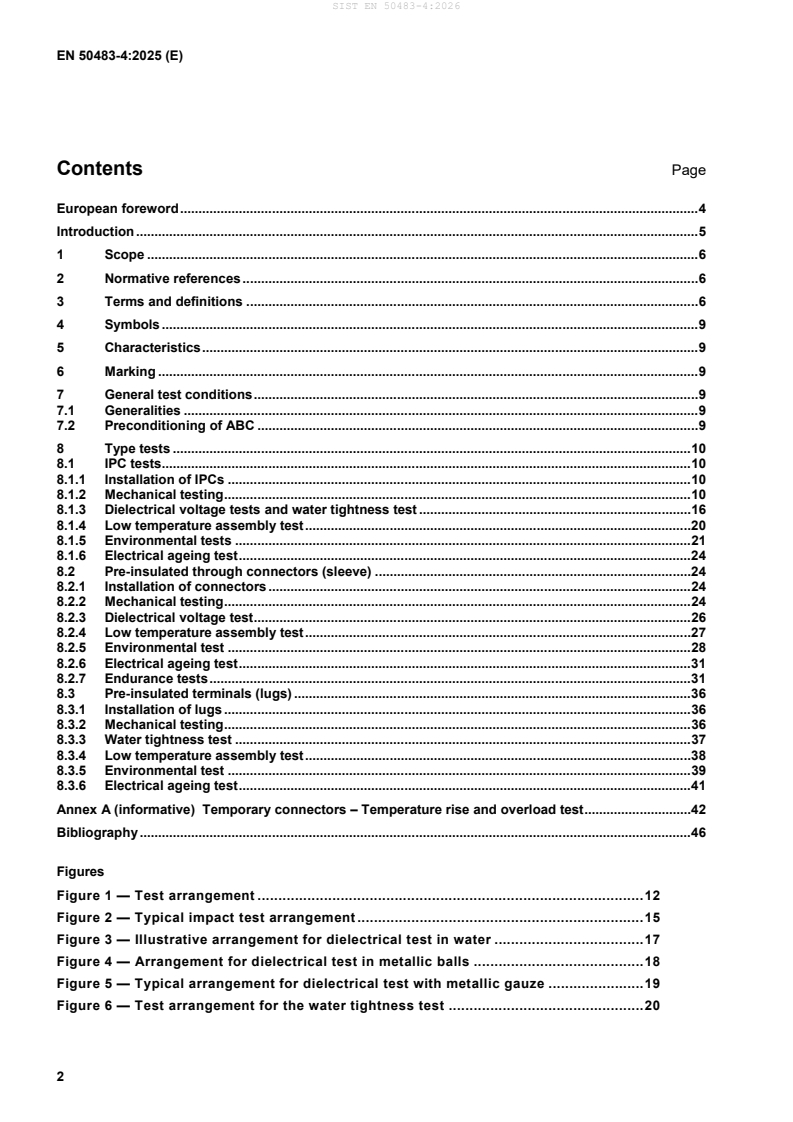
Contents Page
European foreword . 4
Introduction . 5
1 Scope . 6
2 Normative references . 6
3 Terms and definitions . 6
4 Symbols . 9
5 Characteristics . 9
6 Marking . 9
7 General test conditions . 9
7.1 Generalities . 9
7.2 Preconditioning of ABC . 9
8 Type tests . 10
8.1 IPC tests. 10
8.1.1 Installation of IPCs . 10
8.1.2 Mechanical testing . 10
8.1.3 Dielectrical voltage tests and water tightness test . 16
8.1.4 Low temperature assembly test . 20
8.1.5 Environmental tests . 21
8.1.6 Electrical ageing test . 24
8.2 Pre-insulated through connectors (sleeve) . 24
8.2.1 Installation of connectors . 24
8.2.2 Mechanical testing . 24
8.2.3 Dielectrical voltage test . 26
8.2.4 Low temperature assembly test . 27
8.2.5 Environmental test . 28
8.2.6 Electrical ageing test . 31
8.2.7 Endurance tests . 31
8.3 Pre-insulated terminals (lugs) . 36
8.3.1 Installation of lugs . 36
8.3.2 Mechanical testing . 36
8.3.3 Water tightness test . 37
8.3.4 Low temperature assembly test . 38
8.3.5 Environmental test . 39
8.3.6 Electrical ageing test . 41
Annex A (informative) Temporary connectors – Temperature rise and overload test . 42
Bibliography . 46
Figures
Figure 1 — Test arrangement . 12
Figure 2 — Typical impact test arrangement . 15
Figure 3 — Illustrative arrangement for dielectrical test in water . 17
Figure 4 — Arrangement for dielectrical test in metallic balls . 18
Figure 5 — Typical arrangement for dielectrical test with metallic gauze . 19
Figure 6 — Test arrangement for the water tightness test . 20
EN 50483-4:2025 (E)
Figure 7 — Orientation of the samples for the climatic ageing test . 23
Figure 8 — Illustrative installation of the mechanical test . 26
Figure 9 — Illustrative set up for dielectrical voltage test . 27
Figure 10 — Climatic ageing test arrangement . 30
Figure 11 — Illustrative set up of the testing assembly . 32
Figure 12 — Diagram of thermal cycles and mechanical stresses applied on phase
conductor . 33
Figure 13 — Diagram of thermal cycles and mechanical loads on neutral conductor . 35
Figure 14 — Illustrative installation of the mechanical test . 37
Figure 15 — Illustrative figure of immersed lug . 38
Figure 16 — Illustrative arrangement of immersion test in sodium hydroxide solution . 40
Figure A.1 — Example of a pin connection . 43
Figure A.2 — Test loop . 44
Tables
Table 1 . 11
Table 2 — Initial loads required for marking . 25
Table 3 — Test loads . 25
Table 4 — Applied tensile load . 35
Table 5 — Tensile loads. 36
EN 50483-4:2025 (E)
European foreword
This document (EN 50483-4:2026) has been prepared by CLC/TC 20 “Electric cables”.
The following dates are fixed:
• latest date by which this document has to be (dop) 2027-04-30
implemented at national level by publication of
an identical national standard or by
endorsement
• latest date by which the national standards (dow) 2029-04-30
conflicting with this document have to be
withdrawn
This document supersedes EN 50483-4:2009 and all of its amendments and corrigenda (if any).
— Scope was extended to brackets.
This is Part 4 of the EN 50483 series, “Test requirements for low voltage aerial bundled cable accessories”,
which has six parts:
— Part 1: Generalities;
— Part 2: Tension and suspension clamps, fittings and brackets for self-supporting system;
— Part 3: Tension and suspension clamps, fittings and brackets for neutral messenger system;
— Part 4: Connectors;
— Part 5: Electrical ageing test;
— Part 6: Environmental testing.
Attention is drawn to the possibility that some of the elements of this document may be the subject of patent
rights. CENELEC shall not be held responsible for identifying any or all such patent rights.
Any feedback and questions on this document should be directed to the users’ national committee. A
complete listing of these bodies can be found on the CENELEC website.
EN 50483-4:2025 (E)
Introduction
The objective of the EN 50483 series is to provide a method of testing the suitability of accessories when used
under normal operating conditions with low voltage aerial bundled cables (ABC) complying with HD 626 S2.
This document does not invalidate existing approvals of products achieved on the basis of national standards
and specifications and/or the demonstration of satisfactory service performance. However, products approved
according to such national standards or specifications cannot directly claim approval to this document. It might
be possible, subject to agreement between the customer and the manufacturer and/or the supplier, and/or the
relevant conformity assessment body, to demonstrate that conformity to the earlier standard can be used to
claim conformity to this document, provided an assessment is made of any additional type testing that might
need to be carried out. Any such additional testing that is part of a sequence of testing cannot be done
separately.
EN 50483-4:2025 (E)
1 Scope
The EN 50483 series applies to overhead line fittings for tensioning, supporting and connecting aerial bundled
cables (ABC) of rated voltage U /U (U ): 0,6/1 (1,2) kV.
0 m
This document applies to connectors used for the electrical connection of ABC.
The connectors are designed to be installed where either the main and/or branch cable is ABC as defined by
HD 626 S2.
Tests described in this document are type tests.
2 Normative references
The following documents are referred to in the text in such a way that some or all of their content constitutes
requirements of this document. For dated references, only the edition cited applies. For undated references,
the latest edition of the referenced document (including any amendments) applies.
EN 50182, Conductors for overhead lines - Round wire concentric lay stranded conductors
EN 50483-1:2026, Test requirements for low voltage aerial bundled cable accessories - Part 1: Generalities
EN 50483-5:2026, Test requirements for low voltage aerial bundled cable accessories
EN 50483-6:2026, Test requirements for low voltage aerial bundled cable accessories
EN 60529:1991, Degrees of protection provided by enclosures (IP Code)
HD 626 S2, Overhead distribution cables of rated voltage U /U(Um): 0,6/1 (1,2) kV
IEC 60050-461, International Electrotechnical Vocabulary (IEV) – Part 461: Electric cables
3 Terms and definitions
For the purposes of this document, the terms and definitions given in IEC 60050-461 and the following apply.
ISO and IEC maintain terminology databases for use in standardization at the following addresses:
— ISO Online browsing platform: available at https://www.iso.org/obp/
— IEC Electropedia: available at https://www.electropedia.org/
3.1
aerial bundled cable
ABC
aerial cable consisting of a group of insulated conductors which are twisted together including, or not, a non-
insulated conductor
[SOURCE: IEV 461-08-02, modified]
Note 1 to entry: The terms bundled conductors, bundled cables, bundled cores, conductor bundles and bundle could be
used as equivalent to the term aerial bundled cable (ABC).
As impacted by EN 60529:1991/corrigendum May 1993, EN 60529:1991/A1:2000, EN 60529:1991/A2:2013,
EN 60529:1991/AC:2016-12 and EN 60529:1991/A2:2013/AC:2019-02.
EN 50483-4:2025 (E)
3.2
aerial insulated cable
insulated cable designed to be suspended overhead and outdoors
[SOURCE: IEV 461-08-01]
3.3
branch connector
metallic device for connecting a branch conductor to a main conductor at an intermediate point on the latter
[SOURCE: IEV 461-17-05]
3.4
branch conductor
conductor connected to the main conductor by a connector
3.5
conductor insulation
insulation applied on a conductor
[SOURCE: IEV 461-02-02, modified]
3.6
conductor
part of a cable which has the specific function of carrying current
[SOURCE: IEV 461-01-01]
3.7
connector
metallic device to connect cable conductors together
[SOURCE: IEV 461-17-03]
3.8
core
assembly comprising conductor and its own insulation
[SOURCE: IEV 461-04-04, modified]
3.9
insulation
insulating materials incorporated in a cable with the specific function of withstanding voltage
[SOURCE: IEV 461-02-01]
3.10
insulation piercing connector (IPC)
connector in which electrical contact with the conductor is made by metallic protrusions which pierce the
insulation of the ABC core
[SOURCE: IEV 461-11-08, modified]
3.11
messenger
wire or rope, the primary function of which is to support the cable in aerial installations, which may be separate
from or integral with the cable it supports
[SOURCE: IEV 461-08-03]
EN 50483-4:2025 (E)
3.12
minimum breaking load
MBL
minimum breaking load of the conductor given by HD 626 S2 or the cable manufacturer if not defined in the
standard or minimum breaking load of the clamp given by the clamp manufacturer
3.13
neutral messenger system
aerial insulated system where only the neutral messenger supports the ABC
3.14
pre-insulated lug
pre-insulated terminal lug
insulated metallic device for connecting an insulated cable conductor to other electrical equipment
3.15
pre-insulated through connector
pre-insulated through connector sleeve
insulated metallic device for connecting two consecutive lengths of insulated conductors
3.16
rated tensile strength
RTS
estimate of the conductor breaking load calculated using the specified tensile properties of the component
wires
[SOURCE: EN 50182:2001, 3.7]
3.17
reusable connector
connector for connecting ABC to stripped cable or bare conductor where only the branch connection can be
reused
3.18
self-supporting system
aerial insulated system where all the cores of the ABC contribute to its support
3.19
sheath
uniform and continuous tubular covering of metallic or non-metallic material, generally extruded
[SOURCE: IEV 461-05-03]
3.20
shear head
head of a bolt, or a device fitted over the head of a bolt or a nut, which is designed to break at a specified
torque
3.21
type test
test required to be made before supplying a type of material covered by this document on a general
commercial basis, in order to demonstrate satisfactory performance characteristics to meet the intended
application
Note 1 to entry: These tests are of such a nature that, after they have been made, they need not be repeated unless
changes are made to the accessory materials, design or type of manufacturing process which might change the
performance characteristics.
EN 50483-4:2025 (E)
4 Symbols
ρ resistivity (Ω.m)
5 Characteristics
These connectors shall connect cables designed to HD 626 S2 and withstand the following type tests.
6 Marking
See Clause 6 of EN 50483-1:2026.
7 General test conditions
7.1 Generalities
See Clause 9 of EN 50483-1:2026.
Minimum and maximum cross-sections of the conductors used for the tests shall be the minimum and
maximum cross-sections for which the connector is designed.
All conductors used in these tests shall be pre-conditioned in accordance with 7.2.
When tensile test loads are applied to conductors the rate of increase shall be in accordance with
EN 50483-1:2026, 9.1.4.
A torque meter shall be used for all tightening operations and it shall have a resolution and accuracy in
accordance with EN 50483-1:2026, 9.1.8.
All tests shall be carried out at ambient temperature unless otherwise stated in this document.
The frequency of a.c. tests shall be in accordance with EN 50483-1:2026, 9.1.1.
The relative humidity shall be in accordance with EN 50483-1:2026, 9.1.9 unless otherwise altered by this
document.
If a cable breaks beyond any part of a connector, the test result shall be declared void without discrediting the
connector. Tests can be repeated using a new connector and a new cable.
7.2 Preconditioning of ABC
New cores or cables shall be used.
Cores shall be pre-conditioned according to EN 50483-1:2026, 9.1 in order to ensure the dimensional
stabilization of the insulating sheath.
The extremities of the service cables shall be installed into the connector in accordance with the instructions
given by the connector manufacturer.
For the voltage and water tightness tests in 8.1.3, if the connector is tested in horizontal position, the cores
shall first be bent and held in a rigid position using an appropriate device in order to prevent damage to the
connections during handling, as required in the specific test.
For the climatic ageing test in 8.1.5.3, the cores shall be bent as for the dielectrical voltage and water
tightness tests and their ends shall be tightly capped to prevent moisture from penetrating the conductors, as
required in the specific test.
When there is a requirement to bend the cables, the bending radius shall be at least 15 times the outer
diameter of the core.
The cores should be shaped before installing the connectors.
Cores used should comply with the piercing test of the insulating sheath defined in HD 626 S2 where the
customer requires this and it is applicable to the type of cable being tested.
EN 50483-4:2025 (E)
8 Type tests
8.1 IPC tests
8.1.1 Installation of IPCs
Connectors shall be installed in accordance with the manufacturer’s instructions. A torque meter, in
accordance with EN 50483-1:2026, 9.1.8, shall be used for all tightening and untightening operations.
Tightening shall be at the rate specified in EN 50483-1:2026, 9.1.10.
The same core (e.g. Phase 1) of a cable with the same cross-section shall be used for each test.
Connectors, used on cores with a cross-section lower than, or equal to, 35 mm , can be held in position during
tightening if necessary.
8.1.2 Mechanical testing
8.1.2.1 General
The following tests are designed to ensure that the IPC is both mechanically suitable and does not damage
the conductors it connects:
Test Subclause
Test for mechanical damage to the main conductor 8.1.2.2
Branch cable pull-out test 8.1.2.3
Connector bolt tightening test 8.1.2.4
Shear head function test 8.1.2.5
Low temperature impact test 8.1.2.6
8.1.2.2 Test for mechanical damage to the main conductor
8.1.2.2.1 Principle
This test ensures that the mechanical performance of the conductor is not impaired as a consequence of the
installation of the IPC.
8.1.2.2.2 Test arrangement
Two samples shall be tested. Where the IPC is designed to accept more than one size of core, 2 samples
shall be tested in each of the following conductor combinations:
Main Branch
max. max.
min. min.
min. max.
Where max. min. combination is required this may be agreed between the customer and the manufacturer.
The core shall be mounted in a tensile test machine in a suitable manner.
The core, on which the IPCs will be tested, shall be tensioned to between 10 % and 15 % of its MBL for
aluminium conductors (AAC) and between 15 % and 20 % of its MBL for all other conductors as defined in
HD 626 S2 (for example copper and AAAC).
The core length shall be between 0,5 m and 1,5 m.
When using bare main conductors according to EN 50182 not included in HD 626 S2, RTS shall be used.
EN 50483-4:2025 (E)
8.1.2.2.3 Procedure
Connectors shall be installed in accordance with the manufacturer’s instructions.
When the connector is designed with a shear-head, it shall be tightened to the manufacturer’s specified
maximum torque.
When the connector is designed without a shear-head, it shall be tightened to 1,1 times the manufacturer’s
specified nominal torque.
The connectors shall not be removed from the core before the mechanical tensile test.
A tensile test load shall be applied to the main conductor until it reaches the following values in Table 1:
Table 1
System type Conductor Tensile test load
2 2
Copper (4 mm to 16 mm ) 20 % MBL of the cable
Copper (>16 mm ) 80 % MBL of the cable
Self-supporting
2 2
Aluminium (16 mm to 25 mm ) 1 200 N or 40 % MBL of the cable,
whichever is the greater
Aluminium (>25 mm ) 80 % MBL of the cable
Phase 60 % MBL of the cable
Neutral messenger
Neutral 90 % MBL of the cable
Loads for other designs of ABC shall be agreed between the customer and the manufacturer.
Note that for neutral messenger type, when the phase MBL is not specified, the value of 120 N/mm time the
cross section for pure aluminium conductor and 300 N/mm time the cross section for pure copper conductors
can be applied. The load shall be maintained for 60 s.
8.1.2.2.4 Requirements
The conductor shall maintain the test load for 60 s without breaking or any damage that would prevent the
correct function of the cable.
8.1.2.3 Branch cable pull-out test
8.1.2.3.1 Principle
To ensure that the IPC provides mechanical security of the branch cable.
8.1.2.3.2 Test arrangement
Two samples shall be tested. Where the IPC is designed to accept more than one size of conductor, two
samples shall be tested in each of the following conductor combinations:
Main Branch
min. min.
max. min.
Where other combinations are required these may be agreed between the customer and the manufacturer.
The branch connector shall be positioned and then installed in accordance with the manufacturer’s
instructions.
The core lengths shall be between 0,2 m and 0,5 m.
EN 50483-4:2025 (E)
The general arrangement is shown in Figure 1. The IPC shall be installed in accordance with manufacturer’s
instructions.
Key
1 branch
2 main secured in mechanical device
Figure 1 — Test arrangement
8.1.2.3.3 Procedure
When the connector is designed with a shear-head, it shall be tightened to the manufacturer’s specified
maximum torque.
When the connector is designed without a shear-head, it shall be tightened to 1,1 times the manufacturer’s
specified nominal torque.
The core, or in the case of a bare conductor, the conductor, shall be marked at the IPC so that any slippage
during the test can be measured.
A tensile load (F) shall be applied approximately axially, between the branch conductor and the opposing main
conductor which shall be secured in a mechanical device, at a rate between 100 N/min and 500 N/min. This
load shall be 1 kN or 10 % of the MBL of the branch conductor whichever is less.
When the MBL of the main is smaller than the MBL of the branch conductor, then the MBL of the main should
be taken into account instead of the MBL of the branch for the min. min. configuration.
The load shall be maintained for 60 s.
8.1.2.3.4 Requirements
Core slippage shall not exceed 3 mm.
The cores shall maintain the test load for 60 s without breaking or any damage that would prevent the correct
function of the cable.
8.1.2.4 Connector bolt tightening test
8.1.2.4.1 Principle
To ensure that when tightened, the bolts used to make the electrical connection and provide mechanical
security, do not cause the IPC to fail mechanically during installation.
8.1.2.4.2 Test arrangement
Two connectors shall be tested.
The core on to which the IPC is to be installed shall be tensioned to 20 % of its MBL.
The IPCs shall be installed on to cores for which it is designed. Where the IPC is designed to accept more
than one size of conductor, two samples shall be tested in each of the following conductor combinations:
EN 50483-4:2025 (E)
Main Branch
max. max.
min. min.
min. max.
Where max. min. combination is required this may be agreed between the customer and the manufacturer
and/or the supplier.
8.1.2.4.3 Procedure
The connectors shall be tightened, in accordance with EN 50483-1:2026, 9.1.10, to the maximum torque
specified by the manufacturer, plus 20 %.
A higher value of torque may be used when this is agreed between the customer and the manufacturer and/or
the supplier
8.1.2.4.4 Requirements
The connector shall be undamaged.
8.1.2.5 Shear head function test
8.1.2.5.1 Principle
To ensure that the shear head mechanism functions correctly within the specified torque range.
8.1.2.5.2 Test arrangement
Six samples shall be tested at each of the following temperatures:
— the minimum temperature shall be (−10 ± 3) °C;
— the maximum temperature shall be (50 ± 3) °C.
NOTE See EN 50483-1:2026, 9.1, for information on the use of a lower temperature.
The samples shall be tested in either of the following cross-section combinations:
Main Branch
min. min.
max. max.
8.1.2.5.3 Procedure
The connector assemblies shall be placed in a temperature-controlled environment until they reach the test
temperature. The temperature shall be maintained for a minimum of 15 min.
The assembly can be removed from the chamber and the torque applied outside. In this case the temperature
of the connector shall be monitored and the torque applied within the temperature limits defined above.
The shear head shall then be tightened, in accordance with the manufacturer’s installation instructions, until
the head shears. This torque shall be recorded.
The test shall be repeated for the six samples at each of the specified temperatures and cross-section
combination.
8.1.2.5.4 Requirements
For each of the test temperatures and cross-section combination, the torque at which the shear head shears,
shall be within the tolerances of the manufacturer’s specified torque range.
EN 50483-4:2025 (E)
The design of the shearhead may incorporate nominal torques that vary with temperature. In such cases, the
manufacturer shall specify the nominal torque and its range for the ambient temperature as described in 9.1.2
of EN 50483-1:2026, as well as for the maximum and minimum temperatures experienced in this test. Under
these conditions, additional testing could be required by customer when connectors are installed on
conductors at low temperatures, including: § 8.1.2.2 Test for mechanical damage to the main conductor; §
8.1.2.3 Branch cable pull-out test; and § 8.1.6 Electrical ageing test (applicable solely to the Max-Max
configuration).
8.1.2.6 Low temperature impact test
8.1.2.6.1 Principle
To ensure that the connector can withstand an impact when it is cold.
8.1.2.6.2 Test arrangement
Two connectors shall be installed according to the manufacturer’s instructions at ambient temperature in the
manner for which they are designed to be used, at nominal torque.
The samples shall be tested in the following cross-section combinations:
Main Branch
max. min.
max. max.
Figure 2 shows a typical test arrangement.
The connectors and the cores shall be placed in a temperature-controlled environment at
(−10 ± 3) °C until they reach the test temperature.
NOTE See EN 50483-1:2026, 9.1, for information on the use of a lower temperature.
The assembly can be removed from the cold chamber in order to make the test. To ensure that the test is
carried out at the specified temperature the impact test shall be made immediately.
EN 50483-4:2025 (E)
Dimensions in millimetres
Key
1 hammer 900 g
2 steel intermediate piece 100 g
3 test piece
4 steel 10 kg
5 slightly round edges
Figure 2 — Typical impact test arrangement
8.1.2.6.3 Procedure
The separate samples shall be placed in the impact test device and impacted with a cylindrical anvil
approximately 50 mm in diameter with a spherical contact radius of approximately 300 mm. The anvil shall
have a mass of approximately 100 g and shall transfer to the test sample the impact energy of a weight of
900 g falling freely through 200 mm.
Two impacts shall be made on each sample, one acting from the top and one acting on the side.
The position of impact should be agreed between the manufacturer and the customer as being the most
vulnerable points. Without agreement, the top and the side of the connector should be preferred areas of
impact.
The value of weight and distance of fall may be varied as long as the impact energy (mxgxh = 1.8J where m is
the mass, g the gravitational constant and h the height) remains the same.
8.1.2.6.4 Requirements
No damage shall occur which would affect the correct function of the connector.
EN 50483-4:2025 (E)
8.1.3 Dielectrical voltage tests and water tightness test
8.1.3.1 Dielectrical voltage test
8.1.3.1.1 General
This test is not applicable to IPC which connects a bare conductor to an insulated conductor.
In order to meet the requirements of the type tests at least one of the two dielectrical tests shall be carried out.
Connector classes:
— Class 1: connector subjected to dielectric test in water;
— Class 2: connector subjected to dielectric test in air.
The choice of the class should be agreed between the manufacturer and the customer.
8.1.3.1.2 Principle
To ensure that the connector can withstand a dielectrical voltage.
8.1.3.1.3 Test arrangement
Two samples shall be tested. Where the IPC is designed to accept more than one size of conductor, two
samples shall be tested in each of the following conductor combinations:
Main Branch
min. min.
max. min.
8.1.3.1.4 Procedure
8.1.3.1.4.1 General
The connector shall be tightened to the minimum torque indicated by the manufacturer.
Initially, for reusable connectors, the tap core shall be successively, mounted four times and removed three
times.
Should the shear head break whilst mounting the connector then the torque shall be raised to the minimum
value according to the method defined in 8.1.1.
The mounting and removal shall entail taking the conductor out of the connector, but there shall be no change
in orientation, or modification of the stripped end of the conductor.
While mounting and removing the conductor, the bolts shall be tightened to the minimum torque and then un-
tightened.
8.1.3.1.4.2 Test in water (For Class 1 connectors only)
The assembly, of connector and cores, shall be placed at the bottom of a water tank. During the movement of
the assembly it may be supported to ensure no bending of the core or unnecessary movement of the
component parts.
The connector may be placed either vertically or horizontally.
The depth of water shall be measured from the upper part of the connector. The cores shall be of such length
to ensure that they are sufficiently above the water level to prevent flashover (see Figure 3).
The maximum leakage current shall be in accordance with EN 50483-1:2026, 9.1.5.
The resistivity ρ of the water used in this test shall be in accordance with EN 50483-1:2026, 9.1.6.
EN 50483-4:2025 (E)
The voltage shall be applied at a speed specified in EN 50483-1:2026, 9.1.7.
After 30 min under water, the voltage test shall be applied to the sample with a 4 kV a.c. for 60 s according to
Figure 3.
A voltage of 6 kV may be used when agreed between the customer and the manufacturer and/or the supplier.
Dimensions in millimetres
Key
1 tank
2 insulated branch conductor
3 insulated main conductor
4 mounted connector
5 part of connectors for watertight of branch core
6 metallic electrode
7 water
8 watertight insulating cap or core bent so that end is above the surface of water
Figure 3 — Illustrative arrangement for dielectrical test in water
8.1.3.1.4.3 Test in air (For Class 2 connectors only)
Two methods are provided; compliance with either will meet the requirements of this type test.
Method 1
The core shall not be bent near to the connector. Any change in orientation of the core shall be at least 10 cm
from the connector. The assembly shall be mounted so that the connectors lie horizontally.
EN 50483-4:2025 (E)
The assembly shall be covered by 1 cm to 2 cm of metallic balls with 1,3 mm to 1,7 mm diameter. The metallic
balls shall not apply undue mechanical stress to the assembly.
The test arrangement is shown in Figure 4.
Dimensions in millimetres
Key
1 insulated main conductor
2 tank
3 insulated branch conductor
4 insulating cap
5 mounted connector
6 metallic electrode
7 metallic balls
Figure 4 — Arrangement for dielectrical test in metallic balls
After a minimum period of 60 s, a voltage test of 4 kV a.c. shall be applied for 60 s between the core
conductors and the metallic balls.
A voltage of 6 kV a.c. may be used when agreed between the customer and the manufacturer and/or the
supplier.
A metallic foil may be used instead of metallic balls when agreed between the customer and manufacturer.
The maximum leakage current shall be in accordance with EN 50483-1:2026, 9.1.5.
The voltage shall be applied at a speed specified in EN 50483-1:2026, 9.1.7.
Method 2
The assembled connectors shall be closely wrapped with metallic gauze having a mesh size < 5 mm, which
shall be clear of any test connections. If necessary these test points shall be temporarily insulated.
Figure 5 shows a typical test arrangement. Where the insulated end cap is incorporated into the design of the
connector it may be included within the gauze screen.
A test voltage of 4 kV a.c. shall be applied for 60 s between the main conductor and the gauze.
A voltage of 6 kV a.c. may be used when agreed between the customer and the manufacturer and/or the
supplier.
EN 50483-4:2025 (E)
For 10 min immediately preceding the test, and during the time the voltage is applied, the connectors shall be
exposed to artificial rain of characteristics defined in EN 60529:1991, Class IPX3.
The maximum leakage current shall be in accordance with EN 50483-1:2026, 9.1.5.
The voltage shall be applied at a speed specified in EN 50483-1:2026, 9.1.7.
Key
1 metallic gauze
2 ABC cores
3 insulating cap
4 connector
Figure 5 — Typical arrangement for dielectrical test with metallic gauze
8.1.3.1.5 Requirements
No flashover or breakdown shall occur (tripping of voltage generator).
8.1.3.2 Water tightness test
8.1.3.2.1 Principle
This test is required for connectors for which the dielectric test in water is not applicable due to the connector
design.
To ensure that water cannot migrate to the ABC when it is used to connect the ABC to ABC or to a bare
conductor.
This test is applicable for insulated to bare conductors and for Class 2 connectors, if required.
8.1.3.2.2 Test arrangement
Two samples shall be tested. Where the connector is designed to accept more than one size of conductor,
two samples shall be tested in each of the following conductor combinations:
Main Branch
min. min.
min. max.
8.1.3.2.3 Procedure
Figure 6 shows the test arrangement.
EN 50483-4:2025 (E)
The length of main cores shall be approximately 30 cm. The connectors shall be tightened to the minimum
torque specified by the manufacturer.
The assembly of connector and cores shall be placed at the bottom of a water tank. The depth of water shall
be measured above the core.
The branch core shall pass out of the tank through an appropriate seal, which shall be designed to prevent
any excessive stress on the insulation.
The assembly shall be left in the water for 24 h.
Dimensions in millimetres
Key
1 tank
2 sealing
3 branch core
4 bare or insulated main conductor
5 support if any
6 water
Figure 6 — Test arrangement for the water tightness test
8.1.3.2.4 Requirements
No trace of water shall be observed at the end of the core.
8.1.4 Low temperature assembly test
8.1.4.1 Principle
To ensure electrical contact is established when the IPC is applied in cold conditions.
8.1.4.2 Test arrangement
Two samples shall be tested. Where the IPC is designed to accept more than one size of conductor, two
samples shall be tested in each of the following conductor combinations:
EN 50483-4:2025 (E)
Where min. min. combination is required this may be agreed between the customer and the manufacturer
and/or the supplier.
Main Branch
max. max.
min. max.
max. min.
8.1.4.3 Procedure
The connectors and core shall be further pre-conditioned until they reach the test temperature of (−10 ± 3) °C,
then they shall be assembled at this temperature in the cold chamber.
NOTE 1 See EN 50483-1:2026, 9.1, for information on the use of a lower temperature.
Electrical continuity shall be measured between the main and branch cables.
The IPC shall be installed in accordance with the manufacturer’s instructions using a torque meter.
Alternatively the assembly can be removed from the cold chamber and the torque applied outside. In this case
the temperature of the connector and the core shall be monitored and the torque applied within the
temperature limits defined above. This temperature shall be within these limits once contact is made.
The torque at which continuity is achieved shall be recorded.
NOTE 2 Accuracy of torque meters is usually guaranteed at positive temperature ranges. Where the torque is
measured within the cold chamber the accuracy of the torque meter might not be guaranteed.
8.1.4.4 Requirements
Electrical continuity shall be achieved at a torque value less than, or equal to, 70 % of the manufacturer’s
specified minimum installation torque.
8.1.5 Environmental tests
8.1.5.1 General
In order to meet the requirements of the type tests at least one of the three corrosion tests (as detailed in
EN 50483-6:2026, 8.4) and one of the two climatic tests (as detailed in EN 50483-6:2026, 8.5) shall be carried
out.
The choice of the test shall be agreed between the customer and the manufacturer and/or the supplier.
8.1.5.2 Corrosion tests
8.1.5.2.1 Principle
To ensure that the IPC is not affected in corrosive atmospheres.
8.1.5.2.2 Test arrangement - Salt mist test and gas atmosphere test
Two samples shall be tested in accordance with the following conductor combination:
Main Branch
min. min.
For immersion test see test arrangement in EN 50483-6:2026, 8.4.3.1.
EN 50483-4:2025 (E)
8.1.5.2.3 Procedure - Salt mist test and gas atmosphere test
8.1.5.2.3.1 General
The connector shall be placed in the middle of the main core of length 0,5 m to 1,5 m. It shall be tightened to
the minimum torque specified by the manufacturer.
For the immersion test see procedure in EN 50483-6:2026, 8.4.3.1.
8.1.5.2.3.2 Salt mist test
The number of cycles shall be 4 (4 weeks) as defined in EN 50483-6:2026, 8.4.1.
8.1.5.2.3.3 Gas atmosphere test
Method 1: Combined test. There shall be 4 cycles of 14 days. This 14-day cycle consists of 7 days of salt mist
and 7 days in SO atmosphere as defined in of EN 50483-6:2026, 8.4.1 and EN 50483-6:2026, 8.4.2.1.
Method 2: There shall be 500 cycles of 2 h (approximately 6 weeks) as defined in 8.4.2.2 of
EN 50483-6:2026.
8.1.5.2.3.4 Immersion test
See EN 50483-6:2026, 8.4.3.
Method 1:
...