

SIST EN 50483-2:2026
(Main)Test requirements for low voltage aerial bundled cable accessories - Part 2: Tension and suspension clamps, fittings and brackets for self supporting system
General Information
- Abstract
The EN 50483 series applies to overhead line fittings for tensioning, supporting and connecting aerial bundled cables (ABC) of rated voltage U0/U (Um): 0,6/1 (1,2) kV.
This document applies to tensioning devices consisting of tension and suspension clamps, fittings and brackets designed to be used for installation of self-supporting ABC defined in HD 626 S2.
Tests described in this document are type tests.
- Status
- Published
- Public Enquiry End Date
- 31-Dec-2024
- Publication Date
- 16-Apr-2026
- Technical Committee
- IEKA - Electric cables
- Current Stage
- 6060 - National Implementation/Publication (Adopted Project)
- Start Date
- 09-Apr-2026
- Due Date
- 14-Jun-2026
- Completion Date
- 17-Apr-2026
Overview
SIST EN 50483-2:2026 is a European standard published by CENELEC (CLC) that specifies the test requirements for low voltage aerial bundled cable (ABC) accessories, focusing on tension and suspension clamps, fittings, and brackets used in self-supporting systems. As part of the EN 50483 series, this document provides a framework for the type testing of these overhead line fittings, ensuring their suitability and safety in service conditions for cables with rated voltage U₀/U (Uₘ): 0.6/1 (1.2) kV, as detailed in HD 626 S2.
This part addresses devices and fittings designed to tension, support, and attach aerial bundled cables in overhead power distribution networks. The requirements guarantee reliability, mechanical integrity, and compatibility with a wide range of climatic and operational conditions found across Europe.
Key Topics
Scope and Application:
SIST EN 50483-2:2026 applies to tension and suspension clamps, supporting fittings, and mounting brackets for self-supporting ABC installations.Type Testing:
The standard details the protocols for type tests that must be satisfied before a product is commercially supplied. Tests address:- Mechanical strength (tensile and breaking load tests)
- Performance at extreme temperatures (high and low)
- Resistance to environmental influences
- Dielectric voltage withstand ability
Mechanical and Electrical Safety:
Requirements ensure that fittings:- Sustain the mechanical loads of the cables they support
- Avoid damage to cable insulation and conductors
- Prevent accidental contact between conductors or between conductors and clamp metal parts
Marking and Identification:
Accessories must be clearly marked, following general requirements outlined in EN 50483-1, to ensure traceability and compliance.Relevant Definitions and Terms:
The standard provides definitions for key components, such as:- Tension clamp
- Suspension clamp
- Bracket
- Type test
- Minimum breaking load (MBL)
- Self-supporting system
Applications
SIST EN 50483-2:2026 is essential for manufacturers, installers, and utilities working with overhead low voltage power distribution using ABC technology. Its principal applications include:
Product Certification and Market Access:
Compliance with EN 50483-2 is often a prerequisite for legal market entry and project approval throughout Europe.Utility and Network Design:
Engineers specify compliant clamps and fittings in network upgrades or expansions to ensure system safety and longevity.Quality Assurance and Procurement:
Utilities and contractors use the standard during sourcing and procurement to evaluate product suitability and ensure consistent performance.Installation and Maintenance:
Field teams rely on type-tested accessories to reduce the risk of failures, minimize downtime, and ensure safe maintenance practices in diverse climates.
By specifying the rigorous testing needed under realistic mechanical and environmental stresses, the standard helps maintain the safety, reliability, and efficiency of modern overhead distribution systems.
Related Standards
EN 50483-1:2026: Test requirements for low voltage aerial bundled cable accessories – Part 1: Generalities
- Provides common requirements and overall framework for the EN 50483 series.
EN 50483-6:2026: Environmental testing for ABC accessories
- Details extended environmental type tests for accessories used in varying climates.
HD 626 S2: Overhead distribution cables of rated voltage 0.6/1 (1.2) kV
- Defines the cables for which these accessories are intended.
IEC 60050-461: International Electrotechnical Vocabulary - Electric cables
- Offers standardized terminology used throughout SIST EN 50483-2:2026.
By adhering to SIST EN 50483-2:2026, organizations demonstrate a commitment to electrical safety, product reliability, and international best practices in low voltage overhead distribution with aerial bundled cable systems.
Relations
- Effective Date
- 01-Jun-2026
Get Certified
Connect with accredited certification bodies for this standard

IMQ S.p.A. (Certification)
Italian electrical product certification.

SLG Prüf- und Zertifizierungs GmbH
German testing and certification body.

UL Solutions
Global safety science company with testing, inspection and certification.
Sponsored listings
Frequently Asked Questions
SIST EN 50483-2:2026 is a standard published by the Slovenian Institute for Standardization (SIST). Its full title is "Test requirements for low voltage aerial bundled cable accessories - Part 2: Tension and suspension clamps, fittings and brackets for self supporting system". This standard covers: The EN 50483 series applies to overhead line fittings for tensioning, supporting and connecting aerial bundled cables (ABC) of rated voltage U0/U (Um): 0,6/1 (1,2) kV. This document applies to tensioning devices consisting of tension and suspension clamps, fittings and brackets designed to be used for installation of self-supporting ABC defined in HD 626 S2. Tests described in this document are type tests.
The EN 50483 series applies to overhead line fittings for tensioning, supporting and connecting aerial bundled cables (ABC) of rated voltage U0/U (Um): 0,6/1 (1,2) kV. This document applies to tensioning devices consisting of tension and suspension clamps, fittings and brackets designed to be used for installation of self-supporting ABC defined in HD 626 S2. Tests described in this document are type tests.
SIST EN 50483-2:2026 is classified under the following ICS (International Classification for Standards) categories: 29.240.20 - Power transmission and distribution lines. The ICS classification helps identify the subject area and facilitates finding related standards.
SIST EN 50483-2:2026 has the following relationships with other standards: It is inter standard links to SIST EN 50483-2:2009. Understanding these relationships helps ensure you are using the most current and applicable version of the standard.
SIST EN 50483-2:2026 is available in PDF format for immediate download after purchase. The document can be added to your cart and obtained through the secure checkout process. Digital delivery ensures instant access to the complete standard document.
Standards Content (Sample)
SLOVENSKI STANDARD
01-junij-2026
Nadomešča:
SIST EN 50483-2:2009
Zahteve za preskušanje pribora za nizkonapetostne izolirane nadzemne kable - 2.
del: Napenjalne in vzmetne objemke, zatezne in nosilne sponke za samonosilne
sisteme
Test requirements for low voltage aerial bundled cable accessories - Part 2: Tension and
suspension clamps, fittings and brackets for self supporting system
Prüfanforderungen für Bauteile für isolierte Niederspannungsfreileitungen - Teil 2:
Abspann- und Tragklemmen für selbsttragende isolierte Freileitungsseile
Prescriptions relatives aux essais des accessoires pour réseaux aériens basse tension
torsadés - Partie 2: Matériels d’ancrage et de suspension pour réseaux aériens en
conducteurs isolés torsadés auto-portés
Ta slovenski standard je istoveten z: EN 50483-2:2026
ICS:
29.240.20 Daljnovodi Power transmission and
distribution lines
2003-01.Slovenski inštitut za standardizacijo. Razmnoževanje celote ali delov tega standarda ni dovoljeno.
EUROPEAN STANDARD EN 50483-2
NORME EUROPÉENNE
EUROPÄISCHE NORM April 2026
ICS 29.240.20 Supersedes EN 50483-2:2009
English Version
Test requirements for low voltage aerial bundled cable
accessories - Part 2: Tension and suspension clamps, fittings
and brackets for self-supporting system
Prescriptions relatives aux essais des accessoires pour Prüfanforderungen für Bauteile für isolierte
réseaux aériens basse tension torsadés - Partie 2: Niederspannungsfreileitungen - Teil 2: Abspann- und
Matériels d'ancrage et de suspension pour réseaux aériens Tragklemmen für selbsttragende isolierte Freileitungsseile
en conducteurs isolés torsadés auto-portés
This European Standard was approved by CENELEC on 2026-03-09. CENELEC members are bound to comply with the CEN/CENELEC
Internal Regulations which stipulate the conditions for giving this European Standard the status of a national standard without any alteration.
Up-to-date lists and bibliographical references concerning such national standards may be obtained on application to the CEN-CENELEC
Management Centre or to any CENELEC member.
This European Standard exists in three official versions (English, French, German). A version in any other language made by translation
under the responsibility of a CENELEC member into its own language and notified to the CEN-CENELEC Management Centre has the
same status as the official versions.
CENELEC members are the national electrotechnical committees of Austria, Belgium, Bulgaria, Croatia, Cyprus, the Czech Republic,
Denmark, Estonia, Finland, France, Germany, Greece, Hungary, Iceland, Ireland, Italy, Latvia, Lithuania, Luxembourg, Malta, the
Netherlands, Norway, Poland, Portugal, Republic of North Macedonia, Romania, Serbia, Slovakia, Slovenia, Spain, Sweden, Switzerland,
Türkiye and the United Kingdom.
European Committee for Electrotechnical Standardization
Comité Européen de Normalisation Electrotechnique
Europäisches Komitee für Elektrotechnische Normung
CEN-CENELEC Management Centre: Rue de la Science 23, B-1040 Brussels
© 2026 CENELEC All rights of exploitation in any form and by any means reserved worldwide for CENELEC Members.
Ref. No. EN 50483-2:2026 E
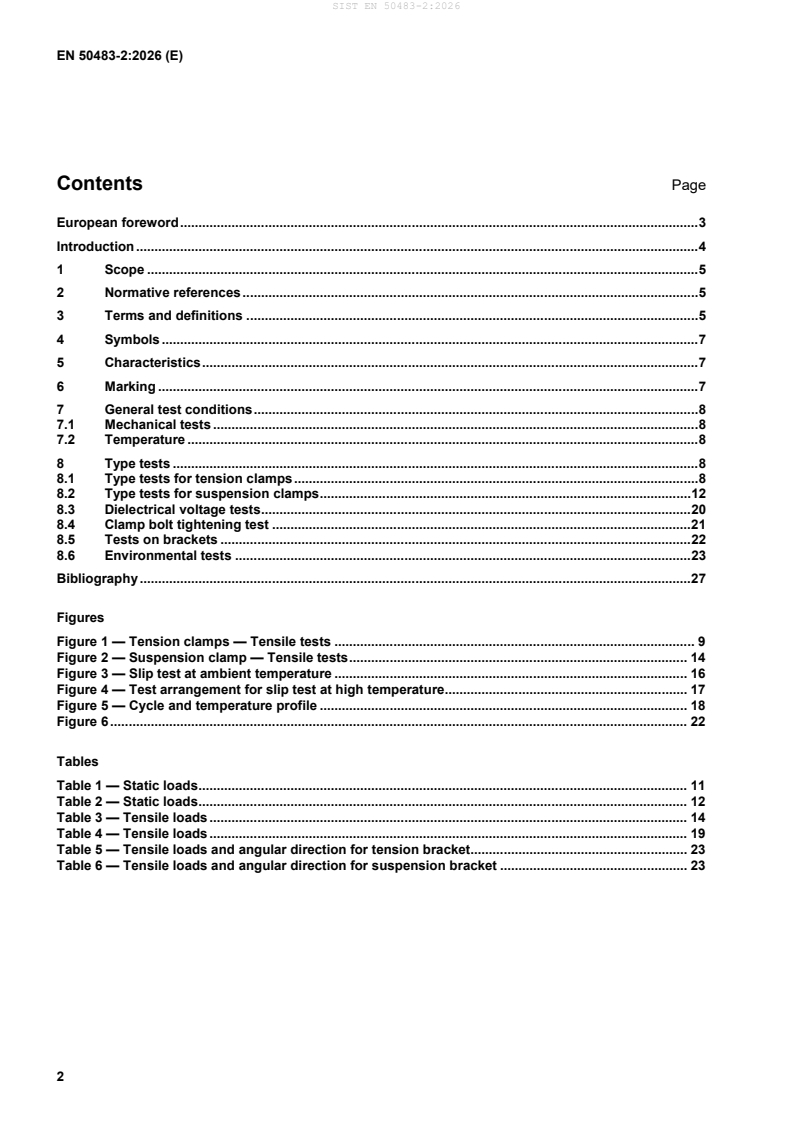
Contents Page
European foreword . 3
Introduction . 4
1 Scope . 5
2 Normative references . 5
3 Terms and definitions . 5
4 Symbols . 7
5 Characteristics . 7
6 Marking . 7
7 General test conditions . 8
7.1 Mechanical tests . 8
7.2 Temperature . 8
8 Type tests . 8
8.1 Type tests for tension clamps . 8
8.2 Type tests for suspension clamps . 12
8.3 Dielectrical voltage tests . 20
8.4 Clamp bolt tightening test . 21
8.5 Tests on brackets . 22
8.6 Environmental tests . 23
Bibliography . 27
Figures
Figure 1 — Tension clamps — Tensile tests . 9
Figure 2 — Suspension clamp — Tensile tests . 14
Figure 3 — Slip test at ambient temperature . 16
Figure 4 — Test arrangement for slip test at high temperature . 17
Figure 5 — Cycle and temperature profile . 18
Figure 6 . 22
Tables
Table 1 — Static loads . 11
Table 2 — Static loads . 12
Table 3 — Tensile loads . 14
Table 4 — Tensile loads . 19
Table 5 — Tensile loads and angular direction for tension bracket . 23
Table 6 — Tensile loads and angular direction for suspension bracket . 23
European foreword
This document (EN 50483-2:2026) has been prepared by CLC/TC 20 “Electric cables”.
The following dates are fixed:
• latest date by which this document has to be (dop) 2027-04-30
implemented at national level by publication of
an identical national standard or by
endorsement
• latest date by which the national standards (dow) 2029-04-30
conflicting with this document have to be
withdrawn
This document supersedes EN 50483-2:2009 and all of its amendments and corrigenda (if any).
— Scope was extended to brackets.
This is Part 2 of the EN 50483 series “Test requirements for low voltage aerial bundled cable accessories”,
which has six parts:
— Part 1: Generalities;
— Part 2: Tension and suspension clamps, fittings and brackets for self-supporting system;
— Part 3: Tension and suspension clamps, fittings and brackets for neutral messenger system;
— Part 4: Connectors;
— Part 5: Electrical ageing test;
— Part 6: Environmental testing.
Attention is drawn to the possibility that some of the elements of this document may be the subject of patent
rights. CENELEC shall not be held responsible for identifying any or all such patent rights.
Any feedback and questions on this document should be directed to the users’ national committee. A
complete listing of these bodies can be found on the CENELEC website.
Introduction
The objective of the EN 50483 series is to provide a method of testing the suitability of accessories when used
under normal operating conditions with low voltage aerial bundled cables (ABC) complying with HD 626 S2.
Climate differs across Europe and in order to meet the differing geographic climatic conditions it is necessary
to provide a range of tests to meet these variations. A range of optional, additional tests is provided to meet
the varying climatic needs and these should be agreed between the customer and the manufacturer and/or
the supplier (see Annex C in EN 50483-6:2025).
This document does not invalidate existing approvals of products achieved on the basis of national standards
and specifications and/or the demonstration of satisfactory service performance. However, products approved
according to such national standards or specifications cannot directly claim approval to this document. It might
be possible, subject to agreement between the customer and the manufacturer and/or the supplier, and/or the
relevant conformity assessment body, to demonstrate that conformity to the earlier standard can be used to
claim conformity to this document, provided an assessment is made of any additional type testing that might
need to be carried out. Any such additional testing that is part of a sequence of testing cannot be done
separately.
1 Scope
The EN 50483 series applies to overhead line fittings for tensioning, supporting and connecting aerial bundled
cables (ABC) of rated voltage U /U (U ): 0,6/1 (1,2) kV.
0 m
This document applies to tensioning devices consisting of tension and suspension clamps, fittings and
brackets designed to be used for installation of self-supporting ABC defined in HD 626 S2.
Tests described in this document are type tests.
2 Normative references
The following documents are referred to in the text in such a way that some or all of their content constitutes
requirements of this document. For dated references, only the edition cited applies. For undated references,
the latest edition of the referenced document (including any amendments) applies.
EN 50483-1:2026, Test requirements for low voltage aerial bundled cable accessories — Part 1: Generalities
EN 50483-6:2026, Test requirements for low voltage aerial bundled cable accessories — Part 6:
Environmental testing
HD 626 S2, Overhead distribution cables of rated voltage U /U(U ): 0,6/1 (1,2) kV
0 m
IEC 60050-461, International Electrotechnical Vocabulary (IEV) — Part 461: Electric cables
3 Terms and definitions
For the purposes of this document, the terms and definitions given in IEC 60050-461 and the following apply.
ISO and IEC maintain terminology databases for use in standardization at the following addresses:
— ISO Online browsing platform: available at https://www.iso.org/obp/
— IEC Electropedia: available at https://www.electropedia.org/
3.1
aerial bundled cable
ABC
aerial cable consisting of a group of insulated conductors which are twisted together including, or not, a non-
insulated conductor
[SOURCE: IEV 461-08-02, modified]
Note 1 to entry: The terms bundled conductors, bundled cables, bundled cores, conductor bundles and bundle could be
used as equivalent to the term aerial bundled cable (ABC).
3.2
aerial insulated cable
insulated cable designed to be suspended overhead and outdoors
[SOURCE: IEV 461-08-01]
3.3
angle of deviation
complementary angle to the angle defined by the two parts of the cable on both sides of the suspension clamp
3.4
clamp bolt
bolt which tightens two parts of a clamp together
3.5
conductor insulation
insulation applied on a conductor
[SOURCE: IEV 461-02-02, modified]
3.6
conductor
part of a cable which has the specific function of carrying current
[SOURCE: IEV 461-01-01]
3.7
core
assembly comprising conductor and its own insulation
[SOURCE: IEV 461-04-04, modified]
3.8
bracket
fitting
device for attaching ABC tension or/and suspension clamps to a pole or to a wall
3.9
insulation
insulating materials incorporated in a cable with the specific function of withstanding voltage
[SOURCE: IEV 461-02-01]
3.10
minimum breaking load
MBL
minimum breaking load of the conductor given by HD 626 S2 or the cable manufacturer if not defined in the
standard, or minimum breaking load of the clamp given by the clamp manufacturer
3.11
self-supporting system
aerial insulated system where all the cores of the ABC contribute to its support
3.12
sheath
uniform and continuous tubular covering of metallic or non-metallic material, generally extruded
[SOURCE: IEV 461-05-03]
3.13
suspension clamp
device which attaches an aerial insulated cable to a bracket in order to carry its weight and any specified
loading
[SOURCE: IEV 461-18-02, modified]
3.14
tension clamp
device which firmly attaches an aerial insulated cable to a support and is designed to transmit the specified
mechanical tension in the cable or messenger to the supporting structure
[SOURCE: IEV 461-18-01,]
3.15
service clamp
device which firmly attaches an aerial insulated cable to a support and is designed to transmit a mechanical
tension in the cable or messenger to the supporting structure lower than the ABC MBL
3.16
standard load clamp
device which firmly attaches an aerial insulated cable to a support and is designed to transmit a normal
mechanical tension in the cable or messenger to the supporting structure
3.17
type test
test required to be made before supplying a type of material covered by this document on a general
commercial basis, in order to demonstrate satisfactory performance characteristics to meet the intended
application
Note 1 to entry: These tests are of such a nature that, after they have been made, they need not be repeated unless
changes are made to the accessory materials, design or type of manufacturing process which might change the
performance characteristics.
4 Symbols
g slippage after 15 cycles
g slippage after 250 cycles
D circumscribed diameter of conductor bundle (mm)
ρ resistivity (Ωm)
α maximum angle (°) of deviation of a suspension clamp as recommended by the manufacturer and/or
supplier or specified by the customer
T tension (N)
F sliding force (N)
5 Characteristics
These fittings shall be capable of supporting the tensile loads applied to the ABC for which they are designed
in accordance with the following tests.
Tension and suspension equipment shall be designed to avoid any direct or accidental contact between
conductors and between any phase and metallic parts of the clamp.
6 Marking
See Clause 6 of EN 50483-1:2026.
7 General test conditions
7.1 Mechanical tests
See Clause 9 of EN 50483-1:2026.
7.2 Temperature
See Clause 9 of EN 50483-1:2026.
8 Type tests
8.1 Type tests for tension clamps
8.1.1 General
The performance characteristics of all tension clamps shall be proven by satisfactorily undergoing the range of
tests listed below. Each clamp shall be tested for the smallest and largest bundled conductor size for which it
is marked.
The following type tests shall be carried out.
Test Subclause
Tensile test at ambient temperature 8.1.2
Breaking load test 8.1.3
Tensile test at high temperature 8.1.4
Tensile test at low temperature 8.1.5
Dielectrical voltage test (clamp) 8.3.1
Dielectrical voltage test (ABC) 8.3.2
Clamp bolt tightening test 8.4
Environmental tests 8.6
NOTE The test procedures for 3 core and 4 core ABC are similar.
8.1.2 Tensile test at ambient temperature
8.1.2.1 Principle
The tension clamps shall be subjected to high mechanical loads at ambient temperature in order to ensure
that they are capable of sustaining loads likely to be encountered in service without being damaged or
damaging the conductor.
The test may be carried out on samples which have been subjected to the climatic ageing test (see 8.6.2).
8.1.2.2 Test arrangement
Two tension clamps shall be assembled on to the ABC, in accordance with the manufacturer’s instructions,
and fitted into a tensile testing machine as shown in Figure 1. The length of tails on the unloaded side of the
clamps shall be a minimum of 350 mm and with a minimum radius of 250 mm.
For bolt tightened clamp, the tested clamp should be tightened at the minimum torque. If the clamp is
equipped with shearheads, the tightening torque should be at the minimum of the manufacturer’s declared
shearhead range.
The span between the two clamps shall be a minimum of 100 × D, where D is the circumscribed diameter of
the ABC.
The test shall be carried out at ambient temperature.
Dimensions in millimetres
Key
1 tension clamp
2 second tension clamp undergoing test
3 length of tail ≥ 350 mm
4 marking
5 low temperature zone
6 arrangement for low temperature testing
Figure 1 — Tension clamps — Tensile tests
8.1.2.3 Procedure
The tensile load shall be applied within 15 min of the clamp being assembled on to the ABC.
The load shall be increased to 20 % of MBL of the cable, and the cores shall be marked where they exit the
clamps. The load shall be maintained at that value ± 10 % for 6 h.
A reduced time period may be agreed between customer and manufacturer and/or supplier.
The load shall then be increased to a limit of 80 % of the MBL of the cable for ABC sizes up to, and including,
2 2
95 mm . For conductor cross sections above 95 mm the load shall be reduced to a limit of 60 % of the MBL
of the cable. This load shall be held for 60 s before the load is removed.
When a clamp of a different rating is needed the clamp may be tested according to the value agreed by the
manufacturer and/or supplier and the customer. If the MBL of the clamp is lower than 20 % of the conductor
MBL, then the tensile load is increased to the MBL of the clamp for 60 s. When the MBL of the clamp is lower
than 80 % (60 % for sections above 95 mm ) and higher than 20 % of the conductor MBL, then the tensile
load is increased to 20 % of the MBL of the cable and maintained for 6 h. Then the tensile load is increased to
the clamp MBL and maintained for 60 s.
8.1.2.4 Requirements
No damage shall occur, which would affect the correct function of the tension clamp.
Slippage of the cores of the cable with respect to the clamp parts when in contact shall not exceed 10 mm.
The clamp shall pass the dielectrical voltage test detailed in 8.3.1.
The cable shall pass the dielectrical voltage test detailed in 8.3.2.
8.1.3 Breaking load test
8.1.3.1 Principle
The tension clamps shall be subjected to increasing mechanical loads, at ambient temperature, in order to
ensure that they do not break before loads equal to or greater than the MBL of the maximum ABC size, for
which the clamp is designed, are reached.
NOTE This test will be carried out on samples which have previously been subjected to the corrosion ageing test
(8.5.1).
8.1.3.2 Test arrangement
Two tension clamps shall be assembled in accordance with the manufacturer’s instructions on a simulated
ABC made of metallic round bars or a suitable conductor of the same diameter as the ABC core and fitted into
a tensile testing machine as shown in Figure 1.
To avoid any slippage between bars and the clamps, fixed stops may be used on the bars.
The test shall be carried out at ambient temperature.
8.1.3.3 Procedure
The tensile load shall be applied within 15 min of the clamp being assembled.
The load shall be increased to the MBL of the largest size of ABC core for which the clamp is designed. It
shall be maintained at this load for 60 s.
The load shall then be increased until the breaking of the tension clamp occurs.
When requested by the customer a different load may be increased to the MBL of the clamp given by the
manufacturer to check the breaking load of the clamp.
The clamps shall not be tightened or adjusted during the test.
NOTE The failure value can be noted for information.
8.1.3.4 Requirements
Neither tension clamp shall break until the test load has been held for 60 s and the MBL of the cable is
reached.
8.1.4 Tensile test at high temperature
8.1.4.1 Principle
The tension clamps shall be subjected to steady load, whilst the cable temperature is varied. The test shall be
carried out in order to ensure that the cable does not slip through the clamp and that the clamp and the cable
remain undamaged.
When a clamp of lower rating is required, for example a service clamp, this test may be omitted when agreed
between the customer and manufacturer and/or supplier.
8.1.4.2 Test arrangement
Two tension clamps shall be assembled on to the ABC in accordance with the manufacturer’s instructions and
fitted into a tensile testing machine as shown in Figure 1.
For bolted clamps, the tested clamp should be tightened at the maximum torque. If the clamp has shearheads,
the tightening torque should be at the maximum of the manufacturer’s declared range for shearhead.
The span between the two clamps shall be a minimum of 100 × D, where D is the circumscribed diameter of
the ABC.
The test shall be carried out with a static load, which shall be found from Table 1.
Table 1 — Static loads
Number of cores Tension load (T) for the tensile test at high temperature
in the ABC
2 18 % of the ABC MBL
4 20 % of the ABC MBL
When a clamp of lower rating is needed, the clamp may be tested according to
another value agreed between the manufacturer and/or supplier and the customer.
8.1.4.3 Procedure
The temperature shall be varied by passing current through the conductors.
For 2-conductor ABC the current shall flow in both conductors and for 4-conductor ABC the current shall flow
in 3 conductors.
Tails of a minimum 350 mm long shall remain outside the two tension clamps to provide connection to the
current source.
When the test load is reached for the first time; the cores shall be marked where they exit from the clamps.
These marks shall be used for reference purposes to measure slippage.
The clamps shall not be tightened or adjusted during the test.
The test shall comprise of 100 heat cycles at a rate of 2 cycles per day during which time the tensile load shall
be stabilized at ± 10 % or adjusted at least once a day within ± 5 % of the value defined in 8.1.4.2.
The temperature shall be measured underneath the insulation with a thermocouple.
NOTE For further information on thermocouple application, see FprEN 50483-5:2025, 5.4.1.
The temperature shall be measured at a position which is not under mechanical tension. The measuring
position shall be at least 1 m from the tension clamp and the end of the ABC. It shall also be at the same
horizontal level as the tension clamp in order to avoid any difference in air temperature.
Each temperature cycle shall consist of
— initial temperature shall be ambient,
— the conductor temperature shall be gradually increased to (70 ± 3) °C, in less than 2 h,
— this high temperature shall be maintained for 8 h,
— the conductor shall be allowed to cool naturally to ambient temperature before the next cycle begins.
8.1.4.4 Requirements
No damage shall occur, which could affect the correct function of the tension clamp.
After 10 days of testing, the slippage of the cores or core of the cable with respect to the clamp parts that are
in contact with the cores shall not exceed 10 mm.
At the end of the testing, slippage of the cores or core of the cable with respect to the clamp parts that are in
contact with the cores shall not exceed 12 mm from the starting position.
The clamp shall pass the dielectrical voltage test detailed in 8.3.1.
The ABC core shall pass the dielectrical voltage test detailed in 8.3.2.
8.1.5 Tensile test at low temperature
8.1.5.1 Principle
The tension clamps shall be subjected to a steady load, whilst at least one tension clamp and the part of the
cable close to the clamp are held at low temperature. The test shall be carried out in order to ensure that the
cable does not slip through the clamp and that the clamp and the cable remain undamaged.
8.1.5.2 Test arrangement
Two tension clamps shall be assembled on to the ABC in accordance with the manufacturer’s instructions and
fitted into a tensile testing machine as shown in Figure 1.
For bolted clamps, the tested clamp should be tightened at the minimum torque. If the clamp has shearheads,
the tightening torque should be at the minimum of the manufacturer’s declared range for shearhead.
The span between the two clamps shall be a minimum of 100 x D, where D is the circumscribed diameter of
the ABC.
The test is carried out with a static load, which shall be
...