

kSIST FprEN 12390-11:2026
(Main)Testing hardened concrete - Part 11: Determination of the chloride resistance of concrete, unidirectional diffusion
- Abstract
This document describes a method for determining the unidirectional apparent chloride diffusion coefficient and surface concentration of specimens of hardened concrete. The test method enables the determination of the chloride penetration after a specified length of curing and length of exposure to NaCl solution.
Since resistance to chloride penetration depends on ageing which includes the effects of continual hydration and interactions with the chloride solution, then the apparent chloride diffusion coefficient also changes with age. A procedure to determine this ageing, expressed here by an ageing exponent, is included in this document and described in Annex A.
The test procedure does not apply to concrete with surface treatments such as silanes and it does not apply to concrete containing fibres (see Clause D.1).
- Status
- Not Published
- Public Enquiry End Date
- 21-Dec-2025
- Technical Committee
- BBB - Concrete, reinforced concrete and prestressed concrete
- Current Stage
- 5020 - Formal vote (FV) (Adopted Project)
- Start Date
- 27-Aug-2026
- Due Date
- 15-Oct-2026

kSIST FprEN 12390-11:2026 is a CEN standard for testing hardened concrete. It specifies a method for determining the unidirectional apparent chloride diffusion coefficient and the surface chloride concentration of concrete specimens after controlled curing and exposure to sodium chloride solution (NaCl).
The standard also includes a procedure for determining an ageing exponent, which shows how chloride resistance changes with time. It is intended for cast specimens and core specimens, but it is not for concrete with surface treatments such as silanes or for concrete containing fibres.
What does kSIST FprEN 12390-11:2026 specify?
kSIST FprEN 12390-11:2026 specifies a laboratory method for assessing chloride penetration in hardened concrete by unidirectional diffusion. It covers the test concept, specimen preparation, exposure, chloride profile measurement, regression analysis, reporting, and precision.
The document is organized into:
- Clause 1 scope
- Clause 2 normative references
- Clause 3 terms, definitions, symbols and abbreviated terms
- Clause 4 principle
- Clause 5 reagents and apparatus
- Clause 6 preparation of specimens
- Clause 7 procedure
- Clause 8 regression procedure and expression of results
- Clause 9 test report
- Clause 10 precision
- Annexes A to E
| Annex | What it covers |
|---|---|
| Annex A | Procedure to determine the ageing exponent |
| Annex B | Core test specimen |
| Annex C | Immersion method for large specimens |
| Annex D | Guidance on the test procedure |
| Annex E | Examples for calibration of the calculation procedure for regression analysis |
What are the key requirements of kSIST FprEN 12390-11:2026?
kSIST FprEN 12390-11:2026 is built around a controlled exposure test followed by chloride profiling and regression analysis. In practice, the test result depends on keeping the specimen condition, exposure conditions, grinding layers, and calculation method consistent.
Specimen preparation and exposure
Clause 4 requires at least two specimens, cast as cylinders or cubes and cured in accordance with EN 12390-2 for a reference period of 28 days. If a different curing period is used, it has to be recorded and reported. This matters because the curing history affects how chloride moves into the concrete.
The standard splits each specimen into a profile specimen and an initial chloride sub-specimen. The profile specimen is sealed on all faces except one exposed face, so chloride ingress is essentially one-directional. That is what makes the diffusion calculation meaningful.
Exposure conditions
Clause 7 provides three exposure methods: immersion, ponding, and inversion. The reference exposure solution is a 3 % by mass NaCl solution, and the reference exposure period is 90 days. Other solutions or exposure periods may be used, but they must be recorded and reported.
The exposure temperature is kept at 20 °C ± 2 °C, and the solution-to-exposed-surface ratio has to be controlled and reported. This matters because chloride depletion in the solution can change the test outcome, especially when comparing results from different specimens.
Grinding and chloride analysis
After exposure, Clause 7 requires at least eight parallel ground layers from the exposed surface. The first surface layer is not used in the regression analysis, and each layer must provide enough material for chloride testing. The acid-soluble chloride content is determined in accordance with EN 14629.
The initial chloride content is measured on the companion sub-specimen. This gives the starting chloride level of the concrete mix, which is needed to separate existing chloride from chloride taken up during the test.
Regression and result quality
Clause 8 fits the measured chloride profile to the error-function solution to Fick’s 2nd law by nonlinear least squares regression. The standard uses this to calculate the apparent chloride diffusion coefficient, Dapp(t), and the surface chloride concentration, Cs(t).
The coefficient of determination, R, has to be greater than 0,950. In practice, that is the standard’s check that the measured profile is well described by the model. If the fit is poorer, more layers or new specimens are needed.
Ageing exponent
Annex A gives a separate procedure for determining the ageing exponent, α. It uses chloride profiles measured after at least 35 days, 90 days, 1 year and 2 years, then regresses Dapp(t) against time. This is useful when a user needs to understand how chloride resistance evolves over longer exposure.
Core specimens and large specimens
Annex B covers cores taken from structures. It includes handling, water saturation options, and reporting of exposure history, which is important when testing existing concrete rather than laboratory-cured specimens. Annex C gives the immersion method for large specimens and the boundary conditions needed to avoid edge effects.
What terms does kSIST FprEN 12390-11:2026 define?
- as-cast surface - the concrete surface exposed in service to a chloride environment.
- chloride content - the amount of acid-soluble chloride, expressed as percent by mass of concrete.
- chloride penetration - the ingress of chlorides into concrete from an external source.
- diffusion coefficient - the proportionality between flux and concentration gradient in the diffusion equation; in this document it is used with a modified Fick’s Law.
- initial chloride content - the chloride content in concrete that has not been influenced by the exposure solution.
- apparent diffusion coefficient, Dapp(t) - the equivalent constant diffusion coefficient that gives a similar chloride profile over exposure time t.
- profile grinding - dry grinding a concrete specimen in successive thin layers.
- ageing exponent, α - the parameter that describes the decrease in Dapp(t) over time.
Who uses kSIST FprEN 12390-11:2026?
kSIST FprEN 12390-11:2026 is used by concrete testing laboratories, materials engineers, quality managers, and researchers who need to quantify chloride resistance. It is also relevant to producers and buyers of concrete for reinforced structures where durability is tied to chloride ingress.
The standard is especially useful for:
- durability testing of concrete mixes
- comparing chloride resistance between mixes or exposure conditions
- service-life-related assessment of reinforced concrete
- testing core specimens from existing structures
- checking calculation software used for regression analysis
What changed in kSIST FprEN 12390-11:2026 from the previous edition?
kSIST FprEN 12390-11:2026 supersedes EN 12390-11:2015. The standard states these significant technical changes:
- non-steady-state diffusion coefficient, Dnss, is replaced by the time-dependent apparent diffusion coefficient, Dapp(t)
- surface chloride concentration, Cs, is made time dependent as Cs(t)
- 28 days of water curing is set as the reference curing period
- 90 days is set as the reference exposure period
- the vacuum saturation requirement is removed
- a new Annex A on the ageing exponent is introduced
- former Annexes A and C from EN 12390-11:2015 are removed
Which standards are used with kSIST FprEN 12390-11:2026?
kSIST FprEN 12390-11:2026 uses two normative references:
- EN 12390-2 - used for making and curing the specimens before chloride exposure
- EN 14629 - used for determining chloride content in hardened concrete
The document also uses EN 12504-1 in Annex B for taking core specimens from structures. That is the sampling basis when the test is applied to existing concrete rather than cast specimens.
What does the kSIST FprEN 12390-11:2026 document contain?
The document contains the test principle, specimen conditioning, exposure arrangements, grinding guidance, chloride analysis, and the regression model used to calculate Dapp(t) and Cs(t). It also gives the reporting items needed to make results traceable across laboratories.
It includes recommended grinding depth intervals in Tables 1 and 2, precision data in Table 3, and worked regression examples in Annex E. Figures show specimen preparation, the exposure arrangements, the regression fit, and the ageing exponent trend.
Annex A gives the ageing-exponent procedure and its reporting items. Annex D gives practical guidance on suitable concretes, exposure solutions, and curve fitting, which helps users apply the method consistently in testing and evaluation.
Relations
- Effective Date
- 09-Feb-2021
Get Certified
Connect with accredited certification bodies for this standard

DIBt (Deutsches Institut für Bautechnik)
German Institute for Building Technology.

DIN CERTCO
DIN Group product certification.

Aboma Certification B.V.
Specialized in construction, metal, and transport sectors.
Sponsored listings
Frequently Asked Questions
kSIST FprEN 12390-11:2026 is a draft published by the Slovenian Institute for Standardization (SIST). Its full title is "Testing hardened concrete - Part 11: Determination of the chloride resistance of concrete, unidirectional diffusion". This standard covers: This document describes a method for determining the unidirectional apparent chloride diffusion coefficient and surface concentration of specimens of hardened concrete. The test method enables the determination of the chloride penetration after a specified length of curing and length of exposure to NaCl solution. Since resistance to chloride penetration depends on ageing which includes the effects of continual hydration and interactions with the chloride solution, then the apparent chloride diffusion coefficient also changes with age. A procedure to determine this ageing, expressed here by an ageing exponent, is included in this document and described in Annex A. The test procedure does not apply to concrete with surface treatments such as silanes and it does not apply to concrete containing fibres (see Clause D.1).
This document describes a method for determining the unidirectional apparent chloride diffusion coefficient and surface concentration of specimens of hardened concrete. The test method enables the determination of the chloride penetration after a specified length of curing and length of exposure to NaCl solution. Since resistance to chloride penetration depends on ageing which includes the effects of continual hydration and interactions with the chloride solution, then the apparent chloride diffusion coefficient also changes with age. A procedure to determine this ageing, expressed here by an ageing exponent, is included in this document and described in Annex A. The test procedure does not apply to concrete with surface treatments such as silanes and it does not apply to concrete containing fibres (see Clause D.1).
kSIST FprEN 12390-11:2026 is classified under the following ICS (International Classification for Standards) categories: 91.100.30 - Concrete and concrete products. The ICS classification helps identify the subject area and facilitates finding related standards.
kSIST FprEN 12390-11:2026 has the following relationships with other standards: It is inter standard links to SIST EN 12390-11:2015. Understanding these relationships helps ensure you are using the most current and applicable version of the standard.
kSIST FprEN 12390-11:2026 is available in PDF format for immediate download after purchase. The document can be added to your cart and obtained through the secure checkout process. Digital delivery ensures instant access to the complete standard document.
Standards Content (Sample)
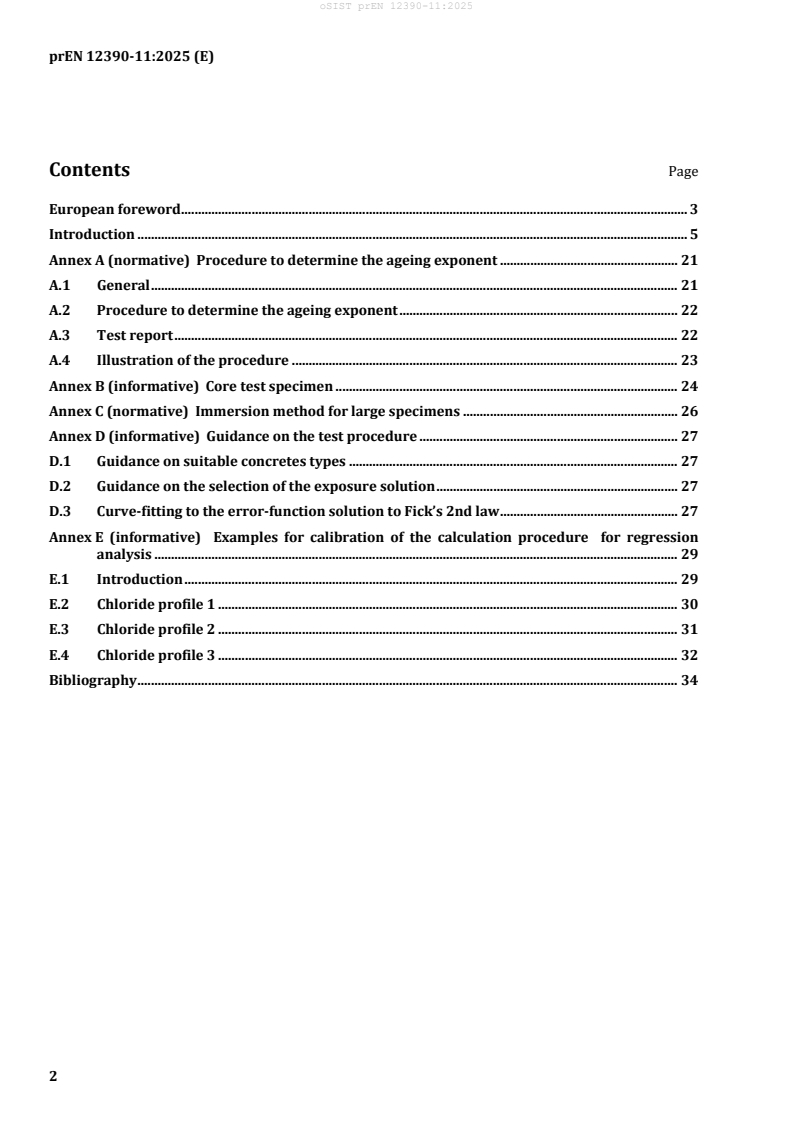
Contents
- Introduction
- Annex A
- 1 Scope
- 2 Normative references
- 3 Term, definitions, symbols and abbreviated terms
- 3.1 Terms and definitions
- 3.1.1 as-cast surface
- 3.1.2 chloride content
- 3.1.3 chloride penetration
- 3.1.4 diffusion
- 3.1.5 diffusion coefficient
- 3.1.6 initial chloride content
- 3.1.7 apparent diffusion coefficient
- 3.1.8 profile grinding
- 3.1.9 ageing exponent
- 3.2 Symbols and abbreviated terms
- 4 Principle
- 5 Reagents and apparatus
- 5.1 Reagents
- 5.2 Apparatus
- 6 Preparation of specimens
- 6.1 Preparing sub-specimens
- 6.2 Conditioning and preparation of profile specimen for chloride testing
- 2 NaCI solution
- 7 Procedure
- 7.1 Exposure conditions
- 7.2 Exposure method
- 7.3 Exposure period
- 7.4 Determination of initial chloride content (Ci)
- 7.5 Profile grinding
- 7.6 Chloride analysis
- 8 Regression procedure and expression of results
- 9 Test report
- 10 Precision
- Annex A
- Annex B
- Annex C
- Annex D
- 2 Dt 2 Dt
- Annex E
- Bibliography
Introduction
Steel reinforced concrete structures exposed to the ingress of chloride, either from seawater or other sources, need to be durable for at least the intended design service life. The possibility of reinforcement corrosion is significantly increased as the chloride level at the embedded reinforcement increases. For this reason, the chloride diffusivity or penetrability of the concrete is an important property to measure. This document sets out a test method, which is applicable to specimens cast or core specimens, to assess the potential chloride resistance properties of a concrete mix after a given reference period of exposure to the chloride-rich environment.
A method is also set out in this document, in order to assess how this potential resistance to chlorides changes with prolonged periods of exposure (determination of the ageing exponent). Specifications regarding the test procedure to determine the ageing exponent of the concrete is given in
Annex A
Specifications regarding the test procedure with core specimens are given in Annex B. NOTE This test method takes a minimum of 118 d comprising a minimum age of the specimen prior to testing of 28 days and then 90 d to expose the specimen to the chloride solution. This test method is one of a series concerned with testing concrete. At the behest of CEN, RILEM reviewed chloride testing methods [1] and this document is based on their recommendations. In addition, this document draws on recommendations from the EU-project “Chlortest” 5th Framework Programme (GRD1-2002-71808/G6RD-CT-2002-00855) [2] immersion test recommendation as well as the Nordtest Method NT Build 443 Concrete, hardened: Accelerated Chloride penetration [3].
oSIST prEN 12390-11:2025 prEN 12390-11:2025 (E)
1 Scope
This document describes a method for determining the unidirectional apparent chloride diffusion coefficient and surface concentration of conditioned specimens of hardened concrete. The test method enables the determination of the chloride penetration after a specified length of curing and length of exposure to NaCl solution.
Since resistance to chloride penetration depends on ageing which includes the effects of continual hydration and interactions with the chloride solution, then the apparent diffusion coefficient also changes with age. A procedure to determine this ageing, expressed here by an ageing exponent, is included in this document and described in Annex A.
The test procedure does not apply to concrete with surface treatments such as silanes and it does not apply to concrete containing fibres (see E.1).
2 Normative references
The following documents, in whole or in part, are normatively referenced in this document and are indispensable for its application. For dated references, only the edition cited applies. For undated references, the latest edition of the referenced document (including any amendments) applies. EN 12390-2, Testing hardened concrete - Part 2: Making and curing specimens for strength tests EN 14629, Products and systems for the protection and repair of concrete structures - Test methods - Determination of chloride content in hardened concrete
3 Term, definitions, symbols and abbreviated terms
For the purposes of this document, the following terms, definitions, symbols and abbreviated terms apply.
ISO and IEC maintain terminology databases for use in standardization at the following addresses:
- ISO Online browsing platform: available at https://www.iso.org/obp/
- IEC Electropedia: available at https://www.electropedia.org/
3.1 Terms and definitions
3.1.1 as-cast surface
surface of a concrete element exposed in the construction works to a chloride environment
3.1.2 chloride content
amount of acid-soluble chloride expressed in percent by mass of concrete
3.1.3 chloride penetration
ingress of chlorides into concrete due to exposure to external chloride sources
3.1.4 diffusion
movement of molecules or ions under a concentration gradient, that is movement from a zone of high concentration to a zone with a lower concentration
oSIST prEN 12390-11:2025 prEN 12390-11:2025 (E)
3.1.5 diffusion coefficient
proportionality between the molecular flux (e.g. rate of flow of chloride ions) and the concentration gradient in the diffusion equation Note 1 to entry: In this document a modified Fick’s Law is adopted.
3.1.6 initial chloride content
C
chloride content at a distance sufficiently remote from the exposed surface as to not have been influenced by penetration of the chloride exposure solution Note 1 to entry: It reflects the initial chloride content that came from the constituents when the concrete was mixed.
3.1.7 apparent diffusion coefficient
D (t) app constant equivalent diffusion coefficient giving similar chloride profile as the measured one for a structure exposed to the chloride environment over a period t [SOURCE: ISO 16204:2012]
3.1.8 profile grinding
dry process grinding a concrete specimen in thin successive layers
3.1.9 ageing exponent
α parameter indicating the decrease over time of the apparent diffusion coefficient Note 1 to entry: The ageing exponent is mathematically defined in Formula A.2
3.2 Symbols and abbreviated terms
α Ageing exponent C Initial chloride content, % by mass of concrete;
C Measured chloride content of concrete layer j, % by mass of concrete m,j C Chloride content of layer j calculated according to Formula (1) using the most suitable r,j combination of C and D (t), % by mass of concrete s app C (t) Calculated chloride content at the exposed surface, % by mass of concrete s C Chloride content measured at average depth x and exposure time t, % by mass of
concrete
D (t) Apparent chloride diffusion coefficient, m /s; app F Sum of squares of the residuals −2 FR Flow rate (flux) in mol m ·s
oSIST prEN 12390-11:2025 prEN 12390-11:2025 (E) j1 to jn Ground layer defined in terms of the number of layers from the exposed surface, the surface layer being j1 R Repeatability R Reproducibility
R Coefficient of determination sr Repeatability standard deviation sR Reproducibility standard deviation S Sum of squares t Exposure time U Variable of the integral with no units X Depth below the exposed surface to the mid-point of the ground layer j, m; Z A dimensional parameter with no units
4 Principle
At least two specimens, either a cylinder or cube, shall be cast and cured in accordance with EN 12390-2, with a curing period of 28 days. Where the curing period is different than 28 days, this shall be recorded and reported.
Annex A gives guidance on determination of ageing exponent.
Annex B gives guidance on the testing of core specimens, where the core may be sampled from a test element, a precast concrete element or a structure.
Annex D gives additional guidance on the test procedure.
The specimens are divided into two sub-specimens, a ‘profile specimen’ that is used to determine the chloride profile after exposure to unidirectional chloride ingress, and an initial chloride sub-specimen that is used to determine the initial chloride level, C . This initial figure is taken as the chloride level of
the cast concrete.
The profile specimens are coated on all sides but one and then the uncoated face is exposed to a chloride exposure solution. The exposure is achieved by either complete immersion, ponding the uncoated face or inverting the specimen and having the uncoated face immersed in the chloride exposure solution. The reference solution is a 3 % by mass sodium chloride (NaCl) solution, for a reference period of 90 d (other concentrations or solutions, e.g. artificial seawater, are permitted as are different exposure periods). The use of large fully immersed specimens is described in Annex C. The preparation of the specimens from end of water curing till the specimen is exposed to the chloride solution shall be without unnecessary delays.
After 90 d of exposure, at least 8 parallel layers of the chloride exposed surface are ground off the profile specimen. The acid-soluble chloride content of each layer and the average depth of the layer from the surface of the concrete exposed to the chloride solution are determined. The initial chloride content is determined by grinding a sample from the other sub-specimen and the acid-soluble chloride content determined.
By nonlinear regression analysis by least squares curve fitting, the surface chloride content (C (t)) and s the non-steady-state chloride diffusion coefficient (D (t)) are determined. app The results shall be reported separately for each specimen and the average value represents the test result.
oSIST prEN 12390-11:2025 prEN 12390-11:2025 (E) Because of the high coefficient of variation, ~ 15 – 30 % for D (t) from the test, the number of app specimens should be increased until the required precision is achieved. NOTE 1 The apparent chloride diffusion coefficient varies with the length of the curing and the length of exposure to the chloride solution.
NOTE 2 The test described in this document is only valid for a constant initial chloride content.
5 Reagents and apparatus
5.1 Reagents
Reagents of analytical quality shall be used.
NOTE Unless otherwise stated, ‘percent’ means percent by mass. 5.1.1 Chloride exposure solution.
5.1.1.1 Reference solution
Dissolve 30 g of analytical quality NaCl in 970 g of distilled or demineralized water having an electrical conductivity ≤ 0,5 mS/m at 20 °C to produce a 3 % by mass NaCl solution. Store it in a clean container. NOTE This NaCl solution has a similar chloride concentration to that of Atlantic seawater.
5.1.1.2 Other exposure solutions
Where the concentration of the chloride exposure solution is other than that in 5.1.1.1, the concentration shall be recorded and reported. Where a different solution is used the composition of the solution shall be recorded and reported.
NOTE 1 Natural and artificial seawater are used to reflect the exposure of construction works. NOTE 2 Higher concentrations of NaCl, such as 16,5 %, and shorter exposure periods (e.g. 35 d) are used to accelerate the development of a chloride profile.
5.1.2 Chloride ion diffusion proof two-component polyurethane or epoxy-based paint or other
equivalent barrier system.
5.1.3 Chemicals for chloride analysis, according to EN 14629.
5.1.4 Distilled or demineralized water, having an electrical conductivity ≤ 0,5 mS/m.
5.2 Apparatus
5.2.1 Water cooled diamond saw.
5.2.2 Balance for weighing NaCl and water, capable of weighing to an accuracy of ± 0,1 g. 5.2.3 Thermometer, capable of measuring to an accuracy of ± 1 °C. 5.2.4 Temperature controlled chamber, capable of keeping a temperature of 20 °C ± 2 °C.
5.2.5 Where used, a polyethylene container with airtight lid for immersion of the profile
specimen. The volume of the exposure solution shall exceed the volume of the specimen by not less
than 12,5 ml per cm of exposed surface. A container may contain more than one specimen provided at
oSIST prEN 12390-11:2025 prEN 12390-11:2025 (E) least the minimum ratio of exposure solution to exposed surface is achieved. The ratio of exposure solution to exposed surface shall be recorded and reported.
During the test, the chloride concentration of the chloride exposure solution reduces and if the ratio of the volume of chloride exposure solution to exposure surface varies, the rate of reduction varies with nominally identical concrete. For this reason, if a direct comparison of results from different specimens is required, the ratio of the volume of chloride exposure solution to exposed surface should be constant.
5.2.6 Where used, pond to be attached to profile specimen. The ponds shall have a constant
diameter and initial depth not less than 125 mm.
5.2.7 Equipment for grinding off and collecting concrete powder in layers less than 2 mm deep,
capable of grinding a surface area of at least 40 cm and not grinding within 10 mm of the edge of the test area.
5.2.8 Compressed air or air blower, to clean dust from specimen and equipment between grinding
layers.
5.2.9 Dust collecting bags.
5.2.10 Equipment for chloride content testing, in accordance with EN 14629. 5.2.11 Calliper, measuring to an accuracy of ± 0,1 mm.
6 Preparation of specimens
6.1 Preparing sub-specimens
A specimen size shall be selected such that after cutting, the minimum dimension of the sub-specimens used to determine a chloride profile are at least three times the nominal maximum aggregate size. At least two specimens, either 100 mm diameter or more cylinders or 100 mm or more cubes, are cast and cured in a water filled bath with a temperature of 20 °C ± 2 °C in accordance with EN 12390-2, where the reference curing period is28 d.
NOTE 1 Where the concrete contains secondary cementing materials, such as fly ash or ground granulated blastfurnace slag, then it can be appropriate to increase the length of curing before testing as it is known that chloride resistance can increase significantly with longer wet curing than 28 d. After 28 d of standard curing, each cylinder, cube or prism is cut into two sub-specimens using the water cooled diamond saw. Cylindrical specimens are cut in the direction parallel to the flat surface and cubical specimens are cut in the direction parallel to the top (trowelled) surface as shown in Figure 1. The tested surface should be free of voids and visible cracks. No dimension of the sub-specimens used to determine a chloride profile shall be less than three times the nominal maximum aggregate size. One sub-specimen (called the ‘profile specimen’) is used to determine the chloride profile, and the initial chloride sub-specimen is used to determine the initial chloride content. This initial chloride content is taken as being the chloride content of the cast concrete. The adjacent sawn faces are used to determine these values.
NOTE 2 Where a chloride profile is required that incorporates the effect of a formed surface then a formed surface from a cube specimen can be specified as the surface for chloride exposure. However, the results from such a procedure are difficult to interpret due to variations in the concentration of cement paste and chloride at the formed surface. The use of this approach has to be reported under Clause 9, m) and o), as it is a non-standard test condition.
oSIST prEN 12390-11:2025 prEN 12390-11:2025 (E)
Key 1 trowelled surface 2 cut to separate specimens and produce exposure surface Figure 1 — Specimen preparation After sawing, the sub-specimen to be used to determine the initial chloride content shall be placed in a close-fitting sealed plastic bag or tested immediately.
Where needed, the sub-specimens may be sawn to reduce their size to aid handling, but the subspecimen for determining the chloride profile shall not have any dimension less than three times the nominal maximum aggregate size.
6.2 Conditioning and preparation of profile specimen for chloride testing
6.2.1 Sealing surfaces other than the surface to be exposed
All surfaces of the profile specimen except for the sawn face shall be either sealed or in accordance with the method in Annex C. After sealing the surfaces, immerse the specimens in tap water for 18 h in order to re-saturate the samples.
NOTE 1 The purpose of sealing the faces other than the face exposed to the chloride solution is to ensure that the ingress of chloride ions into the concrete is a pure unidirectional diffusion process and not a mixture of diffusion and other processes, e.g. capillary suction.
The requirement to seal the faces may be achieved in a number of ways. The following techniques have established suitability.
a) Sealing technique for immersion, ponding or inversion The profile specimen shall be dried in laboratory air until its surface is ‘white-dry’. NOTE 2 This usually takes between 2 h to 4 h.
All faces except the face to be exposed to the chloride solution shall be coated with a layer of epoxy or polyurethane, paraffin wax, or equivalent making sure that the surface to be tested remains free of the coating material. The coating material shall be applied and cured in accordance with the recommendations of the manufacturer.
NOTE 3 Not all epoxy resins and polyurethanes are suitable for this application. b) Alternate sealing technique for ponding
oSIST prEN 12390-11:2025 prEN 12390-11:2025 (E) This technique is only applicable to specimens that are to be ponded. Dry the surfaces with a cloth to remove free water and wrap all faces except the face to be exposed to the chloride solution with insulating tape ensuring sufficient overlap of joints.
6.2.2 Profile specimen for immersion
The specimen shall be transferred directly to exposure without surface drying. A suitable arrangement is shown in Figure 2.
Key
1 chloride solution not less than 12,5 ml per cm of exposed surface 2 seal surfaces 3 exposed surface Figure 2 — Example of an immersed specimen and sealed surfaces
6.2.3 Profile specimen for ponding
After preparation of the specimen, a pond is sealed to the surface of the specimen in a manner that prevents leakage of the chloride exposure solution. A suitable arrangement is shown in Figure 3, noting that the volume of the pond is as defined in 5.2.6. The external border between the plastic tube and specimen is sealed to prevent leakage. The diameter of the tube used to form the pond may be 10 mm to 20 mm less than the diameter of the specimen to allow the formation of a watertight seal. NOTE At the edge of such specimens chloride ingress is not unidirectional. An alternative technique is to use a slightly larger tube and a rubber gasket between the tube and the sealed side of the specimen.
oSIST prEN 12390-11:2025 prEN 12390-11:2025 (E)
Key 1 pond 2 seal 3 profile specimen Figure 3 — Example of a profile specimen and pond sealed to surface
6.2.4 Profile specimen for inversion
After sealing in accordance with 6.2.2, the specimen shall be transferred directly to the inversion exposure apparatus without surface drying. A suitable arrangement is shown in Figure 4. The volume of
the exposure solution shall not be less than 12,5 ml per cm of exposed surface. Dimensions in millimetres
Key 1 sealant on specimen
2 NaCI solution
Figure 4 — Example of an inversion specimen arrangement
7 Procedure
7.1 Exposure conditions
7.1.1 Chloride exposure solution
Unless specified otherwise, the chloride exposure solution shall be a 3 % NaCl solution in accordance with 5.1.1.1. If the chloride exposure solution is other than the reference solution (see 5.1.1.2), it shall
oSIST prEN 12390-11:2025 prEN 12390-11:2025 (E) be reported. The chloride exposure solution concentration after use shall be measured, recorded and reported.
Where testing is related to the intended use in a specific exposure condition, the chloride exposure solution should reflect the anticipated exposure conditions taking into account the expected depletion of chloride (see E.3).
...