

SIST EN 1520:2026
(Main)Precast lightweight concrete products with an open structure
- Abstract
This document covers, regardless of if manufactured in factories or in temporary plants on site under the same conditions, precast concrete elements made of lightweight concrete with an open structure, and with a dry density between 400 and 2000 kg/m3, intended to be used as structural element:
— solid, hollow core and multilayer load-bearing wall elements;
— retaining wall elements, excluding retaining walls intended to retain tanks or reservoirs of liquids and diaphragm walls (concrete sheet piling);
— solid, hollow core and multilayer roof elements, excluding ribbed floor elements and floor slabs elements;
— solid, hollow core and multilayer floor elements excluding floor elements with the intended use to carry traffic loads;
— solid and hollow core beams;
— solid piers.
This document covers, regardless of if manufactured in factories or in temporary plants on site under the same conditions, precast concrete elements made of lightweight concrete with an open structure, and with a dry density between 400 and 2000 kg/m3, intended for not to be used as structural use:
— solid, hollow core and multilayer non-loadbearing wall elements;
— cladding elements;
— rectangular cross-section box culverts;
— components for noise barriers.
NOTE In addition to their loadbearing and encasing function, elements can also be used to provide fire resistance, sound insulation and thermal insulation.
Recycled lightweight concrete with an open structure (other than closed-loop recycling during production) is covered by this document.
- Status
- Published
- Public Enquiry End Date
- 25-Sep-2025
- Publication Date
- 07-Sep-2026
- Technical Committee
- BBB - Concrete, reinforced concrete and prestressed concrete
- Current Stage
- 6060 - National Implementation/Publication (Adopted Project)
- Start Date
- 25-Aug-2026
- Due Date
- 30-Oct-2026
- Completion Date
- 08-Sep-2026

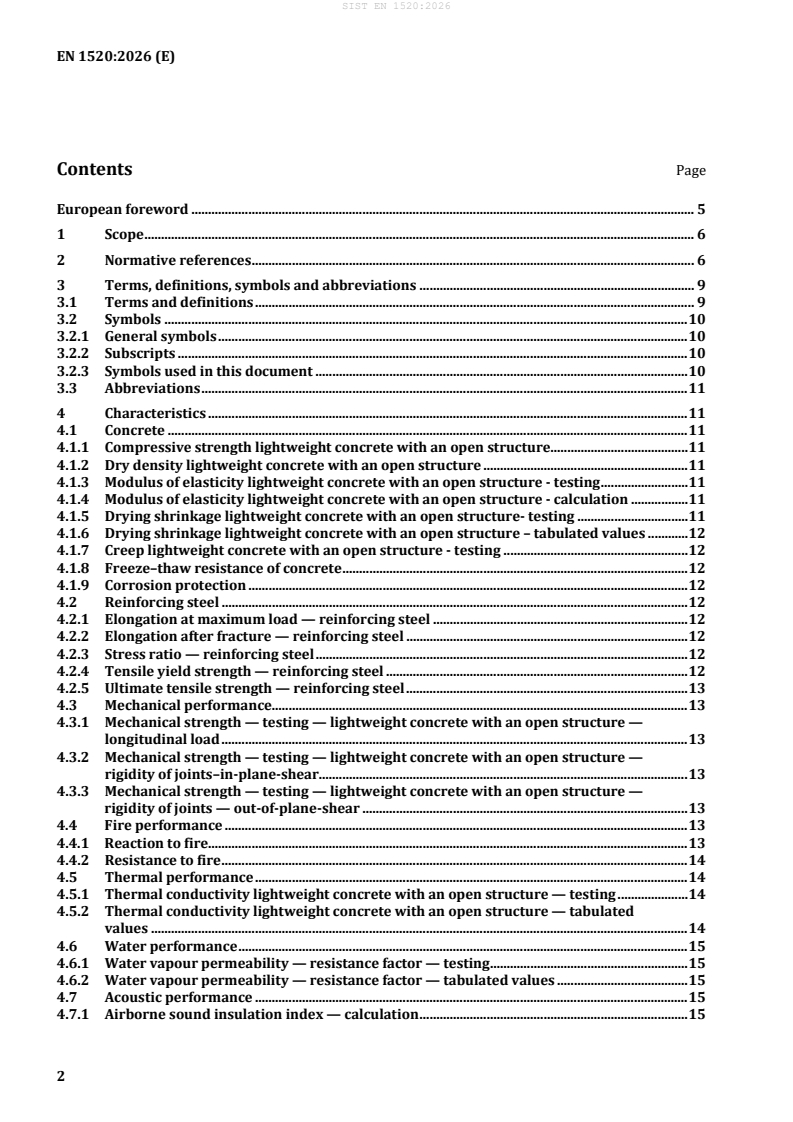
SIST EN 1520:2026 is the Slovenian adoption of EN 1520:2026 from CEN for precast lightweight concrete products with an open structure. It specifies the characteristics, testing, declared performances and AVCP rules for structural and non-structural precast elements made with lightweight concrete of dry density between 400 and 2000 kg/m3.
Manufacturers, designers, laboratories, buyers and notified bodies use SIST EN 1520:2026 to identify the product family, test the relevant properties, and prepare the technical documentation for declaration of performance and CE marking.
What does SIST EN 1520:2026 specify?
SIST EN 1520:2026 applies to precast concrete elements made with lightweight concrete with an open structure, whether produced in factories or in temporary plants on site under the same conditions. It covers products intended for structural use and products intended not to be used as structural use.
The scope includes load-bearing wall elements, retaining wall elements, roof elements, floor elements, beams and solid piers, as well as non-loadbearing wall elements, cladding elements, rectangular cross-section box culverts and components for noise barriers. It also notes that these elements can additionally provide fire resistance, sound insulation and thermal insulation.
The document is organized into six main clauses:
- Clause 1 Scope
- Clause 2 Normative references
- Clause 3 Terms, definitions, symbols and abbreviations
- Clause 4 Characteristics
- Clause 5 Testing, assessment and sampling methods
- Clause 6 Assessment and verification of constancy of performance - AVCP
Annex ZA links the product characteristics to declaration of performance, CE marking and AVCP tasks.
| Annex | What it covers |
|---|---|
| ZA | Relevant characteristics, assessment clauses, declaration of performance, CE marking, and AVCP task assignment for each product type and intended use |
What are the key requirements of SIST EN 1520:2026?
Product material properties and classification
SIST EN 1520:2026 treats the concrete itself as a declared part of the product performance. Clause 4.1 covers compressive strength, dry density, modulus of elasticity, drying shrinkage, creep, freeze-thaw resistance and corrosion protection, while Clause 5.1 gives the corresponding test, calculation and classification methods.
In practice, this means the manufacturer has to show how the lightweight concrete behaves and how it is grouped into strength or density classes where those apply. For a buyer or specifier, these are the numbers that define whether a product fits the intended load, handling and durability needs.
Reinforcing steel and structural performance
SIST EN 1520:2026 also covers the reinforcing steel properties in Clause 4.2, including elongation and tensile strength related characteristics. Clause 4.3 then covers mechanical performance of the element, including mechanical strength testing and the rigidity of joints, with the matching methods in Clause 5.3.
This matters because the product is not assessed only as concrete. The steel and the connections between parts can govern how the element carries loads and how it behaves in service, especially for wall, beam, roof and floor products.
Fire, thermal, water and acoustic performance
SIST EN 1520:2026 includes fire performance in Clause 4.4, thermal performance in Clause 4.5, water vapour permeability in Clause 4.6, acoustic performance in Clause 4.7, and element mass in Clause 4.8. Clause 5 provides the corresponding test or calculation routes, including class declaration, tabulated values and direct testing where applicable.
In practice, this is the part of the standard that supports building design decisions beyond strength. It tells the user how to declare or determine resistance to fire, thermal conductivity, moisture transfer, airborne and impact sound insulation, and sound absorption for building and traffic applications.
Dangerous substances and environmental sustainability
SIST EN 1520:2026 addresses release of dangerous substances to indoor air in Clause 4.9 and to soil and ground water in Clause 4.10, with test methods in Clauses 5.9 and 5.10. It also includes environmental sustainability in Clause 4.11 and Clause 5.11, covering reference service life, life cycle assessment, resource use, waste, output flows and biogenic carbon content.
For practice, this means the document supports both health-related assessment and environmental documentation. It is relevant when the product may be exposed indoors or in contact with soil and ground water, and when environmental product declaration data are needed.
Documentation attached to the declaration of performance
Clause 4.12 and Clause 5.12 deal with documents attached to the declaration of performance. For all products, the attached documents include a detailed set of drawings with nominal dimensions, tolerances and materials.
For custom-made products, the attached documents also include the load and exposure scenarios and the related calculations or tabulated values, plus durability assessment and the calculation method used. For off-the-shelf products, usual scenarios and related calculations or tabulated values may be attached instead.
AVCP and factory production control
Clause 6 sets out assessment and verification of constancy of performance (AVCP). It combines initial assessment, testing, sampling, calculation or tabulated values with factory production control (FPC), initial inspection and continuing surveillance.
This matters because the standard is not only about product properties at one point in time. It also requires the manufacturer to keep production under control so that declared performance remains consistent.
What terms does SIST EN 1520:2026 define?
- Product family - A group of products from one manufacturer for which results for one product are valid for the whole range.
- Lightweight aggregate (LWA) - A mineral aggregate with limited particle density or loose bulk density, used to make lightweight concrete.
- LAC - Lightweight concrete with an open or porous structure and dry density between 400 and 2000 kg/m3, made with LWA.
- Recycled lightweight concrete - Material made from crushed construction and demolition waste originating from lightweight concrete with an open structure elements.
- Loadbearing element - An element designed to contribute to the mechanical resistance and stability of the works.
- Non-loadbearing element - An element that mainly supports its own weight and does not contribute to the stability of the works.
- Reinforced element - An element with reinforcement used for structural or non-structural purposes.
- FPC - Factory production control, the manufacturer’s system for keeping production and declared performance consistent.
- RH - Relative humidity, used in testing and performance conditions.
Who uses SIST EN 1520:2026?
SIST EN 1520:2026 is used by manufacturers of precast lightweight concrete products with an open structure, including producers of walls, roofs, floors, beams, piers, cladding, box culverts and noise barriers. It is also used by design offices, structural engineers, quality managers, testing laboratories and notified bodies.
In practice, these users rely on it to select the relevant product family, choose the test or calculation route, prepare production documentation, set up FPC, and compile the declaration of performance and technical files. Buyers and specifiers use it to compare declared characteristics across products and intended uses.
What changed in SIST EN 1520:2026 from the previous edition?
SIST EN 1520:2026 supersedes SIST EN 1520:2011 and EN 1520:2011.
Which standards are used with SIST EN 1520:2026?
SIST EN 1520:2026 cites several standards for the test methods and assessment routes it uses:
- EN 206-1:2026 - concrete performance, requirements, production and conformity rules.
- EN 992:1995 - dry density of lightweight aggregate concrete with open structure.
- EN 1354:2005 - compressive strength of lightweight aggregate concrete with open structure.
- EN 1352:1996 - static modulus of elasticity under compression.
- EN 1355:1996 - creep strains under compression.
- CEN/TS 12390-9:2016 - freeze-thaw resistance with de-icing salts.
- EN 16516:2017+A1:2020 and EN 16637-1:2023 / EN 16637-2:2023 - release of dangerous substances to indoor air and to soil and ground water.
- EN 15804:2012+A2:2019 and EN 18185:2026 - environmental product declaration rules and product category rules.
- EN ISO 12572:2016, EN ISO 10456:2007, and EN 12664:2001 - water vapour and thermal property determination.
- EN 1364-1:2015, EN 1365-1:2012, EN 1365-2:2014, EN 1365-3:1999, EN 1365-4:1999, EN 13823:2020+A1:2022, EN ISO 1182:2020, EN ISO 1716:2018, EN ISO 11925-2:2026, EN 13501-1:2018 and EN 13501-2:2023 - reaction to fire and fire resistance testing and classification.
- EN ISO 10140-2:2021, EN ISO 10140-3:2021, EN ISO 717-1:2020, EN ISO 717-2:2020, EN ISO 354:2003, EN 12354-1:2017 and EN 12354-2:2017 - acoustic testing, rating and estimation.
- EN 990:2002, EN 1739:2007, EN 1740:1998 and EN 1741:2007 - corrosion protection and joint or component performance.
- EN ISO 15630-1:2019 and EN ISO 15630-2:2019 - test methods for reinforcement steel.
What does the SIST EN 1520:2026 document contain?
SIST EN 1520:2026 contains product characteristics for the concrete, reinforcing steel, mechanical behavior, fire, thermal, water, acoustic, mass, dangerous substances and environmental sustainability. It also contains test, assessment and sampling methods for each of those areas, including specimen preparation, calculation routes, tabulated values and class declarations.
The Annex ZA tables map each product type to the essential characteristics that matter for declaration of performance and CE marking. They also identify which clauses and related standards support each characteristic, and which AVCP tasks apply to the manufacturer and the notified body.
Relations
- Effective Date
- 01-Oct-2026
- Effective Date
- 07-Oct-2026
- Effective Date
- 07-Oct-2026
- Effective Date
- 07-Oct-2026
- Effective Date
- 07-Oct-2026
- Effective Date
- 07-Oct-2026
- Effective Date
- 07-Oct-2026
- Effective Date
- 07-Oct-2026
- Effective Date
- 07-Oct-2026
- Effective Date
- 07-Oct-2026
- Refers
SIST EN 1365-2:2014 - Fire resistance tests for loadbearing elements - Part 2: Floors and roofs - Effective Date
- 07-Oct-2026
- Effective Date
- 07-Oct-2026
- Effective Date
- 07-Oct-2026
- Effective Date
- 07-Oct-2026
- Effective Date
- 07-Oct-2026
Get Certified
Connect with accredited certification bodies for this standard

DIBt (Deutsches Institut für Bautechnik)
German Institute for Building Technology.

DIN CERTCO
DIN Group product certification.

Aboma Certification B.V.
Specialized in construction, metal, and transport sectors.
Sponsored listings
Frequently Asked Questions
SIST EN 1520:2026 is a standard published by the Slovenian Institute for Standardization (SIST). Its full title is "Precast lightweight concrete products with an open structure". This standard covers: This document covers, regardless of if manufactured in factories or in temporary plants on site under the same conditions, precast concrete elements made of lightweight concrete with an open structure, and with a dry density between 400 and 2000 kg/m3, intended to be used as structural element: — solid, hollow core and multilayer load-bearing wall elements; — retaining wall elements, excluding retaining walls intended to retain tanks or reservoirs of liquids and diaphragm walls (concrete sheet piling); — solid, hollow core and multilayer roof elements, excluding ribbed floor elements and floor slabs elements; — solid, hollow core and multilayer floor elements excluding floor elements with the intended use to carry traffic loads; — solid and hollow core beams; — solid piers. This document covers, regardless of if manufactured in factories or in temporary plants on site under the same conditions, precast concrete elements made of lightweight concrete with an open structure, and with a dry density between 400 and 2000 kg/m3, intended for not to be used as structural use: — solid, hollow core and multilayer non-loadbearing wall elements; — cladding elements; — rectangular cross-section box culverts; — components for noise barriers. NOTE In addition to their loadbearing and encasing function, elements can also be used to provide fire resistance, sound insulation and thermal insulation. Recycled lightweight concrete with an open structure (other than closed-loop recycling during production) is covered by this document.
This document covers, regardless of if manufactured in factories or in temporary plants on site under the same conditions, precast concrete elements made of lightweight concrete with an open structure, and with a dry density between 400 and 2000 kg/m3, intended to be used as structural element: — solid, hollow core and multilayer load-bearing wall elements; — retaining wall elements, excluding retaining walls intended to retain tanks or reservoirs of liquids and diaphragm walls (concrete sheet piling); — solid, hollow core and multilayer roof elements, excluding ribbed floor elements and floor slabs elements; — solid, hollow core and multilayer floor elements excluding floor elements with the intended use to carry traffic loads; — solid and hollow core beams; — solid piers. This document covers, regardless of if manufactured in factories or in temporary plants on site under the same conditions, precast concrete elements made of lightweight concrete with an open structure, and with a dry density between 400 and 2000 kg/m3, intended for not to be used as structural use: — solid, hollow core and multilayer non-loadbearing wall elements; — cladding elements; — rectangular cross-section box culverts; — components for noise barriers. NOTE In addition to their loadbearing and encasing function, elements can also be used to provide fire resistance, sound insulation and thermal insulation. Recycled lightweight concrete with an open structure (other than closed-loop recycling during production) is covered by this document.
SIST EN 1520:2026 is classified under the following ICS (International Classification for Standards) categories: 91.100.30 - Concrete and concrete products. The ICS classification helps identify the subject area and facilitates finding related standards.
SIST EN 1520:2026 has the following relationships with other standards: It is inter standard links to SIST EN 1520:2011, SIST EN 15804:2012+A2:2019, SIST EN ISO 12572:2016/A1:2025, SIST EN ISO 12572:2016, SIST EN 992:2001, SIST EN 1365-3:2001, SIST EN ISO 10456:2008, SIST EN ISO 717-1:2021, SIST EN ISO 1716:2018, SIST EN 12504-1:2019, SIST EN 1365-2:2014, SIST EN 16516:2018+A1:2020, SIST EN 1739:2007, SIST EN ISO 10140-3:2021, SIST EN 13501-2:2023. Understanding these relationships helps ensure you are using the most current and applicable version of the standard.
SIST EN 1520:2026 is associated with the following European legislation: EU Directives/Regulations: 305/2011; Standardization Mandates: M/100, M/609, M/627. When a standard is cited in the Official Journal of the European Union, products manufactured in conformity with it benefit from a presumption of conformity with the essential requirements of the corresponding EU directive or regulation.
SIST EN 1520:2026 is available in PDF format for immediate download after purchase. The document can be added to your cart and obtained through the secure checkout process. Digital delivery ensures instant access to the complete standard document.
Standards Content (Sample)
Contents
- 1 Scope
- 2 Normative references
- 3 Terms, definitions, symbols and abbreviations
- 3.1 Terms and definitions
- 3.1.1 product family
- 3.1.2 lightweight aggregate
- 3.1.3 lightweight concrete with an open structure
- 3.1.4 recycled lightweight concrete
- 3.1.5 concrete
- 3.1.6 loadbearing element
- 3.1.7 non-loadbearing element
- 3.1.8 reinforced element
- 3.2 Symbols
- 3.3 Abbreviations
- 4 Characteristics
- 4.1 Concrete
- 4.2 Reinforcing steel
- 4.3 Mechanical performance
- 4.4 Fire performance
- 4.5 Thermal performance
- 4.6 Water performance
- 4.7 Acoustic performance
- 4.8 Other performances
- 4.9 Release of dangerous substances — indoor air
- 4.10 Release of dangerous substances — soil and ground water
- 4.11 Environmental sustainability
- 4.12 Documents attached to the declaration of performances
- 5 Testing, assessment and sampling methods
- 5.1 Lightweight concrete with an open structure
- 5.2 Reinforcing steel
- 5.3 Mechanical performance
- 5.4 Fire performance
- 5.5 Thermal performance
- 5.6 Water performance
- 5.7 Acoustic performance
- 5.8 Other performances
- 5.9 Release of dangerous substances — indoor air
- 5.10 Release of dangerous substances — soil and ground water
- 5.11 Environmental sustainability
- 5.12 Performances in attached documentation of the product
- 6 Assessment and verification of constancy of performance — AVCP
- 6.1 General
- 6.2 Assessment of performance
- 6.3 Verification of constancy of performance
- 5.1.2 Dry density Every 250 m or twice per
- 5.1.5 Shrinkage Every three years
- Annex ZA
- 6.2 taken at the intended use which are declared
- Bibliography
1 Scope
This document covers, regardless of if manufactured in factories or in temporary plants on site under the same conditions, precast concrete elements made of lightweight concrete with an open structure, and
with a dry density between 400 and 2000 kg/m , intended to be used as structural element:
- solid, hollow core and multilayer load-bearing wall elements;
- retaining wall elements, excluding retaining walls intended to retain tanks or reservoirs of liquids and diaphragm walls (concrete sheet piling);
- solid, hollow core and multilayer roof elements, excluding ribbed floor elements and floor slabs elements;
- solid, hollow core and multilayer floor elements excluding floor elements with the intended use to carry traffic loads;
- solid and hollow core beams;
- solid piers.
This document covers, regardless of if manufactured in factories or in temporary plants on site under the same conditions, precast concrete elements made of lightweight concrete with an open structure, and
with a dry density between 400 and 2000 kg/m , intended for not to be used as structural use:
- solid, hollow core and multilayer non-loadbearing wall elements;
- cladding elements;
- rectangular cross-section box culverts;
- components for noise barriers.
NOTE In addition to their loadbearing and encasing function, elements can also be used to provide fire resistance, sound insulation and thermal insulation.
Recycled lightweight concrete with an open structure (other than closed-loop recycling during production) is covered by this document.
2 Normative references
The following documents are referred to in the text in such a way that some or all of their content constitutes the requirements of this document. For dated references, only the edition cited applies. For undated references, the latest edition of the referenced document (including any amendments) applies. CEN/TS 12390-9:2016, Testing hardened concrete - Part 9: Freeze-thaw resistance with de-icing salts - Scaling EN 206-1:2026, Concrete - Specification, performance, production and conformity - Part 1: Performance, requirements, factory production control and assessment criteria for individual values EN 990:2002, Test methods for verification of corrosion protection of reinforcement in autoclaved aerated concrete and lightweight aggregate concrete with open structure EN 991:1995, Determination of the dimension of prefabricated reinforced components made of autoclaved aerated concrete or lightweight aggregate concrete with open structure
SIST EN 1520:2026 EN 1520:2026 (E) EN 992:1995, Determination of the dry density of lightweight aggregate concrete with open structure EN 1352:1996, Determination of static modulus of elasticity under compression of autoclaved aerated concrete or lightweight aggregate concrete with open structure EN 1354:2005, Determination of compressive strength of lightweight aggregate concrete with open structure EN 1355:1996, Determination of creep strains under compression of autoclaved aerated concrete or lightweight aggregate concrete with open structure EN 1364-1:2015, Fire resistance tests for non-loadbearing elements - Part 1: Walls
EN 1365-1:2012, Fire resistance tests for loadbearing elements — Part 1: Walls EN 1365-2:2014, Fire resistance tests for loadbearing elements - Part 2: Floors and roofs EN 1365-3:1999, Fire resistance tests for loadbearing elements - Part 3: Beams EN 1365-4:1999, Fire resistance tests for loadbearing elements - Part 4: Columns EN 1739:2007, Determination of shear strength for in-plane forces of joints between prefabricated components of autoclaved aerated concrete or lightweight aggregate concrete with open structure EN 1740:1998, Performance test for prefabricated reinforced components made of autoclaved aerated concrete or lightweight aggregate concrete with open structure under predominantly longitudinal load (vertical components) EN 1741:1998, Determination of shear strength for out-of-plane forces of joints between prefabricated components made of autoclaved aerated concrete or lightweight aggregate concrete with open structure EN 1745:2020, Masonry and masonry products - Methods for determining thermal properties EN 1793-1:2025, Road traffic noise reducing devices - Test method for determining the acoustic performance - Part 1: Intrinsic characteristics - Sound absorption under diffuse sound field conditions EN 12664:2001, Thermal performance of building materials and products - Determination of thermal resistance by means of guarded hot plate and heat flow meter methods - Dry and moist products of medium and low thermal resistance EN 13501-1:2018, Fire classification of construction products and building elements - Part 1: Classification using data from reaction to fire tests EN 13501-2:2023, Fire classification of construction products and building elements - Part 2: Classification using data from fire resistance and/or smoke control tests, excluding ventilation services EN 13823:2020+A1:2022, Reaction to fire tests for building products - Building products excluding floorings exposed to the thermal attack by a single burning item EN 15804:2012+A2:2019, Sustainability of construction works - Environmental product declarations - Core rules for the product category of construction products
As impacted by EN 1365-1:2012/AC:2013.
SIST EN 1520:2026 EN 1520:2026 (E) EN 16516:2017+A1:2020, Construction products: Assessment of release of dangerous substances - Determination of emissions into indoor air EN 16637-1:2023, Construction products: Assessment of release of dangerous substances - Part 1: Guidance for the determination of leaching tests and additional testing steps EN 16637-2:2023, Construction products: Assessment of release of dangerous substances - Part 2:
Horizontal dynamic surface leaching test EN 18185:2026, Sustainability of construction works - Environmental product declarations - Product Category Rules for precast lightweight concrete with an open structure and precast autoclaved aerated concrete EN ISO 354:2003, Acoustics - Measurement of sound absorption in a reverberation room (ISO 354:2003) EN ISO 717-1:2020, Acoustics - Rating of sound insulation in buildings and of building elements - Part 1:
Airborne sound insulation (ISO 717-1:2020) EN ISO 717-2:2020, Acoustics - Rating of sound insulation in buildings and of building elements - Part 2:
Impact sound insulation (ISO 717-2:2020) EN ISO 1182:2020, Reaction to fire tests for products - Non-combustibility test (ISO 1182:2020) EN ISO 1716:2018, Reaction to fire tests for products - Determination of the gross heat of combustion (calorific value) (ISO 1716:2018) EN ISO 10140-2:2021, Acoustics - Laboratory measurement of sound insulation of building elements - Part 2: Measurement of airborne sound insulation (ISO 10140-2:2021) EN ISO 10140-3:2021, Acoustics - Laboratory measurement of sound insulation of building elements - Part 3: Measurement of impact sound insulation (ISO 10140-3:2021)
EN ISO 10456:2007, Building materials and products — Hygrothermal properties — Tabulated design values and procedures for determining declared and design thermal values (ISO 10456:2007+ Cor. 1:2009) EN ISO 11925-2:2026, Reaction to fire tests - Ignitability of products subjected to direct impingement of flame - Part 2: Single-flame source test (ISO 11925-2:2026) EN ISO 12354-1:2017, Building acoustics - Estimation of acoustic performance of buildings from the performance of elements - Part 1: Airborne sound insulation between rooms (ISO 12354-1:2017) EN ISO 12354-2:2017, Building acoustics - Estimation of acoustic performance of buildings from the performance of elements - Part 2: Impact sound insulation between rooms (ISO 12354-2:2017) EN 12504-1:2019, Testing concrete in structures - Part 1: Cored specimens - Taking, examining and testing in compression
EN ISO 12572:2016, Hygrothermal performance of building materials and products — Determination of water vapour transmission properties (ISO 12572:2016)
As impacted by EN ISO 10456:2007/AC:2009.
As impacted by EN ISO 12572:2016/A1:2024.
SIST EN 1520:2026 EN 1520:2026 (E) EN ISO 15630-1:2019, Steel for the reinforcement and prestressing of concrete - Test methods - Part 1:
Reinforcing bars, rods and wire (ISO 15630-1:2019) EN ISO 15630-2:2019, Steel for the reinforcement and prestressing of concrete - Test methods - Part 2:
Welded fabric and lattice girders (ISO 15630-2:2019)
3 Terms, definitions, symbols and abbreviations
3.1 Terms and definitions
For the purposes of this document, the terms and definitions given in EN 206-1:2026 and the following apply.
ISO and IEC maintain terminology databases for use in standardization at the following addresses:
- ISO Online browsing platform: available at https://www.iso.org/obp/
- IEC Electropedia: available at https://www.electropedia.org/
3.1.1 product family
group of products produced by one manufacturer for which the assessment results for one or more characteristics from any one product within the range are valid for all other products within this range
3.1.2 lightweight aggregate
LWA 3 3 aggregate of mineral origin having a particle density not exceeding 2 000 kg/m (2,00 Mg/m ) or a loose 3 3 bulk density not exceeding 1 200 kg/m (1,20 Mg/m ) [SOURCE: EN 13055-1:2002, 3.2]
3.1.3 lightweight concrete with an open structure
LAC lightweight concrete with an open or porous structure having a dry density between 400 and
2 000 kg/m and made with lightweight aggregates (LWA)
3.1.4 recycled lightweight concrete
material produced from crushed construction and demolition waste originating from lightweight concrete with an open or porous structure elements
3.1.5 concrete
normal-weight concrete with a closed structure having a dry density between 2000 and 2 600 kg/m
3.1.6 loadbearing element
element designed to contribute to the mechanical resistance and stability of the works Note 1 to entry: Elements exposed mainly to wind loads or acting as part of fire-resisting walls are considered to be loadbearing.
SIST EN 1520:2026 EN 1520:2026 (E)
3.1.7 non-loadbearing element
element that mainly supports its own weight and does not contribute to the stability of the work
3.1.8 reinforced element
element with a reinforcement used for both structural and non-structural purposes
3.2 Symbols
3.2.1 General symbols
A area E modulus of elasticity f strength k coefficient, factor
3.2.2 Subscripts
c concrete parameter, compression dry dry state k characteristic value m mean
3.2.3 Symbols used in this document
A elongation at maximum load — reinforcing steel gt A total elongation at fracture — reinforcing steel t Ecm mean value of the modulus of elasticity of LAC f characteristic compressive strength of LAC ck f required minimum compressive strength of LAC cmin f required minimum compressive strength of a test set with n ≥ 6 test specimens c,n f required minimum compressive strength of each test set of three consecutive test specimens c,3 f characteristic value of strength parameters k f required minimum strength min f mean value of n strength results m,n K statistical coefficient for determination of characteristic strength (λ is used in EN 206-1) n n number of test specimens in a sample, number of test results Re yield strength, MPa R Upper yield strength, MPa eH R yield strength at 0,2 % plastic elongation, MPa p0,2 R tensile strength, MPa m
SIST EN 1520:2026 EN 1520:2026 (E) s standard deviation of n test results n η coefficient according to Formula (2)
λ thermal conductivity λ thermal conductivity in the dry state, determined at a mean test temperature of 10 °C 10dry μ moisture content, related to mass m ρ dry density of LAC
3.3 Abbreviations
FPC factory production control LAC lightweight concrete with an open structure RH relative humidity
4 Characteristics
4.1 Concrete
4.1.1 Compressive strength lightweight concrete with an open structure
The compressive strength of lightweight concrete with an open structure is an indication of the loadbearing capacity of an element.
When assessing compressive strength, this shall be determined in accordance with 5.1.2. The performance of compressive strength shall be expressed as a class.
4.1.2 Dry density lightweight concrete with an open structure
The dry density lightweight concrete with an open structure serves as a reference for the calculation of some mechanical values and thermal insulation properties of elements. When assessing dry density, this shall be determined in accordance with 5.1.3, the performance of density shall be expressed as a class.
4.1.3 Modulus of elasticity lightweight concrete with an open structure - testing
When assessing the modulus of elasticity using the test methods given in 5.1.4, the modulus of elasticity shall be expressed in MPa.
4.1.4 Modulus of elasticity lightweight concrete with an open structure - calculation
When assessing the modulus of elasticity using the calculation method given in 5.1.5, the modulus of elasticity shall be expressed in MPa.
4.1.5 Drying shrinkage lightweight concrete with an open structure- testing
When assessing drying shrinkage, this shall be determined in accordance with 5.1.6. The performance of drying shrinkage shall be expressed in mm/m, rounded to the nearest 0,01.
SIST EN 1520:2026 EN 1520:2026 (E)
4.1.6 Drying shrinkage lightweight concrete with an open structure – tabulated values
When using a tabulated value for drying shrinkage, the value given in 5.1.7 shall be used. The performance of drying shrinkage shall be expressed in mm/m, rounded to the nearest 0,01 together with the relevant relative humidity of the environment.
4.1.7 Creep lightweight concrete with an open structure - testing
Creep describes the deformation of lightweight concrete with an open structure under longer lasting stress-induced loading.
When assessing creep, this shall be determined in accordance with 5.1.8. The performance of creep shall be expressed in mm/m.
4.1.8 Freeze–thaw resistance of concrete
When assessing the freeze–thaw resistance of concrete, this shall be determined in accordance with 5.1.9
and expressed in kg/m . The freezing agent used shall be specified.
4.1.9 Corrosion protection
When assessing the corrosion protection of concrete, this shall be determined in accordance with 5.1.10. The type of corrosion protection (galvanized, stainless or coated steel) used shall be provided. The type of corrosion protection and the % of corroded surface area shall be provided. The performance of the corrosion protection shall be expressed as percentage.
4.2 Reinforcing steel
4.2.1 Elongation at maximum load — reinforcing steel
When assessing the elongation at maximum load of reinforcing steel (A ), this shall be determined in gt accordance with 5.2.1. The performance of elongation at maximum load of reinforcing steel shall be expressed as a ratio, rounded to the nearest 0,1.
4.2.2 Elongation after fracture — reinforcing steel
When assessing the elongation after fracture of reinforcing steel (A ), this shall be determined in r accordance with 5.2.2. The performance of elongation after fracture of reinforcing steel shall be expressed as a ratio, rounded to the nearest 0,1.
4.2.3 Stress ratio — reinforcing steel
When assessing the stress ratio of reinforcing steel (R /R ), this shall be determined in accordance with m e 5.2.3. The performance of stress ratio of reinforcing steel shall be expressed as a ratio, rounded to the nearest 0,01.
4.2.4 Tensile yield strength — reinforcing steel
When assessing the tensile yield strength of reinforcing steel (R ), this shall be determined in accordance e with 5.2.4. The performance of tensile yield strength of reinforcing steel shall be expressed in MPa, rounded to the nearest integer.
SIST EN 1520:2026 EN 1520:2026 (E)
4.2.5 Ultimate tensile strength — reinforcing steel
When assessing the ultimate tensile strength of reinforcing steel (R ), this shall be determined in m accordance with 5.2.5. The performance of ultimate tensile strength of reinforcing steel shall be expressed in MPa, rounded to the nearest integer.
4.3 Mechanical performance
4.3.1 Mechanical strength — testing — lightweight concrete with an open structure —
longitudinal load When assessing the mechanical strength of elements under longitudinal load, this shall be determined in accordance with 5.3.2. The performance of mechanical strength of elements under longitudinal load shall be expressed in MN The calculation and corresponding test method shall be part of the documentation provided with the declaration in accordance with 4.12.
4.3.2 Mechanical strength — testing — lightweight concrete with an open structure — rigidity of
joints–in-plane-shear When using the rigidity of joints in design the mechanical strength of joints under in-plane-shear shall be determined in accordance with 5.3.3. The performance mechanical strength of joints under in-planeshear shall be expressed in MPa. The calculation and corresponding test method shall be part of the documentation provided with the declaration in accordance with 4.12.
4.3.3 Mechanical strength — testing — lightweight concrete with an open structure — rigidity of
joints — out-of-plane-shear When using the rigidity of joints in design the mechanical strength of joints under out-of-plane-shear shall be determined in accordance with 5.3.4. The performance mechanical strength of joints under outof-plane-shear shall be expressed in MPa. The calculation and corresponding test method shall be part of the documentation provided with the declaration in accordance with 4.12.
4.4 Fire performance
4.4.1 Reaction to fire
4.4.1.1 Classification by testing
The reaction to fire indicates the response of a lightweight concrete with an open structure element in contributing by its own decomposition to a fire to which it is exposed, under specified conditions. When tested in accordance with the test method given in 5.4.1, relevant for the claimed class, the test results are expressed as a class according to the classification published in the Official Journal of the European Union on this specific matter.
NOTE The applicable document at the time this document was drafted is Commission Delegated Regulation (EU) 2016/364 of 1 July 2015. https://eur-lex.europa.eu/eli/reg_del/2016/364
4.4.1.2 Classification without further testing (WFT)
Whether products covered by this document fulfil the conditions, under which they have demonstrated of having a stable reaction to fire performance in a given reaction to fire class, based on testing to the
SIST EN 1520:2026 EN 1520:2026 (E) appropriate EN test methods, the established assigned class applies to these products without the need of carrying out further reaction to fire tests.
NOTE The rules to apply this classification are published as Commission Decisions or Commission Delegated Regulations.
4.4.1.3 Classification without testing (WT)
Whether products covered by this document are made from one or more of the materials that have been considered, under established conditions, as belonging to the category “No contribution to fire” because of their low level of combustibility, the reaction to fire class A1 applies to these products without the need of carrying out reaction to fire tests.
NOTE The applicable document at the time this document was drafted is Commission Decision 96/603/EC, Materials to be considered as reaction to fire Class A1 without the need for testing as amended by Commission Decision 2000/605/EC of 26 September 2000 (see OJEU L, 2000–10–12) and Commission Decision 2003/424/EC of 6 June 2003
...