

SIST EN 13405:2003
(Main)Surface active agents - Determination of dialkyl-tetralins content in linear alkylbenzene by high performance liquid chromatography (HPLC)
- Abstract
This European Standard specifies a method for the determination of dialkyl-tetralins (DAT), being 1,4-dialkyl-2,3-dihydro-naphthalene in linear alkylbenzene (LAB) in the range of the mass fraction of 0,5 % to 10 %.
- Status
- Published
- Publication Date
- 31-Jan-2003
- Technical Committee
- KDS - Cosmetics, chemical disinfectants and surface active agents
- Current Stage
- 6060 - National Implementation/Publication (Adopted Project)
- Start Date
- 01-Feb-2003
- Due Date
- 01-Feb-2003
- Completion Date
- 01-Feb-2003



SIST EN 13405:2003 is the Slovenian adoption of EN 13405:2002 from SIST. It specifies an HPLC method for determining dialkyl-tetralins (DAT), identified as 1,4-dialkyl-2,3-dihydro-naphthalene, in linear alkylbenzene (LAB) over a mass fraction range of 0.5 % to 10 %. Laboratories use it to check LAB composition in work linked to surface active agents.
What does SIST EN 13405:2003 specify?
SIST EN 13405:2003 specifies one analytical method for measuring DAT in LAB by high performance liquid chromatography (HPLC). The method is aimed at routine laboratory control of LAB samples and gives the result as a mass fraction.
The document is organized into clauses for scope, normative reference, principle, reagents, apparatus, procedure, calculation, precision, and test report. Annex A is informative and provides a gas chromatographic method for determining the carbon number distribution of the LAB sample when that information is needed for the calculation.
| Annex | What it covers |
|---|---|
| Annex A | Informative method for determining the carbon number distribution of the LAB sample by gas chromatography |
What are the key requirements of SIST EN 13405:2003?
SIST EN 13405:2003 uses an isocratic HPLC procedure with a micro-particulate silica stationary phase, 2,2,4-trimethylpentane mobile phase, and ultraviolet absorbance detection at 254 nm. In practice, this means the laboratory needs a suitable HPLC set-up that can separate DAT from the other LAB components and measure the DAT peak reliably.
Clause 4 limits the reagents to analytical-grade materials, with water meeting the grade defined in EN ISO 3696:1995. The method names iso-octane, tetrahydronaphthalene (THN), hexane, and toluene as reagents. That matters because solvent quality affects peak shape, baseline stability, and calibration.
Clause 5 requires ordinary laboratory apparatus plus an HPLC instrument, a normal-phase chromatographic column, a means of peak-area measurement, and a disposable filter. The column and detector arrangement has to support the operating conditions in the document. For the user, this means the method depends on equipment that can produce clean separations and accurate peak integration.
Clause 6.1 requires a preliminary chromatographic check before routine analysis. The laboratory adjusts column length and flow rate to optimize efficiency and resolution, and checks separation with a toluene/THN standard mixture. This step matters because the DAT result is only reliable when the chromatographic separation is adequate.
Clause 6.2 defines calibration with a THN solution in iso-octane. If the mean molar mass of DAT is not known, the sample’s carbon number distribution is first determined, using the informative Annex A method as an example. In practice, this links the chromatogram to the actual LAB composition so the DAT content can be converted correctly.
Clause 6.3 defines sample preparation and measurement: prepare the sample solution in iso-octane, filter it, and analyze it by HPLC. The DAT peak area is measured with a tangent skim technique. This is the part the laboratory actually performs for each sample, so filtration and peak handling affect the final result.
Clause 7 gives the calculation of DAT as a mass fraction from the DAT peak area, the THN calibration response, the sample concentration, and the molar-mass relationship between DAT and THN. The result is reported to one decimal place. Clause 8 provides precision data from an interlaboratory test and gives repeatability and reproducibility limits that depend on the DAT level. Clause 9 requires the test report to identify the sample, cite the standard, state the result and units, and record any relevant operating details or incidents.
What terms does SIST EN 13405:2003 define?
- Dialkyl-tetralins (DAT) - In this standard, DAT means 1,4-dialkyl-2,3-dihydro-naphthalene compounds in LAB.
- Linear alkylbenzene (LAB) - LAB is the sample material analyzed for DAT content.
- High performance liquid chromatography (HPLC) - HPLC is the separation method used to isolate and measure DAT by UV detection.
- Tetrahydronaphthalene (THN) - THN is the external standard used for calibration because pure DAT standards are not available.
- Mass fraction - The method reports DAT content as a percentage of the sample mass.
- Isocratic - The mobile phase composition stays constant during the HPLC run.
Who uses SIST EN 13405:2003?
SIST EN 13405:2003 is used by analytical laboratories, quality-control teams, and producers or buyers of LAB and related surfactant raw materials. It supports routine product checking, incoming inspection, and dispute or specification testing where the DAT content of LAB matters. It is also relevant where a lab needs to document a repeatable chromatographic method for a customer or internal specification.
What changed in SIST EN 13405:2003 from the previous edition?
SIST EN 13405:2003 is the Slovenian version of EN 13405:2002 and is identified as identical to it.
Which standards are used with SIST EN 13405:2003?
- EN ISO 3696:1995 - Supplies the water specification used for analytical work in the method.
- UOP Method 673-88 - Cited in Annex A as the example gas chromatographic method for determining LAB carbon number distribution.
- ASTM D 4307:1994 - Listed in the bibliography as a reference on preparing liquid blends for analytical standards.
What does the SIST EN 13405:2003 document contain?
The document contains the full HPLC procedure for DAT in LAB, including the principle, reagents, apparatus, sample preparation, calibration, calculation, precision, and reporting rules. It also includes two example chromatograms, one for checking resolution and one for the LAB sample measurement. Annex A adds a gas chromatographic method, with operating conditions, calculation steps, and precision notes, for determining the carbon number distribution needed in some calculations.
Relations
- Effective Date
- 28-Jan-2026
Get Certified
Connect with accredited certification bodies for this standard

ECOCERT
Organic and sustainability certification.

Eurofins Food Testing Global
Global leader in food, environment, and pharmaceutical product testing.

Intertek Bangladesh
Intertek certification and testing services in Bangladesh.
Sponsored listings
Frequently Asked Questions
SIST EN 13405:2003 is a standard published by the Slovenian Institute for Standardization (SIST). Its full title is "Surface active agents - Determination of dialkyl-tetralins content in linear alkylbenzene by high performance liquid chromatography (HPLC)". This standard covers: This European Standard specifies a method for the determination of dialkyl-tetralins (DAT), being 1,4-dialkyl-2,3-dihydro-naphthalene in linear alkylbenzene (LAB) in the range of the mass fraction of 0,5 % to 10 %.
This European Standard specifies a method for the determination of dialkyl-tetralins (DAT), being 1,4-dialkyl-2,3-dihydro-naphthalene in linear alkylbenzene (LAB) in the range of the mass fraction of 0,5 % to 10 %.
SIST EN 13405:2003 is classified under the following ICS (International Classification for Standards) categories: 71.100.40 - Surface active agents. The ICS classification helps identify the subject area and facilitates finding related standards.
SIST EN 13405:2003 has the following relationships with other standards: It is inter standard links to SIST EN ISO 3696:1998. Understanding these relationships helps ensure you are using the most current and applicable version of the standard.
SIST EN 13405:2003 is available in PDF format for immediate download after purchase. The document can be added to your cart and obtained through the secure checkout process. Digital delivery ensures instant access to the complete standard document.
Standards Content (Sample)
2003-01.Slovenski inštitut za standardizacijo. Razmnoževanje celote ali delov tega standarda ni dovoljeno.Grenzflächenaktive Stoffe - Bestimmung des Gehaltes von Dialkyltetralin in linearem Alkylbenzol mittels Hochleistungs-Flüssigchromatographie (HPLC)Agents de surface - Détermination de la teneur en dialkyltétralines dans les alkylbenzenes linéaires par chromatographie liquide a haute performance (CLHP)Surface active agents - Determination of dialkyl-tetralins content in linear alkylbenzene by high performance liquid chromatography (HPLC)71.100.40Površinsko aktivna sredstvaSurface active agentsICS:Ta slovenski standard je istoveten z:EN 13405:2002SIST EN 13405:2003en01-februar-2003SIST EN 13405:2003SLOVENSKI
STANDARD
EUROPEAN STANDARDNORME EUROPÉENNEEUROPÄISCHE NORMEN 13405December 2002ICS 71.100.40English versionSurface active agents - Determination of dialkyl-tetralins contentin linear alkylbenzene by high performance liquidchromatography (HPLC)Agents de surface - Détermination de la teneur endialkyltétralines dans les alkylbenzènes linéaires parchromatographie liquide à haute performance (CLHP)Grenzflächenaktive Stoffe - Bestimmung des Gehaltes vonDialkyltetralin in linearem Alkylbenzol mittelsHochleistungs-Flüssigchromatographie (HPLC)This European Standard was approved by CEN on 23 October 2002.CEN members are bound to comply with the CEN/CENELEC Internal Regulations which stipulate the conditions for giving this EuropeanStandard the status of a national standard without any alteration. Up-to-date lists and bibliographical references concerning such nationalstandards may be obtained on application to the Management Centre or to any CEN member.This European Standard exists in three official versions (English, French, German). A version in any other language made by translationunder the responsibility of a CEN member into its own language and notified to the Management Centre has the same status as the officialversions.CEN members are the national standards bodies of Austria, Belgium, Czech Republic, Denmark, Finland, France, Germany, Greece,Iceland, Ireland, Italy, Luxembourg, Malta, Netherlands, Norway, Portugal, Spain, Sweden, Switzerland and United Kingdom.EUROPEAN COMMITTEE FOR STANDARDIZATIONCOMITÉ EUROPÉEN DE NORMALISATIONEUROPÄISCHES KOMITEE FÜR NORMUNGManagement Centre: rue de Stassart, 36
B-1050 Brussels© 2002 CENAll rights of exploitation in any form and by any means reservedworldwide for CEN national Members.Ref. No. EN 13405:2002 ESIST EN 13405:2003
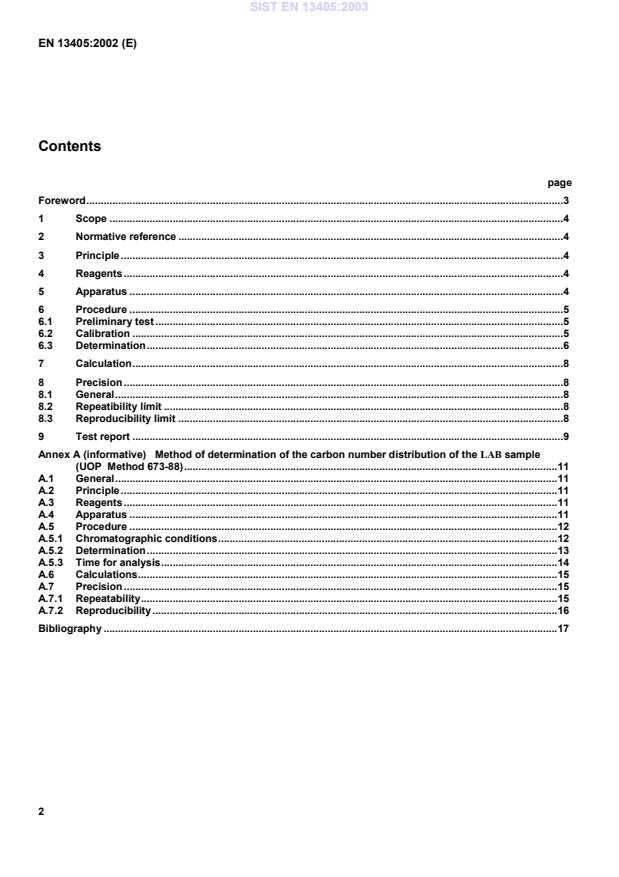
Method of determination of the carbon number distribution of the LAB sample(UOP
Method 673-88).11A.1General.11A.2Principle.11A.3Reagents.11A.4Apparatus.11A.5Procedure.12A.5.1Chromatographic conditions.12A.5.2Determination.13A.5.3Time for analysis.14A.6Calculations.15A.7Precision.15A.7.1Repeatability.15A.7.2Reproducibility.16Bibliography.17SIST EN 13405:2003
...