

SIST-TP IEC/TR 61000-5-3:2004
(Main)Electromagnetic compatibility (EMC) - Part 5-3: Installation and mitigation guidelines - HEMP protection concepts
General Information
- Abstract
This technical report provides elements for:[
]- the design of an adequate protection for civil facilities against the electromagnetic pulse due to a high altitude nuclear explosion, denoted in what follows by HEMP;[
]- the evaluation of already existing protections with respect to stresses imposed by HEMP;[
]- to compare the requirements of HEMP and lightning protection in order to show if they can be combined at low cost;[
]- to emphasise the differences between the requirements of HEMP and lightning protections in order to permit the evaluation of the consequences of HEMP when no additional measures are taken except existing lightning protection.
- Status
- Published
- Publication Date
- 31-Mar-2004
- Technical Committee
- EMC - Electromagnetic compatibility
- Current Stage
- 6060 - National Implementation/Publication (Adopted Project)
- Start Date
- 01-Apr-2004
- Due Date
- 01-Apr-2004
- Completion Date
- 01-Apr-2004

Overview
SIST-TP IEC/TR 61000-5-3:2004 is a technical report published by the International Electrotechnical Commission (IEC) that addresses key concepts for protecting civil facilities against High-Altitude Electromagnetic Pulse (HEMP). As part of the IEC 61000 family dedicated to electromagnetic compatibility (EMC), this document provides industry guidance on installation, evaluation, and cost-effective mitigation of HEMP impacts, especially where civil infrastructure may be exposed to such risks.
HEMP is a powerful electromagnetic disturbance caused by high-altitude nuclear explosions. With increasing reliance on sensitive electrical and electronic systems, robust HEMP protection concepts are critical for ensuring operational continuity and safety in civil installations.
Key Topics
Design of HEMP Protection
Guidelines to develop adequate HEMP protection measures for new and existing civil facilities. Emphasis is placed on combining building design elements, material selection, and installation practices that enhance immunity to electromagnetic pulses.Evaluation of Existing Protections
Tools and strategies for assessing whether current lightning and surge protection systems provide suitable defense against HEMP-induced disturbances, helping stakeholders identify potential vulnerabilities.Comparison with Lightning Protection
Analysis of similarities and differences between HEMP and lightning electromagnetic environments. The report examines circumstances where protection against both phenomena can be combined to optimize costs while maintaining safety.Zoning and Shielding
Recommendations concerning electromagnetic zoning within facilities, classification and use of shields (physical barriers, shielded rooms, and cables), as well as proper penetration protection at entry points to mitigate both radiated and conducted disturbances.Guidelines for Wiring and Installation
Best practices for entry-point protection, effective grounding, and wiring layouts (tree-shaped vs. mesh-shaped systems) to minimize field coupling and conducted interference.Protective Device Selection
Discussion around surge arresters, filters, shielding materials, and the coordination of protective devices. The standard outlines considerations for selecting appropriate protection in terms of voltage, current capacity, rise time, and compatibility with system requirements.
Applications
SIST-TP IEC/TR 61000-5-3:2004's protection concepts are particularly valuable for:
- Design and Upgrade of Civil Facilities: Architects, engineers, facility managers, and EMC specialists use these guidelines during both initial construction and retrofit projects to enhance HEMP resilience.
- Critical Infrastructure: Power utilities, telecom exchanges, transportation hubs, and data centers benefit from HEMP mitigation strategies to ensure continuous operation and prevent catastrophic disruptions.
- Risk Assessment and Compliance: The standard guides organizations in evaluating compliance with EMC and safety regulations and integrating HEMP protection into broader risk management frameworks.
- Combined Protection Solutions: Facilities seeking cost-effective approaches to manage both HEMP and lightning protection requirements can leverage the comparative analysis within the standard.
Related Standards
For comprehensive electromagnetic compatibility and HEMP protection, the following IEC standards and technical reports are closely related:
- IEC 61000-2-9, IEC 61000-2-10: HEMP environmental descriptions (radiated and conducted disturbances)
- IEC 61000-4-5: Testing and measurement techniques – Surge immunity test
- IEC 61000-4-24 and IEC 61000-4-25: Test methods for protective devices for HEMP
- IEC/TR 61000-5-4, IEC 61000-5-5: Specifications for protective devices against HEMP disturbances
- IEC 61312-1: General principles for lightning electromagnetic impulse protection
Implementing SIST-TP IEC/TR 61000-5-3:2004 alongside these related EMC standards enables organizations to build a layered, holistic approach to electromagnetic threat mitigation in civil environments.
Get Certified
Connect with accredited certification bodies for this standard

ANCE
Mexican certification and testing association.

Intertek Slovenia
Intertek testing, inspection, and certification services in Slovenia.

LNE (Laboratoire National de Métrologie et d'Essais)
French national laboratory for metrology and testing.
Sponsored listings
Frequently Asked Questions
SIST-TP IEC/TR 61000-5-3:2004 is a technical report published by the Slovenian Institute for Standardization (SIST). Its full title is "Electromagnetic compatibility (EMC) - Part 5-3: Installation and mitigation guidelines - HEMP protection concepts". This standard covers: This technical report provides elements for:[<BR>]- the design of an adequate protection for civil facilities against the electromagnetic pulse due to a high altitude nuclear explosion, denoted in what follows by HEMP;[<BR>]- the evaluation of already existing protections with respect to stresses imposed by HEMP;[<BR>]- to compare the requirements of HEMP and lightning protection in order to show if they can be combined at low cost;[<BR>]- to emphasise the differences between the requirements of HEMP and lightning protections in order to permit the evaluation of the consequences of HEMP when no additional measures are taken except existing lightning protection.
This technical report provides elements for:[<BR>]- the design of an adequate protection for civil facilities against the electromagnetic pulse due to a high altitude nuclear explosion, denoted in what follows by HEMP;[<BR>]- the evaluation of already existing protections with respect to stresses imposed by HEMP;[<BR>]- to compare the requirements of HEMP and lightning protection in order to show if they can be combined at low cost;[<BR>]- to emphasise the differences between the requirements of HEMP and lightning protections in order to permit the evaluation of the consequences of HEMP when no additional measures are taken except existing lightning protection.
SIST-TP IEC/TR 61000-5-3:2004 is classified under the following ICS (International Classification for Standards) categories: 33.100.01 - Electromagnetic compatibility in general. The ICS classification helps identify the subject area and facilitates finding related standards.
SIST-TP IEC/TR 61000-5-3:2004 is available in PDF format for immediate download after purchase. The document can be added to your cart and obtained through the secure checkout process. Digital delivery ensures instant access to the complete standard document.
Standards Content (Sample)
SLOVENSKI SIST-TP IEC/TR 61000-5-3:2004
STANDARD
april 2004
Electromagnetic compatibility (EMC) - Part 5-3: Installation and mitigation
guidelines - HEMP protection concepts
ICS 33.100.01 Referenčna številka
© Standard je založil in izdal Slovenski inštitut za standardizacijo. Razmnoževanje ali kopiranje celote ali delov tega dokumenta ni dovoljeno
RAPPORT CEI
TECHNIQUE IEC
TR 61000-5-3
TECHNICAL
Première édition
REPORT
First edition
1999-07
PUBLICATION FONDAMENTALE EN CEM
BASIC EMC PUBLICATION
Compatibilité électromagnétique (CEM) –
Partie 5-3:
Guides d'installation et d'atténuation –
Concepts de protection IEMN-HA
Electromagnetic compatibility (EMC) –
Part 5-3:
Installation and mitigation guidelines –
HEMP protection concepts
IEC 1999 Droits de reproduction réservés Copyright - all rights reserved
Aucune partie de cette publication ne peut être reproduite ni No part of this publication may be reproduced or utilized in
utilisée sous quelque forme que ce soit et par aucun procédé, any form or by any means, electronic or mechanical,
électronique ou mécanique, y compris la photo-copie et les including photocopying and microfilm, without permission in
microfilms, sans l'accord écrit de l'éditeur. writing from the publisher.
International Electrotechnical Commission 3, rue de Varembé Geneva, Switzerland
Telefax: +41 22 919 0300 e-mail: inmail@iec.ch IEC web site http://www.iec.ch
CODE PRIX
Commission Electrotechnique Internationale
X
PRICE CODE
International Electrotechnical Commission
Pour prix, voir catalogue en vigueur
For price, see current catalogue
TR 61000-5-3 © IEC:1999 – 3 –
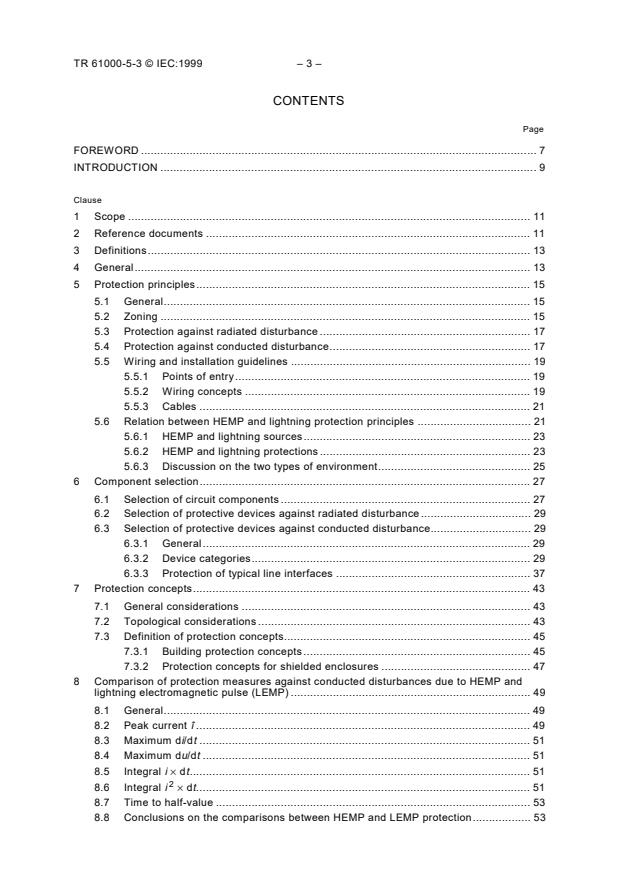
CONTENTS
Page
FOREWORD . 7
INTRODUCTION .9
Clause
1 Scope . 11
2 Reference documents . 11
3 Definitions. 13
4 General. 13
5 Protection principles. 15
5.1 General. 15
5.2 Zoning . 15
5.3 Protection against radiated disturbance . 17
5.4 Protection against conducted disturbance. 17
5.5 Wiring and installation guidelines . 19
5.5.1 Points of entry. 19
5.5.2 Wiring concepts . 19
5.5.3 Cables . 21
5.6 Relation between HEMP and lightning protection principles . 21
5.6.1 HEMP and lightning sources. 23
5.6.2 HEMP and lightning protections . 23
5.6.3 Discussion on the two types of environment. 25
6 Component selection. 27
6.1 Selection of circuit components . 27
6.2 Selection of protective devices against radiated disturbance . 29
6.3 Selection of protective devices against conducted disturbance. 29
6.3.1 General. 29
6.3.2 Device categories. 29
6.3.3 Protection of typical line interfaces . 37
7 Protection concepts. 43
7.1 General considerations . 43
7.2 Topological considerations . 43
7.3 Definition of protection concepts. 45
7.3.1 Building protection concepts . 45
7.3.2 Protection concepts for shielded enclosures . 47
8 Comparison of protection measures against conducted disturbances due to HEMP and
lightning electromagnetic pulse (LEMP) . 49
8.1 General. 49
8.2 Peak current î . 49
8.3 Maximum di/dt . 51
8.4 Maximum du/dt . 51
8.5 Integral i × dt. 51
8.6 Integral i × dt. 51
8.7 Time to half-value . 53
8.8 Conclusions on the comparisons between HEMP and LEMP protection. 53
TR 61000-5-3 © IEC:1999 – 5 –
Page
Annex A Early-time HEMP and lightning radiated environments. 55
Annex B Arrangement showing the use of a distribution transformer with a primary delta
winding . 75
Annex C Transmission characteristics of protective measures . 77
Figure 1 – Example of penetration of radiated and conducted disturbances through
a two-barrier protection. . 15
Figure 2 – Voltage and current flowing through a gas arrester during a surge event. 19
Figure 3 – Concepts for wiring systems. 21
Figure 4 – Typical protection circuit. 35
Figure 5 – Solution to prevent surge current from radiating into protected area. 53
Table 1 – Building protection concepts. 45
Table 2 – Protection concepts for shielded enclosures . 47
Table 3 – Lightning and HEMP current waveforms which can be used for tests. 49
TR 61000-5-3 © IEC:1999 – 7 –
INTERNATIONAL ELECTROTECHNICAL COMMISSION
____________
ELECTROMAGNETIC COMPATIBILITY (EMC) –
Part 5-3: Installation and mitigation guidelines –
HEMP protection concepts
FOREWORD
1) The IEC (International Electrotechnical Commission) is a worldwide organization for standardization comprising
all national electrotechnical committees (IEC National Committees). The object of the IEC is to promote
international co-operation on all questions concerning standardization in the electrical and electronic fields. To
this end and in addition to other activities, the IEC publishes International Standards. Their preparation is
entrusted to technical committees; any IEC National Committee interested in the subject dealt with may
participate in this preparatory work. International, governmental and non-governmental organizations liaising
with the IEC also participate in this preparation. The IEC collaborates closely with the International Organization
for Standardization (ISO) in accordance with conditions determined by agreement between the two
organizations.
2) The formal decisions or agreements of the IEC on technical matters express, as nearly as possible, an
international consensus of opinion on the relevant subjects since each technical committee has representation
from all interested National Committees.
3) The documents produced have the form of recommendations for international use and are published in the form
of standards, technical reports, technical specifications or guides and they are accepted by the National
Committees in that sense.
4) In order to promote international unification, IEC National Committees undertake to apply IEC International
Standards transparently to the maximum extent possible in their national and regional standards. Any
divergence between the IEC Standard and the corresponding national or regional standard shall be clearly
indicated in the latter.
5) The IEC provides no marking procedure to indicate its approval and cannot be rendered responsible for any
equipment declared to be in conformity with one of its standards.
6) Attention is drawn to the possibility that some of the elements of this technical report may be the subject of
patent rights. The IEC shall not be held responsible for identifying any or all such patent rights.
The main task of IEC technical committees is to prepare International Standards. However, a
technical committee may propose the publication of a technical report when it has collected
data of a different kind from that which is normally published as an International Standard, for
example "state of the art".
Technical reports do not necessarily have to be reviewed until the data they provide are
considered to be no longer valid or useful by the maintenance team.
IEC 61000-5-3, which is a technical report, has been prepared by subcommittee 77C: Immunity
to high altitude nuclear electromagnetic pulse (HEMP), of IEC technical committee 77:
Electromagnetic compatibility.
It has the status of a basic EMC publication in accordance with IEC Guide 107.
The text of this technical report is based on the following documents:
Enquiry draft Report on voting
77C/58/CDV 77C/69/RVC
Full information on the voting for the approval of this technical report can be found in the report
on voting indicated in the above table.
This publication has been drafted in accordance with the ISO/IEC directives, Part 3.
This document, which is purely informative is not to be regarded as an International Standard.
TR 61000-5-3 © IEC:1999 – 9 –
INTRODUCTION
IEC 61000-5 is a part of the IEC 61000 series, according to the following structure:
Part 1: General
General considerations (introduction, fundamental principles)
Definitions, terminology
Part 2: Environment
Description of the environment
Classification of the environment
Compatibility levels
Part 3: Limits
Emission limits
Immunity limits (in so far as these limits do not fall under the responsibility of the product
committees)
Part 4: Testing and measurement techniques
Measurement techniques
Testing techniques
Part 5: Installation and mitigation guidelines
Installation guidelines
Mitigation methods and devices
Part 6: Generic standards
Part 9: Miscellaneous
TR 61000-5-3 © IEC:1999 – 11 –
ELECTROMAGNETIC COMPATIBILITY (EMC) –
Part 5-3: Installation and mitigation guidelines –
HEMP protection concepts
1 Scope
This part of IEC 61000 defines and gives information on protection concepts against
electromagnetic pulse due to a high altitude nuclear explosion (denoted in what follows by the
abbreviation HEMP).
The aim of this technical report is to provide elements for
– the design of an adequate protection for civil facilities against HEMP;
– the evaluation of already existing protections with respect to stresses imposed by HEMP;
– the comparison of the requirements of HEMP and lightning protection in order to show if
they can be combined at low cost;
– an emphasis of the differences between the requirements of HEMP and lightning protection
in order to permit an evaluation of the consequences of HEMP when no additional
measures are taken beyond existing lightning protection.
2 Reference documents
IEC 60050(161):1990, International Electrotechnical Vocabulary (IEV) – Chapter 161:
Electromagnetic compatibility
IEC 60060-2:1994, High voltage test techniques – Part 2: Measuring systems
IEC 60099-1:1991, Surge arresters – Part 1: Non-linear resistor type gapped arresters for a.c.
systems
IEC 61000-2-9:1996, Electromagnetic compatibility (EMC) – Part 2: Environment – Section 9:
Description of HEMP environment – Radiated disturbance. Basic EMC publication
IEC 61000-2-10:1998, Electromagnetic compatibility (EMC) – Part 2-10: Environment –
Description of HEMP environment – Conducted disturbance. Basic EMC publication
IEC 61000-2-11, Electromagnetic compatibility (EMC) – Part 2-11: Environment – Description
1)
of HEMP environment – Classification of HEMP environments
IEC 61000-4-5:1995, Electromagnetic compatibility (EMC) – Part 4: Testing and measurement
techniques – Section 5: Surge immunity test
___________
1)
To be published.
TR 61000-5-3 © IEC:1999 – 13 –
IEC 61000-4-23, Electromagnetic compatibility (EMC) – Part 4-23: Testing and measurement
techniques – Test methods for protective devices for HEMP and other radiated disturbance.
1)
Basic EMC publication
IEC 61000-4-24:1997, Electromagnetic compatibility (EMC) – Part 4: Testing and measurement
techniques – Section 24: Test methods for protective devices for HEMP conducted
disturbances. Basic EMC publication.
IEC 61000-4-25, Electromagnetic compatibility (EMC) – Part 4-25: Testing and measurement
techniques – HEMP requirements and test methods for equipment and systems. Basic EMC
1)
Publication
IEC/TR 61000-5-4:1996, Electromagnetic compatibility (EMC) – Part 5: Installation and
mitigation guidelines – Section 4: Immunity to HEMP – Specification for protective devices
against HEMP radiated disturbance. Basic EMC Publication
IEC 61000-5-5:1996, Electromagnetic compatibility (EMC) – Part 5: Installation and mitigation
guidelines – Section 5: Specification of protective devices for HEMP conducted disturbance.
Basic EMC Publication
IEC 61312-1:1995, Protection against lightning electromagnetic impulse – Part 1: General
principles
3 Definitions
For the purpose of this technical report, the definitions of IEC 60050(161) together with the
following definitions apply.
3.1
electromagnetic barrier
topologically closed surface made to prevent or limit EM fields and conducted transients from
entering the enclosed space. The barrier consists of the shield surface and points-of-entry
treatments and encloses the protected volume
3.2
penetration
transfer of electromagnetic energy through an electromagnetic barrier from one volume to
another. This can take place in different ways: by diffusion through the barrier, through
apertures and through conductors connecting the two volumes (wires, cables, conduits, pipes,
ducts, etc.)
4 General
The subject of HEMP is covered from an environmental point of view in clause 3 of
IEC 61000-2-9 and IEC 61000-2-10.
The discussion of the protection concepts refers to shielding procedures for buildings,
equipments and connections between them (transmission lines and cables). The term
"shielding" is used here in its more general sense, i.e. cages, cabinets, shielded cables,
filtering and surge suppressors.
___________
1)
To be published.
TR 61000-5-3 © IEC:1999 – 15 –
5 Protection principles
5.1 General
This subclause deals with general protection principles that can be applied to most of the
protection concepts as defined in clause 7.
In protected areas (buildings, installations, systems or equipment), two main sources of
disturbance – direct electromagnetic radiation (radiated disturbance) and conducted pene-
tration of voltage and current surges (conducted disturbance) – are foreseen (see figure 1).
E, H
E H
st
1st barrier
1 barrier
(building)
E, H (shielding)
E H
2nd band rrier
2 barrier
(shielding)
(shielding)
EquiEquipmpmentent
Conducted penetration with
Conducted penetration with
lightning protection
lightning protection
EMI protection
EMI protection
Lightning
IEC 801/99
& EMI protection
Figure 1 – Example of penetration of radiated and conducted disturbances
through a two-barrier protection
This figure shows an example of an installation protected by two barriers. The radiated
disturbance may be attenuated by construction elements of buildings (concrete, rebars and
other metal parts, etc.) or by metal shields installed specifically for this purpose. Protection
against conducted disturbances penetrating via incoming and outgoing lines may be achieved
by momentarily short-circuiting the line to the shield, by frequency bandwidth limitation or by
combinations of both (e.g. surge protectors plus filters). Very often, such protection already
exists in many buildings against lightning. As discussed below, a check shall be performed to
decide if the lightning protection complies at least partially with the needs for protection against
HEMP. Surge protectors are extremely non-linear elements. Below a certain voltage, their
resistance is in the megohm range but during conduction it may be down to less than 1 mΩ.
Their effectiveness cannot therefore be expressed in decibels or directly compared to shield
effectiveness. The insertion loss of a line filter and the radiation attenuation of a shield also
describe two completely different items. Nevertheless, it should be noted that, when the
residual voltage (or energy) on a line in the protected area is comparable to the voltage (or
energy) that can be induced on the line by fields penetrating the shield, further reduction of the
conducted voltage (or energy) will not be very beneficial.
5.2 Zoning
In a spatially extended system, it may be advisable to define zones of different disturbance
levels. One reason for this may be that parts of the system are not essential and therefore do
not need to be protected, or that some parts of the system are not as susceptible as others.
Correct zoning implies that sufficient penetration protection be applied to make the residual
conducted disturbance comparable to the radiated disturbance within a zone, so that
conducted interference is not a dominant disturbance within the zone. A definition of zoning
and a classification of protection zones from an EMC point of view is given in 5.2 of
IEC 61000-5-6. This comparison can be performed only by comparing the susceptibility of a
TR 61000-5-3 © IEC:1999 – 17 –
given equipment to each kind of disturbance. The susceptibility of the equipment can be
determined by specific tests described in IEC 61000-4-25, but the comparison is not
straightforward because the equipment can be more or less susceptible to one type of
disturbance.
The boundary of a zone is defined by a mechanical structure (concrete building wall, rebar
structure or solid metal shield) that has a certain radiation attenuation whose magnitude as a
function of the degree of protection is defined in clause 7. Lines penetrating zone boundaries
shall be protected against conducted disturbance at every point of entry. If a line penetrates
several boundaries, the protective devices shall be coordinated as described in 6.3.3.6. In
imperfect shields, i.e. shields with an average attenuation of less than 40 dB from about
14 kHz to 1 GHz (see also IEC 61000-5-4), special care shall be taken that shield currents do
not radiate into the zone and do not produce inductive voltage drops between the different
points of entry. In such a case, it is advisable to have only one point of entry (single point
entry) per zone.
5.3 Protection against radiated disturbance
One function of a shield is to attenuate free-field radiation and to prevent radiation from line
currents and shield currents from entering the protected area. This is an important issue for
imperfect shields. Mechanical structures such as concrete walls, rebar meshes and metallic
structural elements may contribute to the total field attenuation if properly integrated in a multi-
shield concept. Optimal use of these structures can only be made if each shield is spatially
separated from each other and penetrating lines (and ground connections) enter the shields
only at one point per shield. Only by this means can line currents be prevented from flowing
into and across protected areas (see figure 1).
5.4 Protection against conducted disturbance
Protective devices shall fulfil two often contradictory requirements. During a surge event
(lightning or HEMP) they shall protect the connected equipment either by insulating the
longitudinal path or by short-circuiting the transversal path. In the absence of a surge, they
should influence the normal operation of the equipment as little as possible. The transition
between the two stages should happen within a few nanoseconds or less.
A surge event in a protective device can be described in terms of voltage or current as a
function of time. Figure 2 shows an example using a gas arrester. During the first phase, as
the voltage rises, the (primary) protection element is still in its insulating state. In this phase,
no significant current flows through the device and the event can be treated considering only
the breakdown voltage of the dielectric material of the protection element. It is only when the
voltage reaches the breakdown or limiting level that a current starts to flow through the
protection element and that the thermal process described in terms of action, i.e. proportional
t
f
to i dt , shall be taken into account,
∫
t
i
t being the initial time of the phenomenon, and
i
t being the final time of the phenomenon.
f
Prior to choosing protective devices, the following questions shall be answered:
– how often do disturbances (lightning) occur?
– which surge parameters are expected (from lightning and HEMP)?
– what is the maximum residual voltage for each waveform that the equipment connected at
the interface can withstand?
TR 61000-5-3 © IEC:1999 – 19 –
– what is the function of the connected equipment or interface?
which parasitic characteristics (longitudinal impedance, insertion loss, capacity, etc.) of the
protective device are allowed that do not disturb normal operation ?
U
U max
U
du max
U
du
dt
dt
max
max
t
t
I
max
I
I max
I
di
di
ddtt
maxmax
t
t
IEC 802/99
Figure 2 – Voltage and current flowing through a gas arrester during a surge event
As different protective devices may function in different ways, the requirements or
specifications for each device type shall be formulated in a manner appropriate to its
functioning. For instance, it would not make sense to require a specific firing voltage for a
varistor or a minimum energy absorbance for a gas arrester.
5.5 Wiring and installation guidelines
5.5.1 Points of entry
With multiple points of entry into an imperfect shield, inductive voltage drops caused by
surge currents flowing on the shield may couple into the protected area and thus by-pass the
conducted protective measures. Multiple grounding points inside an imperfect shield increase
common mode coupling of the remaining radiation field to the system. It is therefore advan-
tageous to have a single entry point for all cables. This means that all protective measures for
penetrating cables should be located on the shield and as close together as possible. This also
means that ground potential for all equipment within the protected area should be taken
exclusively from the location of the single entry point. In 5.6 it is assumed that only a single
point entry and single point grounding are used, and that the equipment housings are insulated
from the building (rebars, metallic construction parts, etc.).
5.5.2 Wiring concepts
Two basic concepts for wiring between the point of entry and the internal equipment are shown
in figures 3a and 3b.
In a mesh-shaped wiring system (see figure 3a), the shield’s internal connections can be
installed arbitrarily, permitting induction loops. Penetrating fields induce voltages and currents
in wiring loops that may affect the system. Therefore, this concept should only be used with
nearly perfect shields where field intensities are low and/or with shielded cables or shielded
cable ducts. It should be noted, however, that large loops may lead to mutual interference
between equipment in a shielded enclosure.
TR 61000-5-3 © IEC:1999 – 21 –
A tree-shaped wiring system (see figure 3b) contains only loops with a very small area. The
penetrating field may induce only common-mode signals to which the system is less
susceptible (the signals on the lines and on the system ground are of the same magnitude and
phase). This wiring concept is preferably used within low attenuation shields. If high quality
shielded cables and/or metal cable ducts are used, the requirement for shield attenuation may
be further reduced.
Shield
shield
Single point
single point
entry
entry
Equipment
equipm.
IEC 803/99
Figure 3a - Mesh-shaped wiring system
shield
Shield
Single point
single point
entry
entry
Equipment
equipm.
IEC 804/99
Figure 3b – Tree-shaped wiring system
Figure 3 – Concepts for wiring systems
5.5.3 Cables
If shielded cables or shielded cable ducts are used, the shields shall be interconnected
between the sections, whether they are in a tree- or mesh-shaped configuration. The
equipment chassis shall also be connected to the shields of the cables. It is highly advisable to
implement the concept of shielding continuity, i.e. to use good quality connectors for the entry
points of the cables into the equipment and to avoid pigtails which are, in practice, ineffective
from an EMC point of view. The pigtails can provide only a protection for persons in case of
short circuits of the mains (at power frequency 50 Hz or 60 Hz) to a cable sheath.
5.6 Relation between HEMP and lightning protection principles
From the source point of view, lightning and HEMP are quite different but the radiated and
conducted environments produced by the two phenomena are very similar. Thus, HEMP
protection principles for civil applications shall take advantage of already installed lightning
protection. The designer of the HEMP protection shall estimate if, by admitting a certain risk,
the lightning protection can also be considered to be sufficient against HEMP as well. The aim
of this subclause is to discuss basic features of the HEMP and lightning environments in order
to define a strategy for protecting the equipment.
TR 61000-5-3 © IEC:1999 – 23 –
5.6.1 HEMP and lightning sources
The sources of lightning effects are the first and subsequent return stroke currents. These
currents may directly hit a line, an equipment, an installation or a building and, as such,
represent the primary lightning conducted environment. If the lightning does not hit parts of the
installation directly, then the lightning current produces an electromagnetic field which
represents a radiated lightning environment. This field will induce voltages and currents in
nearby circuits, producing a secondary lightning conducted environment.
The primary source of effects from HEMP is the radiated electromagnetic field which, by
coupling to transmission lines or to different kinds of circuits, produces the voltages and
currents representing the HEMP conducted environment.
5.6.2 HEMP and lightning protections
The protection concepts for HEMP and for lightning are not the same. Different approaches
are used for radiated and conducted environments.
5.6.2.1 Radiated environment
As covered in clause 7, the attenuation capability of a shielded room should be suitable to
protect the vital equipment against HEMP. Shielded enclosures are not normally used for
protection against lightning radiated electromagnetic fields, except perhaps for very particular
cases, but advantage is taken from the attenuation offered by the metallic structures of the
buildings. Advantage is also taken from shielded cables between two sets of equipment
installed for EMC purposes to provide protection against lightning electromagnetic fields.
5.6.2.2 Conducted environment
5.6.2.2.1 Early- and intermediate-time HEMP
Systematic protection against the lightning primary or secondary conducted environment (see
5.6.1) is installed on low- or medium-voltage power supply or telecommunication lines at entry
points of many buildings. This protection is more common for aerial lines and also for rural
environments. As discussed below, lightning protection employing SPDs (surge protection
devices) can provide some protection against early – and intermediate – time HEMP effects.
5.6.2.2.2 Late-time HEMP
Problems due to late-time HEMP can arise only on long lines (at least 1 km), if both ends of
the line are grounded (e.g. power distribution lines with grounded transformer windings). For
long low voltage lines (such as a communication line) that happen to have a single-point
ground, outages can take place if the voltage induced by the late-time HEMP (40 V/km,
according to IEC 61000-2-10) exceeds the limiting voltage of the arrestors between the line
and the ground. For power transmission or distribution lines, where the operating voltages are
much larger than for communication lines, such arrestor damage is unlikely. However, if the
power line is grounded at two points through transformers or other equipment, a short-circuit
current of about 16 A could flow into connected equipment, according to IEC 61000-2-10.
These currents will essentially give rise to saturation effects in the core of transformers
connected at the two ends of the connection. Therefore, protection concepts against late-time
TR 61000-5-3 © IEC:1999 – 25 –
HEMP induced currents can make use of distribution transformers with at least one delta
winding at the two ends of the connection. In this case, the windings are not grounded and
there is no closed path for the d.c. currents. This concept is illustrated in annex B. More
detailed and practical arrangements for this situation will be given in a future document
dedicated to installation and mitigation guidelines.
5.6.3 Discussion on the two types of environment
Typical lightning radiated and conducted environments have been chosen for comparison with
the HEMP environments, as defined in IEC 61000-2-9 and IEC 61000-2-10. The criteria for this
choice of lightning electromagnetic field are as follows:
a) to be at a distance from the lightning stroke which is not too near to represent a low
probability and not too far to have negligible indirect effects. Distances between 100 m and
1 km have been chosen. The criteria for this choice are discussed in annex A.
b) to have lightning current peak values for the first and subsequent return strokes that
correspond to protection level II which is the average level defined in IEC 61312-1.
It should be noted that these peak values (150 kA for the first stroke and 37,5 kA for the
subsequent strokes) are higher than the statistical average peak values obtained from natural
lightning current measurements.
The curves used to perform this comparison are provided in annex A.
5.6.3.1 Radiated environment
The significant frequency content of the HEMP electric field extends up to at least 100 MHz
and the field spectrum for the first and subsequent lightning strokes does not have significant
values for frequencies larger than 1 MHz for the first stroke and 5 MHz for the subsequent
strokes. This different frequency content is not important with respect to the external field
penetration through the shield because the quality of the materials used for shielding is not
very different at 1 MHz or at 100 MHz, but differences in the internal environment can occur
due to cavity resonances inside the room causing higher stresses than those due to lightning.
At low frequency, however, the higher amplitude of the lightning magnetic field can be
important because the shielding properties for low frequency magnetic fields of all materials,
except special ones like permalloy, are very poor.
The energy content of the HEMP and lightning electric (and magnetic) fields is not very
different. Using the expression for W introduced in IEC 61000-2-9, one finds that, for the
f
HEMP electric field, W = 0,114 J/m .
f
For a lightning stroke at a distance of 600 m (see the criteria defined in annex A): for the first
2 2
lightning return stroke, W ≈ 0,15 J/m and for the subsequent stroke, W ≈ 0,04 J/m . At a
f f
2 2
distance of 100 m, the values for the first return stroke are 5 J/m to 6 J/m and for the
2 2
subsequent stroke 1 J/m to 1,5 J/m , however, the probability of lightning strokes at distances
of 100 m or less from a building is very low.
For cases in which buildings have little or no electromagnetic shielding capability, the radiated
environment inside the building from both HEMP and lightning can be important. In such
cases, braided shields for cables can be effective, reducing the coupling inside the cables up
to 20 MHz to 30 MHz.
TR 61000-5-3 © IEC:1999 – 27 –
5.6.3.2 Conducted environment
5.6.3.2.1 Early-time HEMP
The amplitude of the primary lightning conducted environment (direct lightning currents, from
first or subsequent return strokes) is one to two orders of magnitude higher than the early-time
HEMP, for a 99 % severity environment. The secondary environment (induced lightning
currents, for a lightning stroke at 100 m distance) is more or less of the same order of
magnitude as the early-time HEMP conducted environment. The du/dt ratio is about one order
of magnitude higher for HEMP-induced currents than for lightning (see also 8.4).
The comparison between energies dissipated in gas discharge tubes (see annex A) shows
that:
– for HEMP peak currents of 4 kA, the energy is equal to W = 0,7 mJ;
t
– for a lightning current of 25 kA peak value and having a 8/20 μs waveshape, the energy is
equal to W ≈12 J.
t
5.6.3.2.2 Intermediate-time HEMP
The intermediate-time HEMP conducted environment as defined in IEC 61000-2-10 is a current
with a maximum peak value of 800 A, a rise time of 25 μs and a time to half-value of 1 500 μs.
Such a wave is similar to the 10/700 μs wave, (minimum test level 100 A) given by the test
generator according to ITU and described in IEC 61000-4-5. It is also situated between
the standard current wave for protection element tests 8/20 μs, 250 A to 2 kA given in
IEC 61000-4-5 and the IEC 60060-2 switching test surge of 250/2 500 μs. This means that the
different protection elements used in the various cases for which these specific tests are
foreseen shall also cover this situation.
It should be noted, however, that definitions of rise time for these waveforms are different (see
IEC 61000-4-5). For the test surge 250/2 500 μs, the rise time is defined from zero to the peak
of the voltage curve.
6 Component selection
6.1 Selection of circuit components
This clause helps choose the right (non-protective) circuit components for new developments
and/or judge the susceptibility of existing circuits and equipment.
The use of fibre optic, hydraulic or mechanical transmissions, especially at the circumference
of the system, may reduce the volume to be protected and may prevent interface problems.
Classification of HEMP-induced effects:
– short-time interference with no lasting damage. Be sure that the systems resets itself
automatically. Thermal destruction as a secondary effect of a latch-up is possible;
– permanent degradation or destruction of circuit components. Semiconductor components
with higher breakthrough voltages withstand higher disturbance levels. Voltage break-
throughs may occur on signal inputs of semiconductors and also over the supply voltage of
the circuit. In the latter case, any semiconductor within the equipment may be destroyed.
TR 61000-5-3 © IEC:1999 – 29 –
Breakthrough voltages shall be chosen such that the supply voltage of the circuit may
temporarily be increased by at least 30 % without endangering the components. Supply
voltages should be clamped by zener diodes or avalanche-junction transient voltage
suppressors. Destruction because of a voltage breakthrough may be avoided if the follow-
on current can be limited to a sufficiently low value.
6.2 Selection of protective devices against radiated disturbance
The shielding effectiveness of shielded enclosures is violated by penetrations, openings and
seams. The material and protective devices used for the construction of Faraday cages,
cabinets and shielded buildings are described in IEC 61000-5-4, which gives their principles of
operation, their limitations and a listing of the necessary specifications.
6.3 Selection of protective devices against conducted disturbance
6.3.1 General
The information given in this subclause shall help in the selection of optimal protective devices
for specific applications. For additional information on device specification and test methods,
reference is made to IEC 61000-5-5 and IEC 61000-4-24. Although the present technical report
does not suggest that only IEC-specified devices shall be used for HEMP protection, the use of
IEC specifications may significantly facilitate the selection of devices.
6.3.2 Device categories
6.3.2.1 General
In this subclause, the most important protective element categories are described, using the
following format: functional description, special features, possible application-related problems
and typical applications. For additional information see annexes A, C and E of IEC 61000-5-5.
6.3.2.2 Gas discharge tubes
Gas discharge tubes usually contain two or three electrodes separated by one or several gaps.
They are hermetically sealed so that the gas mixture and pressure are under control. As long
as the voltage across a gap is smaller than its sparkover voltage, the gap insulating resistance
is in the range of several 100 MΩ to more than 1 GΩ. At sparkover voltage, the free electrons,
accelerated by the electric field, ionize some of the gas atoms which, in turn, contribute more
charge carriers to the current path. An avalanche effect breaks down the insulating resistance
of the gap to less than 1 mΩ, usually within less than 1 ns. The sparkover voltage of a 230 V
gas discharge tube at 1 kV/ns is typically about 8 to 15 times higher than for d.c. voltage. After
a recovery time in the micro- to millisecond range (depending on the current-time characteristic
of the surge event), the insulation resistance returns to its initial state.
The main features of gas discharge tubes are a high insulating resistance and a low capacity,
in the non-conducting state, and a high current-carrying capability compared to their size and
cost, in the conducting state.
Problems may arise if the continuous operating voltage of the circuit is higher than the hold-
over voltage of the gas discharge tube. In this case, the gas discharge tube may not return to
its original state, but may remain in its low impedance state after the passage of the surge.
This may result in the destruction of the arrester.
TR 61000-5-3 © IEC:1999 – 31 –
Gas discharge tubes are typically used as primary protection elements on telephone subscriber
lines, in protection circuits, in safety arresters and as sole protection elements in r.f. coaxial
circuits, where their low capacity and linear characteristic in the non-conducting state are
particularly advantageous. Because of hold-over problems, they are not suited for use on a.c.
power lines, unless clearing action is assured by a series resistance or a series varistor (as
used in non-linear resistor type arresters and safety arresters).
6.3.2.3 Metal oxide varistors (MOV)
Metal oxide varistors are non-linear elements made of a sintered mixture of zinc oxide and other
metal oxides. With respect to the main current path, the sintered particles form an aggregate of
series- and parallel-connected micro-varistors. Thus the length (or the thickness) of the varistor
body accounts for the varistor voltage and the width (diameter) for the current carrying-capability.
Its volume is roughly proportional to the energy absorbance capability required for the envisaged
application. The U/I characteristic of a varistor can be described by:
a
×
I = k U
where k is a constant, depending on the geometry of the varistor and a is a non-linearity
exponent (typical value: 35-50).
The main feature of metal oxide varistors is the combination of a high current-carrying
capability and a good voltage-limiting action at a relatively low cost. As they have no break-
down characteristic, they are especially suited for use as primary and secondary protection
elements on a.c. power lines.
As metal oxide varistors tend to lower their 1 mA point as a consequence of their energy
absorption history, their varistor voltage (voltage at 1 mA) shall be chosen very carefully with
respect to the maximum operating voltage (see also 6.3.3.5).
6.3.2.4 Non-linear resistor type arresters
According to definition 2.2. of IEC 60099-1, non-linear resistor type arresters are combinations
of multiple spark gaps and non-linear resistors in series connection. The spark gaps provide a
high insulation resistance in the off-state and the non-linear resistors limit the follow-on current
out of the power supply voltage. Non-linear resistor type arresters are mainly used on a.c.
power circuits for 120 V or higher. After the passage of a surge current, the arrester returns to
its original state when the supply voltage passes through zero.
6.3.2.5 Avalanche-junction transient voltage suppressors (protective diodes)
These suppressors are semiconductor diodes that suppress transient voltages in either the
forward or reverse direction of their voltage-current characteristic. Their main feature is a high
non-linearity exponent a, close to 100 (see also 6.3.2.3). They differ from metal oxide varistors
in that their voltage-current characteristic does not change as a consequence of energy
absorption history (although there is a dependence on temperature).
Typical applications are in input and output circuits for short lines and for protection of d.c.
power supply voltages in the range between 6 V and 250 V. Low capacitance versions
(C = approximately 50 pF) may be used in r.f. circuits.
TR 61000-5-3 © IEC:1999 – 33 –
6.3.2.6 Filters
Although most filters may not be regarded as a complete protection against HEMP-induced
disturbance, they are often used in HEMP protection together with voltage-breakdown and
voltage-limiting devices. In this combination, they integrate and thus attenuate the residual
voltage pulses passing by the primary protection elements. Additionally, they may be used to
provide decoupling between the primary and secondary protection elements. They also prevent
currents in penetrating wires from entering inside the shielded volume.
As HEMP-induced voltages ar
...