

SIST EN ISO 4254-7:2018/A1:2026
(Amendment)Agricultural machinery - Safety - Part 7: Combine harvesters, forage harvesters, cotton harvesters and sugar cane harvesters - Amendment 1 (ISO 4254-7:2017/Amd 1:2025)
- Status
- Published
- Public Enquiry End Date
- 31-Dec-2022
- Publication Date
- 27-May-2026
- Technical Committee
- IMKG - Machinery for agriculture and forestry
- Current Stage
- 6060 - National Implementation/Publication (Adopted Project)
- Start Date
- 27-May-2026
- Due Date
- 01-Aug-2026
- Completion Date
- 28-May-2026
- Directive
- 2006/42/EC - Directive 2006/42/EC of the European Parliament and of the Council of 17 May 2006 on machinery, and amending Directive 95/16/EC (recast)OJ Ref: L 7.9.2026 OJ Date: 07-Sep-2026

SIST EN ISO 4254-7:2018/A1:2026 is the Slovenian adoption of EN ISO 4254-7:2017/A1:2026, based on ISO 4254-7:2017/Amd 1:2025. It updates the safety requirements for combine harvesters, forage harvesters, cotton harvesters and sugar cane harvesters, with particular focus on crop-flow-system hazards, operator controls and maintenance access. Manufacturers, designers, safety engineers and conformity assessors use it to apply the same safety rules to these machines.
What does SIST EN ISO 4254-7:2018/A1:2026 specify?
SIST EN ISO 4254-7:2018/A1:2026 specifies Amendment 1 to the European standard for agricultural machinery safety in Part 7. The amendment changes the safety provisions for the machines named in the title and adds EU-relevant correspondence in Annex ZA.
The document is organized as an amendment to EN ISO 4254-7:2017, with:
- a European foreword
- updated Clause 2 on normative references
- changes in Clause 6, including 6.2.8, 6.3, 6.4 and renumbering of 6.5
- informative Annex ZA on the relationship with Directive 2006/42/EC
| Annex | What it covers |
|---|---|
| ZA | Relationship between this European Standard and the essential requirements of Directive 2006/42/EC aimed to be covered |
What are the key requirements of SIST EN ISO 4254-7:2018/A1:2026?
SIST EN ISO 4254-7:2018/A1:2026 tightens the control of hazardous rotating parts in the crop flow system and links the safety requirements to operator presence, machine motion and maintenance modes. In practice, the amendment is about preventing feed into dangerous moving parts, stopping rotation quickly enough, and making any maintenance mode deliberate and visible.
Clause 2 - Normative references
Clause 2 replaces the list of referenced standards. The amendment points users to documents on operator manuals, control symbols, seat belts, general machinery safety, noise measurement, seat index point, grain tank capacity, audible travel alarms, auto-guidance safety, safety signs, risk assessment and operator controls. This matters because compliance now depends on those external methods and formats.
Clause 6.2.8 - infeed and cutterhead sequencing
Clause 6.2.8 adds a rule that the infeed drive cannot be engaged before the cutterhead drive is engaged. That prevents crop material from being fed into a cutterhead that is not ready to process it.
Clause 6.3.1 - engaged rotating functional elements
Clause 6.3.1 requires protection against hazards from engaged rotating functional elements in the crop flow system, named as the cutterhead, blower and crop processor. If the operator leaves the driving position, the drive shall disengage automatically within 12 s, a visual warning shall appear after detection if disengagement has not happened, and restart shall require intentional operator action. The amendment also allows movable interlocking guards with guard locking or equivalent protected openings as alternative means.
Clause 6.3.1.2 - service and maintenance mode
Clause 6.3.1.2 allows a manufacturer-prescribed service and maintenance operation mode only under controlled conditions. The machine must not be moving, the operator must not be at the workplace, the mode must be activated only after disengaging the rotating elements and by intentional actuation, it must not stay active when travel speed is not zero, and its status must be permanently displayed. This helps maintenance teams work with a controlled and clearly indicated machine state.
Clause 6.3.2 - run-down protection
Clause 6.3.2 requires protection against run-down hazards from the same rotating functional elements. The run-down time shall be limited to 10 s, or equivalent guarded solutions shall be used; the limiting device shall activate automatically after the operator leaves the workstation and the drive is disengaged, with a maximum 12 s delay. The device shall work whether or not the engine is running and regardless of operating mode, and the operator manual shall give specific instructions for clearing crop-flow disorders.
Annex ZA - EU machinery conformity
Annex ZA links the standard to Directive 2006/42/EC. When the standard is cited in the Official Journal of the European Union, compliance with the normative clauses listed in Table ZA.1 can give presumption of conformity within the standard’s scope. For EU market access, that link is often as important as the technical clauses themselves.
What terms does SIST EN ISO 4254-7:2018/A1:2026 use?
The amendment uses these key terms in its safety requirements:
- Crop flow system - the part of the machine that handles harvested material, including the cutterhead, blower and crop processor named in Clause 6.3.
- Cutterhead - a rotating functional element that cuts crop material and can create serious hazards if accessed too early.
- Blower - a rotating functional element that moves crop material through the machine and must be controlled during engagement and run-down.
- Crop processor - a rotating functional element in the crop flow system that needs the same guarding and stopping protection as the cutterhead and blower.
- Driving position - the operator position from which the machine is controlled and which is used as the trigger point for automatic disengagement.
- Operator's workstation - the place where the operator is detected and where warnings must be visible.
- Movable interlocking guards with guard locking - guards that stay locked while the hazard remains active, used as an alternative protection measure.
- Service and maintenance operation mode - a manufacturer-defined mode for maintenance work under restricted conditions.
Who uses SIST EN ISO 4254-7:2018/A1:2026?
SIST EN ISO 4254-7:2018/A1:2026 is used by manufacturers of combine harvesters, forage harvesters, cotton harvesters and sugar cane harvesters when designing guarding, controls and maintenance functions. It is also used by safety engineers, compliance teams, test laboratories and certification or conformity assessment bodies checking operator protection and EU machinery alignment.
Buyers and quality managers use it to set supplier requirements, review safety features and understand what evidence to ask for in a technical file or declaration process.
What changed in SIST EN ISO 4254-7:2018/A1:2026 from the previous edition?
SIST EN ISO 4254-7:2018/A1:2026 is Amendment 1 to EN ISO 4254-7:2017. It updates Clause 2, adds the infeed-drive sequence rule in 6.2.8, replaces Clauses 6.3 and 6.4 with new requirements for rotating functional elements in the crop flow system, and renumbers the former 6.5 as 6.4.
Which standards are used with SIST EN ISO 4254-7:2018/A1:2026?
The amendment cites these standards in Clause 2:
- ISO 3600 - operator manuals content and format
- ISO 3767-1 and ISO 3767-2 - symbols for operator controls and other displays
- ISO 3776-1, ISO 3776-2 and ISO 3776-3 - seat belt anchorage and assembly requirements
- ISO 4254-1 - general safety requirements for agricultural machinery
- ISO 5131 - noise measurement at the operator’s position
- ISO 5353 - seat index point
- ISO 5687 - grain tank capacity and unloading device performance
- ISO 9533 - audible travel alarms and forward horns
- ISO 10975 - safety requirements for auto-guidance systems
- ISO 11684 - safety signs and hazard pictorials
- ISO 12100 - risk assessment and risk reduction
- ISO 15077 - operator controls
What does the SIST EN ISO 4254-7:2018/A1:2026 document contain?
The document contains the European foreword, the amendment text and Annex ZA. The amendment text rewrites the normative references and the crop-flow-system safety clauses, including automatic disengagement, warning timing, run-down limitation and maintenance-mode control. Annex ZA provides a clause-by-clause correspondence with Directive 2006/42/EC for EU conformity work.
It also includes a correspondence table that shows which clauses support specific essential health and safety requirements. That table is used when checking whether the standard can support presumption of conformity for machinery placed on the EU market.
Relations
- Effective Date
- 01-Jul-2026
Get Certified
Connect with accredited certification bodies for this standard

Control Union Certifications
Global certification for agriculture and sustainability.

ECOCERT
Organic and sustainability certification.

FSC International
Forest Stewardship Council certification.
Sponsored listings
Frequently Asked Questions
SIST EN ISO 4254-7:2018/A1:2026 is a amendment published by the Slovenian Institute for Standardization (SIST). Its full title is "Agricultural machinery - Safety - Part 7: Combine harvesters, forage harvesters, cotton harvesters and sugar cane harvesters - Amendment 1 (ISO 4254-7:2017/Amd 1:2025)". This standard covers: No scope available
No scope available
SIST EN ISO 4254-7:2018/A1:2026 is classified under the following ICS (International Classification for Standards) categories: 65.060.50 - Harvesting equipment. The ICS classification helps identify the subject area and facilitates finding related standards.
SIST EN ISO 4254-7:2018/A1:2026 has the following relationships with other standards: It is inter standard links to SIST EN ISO 4254-7:2018. Understanding these relationships helps ensure you are using the most current and applicable version of the standard.
SIST EN ISO 4254-7:2018/A1:2026 is associated with the following European legislation: EU Directives/Regulations: 2006/42/EC; Standardization Mandates: M/396. When a standard is cited in the Official Journal of the European Union, products manufactured in conformity with it benefit from a presumption of conformity with the essential requirements of the corresponding EU directive or regulation.
SIST EN ISO 4254-7:2018/A1:2026 is available in PDF format for immediate download after purchase. The document can be added to your cart and obtained through the secure checkout process. Digital delivery ensures instant access to the complete standard document.
Standards Content (Sample)
SLOVENSKI STANDARD
01-julij-2026
Kmetijski stroji - Varnost - 7. del: Splošni kombajni, kombajni za pripravo krme,
obiranje bombaža in žetev sladkornega trsa - Dopolnilo A1 (ISO 4254-7:2017/Amd
1:2025)
Agricultural machinery - Safety - Part 7: Combine harvesters, forage harvesters, cotton
harvesters and sugar cane harvesters - Amendment 1 (ISO 4254-7:2017/Amd 1:2025)
Landmaschinen - Sicherheit - Teil 7: Mähdrescher, Feldhäcksler,
Baumwollerntemaschinen und Zuckerrohrerntemaschinen - Änderung 1 (ISO 4254-
7:2017/Amd 1:2025)
Matériel agricole - Sécurité - Partie 7: Moissonneuses-batteuses, récolteuses-
hacheuses-chargeuses de fourrage, récolteuses de coton et récolteuses de cannes à
sucre - Amendement 1 (ISO 4254-7:2017/Amd 1:2025)
Ta slovenski standard je istoveten z: EN ISO 4254-7:2017/A1:2026
ICS:
65.060.50 Oprema za spravilo pridelkov Harvesting equipment
2003-01.Slovenski inštitut za standardizacijo. Razmnoževanje celote ali delov tega standarda ni dovoljeno.
EN ISO 4254-7:2017/A1
EUROPEAN STANDARD
NORME EUROPÉENNE
May 2026
EUROPÄISCHE NORM
ICS 65.060.50
English Version
Agricultural machinery - Safety - Part 7: Combine
harvesters, forage harvesters, cotton harvesters and sugar
cane harvesters - Amendment 1 (ISO 4254-7:2017/Amd
1:2025)
Matériel agricole - Sécurité - Partie 7: Moissonneuses- Landmaschinen - Sicherheit - Teil 7: Mähdrescher,
batteuses, récolteuses-hacheuses-chargeuses de Feldhäcksler, Baumwollerntemaschinen und
fourrage, récolteuses de coton et récolteuses de cannes Zuckerrohrerntemaschinen - Änderung 1 (ISO 4254-
à sucre - Amendement 1 (ISO 4254-7:2017/Amd 7:2017/Amd 1:2025)
1:2025)
This amendment A1 modifies the European Standard EN ISO 4254-7:2017; it was approved by CEN on 1 March 2025.
CEN members are bound to comply with the CEN/CENELEC Internal Regulations which stipulate the conditions for inclusion of
this amendment into the relevant national standard without any alteration. Up-to-date lists and bibliographical references
concerning such national standards may be obtained on application to the CEN-CENELEC Management Centre or to any CEN
member.
This amendment exists in three official versions (English, French, German). A version in any other language made by translation
under the responsibility of a CEN member into its own language and notified to the CEN-CENELEC Management Centre has the
same status as the official versions.
CEN members are the national standards bodies of Austria, Belgium, Bulgaria, Croatia, Cyprus, Czech Republic, Denmark, Estonia,
Finland, France, Germany, Greece, Hungary, Iceland, Ireland, Italy, Latvia, Lithuania, Luxembourg, Malta, Netherlands, Norway,
Poland, Portugal, Republic of North Macedonia, Romania, Serbia, Slovakia, Slovenia, Spain, Sweden, Switzerland, Türkiye and
United Kingdom.
EUROPEAN COMMITTEE FOR STANDARDIZATION
COMITÉ EUROPÉEN DE NORMALISATION
EUROPÄISCHES KOMITEE FÜR NORMUNG
CEN-CENELEC Management Centre: Rue de la Science 23, B-1040 Brussels
© 2026 CEN All rights of exploitation in any form and by any means reserved Ref. No. EN ISO 4254-7:2017/A1:2026 E
worldwide for CEN national Members.
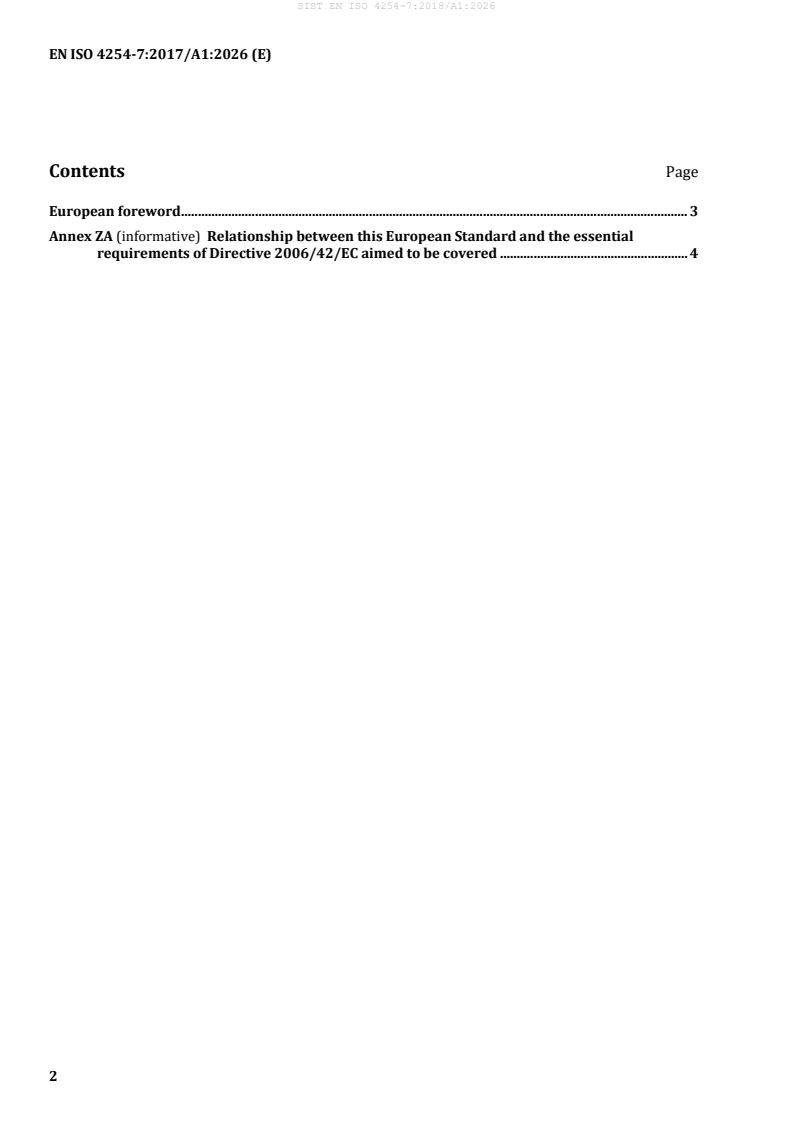
Contents Page
European foreword . 3
Annex ZA (informative) Relationship between this European Standard and the essential
requirements of Directive 2006/42/EC aimed to be covered . 4
European foreword
This document (EN ISO 4254-7:2017/A1:2026) has been prepared by Technical Committee ISO/TC 23
"Tractors and machinery for agriculture and forestry" in collaboration with Technical Committee
CEN/TC 144 “Tractors and machinery for agriculture and forestry” the secretariat of which is held by
AFNOR.
This Amendment to the European Standard EN ISO 4254-7:2017 shall be given the status of a national
standard, either by publication of an identical text or by endorsement, at the latest by November 2026,
and conflicting national standards shall be withdrawn at the latest by November 2026.
Attention is drawn to the possibility that some of the elements of this document may be the subject of
patent rights. CEN shall not be held responsible for identifying any or all such patent rights.
This document has been prepared under a standardization request addressed to CEN by the European
Commission. The Standing Committee of the EFTA States subsequently approves these requests for its
Member States.
For the relationship with EU Legislation, see informative Annex ZA, which is an integral part of this
document.
Any feedback and questions on this document should be directed to the users’ national standards
body/national committee. A complete listing of these bodies can be found on the CEN website.
According to the CEN-CENELEC Internal Regulations, the national standards organizations of the
following countries are bound to implement this European Standard: Austria, Belgium, Bulgaria,
Croatia, Cyprus, Czech Republic, Denmark, Estonia, Finland, France, Germany, Greece, Hungary, Iceland,
Ireland, Italy, Latvia, Lithuania, Luxembourg, Malta, Netherlands, Norway, Poland, Portugal, Republic of
North Macedonia, Romania, Serbia, Slovakia, Slovenia, Spain, Sweden, Switzerland, Türkiye and the
United Kingdom.
Endorsement notice
The text of ISO 4254-7:2017/Amd 1:2025 has been approved by CEN as EN ISO 4254-7:2017/A1:2026
without any modification.
Annex ZA
(informative)
Relationship between this European Standard and the essential
requirements of Directive 2006/42/EC aimed to be covered
This European Standard has been prepared under a Commission’s standardization request “M/396
Mandate to CEN and CENELEC for Standardisation in the field of machinery" to provide one voluntary
means of conforming to essential requirements of Directive 2006/42/EC of the European Parliament
and of the Council of 17 May 2006 on machinery, and amending Directive 95/16/EC (recast).
Once this standard is cited in the Official Journal of the European Union under that Directive,
compliance with the normative clauses of this standard given in Table ZA.1 confers, within the limits of
the scope of this standard, a presumption of conformity with the corresponding essential requirements
of that Directive, and associated EFTA regulations.
Table ZA.1 — Correspondence between this European Standard and Annex I of Directive
2006/42/EC
The relevant Essential Requirements of Clause(s)/sub-clause(s) Remarks/Notes
EU Directive 2006/42/EC of this EN
1.1.2.a) Principles of safety integration 4; 5; 6; 7; 8; 9;10
1.1.2.c) Principles of safety integration 4; 5; 6; 7; 8; 9;10
1.1.2.d) Principles of safety integration 4; 5; 6; 7; 8; 9;10
1.1.2.e) Principles of safety integration 4; 5; 6; 7; 8; 9;10
1.1.3.e) Materials and products 4.10.3; 4.16; 4.17.1
1.1.4 Lighting 4.3.11.7
1.1.5 Design of machinery to facilitate its 4.1; 4.2; 4.3; 4.4; 4.5; 4.8;
handling 4.9.1; 4.9.3; 4.9.4; 4.9.5; 4.12;
4.13.3; 4.17; 5.1; 5.2; 5.4.5.2;
6.1; 6.2.5; 7.1.2.1; 7.2.2.1;
7.3; 8.3; 8.5; 10
1.1.6 Ergonomics 4.1; 4.2; 4.3; 4.4; 4.5; 4.9.1;
4.9.3; 4.9.6.2, 4.12; 4.13.3;
5.2; 5.4.5.2; 6.1; 6.2.5;
7.1.2.1; 7.2.2.1; 7.3; 8.5
1.1.7 Operating positions 4.1.3; 4.3; 4.4; 6.1
1.1.8 Seating 4.3.1; 4.3.2
1.2.1 Safety and reliability of control 4.2; 4.3.9; 4.7; 4.16; 4.17; 8.2
systems
1.2.2 Control devices 4.2; 4.3; 4.12; 4.13.3; 4.14;
5.4.5.2; 6.2.5; 6.4; 7.1.2.1;
7.2.2.1; 8.5
1.2.3 Starting 4.3.9; 4.12; 4.13.3; 5.4.5.2;
6.2.5; 6.3; 7.1.2.1; 7.2.2.1
1.2.4 Stopping 4.1.3; 4.2; 4.3.9
1.2.6 Failure of the power supply 4.1.3; 4.2.3; 4.3.9; 4.7; 4.9.4;
4.12.2; 4.13; 4.16; 4.17.1;
5.4.5.2; 6.2.5; 7.2.2.1; 8.5
1.3.1 Risk of loss of stability 4.1.3; 4.9.4; 4.9.5; 7.2.3; 10.1,
10.2
1.3.2 Risk of break-up during operation 4.9.4; 4.16
1.3.3 Risks due to falling or ejected objects 4.1.3; 4.5; 4.9.4; 4.16; 5.5.2;
5.6.1.2; 5.6.5; 5.7; 6.5.1
1.3.4 Risks due to surfaces, edges or angles 4.1; 4.8
4.1.3; 4.2.2; 4.2.3; 4.3.3, 4.3.5;
4.3.7; 4.17.1; 5.3; 5.4.1; 5.4.2;
5.4.3; 5.4.4; 5.4.5.1; 5.5;
5.6.2; 5.6.3; 5.6.4; 5.8; 6.2;
6.5.1; 6.5.2; 7.1.2.1.2; 7.2.1;
7.2.2
1.3.7 Risks related to moving parts 4.2.1; 4.2.3; 4.3.4; 4.3.5; 4.5;
4.9.4; 5.3; 5.4; 5.5; 6.2; 6.3;
6.4; 6.5; 7.1; 7.2; 8.5; 8.6;
10.1; 10.2.3
1.3.8.1 Moving power transmission parts 4.6.2
1.3.8.2 Moving parts involved in the process 5.3; 5.4; 5.5; 5.6; 6.2; 6.3; 6.4;
6.5; 7.1; 7.2; 8.5; 8.6
1.3.9 Risks of uncontrolled movement 4.2.3; 4.5; 4.9.4
1.4.1 General requirements 5.6.2
1.4.2.1 Fixed guards 5.5.2.2
1.5.1 Electricity supply 4.9.2; 4.13.2; 4.17
1.5.3 Energy supply other than electricity 4.6.2; 4.16
1.5.4 Errors of fitting 4.1.3; 4.6.2; 10.1
1.5.5 Extreme temperatures 4.8
1.5.6 Fire 4.9.3; 4.10; 10.1.2
1.5.8 Noise 4.15
1.5.9 Vibrations Not covered
1.5.10 Radiation Not covered
1.5.11 External radiation Not covered
1.5.12 Laser radiation Not covered
1.5.13 Emissions of hazardous materials 4.3.12.5; 4.9.2.1; 4.9.3;
and substances 4.10.3; 4.16
1.5.14 Risk of being trapped in a machine 4.3.12.4
1.5.15 Risk of slipping, tripping or falling 4.3; 4.4; 5.2; 5.4.2; 7.2.4; 8.3;
10.1.3
1.6.1 Machinery maintenance 4.4; 4.9.3; 4.9.4; 5.4.2; 7.2.1;
7.2.2; 7.2.4; 8.4; 10.1
1.6.2 Access to operating positions and 4.2.1.3; 4.3.5; 4.3.8; 4.3.9.2;
service points 4.4; 4.9.2; 4.9.3; 4.9.4; 5.4.2;
5.4.3; 7.2.1; 7.2.2; 7.2.4; 8.4;
10.1
1.6.3 Isolation of energy sources 4.9.2; 4.13.2
1.6.4 Operator intervention 4.1; 4.2; 4.3.3; 4.3.8; 4.3.9;
4.4; 4.9.3; 4.9.4; 4.12; 4.13.3;
5.4.5.2; 6.2.5; 6.3; 6.4; 6.5;
7.1.2.1; 7.2.2.1; 8.5
1.7.1 Information and warnings on the 10
machinery
1.7.1.1 Information and information devices 10
1.7.1.2 Warning devices 5.1.2
1.7.2 Warning of residual risks 5.5.1.2; 5.6.1.2; 10.1; 10.2.3.2
1.7.3 Marking of machinery 10.2.1
1.7.4.1 General principles for the drafting of 10.1
instructions
1.7.4.2 Contents of the instructions 10.1
3.2.1 Driving position 4.3.4; 4.3.11
3.2.2 Seating 4.3.1; 5.1.1; 8.1
3.2.3 Positions for other persons 4.3.2
3.3 Control systems 4.2.3
3.3.1 Control devices 4.2.1; 4.2.2; 4.2.3; 4.3.1.1;
4.3.3; 4.3.8; 4.3.9; 4.7; 4.12;
4.13.3; 4.14; 5.4.5.2; 6.2.5;
7.1.2.1; 7.2.2.1; 8.5; 10.1.2
3.3.2 Starting/moving 4.2.1.5; 4.2.3; 4.5
3.3.3 Traveling function Not covered
3.3.5 Control circuit failure Not covered
3.4.1 Uncontrolled movements 4.1.3
3.4.2. Moving transmission parts Not covered
3.4.3 Roll-over and tip-over Not covered
3.4.5 Means of access 4.2.1; 4.3; 4.4; 4.12.2; 4.13.3;
4.14; 5.2; 5.4.5.2; 6.2.5;
7.1.2.1; 8.3
3.4.6 Towing devices Not covered
3.4.7 Transmission of power between self- 4.1.3; 4.6.2
propelled machinery (or tractor) and
recipient machinery
3.5.1 Batteries 4.9.2
3.5.2 Fire 4.9.3; 4.10
3.6.1 Signs, signals and warnings 4.3.11.5; 4.8; 5.1.2; 5.6.5;
7.2.3; 10.1.2; 10.2.2; 10.2.3
3.6.2 Marking 10.2
3.6.3.1 Vibrations 10.1.1.3
WARNING 1 — Presumption of conformity stays valid only as long as a reference to this European
Standard is maintained in the list published in the Official Journal of the
...