

oSIST prEN IEC 60731:2026
(Main)Medical electrical equipment - Dosimeters with ionization chambers or solid-state detectors as used in radiotherapy
General Information
- Abstract
- Status
- Not Published
- Public Enquiry End Date
- 30-Jun-2026
- Technical Committee
- IEMO - Electrical equipment in medical practice
- Current Stage
- 4020 - Public enquire (PE) (Adopted Project)
- Start Date
- 15-Apr-2026
- Due Date
- 02-Sep-2026
- Completion Date
- 08-Jul-2026
- Directive
- 93/42/EEC - Medical devices


Overview
oSIST prEN IEC 60731:2026 specifies performance requirements for medical electrical equipment dosimeters incorporating ionization chambers or solid-state detectors used in radiotherapy. Published by the International Electrotechnical Commission (IEC) and developed under CLC (European Committee for Electrotechnical Standardization), this standard focuses on ensuring accuracy and reliability in radiation dose measurements critical for effective cancer treatment.
Dosimeters addressed in this standard are key instruments for verifying and calibrating the radiation dose delivered during radiotherapy procedures. The standard applies to reference-class dosimeters, field-class dosimeters, and certain solid-state detector-based dosimeters, focusing on their application in photon, electron, proton, and ion therapy. By providing internationally harmonized performance criteria, oSIST prEN IEC 60731:2026 supports high-quality patient care and confidence in radiotherapy practices.
Key Topics
Performance Requirements
- Specifies criteria for stability, repeatability, leakage current, radiation quality dependence, and electromagnetic compatibility.
- Establishes precise test methods and classification for different dosimeter types (field-class, reference-class, solid-state).
- Includes constructional requirements, marking, and documentation for detectors and associated measuring assemblies.
Detector Assembly Types
- Covers ionization chambers (vented, sealed, parallel-plate, shell chambers) and solid-state detectors as used in clinical radiotherapy.
- Details environmental and operational conditions, such as temperature, humidity, pressure, and electromagnetic influences.
Measuring Assemblies & Accessories
- Describes requirements for measuring assemblies (display, calibration, stability check devices).
- Outlines accompanying documentation (user manuals, calibration certificates).
Exclusions
- Excludes in-vivo dosimetry, dose monitoring systems integrated into therapy machines, and well-type ionization chambers used for brachytherapy.
Applications
High-quality, standardized dosimeters are vital for radiotherapy departments, medical physicists, and equipment manufacturers:
Calibration and Quality Assurance
- Ensures that both reference-class and field-class dosimeters provide the accuracy needed for machine calibration, reference dose determination, and treatment verification.
- Supports compliance with international dosimetry protocols (such as IAEA TRS-398) and quality assurance requirements.
Clinical Practice
- Enables precise absorbed dose and air kerma measurements, critical for treatment planning and patient safety.
- Assists in routine QA checks, commissioning of new radiotherapy equipment, and verifying stable operation over time.
Research and Development
- Provides a benchmark for device development, innovation, and validation of new dosimeter technologies and measurement systems.
Regulatory and Certification Context
- Facilitates conformity assessment and harmonizes regulatory acceptance for dosimetry equipment in healthcare sectors across Europe and beyond.
Related Standards
When implementing or specifying dosimeters under oSIST prEN IEC 60731:2026, consider compliance with relevant, referenced standards:
- IEC 60601-1: Medical electrical equipment - General safety and performance requirements.
- IEC 60601-1-2: Electromagnetic compatibility requirements for medical devices.
- IEC 60601-1-3: Radiation protection requirements for medical electrical equipment.
- IEC 61326-1: Electrical equipment for measurement, control, and laboratory use - EMC requirements.
- IAEA TRS-398: Absorbed dose determination in external beam radiotherapy.
- Relevant dosimetry protocols and ISO standards for calibration and measurement traceability.
Practical Value
Adopting oSIST prEN IEC 60731:2026 enables radiotherapy service providers and device manufacturers to:
- Demonstrate compliance with international best practices
- Enhance patient safety and treatment outcomes through accurate dose delivery
- Streamline procurement and acceptance testing of radiotherapy dosimeters
- Maintain a competitive edge by meeting stringent performance and documentation requirements
For organizations seeking reliability and accreditation in radiotherapy dosimetry, this standard will be an essential reference for both operational excellence and regulatory compliance.
Relations
- Effective Date
- 25-Jul-2023
- Effective Date
- 25-Jul-2023
Get Certified
Connect with accredited certification bodies for this standard

BSI Group
BSI (British Standards Institution) is the business standards company that helps organizations make excellence a habit.

TÜV Rheinland
TÜV Rheinland is a leading international provider of technical services.

TÜV SÜD
TÜV SÜD is a trusted partner of choice for safety, security and sustainability solutions.
Sponsored listings
Frequently Asked Questions
oSIST prEN IEC 60731:2026 is a draft published by the Slovenian Institute for Standardization (SIST). Its full title is "Medical electrical equipment - Dosimeters with ionization chambers or solid-state detectors as used in radiotherapy". This standard covers: Medical electrical equipment - Dosimeters with ionization chambers or solid-state detectors as used in radiotherapy
Medical electrical equipment - Dosimeters with ionization chambers or solid-state detectors as used in radiotherapy
oSIST prEN IEC 60731:2026 is classified under the following ICS (International Classification for Standards) categories: 11.040.50 - Radiographic equipment; 17.240 - Radiation measurements. The ICS classification helps identify the subject area and facilitates finding related standards.
oSIST prEN IEC 60731:2026 has the following relationships with other standards: It is inter standard links to SIST EN 60731:2012, SIST EN 60731:2012/A1:2022. Understanding these relationships helps ensure you are using the most current and applicable version of the standard.
oSIST prEN IEC 60731:2026 is associated with the following European legislation: EU Directives/Regulations: 93/42/EEC; Standardization Mandates: M/295. When a standard is cited in the Official Journal of the European Union, products manufactured in conformity with it benefit from a presumption of conformity with the essential requirements of the corresponding EU directive or regulation.
oSIST prEN IEC 60731:2026 is available in PDF format for immediate download after purchase. The document can be added to your cart and obtained through the secure checkout process. Digital delivery ensures instant access to the complete standard document.
Standards Content (Sample)
SLOVENSKI STANDARD
01-junij-2026
Medicinska električna oprema - Dozimetri z ionizacijskimi komorami ali trdnimi
detektorji za uporabo v radioterapiji
Medical electrical equipment - Dosimeters with ionization chambers or solid-state
detectors as used in radiotherapy
Appareils électromédicaux - Dosimètres à chambres d'ionisation ou détecteur à état
solide utilisés en radiothérapie
Ta slovenski standard je istoveten z: prEN IEC 60731:2026
ICS:
11.040.50 Radiografska oprema Radiographic equipment
17.240 Merjenje sevanja Radiation measurements
2003-01.Slovenski inštitut za standardizacijo. Razmnoževanje celote ali delov tega standarda ni dovoljeno.
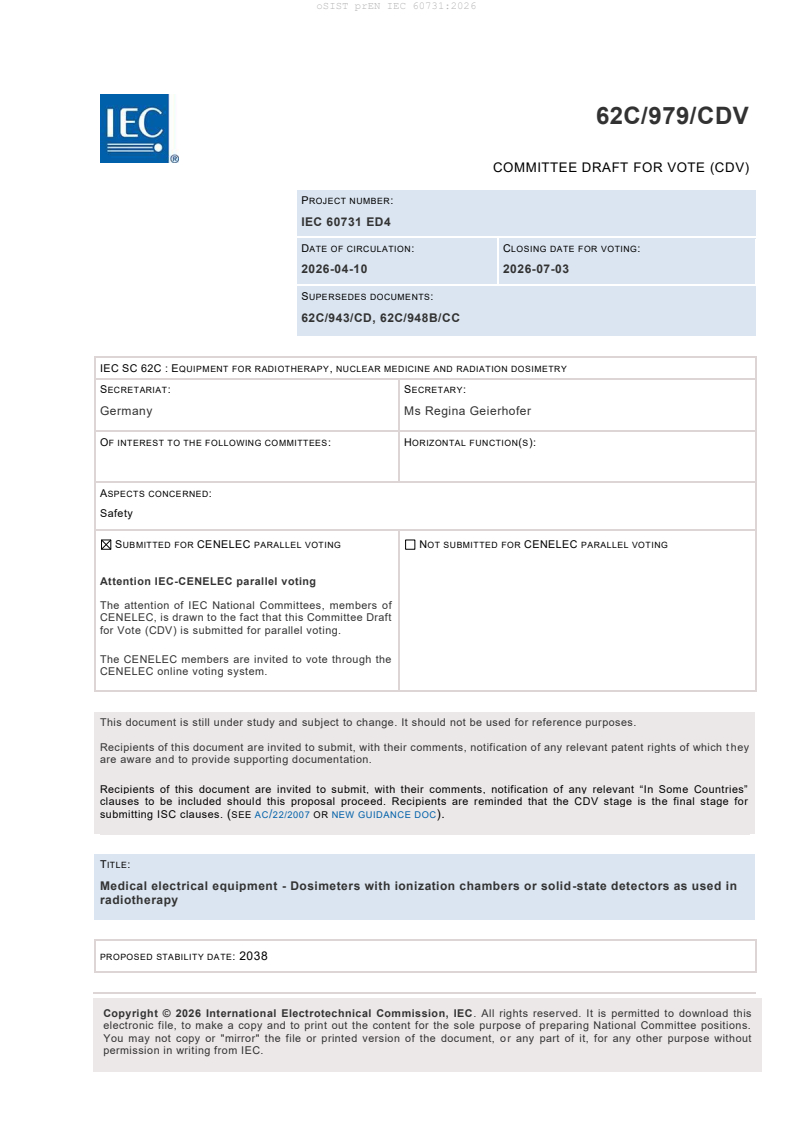
62C/979/CDV
COMMITTEE DRAFT FOR VOTE (CDV)
PROJECT NUMBER:
IEC 60731 ED4
DATE OF CIRCULATION: CLOSING DATE FOR VOTING:
2026-04-10 2026-07-03
SUPERSEDES DOCUMENTS:
62C/943/CD, 62C/948B/CC
IEC SC 62C : EQUIPMENT FOR RADIOTHERAPY, NUCLEAR MEDICINE AND RADIATION DOSIMETRY
SECRETARIAT: SECRETARY:
Germany Ms Regina Geierhofer
OF INTEREST TO THE FOLLOWING COMMITTEES: HORIZONTAL FUNCTION(S):
ASPECTS CONCERNED:
Safety
SUBMITTED FOR CENELEC PARALLEL VOTING NOT SUBMITTED FOR CENELEC PARALLEL VOTING
Attention IEC-CENELEC parallel voting
The attention of IEC National Committees, members of
CENELEC, is drawn to the fact that this Committee Draft
for Vote (CDV) is submitted for parallel voting.
The CENELEC members are invited to vote through the
CENELEC online voting system.
This document is still under study and subject to change. It should not be used for reference purposes.
Recipients of this document are invited to submit, with their comments, notification of any relevant patent rights of which t hey
are aware and to provide supporting documentation.
Recipients of this document are invited to submit, with their comments, notification of any relevant “In Some Countries”
clauses to be included should this proposal proceed. Recipients are reminded that the CDV stage is the final stage for
submitting ISC clauses. (SEE AC/22/2007 OR NEW GUIDANCE DOC).
TITLE:
Medical electrical equipment - Dosimeters with ionization chambers or solid-state detectors as used in
radiotherapy
PROPOSED STABILITY DATE: 2038
electronic file, to make a copy and to print out the content for the sole purpose of preparing National Committee positions.
You may not copy or "mirror" the file or printed version of the document, or any part of it, for any other purpose without
permission in writing from IEC.
IEC CDV 60731 © IEC 2026
NOTE FROM TC/SC OFFICERS:
IEC CDV 60731 © IEC 2026
Link to Committee Draft for Vote (CDV) online document:
Click here
How to access
This link leads you to the Online Standards Development (OSD) platform for National Mirror
Committee’s (NMC) comments. The project draft may be found further down this document.
Resource materials
We recommend NCs to review the available materials to better understand the member commenting
on the OSD platform. This includes the:
• OSD NC roles overview
• How to add and submit comments to the IEC
Contact
Should you require any assistance, please contact the IEC IT Helpdesk.
IEC CDV 60731 © IEC 2026
CONTENTS
How to access . 3
Resource materials . 3
Contact . 3
CONTENTS . 1
FOREWORD . 6
INTRODUCTION . 8
1 Scope and object . 9
1.1 Scope . 9
1.2 Object . 9
2 Normative references . 10
3 Terms and definitions . 11
4 General requirements . 37
4.1 Performance requirements . 37
4.2 Reference values and standard test values (3.146) . 37
4.3 General test conditions and methods . 38
4.3.1 Standard test conditions . 38
4.3.2 Test of components . 38
4.3.3 Rated or effective range (3.36) of dose (or kerma (3.67)) rates . 38
4.3.4 Uncertainty of measurement (3.74) . 39
4.3.5 Adjustments during test . 39
4.3.6 Test conditions particular to chamber assemblies (3.17) . 39
4.3.7 Test conditions particular to measuring assemblies (3.75) . 39
4.3.8 Test conditions particular to stability check devices (3.141) . 40
4.3.9 Use of stability check devices (3.141) . 40
4.3.10 Calculation of the ion collection time (3.63) of an ionization chamber
(3.64) . 40
4.4 Summary tables . 41
4.5 Classification of equipment according to limits of variation (3.69) . 50
4.5.1 Field-class dosimeter . 50
4.5.2 Reference-class dosimeter . 50
4.6 Reference radiation quality . 51
4.7 Referencing to Co-60 in cases when a Co-60 beam is not available . 51
5 Detector assembly performance requirements . 51
5.1 General . 51
5.2 General performance requirements for (radiotherapy (3.110)) detectors
(3.28) . 52
5.2.1 Stabilization time . 52
5.2.2 Pre-irradiation dose . 52
5.2.3 Rated range of field sizes . 53
5.2.4 Cable microphony . 53
5.2.5 Electromagnetic compatibility . 54
5.3 Performance requirements particular to ionization chambers (3.64) but not
solid-state detectors (3.136) . 54
5.3.1 Stability . 54
5.3.2 Chamber assembly (3.17) leakage current (3.18) without irradiation
(3.66) . 55
5.3.3 Post-irradiation (3.66) leakage . 55
IEC CDV 60731 © IEC 2026
5.3.4 Rated or effective range (3.36) of dose rate (continuous radiation) . 56
5.3.5 Maximum rated (3.113) dose per pulse (pulsed radiation) . 57
5.3.6 stray radiation (3.148) . 58
5.3.7 Guard/collector insulation . 59
5.3.8 Polarity of polarizing voltage effect . 59
5.3.9 Impermeability for water . 60
5.4 Performance requirements particular to shell chambers (3.135) . 61
5.4.1 Dependence on radiation quality (3.106) . 61
5.4.2 Rated range of field sizes . 64
5.4.3 Detector orientation . 66
5.5 Performance requirements particular to parallel-plate chambers (3.91) . 67
5.5.1 Dependence on radiation quality (3.106) . 67
5.5.2 Chamber orientation . 69
5.6 Performance requirements particular to vented chambers (3.163) . 69
5.6.1 Atmospheric pressure change . 69
5.6.2 Temperature . 70
5.6.3 Humidity . 70
5.7 Performance requirements particular to sealed chambers (3.134) . 71
5.7.1 Atmospheric pressure change . 71
5.7.2 Temperature . 71
5.8 Performance requirements particular to solid-state detectors . 72
5.8.1 Dependence on radiation quality . 72
5.8.2 Rated range of field sizes . 74
5.8.3 Accumulated Dose Stability . 75
5.8.4 Minimum rated (3.113) or effective dose rate (continuous radiation) . 76
5.8.5 Rated (3.113) range of dose per pulse (pulsed radiation) . 76
5.8.6 Post-irradiation leakage . 77
5.8.7 Leakage . 77
5.8.8 Minimum bending radius of the cable and light-guide . 79
5.8.9 Detector orientation . 79
5.8.10 Temperature . 79
5.8.11 Humidity . 80
5.8.12 Impermeability for water . 80
5.8.13 Ambient light . 80
6 Measuring assembly performance requirements . 81
6.1 General . 81
6.2 General performance requirements for radiotherapy dosimeters (3.111) . 81
6.2.1 Effective ranges . 81
6.2.2 Maximum rated charge per pulse . 82
6.2.3 Maximum rated instantaneous input current (3.59) . 83
6.2.4 Resolution of the display or data output terminal . 83
6.2.5 Repeatability . 83
6.2.6 Long-term stability . 84
6.2.7 Stabilization time . 84
6.2.8 Input offset voltage (3.58) . 84
6.2.9 Electromagnetic compatibility . 85
6.3 Performance requirements particular to dosimeters . 86
6.3.1 Zero drift . 86
6.3.2 Zero shift . 87
IEC CDV 60731 © IEC 2026
6.3.3 Non-linearity . 88
6.3.4 Range changing . 89
6.3.5 Dead time . 90
6.3.6 Temperature . 90
6.3.7 Humidity . 91
6.3.8 Stray radiation effect . 91
6.3.9 Charge leakage . 92
6.3.10 Dose rate dependence of dosimeters . 92
6.4 Performance requirements particular to dose rate meters . 93
6.4.1 Zero drift . 93
6.4.2 Zero shift . 94
6.4.3 Non-linearity . 95
6.4.4 Range changing . 96
6.4.5 Response time . 98
6.4.6 Temperature . 98
6.4.7 Humidity . 99
6.4.8 Stray radiation effect . 99
6.5 Performance requirements particular to battery-operated measuring
assemblies (3.75) . 100
6.6 Performance requirements particular to supply mains (3.149)-operated
measuring assemblies (3.75) . 100
6.6.1 Mains voltage – static . 100
6.6.2 Mains voltage – variation (3.162) during a measurement . 100
7 Stability check device performance requirements . 101
7.1 General . 101
7.2 General performance requirements for stability check devices (3.141) . 101
7.2.1 Long-term stability . 102
7.2.2 Repeatability . 102
8 Constructional requirements as related to performance characteristics (3.96) . 102
8.1 Constructional requirements on chamber assemblies (3.17) . 102
8.2 Constructional requirements on measuring assemblies (3.75) . 102
8.2.1 Adjustment of response (3.125) . 102
8.2.2 Display device . 103
8.2.3 Battery indication and compensation . 104
8.2.4 Input current threshold . 104
8.2.5 Automatic termination of measurement in the dose mode . 104
8.3 Constructional requirements on stability check devices (3.141) . 104
8.3.1 Output of the stability check devices (3.141) . 104
8.3.2 Constructional requirements particular to a radioactive type stability
check device (3.141) . 104
8.3.3 Constructional requirements particular to an overall stability check
device (3.141) . 105
8.4 Constructional requirements on phantoms (3.97) and build-up caps . 105
9 Marking . 106
9.1 Marking required on detector assembly (3.29). 106
9.1.1 Safety information about possible contact of the detector assembly
(3.29) with a patient (3.93) . 106
9.1.2 Other information . 106
9.1.3 Compliance check . 106
9.2 Marking required on measuring assembly (3.75) . 106
IEC CDV 60731 © IEC 2026
9.2.1 Safety information about possible contact of the measuring assembly
(3.75) or the dosimeter with a patient (3.93) . 106
9.2.2 Each measuring assembly (3.75) . 107
9.2.3 Measuring assembly with a display scaled in dose . 107
9.2.4 Multi-range measuring assembly (3.75) . 107
9.2.5 Measuring assembly with more than one chamber . 107
9.2.6 Graphical symbols . 107
9.2.7 Compliance check . 108
9.3 Marking required on stability check device (3.141) . 108
9.3.1 General . 108
9.3.2 Stability check device containing a radioactive source (3.108) . 108
9.3.3 Device which contributes to protection against ionizing radiation (3.65) . 108
9.3.4 Compliance check . 108
9.4 Marking required on phantom (3.97) or build-up cap . 108
10 Accompanying documents . 108
10.1 Accompanying documents for chamber assembly (3.17) . 108
10.1.1 Instructions for use of chamber assembly (3.17) . 108
10.1.2 Test sheet for chamber assembly (3.17) . 110
10.1.3 Calibration certificate for chamber assembly (3.17) . 111
10.2 Accompanying documents for the solid-state detector assembly (3.137) . 112
10.2.1 Instructions for use of solid-state detector assembly (3.137) . 112
10.3 Accompanying documents for measuring assembly (3.75) . 113
10.3.1 Instructions for use of measuring assembly (3.75) . 113
10.3.2 Test sheet for measuring assembly (3.75) . 114
10.3.3 Calibration certificate for measuring assembly (3.75) . 115
10.4 Accompanying documents for stability check device (3.141) . 115
10.4.1 Instructions for use of stability check device (3.141) . 115
10.4.2 Test sheet for stability check device (3.141) . 116
10.4.3 Measurement certificate for stability check device (3.141) . 116
10.5 Accompanying documents for phantoms (3.97) and build-up caps. 117
Annex A (informative) Values, error and uncertainty (3.74) . 119
Annex B (normative) Test equipment for cable microphony . 120
Annex C (normative) Uncertainty of measurement . 121
C.1 Introduction . 121
C.2 Categories of uncertainties (3.74) for dosimeters . 121
C.3 Summary of recommendations . 121
C.4 Recommended coverage factor (3.25). 122
C.5 Formalism . 122
Bibliography . 131
Figure 1 – Tolerance of depth in phantom (3.97) . 105
Figure 2 – Tolerance of lateral position in phantom (3.97) . 105
Figure A.1 – Graphical illustration of values, error and uncertainty (3.74) . 119
Figure B.1 – Test equipment for cable microphony. 120
Figure C.1 – Probability distributions for the performance characteristics (3.96) to be
within the limits of variation (3.69) ±L and the expression of their variances (3.161) in
terms of L . 123
IEC CDV 60731 © IEC 2026
Table 1 – Reference conditions and standard test conditions (3.145) – detector
assembly (3.29) . 41
Table 2 – Reference conditions and standard test conditions (3.145) –measuring
assembly (3.75) . 42
Table 3 – Limits of performance characteristics (3.96) at standard test conditions
(3.145) –chamber assembly (3.17) . 43
Table 4 – Limits of performance characteristics (3.96) at standard test conditions
(3.145) – solid-state detector assembly (3.137) . 43
Table 5 – Limits of performance characteristics (3.96) at standard test conditions
(3.145) –measuring assembly (3.75) . 43
Table 6 – Limits of variation (3.162) of performance characteristics (3.96) for effects of
influence quantities (3.57) and instrument parameters (3.61) –detector assembly (3.29) . 44
Table 7 – Limits of variation (3.162) of performance characteristics (3.96) for effects of
influence quantities (3.57) and instrument parameters (3.61) –measuring assembly
(3.75) . 48
Table 8 – Limits of variation (3.162) of performance characteristics (3.96) for effects of
influence quantities (3.57) and instrument parameters (3.61) – Chamber and
measuring assemblies (3.75) combined . 50
Table 9 – . 91
Table 10 – . 99
Table C.1 – Numerical factors to calculate the standard uncertainty (3.147) for a
performance characteristic (3.96) value, based on the assumption of a symmetric
probability distribution . 124
Table C.2 – Estimate of combined standard uncertainty (3.19) for the performance of a
hypothetical field-class or reference-class dosimeter. . 125
Table C.3 – A hypothetical example of the assessment of the uncertainties (3.74) on
the output measurement of an X-ray set using a field-class dosimeter (3.50) . 129
IEC CDV 60731 © IEC 2026
INTERNATIONAL ELECTROTECHNICAL COMMISSION
____________
Medical electrical equipment - Dosimeters with ionization chambers or
solid-state detectors as used in radiotherapy
FOREWORD
a) The International Electrotechnical Commission (IEC) is a worldwide organization for standardization comprising
all national electrotechnical committees (IEC National Committees). The object of IEC is to promote international
co-operation on all questions concerning standardization in the electrical and electronic fields. To this end and
in addition to other activities, IEC publishes International Standards, Technical Specifications, Technical
Reports, Publicly Available Specifications (PAS) and Guides (hereafter referred to as “IEC Publication(s)”). Their
preparation is entrusted to technical committees; any IEC National Committee interested in the subject dealt
with may participate in this preparatory work. International, governmental and non-governmental organizations
liaising with the IEC also participate in this preparation. IEC collaborates closely with the International
Organization for Standardization (ISO) in accordance with conditions determined by agreement between the two
organizations.
b) The formal decisions or agreements of IEC on technical matters express, as nearly as possible, an international
consensus of opinion on the relevant subjects since each technical committee has representation from all
interested IEC National Committees.
c) IEC Publications have the form of recommendations for international use and are accepted by IEC National
Committees in that sense. While all reasonable efforts are made to ensure that the technical content of IEC
Publications is accurate, IEC cannot be held responsible for the way in which they are used or for any
misinterpretation by any end user.
d) In order to promote international uniformity, IEC National Committees undertake to apply IEC Publications
transparently to the maximum extent possible in their national and regional publications. Any divergence between
any IEC Publication and the corresponding national or regional publication shall be clearly indicated in the latter.
e) IEC itself does not provide any attestation of conformity. Independent certification bodies provide conformity
assessment services and, in some areas, access to IEC marks of conformity. IEC is not responsible for any
services carried out by independent certification bodies.
f) All users should ensure that they have the latest edition of this publication.
g) No liability shall attach to IEC or its directors, employees, servants or agents including individual experts and
members of its technical committees and IEC National Committees for any personal injury, property damage or
other damage of any nature whatsoever, whether direct or indirect, or for costs (including legal fees) and
expenses arising out of the publication, use of, or reliance upon, this IEC Publication or any other IEC
Publications.
h) Attention is drawn to the Normative references cited in this publication. Use of the referenced publications is
indispensable for the correct application of this publication.
i) Attention is drawn to the possibility that some of the elements of this IEC Publication may be the subject of patent
rights. IEC shall not be held responsible for identifying any or all such patent rights.
International Standard IEC 60731 has been prepared by subcommittee 62C: Equipment for
radiotherapy, nuclear medicine and radiation dosimetry of IEC technical committee 62:
Electrical equipment in medical practice.
This fourth edition of IEC 60731 cancels and replaces IEC 60731:2011/AMD:2016 and is a
major update. The number of clauses on detector performance has increased from ~40 to ~60
and many of the existing clauses were updated. For the measuring assembly, a few new clauses
were added.
The major changes are:
– Inclusion of solid-state detectors.
– The reference class requirements have been increased to incorporate the new requirements
from TG-51 Addendum [1], TRS-398 [2] and TRS-483 [3].
– Allowance of 6 MV as reference beam quality due to the predicted scarcity of Co-60 sources.
Other changes:
IEC CDV 60731 © IEC 2026
– The scanning class has been removed.
– Clauses for charge per pulse and instantaneous current have been added for the measuring
assembly.
In this standard, the following print types are used:
a) requirements, compliance with which can be tested, and definitions: in roman type;
b) explanations, advice, general statements, exceptions and notes: in small roman type;
c) test specifications: in italic type.
The committee has decided that the contents of the base publication and its amendment will
remain unchanged until the stability date indicated on the IEC web site under
"http://webstore.iec.ch" in the data related to the specific publication. At this date, the
publication will be
• reconfirmed,
• withdrawn,
• replaced by a revised edition, or
• amended.
IEC CDV 60731 © IEC 2026
INTRODUCTION
This International Standard is applicable to the performance of radiotherapy dosimeters (3.111)
with ionization chambers (3.64) or solid-state detectors (3.136) as used in radiotherapy (3.110).
The effectiveness of treatment of patients (3.93) receiving radiotherapy (3.110) depends on the
accuracy of the dose of radiation received, as well as on the accuracy of their spatial
distribution. An excessive dose can lead to excessive tissue damage, while an insufficient dose
will not provide the therapeutic benefit sought. The equipment covered by this document plays
an essential part in achieving the required accuracy.
This document is not concerned with the safety aspects of dosimeters. The requirements for
safety applying to dosimeters as used in radiotherapy are contained either in IEC 61010 -1 or
IEC 60601-1. The international standard to be applied shall be decided by the manufacturer in
accordance with the scope of the respective international standard.
This document is not concerned with the electromagnetic compatibility (3.38) aspects of
dosimeters. The requirements for electromagnetic compatibility (3.38) applying to dosimeters
as used in radiotherapy are contained either in IEC 61326-1 or IEC 60601-1-2. The international
standard to be applied shall be decided by the manufacturer in accordance with the scope of
the respective international standard.
Irrespective of this choice, this document will define exceptions of tests which are described in
the electromagnetic compatibility (3.38) standards mentioned above. These exceptions will
either refer to tests of IEC 61326-1 or IEC 60601-1-2. Citing of an internatinoal standard to
define an exception does not imply that such an internatnional standard shall be used for
testing.
Dosimeters that comply with this document should nevertheless be used in accordance with the
relevant national or international dosimetry protocol (code of practice). In particular,
measurements should be made to determine the ion collection efficiency and polarity effect of
the chamber under the exact conditions of use.
IEC CDV 60731 © IEC 2026
1 Scope and object
1.1 Scope
This International Standard specifies the performance requirements of radiotherapy dosimeters
(3.111), intended for the measurement of absorbed dose to water (3.4) or air kerma (3.8) (and
their rates and spatial distributions) in photon (3.98), electron (3.39), proton or light and heavy
ion radiation fields (3.105) as used in radiotherapy (3.110).
Specificly, the document outlines general and specific performance requirements for detector
assemblies (3.29) (ionization chambers (3.64) and solid-state detectors (3.136)), measuring
assemblies (3.75), and stability check devices (3.141). These requirements cover aspects such
as stability, leakage current, radiation quality dependence, and more.
The following devices are outside the scope of this document and therefore not covered here:
– Dose monitoring systems (3.35) incorporated in radiotherapy (3.110) treatment machines
– Re-entrant (also known as well-type) ionization chambers (3.64) used for brachytherapy
source calibration
– constancy check devices
This document is applicable to the following types of dosimeter:
a) Dosimeters, classified as reference-class dosimeters (3.122) , normally used for
1) kerma (3.67) or dose determination under reference conditions;
2) the calibration of field-class dosimeters (3.50) ;
NOTE 1 reference-class dosimeters (3.122) may be used as field-class dosimeters (3.50).
b) Dosimeters, classified as field-class dosimeters (3.50), normally used for
1) the measurement of kerma (3.67) or dose in a radiation beam (3.104), either in air or in
a phantom (3.97);
2) relative dose distribution measurements with a scanning system (3.130) such as an
automatic water phantom (3.97).
NOTE 2 In this document, field-class dosimeters (3.50) and reference-class dosimeters (3.122) employ ionization
chambers (3.64) as detector (3.28)
c) Solid-state dosimeters (3.138), where the solid-state detector (3.136) is intended for
operation at zero bias voltage, normally used for
1) relative dose distribution measurements with a scanning system (3.130) such as an
automatic water phantom (3.97);
2) point-dose measurements in a solid-state phantom (3.97) or automatic water phantom
(3.97).
NOTE 3 Solid-State detectors that are intended for In-Vivo dosimetry applications are outside the scope of this
document.
1.2 Object
The object of this documentis:
– to establish requirements for a satisfactory level of performance for radiotherapy dosimeters
(3.111);
– to standardize methods for the determination of compliance with this level of performance.
Three levels of performance are specified:
– a lower level of performance applying to field-class dosimeters (3.50);
– a higher level of performance applying to reference-class dosimeters (3.122);
IEC CDV 60731 © IEC 2026
– a specific level of performance applying to dosimeters where at least one detector assembly
is a Solid-state detector (3.136). This may also be designated as solid-state class
2 Normative references
The following documents are referred to in the text in such a way that some or all of their content
constitutes requirements of this document. For dated references, only the edition cited applies.
For undated references, the latest edition of the referenced document (including any
amendments) applies.
IEC 60417, Graphical symbols for use on equipment
IEC 60601‑1:2005, Medical electrical equipment – Part 1: General requirements for basic safety
and essential performance
IEC 60601-1-2:2014/AMD1:2020, Amendment 1 - Medical electrical equipment - Part 1-2:
General requirements for basic safety and essential performance - Collateral Standard:
Electromagnetic disturbances - Requirements and tests
IEC 60601‑1‑3:2008, Medical electrical equipment – Part 1-3: General requirements for basic
safety and essential performance – Collateral Standard: Radiation protection in diagnostic X-
ray equipment
IEC 60601-1:2005/ISH3:2013, Interpretation sheet 3 - Medical electrical equipment - Part 1:
General requirements for basic safety and essential performance
IEC 60601‑2‑8:2010, Medical electrical equipment – Part 2-8: Particular requirements for the
basic safety and essential performance of therapeutic X-ray equipment operating in the range
10 kV to 1 MV
IEC/TR 60788:2004, Medical electrical equipment – Glossary of defined terms
IEC 60976:2007, Medical electrical equipment – Medical electron accelerators – Functional
performance characteristics
IEC 61010-1, Safety requirements for electrical equipment for measurement, control, and
laboratory use - Part 1: General requirements
IEC 61010-1:2010, Safety requirements for electrical equipment for measurement, control, and
laboratory use - Part 1: General requirements
IEC 61187, Electrical and electronic measuring equipment – Documentation
IEC 61674:2024, Medical electrical equipment - Dosimeters with ionization chambers and/or
semiconductor detectors as used in X-ray diagnostic imaging
IEC 61676:2002, Medical electrical equipment – Dosimetric instruments used for non-invasive
measurement of X-ray tube voltage in diagnostic radiology
ISO/IEC Guide 98‑3:2008, Uncertainty of measurement – Part 3: Guide to the expression of
uncertainty in measurement (GUM:1995)
ISO/IEC Guide 99:2007, International vocabulary of metrology – Basic and general concepts
and associated terms (VIM)
IEC CDV 60731 © IEC 2026
ISO 3534‑1:2006, Statistics – Vocabulary and symbols – Part 1: General statistical terms and
terms used in probability
DIN 6800-2:2008, Dosismessverfahren nach der Sondenmethode für Photonen- und
Elektronenstrahlung – Teil 2: Dosimetrie hochenergetischer Photonen- und Elektronenstrahlung
mit Ionisationskammern
3 Terms and definitions
For the purpose of this International Standard the terms and definitions listed in index of defined
terms and the following apply.
NOTE The definitions given in this document are generally in agreement with those in IEC TR 60788:2004 and ISO
International vocabulary of basic and general terms in metrology, except that some definitions have been made more
restricted. Any such special definitions should be regarded as applying only to this document.
Any terms not defined in this document have the meanings defined in the above publications or are assumed to be
in general scientific usage.
Throughout this document:
– if no material is specified, the term "absorbed dose" or "dose" means "absorbed dose to
water (in water)" and the term "kerma" means "air kerma (in air)";
– air kerma (in air), expressed in units of Gy, and exposure, expressed in units of C/kg, are
different quantities. Nevertheless, in this document, when the quantity "air kerma (in air)" is
used, the quantity "exposure" is also allowable.;
– the term “light and heavy ion“ addresses the range of nuclides from 2-He to 18-Ar.
3.1
6 MV reference radiation quality
reference radiation quality which is 6 MV and not Co-60
Note 1 to entry: See clause 4.6 for details.
3.2
absorbed dose
mean energy imparted by ionizing radiation to matter
Note 1 to entry: Letter symbol: D.
Note 2 to entry: Absorbed dose is determined as the quotient of 𝑑𝜀by dm, where 𝑑𝜀 is the mean energy imparted
by ionizing radiation to matter of mass dm:
𝑑𝜀
𝐷 =
𝑑𝑚
-1
Note 3 to entry: The unit of absorbed dose is the joule per kilogram (J.kg ). The special name of the unit of absorbed
-2 -1
dose is the gray (Gy). The earlier unit of absorbed dose was the rad, 1 rad being equal to 10 J.kg .
[SOURCE: IEC/TR 60788:2004 , rm-13-08]
3.3
absorbed dose rate to water
Ḋ
quotient of dD by dt, where dD is the increment of absorbed dose to water (3.4) in the time
interval dt
−1 −1 −1
Note 1 to entry: The unit of absorbed dose rate to water (3.3) is Gy·s (Gy·min ; Gy·h ).
Note 2 to entry: This definition is derived from the definition in C.5 of ICRU 33 ICRU Report 33 [4].
IEC CDV 60731 © IEC 2026
3.4
absorbed dose to water
D
quotient of
𝑑𝜀 by dm where
𝑑𝜀 is the mean energy imparted by ionizing radiation (3.65) to water of mass dm
−1
Note 1 to entry: The unit of absorbed dose to water (3.4) is Gy (where 1 Gy = 1 J·kg ).
Note 2 to entry: This definition is derived from the definition in C.4 of ICRU 33 ICRU Report 33 [4]).
3.5
accessory
additional part for use with equipment in order to:
– achieve the intended use,
– adapt it to some special use,
– facilitate its use,
– enhance its performance, or
– enable its functions to be integrated with those of other equipment
[SOURCE: IEC 60601‑1:2005 , 3.3]
3.6
accompanying document
document accompanying me equipment (3.79), an me system (3.80), equipment or an
accessory (3.5) and containing information
...