

SIST EN IEC 60825-2:2026
(Main)Safety of laser products - Part 2: Safety of optical fibre communication systems (OFCSs)
- Abstract
This document provides requirements and specific guidance for the safe operation and maintenance of optical fibre communication systems (OFCSs). In these systems, optical power is possibly accessible outside the confines of the transmitting equipment and/or at great distance from the optical source.
This document requires the assessment of hazard level at each accessible location of the OFCS as a replacement for product classification according to IEC 60825-1. It applies to the installed OFCS as an engineered, end-to-end assembly for the generation, transfer and receipt of optical radiation arising from lasers, light-emitting diodes (LEDs) or optical amplifiers, in which the transference is by means of optical fibre for communication and/or control purposes.
NOTE 1 Throughout this document, a reference to 'laser' is taken to include LEDs and optical amplifiers.
Individual components and subassemblies that fall under the definition of a laser product are subject to the applicable subclause(s) of IEC 60825-1. This document is applicable to individual components and subassemblies intended to be installed within OFCSs.
This document does not apply to optical fibre systems primarily designed to transmit optical power for applications such as material processing or medical treatment.
In addition to the hazards resulting from laser radiation, OFCSs possibly give rise to other hazards, such as fire.
This document does not address safety issues associated with explosion or fire with respect to OFCSs deployed in explosive atmospheres.
NOTE 2 The hazard presented by optical radiation emerging from a fibre is determined by the wavelength and power emerging from the fibre and also by the optical characteristics of the fibre itself (see Annex A).
- Status
- Published
- Publication Date
- 29-Jun-2026
- Technical Committee
- ISS EIT.EVL - Optical radiation safety and laser equipment
- Current Stage
- 6060 - National Implementation/Publication (Adopted Project)
- Start Date
- 09-Jun-2026
- Due Date
- 14-Aug-2026
- Completion Date
- 30-Jun-2026
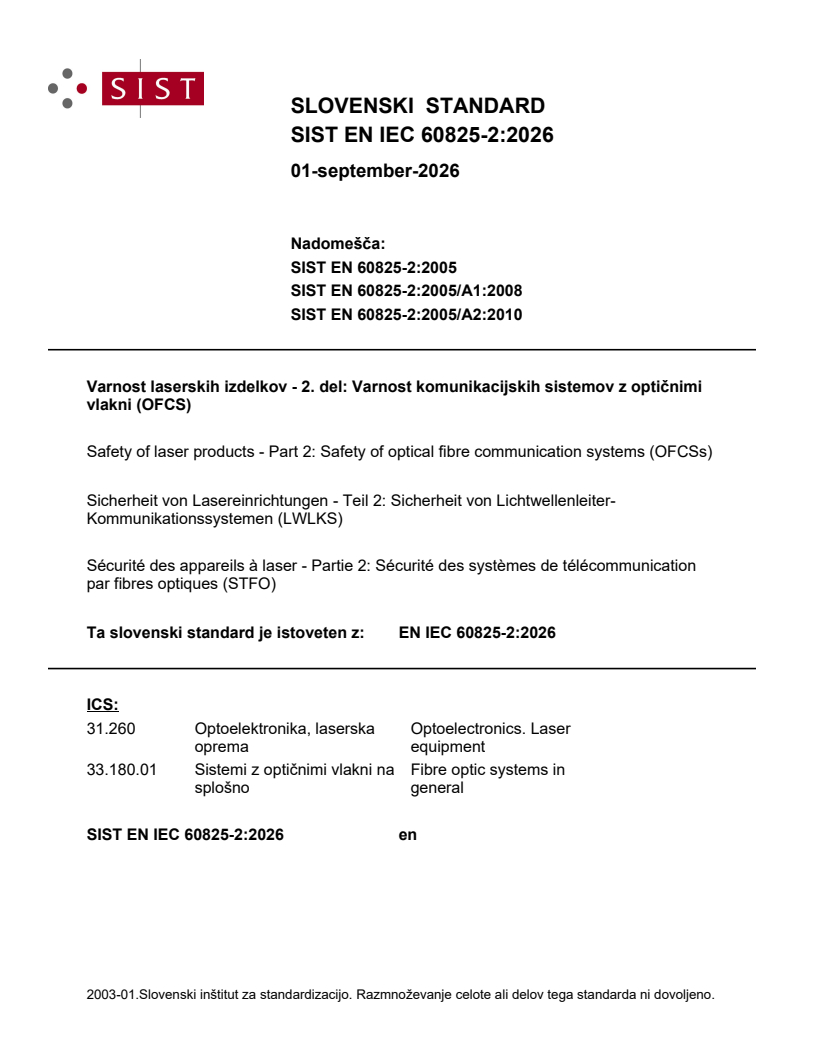

SIST EN IEC 60825-2:2026 is the Slovenian adoption of EN IEC 60825-2:2026, published by SIST. It specifies safety requirements and practical guidance for optical fibre communication systems (OFCSs), especially how to assess the hazard level at each accessible location and how to install, operate, service and mark these systems safely.
The document is written for manufacturers, installers, service teams, operating organizations and end-users who work with installed OFCSs where optical power can be accessible outside the transmitting equipment or far from the source.
What does SIST EN IEC 60825-2:2026 specify?
SIST EN IEC 60825-2:2026 specifies requirements and guidance for the safe operation and maintenance of OFCSs. It treats the installed OFCS as an end-to-end system for generating, transferring and receiving optical radiation for communication and/or control by optical fibre.
The document replaces product classification with hazard level assessment at each accessible location. It also makes clear that lasers in this document include LEDs and optical amplifiers.
| Annex / clause | What it covers |
|---|---|
| Clause 1 | Scope |
| Clause 2 | Normative references |
| Clause 3 | Terms and definitions |
| Clause 4 | Requirements |
| Annex A | Rationale |
| Annex B | Clarification of the meaning of “hazard level” |
| Annex C | Methods of hazard/safety analysis |
| Annex D | Application notes for the safe use of OFCS |
| Annex E | Guidance for service and maintenance |
| Annex ZA | Normative references to international publications and their European publications |
The scope excludes fibre systems mainly intended to transmit optical power for material processing or medical treatment. It also leaves out explosion- and fire-safety issues for OFCSs in explosive atmospheres.
What are the key requirements of SIST EN IEC 60825-2:2026?
SIST EN IEC 60825-2:2026 focuses on location-based hazard control. The main practical point is that safety is assessed at the accessible point, not only at the source, and the system must be managed so that the hazard level at each accessible location matches the allowed use of that location.
Hazard assessment is done location by location
Clause 4.1 requires separate assessment of each accessible location within an OFCS. If the system is altered, the responsible organization must check whether the original hazard level has changed and relabel accessible locations if needed.
For conventional loose-tube cable, each fibre is assessed individually and the highest radiation from one fibre is used. For ribbon cable, the cumulative radiation from one flat ribbon fibre is assessed as an extended source or a point source as appropriate. In practice, this means the method depends on the cable construction and on whether fibre-by-fibre data are available.
Protective housing and cable construction are part of safety
Clause 4.2 requires a protective housing that prevents human access to laser radiation above hazard level 1 under normal operating conditions. Clause 4.3 requires the fibre cable to have mechanical properties suitable for its installation location, with extra protection such as ducting, conduit or raceway where needed.
This matters because optical power in a cable can still exceed the maximum permissible exposure even when the location hazard level is low. The document therefore links optical safety with physical cable protection.
Connectors, labels and warnings depend on the location
Clause 4.4 and Clause 4.5 control cable connectors and safety marking. The rules differ for unrestricted, restricted and controlled locations, and higher hazard levels need progressively stronger controls.
In practice, this means the designer must decide whether access is open to the public, limited to authorized people, or limited to trained personnel. The document also uses warning labels, explanatory labels and durability requirements for safety markings, and it includes special warning language for invisible radiation.
Organizations have defined responsibilities
Clause 4.6 assigns responsibilities to manufacturers of ready-to-use or turnkey OFCSs, installation and service organizations, and operating organizations. The user of the document may belong to one or more of these categories.
For a buyer or operator, this matters because the standard expects safety duties to be clear before installation, during service, and during normal operation. The installation organization and service organization must follow the safety instructions for their work, and the operating organization must do the same for operation and maintenance.
Hazard level assessment replaces IEC 60825-1 classification
Clause 4.7 sets the method for determining hazard level. The hazard level at a location is based on the radiation that could become accessible in a reasonably foreseeable event such as a fibre break or connector disconnection, not only on normal enclosed operation.
The document uses the accessible emission limit tables and the measurement conditions from IEC 60825-1, including Condition 2. It also covers transient exposure when APR is used. Annex A and Annex B explain why OFCSs are treated differently from ordinary laser products.
APR is allowed, but it must be controlled
Clause 4.8 covers automatic power reduction (APR). APR is a safety feature that lowers accessible power to a specified level within a specified time when an event could expose people to radiation.
The clause also distinguishes automatic restart, manual restart with assured continuity, manual restart without assured continuity, and disabling of APR. In practice, the system must be designed so that the APR function is reliable enough to support the assigned hazard level.
Location type determines what is permitted
Clause 4.9 ties the permitted hazard level to unrestricted, restricted and controlled locations. Unrestricted locations are the most demanding, while controlled locations allow access only through engineering or administrative control and only to authorized personnel with appropriate laser safety training.
Annex A notes that hazard level 3R is not applicable in fibre optic applications, and hazard level 4 is not permitted within this document. Annex D shows how power limits and shutdown times are used to meet the required hazard level.
What terms does SIST EN IEC 60825-2:2026 define?
- optical fibre communication system (OFCS) - An engineered end-to-end assembly that generates, transfers and receives optical radiation through optical fibre for communication and/or control purposes.
- accessible location - A part of an OFCS where human access to laser radiation is possible under reasonably foreseeable events without using a tool.
- hazard level - The level of potential hazard at an accessible location within an OFCS, based on radiation that could become accessible in a foreseeable event.
- automatic power reduction (APR) - A feature that reliably reduces accessible power to a specified level within a specified time after an event that could expose people to radiation.
- controlled location - An accessible location with controlled access, where engineering or administrative control keeps access limited to authorized personnel with laser safety training.
- restricted location - An accessible location that is normally inaccessible to the general public but may be accessible to authorized personnel who might not have laser safety training.
- unrestricted location - An accessible location with no access restriction for members of the general public.
- reasonably foreseeable event - An event whose occurrence can be predicted fairly accurately and is not low or very low in probability, such as a fibre break or connector disconnection.
Who uses SIST EN IEC 60825-2:2026?
SIST EN IEC 60825-2:2026 is used by manufacturers, installation organizations, service organizations, operating organizations and end-users of OFCSs. The document says a user can belong to more than one of these roles.
In practice, it is used in telecommunications and control installations where optical radiation may become accessible at connectors, breaks or other discontinuities. Engineers use it to set hazard levels and choose protection measures, service teams use it to plan safe work, and operators use it to define safe operating and maintenance procedures.
What changed in SIST EN IEC 60825-2:2026 from the previous edition?
SIST EN IEC 60825-2:2026 replaces SIST EN 60825-2:2005, SIST EN 60825-2:2005/A1:2008 and SIST EN 60825-2:2005/A2:2010. The European foreword says it supersedes EN 60825-2:2004, EN 60825-2:2004/A1:2007 and EN 60825-2:2004/A2:2010, and that the IEC text IEC 60825-2:2021 + COR1:2021 was approved without modification.
Which standards are used with SIST EN IEC 60825-2:2026?
| Standard | How it is used |
|---|---|
| IEC 60825-1:2014 | Normative reference for laser product classification, accessible emission limits, measurement conditions and label content used in hazard assessment |
| IEC 60794-2 series | Cited for cable types and mechanical suitability in installation environments |
| IEC 60794-3 series | Cited for cable types and mechanical suitability in installation environments |
| IEC 60794-4 series | Cited for fibre cable types and for electric power transmitting cables with optical fibre cables |
| IEC 61508 series | Used in Annex C for consequence analysis |
| IEC 60812 | Used in Annex C for failure modes, effects and criticality analysis (FMECA) |
| IEC 62368-1 | Listed in the European bibliography notes |
| IEC 60825-12 | Listed in the European bibliography notes |
What does the SIST EN IEC 60825-2:2026 document contain?
SIST EN IEC 60825-2:2026 contains the requirements framework in Clause 4, including protective housing, fibre cables, connectors, labelling and marking, organizational duties, hazard level assessment, APR and location-based hazard rules. It also contains Annex ZA for European normative references.
The informative annexes add the practical material that users often need during design and maintenance. Annex C lists analysis methods such as preliminary hazard analysis, FMEA, FMECA, fault tree analysis, event tree analysis and HAZOPS. Annex D gives application notes, OFCS power limits, worked hazard-level examples for single and multiple wavelengths, bidirectional transmission, APR, multiple fibres and ribbon cables, plus shutdown calculations. Annex E gives service and maintenance guidance, including testing, viewing optics, safe working practices and training.
Relations
- Effective Date
- 01-Sep-2026
- Effective Date
- 01-Sep-2026
- Effective Date
- 01-Sep-2026
- Effective Date
- 02-Jun-2026
- Effective Date
- 02-Jun-2026
- Effective Date
- 02-Jun-2026
- Effective Date
- 02-Jun-2026
- Effective Date
- 02-Jun-2026
- Effective Date
- 02-Jun-2026
- Effective Date
- 02-Jun-2026
- Effective Date
- 02-Jun-2026
- Effective Date
- 02-Jun-2026
- Effective Date
- 02-Jun-2026
- Effective Date
- 02-Jun-2026
- Effective Date
- 02-Jun-2026
Get Certified
Connect with accredited certification bodies for this standard

ANCE
Mexican certification and testing association.

Intertek Slovenia
Intertek testing, inspection, and certification services in Slovenia.

LNE (Laboratoire National de Métrologie et d'Essais)
French national laboratory for metrology and testing.
Sponsored listings
Frequently Asked Questions
SIST EN IEC 60825-2:2026 is a standard published by the Slovenian Institute for Standardization (SIST). Its full title is "Safety of laser products - Part 2: Safety of optical fibre communication systems (OFCSs)". This standard covers: This document provides requirements and specific guidance for the safe operation and maintenance of optical fibre communication systems (OFCSs). In these systems, optical power is possibly accessible outside the confines of the transmitting equipment and/or at great distance from the optical source. This document requires the assessment of hazard level at each accessible location of the OFCS as a replacement for product classification according to IEC 60825-1. It applies to the installed OFCS as an engineered, end-to-end assembly for the generation, transfer and receipt of optical radiation arising from lasers, light-emitting diodes (LEDs) or optical amplifiers, in which the transference is by means of optical fibre for communication and/or control purposes. NOTE 1 Throughout this document, a reference to 'laser' is taken to include LEDs and optical amplifiers. Individual components and subassemblies that fall under the definition of a laser product are subject to the applicable subclause(s) of IEC 60825-1. This document is applicable to individual components and subassemblies intended to be installed within OFCSs. This document does not apply to optical fibre systems primarily designed to transmit optical power for applications such as material processing or medical treatment. In addition to the hazards resulting from laser radiation, OFCSs possibly give rise to other hazards, such as fire. This document does not address safety issues associated with explosion or fire with respect to OFCSs deployed in explosive atmospheres. NOTE 2 The hazard presented by optical radiation emerging from a fibre is determined by the wavelength and power emerging from the fibre and also by the optical characteristics of the fibre itself (see Annex A).
This document provides requirements and specific guidance for the safe operation and maintenance of optical fibre communication systems (OFCSs). In these systems, optical power is possibly accessible outside the confines of the transmitting equipment and/or at great distance from the optical source. This document requires the assessment of hazard level at each accessible location of the OFCS as a replacement for product classification according to IEC 60825-1. It applies to the installed OFCS as an engineered, end-to-end assembly for the generation, transfer and receipt of optical radiation arising from lasers, light-emitting diodes (LEDs) or optical amplifiers, in which the transference is by means of optical fibre for communication and/or control purposes. NOTE 1 Throughout this document, a reference to 'laser' is taken to include LEDs and optical amplifiers. Individual components and subassemblies that fall under the definition of a laser product are subject to the applicable subclause(s) of IEC 60825-1. This document is applicable to individual components and subassemblies intended to be installed within OFCSs. This document does not apply to optical fibre systems primarily designed to transmit optical power for applications such as material processing or medical treatment. In addition to the hazards resulting from laser radiation, OFCSs possibly give rise to other hazards, such as fire. This document does not address safety issues associated with explosion or fire with respect to OFCSs deployed in explosive atmospheres. NOTE 2 The hazard presented by optical radiation emerging from a fibre is determined by the wavelength and power emerging from the fibre and also by the optical characteristics of the fibre itself (see Annex A).
SIST EN IEC 60825-2:2026 is classified under the following ICS (International Classification for Standards) categories: 31.260 - Optoelectronics. Laser equipment; 33.180.01 - Fibre optic systems in general. The ICS classification helps identify the subject area and facilitates finding related standards.
SIST EN IEC 60825-2:2026 has the following relationships with other standards: It is inter standard links to SIST EN 60825-2:2005/A1:2008, SIST EN 60825-2:2005, SIST EN 60825-2:2005/A2:2010, SIST EN IEC 62129-3:2019, SIST EN 61918:2014, SIST EN IEC 60728-115:2022, SIST EN 61300-1:2011, SIST EN IEC 62368-1:2020, SIST EN 50411-3-8:2016, SIST EN 50411-3-5:2016, SIST EN 61300-1:2017, SIST EN IEC 61280-4-1:2019, SIST EN 60079-28:2015, SIST EN 60728-11:2018, SIST EN IEC 60793-1-49:2019. Understanding these relationships helps ensure you are using the most current and applicable version of the standard.
SIST EN IEC 60825-2:2026 is associated with the following European legislation: EU Directives/Regulations: 2010-01-1695, 2014/35/EU, 2014/53/EU; Standardization Mandates: M/511, M/536. When a standard is cited in the Official Journal of the European Union, products manufactured in conformity with it benefit from a presumption of conformity with the essential requirements of the corresponding EU directive or regulation.
SIST EN IEC 60825-2:2026 is available in PDF format for immediate download after purchase. The document can be added to your cart and obtained through the secure checkout process. Digital delivery ensures instant access to the complete standard document.
Standards Content (Sample)
SLOVENSKI STANDARD
01-september-2026
Nadomešča:
SIST EN 60825-2:2005
SIST EN 60825-2:2005/A1:2008
SIST EN 60825-2:2005/A2:2010
Varnost laserskih izdelkov - 2. del: Varnost komunikacijskih sistemov z optičnimi
vlakni (OFCS)
Safety of laser products - Part 2: Safety of optical fibre communication systems (OFCSs)
Sicherheit von Lasereinrichtungen - Teil 2: Sicherheit von Lichtwellenleiter-
Kommunikationssystemen (LWLKS)
Sécurité des appareils à laser - Partie 2: Sécurité des systèmes de télécommunication
par fibres optiques (STFO)
Ta slovenski standard je istoveten z: EN IEC 60825-2:2026
ICS:
31.260 Optoelektronika, laserska Optoelectronics. Laser
oprema equipment
33.180.01 Sistemi z optičnimi vlakni na Fibre optic systems in
splošno general
2003-01.Slovenski inštitut za standardizacijo. Razmnoževanje celote ali delov tega standarda ni dovoljeno.
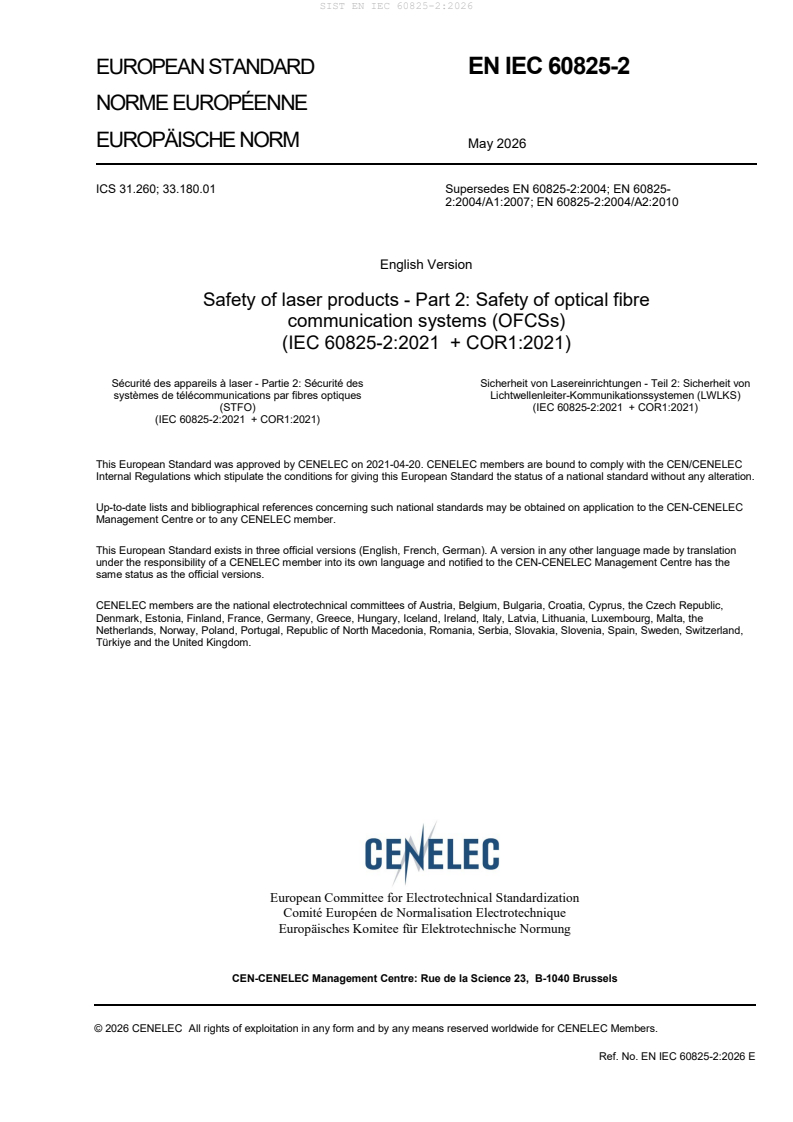
EUROPEAN STANDARD EN IEC 60825-2
NORME EUROPÉENNE
EUROPÄISCHE NORM May 2026
ICS 31.260; 33.180.01 Supersedes EN 60825-2:2004; EN 60825-
2:2004/A1:2007; EN 60825-2:2004/A2:2010
English Version
Safety of laser products - Part 2: Safety of optical fibre
communication systems (OFCSs)
(IEC 60825-2:2021 + COR1:2021)
Sécurité des appareils à laser - Partie 2: Sécurité des Sicherheit von Lasereinrichtungen - Teil 2: Sicherheit von
systèmes de télécommunications par fibres optiques Lichtwellenleiter-Kommunikationssystemen (LWLKS)
(STFO) (IEC 60825-2:2021 + COR1:2021)
(IEC 60825-2:2021 + COR1:2021)
This European Standard was approved by CENELEC on 2021-04-20. CENELEC members are bound to comply with the CEN/CENELEC
Internal Regulations which stipulate the conditions for giving this European Standard the status of a national standard without any alteration.
Up-to-date lists and bibliographical references concerning such national standards may be obtained on application to the CEN-CENELEC
Management Centre or to any CENELEC member.
This European Standard exists in three official versions (English, French, German). A version in any other language made by translation
under the responsibility of a CENELEC member into its own language and notified to the CEN-CENELEC Management Centre has the
same status as the official versions.
CENELEC members are the national electrotechnical committees of Austria, Belgium, Bulgaria, Croatia, Cyprus, the Czech Republic,
Denmark, Estonia, Finland, France, Germany, Greece, Hungary, Iceland, Ireland, Italy, Latvia, Lithuania, Luxembourg, Malta, the
Netherlands, Norway, Poland, Portugal, Republic of North Macedonia, Romania, Serbia, Slovakia, Slovenia, Spain, Sweden, Switzerland,
Türkiye and the United Kingdom.
European Committee for Electrotechnical Standardization
Comité Européen de Normalisation Electrotechnique
Europäisches Komitee für Elektrotechnische Normung
CEN-CENELEC Management Centre: Rue de la Science 23, B-1040 Brussels
© 2026 CENELEC All rights of exploitation in any form and by any means reserved worldwide for CENELEC Members.
Ref. No. EN IEC 60825-2:2026 E
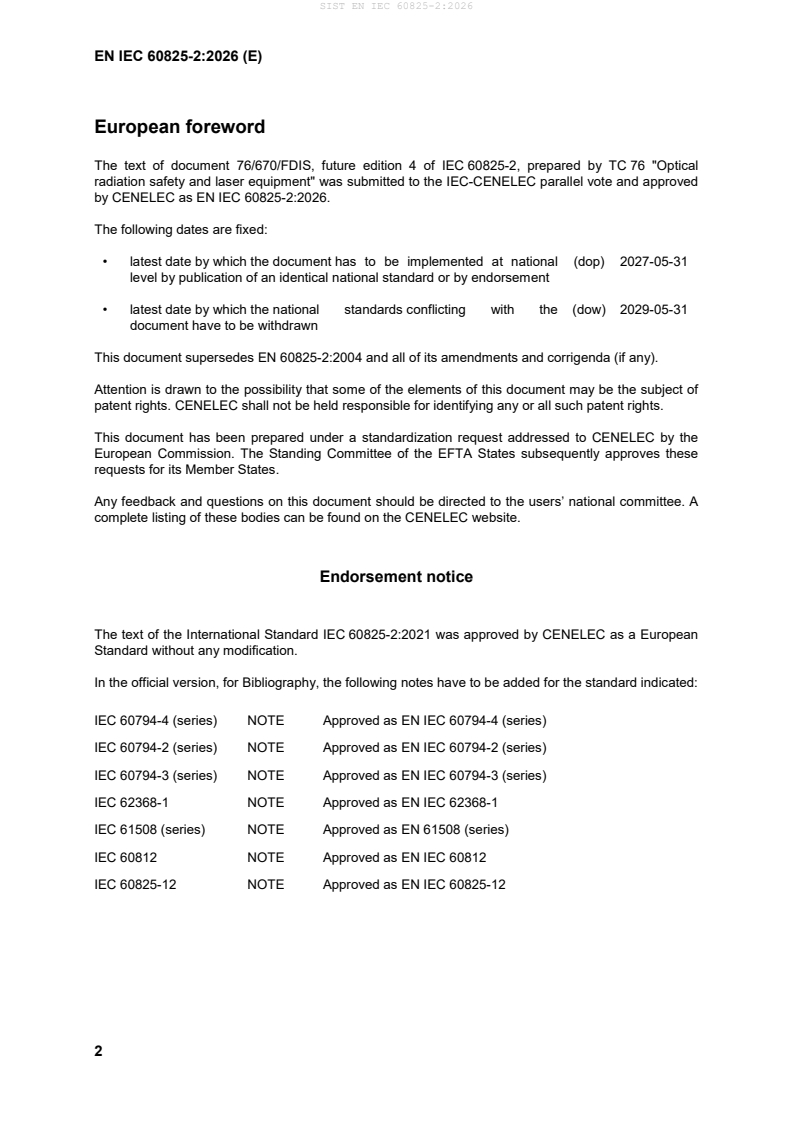
European foreword
The text of document 76/670/FDIS, future edition 4 of IEC 60825-2, prepared by TC 76 "Optical
radiation safety and laser equipment" was submitted to the IEC-CENELEC parallel vote and approved
by CENELEC as EN IEC 60825-2:2026.
The following dates are fixed:
• latest date by which the document has to be implemented at national (dop) 2027-05-31
level by publication of an identical national standard or by endorsement
• latest date by which the national standards conflicting with the (dow) 2029-05-31
document have to be withdrawn
This document supersedes EN 60825-2:2004 and all of its amendments and corrigenda (if any).
Attention is drawn to the possibility that some of the elements of this document may be the subject of
patent rights. CENELEC shall not be held responsible for identifying any or all such patent rights.
This document has been prepared under a standardization request addressed to CENELEC by the
European Commission. The Standing Committee of the EFTA States subsequently approves these
requests for its Member States.
Any feedback and questions on this document should be directed to the users’ national committee. A
complete listing of these bodies can be found on the CENELEC website.
Endorsement notice
The text of the International Standard IEC 60825-2:2021 was approved by CENELEC as a European
Standard without any modification.
In the official version, for Bibliography, the following notes have to be added for the standard indicated:
IEC 60794-4 (series) NOTE Approved as EN IEC 60794-4 (series)
IEC 60794-2 (series) NOTE Approved as EN IEC 60794-2 (series)
IEC 60794-3 (series) NOTE Approved as EN IEC 60794-3 (series)
IEC 62368-1 NOTE Approved as EN IEC 62368-1
IEC 61508 (series) NOTE Approved as EN 61508 (series)
IEC 60812 NOTE Approved as EN IEC 60812
IEC 60825-12 NOTE Approved as EN IEC 60825-12
Annex ZA
(normative)
Normative references to international publications
with their corresponding European publications
The following documents are referred to in the text in such a way that some or all of their content
constitutes requirements of this document. For dated references, only the edition cited applies. For
undated references, the latest edition of the referenced document (including any amendments)
applies.
NOTE 1 Where an International Publication has been modified by common modifications, indicated by (mod),
the relevant EN/HD applies.
NOTE 2 Up-to-date information on the latest versions of the European Standards listed in this annex is available
here: www.cencenelec.eu.
Publication Year Title EN/HD Year
IEC 60825-1 2014 Safety of laser products – Part 1: - -
Equipment classification and
requirements
IEC 60825-2 ®
Edition 4.0 2021-03
INTERNATIONAL
STANDARD
NORME
INTERNATIONALE
Safety of laser products –
Part 2: Safety of optical fibre communication systems (OFCSs)
Sécurité des appareils à laser –
Partie 2: Sécurité des systèmes de télécommunications par fibres optiques
(STFO)
INTERNATIONAL
ELECTROTECHNICAL
COMMISSION
COMMISSION
ELECTROTECHNIQUE
INTERNATIONALE
ICS 31.260; 33.180.01 ISBN 978-2-8322-9366-9
– 2 – IEC 60825-2:2021 © IEC 2021
CONTENTS
FOREWORD . 5
INTRODUCTION . 7
1 Scope . 8
2 Normative references . 8
3 Terms and definitions . 8
4 Requirements . 12
4.1 General . 12
4.2 Protective housing of OFCS . 12
4.3 Fibre cables . 13
4.4 Cable connectors . 13
4.4.1 General . 13
4.4.2 Unrestricted locations . 13
4.4.3 Restricted locations . 13
4.4.4 Controlled locations . 13
4.5 Labelling and marking . 14
4.5.1 General requirements . 14
4.5.2 Marking of connectors of optical transmitters and optical amplifiers . 17
4.5.3 Markings for groups of connectors . 18
4.5.4 Durability – Indelibility requirements for safety markings . 18
4.5.5 Warning for invisible radiation . 18
4.6 Organizational requirements . 18
4.6.1 Manufacturers of ready-to-use OFCSs or turnkey systems . 18
4.6.2 Installation and service organization . 19
4.6.3 Operating organization . 19
4.7 Assessment of hazard level . 20
4.7.1 Determination of hazard level and the use of Condition 2 . 20
4.7.2 Hazard level assignment of OFCS . 20
4.7.3 Additional requirements applicable to all hazard levels . 22
4.7.4 Requirements for transient accessible exposures when using APR . 23
4.7.5 Conditions for tests and assessment . 23
4.8 Automatic power reduction (APR) . 24
4.8.1 General . 24
4.8.2 Automatic restart . 24
4.8.3 Manual restart with assured continuity . 24
4.8.4 Manual restart without assured continuity . 24
4.8.5 Disabling of the APR . 24
4.9 Hazard level requirements by location type . 25
4.9.1 General . 25
4.9.2 Unrestricted locations . 25
4.9.3 Restricted locations . 25
4.9.4 Controlled locations . 26
Annex A (informative) Rationale . 27
Annex B (informative) Clarification of the meaning of "hazard level". 28
B.1 General . 28
B.2 Class . 28
B.3 Hazard level . 28
IEC 60825-2:2021 © IEC 2021 – 3 –
B.4 Rationale to 4.7 . 28
B.5 Rationale to Clause D.5 . 29
Annex C (informative) Methods of hazard/safety analysis . 30
Annex D (informative) Application notes for the safe use of OFCS . 31
D.1 Overview. 31
D.2 Areas of application . 31
D.2.1 Typical OFCS installations . 31
D.2.2 Typical system components . 32
D.2.3 Typical operating functions . 33
D.3 OFCS power limits . 33
D.4 Hazard level evaluation examples . 35
D.4.1 Single wavelength over the same fibre . 35
D.4.2 Multiple wavelengths over the same fibre . 41
D.4.3 Bi-directional (full duplex) transmission. 43
D.4.4 Automatic power reduction . 43
D.4.5 Multiple fibres . 45
D.4.6 Ribbon cable . 45
D.4.7 Power diminution due to power splitters and fibre losses . 47
D.4.8 General considerations and examples . 47
D.5 Fault analysis – Explanation and guidance . 48
D.5.1 General . 48
D.5.2 Commonly used fault analysis techniques . 48
D.5.3 Failure modes, effects, and criticality analysis . 48
D.5.4 Consequence analysis . 48
D.6 Suggested working practices . 50
D.6.1 General working practices . 50
D.6.2 Live working practices for hazard levels 1, 1M, 2, 2M and 3R . 51
D.6.3 Working practices for hazard level 3B . 51
D.6.4 Formal power-down and power-up procedure for hazard level 3B . 51
D.7 Maximum output power during shutdown . 52
Annex E (informative) Guidance for service and maintenance . 54
E.1 Tests and measurements . 54
E.2 Safety precautions . 54
E.2.1 General remarks . 54
E.2.2 Precautions in locations with hazard levels 1M, 2M, 3R and 3B . 55
E.2.3 Training programme . 55
Bibliography . 56
Figure D.1 – PON (passive optical network)-based system . 47
Table 1 – Marking in unrestricted locations . 15
Table 2 – Marking in restricted locations . 16
Table 3 – Marking in controlled locations . 17
Table 4 – Measurement aperture diameters and distances for the default (simplified)
evaluation . 20
Table 5 – Summary of requirements for location types in OFCS . 26
Table D.1 – OFCS power limits for 11 µm mode field diameter (MFD) single-mode (SM)
fibres and 0,18 numerical aperture multimode (MM) fibres (core diameter 50 µm) . 34
– 4 – IEC 60825-2:2021 © IEC 2021
Table D.2 – Relation between the number of fibres in a ribbon fibre and the maximum
permitted power (example) . 46
Table D.3 – Examples of power limits for optical fibre communication systems having
automatic power reduction to reduce emissions to a lower hazard level . 53
IEC 60825-2:2021 © IEC 2021 – 5 –
INTERNATIONAL ELECTROTECHNICAL COMMISSION
____________
SAFETY OF LASER PRODUCTS –
Part 2: Safety of optical fibre communication systems (OFCSs)
FOREWORD
1) The International Electrotechnical Commission (IEC) is a worldwide organization for standardization comprising
all national electrotechnical committees (IEC National Committees). The object of IEC is to promote international
co-operation on all questions concerning standardization in the electrical and electronic fields. To this end and
in addition to other activities, IEC publishes International Standards, Technical Specifications, Technical Reports,
Publicly Available Specifications (PAS) and Guides (hereafter referred to as "IEC Publication(s)"). Their
preparation is entrusted to technical committees; any IEC National Committee interested in the subject dealt with
may participate in this preparatory work. International, governmental and non-governmental organizations liaising
with the IEC also participate in this preparation. IEC collaborates closely with the International Organization for
Standardization (ISO) in accordance with conditions determined by agreement between the two organizations.
2) The formal decisions or agreements of IEC on technical matters express, as nearly as possible, an international
consensus of opinion on the relevant subjects since each technical committee has representation from all
interested IEC National Committees.
3) IEC Publications have the form of recommendations for international use and are accepted by IEC National
Committees in that sense. While all reasonable efforts are made to ensure that the technical content of IEC
Publications is accurate, IEC cannot be held responsible for the way in which they are used or for any
misinterpretation by any end user.
4) In order to promote international uniformity, IEC National Committees undertake to apply IEC Publications
transparently to the maximum extent possible in their national and regional publications. Any divergence between
any IEC Publication and the corresponding national or regional publication shall be clearly indicated in the latter.
5) IEC itself does not provide any attestation of conformity. Independent certification bodies provide conformity
assessment services and, in some areas, access to IEC marks of conformity. IEC is not responsible for any
services carried out by independent certification bodies.
6) All users should ensure that they have the latest edition of this publication.
7) No liability shall attach to IEC or its directors, employees, servants or agents including individual experts and
members of its technical committees and IEC National Committees for any personal injury, property damage or
other damage of any nature whatsoever, whether direct or indirect, or for costs (including legal fees) and
expenses arising out of the publication, use of, or reliance upon, this IEC Publication or any other IEC Publications.
8) Attention is drawn to the Normative references cited in this publication. Use of the referenced publications is
indispensable for the correct application of this publication.
9) Attention is drawn to the possibility that some of the elements of this IEC Publication may be the subject of patent
rights. IEC shall not be held responsible for identifying any or all such patent rights.
International Standard IEC 60825-2 has been prepared by IEC technical committee 76: Optical
radiation safety and laser equipment.
This fourth edition cancels and replaces the third edition published in 2004, Amendment 1:2006
and Amendment 2:2010. This edition constitutes a technical revision.
This edition includes the following significant technical changes with respect to the previous
edition.
a) Recommendations for individual components and subassemblies have been clarified; see
Clause 1, paragraph 3.
b) C has been revised in accordance with IEC 60825-1:2014, but with an additional limitation
related to the skin MPE; see 4.7.2.
c) Condition 2 has been changed, and a detailed description of the measurement and
determination method for hazard level has been added; see 4.7.1 and 4.7.2.
d) Annex B has been moved into 4.9. Annex F has been moved forward as Annex B.
e) Clause D.4 Hazard level evaluation examples – Additional examples have been added.
f) Clause D.5 Fault analysis – Explanation and guidance has been simplified.
– 6 – IEC 60825-2:2021 © IEC 2021
The text of this International Standard is based on the following documents:
FDIS Report on voting
76/670/FDIS 76/674/RVD
Full information on the voting for the approval of this International Standard can be found in the
report on voting indicated in the above table.
This document has been drafted in accordance with the ISO/IEC Directives, Part 2.
A list of all parts in the IEC 60825 series, published under the general title Safety of laser
products, can be found on the IEC website.
The committee has decided that the contents of this document will remain unchanged until the
stability date indicated on the IEC website under "http://webstore.iec.ch" in the data related to
the specific document. At this date, the document will be
• reconfirmed,
• withdrawn,
• replaced by a revised edition, or
• amended.
The contents of the corrigendum of June 2021 have been included in this copy.
IEC 60825-2:2021 © IEC 2021 – 7 –
INTRODUCTION
The objective of this document is to:
– protect people from optical radiation emitted by OFCSs;
– provide requirements for manufacturers, installation organizations, service organizations
and operating organizations in order to establish procedures and supply information so that
proper precautions can be adopted;
– ensure adequate warnings are provided to individuals regarding the potential hazards
associated with OFCSs through the use of signs, labels and instructions.
Annex A gives a more detailed rationale for this document.
The safety of an OFCS depends to a significant degree on the characteristics of the equipment
forming that system. Depending on the characteristics of the equipment, relevant safety
information needs to be marked on the product or included within the instructions for use.
Where required by the level of potential hazard, the installation organization or end-user /
operating organization or both are responsible for the safe deployment and use of OFCSs.
The installation organization and service organization are responsible for adherence to safety
instructions during installation and service operations, respectively. The end-user or operating
organization is responsible for adherence to safety instructions during operation and
maintenance functions.
It is recognized that the user of this document can fall into one or more of the aforementioned
categories of manufacturer, installation organization, end-user or operating organization.
– 8 – IEC 60825-2:2021 © IEC 2021
SAFETY OF LASER PRODUCTS –
Part 2: Safety of optical fibre communication systems (OFCSs)
1 Scope
This document provides requirements and specific guidance for the safe operation and
maintenance of optical fibre communication systems (OFCSs). In these systems, optical power
is possibly accessible outside the confines of the transmitting equipment and/or at great
distance from the optical source.
This document requires the assessment of hazard level at each accessible location of the OFCS
as a replacement for product classification according to IEC 60825-1. It applies to the installed
OFCS as an engineered, end-to-end assembly for the generation, transfer and receipt of optical
radiation arising from lasers, light-emitting diodes (LEDs) or optical amplifiers, in which the
transference is by means of optical fibre for communication and/or control purposes.
NOTE 1 Throughout this document, a reference to 'laser' is taken to include LEDs and optical amplifiers.
Individual components and subassemblies that fall under the definition of a laser product are
subject to the applicable subclause(s) of IEC 60825-1. This document is applicable to individual
components and subassemblies intended to be installed within OFCSs.
This document does not apply to optical fibre systems primarily designed to transmit optical
power for applications such as material processing or medical treatment.
In addition to the hazards resulting from laser radiation, OFCSs possibly give rise to other
hazards, such as fire.
This document does not address safety issues associated with explosion or fire with respect to
OFCSs deployed in explosive atmospheres.
NOTE 2 The hazard presented by optical radiation emerging from a fibre is determined by the wavelength and
power emerging from the fibre and also by the optical characteristics of the fibre itself (see Annex A).
2 Normative references
The following documents are referred to in the text in such a way that some or all of their content
constitutes requirements of this document. For dated references, only the edition cited applies.
For undated references, the latest edition of the referenced document (including any
amendments) applies.
IEC 60825-1:2014, Safety of laser products – Part 1: Equipment classification and requirements
3 Terms and definitions
For the purposes of this document, the terms and definitions given in IEC 60825-1 and the
following apply.
IEC 60825-2:2021 © IEC 2021 – 9 –
ISO and IEC maintain terminological databases for use in standardization at the following
addresses:
• IEC Electropedia: available at http://www.electropedia.org/
• ISO Online browsing platform: available at http://www.iso.org/obp
3.1
accessible location
part or location within an OFCS at which, under reasonably foreseeable events, human access
to laser radiation is possible without the use of a tool
3.2
automatic power reduction
APR
feature of an OFCS whereby the accessible power is reliably reduced to a specified level within
a specified time, whenever there is an event which could result in human exposure to radiation
Note 1 to entry: The term "automatic power reduction" (APR) used in this document encompasses the following
terms used in ITU-T Recommendation G.664 [1]:
– automatic laser shutdown (ALS);
– automatic power reduction (APR);
– automatic power shutdown (APSD).
Note 2 to entry: The term automatic laser shut off (ALSO) has also been used by some manufacturers in the industry.
Note 3 to entry: A fibre-cable break is an example of an event which could result in human exposure to radiation.
3.3
end-user
person or organization using the OFCS in the manner the system was designed to be used
Note 1 to entry: The end-user cannot necessarily control the power generated and transmitted within the system.
Note 2 to entry: If the person or organization is using the OFCS for a communications application in a manner other
than as designed by the manufacturer, then that person/organization assumes the responsibilities defined in this
document applicable to a manufacturer or installation organization.
3.4
hazard level
level of potential hazard at any accessible location within an OFCS
Note 1 to entry: It is based on the level of laser radiation which could become accessible in a reasonably
foreseeable event, e.g. a fibre cable break. It is closely related to the laser classification procedure defined in 5.3 in
IEC 60825-1:2014. The meaning of hazard level is clarified in Annex B.
3.5
hazard level 1
hazard level at which, under a reasonably foreseeable event, human access to laser radiation
(accessible emission), evaluated by the measurement conditions for hazard level 1 as defined
in 4.7.2 a) and 4.7.3, will not exceed the accessible emission limits of Class 1 in IEC 60825-1
for the applicable wavelength and emission duration, with additional constraints as defined in
4.7.2 a)
Note 1 to entry: "Additional constraints" refers to additional and stricter constraints that 4.7.2 a) of this document
places on the values specified in IEC 60825-1:2014 for the accessible emission limits of Class 1 in the wavelength
range 1 200 nm to 1 400 nm.
– 10 – IEC 60825-2:2021 © IEC 2021
3.6
hazard level 1M
hazard level at which, under a reasonably foreseeable event, human access to laser radiation
(accessible emission), evaluated by the measurement conditions for hazard level 1M as defined
in 4.7.2 a) and 4.7.3, will not exceed the accessible emission limits of Class 1 in IEC 60825-1
for the applicable wavelength and emission duration, with additional constraints as defined in
4.7.2 a)
Note 1 to entry: "Additional constraints" refers to additional and stricter constraints that 4.7.2 a) of this document
places on the values specified in IEC 60825-1:2014 for the accessible emission limits of Class 1 in the wavelength
range 1 200 nm to 1 400 nm.
3.7
hazard level 2
hazard level at which, under a reasonably foreseeable event, human access to laser radiation
(accessible emission), evaluated by the measurement conditions for hazard level 2 as defined
in 4.7.2 b) and 4.7.3, will not exceed the accessible emission limits of Class 2 in IEC 60825-1
for the applicable wavelength and emission duration
3.8
hazard level 2M
hazard level at which, under a reasonably foreseeable event, human access to laser radiation
(accessible emission), evaluated by the measurement conditions for hazard level 2M as defined
in 4.7.2 b) and 4.7.3, will not exceed the accessible emission limits of Class 2 in IEC 60825-1
for the applicable wavelength and emission duration
3.9
hazard level 3R
hazard level at which, under a reasonably foreseeable event, human access to laser radiation
(accessible emission), evaluated by the measurement conditions for hazard level 3R as defined
in 4.7.2 c) and 4.7.3, will not exceed the accessible emission limits of Class 3R in IEC 60825-
1 for the applicable wavelength and emission duration, with additional constraints as defined in
4.7.2 c)
Note 1 to entry: "Additional constraints" refers to additional and stricter constraints that 4.7.2 c) of this document
places on the values specified in IEC 60825-1:2014 for the accessible emission limits of Class 3R in the wavelength
range 1 200 nm to 1 400 nm.
3.10
hazard level 3B
hazard level at which, under a reasonably foreseeable event, human access to laser radiation
(accessible emission), evaluated by the measurement conditions for hazard level 3B as defined
in 4.7.2 d) and 4.7.3, will not exceed the accessible emission limits of Class 3B in IEC 60825-
1 for the applicable wavelength and emission duration
3.11
hazard level 4
hazard level at which, under a reasonably foreseeable event, human access to laser radiation
(accessible emission), evaluated by the measurement conditions for hazard level 4 as defined
in 4.7.2 e) and 4.7.3, will exceed the accessible emission limits of Class 3B in IEC 60825-1 for
the applicable wavelength and emission duration
Note 1 to entry: This document is applicable for the operation and maintenance of OFCS. In order to achieve an
adequate level of safety for persons who might come into contact with the optical transmission path, hazard level 4
is not permitted within this document. It is permitted to use protection systems, such as automatic power reduction,
to achieve the required hazard level where the transmitted power under normal operating conditions (e.g. no fault
exists in the fibre path) exceeds that permitted for a particular location type. For instance, it is possible for accessible
parts of an OFCS to be hazard level 1 even though the power transmitted down the fibre under normal operating
conditions is Class 4.
3.12
installation organization
organization or individual that is responsible for the installation of an OFCS
IEC 60825-2:2021 © IEC 2021 – 11 –
3.13
controlled location
location with controlled access
accessible location where an engineering or administrative control is present to make it
inaccessible, except to authorized personnel with appropriate laser safety training
Note 1 to entry: For examples, see D.2.1 a).
3.14
restricted location
location with restricted access
accessible location that is normally inaccessible by the general public by means of any
administrative or engineering control measure, but that is accessible to authorized personnel
who might not have laser safety training
Note 1 to entry: For examples, see D.2.1 b).
3.15
unrestricted location
location with unrestricted access
accessible location where there are no measures restricting access to members of the general
public
Note 1 to entry: For examples, see D.2.1 c).
3.16
manufacturer
organization or individual that constructs or modifies OFCSs by assembling or incorporating
optical devices and other components
Note 1 to entry: Typical components in OFCSs are shown in D.2.2.
3.17
operating organization
organization or individual that is responsible for the operation of an OFCS
3.18
optical fibre communication system
OFCS
engineered, end-to-end assembly for the generation, transfer and reception of optical radiation
arising from lasers, LEDs or optical amplifiers, in which the transference is by means of optical
fibre for communication and/or control purposes
3.19
reasonably foreseeable event
event whose occurrence under given circumstances can be predicted fairly accurately, and the
occurrence probability or frequency of which is not low or very low
Note 1 to entry: Examples of reasonably foreseeable events might include the following: fibre cable break, optical
connector disconnection, operator error or inattention to safe working practices.
Note 2 to entry: Any intentional act to create a hazard is not considered as a reasonably foreseeable event.
3.20
service organization
organization or individual that is responsible for the servicing of an OFCS
– 12 – IEC 60825-2:2021 © IEC 2021
3.21
subassembly
discrete unit, subsystem, network element, or module of an OFCS which contains an optical
emitter or optical amplifier
Note 1 to entry: The definition of subassembly is different from that of optical sub-assembly defined in
IEC TS 62538 [2].
4 Requirements
4.1 General
Clause 0 defines the restrictions that are to be placed on an OFCS and on the location types in
which an OFCS can operate, in accordance with the hazard that arises from optical radiation
becoming accessible as a result of a reasonably foreseeable event, such as an open connector
or fibre break, etc. Whenever one or more alterations are made to an OFCS, the organization
responsible for such alteration(s) shall determine whether each alteration could affect the
originally assigned hazard level. If the originally assigned hazard level has changed, the
organization responsible for the alteration(s) shall, if necessary, re-label those locations in the
system that are accessible so as to ensure continued compliance with this document.
Each accessible location within an OFCS shall be separately assessed to determine the hazard
level at that location. Where multiple communications systems are present at a location, the
hazard level for the location shall be evaluated by the following methods depending on the types
of the fibre cables.
a) For a conventional loose tube fibre optic cable without ribbon fibre structures, the radiation
shall be assessed individually from each of the fibres in a cable, and the maximum radiation
from one fibre shall be used as the basis for the hazard level evaluation.
b) For a ribbon fibre optic cable, the cumulative radiation from one flat ribbon fibre shall be
assessed as either an extended source or a point source, as appropriate.
It is noted that there is no need to perform the complete evaluation for extended sources if the
simplified point source analysis for the ribbon fibres results in a hazard level acceptable to the
operating organization. Additionally, in order to perform the extended source analysis, it is
necessary to know the radiation from each individual fibre in the ribbon. If this information is
not available then a point source analysis using C = 1 is applied.
Based on the determined hazard level, appropriate actions shall be taken to ensure compliance
with this document. These actions could for example involve restriction of access to the location,
or the implementation of additional safety features or redesign of the optical communications
system to reduce the hazard level.
Visual observation of fibre tips using magnifying optics should be avoided in situations where
there is potential for optical emission from the fibre.
Electric power transmitting cables comprising OFCSs with optical fibre cables defined in the
IEC 60794-4 series [3] shall meet the requirements of any applicable electrical standard
besides this document.
4.2 Protective housing of OFCS
Each OFCS shall have a protective housing which, when in place, prevents human access to
laser radiation in excess of hazard level 1 limits under normal operating conditions.
___________
Numbers in square brackets refer to the Bibliography.
IEC 60825-2:2021 © IEC 2021 – 13 –
4.3 Fibre cables
For all hazard levels, the fibre optic cable shall have mechanical properties appropriate to its
physical location. Cables for various physical locations are described in the IEC 60794-2 series
[4], IEC 60794-3 series [5] and IEC 60794-4 series [3]. Where necessary, additional protection,
for example ducting, conduit or raceway, might be required for locations where the fibre would
otherwise be susceptible to damage. Even if the potential hazard at any accessible location
within an OFCS is the lowest hazard level, the mechanical properties need to be considered as
optical power in fibre cable can exceed the MPE.
4.4 Cable connectors
4.4.1 General
The following requirements for cable connectors can be achieved by the mechanical design of
the connectors, or by the positioning of the connector, or by any other suitable means.
Whichever means is chosen, human access to radiation above that permitted for connectors in
a particular location type shall be prevented.
Hazard level is required to be assigned more strictly for connectors than that for fibre cables.
For example in an unrestricted location, accessible radiation level is allowed up to hazard level
1M for cables whereas the accessible radiation from an optical connector is limited to hazard
level 1.
NOTE The use of a tool for disconnection is one example of a mechanical solution.
4.4.2 Unrestricted locations
In unrestricted locations,
– if the accessible radiation level exceeds hazard level 2 within the wavelength range 400 nm
to 700 nm, then suitable means shall limit access to the radiation exceeding hazard level 2
from the connector,
– if the accessible radiation level exceeds hazard level 1 in all other cases, then suitable
means shall limit access to the radiation exceeding hazard level 1 from the connector.
NOTE In an unrestricted location the highest hazard levels are hazard level 2M for the wavelength range 400 nm
to 700 nm and hazard level 1M in all other cases (see 4.9.2).
4.4.3 Restricted locations
In restricted locations,
– if the accessible radiation level exceeds hazard level 2M within the wavelength range
400 nm to 700 nm, then suitable means shall limit access to the radiation exceeding hazard
level 2M from the connector,
– if the accessible radiation level exceeds hazard level 1M in all other cases, then suitable
means shall limit access to the radiation exceeding hazard level 1M from the connector.
NOTE In a restricted location the highest hazard level is hazard level 1M, 2M or 3R, whichever is the higher (see
4.9.3).
4.4.4 Controlled locations
In controlled locations,
– if the accessible radiation level exceeds hazard level 2M within the wavelength range
400 nm to 700 nm, then suitable means shall limit access to the radiation exceeding hazard
level 2M from the connector,
– if the accessible radiation level exceeds hazard level 1M in all other cases, then suitable
means shall limit access to the radiation exceeding hazard level 1M from the connector.
NOTE In a controlled location the highest hazard level is hazard level 3B (see 4.9.4).
– 14 – IEC 60825-2:2021 © IEC 2021
4.5 Labelling and marking
4.5.1 General requirements
Where required by 4.5, each optical connector, splice box or other part emitting radiation when
opened, shall be marked (e.g. with a label, sleeve, tag, tape, etc.), if the hazard level at the
location is in excess of hazard level 1. The information shall consist of the information identified
in Table 1, Table 2 or Table 3, as applicable.
Where the accessible radiation at points of disconnection is hazard level 1 or hazard level 1M,
it is permitted for the above information to be provided in information for the user instead of as
a marking on the product.
Labelling of hazard level 1M is permitted but not mandatory since it is only in restricted or
controlled locations that the connector outputs assigned as hazard level 1M are allowed and
only appropriately trained technical staff are allowed to work in such locations.
Markings shall be coloured black on a yellow background. Labels reproduced in the
documentation provided by the manufacturer or by
...