

SIST EN 14025:2018/oprA1:2020
(Amendment)Tanks for the transport of dangerous goods - Metallic pressure tanks - Design and construction
General Information
- Abstract
This document specifies the minimum requirements for the design and construction of metallic pressure tanks having a maximum working pressure exceeding 50 kPa (0,5 bar), for the transport of dangerous goods by road and rail and sea. This document includes requirements for openings, closures and structural equipment; it does not cover requirements of service equipment. For tanks for the transport of cryogenic liquids, EN 13530 1 and EN 13530 2 apply.
Design and construction of pressure tanks according to the Scope of this document are primarily subject to the requirements of RID/ADR, Subsections 6.8.2.1, 6.8.3.1 and 6.8.5, as relevant. In addition, the relevant requirements of RID/ADR, Table A, columns 12 and 13, to Chapters 3.2, 4.3 and Subsection 6.8.2.4 apply. For the structural equipment RID/ADR, Subsections 6.8.2.2 and 6.8.3.2 apply, as relevant. The definitions of RID/ADR, Subsection 1.2.1, are referred to. For portable tanks see also RID/ADR, Chapter 4.2 and Sections 6.7.2 and 6.7.2. In addition, the relevant requirements of RID/ADR, Table A, Columns 10 and 11 to Chapters 3.2, 4.2, and Sections 6.7.2 and 6.7.3 apply. The paragraph numbers above relate to the 2017 issue of RID/ADR which are subject to regular revisions. This can lead to temporary non-compliances with EN 14025.
This document is applicable to liquefied gases including LPG; however for a dedicated LPG standard see EN 12493.
If not otherwise specified, provisions which take up the whole width of the page apply to all kind of tanks. Provisions contained in a single column apply only to:
tanks according to RID/ADR Chapter 6.8 (left-hand column); portable tanks according to RID/ADR Chapter 6.7 (right-hand column).
- Status
- Not Published
- Public Enquiry End Date
- 02-Feb-2020
- Technical Committee
- TLP - Pressure vessels
- Current Stage
- 98 - Abandoned project (Adopted Project)
- Start Date
- 13-Jan-2020
- Due Date
- 18-Jan-2020
- Completion Date
- 30-Mar-2020

Overview
EN 14025:2018/prA1 - Tanks for the transport of dangerous goods - Metallic pressure tanks - Design and construction - is a CEN standard that specifies the minimum requirements for design and construction of metallic pressure tanks intended for the transport of dangerous goods by road, rail and sea. It applies to metallic pressure tanks with a maximum working pressure exceeding 50 kPa (0.5 bar) and covers structural aspects such as openings, closures and structural equipment. Service equipment requirements are excluded. For cryogenic tanks and dedicated LPG rules, the standard points to EN 13530 series and EN 12493 respectively.
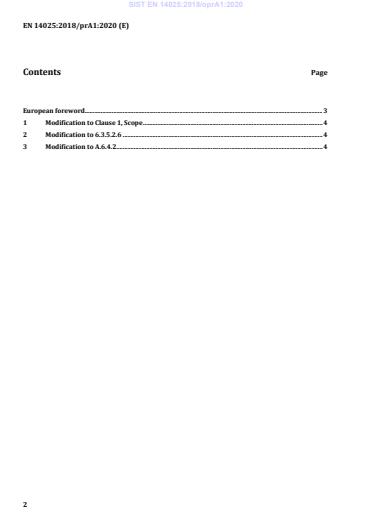
Note: prA1 is a draft amendment submitted to CEN members (January 2020) and includes corrections to the scope, a formula (37) and a pressure symbol in Annex A.
Key topics and technical requirements
- Scope: Metallic pressure tanks for transport of dangerous goods (road, rail, sea); portable tanks guidance referenced to RID/ADR chapters.
- Design & construction criteria: Minimum structural requirements, strength calculations and construction rules for tanks with working pressure >50 kPa.
- Openings and closures: Requirements for manholes, valves, fittings and closures to ensure containment during transport.
- Structural equipment: Supports, saddles, mounting and protective structures; provisions differ for tanks under RID/ADR Chapters 6.8 (tanks) and 6.7 (portable tanks).
- Regulatory alignment: Designed primarily in the context of RID/ADR requirements (subsections and table columns referenced in the standard); definitions are aligned with RID/ADR Subsection 1.2.1.
- Corrections in prA1: scope references for portable tanks corrected; Formula (37) corrected; symbol for actual pressure in A.6.4.2 corrected (actual pressure P = 0.04 MPa).
Applications and who uses this standard
- Tank manufacturers and designers: for design validation, material selection and welding/construction requirements of metallic pressure tanks.
- Compliance and certification bodies: for conformity assessment against RID/ADR and national transposition of EN 14025.
- Transport operators and fleet engineers: to verify tanks meet structural integrity and safety requirements for hazardous goods transport.
- Inspection and maintenance organizations: to interpret design limits, openings/closures requirements and structural equipment criteria during inspections.
- Regulators and consultants: for aligning national rules with European ADR/RID provisions referenced by the standard.
Related standards and references
- RID/ADR: Primary regulatory framework referenced throughout (Chapters 3.2, 4.2, 4.3, 6.7, 6.8 and Table A columns).
- EN 13530-1 / EN 13530-2: for tanks transporting cryogenic liquids.
- EN 12493: dedicated LPG tank standard.
This standard is essential for safe, compliant design and construction of metallic pressure tanks used in the transport of dangerous goods and should be used together with the RID/ADR regulatory texts and the related EN standards listed above.
Relations
- Effective Date
- 01-Jan-2020
Get Certified
Connect with accredited certification bodies for this standard

CIS Institut d.o.o.
Personal Protective Equipment (PPE) certification body. Notified Body NB-2890 for EU Regulation 2016/425 PPE.
Institut za varilstvo d.o.o. (Welding Institute)
Slovenia's leading welding institute since 1952. ISO 3834, EN 1090, pressure equipment certification, NDT personnel, welder qualification. Only IIW Au

Kiwa BDA Testing
Building and construction product certification.
Sponsored listings
Frequently Asked Questions
SIST EN 14025:2018/oprA1:2020 is a draft published by the Slovenian Institute for Standardization (SIST). Its full title is "Tanks for the transport of dangerous goods - Metallic pressure tanks - Design and construction". This standard covers: This document specifies the minimum requirements for the design and construction of metallic pressure tanks having a maximum working pressure exceeding 50 kPa (0,5 bar), for the transport of dangerous goods by road and rail and sea. This document includes requirements for openings, closures and structural equipment; it does not cover requirements of service equipment. For tanks for the transport of cryogenic liquids, EN 13530 1 and EN 13530 2 apply. Design and construction of pressure tanks according to the Scope of this document are primarily subject to the requirements of RID/ADR, Subsections 6.8.2.1, 6.8.3.1 and 6.8.5, as relevant. In addition, the relevant requirements of RID/ADR, Table A, columns 12 and 13, to Chapters 3.2, 4.3 and Subsection 6.8.2.4 apply. For the structural equipment RID/ADR, Subsections 6.8.2.2 and 6.8.3.2 apply, as relevant. The definitions of RID/ADR, Subsection 1.2.1, are referred to. For portable tanks see also RID/ADR, Chapter 4.2 and Sections 6.7.2 and 6.7.2. In addition, the relevant requirements of RID/ADR, Table A, Columns 10 and 11 to Chapters 3.2, 4.2, and Sections 6.7.2 and 6.7.3 apply. The paragraph numbers above relate to the 2017 issue of RID/ADR which are subject to regular revisions. This can lead to temporary non-compliances with EN 14025. This document is applicable to liquefied gases including LPG; however for a dedicated LPG standard see EN 12493. If not otherwise specified, provisions which take up the whole width of the page apply to all kind of tanks. Provisions contained in a single column apply only to: tanks according to RID/ADR Chapter 6.8 (left-hand column); portable tanks according to RID/ADR Chapter 6.7 (right-hand column).
This document specifies the minimum requirements for the design and construction of metallic pressure tanks having a maximum working pressure exceeding 50 kPa (0,5 bar), for the transport of dangerous goods by road and rail and sea. This document includes requirements for openings, closures and structural equipment; it does not cover requirements of service equipment. For tanks for the transport of cryogenic liquids, EN 13530 1 and EN 13530 2 apply. Design and construction of pressure tanks according to the Scope of this document are primarily subject to the requirements of RID/ADR, Subsections 6.8.2.1, 6.8.3.1 and 6.8.5, as relevant. In addition, the relevant requirements of RID/ADR, Table A, columns 12 and 13, to Chapters 3.2, 4.3 and Subsection 6.8.2.4 apply. For the structural equipment RID/ADR, Subsections 6.8.2.2 and 6.8.3.2 apply, as relevant. The definitions of RID/ADR, Subsection 1.2.1, are referred to. For portable tanks see also RID/ADR, Chapter 4.2 and Sections 6.7.2 and 6.7.2. In addition, the relevant requirements of RID/ADR, Table A, Columns 10 and 11 to Chapters 3.2, 4.2, and Sections 6.7.2 and 6.7.3 apply. The paragraph numbers above relate to the 2017 issue of RID/ADR which are subject to regular revisions. This can lead to temporary non-compliances with EN 14025. This document is applicable to liquefied gases including LPG; however for a dedicated LPG standard see EN 12493. If not otherwise specified, provisions which take up the whole width of the page apply to all kind of tanks. Provisions contained in a single column apply only to: tanks according to RID/ADR Chapter 6.8 (left-hand column); portable tanks according to RID/ADR Chapter 6.7 (right-hand column).
SIST EN 14025:2018/oprA1:2020 is classified under the following ICS (International Classification for Standards) categories: 13.300 - Protection against dangerous goods; 23.020.20 - Vessels and containers mounted on vehicles. The ICS classification helps identify the subject area and facilitates finding related standards.
SIST EN 14025:2018/oprA1:2020 has the following relationships with other standards: It is inter standard links to SIST EN 14025:2018. Understanding these relationships helps ensure you are using the most current and applicable version of the standard.
SIST EN 14025:2018/oprA1:2020 is associated with the following European legislation: EU Directives/Regulations: 2008/68/EC; Standardization Mandates: M/086, M/TDG. When a standard is cited in the Official Journal of the European Union, products manufactured in conformity with it benefit from a presumption of conformity with the essential requirements of the corresponding EU directive or regulation.
SIST EN 14025:2018/oprA1:2020 is available in PDF format for immediate download after purchase. The document can be added to your cart and obtained through the secure checkout process. Digital delivery ensures instant access to the complete standard document.
Standards Content (Sample)
SLOVENSKI STANDARD
01-januar-2020
Cisterne za prevoz nevarnega blaga - Kovinske tlačne posode - Konstruiranje in
izdelava
Tanks for the transport of dangerous goods - Metallic pressure tanks - Design and
construction
Tanks für die Beförderung gefährlicher Güter - Metallische Drucktanks - Auslegung und
Bau
Citernes pour le transport de matières dangereuses - Citernes métalliques sous pression
- Conception et fabrication
Ta slovenski standard je istoveten z: EN 14025:2018/prA1
ICS:
13.300 Varstvo pred nevarnimi Protection against dangerous
izdelki goods
23.020.20 Posode in vsebniki, montirani Vessels and containers
na vozila mounted on vehicles
2003-01.Slovenski inštitut za standardizacijo. Razmnoževanje celote ali delov tega standarda ni dovoljeno.
DRAFT
EUROPEAN STANDARD
EN 14025:2018
NORME EUROPÉENNE
EUROPÄISCHE NORM
prA1
January 2020
ICS 13.300; 23.020.20
English Version
Tanks for the transport of dangerous goods - Metallic
pressure tanks - Design and construction
Citernes pour le transport de matières dangereuses - Tanks für die Beförderung gefährlicher Güter -
Citernes métalliques sous pression - Conception et Metallische Drucktanks - Auslegung und Bau
fabrication
This draft amendment is submitted to CEN members for enquiry. It has been drawn up by the Technical Committee CEN/TC 296.
This draft amendment A1, if approved, will modify the European Standard EN 14025:2018. If this draft becomes an amendment,
CEN members are bound to comply with the CEN/CENELEC Internal Regulations which stipulate the conditions for inclusion of
this amendment into the relevant national standard without any alteration.
This draft amendment was established by CEN in three official versions (English, French, German). A version in any other
language made by translation under the responsibility of a CEN member into its own language and notified to the CEN-CENELEC
Management Centre has the same status as the official versions.
CEN members are the national standards bodies of Austria, Belgium, Bulgaria, Croatia, Cyprus, Czech Republic, Denmark, Estonia,
Finland, France, Germany, Greece, Hungary, Iceland, Ireland, Italy, Latvia, Lithuania, Luxembourg, Malta, Netherlands, Norway,
Poland, Portugal, Republic of North Macedonia, Romania, Serbia, Slovakia, Slovenia, Spain, Sweden, Switzerland, Turkey and
United Kingdom.
Recipients of this draft are invited to submit, with their comments, notification of any relevant patent rights of which they are
aware and to provide supporting documentation.
Warning : This document is not a Eur
...