Eurocode 3: Design of steel structures - Part 1-9: Fatigue

TC - Modifications to Clauses 2, 3, 4, 5, 8 and Subclause 7.1 (including modifications from EN 1993-1-9:2005/AC:2005).

Eurocode 3: Bemessung und Konstruktion von Stahlbauten - Teil 1-9: Ermüdung

Eurocode 3: Calcul des structures en acier - Partie 1-9: Fatigue

Evrokod 3: Projektiranje jeklenih konstrukcij - 1-9. del: Utrujanje

General Information

Status
Published
Publication Date
04-May-2009
Technical Committee
Current Stage
6060 - National Implementation/Publication (Adopted Project)
Start Date
14-Apr-2009
Due Date
19-Jun-2009
Completion Date
05-May-2009

Relations

Corrigendum
SIST EN 1993-1-9:2005/AC:2009
English language
5 pages
sale 10% off
Preview
sale 10% off
Preview
e-Library read for
1 day

Frequently Asked Questions

SIST EN 1993-1-9:2005/AC:2009 is a corrigendum published by the Slovenian Institute for Standardization (SIST). Its full title is "Eurocode 3: Design of steel structures - Part 1-9: Fatigue". This standard covers: TC - Modifications to Clauses 2, 3, 4, 5, 8 and Subclause 7.1 (including modifications from EN 1993-1-9:2005/AC:2005).

TC - Modifications to Clauses 2, 3, 4, 5, 8 and Subclause 7.1 (including modifications from EN 1993-1-9:2005/AC:2005).

SIST EN 1993-1-9:2005/AC:2009 is classified under the following ICS (International Classification for Standards) categories: 91.010.30 - Technical aspects; 91.080.13 - Steel structures. The ICS classification helps identify the subject area and facilitates finding related standards.

SIST EN 1993-1-9:2005/AC:2009 has the following relationships with other standards: It is inter standard links to SIST EN 1993-1-9:2005/AC:2006, SIST EN 1993-1-9:2005, kSIST FprEN 1993-1-9:2024. Understanding these relationships helps ensure you are using the most current and applicable version of the standard.

SIST EN 1993-1-9:2005/AC:2009 is associated with the following European legislation: EU Directives/Regulations: 2005-01-4408, 305/2011, 89/106/EEC; Standardization Mandates: M/265, M/BC/CEN/89/11. When a standard is cited in the Official Journal of the European Union, products manufactured in conformity with it benefit from a presumption of conformity with the essential requirements of the corresponding EU directive or regulation.

You can purchase SIST EN 1993-1-9:2005/AC:2009 directly from iTeh Standards. The document is available in PDF format and is delivered instantly after payment. Add the standard to your cart and complete the secure checkout process. iTeh Standards is an authorized distributor of SIST standards.

Standards Content (Sample)


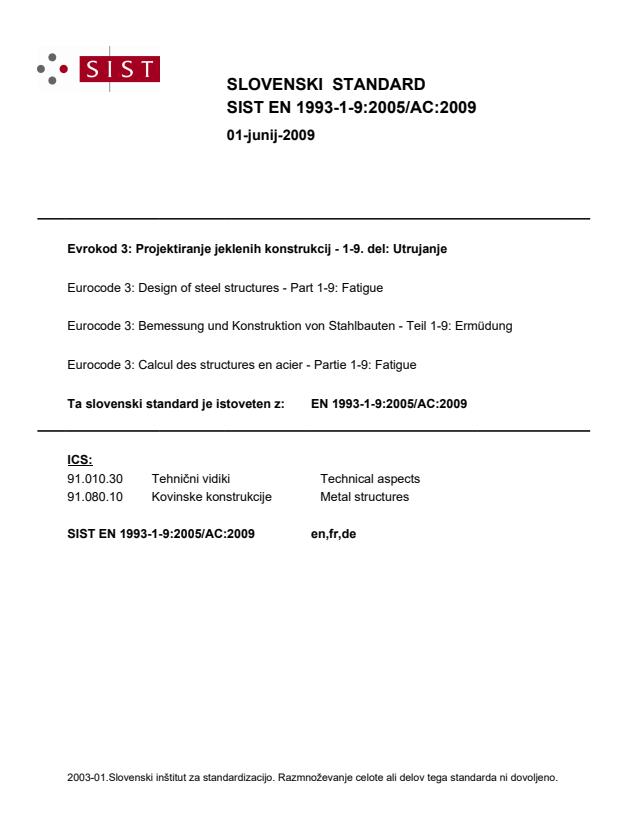
2003-01.Slovenski inštitut za standardizacijo. Razmnoževanje celote ali delov tega standarda ni dovoljeno.Evrokod 3: Projektiranje jeklenih konstrukcij - 1-9. del: UtrujanjeEurocode 3: Bemessung und Konstruktion von Stahlbauten - Teil 1-9: ErmüdungEurocode 3: Calcul des structures en acier - Partie 1-9: FatigueEurocode 3: Design of steel structures - Part 1-9: Fatigue91.080.10Kovinske konstrukcijeMetal structures91.010.30Technical aspectsICS:Ta slovenski standard je istoveten z:EN 1993-1-9:2005/AC:2009SIST EN 1993-1-9:2005/AC:2009en,fr,de01-junij-2009SIST EN 1993-1-9:2005/AC:2009SLOVENSKI
STANDARD
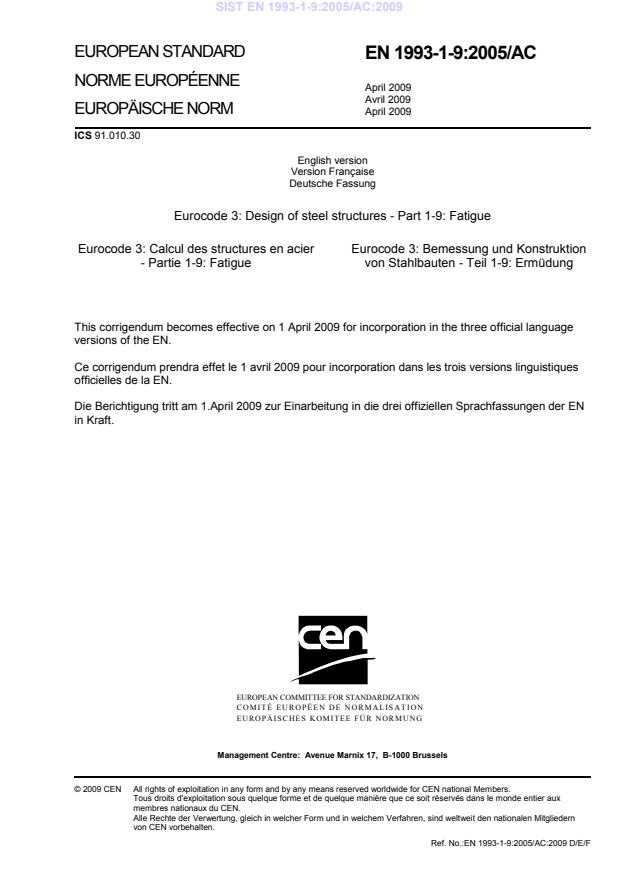
EUROPEAN STANDARD NORME EUROPÉENNE EUROPÄISCHE NORM
EN 1993-1-9:2005/AC
April 2009
Avril 2009
April 2009 ICS 91.010.30 English version Version Française Deutsche Fassung
Eurocode 3: Design of steel structures - Part 1-9: Fatigue
Eurocode 3: Calcul des structures en acier - Partie 1-9: Fatigue
Eurocode 3: Bemessung und Konstruktion von Stahlbauten - Teil 1-9: Ermüdung This corrigendum becomes effective on 1 April 2009 for incorporation in the three official language versions of the EN.
Ce corrigendum prendra effet le 1 avril 2009 pour incorporation dans les trois versions linguistiques officielles de la EN.
Die Berichtigung tritt am 1.April 2009 zur Einarbeitung in die drei offiziellen Sprachfassungen der EN in Kraft.
EUROPEAN COMMITTEE FOR STANDARDIZATION
COMITÉ EUROPÉEN DE NORMALISATION EUROPÄISCHES KOMITEE FÜR NORMUNG
Management Centre:
Avenue Marnix 17,
B-1000 Brussels © 2009 CEN All rights of exploitation in any form and by any means reserved worldwide for CEN national Members. Tous droits d'exploitation sous quelque forme et de quelque manière que ce soit réservés dans le monde entier aux membres nationaux du CEN. Alle Rechte der Verwertung, gleich in welcher Form und in welchem Verfahren, sind weltweit den nationalen Mitgliedern von CEN vorbehalten. Ref. No.:EN 1993-1-9:2005/AC:2009 D/E/FSIST EN 1993-1-9:2005/AC:2009

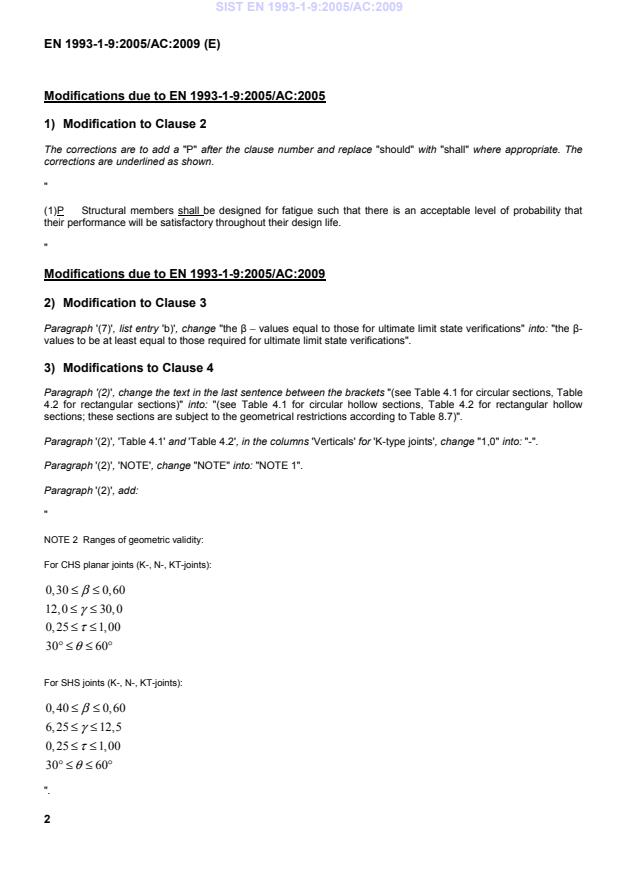
" (1)P Structural members shall be designed for fatigue such that there is an acceptable level of probability that their performance will be satisfactory throughout their design life. " Modifications due to EN 1993-1-9:2005/AC:2009 2) Modification to Clause 3 Paragraph '(7)', list entry 'b)', change "the
– values equal to those for ultimate limit state verifications" into: "the -values to be at least equal to those required for ultimate limit state verifications". 3) Modifications to Clause 4 Paragraph '(2)', change the text in the last sentence between the brackets "(see Table 4.1 for circular sections, Table 4.2 for rectangular sections)" into: "(see Table 4.1 for circular hollow sections, Table 4.2 for rectangular hollow sections; these sections are subject to the geometrical restrictions ac
...

Questions, Comments and Discussion

Ask us and Technical Secretary will try to provide an answer. You can facilitate discussion about the standard in here.

Loading comments...

SIST EN 1993-1-9:2005/AC:2009は、鉄鋼構造物の設計における疲労に関する重要な基準であり、特にその範囲にはCLAUSE 2、3、4、5、8およびサブクローズ7.1の改訂が含まれています。この標準は、鉄鋼構造物の耐久性を確保し、設計者が構造物の疲労寿命を適切に評価できるようにするための指針を提供します。 この標準の強みは、欧州全体で広く適用されているEurocodeの体系に組み込まれていることで、国際的な整合性を確保している点です。また、疲労に関する詳細な計算方法とデザイン原則が提供されているため、設計者にとって非常に実用的です。特に、複雑な鉄鋼構造において、疲労破損のリスクを低減するための具体的な手引きを提供しており、技術者は安全性の高い設計を行うことができます。 さらに、SIST EN 1993-1-9:2005/AC:2009は、最新の研究成果や技術の進歩を反映しており、建設業界における鉄鋼構造物の安全基準の向上に寄与しています。この標準を遵守することにより、設計者はより信頼性の高い構造を提供でき、結果として全体的な構造物のパフォーマンスを向上させることができます。したがって、この基準は現代の土木・建築業界において非常に重要な役割を果たしています。

Die Norm SIST EN 1993-1-9:2005/AC:2009 behandelt den Eurocode 3, der sich mit dem Entwurf von Stahlkonstruktionen befasst, insbesondere im Hinblick auf Ermüdung. Diese Norm stellt eine wesentliche Grundlage für die Berechnung und das Design von Stahlstrukturen dar, und ihre Bedeutung zeigt sich in der klaren Strukturierung der relevanten Anpassungen an den bestehenden Klauseln 2, 3, 4, 5, 8 und Unterklausel 7.1. Ein hervorstechendes Merkmal der Norm ist die umfassende Analyse der Ermüdungserscheinungen in Stahlkonstruktionen. Die klare Definition der Parameter und die Modifikationen, die aus der vorhergehenden Version EN 1993-1-9:2005/AC:2005 übernommen wurden, gewährleisten eine hohe Relevanz und Praxisnähe, insbesondere für Ingenieure und Planer, die im Bereich des Stahlbaus tätig sind. Die Stärkung der Festlegungen in den modifizierten Klauseln trägt dazu bei, dass die Norm nicht nur theoretische Anforderungen, sondern auch praktische Umsetzungshinweise für das Design von Stahlstrukturen in verschiedenen Anwendungsszenarien bietet. Zudem berücksichtigt die Norm aktuelle Entwicklungen und Erkenntnisse im Bereich der Materialwissenschaft und der Baupraktiken, was ihre Anwendung in der modernen Bauindustrie zusätzlich fördert. Darüber hinaus trägt die Norm zur Sicherheit und Zuverlässigkeit von Bauwerken bei, indem sie Materialien, Konstruktionen und Lasten analysiert, um die Langlebigkeit der Strukturen zu gewährleisten. Dies ist von besonderer Bedeutung für Projekte, die erhöhten Ermüdungsbelastungen ausgesetzt sind, wie beispielsweise Brücken und Industriebauten. Insgesamt zeichnet sich die SIST EN 1993-1-9:2005/AC:2009 durch ihre fundierten Modifikationen und klaren Richtlinien aus, die nicht nur die strukturelle Integrität von Stahlkonstruktionen sichern, sondern auch als Leitfaden für Best Practices in der Ingenieurpraxis dienen.

La norme SIST EN 1993-1-9:2005/AC:2009, qui fait partie de l'Eurocode 3, aborde de manière essentielle la conception des structures en acier, en se concentrant sur la fatigue. Cette norme est cruciale pour les ingénieurs et les concepteurs du secteur de la construction, car elle précise les exigences relatives à la durabilité des structures métalliques dans des conditions de chargement répétées. L'un des points forts de cette norme est la mise à jour et les modifications apportées aux clauses 2, 3, 4, 5, 8 et à la sous-clause 7.1. Ces ajustements sont particulièrement pertinents pour intégrer des connaissances récentes et des applications pratiques qui répondent aux besoins actuels du secteur. En révisant ces clauses, la norme offre une base solide pour assurer la sécurité et la pérennité des structures en acier face aux problèmes de fatigue. Par ailleurs, la pertinence de la norme SIST EN 1993-1-9:2005/AC:2009 réside dans son approche systématique orientée vers l’analyse approfondie des cycles de charge, permettant ainsi aux ingénieurs de mieux évaluer les performances à long terme des éléments sous contrainte. Cela est primordial pour garantir que les structures en acier peuvent résister non seulement aux efforts initiaux mais également aux effets cumulés des charges alternées qui peuvent compromettre leur intégrité dans le temps. En résumé, la norme SIST EN 1993-1-9:2005/AC:2009 est un document fondamental qui renforce considérablement les pratiques de conception dans l’ingénierie des structures en acier. Grâce à son actualisation et à son engagement envers l’excellence technique, elle demeure un outil incontournable pour les professionnels du secteur.

SIST EN 1993-1-9:2005/AC:2009 표준은 철강 구조물의 설계를 규명하는 유로코드 3의 중요한 파트로, 피로 현상에 대한 명확한 지침을 제공합니다. 이 표준의 범위는 조항 2, 3, 4, 5, 8 및 하위 조항 7.1의 수정사항을 포함하며, 이는 EN 1993-1-9:2005/AC:2005에서 발생한 수정도 반영하고 있습니다. 이 표준의 강점 중 하나는 피로 수명 예측에 대한 포괄적인 접근 방식을 제공한다는 점입니다. 이를 통해 엔지니어들은 다양한 사용 조건에서 철강 구조물의 신뢰성을 극대화할 수 있습니다. 또한, 표준은 다양한 부하 조건에 대한 내구성을 평가할 수 있는 명확한 계산 방법을 채택하여, 실제 사용 환경에서 구조물의 성능을 보다 정확하게 반영합니다. SIST EN 1993-1-9:2005/AC:2009는 또한 구조 설계의 최신 동향과 기술 발전을 반영함으로써, 엔지니어들이 보다 현대적인 요구사항을 충족할 수 있도록 돕습니다. 이 표준은 피로를 포함한 구조물의 전반적인 안정성을 보장하는 데 필수적인 기초 자료로 작용하며, 철강 구조물의 안전성을 제고하는 중요한 역할을 합니다. 전반적으로, 이 표준은 건설 산업의 핵심 요소인 철강 구조물의 피로 설계에 대한 명확하고 신뢰할 수 있는 기준을 제공하며, 지속 가능한 구조 설계를 위한 필수적인 자료로 평가됩니다.

The standard SIST EN 1993-1-9:2005/AC:2009, titled "Eurocode 3: Design of steel structures - Part 1-9: Fatigue," presents crucial guidelines specifically related to the fatigue design of steel structures. This document is paramount for engineers and architects, ensuring that design practices comply with established norms within the European framework for steel structure development. The scope of this standard encompasses essential modifications to Clauses 2, 3, 4, 5, 8, and Subclause 7.1, including necessary updates derived from EN 1993-1-9:2005/AC:2005. This comprehensive inclusion not only clarifies the requirements for fatigue design but also addresses specific scenarios that may affect the integrity and longevity of steel structures. By focusing on fatigue, the standard recognizes the critical impact of cyclic loading on structural components, thereby enhancing the safety and durability of engineering projects. One of the significant strengths of SIST EN 1993-1-9:2005/AC:2009 is its rigor in addressing modifications based on real-world applications and empirical data. The standard effectively integrates advancements in design methodologies and analytical techniques, ensuring that structural engineers are equipped with current best practices. Furthermore, the clarity and precision of the language used within the document facilitate a better understanding and implementation of the guidelines, fostering compliance across various projects. Additionally, the relevance of this standard is underscored by the increasing demand for sustainable and reliable construction solutions. As the industry shifts towards minimizing maintenance costs and enhancing structural resilience, the adoption of fatigue design principles laid out in this standard becomes increasingly critical. With its systematic approach to addressing fatigue, the SIST EN 1993-1-9:2005/AC:2009 serves as an invaluable resource for professionals striving to achieve both safety and performance excellence in steel structure design. In sum, the standard embodies a forward-looking perspective on structural integrity and longevity while ensuring that practitioners are well-informed of the latest methodologies in fatigue design. Its comprehensive updates and modifications further solidify its role as a foundational document in the ongoing evolution of steel construction standards in Europe.