

SIST EN IEC 61169-54:2021/kFprA1:2026
(Amendment)Amendment 1 - Radio frequency connectors - Part 54: Sectional specification for coaxial connectors with 10 mm inner diameter of outer conductor, nominal characteristic impedance 50 Ω, Series 4,3-10
- Status
- Not Published
- Public Enquiry End Date
- 09-Oct-2025
- Technical Committee
- MOC - Mobile Communications
- Current Stage
- 5020 - Formal vote (FV) (Adopted Project)
- Start Date
- 28-Jul-2026
- Due Date
- 15-Sep-2026
- Completion Date
- 03-Aug-2026


SIST EN IEC 61169-54:2021/kFprA1:2026 is the Slovenian adoption of an IEC amendment for radio frequency connectors, published by SIST. It updates Part 54 for coaxial connectors with 10 mm inner diameter of outer conductor, nominal characteristic impedance 50 Ω, Series 4,3-10. In practice, it changes the mechanical data for screw type connectors, especially the coupling torque used to keep connections secure in service.
What does SIST EN IEC 61169-54:2021/kFprA1:2026 specify?
SIST EN IEC 61169-54:2021/kFprA1:2026 specifies an amendment to Part 54 of the IEC 61169 series for Series 4,3-10 coaxial RF connectors. Its main purpose is to update the coupling torque for screw type connectors and the related mechanical data table.
The amendment is organized around a short purpose statement, a replacement of the mechanical data in table 8 of IEC 61169-54 Edition 2 2021-08, and a brief reasoning note. For engineers and buyers, that means the document should be read together with the base Part 54, because it changes one mechanical performance area rather than replacing the whole connector specification.
What are the key requirements of SIST EN IEC 61169-54:2021/kFprA1:2026?
The key change in SIST EN IEC 61169-54:2021/kFprA1:2026 is the revised strength of coupling mechanism for screw type connectors. The amendment raises the permitted coupling torque so connectors are less likely to loosen under vibration, which matters for outdoor and tower-mounted installations.
Mechanical performance data
The amendment replaces the mechanical data in table 8 and keeps the structure of the connector checks used in Part 54. The table covers:
- Centre contact captivation - the centre contact is limited in axial movement and checked with an axial force.
- Engagement and separation force - the forces needed to mate and unmate the connector, with separate entries for push pull connectors.
- Strength of coupling mechanism - the coupling torque and proof torque for screw type connectors.
- Insertion force - the force needed at the centre contact and outer contact.
- Mechanical tests on cable fixing - cable rotation, pulling, bending, and torsion.
For users, this means the amendment affects how manufacturers verify connector retention, mating behavior, and resistance to misuse or field loads.
Torque-related behavior in service
The reasoning behind the change is practical: customers reported loosening of screw type connections under tower vibrations. Tests confirmed that a higher coupling torque solved the problem, and the amendment aligns the connector choice with that field behavior.
For design and quality teams, the important point is that coupling torque is not just a theoretical value. It is tied to real installation conditions, so test plans and product approval should reflect the revised torque behavior.
Test and verification focus
The referenced subclauses in the mechanical data table point to the checks used to confirm connector performance. These are the measures manufacturers and laboratories use when validating a connector design, especially where vibration, repeated mating, or cable strain may affect reliability.
What terms does SIST EN IEC 61169-54:2021/kFprA1:2026 define?
- Coupling torque - the tightening torque used when mating a screw type connector.
- Proof torque - the higher torque used to check that the coupling mechanism withstands more than the coupling torque.
- Centre contact captivation - the retention of the centre contact against unwanted axial movement.
- Engagement and separation force - the axial force needed to connect and disconnect the connector.
- Nominal characteristic impedance - the stated impedance value of 50 Ω for this connector series.
- Screw type - a connector type that uses threaded coupling rather than push-pull action.
- Push pull - a connector type that mates and separates by axial pushing and pulling.
Who uses SIST EN IEC 61169-54:2021/kFprA1:2026?
SIST EN IEC 61169-54:2021/kFprA1:2026 is used by RF connector manufacturers, especially those making Series 4,3-10 screw type coaxial connectors. It is also used by design engineers, test laboratories, and quality managers who need to verify coupling torque, force behavior, and cable fixing performance.
In practice, it supports work in the RF and microwave passive components field, where connector loosening, mating force, and mechanical retention affect field reliability. Buyers and technical evaluators use it to compare products against the same mechanical performance basis.
What changed in SIST EN IEC 61169-54:2021/kFprA1:2026 from the previous edition?
SIST EN IEC 61169-54:2021/kFprA1:2026 amends IEC 61169-54 Edition 2 2021-08 by changing the coupling torque for screw type connectors. The reasoning states that the earlier torque limit allowed loosening under tower vibration, and test results showed that a higher torque solved the problem without requiring design changes from manufacturers.
Which standards are used with SIST EN IEC 61169-54:2021/kFprA1:2026?
- IEC 61169-54 Edition 2 2021-08 - the base Part 54 that this amendment updates, including the replaced mechanical data table.
- EN IEC 61169-54:2021/prA1:2025 - the European parallel amendment identified with the same technical subject.
What does the SIST EN IEC 61169-54:2021/kFprA1:2026 document contain?
The document contains the amendment front matter, the stated purpose of the change, the replacement of table 8 mechanical data, and a short reasoning note. The table identifies the connector checks used for centre contact retention, mating and separation force, coupling mechanism strength, insertion force, and cable fixing tests.
For engineers and test teams, that means the document is mainly a mechanical update to an existing connector specification, not a full rewrite of the series. It is used when designing, testing, and approving screw type Series 4,3-10 RF connectors for service where vibration and cable loads matter.
Relations
- Effective Date
- 15-Apr-2025
Get Certified
Connect with accredited certification bodies for this standard

ANCE
Mexican certification and testing association.

Intertek Slovenia
Intertek testing, inspection, and certification services in Slovenia.

LNE (Laboratoire National de Métrologie et d'Essais)
French national laboratory for metrology and testing.
Sponsored listings
Frequently Asked Questions
SIST EN IEC 61169-54:2021/kFprA1:2026 is a draft published by the Slovenian Institute for Standardization (SIST). Its full title is "Amendment 1 - Radio frequency connectors - Part 54: Sectional specification for coaxial connectors with 10 mm inner diameter of outer conductor, nominal characteristic impedance 50 Ω, Series 4,3-10". This standard covers: Amendment 1 - Radio frequency connectors - Part 54: Sectional specification for coaxial connectors with 10 mm inner diameter of outer conductor, nominal characteristic impedance 50 Ω, Series 4,3-10
Amendment 1 - Radio frequency connectors - Part 54: Sectional specification for coaxial connectors with 10 mm inner diameter of outer conductor, nominal characteristic impedance 50 Ω, Series 4,3-10
SIST EN IEC 61169-54:2021/kFprA1:2026 is classified under the following ICS (International Classification for Standards) categories: 33.120.30 - RF connectors. The ICS classification helps identify the subject area and facilitates finding related standards.
SIST EN IEC 61169-54:2021/kFprA1:2026 has the following relationships with other standards: It is inter standard links to SIST EN IEC 61169-54:2021. Understanding these relationships helps ensure you are using the most current and applicable version of the standard.
SIST EN IEC 61169-54:2021/kFprA1:2026 is available in PDF format for immediate download after purchase. The document can be added to your cart and obtained through the secure checkout process. Digital delivery ensures instant access to the complete standard document.
Standards Content (Sample)
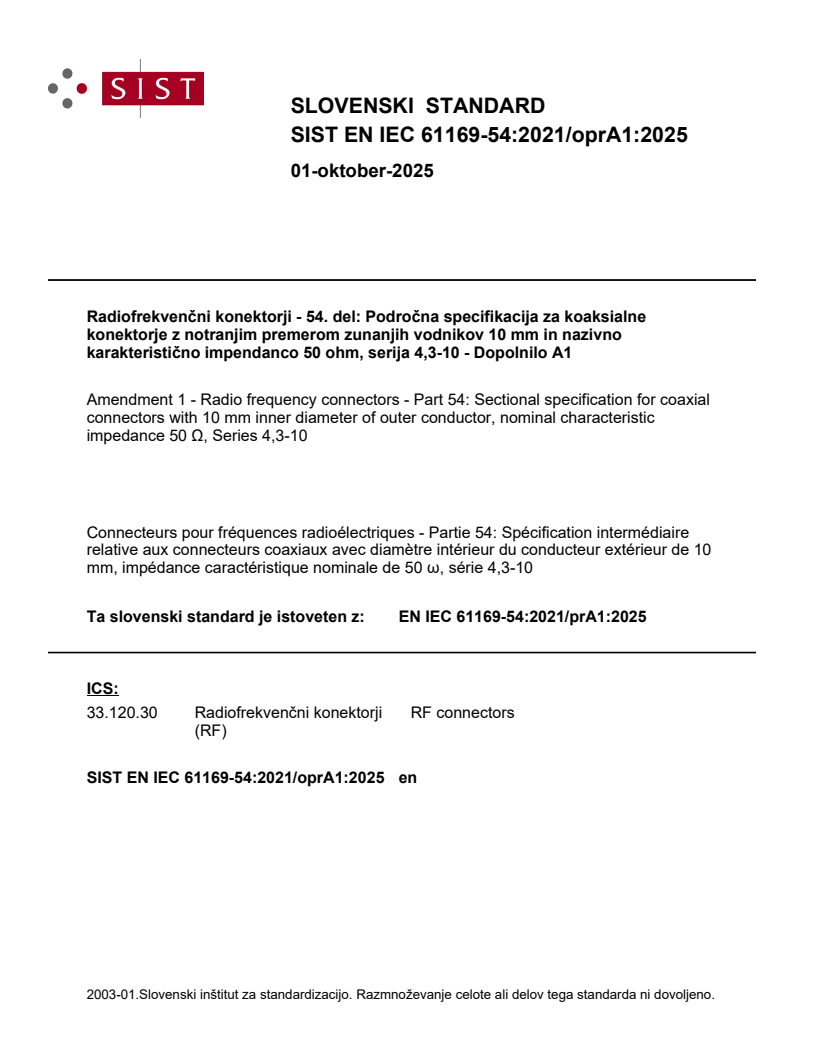
SLOVENSKI STANDARD
SIST EN IEC 61169-54:2021/oprA1:2025
01-oktober-2025
Radiofrekvenčni konektorji - 54. del: Področna specifikacija za koaksialne
konektorje z notranjim premerom zunanjih vodnikov 10 mm in nazivno
karakteristično impendanco 50 ohm, serija 4,3-10 - Dopolnilo A1
Amendment 1 - Radio frequency connectors - Part 54: Sectional specification for coaxial
connectors with 10 mm inner diameter of outer conductor, nominal characteristic
impedance 50 Ω, Series 4,3-10
Connecteurs pour fréquences radioélectriques - Partie 54: Spécification intermédiaire
relative aux connecteurs coaxiaux avec diamètre intérieur du conducteur extérieur de 10
mm, impédance caractéristique nominale de 50 ω, série 4,3-10
Ta slovenski standard je istoveten z: EN IEC 61169-54:2021/prA1:2025
ICS:
33.120.30 Radiofrekvenčni konektorji RF connectors
(RF)
SIST EN IEC 61169-54:2021/oprA1:2025 en
2003-01.Slovenski inštitut za standardizacijo. Razmnoževanje celote ali delov tega standarda ni dovoljeno.
SIST EN IEC 61169-54:2021/oprA1:2025
SIST EN IEC 61169-54:2021/oprA1:2025
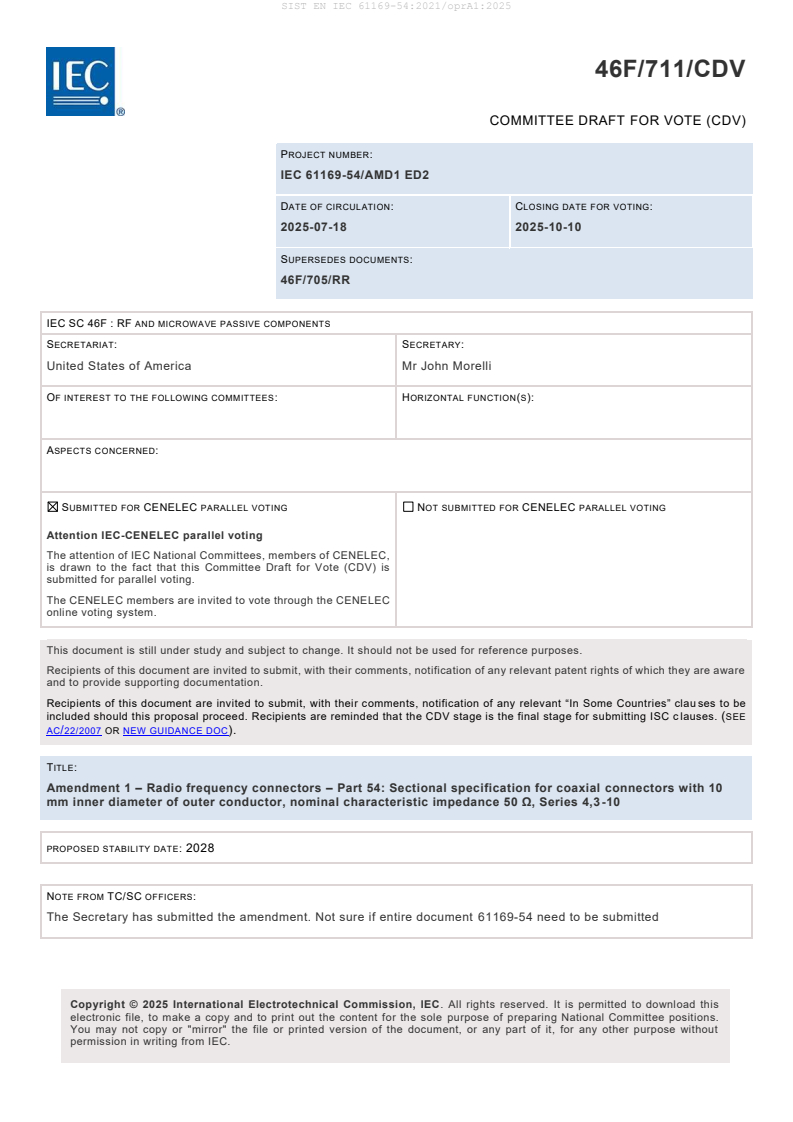
46F/711/CDV
COMMITTEE DRAFT FOR VOTE (CDV)
PROJECT NUMBER:
IEC 61169-54/AMD1 ED2
DATE OF CIRCULATION: CLOSING DATE FOR VOTING:
2025-07-18 2025-10-10
SUPERSEDES DOCUMENTS:
46F/705/RR
IEC SC 46F : RF AND MICROWAVE PASSIVE COMPONENTS
SECRETARIAT: SECRETARY:
United States of America Mr John Morelli
OF INTEREST TO THE FOLLOWING COMMITTEES: HORIZONTAL FUNCTION(S):
ASPECTS CONCERNED:
SUBMITTED FOR CENELEC PARALLEL VOTING NOT SUBMITTED FOR CENELEC PARALLEL VOTING
Attention IEC-CENELEC parallel voting
The attention of IEC National Committees, members of CENELEC,
is drawn to the fact that this Committee Draft for Vote (CDV) is
submitted for parallel voting.
The CENELEC members are invited to vote through the CENELEC
online voting system.
This document is still under study and subject to change. It should not be used for reference purposes.
Recipients of this document are invited to submit, with their comments, notification of any relevant patent rights of which they are aware
and to provide supporting documentation.
Recipients of this document are invited to submit, with their comments, notification of any relevant “In Some Countries” clau ses to be
included should this proposal proceed. Recipients are reminded that the CDV stage is the final stage for submitting ISC c lauses. (SEE
AC/22/2007 OR NEW GUIDANCE DOC).
TITL
...