

OSIST prEN 15001-1:2004
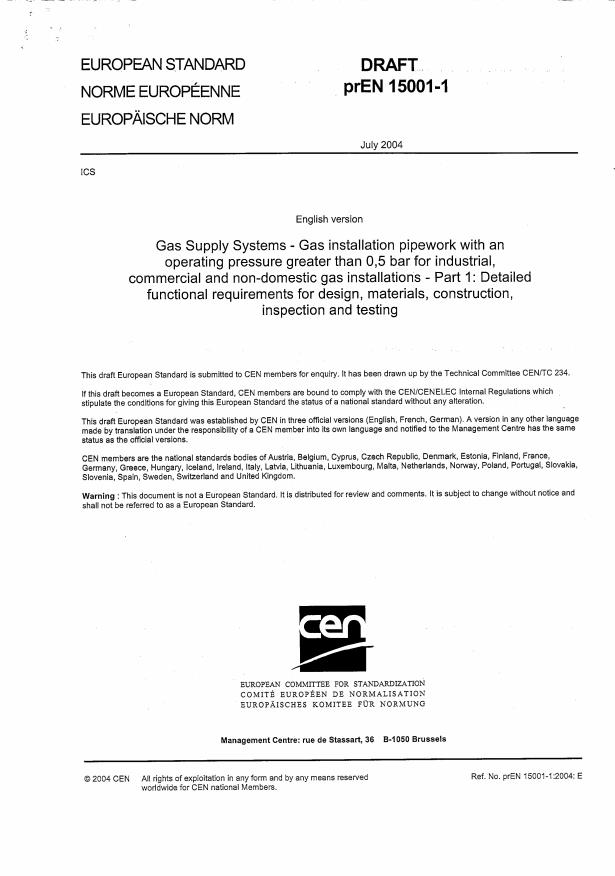
(Main)Gas Supply Systems - Gas installation pipework with an operating pressure greater than 0,5 bar for industrial, commercial and non-domestic gas installations - Part 1: Detailed functional requirements for design, materials, construction, inspection and testing
General Information
- Abstract
This standard specifies detailed functional requirements for the design, selection of materials, construction, inspection and testing of industrial gas installations and assemblies with an operating pressure greater than 0,5 bar and of non-industrial gas installations with an operating pressure greater than 5 bar in buildings and areas intended for domestic, commercial, public and mixed uses, starting from the gas supplier's behind the network operator's point of delivery up to the inlet connection to the gas appliance; normally the inlet isolation valve. This standard also covers the inlet connection to the gas appliance comprising of the pipework that does not fall within the scope of the appliance standard.
This standard applies to gas installations operating at ambient temperatures between -20°C and 40°C and operating pressures up to and including 60 bar. For operating conditions outside these limitations, reference should be made to EN 13480 for metallic pipework.
For industrial gas installations up to and including 0,5 bar and for non-industrial (domestic and commercial) gas installations up to and including 5 bar in buildings and areas intended for domestic, commercial, public and mixed use, EN 1775 applies.
For gas installations that do not fall within the scope of EN 1775 or other European standards, this standard applies.
In this standard, the term "gas" refers to combustible gases, which are gaseous at 15°C and 1 013 mbar absolute atmospheric pressure. These gases are commonly referred to as manufactured gas, natural gas or Liquidfied Petroleum Gas (LPG). They are also referred to as first, second or third family gases (see table 1 of EN 437:1993).
LPG storage vessels (including all ancillaries fitted directly to storage vessels) are excluded. Also excluded are LPG installations and sections of LPG installations operating at vapour pressure.
In this standard, all pressures are gauge pressures unless otherwise stated.
This standard has been harmon
- Status
- Not Published
- Technical Committee
- DPL - Gas supply
- Current Stage
- 98 - Abandoned project (Adopted Project)
- Start Date
- 03-Dec-2009
- Due Date
- 08-Dec-2009
- Completion Date
- 03-Dec-2009
- Directive
- 97/23/EC - Pressure equipment

Overview
OSIST prEN 15001-1:2004 establishes detailed functional requirements for the design, selection of materials, construction, inspection, and testing of gas installation pipework operating above 0.5 bar in industrial, commercial, and non-domestic environments. Developed by SIST (Slovenian Institute for Standardization), this standard helps ensure the safety and efficiency of gas supply systems for buildings and facilities used for domestic, commercial, public, and mixed purposes. It specifies the requirements for pipework from the gas supplier's delivery point to the inlet isolation valve of gas appliances, except for sections covered by appliance-specific standards.
Key Topics
Scope of Application
- Industrial gas installations and assemblies with operating pressure above 0.5 bar
- Non-industrial installations with operating pressure greater than 5 bar
- Applicable for ambient temperatures between -20°C and 40°C and up to 60 bar operating pressure
- Excludes LPG storage vessels and pipework operating at vapor pressure
Gases Covered
- Applies to combustible gases: manufactured gas, natural gas, and LPG
- Covers first, second, and third gas families per EN 437:1993
Major Requirements
- Design considerations: Emphasizes safety, integrity, and compliance with operating conditions
- Material selection: Specifies appropriate materials for high-pressure gas systems
- Construction guidance: Addresses methods of assembly and joining of pipework
- Inspection and testing: Details procedures for commissioning, leak testing, and routine inspection
Interfacing Standards
- For conditions outside 0.5 to 60 bar or -20°C to 40°C, refer to EN 13480 (metallic pipework)
- For lower pressure ranges in industrial and non-industrial applications, EN 1775 applies
Applications
OSIST prEN 15001-1:2004 is vital for a variety of professionals and sectors, including:
- Designers and engineers: Ensures that gas installation projects in commercial and industrial settings comply with EU safety and reliability standards.
- Construction contractors: Guides correct assembly and materials selection for safe installation.
- Gas network operators: Sets protocols for safe inspection, pressure testing, and maintenance of gas supply systems.
- Facility managers: Ensures ongoing compliance, safety, and performance in existing gas systems.
- Regulatory authorities: Provides a benchmark for conformity assessment and regulatory inspection.
Typical implementations include:
- Industrial manufacturing facilities with significant gas usage
- Commercial sites such as shopping centers, hospitals, and hotels
- Public buildings requiring reliable and safe gas infrastructure
- Mixed-use developments with high-pressure gas distribution needs
Related Standards
When working with gas installation pipework and related gas supply systems, refer also to:
- EN 13480: Metallic industrial piping - for installations outside the scope of prEN 15001-1, especially at higher/lower temperatures or pressures.
- EN 1775: Gas supply systems - for industrial gas installations up to 0.5 bar and non-industrial up to 5 bar.
- EN 437:1993: Test gases, test pressures, and categories of appliances - for classification of gas families.
- National annexes and safety regulations: Consider local regulatory requirements that supplement or elaborate on European standards.
Adhering to OSIST prEN 15001-1:2004 ensures compliance, maximizes system longevity, and upholds the highest safety standards for industrial, commercial, and public gas installations across Europe. For specialized situations or unique installation environments, always check for the applicability of related or superseding standards.
Relations
- Effective Date
- 01-Dec-2009
Get Certified
Connect with accredited certification bodies for this standard

DIBt (Deutsches Institut für Bautechnik)
German Institute for Building Technology.
DIN CERTCO
DIN Group product certification.

Aboma Certification B.V.
Specialized in construction, metal, and transport sectors.
Sponsored listings
Frequently Asked Questions
OSIST prEN 15001-1:2004 is a draft published by the Slovenian Institute for Standardization (SIST). Its full title is "Gas Supply Systems - Gas installation pipework with an operating pressure greater than 0,5 bar for industrial, commercial and non-domestic gas installations - Part 1: Detailed functional requirements for design, materials, construction, inspection and testing". This standard covers: This standard specifies detailed functional requirements for the design, selection of materials, construction, inspection and testing of industrial gas installations and assemblies with an operating pressure greater than 0,5 bar and of non-industrial gas installations with an operating pressure greater than 5 bar in buildings and areas intended for domestic, commercial, public and mixed uses, starting from the gas supplier's behind the network operator's point of delivery up to the inlet connection to the gas appliance; normally the inlet isolation valve. This standard also covers the inlet connection to the gas appliance comprising of the pipework that does not fall within the scope of the appliance standard. This standard applies to gas installations operating at ambient temperatures between -20°C and 40°C and operating pressures up to and including 60 bar. For operating conditions outside these limitations, reference should be made to EN 13480 for metallic pipework. For industrial gas installations up to and including 0,5 bar and for non-industrial (domestic and commercial) gas installations up to and including 5 bar in buildings and areas intended for domestic, commercial, public and mixed use, EN 1775 applies. For gas installations that do not fall within the scope of EN 1775 or other European standards, this standard applies. In this standard, the term "gas" refers to combustible gases, which are gaseous at 15°C and 1 013 mbar absolute atmospheric pressure. These gases are commonly referred to as manufactured gas, natural gas or Liquidfied Petroleum Gas (LPG). They are also referred to as first, second or third family gases (see table 1 of EN 437:1993). LPG storage vessels (including all ancillaries fitted directly to storage vessels) are excluded. Also excluded are LPG installations and sections of LPG installations operating at vapour pressure. In this standard, all pressures are gauge pressures unless otherwise stated. This standard has been harmon
This standard specifies detailed functional requirements for the design, selection of materials, construction, inspection and testing of industrial gas installations and assemblies with an operating pressure greater than 0,5 bar and of non-industrial gas installations with an operating pressure greater than 5 bar in buildings and areas intended for domestic, commercial, public and mixed uses, starting from the gas supplier's behind the network operator's point of delivery up to the inlet connection to the gas appliance; normally the inlet isolation valve. This standard also covers the inlet connection to the gas appliance comprising of the pipework that does not fall within the scope of the appliance standard. This standard applies to gas installations operating at ambient temperatures between -20°C and 40°C and operating pressures up to and including 60 bar. For operating conditions outside these limitations, reference should be made to EN 13480 for metallic pipework. For industrial gas installations up to and including 0,5 bar and for non-industrial (domestic and commercial) gas installations up to and including 5 bar in buildings and areas intended for domestic, commercial, public and mixed use, EN 1775 applies. For gas installations that do not fall within the scope of EN 1775 or other European standards, this standard applies. In this standard, the term "gas" refers to combustible gases, which are gaseous at 15°C and 1 013 mbar absolute atmospheric pressure. These gases are commonly referred to as manufactured gas, natural gas or Liquidfied Petroleum Gas (LPG). They are also referred to as first, second or third family gases (see table 1 of EN 437:1993). LPG storage vessels (including all ancillaries fitted directly to storage vessels) are excluded. Also excluded are LPG installations and sections of LPG installations operating at vapour pressure. In this standard, all pressures are gauge pressures unless otherwise stated. This standard has been harmon
OSIST prEN 15001-1:2004 is classified under the following ICS (International Classification for Standards) categories: 91.140.40 - Gas supply systems. The ICS classification helps identify the subject area and facilitates finding related standards.
OSIST prEN 15001-1:2004 has the following relationships with other standards: It is inter standard links to SIST EN 15001-1:2009. Understanding these relationships helps ensure you are using the most current and applicable version of the standard.
OSIST prEN 15001-1:2004 is associated with the following European legislation: EU Directives/Regulations: 97/23/EC, TRRTP129; Standardization Mandates: M/071. When a standard is cited in the Official Journal of the European Union, products manufactured in conformity with it benefit from a presumption of conformity with the essential requirements of the corresponding EU directive or regulation.
OSIST prEN 15001-1:2004 is available in PDF format for immediate download after purchase. The document can be added to your cart and obtained through the secure checkout process. Digital delivery ensures instant access to the complete standard document.
Standards Content (Sample)
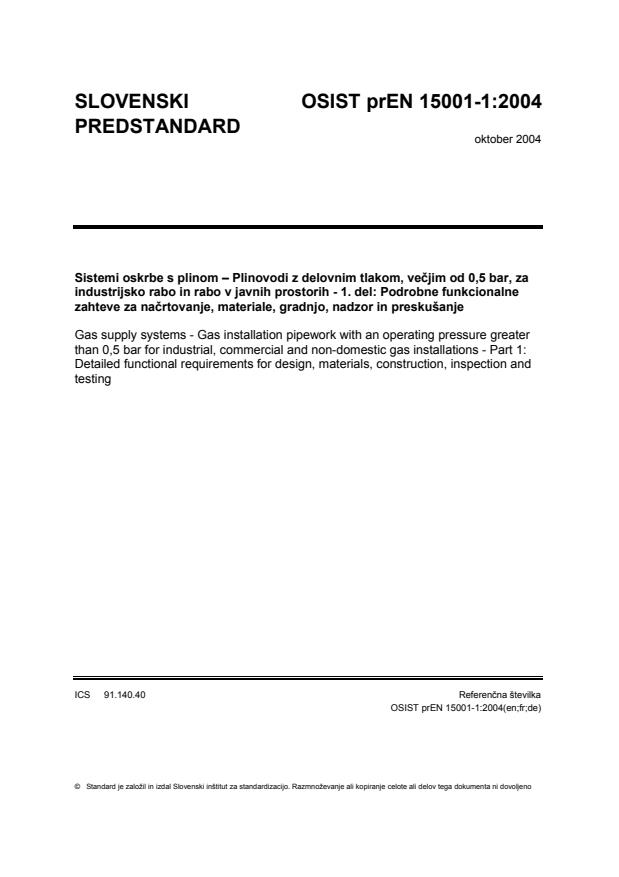
SLOVENSKI OSIST prEN 15001-1:2004
PREDSTANDARD
oktober 2004
Sistemi oskrbe s plinom – Plinovodi z delovnim tlakom, večjim od 0,5 bar, za
industrijsko rabo in rabo v javnih prostorih - 1. del: Podrobne funkcionalne
zahteve za načrtovanje, materiale, gradnjo, nadzor in preskušanje
Gas supply systems - Gas installation pipework with an operating pressure greater
than 0,5 bar for industrial, commercial
...