

kSIST FprEN 3-11:2026
(Main)Portable fire extinguishers - Part 11: Performance, requirements, test method and marking for EN 3-7 extinguishers suitable to be used on lithium-ion battery fires
- Abstract
This document specifies performance requirements for portable fire extinguishers in addition to the requirements of EN 3-7, to demonstrate their suitability for extinguishing fires in rechargeable batteries based on lithium-ion chemistry with a maximum capacity of 600 Wh, as used for example:
- portable electronic equipment (smartphones, laptops);
- power tools and domestic appliances;
- portable medical equipment;
- toys and radio-controlled objects;
- drones;
- bicycles.
This document contains general requirements and procedures for extinguishing tests. The size of the extinguishing tests is comparable to the battery capacities in the above mentioned applications where the battery is accessible. This document doesn’t apply to larger fire
- Status
- Not Published
- Public Enquiry End Date
- 29-Apr-2025
- Technical Committee
- POZ - Požarna varnost
- Current Stage
- 5020 - Formal vote (FV) (Adopted Project)
- Start Date
- 28-May-2026
- Due Date
- 16-Jul-2026
- Completion Date
- 29-May-2026

kSIST FprEN 3-11:2026 is a CEN standard for portable fire extinguishers that adds requirements to EN 3-7 for testing and marking extinguishers used on small lithium-ion battery fires. It covers extinguishers intended for battery fires up to a nominal capacity of 600 Wh, such as those in portable electronics, power tools, medical equipment, toys, drones and bicycles.
The document is aimed at proving that a specific extinguisher model, with a specific extinguishing agent, is suitable for this battery-fire risk and how that suitability is marked on the product.
What does kSIST FprEN 3-11:2026 specify?
kSIST FprEN 3-11:2026 specifies extra performance requirements, a test method and marking rules for portable fire extinguishers used on lithium-ion battery fires. It builds on EN 3-7 and uses extinguishing tests on pouch-cell battery assemblies to show suitability for this specific fire scenario.
The document is organized into six clauses and three annexes.
| Annex | What it covers |
|---|---|
| Annex A | Normative extinguishing tests, including material, test set-up, ignition, execution and pass/fail criteria |
| Annex B | Informative model test report |
| Annex C | Informative safety precautions during testing |
The scope ties the tests to smaller battery capacities in common portable applications. It also excludes validation for larger risks such as vehicle batteries and stationary energy storage battery sets.
What are the key requirements of kSIST FprEN 3-11:2026?
kSIST FprEN 3-11:2026 requires the extinguisher to satisfy EN 3-7 first, then adds battery-fire testing, product documentation and marking rules. In practice, this means the product has to pass both the base extinguisher standard and the additional lithium-ion battery test program.
General product requirements
- The portable fire extinguisher shall meet EN 3-7 requirements, including an A-rating and successful dielectric testing. This matters because the product must already be a compliant extinguisher before it is assessed for battery fires.
- Before testing starts, a complete product file shall be submitted. It includes the extinguisher technical datasheet, parts and assembly drawings, extinguishing-agent datasheet, analysis report and safety datasheet. This gives the test institute traceable evidence for the exact product and agent tested.
Suitability for lithium-ion battery fires
- Suitability is demonstrated by extinguishing tests on combined flat pouch cells according to Annex A. The test method is therefore focused on a battery-pack fire scenario, not on ordinary solid, liquid or gas fires.
- The fire rating is expressed as nominal capacity in Wh. For the 600 Wh rating, the maximum extinguishing-agent quantity is 9 l. This tells the user what battery size the extinguisher was shown to handle.
- A portable fire extinguisher is suitable only if the extinguishing tests in Annex A are successfully completed. The result depends on both the free burn test and the extinguishing tests.
Test method and pass criteria
- Annex A uses new NMC pouch cells from one production batch for each test series, and the cell capacity is verified against the datasheet. This keeps the test consistent and tied to a known battery type.
- The test series includes one or two free burn tests and two or three extinguishing tests. The free burn test confirms the battery assembly behaves as expected before extinguishing is assessed.
- The extinguishing test has a 3 min limit from ignition of the first cell, followed by a 20 min observation period with no re-ignition. At the end, at least one set must remain unignited and at least one cell in that set must still deliver at least 3.7 V.
- A test series is successful when the free burn test and at least two extinguishing tests pass. If the first two extinguishing tests pass, the third is not needed.
Marking
- If the requirements are met, the extinguisher shall carry a suitability marking on the front in a clearly visible position, outside the EN 3-7 marking area. The marking includes the battery icon, the word Li, the demonstrated fire rating in Wh and the standard reference.
- A pictogram is also required in Part 2 as defined by EN 3-7, and it may only be used when the corresponding fire rating appears on the marking. This helps users match the extinguisher to the battery-fire application.
What terms does kSIST FprEN 3-11:2026 define?
kSIST FprEN 3-11:2026 defines the basic battery terms used in the test method and scope.
- Cell - a single source of electrical energy obtained by converting chemical energy.
- Battery - a set of interconnected battery cells in a common enclosure.
- Pouch cell - a flat battery cell with internal components stacked and packed in plastic foil.
- NMC - nickel manganese cobalt oxide, used here as the chemistry identification for the lithium battery cells.
- Thermal runaway - the uncontrolled reaction described in the introduction where heat release causes adjacent cells to ignite and the fire to spread through the battery pack.
Who uses kSIST FprEN 3-11:2026?
kSIST FprEN 3-11:2026 is used by fire extinguisher manufacturers, test institutes and compliance teams that need to show a product is suitable for lithium-ion battery fires. It is also relevant to certification bodies and product developers who specify extinguishers for workplaces, service vehicles or equipment areas where small battery fires are a known risk.
It matters for industries using portable lithium-ion batteries in electronics, tools, domestic appliances, medical devices, toys, radio-controlled products, drones and bicycles. For these users, the standard helps connect a product claim to a defined test and marking method.
Which standards are used with kSIST FprEN 3-11:2026?
kSIST FprEN 3-11:2026 uses EN 3-7:2004+A1:2007 as its normative basis. EN 3-7 provides the general portable fire extinguisher characteristics, performance requirements and test methods that remain applicable before the extra lithium-ion battery-fire requirements are checked.
What does the kSIST FprEN 3-11:2026 document contain?
kSIST FprEN 3-11:2026 contains the scope, normative references, terms and definitions, general product requirements, suitability testing, and marking rules. It also includes the detailed normative test method in Annex A, so the reader can see how the battery cells are prepared, how ignition is triggered, how the extinguisher is used, and how success is judged.
Annex B provides a model test report that captures the extinguisher identity, test results and supporting documents. Annex C gives safety precautions for the test site, including personal protection, insulated tools, battery handling and the role of a safety officer.
Get Certified
Connect with accredited certification bodies for this standard

CIS Institut d.o.o.
Personal Protective Equipment (PPE) certification body. Notified Body NB-2890 for EU Regulation 2016/425 PPE.

Kiwa BDA Testing
Building and construction product certification.
Kmetijski inštitut Slovenije
Agricultural Institute of Slovenia. Soil testing, plant health, agricultural product analysis.
Sponsored listings
Frequently Asked Questions
kSIST FprEN 3-11:2026 is a draft published by the Slovenian Institute for Standardization (SIST). Its full title is "Portable fire extinguishers - Part 11: Performance, requirements, test method and marking for EN 3-7 extinguishers suitable to be used on lithium-ion battery fires". This standard covers: This document specifies performance requirements for portable fire extinguishers in addition to the requirements of EN 3-7, to demonstrate their suitability for extinguishing fires in rechargeable batteries based on lithium-ion chemistry with a maximum capacity of 600 Wh, as used for example: - portable electronic equipment (smartphones, laptops); - power tools and domestic appliances; - portable medical equipment; - toys and radio-controlled objects; - drones; - bicycles. This document contains general requirements and procedures for extinguishing tests. The size of the extinguishing tests is comparable to the battery capacities in the above mentioned applications where the battery is accessible. This document doesn’t apply to larger fire
This document specifies performance requirements for portable fire extinguishers in addition to the requirements of EN 3-7, to demonstrate their suitability for extinguishing fires in rechargeable batteries based on lithium-ion chemistry with a maximum capacity of 600 Wh, as used for example: - portable electronic equipment (smartphones, laptops); - power tools and domestic appliances; - portable medical equipment; - toys and radio-controlled objects; - drones; - bicycles. This document contains general requirements and procedures for extinguishing tests. The size of the extinguishing tests is comparable to the battery capacities in the above mentioned applications where the battery is accessible. This document doesn’t apply to larger fire
kSIST FprEN 3-11:2026 is classified under the following ICS (International Classification for Standards) categories: 13.220.10 - Fire-fighting. The ICS classification helps identify the subject area and facilitates finding related standards.
kSIST FprEN 3-11:2026 is available in PDF format for immediate download after purchase. The document can be added to your cart and obtained through the secure checkout process. Digital delivery ensures instant access to the complete standard document.
Standards Content (Sample)
SLOVENSKI STANDARD
oSIST prEN 3-11:2025
01-april-2025
Prenosni gasilniki - 11. del: Delovanje, zahteve, preskusna metoda in označevanje
gasilnikov EN 3-7, primernih za uporabo pri požarih litij-ionskih baterij
Portable fire extinguishers - Part 11: Performance, requirements, test method and
marking for EN 3-7 extinguishers suitable to be used on lithium-ion battery fires
Tragbare Feuerlöscher - Teil 11: Leistungsmerkmale, Anforderungen, Prüfverfahren und
Kennzeichnung nach EN 3-7, geeignet für Brände mit Lithium-Ionen-Batterien
Extincteurs d’incendie portatifs - Partie 11 : Performances, exigences, méthode d’essai
et marquage pour les extincteurs EN 3 7 utilisables sur des feux de batteries lithium-ion
Ta slovenski standard je istoveten z: prEN 3-11
ICS:
13.220.10 Gašenje požara Fire-fighting
oSIST prEN 3-11:2025 en,fr,de
2003-01.Slovenski inštitut za standardizacijo. Razmnoževanje celote ali delov tega standarda ni dovoljeno.
oSIST prEN 3-11:2025
oSIST prEN 3-11:2025
DRAFT
EUROPEAN STANDARD
prEN 3-11
NORME EUROPÉENNE
EUROPÄISCHE NORM
February 2025
ICS 13.220.10
English Version
Portable fire extinguishers - Part 11: Performance,
requirements, test method and marking for EN 3-7
extinguishers suitable to be used on lithium-ion battery
fires
Extincteurs d'incendie portatifs - Partie 11 : Tragbare Feuerlöscher - Teil 11: Leistungsmerkmale,
Performances, exigences, méthode d'essai et marquage Anforderungen, Prüfverfahren und Kennzeichnung
pour les extincteurs EN 3-7 utilisables sur des feux de nach EN 3-7, geeignet für Brände mit Lithium-Ionen-
batteries lithium-ion Batterien
This draft European Standard is submitted to CEN members for enquiry. It has been drawn up by the Technical Committee
CEN/TC 70.
If this draft becomes a European Standard, CEN members are bound to comply with the CEN/CENELEC Internal Regulations
which stipulate the conditions for giving this European Standard the status of a national standard without any alteration.
This draft European Standard was established by CEN in three official versions (English, French, German). A version in any other
language made by translation under the responsibility of a CEN member into its own language and notified to the CEN-CENELEC
Management Centre has the same status as the official versions.
CEN members are the national standards bodies of Austria, Belgium, Bulgaria, Croatia, Cyprus, Czech Republic, Denmark, Estonia,
Finland, France, Germany, Greece, Hungary, Iceland, Ireland, Italy, Latvia, Lithuania, Luxembourg, Malta, Netherlands, Norway,
Poland, Portugal, Republic of North Macedonia, Romania, Serbia, Slovakia, Slovenia, Spain, Sweden, Switzerland, Türkiye and
United Kingdom.
Recipients of this draft are invited to submit, with their comments, notification of any relevant patent rights of which they are
aware and to provide supporting documentation.
Warning : This document is not a European Standard. It is distributed for review and comments. It is subject to change without
notice and shall not be referred to as a European Standard.
EUROPEAN COMMITTEE FOR STANDARDIZATION
COMITÉ EUROPÉEN DE NORMALISATIO N
EUROPÄISCHES KOMITEE FÜR NORMUN G
CEN-CENELEC Management Centre: Rue de la Science 23, B-1040 Brussels
© 2025 CEN All rights of exploitation in any form and by any means reserved Ref. No. prEN 3-11:2025 E
worldwide for CEN national Members.
oSIST prEN 3-11:2025
prEN 3-11:2025 (E)
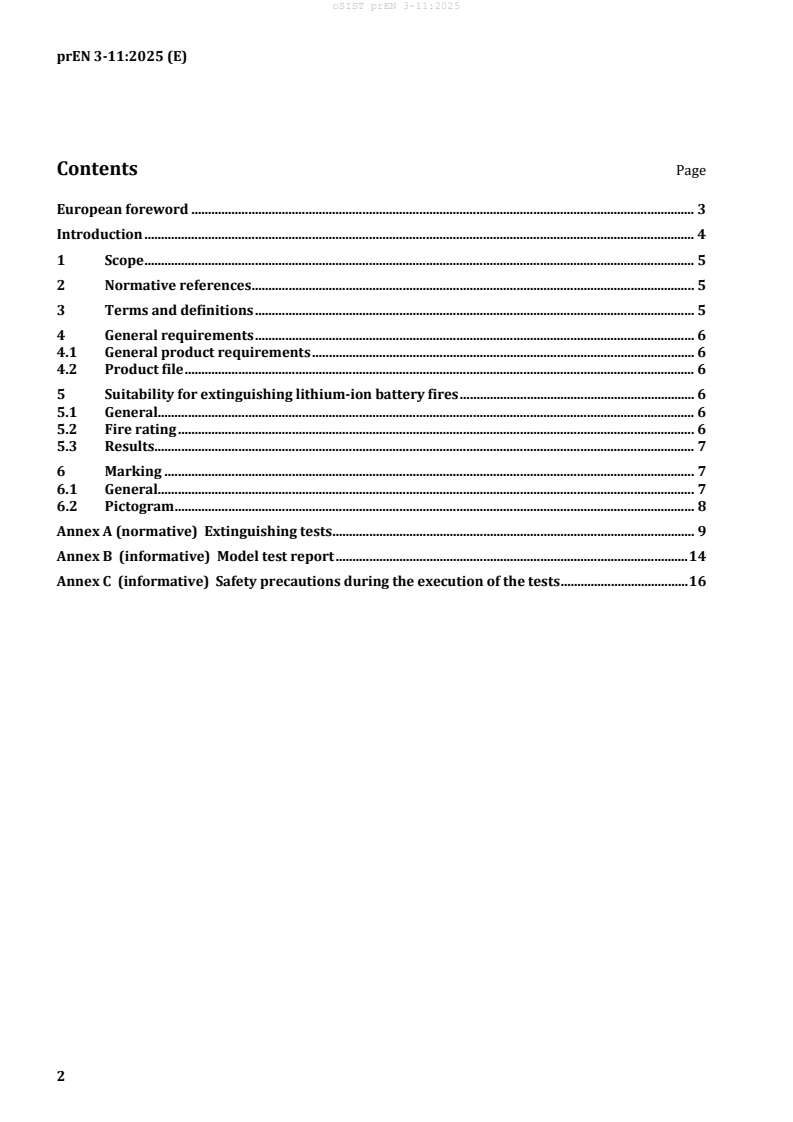
Contents Page
European foreword . 3
Introduction . 4
1 Scope . 5
2 Normative references . 5
3 Terms and definitions . 5
4 General requirements . 6
4.1 General product requirements . 6
4.2 Product file . 6
5 Suitability for extinguishing lithium-ion battery fires . 6
5.1 General. 6
5.2 Fire rating . 6
5.3 Results . 7
6 Marking . 7
6.1 General. 7
6.2 Pictogram . 8
Annex A (normative) Extinguishing tests . 9
Annex B (informative) Model test report . 14
Annex C (informative) Safety precautions during the execution of the tests . 16
oSIST prEN 3-11:2025
prEN 3-11:2025 (E)
European foreword
This document (prEN 3-11:2025) has been prepared by Technical Committee CEN/TC 70 “Manual
means of fire fighting equipment”, the secretariat of which is held by AFNOR.
This document is currently submitted to the CEN Enquiry.
This document describes a reliable and standardized fire extinguishing test that demonstrates the
suitability of an EN 3-7 fire extinguisher model to extinguish a lithium-ion battery fire. It also specifies
corresponding marking.
This document has been prepared by a working group of CEN/TC 70.
oSIST prEN 3-11:2025
prEN 3-11:2025 (E)
Introduction
Rechargeable batteries based on lithium chemistry have high energy density, low weight, and a long
service life. These characteristics make this type of battery very popular in portable and mobile
applications such as laptops, mobile phones, power tools, bicycles, and cars.
This relatively new technology has a considerable disadvantage: the contents of the battery cells can
ignite due to overloading, heating, or mechanical damage. An uncontrollable chemical reaction
(‘thermal runaway’) then occurs in the battery cell and large amounts of heat are released in a short
period of time. This usually causes intense flames and leads to a sharp rise of pressure and temperature
in the cell.
Modern lithium-ion batteries have built-in protective circuits that prevent ignition by overloading. But
these systems cannot prevent ignition of the cell as a result of heating or mechanical damage. After the
first cell in a lithium-ion battery is ignited, the heat will cause a thermal runaway in adjacent cells as
well and the fire will spread through the battery pack until all cells are fully burnt. This releases a great
deal of energy for a prolonged time which may ignite other combustible materials in the vicinity.
Test-protocol
As of yet, there are no known extinguishing agents that can stop a thermal runaway in a lithium-ion
battery cell. There are, however, extinguishing agents that can effectively stop the fire propagation in
the battery pack.
The fire development in burning lithium ion batteries cannot be compared with the development of
normal fires of solid materials, liquids or gases. Therefore, existing test protocols of
EN 3-7:2004+A1:2007 cannot be used for the evaluation of the suitability of extinguishing agents for
this specific risk.
The test protocol described in this document can be used to demonstrate that a certain extinguishing
agent used in combination with a specific type or model of portable fire extinguisher can stop a fire in a
lithium battery pack. The test protocol is aligned with the current common capacity of bicycle batteries.
WARNING During an extinguishing action, the user of a portable fire extinguisher is exposed to
health risks as a result of the released heat and combustion products. This is the case with any fire, but
certainly when lithium-ion batteries are involved. This type of fire releases toxic and highly irritating
combustion products. The user is advised to follow specific instruction for this type of fire and use
suitable personal protection equipment, for example a breathing mask. Where applicable, it is advised
to pay close attention to these risks and measures in the workplace safety procedures.
During and after a lithium-ion battery fire, it is important to thoroughly ventilate the area to remove
harmful combustion products.
After each extinguishing action it is advised:
— to cool damaged and burnt batteries under water for a prolonged time (48 h) to prevent re-ignition;
— to store damaged batteries outside at a safe distance from other objects until they can be safely
removed;
— to consider proper treatment of the used cooling water.
oSIST prEN 3-11:2025
prEN 3-11:2025 (E)
1 Scope
This document describes performance requirements for portable fire extinguishers in addition to the
requirements of EN 3-7:2004+A1:2007, to demonstrate their suitability for extinguishing fires in
rechargeable and non-rechargeable batteries based on lithium ion chemistry with a limited capacity, as
used in:
— portable electronic equipment (smartphones, laptops);
— power tools and domestic appliances;
— portable medical equipment;
— toys and radio-controlled objects;
— drones;
— bicycles.
This document contains general requirements and procedures for extinguishing tests. The size of the
extinguishing tests is comparable to the battery capacities in the abovementioned applications.
Suitability for extinguishing larger fire risks, such as vehicle batteries and battery sets of stationary
energy storage systems, cannot be validated with this document.
2 Normative references
The following documents are referred to in the text in such a way that some or all of their content
constitutes requirements of this document. For dated references, only the edition cited applies. For
undated references, the latest edition of the referenced document (including any amendments) applies.
EN 3-7:2004+A1:2007, Portable fire extinguishers — Part7: Characteristics, performance requirements
and test methods
3 Terms and definitions
For the purposes of this document, the following terms and definitions apply.
ISO and IEC maintain terminology databases for use in standardization at the following addresses:
— ISO Online browsing platform: available at https://www.iso.org/obp/
— IEC Electropedia: available at https://www.electropedia.org/
3.1
cell
battery cell
single source of electrical energy obtained by the conversion of chemical energy
3.2
battery
set of interconnected battery cells in a common enclosure
3.3
pouch cell
battery cell with a flat shape, of which the internal components are stacked and packed in a plastic foil
oSIST prEN 3-11:2025
prEN 3-11:2025 (E)
3.4
NMC
nickel manganese cobalt oxide
type identification of lithium batteries based on nickel manganese cobalt oxide (LiNiMnCoO ) chemistry
4 General requirements
4.1 General product requirements
The portable fire extinguisher shall at least meet the requirements of EN 3-7:2004+A1:2007, including:
— the extinguisher has an A-rating in accordance with 6.4.2 of EN 3-7:2004+A1:2007;
— successful completion of the dielectric test shall be demonstrated in accordance with Clause 9 of
EN 3-7:2004+A1:2007.
4.2 Product file
Before the start of the extinguishing tests (Annex A), a complete product file shall be submitted
containing at least the following information:
— detailed technical specifications of the extinguisher (technical datasheet);
— detailed parts and assembly drawings documenting material specifications, dimensions and
tolerances and, where relevant, production processes;
— detailed specifications of extinguishing
...