

oSIST prEN 9300-300:2026
(Main)Aerospace series - LOTAR - LOng Term Archiving and Retrieval of digital technical product documentation such as 3D, CAD and PDM data - Part 300: Common concepts for Long term archiving and retrieval of Composite Structure
- Abstract
1 Scope
1.1 In scope
This document describes:
- the fundamentals and concepts for Long Term Archiving and Retrieval of CAD 3D mechanical composite information and associated composite specific PMI;
- the document structure of the EN 9300-3XX family, and the links between all these parts;
- the qualification methods for long term preservation of archived composite information; more specially, principles for the validation properties and for verification of the quality of the composite information archived;
- specifications for the preservation planning of archived composite information;
- specific functions for administration and monitoring of CAD composite archived models;
- the definition of Archive Information Packages for composite CAD data.
This document establishes long term archiving requirements applicable to, but not limited to, most laminated type composite items made with composite manufacturing processes such as:
- hand lay-up;
- tape laying;
- fibre placement;
- stitched resin film infusion (SRFI);
- resin transfer moulding (RTM);
- vacuum-assisted resin transfer moulding (VARTM);
- controlled Atmospheric Pressure Resin Infusion (CAPRI);
- co-cured or co-bonded composite items;
- sandwich panel composite construction;
- braided layers.
1.2 Out of scope
The following is outside the scope of this part of EN 9300:
- multi-function advanced composite structure;
- composite items made with composite manufacturing processes such as filament winding, 3D braiding, or 3D weaving;
NOTE Braided parts that can be represented as layered braided sleeve material can be in scope.
- injection moulded fibre reinforced thermoplastics;
- other Additive Manufacturing processes such as those covered by ISO/ASTM 52900;
- PMI described in EN 9300-1xx series.
- Status
- Not Published
- Public Enquiry End Date
- 24-Jun-2026
- Technical Committee
- I13 - Imaginarni 13
- Current Stage
- 4020 - Public enquire (PE) (Adopted Project)
- Start Date
- 20-Apr-2026
- Due Date
- 07-Sep-2026
- Completion Date
- 10-Jul-2026

Overview
oSIST prEN 9300-300:2026 is a draft European Standard within the CEN Aerospace series, focused on LOTAR (LOng Term Archiving and Retrieval) for digital technical product documentation-including 3D, CAD, and PDM data-specific to composite structures. This standard defines the common concepts and framework necessary for the long-term preservation and retrieval of digital composite structure data in aerospace applications. It serves as an essential guideline for ensuring the integrity, accessibility, and quality of composite 3D CAD information throughout the product lifecycle.
Key Topics
oSIST prEN 9300-300:2026 addresses the following major areas:
- Core concepts and fundamentals of long-term archiving for CAD 3D mechanical composite information and relevant product manufacturing information (PMI)
- Document structure of the EN 9300-3XX (composite structures) standard family, defining links and relationships between parts
- Qualification methods for long-term preservation, focusing on validation and quality verification of archived composite data
- Preservation planning: specifications for maintaining and keeping archived composite information accessible and usable over decades
- Administration & monitoring of CAD composite archives: functional requirements for managing archived composite models
- Defining Archive Information Packages (AIPs) for composite CAD data, ensuring completeness and consistency in storage
The standard covers archiving requirements for most laminated-type composite items produced with typical aerospace composite manufacturing processes, such as:
- Hand lay-up
- Tape laying
- Fibre placement
- Stitched resin film infusion (SRFI)
- Resin transfer moulding (RTM)
- Vacuum-assisted resin transfer moulding (VARTM)
- Controlled Atmospheric Pressure Resin Infusion (CAPRI)
- Co-cured or co-bonded items
- Sandwich panel constructions
- Braided layers (layered braided sleeve materials)
Out of Scope: Multi-function advanced composites, items made by filament winding, 3D braiding or weaving, injection-moulded fibre reinforced thermoplastics, additive manufacturing processes (per ISO/ASTM 52900), and PMI topics covered in EN 9300-1XX are excluded.
Applications
oSIST prEN 9300-300:2026 provides practical value in several key aerospace and manufacturing areas:
- Digital continuity: Ensures that critical 3D and CAD data for composite structures remain accessible, intelligible, and trustworthy throughout extended service lives, supporting product maintenance, repair, and regulatory audit requirements.
- Regulatory compliance: Provides a basis for conforming to aerospace regulations regarding data retention, technical product documentation, and traceability.
- Interoperability: Establishes a uniform standard for archiving composite CAD data, facilitating secure data exchange and collaboration between organizations, global suppliers, and stakeholders across the aerospace sector.
- Innovation support: Prepares the ground for future enhancements in composite manufacturing, as advances can be incorporated via additional standard segments without disrupting established archival processes.
- Lifecycle management: Enhances product lifecycle management (PLM) by integrating reliable, long-term digital archiving routines for composite structure data.
Related Standards
Several related documents and standards contribute to a comprehensive framework for long-term digital archiving in aerospace:
- EN 9300-007: Terms and definitions for LOTAR
- EN 9300-003: Fundamentals and concepts for long-term archiving
- EN 9300-1XX series: Product and manufacturing information (PMI) standards for CAD data
- ISO 10303 (STEP): International standards for the exchange and representation of product data
- ISO/ASTM 52900: Standards for additive manufacturing processes (not covered by oSIST prEN 9300-300:2026)
Conclusion
By providing robust, standardized methods for the long-term archiving and retrieval of composite structure data, oSIST prEN 9300-300:2026 safeguards the digital continuity and quality of aerospace products. For manufacturers, regulatory authorities, and maintenance providers, adopting this standard ensures efficient management of composite CAD data, compliance with industry requirements, and supports the evolution to increasingly digital product development environments.
Get Certified
Connect with accredited certification bodies for this standard

BSI Group
BSI (British Standards Institution) is the business standards company that helps organizations make excellence a habit.

Bureau Veritas
Bureau Veritas is a world leader in laboratory testing, inspection and certification services.

DNV
DNV is an independent assurance and risk management provider.
Sponsored listings
Frequently Asked Questions
oSIST prEN 9300-300:2026 is a draft published by the Slovenian Institute for Standardization (SIST). Its full title is "Aerospace series - LOTAR - LOng Term Archiving and Retrieval of digital technical product documentation such as 3D, CAD and PDM data - Part 300: Common concepts for Long term archiving and retrieval of Composite Structure". This standard covers: 1 Scope 1.1 In scope This document describes: - the fundamentals and concepts for Long Term Archiving and Retrieval of CAD 3D mechanical composite information and associated composite specific PMI; - the document structure of the EN 9300-3XX family, and the links between all these parts; - the qualification methods for long term preservation of archived composite information; more specially, principles for the validation properties and for verification of the quality of the composite information archived; - specifications for the preservation planning of archived composite information; - specific functions for administration and monitoring of CAD composite archived models; - the definition of Archive Information Packages for composite CAD data. This document establishes long term archiving requirements applicable to, but not limited to, most laminated type composite items made with composite manufacturing processes such as: - hand lay-up; - tape laying; - fibre placement; - stitched resin film infusion (SRFI); - resin transfer moulding (RTM); - vacuum-assisted resin transfer moulding (VARTM); - controlled Atmospheric Pressure Resin Infusion (CAPRI); - co-cured or co-bonded composite items; - sandwich panel composite construction; - braided layers. 1.2 Out of scope The following is outside the scope of this part of EN 9300: - multi-function advanced composite structure; - composite items made with composite manufacturing processes such as filament winding, 3D braiding, or 3D weaving; NOTE Braided parts that can be represented as layered braided sleeve material can be in scope. - injection moulded fibre reinforced thermoplastics; - other Additive Manufacturing processes such as those covered by ISO/ASTM 52900; - PMI described in EN 9300-1xx series.
1 Scope 1.1 In scope This document describes: - the fundamentals and concepts for Long Term Archiving and Retrieval of CAD 3D mechanical composite information and associated composite specific PMI; - the document structure of the EN 9300-3XX family, and the links between all these parts; - the qualification methods for long term preservation of archived composite information; more specially, principles for the validation properties and for verification of the quality of the composite information archived; - specifications for the preservation planning of archived composite information; - specific functions for administration and monitoring of CAD composite archived models; - the definition of Archive Information Packages for composite CAD data. This document establishes long term archiving requirements applicable to, but not limited to, most laminated type composite items made with composite manufacturing processes such as: - hand lay-up; - tape laying; - fibre placement; - stitched resin film infusion (SRFI); - resin transfer moulding (RTM); - vacuum-assisted resin transfer moulding (VARTM); - controlled Atmospheric Pressure Resin Infusion (CAPRI); - co-cured or co-bonded composite items; - sandwich panel composite construction; - braided layers. 1.2 Out of scope The following is outside the scope of this part of EN 9300: - multi-function advanced composite structure; - composite items made with composite manufacturing processes such as filament winding, 3D braiding, or 3D weaving; NOTE Braided parts that can be represented as layered braided sleeve material can be in scope. - injection moulded fibre reinforced thermoplastics; - other Additive Manufacturing processes such as those covered by ISO/ASTM 52900; - PMI described in EN 9300-1xx series.
oSIST prEN 9300-300:2026 is classified under the following ICS (International Classification for Standards) categories: 01.110 - Technical product documentation; 35.240.30 - IT applications in information, documentation and publishing; 49.020 - Aircraft and space vehicles in general. The ICS classification helps identify the subject area and facilitates finding related standards.
oSIST prEN 9300-300:2026 is available in PDF format for immediate download after purchase. The document can be added to your cart and obtained through the secure checkout process. Digital delivery ensures instant access to the complete standard document.
Standards Content (Sample)
SLOVENSKI STANDARD
01-junij-2026
Aeronavtika - LOTAR - Dolgotrajno arhiviranje in iskanje digitalne tehnične
dokumentacije o izdelkih, kot so podatki o 3D, CAD in PDM - 300. del: Splošni
koncepti za dolgoročno arhiviranje in iskanje sestavljenih struktur
Aerospace series - LOTAR - LOng Term Archiving and Retrieval of digital technical
product documentation such as 3D, CAD and PDM data - Part 300: Common concepts
for Long term archiving and retrieval of Composite Structure
Luft- und Raumfahrt - LOTAR - Langzeitarchivierung und -bereitstellung digitaler
technischer Produktdokumentationen, wie zum Beispiel von 3D-, CAD- und PDM-Daten -
Teil 300: Allgemeine Konzepte für die Langzeitarchivierung und -bereitstellung von
Verbundstrukturen
Ta slovenski standard je istoveten z: prEN 9300-300
ICS:
01.110 Tehnična dokumentacija za Technical product
izdelke documentation
35.240.30 Uporabniške rešitve IT v IT applications in information,
informatiki, dokumentiranju in documentation and
založništvu publishing
49.020 Letala in vesoljska vozila na Aircraft and space vehicles in
splošno general
2003-01.Slovenski inštitut za standardizacijo. Razmnoževanje celote ali delov tega standarda ni dovoljeno.
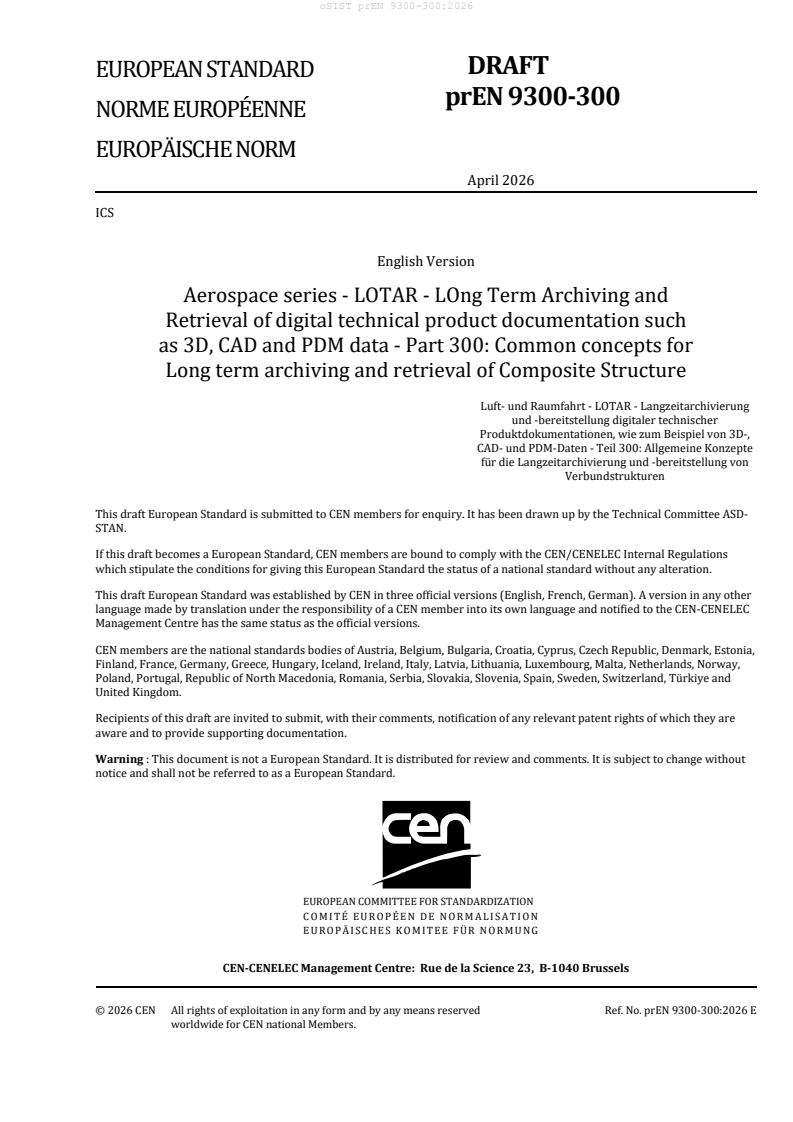
DRAFT
EUROPEAN STANDARD
NORME EUROPÉENNE
EUROPÄISCHE NORM
April 2026
ICS
English Version
Aerospace series - LOTAR - LOng Term Archiving and
Retrieval of digital technical product documentation such
as 3D, CAD and PDM data - Part 300: Common concepts for
Long term archiving and retrieval of Composite Structure
Luft- und Raumfahrt - LOTAR - Langzeitarchivierung
und -bereitstellung digitaler technischer
Produktdokumentationen, wie zum Beispiel von 3D-,
CAD- und PDM-Daten - Teil 300: Allgemeine Konzepte
für die Langzeitarchivierung und -bereitstellung von
Verbundstrukturen
This draft European Standard is submitted to CEN members for enquiry. It has been drawn up by the Technical Committee ASD-
STAN.
If this draft becomes a European Standard, CEN members are bound to comply with the CEN/CENELEC Internal Regulations
which stipulate the conditions for giving this European Standard the status of a national standard without any alteration.
This draft European Standard was established by CEN in three official versions (English, French, German). A version in any other
language made by translation under the responsibility of a CEN member into its own language and notified to the CEN-CENELEC
Management Centre has the same status as the official versions.
CEN members are the national standards bodies of Austria, Belgium, Bulgaria, Croatia, Cyprus, Czech Republic, Denmark, Estonia,
Finland, France, Germany, Greece, Hungary, Iceland, Ireland, Italy, Latvia, Lithuania, Luxembourg, Malta, Netherlands, Norway,
Poland, Portugal, Republic of North Macedonia, Romania, Serbia, Slovakia, Slovenia, Spain, Sweden, Switzerland, Türkiye and
United Kingdom.
Recipients of this draft are invited to submit, with their comments, notification of any relevant patent rights of which they are
aware and to provide supporting documentation.
Warning : This document is not a European Standard. It is distributed for review and comments. It is subject to change without
notice and shall not be referred to as a European Standard.
EUROPEAN COMMITTEE FOR STANDARDIZATION
COMITÉ EUROPÉEN DE NORMALISATION
EUROPÄISCHES KOMITEE FÜR NORMUNG
CEN-CENELEC Management Centre: Rue de la Science 23, B-1040 Brussels
© 2026 CEN All rights of exploitation in any form and by any means reserved Ref. No. prEN 9300-300:2026 E
worldwide for CEN national Members.
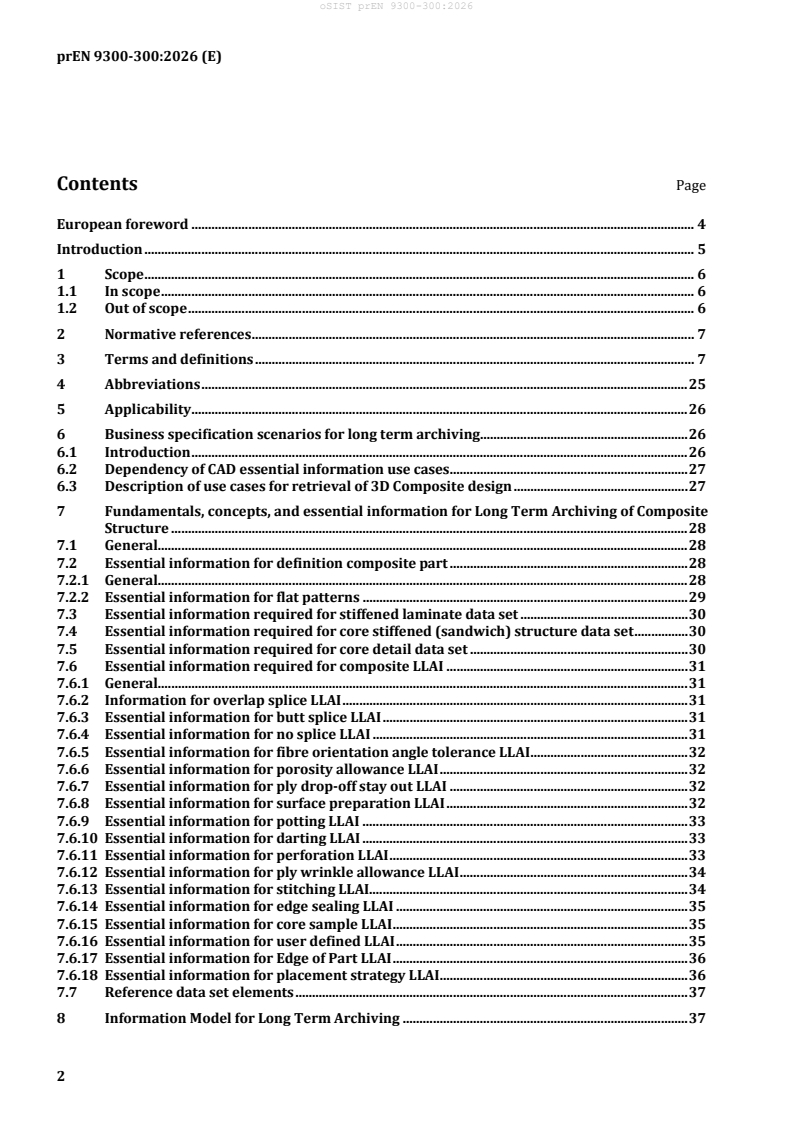
Contents Page
European foreword . 4
Introduction . 5
1 Scope . 6
1.1 In scope . 6
1.2 Out of scope . 6
2 Normative references . 7
3 Terms and definitions . 7
4 Abbreviations . 25
5 Applicability . 26
6 Business specification scenarios for long term archiving. 26
6.1 Introduction . 26
6.2 Dependency of CAD essential information use cases . 27
6.3 Description of use cases for retrieval of 3D Composite design . 27
7 Fundamentals, concepts, and essential information for Long Term Archiving of Composite
Structure . 28
7.1 General. 28
7.2 Essential information for definition composite part . 28
7.2.1 General. 28
7.2.2 Essential information for flat patterns . 29
7.3 Essential information required for stiffened laminate data set . 30
7.4 Essential information required for core stiffened (sandwich) structure data set . 30
7.5 Essential information required for core detail data set . 30
7.6 Essential information required for composite LLAI . 31
7.6.1 General. 31
7.6.2 Information for overlap splice LLAI . 31
7.6.3 Essential information for butt splice LLAI . 31
7.6.4 Essential information for no splice LLAI . 31
7.6.5 Essential information for fibre orientation angle tolerance LLAI . 32
7.6.6 Essential information for porosity allowance LLAI . 32
7.6.7 Essential information for ply drop-off stay out LLAI . 32
7.6.8 Essential information for surface preparation LLAI . 32
7.6.9 Essential information for potting LLAI . 33
7.6.10 Essential information for darting LLAI . 33
7.6.11 Essential information for perforation LLAI . 33
7.6.12 Essential information for ply wrinkle allowance LLAI . 34
7.6.13 Essential information for stitching LLAI. 34
7.6.14 Essential information for edge sealing LLAI . 35
7.6.15 Essential information for core sample LLAI . 35
7.6.16 Essential information for user defined LLAI . 35
7.6.17 Essential information for Edge of Part LLAI . 36
7.6.18 Essential information for placement strategy LLAI. 36
7.7 Reference data set elements . 37
8 Information Model for Long Term Archiving . 37
Annex A (informative) Advanced Composite Structure Use Case Discussion . 38
Bibliography . 40
European foreword
This document (prEN 9300-300:2026) has been prepared by ASD-STAN.
After enquiries and votes carried out in accordance with the rules of this Association, this document has
received the approval of the National Associations and the Official Services of the member countries of
ASD-STAN, prior to its presentation to CEN.
This document is currently submitted to the CEN Enquiry.
Introduction
This document was prepared jointly by AIA, ASD-STAN, PDES, Inc. and the PROSTEP iViP Association.
The PROSTEP iViP Association is an international non-profit association in Europe. For establishing
leadership in IT-based engineering it offers a moderated platform to its nearly 200 members from leading
industries, system vendors and research institutions. Its product and process data standardization
activities at European and worldwide levels are well known and accepted. The PROSTEP iViP Association
sees this standard and the related parts as a milestone of product data technology.
PDES, Inc. is an international non-profit association in USA. The mission of PDES, Inc. is to accelerate the
development and implementation of ISO 10303, enabling enterprise integration and PLM
interoperability for member companies. PDES, Inc. gathers members from leading manufacturers,
national government agencies, PLM vendors and research organizations. PDES, Inc. supports this
standard as an industry resource to sustain the interoperability of digital product information, ensuring
and maintaining authentic longevity throughout their product lifecycle.
Readers of this standard should note that all standards undergo periodic revisions and that any reference
made herein to any other standard implies its latest edition, unless otherwise stated.
The LOTAR Standards will be published under two different standards organizations using different
prefixes. ASD-STAN will publish the standard under the number EN 9300–xxx. AIA will publish the
standard under the number NAS9300–xxx. The content in the EN 9300 and NAS9300 documents will be
the same. The differences will be noted in the reference documentation (i.e. for EN 9300 Geometric
Dimensioning and Tolerancing will be referenced in ISO 1101 and ISO 16792, and for EN 9300 the same
information will be referenced in ASME Y14.5 and ASME Y14.41). The document formatting, etc., will
follow that of the respective editorial rules of ASD-Stan and AIA.
This document specifies common fundamental concepts for long term archiving and retrieval of
composite structure. It details the “fundamentals and concepts” of EN 9300-003 in the specific context of
long-term archiving of CAD mechanical models representing composite items.
Composites CAD information is divided into assembly structure and geometrical information, both
including explicit and implicit geometrical representation, multiple material specifications, Limited
Length or Area Indicators (LLAI – ASME), individual orientation attributes and referential orientation
elements (rosettes).
The EN 9300-3XX family is organized as a series, each building on the previous in a consistent way, each
adding a level of complexity in the data model. This includes the detailing of relationships between the
essential information for the different types of CAD composite information covered by the EN 9300-3XX
family.
As technology matures, additional segments will be released in order to support new requirements
within the composite design and manufacturing communities. Advanced composite structure use case
discussion is given in Annex A.
1 Scope
1.1 In scope
This document describes:
— the fundamentals and concepts for Long Term Archiving and Retrieval of CAD 3D mechanical
composite information and associated composite specific PMI;
— the document structure of the EN 9300-3XX family, and the links between all these parts;
— the qualification methods for long term preservation of archived composite information; more
specially, principles for the validation properties and for verification of the quality of the composite
information archived;
— specifications for the preservation planning of archived composite information;
— specific functions for administration and monitoring of CAD composite archived models;
— the definition of Archive Information Packages for composite CAD data.
This document establishes long term archiving requirements applicable to, but not limited to, most
laminated type composite items made with composite manufacturing processes such as:
— hand lay-up;
— tape laying;
— fibre placement;
— stitched resin film infusion (SRFI);
— resin transfer moulding (RTM);
— vacuum-assisted resin transfer moulding (VARTM);
— controlled Atmospheric Pressure Resin Infusion (CAPRI);
— co-cured or co-bonded composite items;
— sandwich panel composite construction;
— braided layers.
1.2 Out of scope
The following is outside the scope of this part of EN 9300:
— multi-function advanced composite structure;
— composite items made with composite manufacturing processes such as filament winding,
3D braiding, or 3D weaving;
NOTE Braided parts that can be represented as layered braided sleeve material can be in scope.
— injection moulded fibre reinforced thermoplastics;
— other Additive Manufacturing processes such as those covered by ISO/ASTM 52900;
— PMI described in EN 9300-1xx series.
2 Normative references
The following documents are referred to in the text in such a way that some or all of their content
constitutes requirements of this document. For dated references, only the edition cited applies. For
undated references, the latest edition of the referenced document (including any amendments) applies.
EN 9300-007:2025, Aerospace series — LOTAR — LOng Term Archiving and Retrieval of digital technical
product documentation such as 3D, CAD and PDM data — Part 007: Terms and definitions
3 Terms and definitions
For the purposes of this document, the terms and definitions given in EN 9300-007 and the following
apply.
ISO and IEC maintain terminology databases for use in standardization at the following addresses:
— ISO Online browsing platform: available at https://www.iso.org/obp
— IEC Electropedia: available at https://www.electropedia.org/
3.1
3D annotation
text, notes, flag notes, dimensions, tolerances, or GD&T that is modelled in 3D space with leaders pointing
to the solid model features
[SOURCE: EN 9300-007:2025]
3.2
adhesive
substance used to bind two or more other components together via surface contact
Note 1 to entry: The adhesive can be a film, paste or liquid.
[SOURCE: EN 9300-007:2025]
3.3
advanced composite structure
hybrid structure in which composite laminates of materials with high strength and stiffness with a resin
matrix [thermoset or thermoplastic) are used in combination with other components (like core, fibre
optics, active electronics, passive electronics, metal, .) in order to create a multi-functional design
[SOURCE: EN 9300-007:2025]
3.4
allowable
material strength, strain or load which can be used as a basis for generating a margin of safety
[SOURCE: EN 9300-007:2025]
3.5
anisotropic
exhibiting different properties along axes in different directions
[SOURCE: EN 9300-007:2025]
3.6
as fabricated
representation of a part as it is made by the prime or a supplier
[SOURCE: EN 9300-007:2025]
3.7
as installed
representation of a part which shows how the part is deformed from its “as fabricated” configuration
when it is installed in an assembly
[SOURCE: EN 9300-007:2025]
3.8
autoclave
sealed containment vessel used to induce a chemical reaction under heat and pressure
[SOURCE: EN 9300-007:2025]
3.9
automated fibre placement
AFP
process by which a machine lays multiple courses of narrow tows on a form
[SOURCE: EN 9300-007:2025]
3.10
automated tape laying or lamination
ATL
process by which a machine lays a series of single, wide tapes on a form
[SOURCE: EN 9300-007:2025]
3.11
bag side
side of a composite part next to the vacuum bag during the cure cycle
Note 1 to entry: Thickness variation is pushed to this side of the laminate and away from the tool-side.
[SOURCE: EN 9300-007:2025]
3.12
band
grouping of tows that a fibre placement machine puts down on a lay-up surface at any one time
Note 1 to entry: The width of a band can be made wider or narrower during a single pass by adding or eliminating
tows.
Note 2 to entry: See “course”.
[SOURCE: EN 9300-007:2025]
3.13
bond assembly
part made up of composites and other components like core, fibre optics, active and passive electronics,
other systems and procured details that are bonded together to generate a detailed part
[SOURCE: EN 9300-007:2025]
3.14
bridging
condition where plies span a chamfer or radius without generating full contact
Note 1 to entry: Bridging can be reduced with male tooling, larger radius tooling and pressure intensifiers.
[SOURCE: EN 9300-007:2025]
3.15
broad goods
typically wide prepreg material (fabric or unidirectional) in roll format
[SOURCE: EN 9300-007:2025]
3.16
carbon fibre
high-strength fibre used in advanced composite designs
[SOURCE: EN 9300-007:2025]
3.17
caul plate
secondary tooling on the bag side used to provide a smooth and controlled surface
[SOURCE: EN 9300-007:2025]
3.18
co-bond
joining together cured composites and other non-composite components (metal, systems, etc.) to an
uncured composite lay-up
[SOURCE: EN 9300-007:2025]
3.19
co-cured
simultaneously bonded and curing assemblies of uncured composite details to one another
[SOURCE: EN 9300-007:2025]
3.20
composite
material created from a fibre (or reinforcement) and a matrix material in order to maximize specific
properties
Note 1 to entry: The constituents do not merge – but retain their identities as they act in concert.
[SOURCE: EN 9300-007:2025]
3.21
composite inseparable assembly
design that contains the geometric definition of all of the composite plies along with the relative location
and stacking of any additional components
Note 1 to entry: At a minimum the plies will be defined by geometry, material and an orientation with a related
rosette.
Note 2 to entry: There can be core, pre- and co-cured definitions, stitching, pinning, systems, impact strips and
other embedded components.
[SOURCE: EN 9300-007:2025]
3.22
composite materials
two or more materials that are combined to form a useful engineering material that has properties not
found in the constituents which retain their identities in the composite process
[SOURCE: EN 9300-007:2025]
3.23
composite part
inseparable assembly of composite material(s) that may include non-composite material(s) or items
[SOURCE: EN 9300-007:2025]
Note 1 to entry: It uses the typical dimensioning practices with GD&T and PMI and is specified with a non-
homogenous material property.
Note 2 to entry: A best practice would be to create it as a separate data set with a “make from” note referencing
the related composite inseparable assembly but not containing any information about the plies, components or
materials that make it up.
3.24
composite structure
all information required to convey the pre- and post- cured configurations of the part is contained and
communicated in one or more related datasets
Note 1 to entry: Some information is identified as authoritative for item definition.
Note 2 to entry: Non-authoritative information is identified as reference and aids in item definition.
3.25
core
internal item of a sandwich construction to which the sandwich faces or skins are attached
Note 1 to entry: The material may either be metal or non-metallic.
[SOURCE: EN 9300-007:2025]
3.26
core ribbon direction
indicator that shows the direction of maximum shear strength and rigidity along the continuous webs of
material
[SOURCE: EN 9300-007:2025]
3.27
course
head path and all the tows which are laid as a machine's head traverses the path
Note 1 to entry: See “band”.
[SOURCE: EN 9300-007:2025]
3.28
cross-linking
irreversible bonding of polymer chains that restricts movements between the chains and results in
significant changes to the mechanical properties
[SOURCE: EN 9300-007:2025]
3.29
crossply
plies definitions in which different layers have orientations that cross each other
EXAMPLE A 0/90 layup.
[SOURCE: EN 9300-007:2025]
3.30
cure
irreversibly change the properties of the binding resin in a composite layup
[SOURCE: EN 9300-007:2025]
3.31
cured ply thickness
CPT
thickness of a ply after it has been cured and typically less than the uncured thickness
[SOURCE: EN 9300-007:2025]
3.32
dart
cut or fold in the material of a ply in order to facilitate laydown without stretching or wrinkling
3.33
delamination
post-cure separation of plies in a laminate causing reduced mechanical properties
[SOURCE: EN 9300-007:2025]
3.34
draping direction
direction perpendicular to the ply definition surface defining the direction in which the layers of plies will
be stacked-up
[SOURCE: EN 9300-007:2025]
3.35
edgeband
laminate areas on a honeycomb sandwich part that are outside the edge of the core definition engineering
edge of part
[SOURCE: EN 9300-007:2025]
3.36
EEOP
supplemental geometry represented in the dataset that defines the engineering defined periphery of the
part
Note 1 to entry: See EOP.
[SOURCE: EN 9300-007:2025]
3.37
end item
item, such as an individual part or assembly, in its final or completed state (ASME Y14.24) explicit
composite ply representation where each ply element is defined in terms of the space it exists in
EXAMPLE A ply is defined by its 3D shape representation.
Note 1 to entry: An explicit ply element may be constructed by using the implicit representation of the ply and
certain parameters (e.g. thickness etc.), and the composite mechanism used to produce it.
[SOURCE: EN 9300-007:2025]
3.38
fabric
cloth
material constructed of woven fibres
[SOURCE: EN 9300-007:2025]
3.39
face sheets
laminate skins surrounding the core material in sandwich construction
[SOURCE: EN 9300-007:2025]
3.40
fibre
homogeneous strand of material used as the main load carrying component of advanced composites
[SOURCE: EN 9300-007:2025]
3.41
fibre content
percentage of fibre found in a composite part defined by weight or volume
[SOURCE: EN 9300-007:2025]
3.42
fibre orientation
ply orientation
fibre direction
relative alignment of the fibres in a composite ply to the definition rosette assigned to that that ply
[SOURCE: EN 9300-007:2025]
3.43
ply orientation
see “fibre orientation”
reference angle defining the desired rotation of the individual plies fibres relative to the reference
coordinate system defined by a rosette
Note 1 to entry: Typically, orientations are 0 deg., 90 deg., +45 deg. and −45 deg. but they can be any angle
between 0 deg. and 90 deg.
[SOURCE: EN 9300-007:2025]
3.44
filament
single strand of fibre
Note 1 to entry: Thousands are bundled together to create a tow.
[SOURCE: EN 9300-007:2025]
3.45
filler ply
plies that are not required for mechanical properties but are added for some other manufacturing or
assembly related requirement
[SOURCE: EN 9300-007:2025]
3.46
flat pattern
2-Dimensional shape of a 3D contoured part whose boundary curve lengths are the same as the part in
its formed shape
[SOURCE: EN 9300-007:2025]
3.47
hand layup
manual process of applying fabric (usually prepreg) to a layup tool
[SOURCE: EN 9300-007:2025]
3.48
honeycomb core
lightweight cellular structure formed into nested cells (usually hexagonal, like a beehive) that is used in
composite sandwich constructions
[SOURCE: EN 9300-007:2025]
3.49
inner mould line
IML
derived surface generated by the last ply defined in a laminate stack-up (EN 9300-007:2025) implicit
composite ply representation where each ply element is not explicitly defined in terms of the space it
exists in but can be defined by the contour and the tooling surface
Note 1 to entry: An explicit ply element may be constructed by using the implicit representation of the ply and
certain parameters (e.g. thickness etc.), and the composite mechanism used to produce it.
[SOURCE: EN 9300-007:2025]
3.50
inclusion
discontinuity in a composite part usually composed of encapsulated foreign material
[SOURCE: EN 9300-007:2025]
3.51
inner skin assembly
ISA
derived surface generated by the combination of the last plies defined in a co-cured “skin” assembly type
design
Note 1 to entry: Equivalent to the inner skin surface (ISS) plus the IMLs of parts defined and co-cured on the ISS.
[SOURCE: EN 9300-007:2025]
3.52
inner skin surface
ISS
derived surface generated by the last ply in a “skin” part type definition
[SOURCE: EN 9300-007:2025]
3.53
insert
separate part made of metal or plastic that is inserted into a composite part, typically where point loads
are to be introduced into a sandwich panel
[SOURCE: EN 9300-007:2025]
3.54
interlaminar
related to the interface surface between the plies
[SOURCE: EN 9300-007:2025]
3.55
isotropic
materials that have uniform mechanical properties in all directions
[SOURCE: EN 9300-007:2025]
3.56
lamina
single ply of composite material
[SOURCE: EN 9300-007:2025]
3.57
laminate
product made by bonding together two or more plies. Basically, means a composite system made up of
layers/plies of fibre reinforcement in a resin without intermediate inserts (like core)
[SOURCE: EN 9300-007:2025]
3.58
laminate coordinate axes
see “rosette”
[SOURCE: EN 9300-007:2025]
3.59
laminate table
see “ply table”
[SOURCE: EN 9300-007:2025]
3.60
laser projection
visualization of plies and related information based on traces projected from lasers onto a layup tool
[SOURCE: EN 9300-007:2025]
3.61
layup
stack of plies prior to cure
[SOURCE: EN 9300-007:2025]
3.62
limited length or area indicator
LLAI
one or more grouped geometric elements and associated PMI to define a specific region of a part with
unique characteristics or requirements
[EN 9300-007:2025]
3.63
LLAI, overlap splice
specific region of a part specifying a requirement for ply pieces on that ply level to overlap
Note 1 to entry: The LLAI will specify, directly or via references to related data, the overlap direction, overlap
width, stagger distance between splices, and number of required ply levels between repeated splice locations.
[SOURCE: ISO 10303-242]
3.64
LLAI, butt splice
specific region of a part specifying requirements for the edges of ply pieces on that ply level to be adjacent,
and not overlap
Note 1 to entry: The LLAI will specify, directly or via references to related data, the minimum gap between
adjacent ply piece edges, maximum gap between adjacent ply piece edges, stagger distance between splice locations,
and required number the of ply levels between repeated splice locations.
[SOURCE: ISO 10303-242]
3.65
LLAI, no splice
specific region of a part with a requirement for one or more indicated ply levels to be a continuous layer
of material, without splices, within the specified area
[SOURCE: ISO 10303-242]
3.66
LLAI, fibre orientation angle tolerance
specific region of a part, where the angular deviation requirements for the fibre directions may be larger
or smaller than the default tolerance specified for the part by the process specification or general angular
tolerance requirement
[SOURCE: ISO 10303-242]
3.67
LLAI, porosity allowance
specification or requirement defining a specific region of a part, where porosity requirements may vary
from the default process specification porosity requirements for the part
Note 1 to entry: The LLAI will specify porosity measurement characteristics and limits. Due to the general
complexity in industry for defining porosity limits and measurement methods, most often the LLAI will provide
reference to related data such as a fabrication process specification.
[SOURCE: ISO 10303-242]
3.68
LLAI, ply drop-off stay out
specification or requirement defining a specific region of a part, where no edge of ply (or ply piece) should
coincide, such that the resulting surface of the part meets required smoothness parameters without any
bumps or ridges due to edges of a ply or ply piece
Note 1 to entry: It may also be commonly called Faying Area, Interface Area, or minimum flat area.
[SOURCE: ISO 10303-242]
3.69
LLAI, surface preparation
specification or requirement defining a specific region of a part that describes surface preparation
processes and attributes required locally to meet specific product and manufacturing information or
processes, including but not limited to
EXAMPLE Secondary bonding, electrical conductivity or grounding, mating condition requirements, or
sacrificial machining.
Note 1 to entry: The LLAI will specify directly or via references to related data, the surface preparation processes,
tolerances, and other related product or manufacturing information.
[SOURCE: ISO 10303-242]
3.70
LLAI, potting
specification or requirement defining a specific region of a part, where potting compound will be used to
fill open cell sandwich core materials such as honeycomb cores
Note 1 to entry: The LLAI will specify directly or via references to related data, the potting material, processes, and
tolerances.
[SOURCE: ISO 10303-242]
3.71
LLAI, darting
specification or requirement defining a specific region of a part, where darting may be allowed or
prohibited
Note 1 to entry: The LLAI will specify directly or via references to related data, the allowed dart type, dart shape,
location, spacing between darts, and process.
[SOURCE: ISO 10303-242]
3.72
LLAI, perforation
specification or requirement defining a specific region of a part where a pattern or random set of holes is
required
Note 1 to entry: This is commonly used as an acoustic treatment for honeycomb core sandwich panels, but other
uses are found in industry. As current CAD modelling software may struggle to represent 10s of thousands or
millions of tiny holes as features, an LLAI will specify the hole size, hole shape, and pattern. A “unit cell” example
may be provided as part of the LLAI, with the pattern intended to apply to the entire specified area or feature defined
by LLAI.
[SOURCE: ISO 10303-242]
3.73
LLAI, ply wrinkle allowance
specification or requirement defining a specific region of a part, where ply wrinkle limitation
requirements may vary from the default specification for the part
Note 1 to entry: The LLAI will specify directly, or via references to related data, the allowed amplitude and
magnitude of ply wrinkles. Due to the general complexity and variation between OEMs in industry for defining ply
wrinkle limits and measurement methods, the LLAI may simply provide reference to related data such as a
fabrication process specification
[SOURCE: ISO 10303-242]
3.74
LLAI, stitching
specification or requirement defining a specific region of a part, where ply pieces are stitched together
Note 1 to entry: The LLAI will specify directly, or via references to related data, the thread material, seam type,
stitch type, and stitch density per ASTM D6193.
[SOURCE: ISO 10303-242]
3.75
LLAI, edge sealing
specification or requirement defining edge sealing requirements for the trimmed edge of the part
Note 1 to entry: The LLAI will specify directly or via references to related data, the edge sealing material and
application process requirements.
[SOURCE: ISO 10303-242]
3.76
LLAI, core sample
specification or requirement at a given point location of a part that specifies the ply count, ply materials,
thickness, laminate code, or local ply table stack-up at that location
Note 1 to entry: See also ISO 10303-242 Point Zone.
[SOURCE: ISO 10303-242]
3.77
LLAI, user defined
LLAI type used to define a specific region of the part with unique characteristics or requirements, that is
not otherwise covered by other LLAI sub-types, or for which the authoring software does not have a
specific LLAI feature that aligns to one of the other sub-types
Note 1 to entry: The LLAI will specify directly, or via references to related data, such as a fabrication process
specification, the necessary product or manufacturing information necessary to define the requirement.
[SOURCE: ISO 10303-242]
3.78
LLAI, placement strategy
strategy that defines parameters and process requirements for how to layup or place composite materials
onto the tooling surface
3.79
manufacturing edge of part
MEOP
supplemental geometry represented in the dataset that defines the manufacturing periphery of the part
which is usually outside the EEOP
Note 1 to entry: The MEOP may include material to account for tooling tabs or handling lugs, or material excess
for producibility of the part, and allows material to be trimmed back to the engineering Edge of Part [EEOP) prior
to or on assembly.
Note 2 to entry: See EOP.
Note 3 to entry: See comments on EEOP.
[SOURCE: EN 9300-007:2025]
3.80
matrix content
percentage of matrix found in a composite by volume or weight
[SOURCE: EN 9300-007:2025]
3.81
minimum length tow
distance between where the pressure is applied and the tows are cut is the minimum length of tow that
can be laid and is the limiting factor when trying to match ply boundaries with sharp corners, requiring
additional or extra material to assure total coverage
Note 1 to entry: Fibre placement machines typically have a head design that heats and applies pressure to the
tows that are being placed and includes a set of rollers and knives.
[SOURCE: EN 9300-007:2025]
3.82
model based definition
MBD
set of concepts, processes, and tools that allow the creation of an annotated 3D product definition based
on a 3D geometric representation, and includes all engineering intent requirements (including process
specifications, product and manufacturing information [PMI], geometric dimensioning and tolerancing
[GD&T], and other required information)
Note 1 to entry: The MBD data set defines complete requirements for a product in its nominal condition as well
as permissible limits of variation and other acceptance criteria, providing all the data needed to plan, fabricate, and
validate an article of product hardware.
Note 2 to entry: Combined with product lifecycle management (PLM) attributes, a parts list, and general notes,
this constitutes an authoritative, single source of master product definition data that does not include or depend
upon traditional 2D drawings.
[SOURCE: EN 9300-007:2025]
3.83
nesting
process of locating the flat patterns produced from plies next to each other on rolls of “broad goods”,
(fibre woven to form fabric up to 1 270 mm), in order to minimize scrap and optimize production rates
Note 1 to entry: Once they are cut from the roll they are usually kitted or grouped together for manufacturing
consumption.
[SOURCE: EN 9300-007:2025]
3.84
non-destructive inspection
NDI
measuring the condition of a composite part without damaging/degrading the laminate or other
components
[SOURCE: EN 9300-007:2025]
3.85
noodle
see “radius filler”
[SOURCE: EN 9300-007:2025]
3.86
outer mould line
OML
lofted surface representing the initial or definition surface for a composite definition
Note 1 to entry: Typically, in aerospace this corresponds to the outer wetted surface of the aircraft.
[SOURCE: EN 930-007:2025]
3.87
ply
one of the components that make up a composite stack or laminate
Note 1 to entry: There can be one or more plies in each layer/step/sequence, but they should not overlap.
[SOURCE: EN 9300-007:2025]
3.88
ply boundary
inner and outer edges of a ply
[SOURCE: EN 9300-007:2025]
3.89
ply coordinate axes
see “rosette”
[SOURCE: EN 9300-007:2025]
3.90
ply definition surface
base surface engineering used to define plies on
Note 1 to entry: It is typically equivalent to the tool-side surface, but not always.
Note 2 to entry: Engineering sequencing and ply stack-up definition begin on this surface.
3.91
ply draping
placement of a ply on the manufacturing tool and previously placed components so that it lays smoothly
without wrinkles
[SOURCE: EN 9300-007:2025]
3.92
ply stack-up schematic
curves (or surfaces) on a plane in their 3D location that define changes in the ply stack-up, thickness
transitions, and core location
3.93
ply table (laminate table)
internal constituents or structural makeup of an overall composite part or a particular zone, area, or point
on the part, in an organized schema
Note 1 to entry: It can be a table of information describing the properties (such as material, orientation, rosette,
process notes) related to each ply, ply piece, or component of the part.
[SOURCE: EN 9300-007:2025]
3.94
potting
paste used to reinforce local areas of core
[SOURCE: EN 9300-007:2025]
3.95
pre-cured
laminate that has been cured prior to bonding to another laminate or component assembly
[SOURCE: EN 9300-007:2025]
3.96
preform
insert of “dry” fabric or fibres that have been build up independent of the overall laminate definition
Note 1 to entry: Often used in RTM or SRFI manufacturing processes.
[SOURCE: EN 9300-007:2025]
3.97
prepreg
composite material pre-impregnated with resin in the form of sheets, tape or tow
[SOURCE: EN 9300-007:2025]
3.98
pultrusion
process of producing a continuous composite shape by pulling collated prepreg material through a die
3.99
quasi-isotropic
laminate that approximates isotropic properties by orienting plies in several directions
3.100
radius filler
filler material added at the intersection of two or more laminates to smooth the contour or fill a void at
the intersection
Note 1 to entry: It may also be added at core edge.
[SOURCE: EN 9300-007:2025]
3.101
resin
polymer used to bind together the reinforcing materials (fibres) in a composite
[SOURCE: EN 9300-007:2025]
3.102
rosette
coordinate system, associated with a set of rules, which ensure that all the plies maintain their correct
relative angles at any location within the part boundary
[SOURCE: EN 9300-007:2025]
3.103
resin transfer melding
RTM
closed-mould process in which:
— dry fabric, tape, perform, or stitched material is placed within a die;
— the matching die is then clamped in place;
— resin is then pumped into the die under pressure and residual air bled out;
— the die is then heated until the part is cured
[SOURCE: EN 9300-007:2025]
3.104
sandwich construction
composite composed of a core (usually honeycomb or foamed plastic) to which two or more functional
skins are attached
[SOURCE: EN 9300-007:2025]
3.105
seed or strategy point
point on the ply definition surface that defines the starting location for draping and producibility analysis
[SOURCE: EN 9300-007:2025]
3.106
sequence
container for a group of independent plies that do not overlap and are at the same stacking position and
per best practice all the plies in a sequence will have the same material and orientation parameters
Note 1 to entry: Also called a Step, Layer, or Ply level.
Note 2 to entry: In manufacturing, each sequence would be inspected prior to moving on to the next operation.
The sequencing used by engineering and manufacturing is identical in most situations, but not all.
Note 3 to entry: In the case of IML tooling, the engineering stack-up definition will have to be inverted to create
the proper “lay-down” sequencing required in manufacturing.
[SOURCE: EN 9300-007:2025]
3.107
splice
two pieces of material that are placed next to each other to produce a continuous surface
Note 1 to entry: They can be placed adjacent to one another to form a butt slice or overlapping each other to
generate an overlap splice.
[SOURCE: EN 9300-007:2025]
3.108
stitched resin
...