

SIST EN 354:2010
Personal protective equipment against falls from a height - Lanyards
General Information
- Abstract
This European Standard specifies the requirements, test methods, marking, information supplied by the manufacturer and packaging for lanyards. Lanyards conforming to this European Standard are used as connecting elements or components in personal fall protection systems (i.e. restraint systems, work positioning systems, rope access systems, fall arrest systems and rescue systems).
- Status
- Published
- Public Enquiry End Date
- 19-Aug-2008
- Publication Date
- 14-Sep-2010
- Technical Committee
- OVP - Personal protecting equipment
- Current Stage
- 6060 - National Implementation/Publication (Adopted Project)
- Start Date
- 19-Aug-2010
- Due Date
- 24-Oct-2010
- Completion Date
- 15-Sep-2010
- Directive
- 2016/425 - Regulation (EU) 2016/425 of the European Parliament and of the Council of 9 March 2016 on personal protective equipment and repealing Council Directive 89/686/EECOJ Ref: C 113 OJ Date: 27-Mar-2018
89/686/EEC - Personal protective equipment (PPE)OJ Ref: C 205 OJ Date: 09-Jul-2011 Conflicting Date: 09-Jul-2011

Overview
EN 354:2010 is the CEN (European) standard for personal fall protection equipment - lanyards. It defines requirements, test methods, marking, manufacturer information and packaging for lanyards used as connecting elements in personal fall protection systems (restraint, work‑positioning, rope access, fall‑arrest and rescue systems). EN 354:2010 supersedes EN 354:2002 and is intended for manufacturers, test laboratories, specifiers and safety professionals across Europe.
Key Topics and Requirements
The standard addresses design, materials, terminations, strength and testing. Major technical highlights include:
- Scope and definitions - clear definitions for lanyard, termination, length adjustment device and lanyard length.
- Design & ergonomics - smooth finishes, no sharp edges, secure length adjustment devices and end‑stops; connectors incorporated must conform to EN 362.
- Materials - textile elements must use virgin synthetic fibres of known tenacity; wire ropes, chains and ferrules must meet relevant steel and galvanising specifications.
- Terminations - splices, sewn loops, knots and eyes must be secured and inspectable; sewing threads should be contrasting to aid visual inspection.
- Static strength - textile or textile‑element lanyards: minimum sustained force of 22 kN; fully metallic lanyards: 15 kN.
- Dynamic performance - lanyards with length‑adjustment devices must arrest and retain the test mass and subsequently withstand a static test force of approximately 3 kN (per the standard’s test sequence).
- Slippage - for adjustable lanyards, slippage through the device shall not exceed 50 mm under test.
- Corrosion resistance - metallic elements must show no base‑metal corrosion after salt‑spray testing; tarnishing/scaling acceptable but function must be retained.
- Marking & information - mandatory product marking, user information, maintenance and packaging instructions as specified in Clauses 6–7.
Test methods include conditioning (ambient, wet/cold, very cold), static and dynamic tests, termination examinations and corrosion testing (e.g., salt spray per EN ISO 9227).
Applications and Who Uses It
EN 354:2010 is used to specify, design, test and certify lanyards for:
- Fall‑arrest and rope access systems
- Work‑positioning and restraint setups
- Rescue equipment and temporary anchor connections
Primary users:
- Lanyard and PPE manufacturers and designers
- Conformity assessment bodies and testing laboratories
- Safety managers, procurement officers and specifiers in construction, utilities, offshore, maintenance and rope‑access industries
- Inspectors and competent persons performing periodic examinations
Related Standards
Relevant referenced standards include:
- EN 362 (connectors)
- EN 363:2008 (personal fall protection systems)
- EN 364 (test methods)
- EN 365 (instructions, maintenance, marking)
- EN 892 (dynamic mountaineering ropes)
- EN ISO 9227 / ISO 9227 (salt spray corrosion)
- ISO 1835, ISO 2232 (chain and wire rope specifications)
EN 354:2010 is essential when specifying compliant, tested lanyards and ensuring safe connection elements within European personal fall protection systems.
Relations
- Effective Date
- 01-Oct-2010
- Effective Date
- 25-Aug-2026
- Effective Date
- 28-Jan-2026
- Effective Date
- 28-Jan-2026
- Refers
SIST EN ISO 9227:2023 - Corrosion tests in artificial atmospheres - Salt spray tests (ISO 9227:2022) - Effective Date
- 28-Jan-2026
- Effective Date
- 28-Jan-2026
- Refers
SIST EN 817:1997 - Sanitary tapware - Mechanical mixers (PN 10) - General technical specifications - Effective Date
- 28-Jan-2026
- Effective Date
- 28-Jan-2026
- Effective Date
- 28-Jan-2026
- Effective Date
- 28-Jan-2026
Get Certified
Connect with accredited certification bodies for this standard

CIS Institut d.o.o.
Personal Protective Equipment (PPE) certification body. Notified Body NB-2890 for EU Regulation 2016/425 PPE.

Kiwa BDA Testing
Building and construction product certification.
Kmetijski inštitut Slovenije
Agricultural Institute of Slovenia. Soil testing, plant health, agricultural product analysis.
Sponsored listings
Frequently Asked Questions
SIST EN 354:2010 is a standard published by the Slovenian Institute for Standardization (SIST). Its full title is "Personal protective equipment against falls from a height - Lanyards". This standard covers: This European Standard specifies the requirements, test methods, marking, information supplied by the manufacturer and packaging for lanyards. Lanyards conforming to this European Standard are used as connecting elements or components in personal fall protection systems (i.e. restraint systems, work positioning systems, rope access systems, fall arrest systems and rescue systems).
This European Standard specifies the requirements, test methods, marking, information supplied by the manufacturer and packaging for lanyards. Lanyards conforming to this European Standard are used as connecting elements or components in personal fall protection systems (i.e. restraint systems, work positioning systems, rope access systems, fall arrest systems and rescue systems).
SIST EN 354:2010 is classified under the following ICS (International Classification for Standards) categories: 13.340.60 - Protection against falling and slipping. The ICS classification helps identify the subject area and facilitates finding related standards.
SIST EN 354:2010 has the following relationships with other standards: It is inter standard links to SIST EN 354:2002, SIST ISO 2232:1997, SIST EN 363:2008, SIST EN 362:2005, SIST EN ISO 9227:2023, SIST EN 458:1996, SIST EN 817:1997, SIST EN 365:2005, SIST EN 892:2012+A3:2023, SIST EN 358:2000. Understanding these relationships helps ensure you are using the most current and applicable version of the standard.
SIST EN 354:2010 is associated with the following European legislation: EU Directives/Regulations: 2016/425, 89/686/EEC, 93/68/EEC, 93/95/EEC, 96/58/EC, EUR-PUB; Standardization Mandates: M/BC/CEN/88/11. When a standard is cited in the Official Journal of the European Union, products manufactured in conformity with it benefit from a presumption of conformity with the essential requirements of the corresponding EU directive or regulation.
SIST EN 354:2010 is available in PDF format for immediate download after purchase. The document can be added to your cart and obtained through the secure checkout process. Digital delivery ensures instant access to the complete standard document.
Standards Content (Sample)
2003-01.Slovenski inštitut za standardizacijo. Razmnoževanje celote ali delov tega standarda ni dovoljeno.Persönliche Schutzausrüstung gegen Absturz - VerbindungsmittelEquipement de protection individuelle contre les chutes de hauteur - LongesPersonal protective equipment against falls from a height - Lanyards13.340.60Protection against falling and slippingICS:Ta slovenski standard je istoveten z:EN 354:2010SIST EN 354:2010en,fr,de01-oktober-2010SIST EN 354:2010SLOVENSKI
STANDARDSIST EN 354:20021DGRPHãþD
EUROPEAN STANDARD NORME EUROPÉENNE EUROPÄISCHE NORM
EN 354
July 2010 ICS 13.340.60 Supersedes EN 354:2002English Version
Personal fall protection equipment - Lanyards
Equipement de protection individuelle contre les chutes de hauteur - Longes
Persönliche Schutzausrüstung
gegen Absturz - Verbindungsmittel This European Standard was approved by CEN on 12 June 2010.
CEN members are bound to comply with the CEN/CENELEC Internal Regulations which stipulate the conditions for giving this European Standard the status of a national standard without any alteration. Up-to-date lists and bibliographical references concerning such national standards may be obtained on application to the CEN Management Centre or to any CEN member.
This European Standard exists in three official versions (English, French, German). A version in any other language made by translation under the responsibility of a CEN member into its own language and notified to the CEN Management Centre has the same status as the official versions.
CEN members are the national standards bodies of Austria, Belgium, Bulgaria, Croatia, Cyprus, Czech Republic, Denmark, Estonia, Finland, France, Germany, Greece, Hungary, Iceland, Ireland, Italy, Latvia, Lithuania, Luxembourg, Malta, Netherlands, Norway, Poland, Portugal, Romania, Slovakia, Slovenia, Spain, Sweden, Switzerland and United Kingdom.
EUROPEAN COMMITTEE FOR STANDARDIZATION
COMITÉ EUROPÉEN DE NORMALISATION EUROPÄISCHES KOMITEE FÜR NORMUNG
Management Centre:
Avenue Marnix 17,
B-1000 Brussels © 2010 CEN All rights of exploitation in any form and by any means reserved worldwide for CEN national Members. Ref. No. EN 354:2010: ESIST EN 354:2010
Significant technical changes between this European Standard and the previous edition EN 354:2002 . 14Annex ZA (informative)
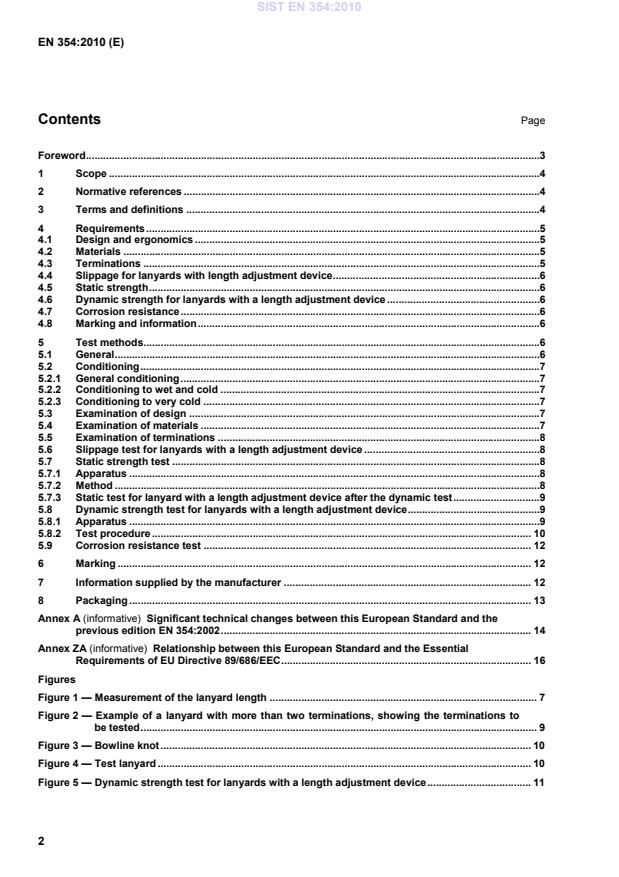
Relationship between this European Standard and the Essential Requirements of EU Directive 89/686/EEC . 16Figures Figure 1 — Measurement of the lanyard length . 7Figure 2 — Example of a lanyard with more than two terminations, showing the terminations to be tested . 9Figure 3 — Bowline knot . 10Figure 4 — Test lanyard . 10Figure 5 — Dynamic strength test for lanyards with a length adjustment device . 11 SIST EN 354:2010
According to the CEN/CENELEC Internal Regulations, the national standards organizations of the following countries are bound to implement this European Standard: Austria, Belgium, Bulgaria, Croatia, Cyprus, Czech Republic, Denmark, Estonia, Finland, France, Germany, Greece, Hungary, Iceland, Ireland, Italy, Latvia, Lithuania, Luxembourg, Malta, Netherlands, Norway, Poland, Portugal, Romania, Slovakia, Slovenia, Spain, Sweden, Switzerland and the United Kingdom.
NOTE A termination may be, for example, a spliced eye, a sewn loop, or a metal ring. 3.3 personal fall protection system assembly of components for protection against falls from a height, including a body holding device and an attachment system, which can be connected to a reliable anchorage point SIST EN 354:2010
4.3.3 Threads used for sewing shall be of a contrasting shade or colour in order to facilitate visual inspection. 4.3.4 When using a knot for forming a termination, the knot shall be secured so that it cannot be opened without the use of a tool. After the static strength test in accordance with 5.7, the tail end of the knot shall have a minimum length of 100 mm. 4.3.5 Ends of the lanyard shall be prevented from unravelling. 4.
...