

SIST EN 18161:2026
(Main)Water quality - Guidance standard on survey and monitoring freshwater mussel populations and their environment
- Abstract
This document provides the information needed to assess the condition over time of a unionid population, and the level of information for assessing whether a plan or project may be detrimental to their future prospects. It provides guidance on methods for survey and monitoring unionid mussel populations and the environmental characteristics important for maintaining populations in favourable condition. The document is based on best practice developed and used by unionid mussel experts in Europe, and describes approaches that individual countries have adopted for survey, data analysis and condition assessment.
Standard methods for restoring populations are not within the scope of this document.
- Status
- Published
- Public Enquiry End Date
- 01-Apr-2025
- Publication Date
- 18-Jun-2026
- Technical Committee
- KAV - Water quality
- Current Stage
- 6060 - National Implementation/Publication (Adopted Project)
- Start Date
- 04-Jun-2026
- Due Date
- 09-Aug-2026
- Completion Date
- 19-Jun-2026

SIST EN 18161:2026 is the Slovenian adoption of EN 18161:2026, a CEN European Standard for water quality guidance on surveying and monitoring freshwater mussel populations and the environments they depend on. It explains how to gather comparable field data on unionid mussels, their hosts, habitat, water quality and pressures so users can judge population condition over time and assess whether a plan or project could harm future prospects.
What does SIST EN 18161:2026 specify?
SIST EN 18161:2026 gives guidance for survey, monitoring and condition assessment of unionid freshwater mussel populations and the environmental features needed to keep them in favourable condition. It is organized into a short set of clauses covering scope, terms, the taxonomic summary, survey methods, environmental conditions, pressures, and assessment of plans or projects.
The document focuses on practical monitoring of living populations and the habitats that support them. Restoration methods are outside its scope.
| Annex | What it covers |
|---|---|
| Annex A (informative) | Geographical distribution of freshwater mussel species in Europe |
What are the key requirements of SIST EN 18161:2026?
Survey design starts with the water body and the survey objective
SIST EN 18161:2026 says surveyors should first classify the water body by type, size, flow and substrate, because those features determine which methods are suitable. In practice, that means choosing between wading, snorkelling, scuba, dredging or other methods based on depth, visibility and safety.
The standard distinguishes between baseline surveys, routine monitoring and investigative monitoring after events such as droughts, floods or construction. It also says the objective may be a single species or the full mussel community, so the sampling design has to match the question being asked.
Population monitoring is built around repeatable methods and measurable attributes
SIST EN 18161:2026 recommends repeated, standardized surveys so changes in distribution, abundance and size structure can be compared over time. Table 1 links each attribute to a method and an output, for example maps for distribution, counts or densities for abundance, and size measurements for population structure.
For practice, this means survey teams should record methods carefully, repeat work at suitable intervals, and keep the baseline data that later surveys will be compared against. Where distributions are still unknown, the document allows environmental DNA (eDNA) screening as an initial tool.
Population structure, recruitment and brooding need targeted sampling
SIST EN 18161:2026 directs users to measure mussel size, age structure and recruitment from the same samples used for abundance estimates. It notes that small mussels are easy to miss in visual searches, so quadrat excavation, sieving and, where needed, microscopic examination may be necessary.
The document also covers brooding levels and the presence of glochidia, the mussel larval stage. In practice, that information helps separate a population that is present from one that is reproducing successfully, which is important when judging conservation status or explaining recruitment failure.
Training, quality assurance and licensing are part of reliable survey work
SIST EN 18161:2026 places clear emphasis on surveyor training, refresher courses, training manuals and trial surveys before certification. It also calls for validation of data entry, because errors during transfer to databases or Geographical Information Systems (GIS) can distort trends.
The standard also notes that some surveys require licences and that sensitive population data should be handled under national protocols. For users, this means survey results are only as reliable as the people, records and permissions behind them.
Fish hosts, hydromorphology, water quality and biotic features all need assessment
SIST EN 18161:2026 treats mussel survey as part of a broader habitat assessment. Clause 6 covers fish hosts, hydromorphology, water quality and biotic features because mussels depend on host fish, suitable flow and substrate, and suitable chemical and biological conditions.
For fish hosts, the document asks for suitability, availability and fisheries management effects to be checked. For hydromorphology, it covers running waters and standing waters separately, with attention to flow, depth, velocity, substrate composition, substrate stability and water level fluctuation. For water quality, it highlights temperature, pH, calcium, alkalinity, dissolved oxygen, BOD, COD, electrical conductivity, nutrients, turbidity, suspended solids and contaminants. For biotic features, it includes phytoplankton, phytobenthos, aquatic macrophytes, macroinvertebrates, riparian vegetation, predators, competitors, parasites and diseases.
Environmental pressures and project screening are handled through checklists
SIST EN 18161:2026 includes a pressure-monitoring clause and a separate checklist for plans or projects that may affect mussel habitats. It asks users to look at activities such as abstraction, drainage, river engineering, forestry, agriculture, sewage discharges, invasive species, recreation, shipping, mining and sediment extraction.
In practice, this section is used for environmental impact assessment and for identifying the information needed before a project goes ahead. The questions help users test whether a proposal might affect mussels directly, alter host fish, change water quality, or modify flow and substrate conditions.
What terms does SIST EN 18161:2026 define?
- Acoustic Doppler Current Profiler (ADCP) - a sonar device that records water current velocities at different depths.
- Brooding period - the time during which glochidia remain inside a gravid mussel.
- Chemical oxygen demand (COD) - a measure of the oxygen that can be consumed by reactions in a water sample.
- Glochidium - a mussel larva.
- Hydromorphology - the physical and hydrological characteristics of rivers and the processes that create them.
- Recruitment - the survival of juvenile mussels and their addition to a reproducing population.
- Survey - the recording of qualitative or quantitative data with repeatable standardized techniques over a restricted period.
- Turbidity - the reduction of transparency in a liquid caused by undissolved matter.
Who uses SIST EN 18161:2026?
SIST EN 18161:2026 is used by ecologists, freshwater biologists, conservation managers, consultants, regulators and researchers who work on unionid mussels and the waters they inhabit. It is also relevant to hydrologists, hydrogeologists, geomorphologists, fisheries managers and environmental impact assessors.
In practice, these users apply it for baseline surveys, monitoring programmes, host fish assessments, habitat assessment, licensing support, data validation and screening of plans or projects. It is especially useful where a water body contains sensitive or declining mussel populations and decisions depend on comparable field evidence.
What does the SIST EN 18161:2026 document contain?
SIST EN 18161:2026 contains a taxonomic summary of the European unionid mussels covered by the standard and an informative annex showing their geographical distribution in Europe. It also contains detailed tables that link survey attributes to methods and outputs, which helps users choose an approach that fits the water body and the monitoring objective.
The document includes guidance on wading, snorkelling, scuba, dredging, quadrats, transects, sieving, growth analysis, host-fish assessment, water-quality sampling, penetrometry, fluvial audit and lake-habitat assessment. Those methods support field surveys, monitoring programmes and environmental assessment work without reproducing the standard’s detailed procedures here.
Get Certified
Connect with accredited certification bodies for this standard

CIS Institut d.o.o.
Personal Protective Equipment (PPE) certification body. Notified Body NB-2890 for EU Regulation 2016/425 PPE.

Kiwa BDA Testing
Building and construction product certification.
Kmetijski inštitut Slovenije
Agricultural Institute of Slovenia. Soil testing, plant health, agricultural product analysis.
Sponsored listings
Frequently Asked Questions
SIST EN 18161:2026 is a standard published by the Slovenian Institute for Standardization (SIST). Its full title is "Water quality - Guidance standard on survey and monitoring freshwater mussel populations and their environment". This standard covers: This document provides the information needed to assess the condition over time of a unionid population, and the level of information for assessing whether a plan or project may be detrimental to their future prospects. It provides guidance on methods for survey and monitoring unionid mussel populations and the environmental characteristics important for maintaining populations in favourable condition. The document is based on best practice developed and used by unionid mussel experts in Europe, and describes approaches that individual countries have adopted for survey, data analysis and condition assessment. Standard methods for restoring populations are not within the scope of this document.
This document provides the information needed to assess the condition over time of a unionid population, and the level of information for assessing whether a plan or project may be detrimental to their future prospects. It provides guidance on methods for survey and monitoring unionid mussel populations and the environmental characteristics important for maintaining populations in favourable condition. The document is based on best practice developed and used by unionid mussel experts in Europe, and describes approaches that individual countries have adopted for survey, data analysis and condition assessment. Standard methods for restoring populations are not within the scope of this document.
SIST EN 18161:2026 is classified under the following ICS (International Classification for Standards) categories: 13.060.70 - Examination of biological properties of water. The ICS classification helps identify the subject area and facilitates finding related standards.
SIST EN 18161:2026 is available in PDF format for immediate download after purchase. The document can be added to your cart and obtained through the secure checkout process. Digital delivery ensures instant access to the complete standard document.
Standards Content (Sample)
SLOVENSKI STANDARD
01-julij-2026
Kakovost vode - Navodilo za monitoring populacije sladkovodnih školjk in
njihovega okolja
Water quality - Guidance standard on survey and monitoring freshwater mussel
populations and their environment
Wasserbeschaffenheit - Anleitung für das Monitoring und Bewertung von
Süßwassermuscheln
Qualité de l'eau - Norme guide pour l'étude et le suivi des populations de moules d'eau
douce et de leur environnement
Ta slovenski standard je istoveten z: EN 18161:2026
ICS:
13.060.70 Preiskava bioloških lastnosti Examination of biological
vode properties of water
2003-01.Slovenski inštitut za standardizacijo. Razmnoževanje celote ali delov tega standarda ni dovoljeno.
EN 18161
EUROPEAN STANDARD
NORME EUROPÉENNE
June 2026
EUROPÄISCHE NORM
ICS 13.060.70
English Version
Water quality - Guidance standard on survey and
monitoring freshwater mussel populations and their
environment
Qualité de l'eau - Recommandations relatives à l'étude Wasserbeschaffenheit - Anleitung für das Monitoring
et au suivi des populations de moules d'eau douce et de und Bewertung von Süßwassermuscheln
leur environnement
This European Standard was approved by CEN on 13 April 2026.
CEN members are bound to comply with the CEN/CENELEC Internal Regulations which stipulate the conditions for giving this
European Standard the status of a national standard without any alteration. Up-to-date lists and bibliographical references
concerning such national standards may be obtained on application to the CEN-CENELEC Management Centre or to any CEN
member.
This European Standard exists in three official versions (English, French, German). A version in any other language made by
translation under the responsibility of a CEN member into its own language and notified to the CEN-CENELEC Management
Centre has the same status as the official versions.
CEN members are the national standards bodies of Austria, Belgium, Bulgaria, Croatia, Cyprus, Czech Republic, Denmark, Estonia,
Finland, France, Germany, Greece, Hungary, Iceland, Ireland, Italy, Latvia, Lithuania, Luxembourg, Malta, Netherlands, Norway,
Poland, Portugal, Republic of North Macedonia, Romania, Serbia, Slovakia, Slovenia, Spain, Sweden, Switzerland, Türkiye and
United Kingdom.
EUROPEAN COMMITTEE FOR STANDARDIZATION
COMITÉ EUROPÉEN DE NORMALISATION
EUROPÄISCHES KOMITEE FÜR NORMUNG
CEN-CENELEC Management Centre: Rue de la Science 23, B-1040 Brussels
© 2026 CEN All rights of exploitation in any form and by any means reserved Ref. No. EN 18161:2026 E
worldwide for CEN national Members.
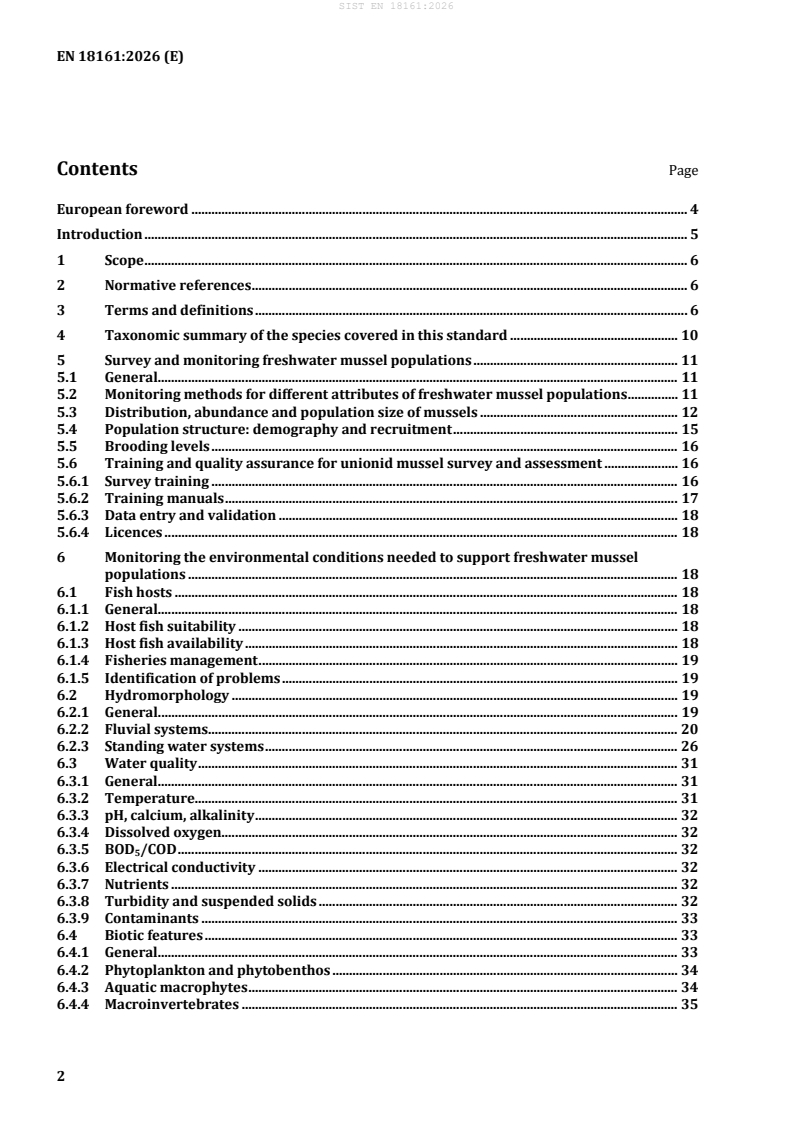
Contents Page
European foreword . 4
Introduction . 5
1 Scope . 6
2 Normative references . 6
3 Terms and definitions . 6
4 Taxonomic summary of the species covered in this standard . 10
5 Survey and monitoring freshwater mussel populations . 11
5.1 General. 11
5.2 Monitoring methods for different attributes of freshwater mussel populations . 11
5.3 Distribution, abundance and population size of mussels . 12
5.4 Population structure: demography and recruitment . 15
5.5 Brooding levels . 16
5.6 Training and quality assurance for unionid mussel survey and assessment . 16
5.6.1 Survey training . 16
5.6.2 Training manuals . 17
5.6.3 Data entry and validation . 18
5.6.4 Licences . 18
6 Monitoring the environmental conditions needed to support freshwater mussel
populations . 18
6.1 Fish hosts . 18
6.1.1 General. 18
6.1.2 Host fish suitability . 18
6.1.3 Host fish availability . 18
6.1.4 Fisheries management . 19
6.1.5 Identification of problems . 19
6.2 Hydromorphology . 19
6.2.1 General. 19
6.2.2 Fluvial systems. 20
6.2.3 Standing water systems . 26
6.3 Water quality . 31
6.3.1 General. 31
6.3.2 Temperature. 31
6.3.3 pH, calcium, alkalinity . 32
6.3.4 Dissolved oxygen. 32
6.3.5 BOD /COD . 32
6.3.6 Electrical conductivity . 32
6.3.7 Nutrients . 32
6.3.8 Turbidity and suspended solids . 32
6.3.9 Contaminants . 33
6.4 Biotic features . 33
6.4.1 General. 33
6.4.2 Phytoplankton and phytobenthos . 34
6.4.3 Aquatic macrophytes . 34
6.4.4 Macroinvertebrates . 35
6.4.5 Riparian vegetation . 35
6.4.6 Predators and competitors . 36
6.4.7 Parasites and diseases . 36
6.4.8 Other aspects . 36
7 Monitoring environmental pressures . 36
8 Information needed to assess plans or projects on water bodies with freshwater mussels . 38
Annex A (informative) Geographical distribution of freshwater mussel species in Europe . 40
Bibliography . 43
European foreword
This document (EN 18161:2026) has been prepared by Technical Committee CEN/TC 230 “Water
analysis”, the secretariat of which is held by DIN.
This European Standard shall be given the status of a national standard, either by publication of an
identical text or by endorsement, at the latest by December 2026 and conflicting national standards shall
be withdrawn at the latest by December 2026.
Attention is drawn to the possibility that some of the elements of this document may be the subject of
patent rights. CEN shall not be held responsible for identifying any or all such patent rights.
Any feedback and questions on this document should be directed to the users’ national standards body.
A complete listing of these bodies can be found on the CEN website.
According to the CEN-CENELEC Internal Regulations, the national standards organizations of the
following countries are bound to implement this European Standard: Austria, Belgium, Bulgaria, Croatia,
Cyprus, Czech Republic, Denmark, Estonia, Finland, France, Germany, Greece, Hungary, Iceland, Ireland,
Italy, Latvia, Lithuania, Luxembourg, Malta, Netherlands, Norway, Poland, Portugal, Republic of North
Macedonia, Romania, Serbia, Slovakia, Slovenia, Spain, Sweden, Switzerland, Türkiye and the United
Kingdom.
Introduction
This document provides guidance on the survey and monitoring of populations of unionid mussels (i.e.
Order: Unionida, also referred to as naiads) and the environmental features on which they depend. There
are 24 species of native unionid bivalves in Europe other than Margaritifera margaritifera, which is
covered in a CEN standard to provide guidance on survey and monitoring. None of these unionid species
can be considered to be secure throughout their range based on IUCN threat assessments. A standard
approach to collecting the information required to undertake accurate threat assessments is not
available.
Unionid species are distributed according to their natural habitat requirements, the distribution of their
host fish, and the historical means by which both mussels and hosts have been distributed, and the
biogeographical barriers to their spread. The European unionids fill a wide range of habitat types, and
their survey, monitoring and condition assessment needs to be relevant to the individual requirements
of each species. Some species are generalists and occupy a wide range of habitats, while others are more
restricted by river/ lake/ canal bed substrate, water quality and water flow, in particular lentic or lotic
conditions.
Freshwater mussels are threatened by a range of pressures, as outlined in Lopes-Lima et al. [1]:
a) habitat loss, fragmentation, and degradation;
b) overexploitation;
c) pollution and eutrophication;
d) loss of fish hosts;
e) invasive species;
f) water abstraction and climate change;
g) other threats resulting in mussel declines (e.g. diseases), where the habitat appears intact with
healthy populations of fish, insects, gastropods, and other biota.
Further research is needed to detect new and emerging pressures, requiring consistent and comparable
mussel survey and data interpretation. This document aims to assist in the conservation of unionid
mussels through facilitating a consistent approach to understanding mussel populations across the
species and the bioregions in which they occur, including undertaking environmental impact assessment,
and restoring mussel populations. The applications of the document also include the provision of site-
level data that will contribute to reporting under Article 17 of the European Habitats Directive
(http://bd.eionet.europa.eu/article17/reference_portal).
NOTE Although freshwater mussels are invertebrates, their survey is conducted in a very different way from
standard surveys for other benthic macroinvertebrates. Surveys for mussels are concentrated on the restricted
habitat of the species of mussel being surveyed, and consider the habitat and water quality conditions required to
complete its full life cycle. For this reason, it is not possible to use EN 16859 (‘Guidance standard on monitoring
freshwater pearl mussel (Margaritifera margaritifera) populations and their environment’ [2]) for other mussel
species. The freshwater pearl mussel is unique among other European mussel species in that it lives in fast-flowing
oligotrophic habitats which are unsuitable for other mussel species. It is not possible, either, to use EN 16150
(‘Guidance on pro-rata multi-habitat sampling of benthic macro-invertebrates from rivers and streams’) as this
guidance is focused on finding the macroinvertebrate species present across a full representative range of habitat
types within a water body, and is thus unsuitable for a survey of mussels in their restricted habitat. The use of
EN 16150 is also confined to rivers and streams rather than the wide range of water bodies, including lakes and
ponds, that are important habitats for mussels.
1 Scope
This document provides the information needed to assess the condition over time of a unionid
population, and the level of information for assessing whether a plan or project could be detrimental to
their future prospects. It provides guidance on methods for survey and monitoring unionid mussel
populations and the environmental characteristics important for maintaining populations in favourable
condition. The document is based on best practice developed and used by unionid mussel experts in
Europe, and describes approaches that individual countries have adopted for survey, data analysis and
condition assessment.
Standard methods for restoring populations are not within the scope of this document.
2 Normative references
There are no normative references in this document.
3 Terms and definitions
For the purposes of this document, the following terms and definitions apply.
ISO and IEC maintain terminology databases for use in standardization at the following addresses:
— ISO Online browsing platform: available at https://www.iso.org/obp/
— IEC Electropedia: available at https://www.electropedia.org/
3.1
acoustic doppler current profiler
ADCP
sonar device that produces a record of water current velocities for a range of depths
[SOURCE: EN 16859:2017, definition 3.1]
3.2
aquatic macrophyte
larger plant of fresh water which is easily seen with the naked eye, including all aquatic vascular plants,
bryophytes, stoneworts (Characeae) and macro-algal growths
Note 1 to entry: This definition includes plants associated with open water or wetlands with shallow water.
[SOURCE: EN 14614:2004 [3], definition 2.1]
3.3
bankfull
maximum point on banks at which floods are held within the channel before spilling over onto the
floodplain
[SOURCE: EN 14614:2004, definition 2.5]
3.4
bathtub ring
high-water mark, visible at low water levels around the shoreline of a lake, often resulting from the
deposition of minerals on previously submerged surfaces
3.5
bathyscope
bucket with a transparent bottom used for viewing freshwater mussels on the river bed
[SOURCE: EN 16859:2017, definition 3.5, modified]
3.6
brooding period
length of time that glochidia remain within the body of a gravid mussel
[SOURCE: EN 16859:2017, definition 3.7, modified]
3.7
chemical oxygen demand
COD
indicative measure of the amount of oxygen that can be consumed by reactions in a measured solution,
−1
expressed as mass of oxygen consumed/volume of solution in mg L
3.8
cofferdam
temporary, watertight enclosure built within a body of water, from which water is pumped to provide a
dry working environment
3.9
colmation
blockage of stream-bed interstitial spaces by the ingress of fine sediments and organic material
[SOURCE: EN 16859:2017, definition 3.8]
3.10
culvert
arched, enclosed or piped structure constructed to carry water under roads, railways and buildings
[SOURCE: EN 15843:2025, definition 3.9]
3.11
flow duration curve
graphical representation of a ranking of all the flows in a given period, from the lowest to the highest,
where the rank is the percentage of time the flow value is equalled or exceeded
Note 1 to entry: These curves may be derived for flows in any time interval, such as daily flows, monthly flows or
annual flows.
[SOURCE: EN 16859:2017, definition 3.17]
3.12
fluvial audit
method for assessing the condition of a river and its associated human pressures, using information from
field survey, remote sensing, historical and recent maps, scientific literature and other sources
[SOURCE: EN 16859:2017, definition 3.18]
3.13
glide
moderately-flowing water with undisturbed surface other than occasional swirls or eddies, and with
constant depth across part of the channel
[SOURCE: EN 14614:2004, definition 2.17]
3.14
glochidium
glochidia, pl
mussel larva
[SOURCE: EN 16859:2017, definition 3.21, modified]
3.15
hydromorphology
physical and hydrological characteristics of rivers including the underlying processes from which they
result
[SOURCE: EN 14614:2004, definition 2.18]
3.16
marsupium
marsupia, pl
section of mussel gill expanded to form a pouch to protect eggs
3.17
monitoring
comparison of repeated surveys, ideally against pre-defined targets
3.18
penetrometry
method for assessing the resistance of the river-bed substrate in situ using a standard cone or disc
penetrometer
[SOURCE: EN 16859:2017, definition 3.28]
3.19
pool
habitat feature characterized by distinctly deeper parts of the channel that are usually no longer than one
to three times the channel’s bankfull width, and where the hollowed river bed profiles are sustained by
scouring
[SOURCE: EN 14614:2004, definition 2.24]
3.20
recruitment
survival of juvenile mussels and their addition to a reproducing population
[SOURCE: EN 16859:2017, definition 3.30, modified]
3.21
revetment
retaining wall or facing of masonry or other materials supporting or protecting banks from erosion
3.22
riffle
fast-flowing shallow water with distinctly broken or disturbed surface over gravel/pebble or cobble
substrate
[SOURCE: EN 14614:2004, definition 2.28]
3.23
riparian zone
area of land adjoining a river channel (including the river bank) capable of directly influencing the
condition of the aquatic ecosystem (e.g. by shading and leaf litter input)
Note 1 to entry: In this document, the term ‘riparian zone’ does not include the wider floodplain.
[SOURCE: EN 14614:2004, definition 2.29]
3.24
salt bridge
device containing a chemically inert electrolyte which is used to increase electrical conductivity locally
[SOURCE: EN 16859:2017, definition 3.37]
3.25
shear stress
measure of the force of friction caused by water flowing around a submerged surface or object
[SOURCE: EN 16859:2017, definition 3.38]
3.26
survey
recording of qualitative or quantitative data using easily repeatable standardized techniques over a
restricted period without preconception of the results
3.27
tumidity
measurement of a mussel at its widest point across the two valves
Note 1 to entry: While the length and width are measured across the longer and shorter side of one valve, the
tumidity is measured across the two valves.
3.28
turbidity
reduction of transparency of a liquid caused by the presence of undissolved matter
[SOURCE: ISO 6107:2021, definition 3.588]
3.29
umbonal sculpture
shape and arrangement of contours at the dorsal protuberance on bivalve shells that generally rises
above the hinge
3.30
woody material
material that falls into rivers and streams, ranging in size from leaf fragments (fine woody material) to
branches or whole trees (coarse woody material)
[SOURCE: EN 16859:2017, definition 3.41]
4 Taxonomic summary of the species covered in this standard
The European unionid mussels are divided into two families, the Margaritiferidae and the Unionidae.
In the Margaritiferidae, only two species currently occur in Europe – Margaritifera margaritifera
(Linnaeus, 1758) and Pseudunio auricularius (Spengler, 1793). In the Unionidae, 23 species are divided
into two subfamilies: the Unioninae and the Gonideinae. The Unioninae are further subdivided into tribes
Anodontini and Unionini.
The European Anodontini includes two genera – the genus Anodonta with three species: the widespread
Anodonta anatina (Linnaeus, 1758), Anodonta cygnea (Linnaeus, 1758), and the south-central European
Anodonta exulcerata Porro, 1838; and the genus Pseudanodonta with a single species, Pseudanodonta
complanata (Rossmassler, 1835).
The Unionini includes 16 valid species belonging to the genus Unio. This genus is divided into several
groups that correspond to four evolutionary monophyletic clades – the crassus, the pictorum, the gibbus
and tumidus clades, all of them with at least one species in Europe. The pictorum clade includes five valid
species: Unio delphinus Spengler, 1793; Unio elongatulus Pfeiffer, 1825; Unio mancus Lamarck, 1819; Unio
pictorum (Linnaeus, 1758); and Unio ravoisieri Deshayes, 1848. The crassus clade includes nine species:
Unio bruguierianus Bourguignat, 1853; Unio carneus Kuster, 1854; Unio crassus Philipsson in Retzius,
1788; Unio cytherea Kuster, 1833; Unio desectus Westerlund in Westerlund & Blanc, 1879; Unio gontierii
Bourguignat, 1856; Unio ionicus Drouët, 1879; Unio tumidiformis Castro, 1885; and Unio vicarius
Westerlund in Westerlund & Blanc, 1879. The gibbus clade includes the single species Unio gibbus
Spengler, 1793, only present in a single river in southern Spain. Finally, the tumidus clade only includes a
single species - the widespread Unio tumidus (Philipsson, 1788).
The second subfamily Gonideinae only includes two genera divided into three species in the south of
Europe. The genus Microcondylaea only includes a single species, Microcondylaea bonellii (Férussac,
1827), in south-central Europe. The genus Potomida includes two species in Europe, the Western
European Potomida littoralis (Cuvier, 1798) and Potomida acarnanica (Kobelt, 1879) only present in
Greece.
A list of the species covered in this document, together with details of their geographical distribution is
given in informative Annex A, Table A.1.
5 Survey and monitoring freshwater mussel populations
5.1 General
As many mussel populations and their habitats are in poor condition, obtaining adequate information on
unionid populations that are in good quality habitats and with successful recruitment can be helpful as
well as monitoring populations of lower quality. This information is also needed to plan the restoration
of declining populations to favourable condition.
In order to determine the most appropriate methods for survey and monitoring it will first be necessary
to categorize the water body by type (large river, small river, stream, canal, large lake/reservoir, small
lake/large pond); size (length, width, depth); flow and substrate characteristics. This is important when
deciding which sampling method will be required, such as wading in shallow and clean streams,
snorkelling in larger but still clean water bodies, scuba-diving in deeper rivers and lakes or with poor
visibility, or using dredges or other devices where conditions are not safe. The sampling method will also
determine which sampling design will be adequate to meet the objectives.
In general, smaller water bodies are easier to survey and monitor than larger ones, where there can be
large variation in habitat, and methods for measuring change are more difficult to design.
During the design of monitoring surveys, the decision on whether the target of the study is a single species
or the full mussel community present in the habitat will depend on the objective of the study, e.g. baseline
surveys, conservation monitoring, investigative monitoring following extreme events such as droughts
and floods.
5.2 Monitoring methods for different attributes of freshwater mussel populations
Unionid mussels are often present as assemblages of mixed species. Where this is the case, the mussel
faunal composition should first be established. Nevertheless, it should always be recognized that some
previously unrecorded species may be present as well.
An initial screening of potential habitats can help identify core areas of distribution as well as wider limits.
This can assist in identifying the most appropriate areas and survey methods. Changes in relative
abundance can be monitored over time, especially if repeated surveys are conducted in pre-established
locations. Making and reporting detailed records of methods used in each survey is essential to aid
comparisons of monitoring results and trends over time. This will also help when comparing the results
from different water bodies. Mussel populations can be monitored by focusing on particular attributes
according to the information required (Table 1).
Table 1 — Checklist of survey methods recommended for collecting data on mussel attributes
Attribute Method Output (units) Notes
Distribution Wading or snorkelling Map Once thoroughly to create a
/scuba survey counts baseline with annual checks or
with direct observation, at appropriate intervals, taking
into account the species’
fingertip searches or
biological cycle and the
dredging
monitoring objectives.
Where species’
distributions are largely
unknown, environmental
DNA methods can be used
Population Wading or snorkelling/ Number of mussels per At appropriate intervals taking
(including into account the species’
density scuba survey counts m
(including transects or variability across the biological cycle and
quadrats) with direct sites sampled) monitoring objectives.
observation, fingertip
searches or dredging
Size and age Determination of Mussel measurement It is useful to establish a
structure of individual mussel sizes (mm). Growth curve relationship between size and
mussel per species in quadrats or (mm per year) and age. If this is not possible, size
populations plots growth parameters distribution can be used as a
(e.g. growth surrogate. Size distribution
coefficient). Time according to species and
comparisons of baseline data. Demography
population size should be assessed annually or
structures at appropriate intervals taking
into account the species’
biological cycle and the
monitoring objectives.
Measurements are usually
maximum length, height, and
tumidity.
Brooding levels Visual, sub-sample of Percentage of surveyed To be undertaken where levels
mussel adults checked by mussels with evidence are low or no other evidence of
trained expert of brooding, based on a recruitment has been found.
representative sub-
sample. This can
include qualitative or
quantitative
approaches.
5.3 Distribution, abundance and population size of mussels
Baseline surveys should initially be undertaken with sufficient information collected as a reference point
to allow changes to be detected in subsequent monitoring surveys. Care needs to be taken to undertake
repeated monitoring surveys during appropriate seasons and conditions, as some seasonal changes can
affect the ease of finding some species more than others.
The area of a river or lake to survey will depend on its size. For medium to large rivers and lakes where
environmental conditions are suitable, sampling is best carried out from a boat/inflatable equipped with
an outboard motor so that a relatively large geographical area can be covered in a day and marginal areas
are easily reached and sampled. A representative range of habitats should be sampled to ensure that no
species are missed.
The extent of distribution of a population may require a series of surveys from broad, wide-ranging
efforts to understand the overall extent, to more detailed investigations in sub-sections of the population.
A previously surveyed water body typically needs a different initial approach compared with already
known populations, to establish the species composition present, microhabitat distribution and basic
distribution patterns that are needed to design further monitoring programmes.
Providing reliable information on a species’ population size is wholly dependent on size/depth of the
water body, accessibility, and water clarity. Major constraints to sampling freshwater mussels include
difficult access to water bodies, poor visibility, deep or fast-flowing water and poor water quality that
may impose health risks. Common sense should always be used when planning a survey, so that
appropriate methods are used in specific locations to meet the required objectives without compromising
health and safety issues. Most unionids live in very soft sediment/mud and may be scarcely visible even
in clear water, and many of the mussels will be hidden within the substrate. Furthermore, as more than
one species may co-exist in a very small area, species abundance can only be determined by some form
of invasive sampling. The best accuracy will be achieved by hand sampling of quadrats, but this is only
really feasible in water < 0,7 m deep. In deeper water this would be possible by scuba sampling of
quadrats. Quadrats shall be set using a sampling design that takes into account previous basic knowledge
of the mussels’ distribution and microhabitats present. Usually, a stratified or adapted sampling design
[4] that takes into account population density is necessary for reliable population estimates, rather than
random or systematic schemes. The number of quadrats to sample should be decided in accordance with
the total area to survey, the distribution pattern of mussels and the required precision of the estimates
(see [4] for details). In larger, deeper water bodies, and in those with turbid water, hand dredges can also
be an effective way of sampling and may be the only option for use in contaminated water, although they
are less accurate with respect to population size and abundance.
The efficiency of sampling mussels depends greatly on the substrate. Typically, three basic tools are used:
scratch sampler (a rake with netting) usually used in shallows and in soft sediment, and different types
of bottom samplers (Ekman’s grab, Van Veen grab, etc.) [5] in deeper parts. In many situations only scuba-
diving and sampling with quadrats give reliable results, assuming the removal of any obstacles for bottom
sampling. The efficiency of sampling may differ considerably depending on the vegetation and structure
of the substrate (e.g. shingle bars on the bottom built of cobbles or pebbles). Even with soft bottoms,
sampling may be hampered, e.g. by Nuphar luteum, which can completely cover the substrate with strong
and very thick rhizomes (up to 20 cm in diameter); however, this armoured layer decomposes in autumn
exposing soft sediments.
Standard methods developed for the country in which the survey is carried out should be used. Most
sampling strategies, including wading, snorkelling and scuba-diving are adequate for locating adult
mussels that are semi-buried in the substrate. Locating juveniles or other age classes that are fully buried
requires different strategies, including quadrat excavation or the use of dredges. Note that in some
countries, standard methods do not include investigations of buried mussels. A careful evaluation of the
objectives of the monitoring programme should be made before considering the use of these techniques,
as they can be locally destructive to microhabitats.
In all cases, mussels should be identified to species level and counted. Identification is straightforward
for some species but may be more difficult for others. When necessary, morphometric or molecular
techniques should be used for identification. The same mussels should also be used for demographic
analysis (see 5.2). The intervals at which mussels are monitored depend on the objectives of the
monitoring programme; one-time surveys are usually only adequate for establishing a reference
characterization of the population. Annual monitoring can be useful for following trends in mussel
species, especially for populations that are at risk. Stable populations of long-lived species may be
surveyed at longer intervals for the same purposes, whereas specific objectives such as investigating the
reproductive success or impact of disturbance events (droughts, construction, pollution, etc.) may
require monitoring at monthly or other short intervals. Monitoring methods are shown in Table 2. The
timing of sampling itself should match ideal water levels, using opportunities such as when reservoirs
and canals dry up for maintenance or natural habitats dry up because of droughts. Quadrats should still
be used even if little or no water is left, as live mussels may still be present.
Table 2 — Sampling methods suitable for different water body types
Water body Criteria / Restrictions Methods
Rivers and streams If mussel fauna and distribution is eDNA analysis of water samples at an
completely unknown appropriate number of locations
There may be beaches or shoals Rapid walkover survey of these areas
where dead shells are cast up, or (usually identifiable from aerial
spoil tips arising from channel photographs) to collect/record dead
dredging mussel shells
In water that is < 0,7 m deep, Wading using bathyscope if substrate is
clear or turbid stable enough, snorkelling if substrate is
very soft, by touch or using a robust pond
net if the visibility is poor. For
quantification place 0,5 m × 0,5 m
quadrats on the substrate surface or use
transects according to the most
appropriate sampling design for each
site. Hand-search the quadrat or transect
and place all mussels into a keep net.
Ensure all buried mussels are collected if
appropriate. The number of quadrats
should be representative of the spatial
distribution of mussels. Ideally at least 10
quadrats at each ‘site’ should be
analysed.
Water > 0,7 m deep but with good Scuba/snorkelling survey.
visibility
Water > 0,7 m deep but with poor Small hand dredge deployed from the
visibility bank or from a small boat. For large, deep
rivers an air-lifter /suction dredge can be
deployed from an appropriately sized
vessel. Scuba survey may be appropriate
for specific objectives.
Water body Criteria / Restrictions Methods
Canals In general, canals tend to have Small hand dredge deployed from bank
turbid water and an even bed or from a small boat. Wading may be
profile (with no shallower possible when water levels are low due
margins), with a muddy to canal maintenance.
substrate, and are usually
dredged for maintenance. Water
likely to be > 0,5 to 0,7 m deep.
Lakes/reservoirs/ For substrates comprising deep, Margins may be sampled by a robust
large ponds and soft mud ‘pond net’ or by a small hand dredge. A
lowland rivers wider area and lakes with dense fringing
vegetation are best sampled from a
shallow-draft boat using either a glass-
bottomed bucket if water clarity is good,
fingertip searching if shallow enough, or
a hand dredge.
For more stable substrates and Wading using a bathyscope, or fingertip
sparsely vegetated margins searching if water is turbid; snorkelling,
scuba or hand dredging in deeper water
5.4 Population structure: demography and recruitment
The same rationale for determining population structure and recruitment applies to all types of water
bodies.
Population structure is determined by measuring all mussels collected from samples taken for estimating
population size (see 5.3). Detailed measurements should be made to the nearest millimetre, and then size
distributions compared at regular intervals with baseline data. Mussels smaller than 2 cm to 3 cm in
length are likely to be missed by hand or visual searches, especially in turbid water. Where permitted and
if relevant to determine recent juvenile recruitment, all surface substrate within quadrats needs to be
collected and analysed. All sediment should be passed through a sieve (approx. 5 mm is likely to be
adequate), and all visible small unionids removed, identified and measured. Small unionids (< 5 mm) are
difficult to distinguish when there are also large numbers of pea bivalves present and the samples should
then be analysed in the laboratory using a microscope. Very small unionids are also potentially difficult
to identify to species in mixed assemblages and for some species attention should be given to the umbonal
sculpture.
If the water body can only be sampled by using hand dredges (or suction lifters) then a quantity of
sediment collected in the dredge should be sieved and analysed as described above. If the mesh on the
dredge net is too coarse then mussels will slip through. Mesh sizes should be chosen appropriately in
order to capture all sizes of unionids.
Monitoring should follow a sampling design and methodology as recommended in Table 2, to establish a
baseline. Once a baseline is established, the frequency of monitoring should be based on an assessment
of risk to the population, with some aspects needing to be carried out at a higher frequency than others.
Where adverse pressures are apparent, investigative monitoring may be required to determine their
cause.
Monitoring sites should be selected in accordance with the objectives of the monitoring programme
(mussel distribution, abundance, age structure, active recruitment, growth conditions). Ideally transects
or quadrats should be placed at the same site on successive monitoring occasions, but when disturbance
events eliminate or greatly reduce mussel beds this may not be possible. In order to assess the impact of
disturbance at a population level the baseline data should include a minimum of five replicates for each
microhabitat present. If disturbance is likely to affect whole sites, several sites should be selected based
on their similarity and in relatively uniform areas or stretches of river. This will allow some losses to be
accommodated without significantly affecting the monitoring results.
Age can be estimated by counting growth rings on the shells, usually on thin sections observed under the
microscope after applying an appropriate dye. Care should be taken when doing so as growth rings may
not always be annual and false rings are common. A growth curve can be calculated according to Von
Bertalanffy [6] or other suitable model, and used to compare different populations, such as in Müller et
al. [7]. Calibration of the relationship between size and age is needed as it is often lake-, river- or even
site-specific. For medium- to long-term monitoring, some mussels should be individually tagged, and real
growth can be registered from recapture data and used for calibration and constructing growth models.
5.5 Brooding levels
A subset of adult mussels can be checked for brooding levels of glochidia if sampling is undertaken at the
appropriate time. Mussels can be checked for the presence of glochidia without harm by gently opening
the valves to allow the inspection of the marsupia. The stage of development of glochidia can be checked
by collecting a sample with a pipette and observing them under a microscope. Mature glochidia are
readily identified by the absence of a capsule and active reaction to the presence of salt (NaCl). The
presence and proportion of mussels with glochidia, and the ability to produce mature glochidia, are
important indicators of the reproductive output of a population and may help to identify reasons for
recruitment failure. In order to accurately determine glochidial production, sampling should be repeated
at regular intervals within the glochidial production period of each species. The timing and duration of
brooding periods vary according to climatic conditions. Multiple broods during the appropriate period
are also common in many species. Fertility estimates usually imply sacrificing specimens but may be
necessary for investigative monitoring.
5.6 Training and quality assurance for unionid mussel survey and assessment
5.6.1 Survey training
Surveyor training is essential to ensure consistency, accuracy and precision. Surveyors need to
understand sufficiently the biology of the various species under study to appreciate the reasons for the
methods used and the need for care in their application to avoid damage to mussels.
Training should be structured to cover the level of survey required, from minimally invasive counts of
adults to specialist demographic quadrat analysis. Where relevant, a qualification in
...