

SIST EN ISO 14021:2026
(Main)Environmental statements and programmes for products - Self-declared environmental claims (ISO 14021:2026)
General Information
- Abstract
This document establishes principles, specifies requirements and gives guidance on self-declared environmental claims about products and their environmental statement programmes, including claims that also cover related social and economic aspects that are affected by environmental conditions or the environmental performance of a product.
This document defines selected terms commonly used in self-declared environmental claims and provides qualifications for their use, as well as describing the documentation and methodologies required for assessing self-declared environmental claims.
This document is applicable to self-declared environmental claims that predominantly take the form of words, but can also be symbols or graphics on product or package labels, or appear in product literature, technical bulletins, advertising and publicity, including on digital platforms.
- Status
- Published
- Public Enquiry End Date
- 30-Jun-2025
- Publication Date
- 13-Sep-2026
- Technical Committee
- UZO - Environmental management
- Current Stage
- 6060 - National Implementation/Publication (Adopted Project)
- Start Date
- 03-Sep-2026
- Due Date
- 08-Nov-2026
- Completion Date
- 14-Sep-2026

Overview
SIST EN ISO 14021:2026 is an international standard developed by the Slovenian Institute for Standardization (SIST) that specifies principles, requirements, and guidance for self-declared environmental claims about products. Also referred to as "Type II environmental labelling," this standard ensures that manufacturers, importers, retailers, and other parties making environmental statements adhere to clear, transparent, and scientifically sound practices. Self-declared environmental claims may include words, symbols, or graphics appearing on product labels, packaging, literature, advertising, and digital platforms.
The standard's key purpose is to help organizations communicate accurate, relevant, and verifiable environmental information, reduce marketplace confusion, and prevent greenwashing. It contributes to harmonizing international approaches to product environmental statements and supports businesses in substantiating their claims.
Key Topics
SIST EN ISO 14021:2026 covers a wide range of topics essential for accurate and effective self-declared environmental claims:
- Definitions and Key Terms: Establishes standardized terminology for environmental claims.
- Principles of Environmental Statements: Emphasizes transparency, accuracy, and verifiability to avoid deceptive or vague claims.
- Requirements for Environmental Claim Programmes: Outlines program governance, stakeholder involvement, assessment criteria, data quality, and access to supporting information.
- Format and Communication: Addresses the presentation of claims through text, symbols, graphics, and digital media, including comparative or multiple claims.
- Specific Claim Types: Provides guidance on claims such as recycled content, recyclability, biodegradability, compostability, renewable material, energy efficiency, and waste reduction.
- Documentation and Methodologies: Stresses the importance of robust documentation for substantiating claims and outlines methods for assessing their validity.
- Handling of Endorsements, Donations, and Chain of Custody: Describes requirements when claims reference endorsements, contributions, or traceability systems.
- Prevention of Greenwashing: Sets requirements for credible, non-misleading claims to support responsible green marketing.
Applications
SIST EN ISO 14021:2026 has practical value across multiple sectors and product categories:
- Product Labelling: Enables companies to convey verified environmental information directly on packaging and product labels, supporting consumer trust and transparency.
- Marketing and Advertising: Supports clear, accurate environmental messaging in brochures, websites, digital channels, and advertising campaigns.
- Procurement and Supply Chains: Assists public and private sector buyers in evaluating and comparing products based on reliable environmental claims.
- Regulatory Compliance and Trade: Facilitates international trade by harmonizing claim requirements and supporting compliance with environmental regulations.
- Corporate Social Responsibility: Helps organizations document and communicate environmental improvements, contributing to sustainability goals.
- Prevention of Greenwashing: Provides a framework for credible self-declared claims, minimizing the risk of reputational damage from misleading or unsupported statements.
By applying this standard, organizations can enhance their environmental credibility, enable informed purchasing decisions, and contribute to market-driven sustainability improvements.
Related Standards
SIST EN ISO 14021:2026 forms part of the ISO 14020 series and aligns with other key international standards:
- ISO 14020: Provides general principles and definitions for all types of environmental labels and declarations.
- ISO 14024: Covers Type I environmental labelling - voluntary, third-party certified eco-labels.
- ISO 14025: Relates to Type III environmental declarations, which are based on quantitative life cycle data.
- ISO 14040/44: Focuses on life cycle assessment methodologies, often referenced for supporting data.
- Other Regional Ecolabelling Standards: Complements various national and European ecolabelling systems.
Implementing SIST EN ISO 14021:2026 helps organizations align with best practices in environmental communication and supports international harmonization in environmental labelling and declarations.
Relations
- Effective Date
- 01-Oct-2026
- Effective Date
- 01-Oct-2026
- Referred By
SIST EN 16935:2017 - Bio-based products - B2C reporting and communication - Requirements for claims - Effective Date
- 15-Jul-2026
- Effective Date
- 15-Jul-2026
- Effective Date
- 15-Jul-2026
- Effective Date
- 15-Jul-2026
- Effective Date
- 15-Jul-2026
- Effective Date
- 15-Jul-2026
- Effective Date
- 15-Jul-2026
- Effective Date
- 15-Jul-2026
- Effective Date
- 15-Jul-2026
- Effective Date
- 15-Jul-2026
- Effective Date
- 15-Jul-2026
- Effective Date
- 15-Jul-2026
- Effective Date
- 15-Jul-2026
Get Certified
Connect with accredited certification bodies for this standard

BSI Group
BSI (British Standards Institution) is the business standards company that helps organizations make excellence a habit.

Bureau Veritas
Bureau Veritas is a world leader in laboratory testing, inspection and certification services.

DNV
DNV is an independent assurance and risk management provider.
Sponsored listings
Frequently Asked Questions
SIST EN ISO 14021:2026 is a standard published by the Slovenian Institute for Standardization (SIST). Its full title is "Environmental statements and programmes for products - Self-declared environmental claims (ISO 14021:2026)". This standard covers: This document establishes principles, specifies requirements and gives guidance on self-declared environmental claims about products and their environmental statement programmes, including claims that also cover related social and economic aspects that are affected by environmental conditions or the environmental performance of a product. This document defines selected terms commonly used in self-declared environmental claims and provides qualifications for their use, as well as describing the documentation and methodologies required for assessing self-declared environmental claims. This document is applicable to self-declared environmental claims that predominantly take the form of words, but can also be symbols or graphics on product or package labels, or appear in product literature, technical bulletins, advertising and publicity, including on digital platforms.
This document establishes principles, specifies requirements and gives guidance on self-declared environmental claims about products and their environmental statement programmes, including claims that also cover related social and economic aspects that are affected by environmental conditions or the environmental performance of a product. This document defines selected terms commonly used in self-declared environmental claims and provides qualifications for their use, as well as describing the documentation and methodologies required for assessing self-declared environmental claims. This document is applicable to self-declared environmental claims that predominantly take the form of words, but can also be symbols or graphics on product or package labels, or appear in product literature, technical bulletins, advertising and publicity, including on digital platforms.
SIST EN ISO 14021:2026 is classified under the following ICS (International Classification for Standards) categories: 13.020.50 - Ecolabelling. The ICS classification helps identify the subject area and facilitates finding related standards.
SIST EN ISO 14021:2026 has the following relationships with other standards: It is inter standard links to SIST EN ISO 14021:2016, SIST EN ISO 14021:2016/A1:2021, SIST EN 16935:2017, SIST EN 868-6:2025, SIST EN 15343:2008, SIST EN 868-4:2025, SIST EN 14471:2014, SIST EN 868-3:2025, SIST EN 14471:2006, SIST EN 12542:2010, SIST EN 50598-3:2015, SIST EN 15941:2024, SIST EN 868-2:2025, SIST-TS CEN/TS 16295:2012, SIST EN 16119:2013. Understanding these relationships helps ensure you are using the most current and applicable version of the standard.
SIST EN ISO 14021:2026 is associated with the following European legislation: EU Directives/Regulations: 765/2008; Standardization Mandates: M/580. When a standard is cited in the Official Journal of the European Union, products manufactured in conformity with it benefit from a presumption of conformity with the essential requirements of the corresponding EU directive or regulation.
SIST EN ISO 14021:2026 is available in PDF format for immediate download after purchase. The document can be added to your cart and obtained through the secure checkout process. Digital delivery ensures instant access to the complete standard document.
Standards Content (Sample)
SLOVENSKI STANDARD
01-oktober-2026
Nadomešča:
SIST EN ISO 14021:2016
SIST EN ISO 14021:2016/A1:2021
Okoljske izjave in programi za proizvode - Okoljsko samodeklariranje (ISO
14021:2026)
Environmental statements and programmes for products - Self-declared environmental
claims (ISO 14021:2026)
ISO 14021 Umweltaussagen und -programme für Produkte - Selbsterklärter
Umweltanspruch
Marquage et déclarations environnementaux Autodéclarations environnementales
(Étiquetage de type II)
Ta slovenski standard je istoveten z: EN ISO 14021:2026
ICS:
13.020.50 Označevanje z ekološko Ecolabelling
nalepko
2003-01.Slovenski inštitut za standardizacijo. Razmnoževanje celote ali delov tega standarda ni dovoljeno.
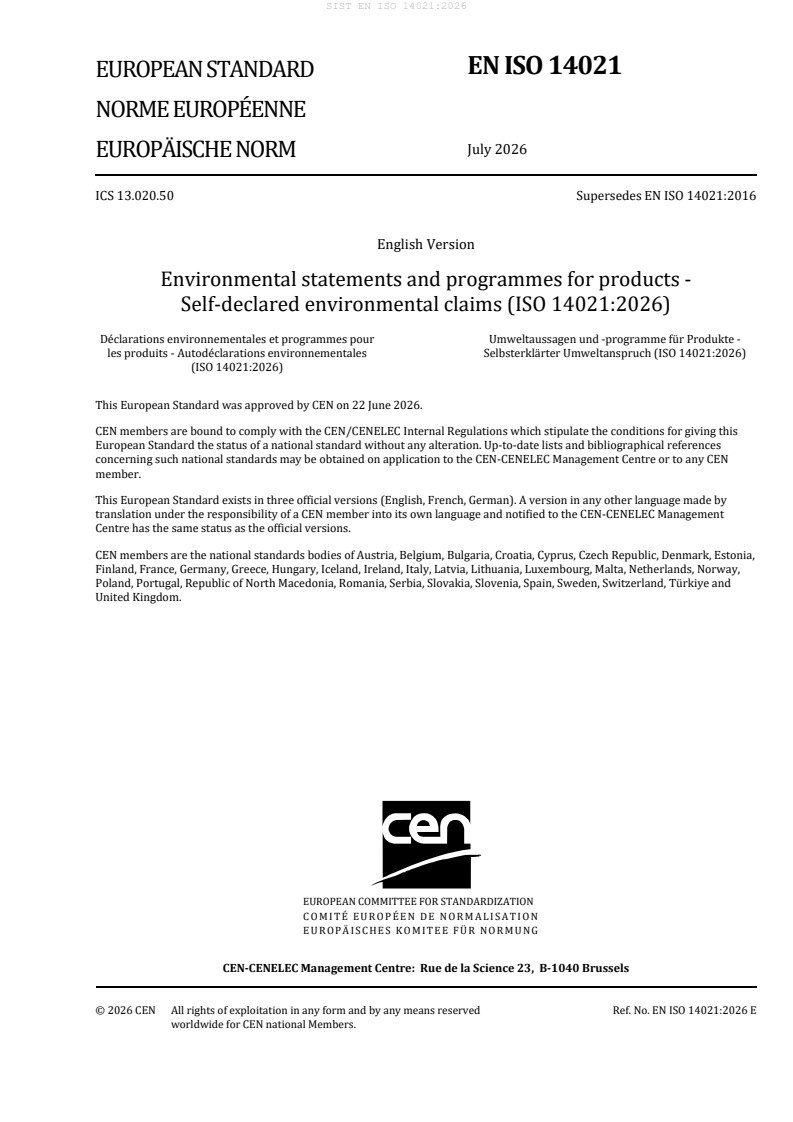
EN ISO 14021
EUROPEAN STANDARD
NORME EUROPÉENNE
July 2026
EUROPÄISCHE NORM
ICS 13.020.50 Supersedes EN ISO 14021:2016
English Version
Environmental statements and programmes for products -
Self-declared environmental claims (ISO 14021:2026)
Déclarations environnementales et programmes pour Umweltaussagen und -programme für Produkte -
les produits - Autodéclarations environnementales Selbsterklärter Umweltanspruch (ISO 14021:2026)
(ISO 14021:2026)
This European Standard was approved by CEN on 22 June 2026.
CEN members are bound to comply with the CEN/CENELEC Internal Regulations which stipulate the conditions for giving this
European Standard the status of a national standard without any alteration. Up-to-date lists and bibliographical references
concerning such national standards may be obtained on application to the CEN-CENELEC Management Centre or to any CEN
member.
This European Standard exists in three official versions (English, French, German). A version in any other language made by
translation under the responsibility of a CEN member into its own language and notified to the CEN-CENELEC Management
Centre has the same status as the official versions.
CEN members are the national standards bodies of Austria, Belgium, Bulgaria, Croatia, Cyprus, Czech Republic, Denmark, Estonia,
Finland, France, Germany, Greece, Hungary, Iceland, Ireland, Italy, Latvia, Lithuania, Luxembourg, Malta, Netherlands, Norway,
Poland, Portugal, Republic of North Macedonia, Romania, Serbia, Slovakia, Slovenia, Spain, Sweden, Switzerland, Türkiye and
United Kingdom.
EUROPEAN COMMITTEE FOR STANDARDIZATION
COMITÉ EUROPÉEN DE NORMALISATION
EUROPÄISCHES KOMITEE FÜR NORMUNG
CEN-CENELEC Management Centre: Rue de la Science 23, B-1040 Brussels
© 2026 CEN All rights of exploitation in any form and by any means reserved Ref. No. EN ISO 14021:2026 E
worldwide for CEN national Members.
Contents Page
European foreword . 3
European foreword
This document (EN ISO 14021:2026) has been prepared by Technical Committee ISO/TC 207
"Environmental management" in collaboration with CCMC.
This European Standard shall be given the status of a national standard, either by publication of an
identical text or by endorsement, at the latest by January 2027, and conflicting national standards shall
be withdrawn at the latest by January 2027.
Attention is drawn to the possibility that some of the elements of this document may be the subject of
patent rights. CEN shall not be held responsible for identifying any or all such patent rights.
This document supersedes EN ISO 14021:2016.
Any feedback and questions on this document should be directed to the users’ national standards
body/national committee. A complete listing of these bodies can be found on the CEN website.
According to the CEN-CENELEC Internal Regulations, the national standards organizations of the
following countries are bound to implement this European Standard: Austria, Belgium, Bulgaria,
Croatia, Cyprus, Czech Republic, Denmark, Estonia, Finland, France, Germany, Greece, Hungary, Iceland,
Ireland, Italy, Latvia, Lithuania, Luxembourg, Malta, Netherlands, Norway, Poland, Portugal, Republic of
North Macedonia, Romania, Serbia, Slovakia, Slovenia, Spain, Sweden, Switzerland, Türkiye and the
United Kingdom.
Endorsement notice
The text of ISO 14021:2026 has been approved by CEN as EN ISO 14021:2026 without any modification.
International
Standard
ISO 14021
Third edition
Environmental statements and
2026-06
programmes for products — Self-
declared environmental claims
Déclarations environnementales et programmes pour les
produits — Autodéclarations environnementales
Reference number
ISO 14021:2026(en) © ISO 2026
ISO 14021:2026(en)
© ISO 2026
All rights reserved. Unless otherwise specified, or required in the context of its implementation, no part of this publication may
be reproduced or utilized otherwise in any form or by any means, electronic or mechanical, including photocopying, or posting on
the internet or an intranet, without prior written permission. Permission can be requested from either ISO at the address below
or ISO’s member body in the country of the requester.
ISO copyright office
CP 401 • Ch. de Blandonnet 8
CH-1214 Vernier, Geneva
Phone: +41 22 749 01 11
Email: copyright@iso.org
Website: www.iso.org
Published in Switzerland
ii
ISO 14021:2026(en)
Contents Page
Foreword .vi
Introduction .viii
1 Scope . 1
2 Normative references . 1
3 Terms and definitions . 1
3.1 Terms related to the environment .1
3.2 Terms related to environmental statements .2
3.3 Terms related to programmes .4
3.4 Terms related to products and their characteristics .4
3.5 Terms related to processes and activities .8
3.6 Other terms .8
4 Principles . 9
5 Environmental statements not covered by this document . 9
5.1 General .9
5.2 Documents on environmental statements for products .10
5.3 Footprint communications .10
5.4 Carbon neutral and net zero .10
5.5 Low carbon energy .10
5.6 Statements of sustainability .11
5.7 Statements of circularity .11
6 Requirements applying to self-declared environmental claim programmes .11
6.1 Self-declared environmental claim programme .11
6.2 Environmental statement programme operator . 12
6.3 Involvement of interested parties . 12
6.4 Scope of the programme, claimants and intended audiences . 12
6.5 Specified requirements and criteria for the evaluation of self-declared environmental
claims . 12
6.5.1 Responsibilities of the programme operator . 12
6.5.2 Selection of assessment methods . 13
6.5.3 Access to information . 13
6.6 Quantification methodologies, data quality and reporting .14
6.7 Conformity assessment .14
6.8 Format of self-declared environmental claims, reporting and publication .14
6.9 Changes or revisions to environmental statement programmes, specified requirements
and criteria, and self-declared environmental claims .14
7 Requirements applying to all self-declared environmental claims . 14
7.1 General .14
7.2 Multiple self-declared environmental claims .16
7.3 Other information and statements .16
7.4 Use of symbols and graphics in self-declared environmental claims .16
7.5 Comparative claims .17
7.6 Explanatory text and supporting information .17
7.6.1 Explanatory text .17
7.6.2 Supporting information .18
7.7 Claims of attribution using chain of custody models .19
7.8 Donations and contributions .19
7.9 Endorsements .19
7.10 Vague or non-specific self-declared environmental claims .19
7.10.1 General .19
7.10.2 Natural content .19
7.10.3 Claims based on geographical origin . 20
7.10.4 Statements of sustainability . 20
iii
ISO 14021:2026(en)
7.10.5 Disposal into the general waste stream . 20
8 Requirements for selected self-declared environmental claims .20
8.1 General . 20
8.2 Designed for disassembly .21
8.2.1 Description .21
8.2.2 Limitations .21
8.2.3 Assessment method . 22
8.3 Designed for dismantling . 23
8.3.1 Description . 23
8.3.2 Limitations . 23
8.3.3 Assessment method .24
8.4 Recovered material .24
8.4.1 Description .24
8.4.2 Limitations .24
8.4.3 Assessment method .24
8.5 Recycled content .24
8.5.1 Description .24
8.5.2 Limitations . 25
8.5.3 Use of chain of custody models. 25
8.5.4 Assessment method . 26
8.5.5 Use of a symbol . 26
8.6 “… free” . 26
8.6.1 Description . 26
8.6.2 Limitations . 26
8.6.3 Assessment method .27
8.7 Recovered energy .27
8.7.1 Description .27
8.7.2 Limitations .27
8.7.3 Assessment method . 28
8.8 Renewable material . 28
8.8.1 Description . 28
8.8.2 Limitations . 28
8.8.3 Use of chain of custody models. 29
8.8.4 Assessment method . 29
8.9 Renewable energy . 29
8.9.1 Description . 29
8.9.2 Limitations . 29
8.9.3 Assessment method . 30
8.10 Bio-based . 30
8.10.1 Description . 30
8.10.2 Limitations . 30
8.10.3 Assessment method . 30
8.11 Reusable . 30
8.11.1 Description . 30
8.11.2 Limitations .31
8.11.3 Assessment method .31
8.12 Refillable .31
8.12.1 Description .31
8.12.2 Limitations .31
8.12.3 Assessment method .32
8.13 Repairable .32
8.13.1 Description .32
8.13.2 Limitations .32
8.13.3 Assessment method . 33
8.14 Compostable . 33
8.14.1 Description . 33
8.14.2 Limitations . 33
8.14.3 Assessment method . 34
iv
ISO 14021:2026(en)
8.15 Degradable . 34
8.15.1 Description . 34
8.15.2 Limitations . 35
8.15.3 Assessment method . 35
8.16 Biodegradable . 35
8.16.1 Description . 35
8.16.2 Limitations . 35
8.16.3 Assessment method . 36
8.17 Recyclable . 36
8.17.1 Description . 36
8.17.2 Limitations . 36
8.17.3 Assessment method . 36
8.17.4 Use of a symbol .37
8.18 Extended life . 38
8.18.1 Description . 38
8.18.2 Limitations . 38
8.18.3 Assessment method . 38
8.19 Waste reduction . 38
8.19.1 Description . 38
8.19.2 Limitations . 38
8.19.3 Assessment method . 39
8.20 Reduced resource use . 39
8.20.1 Description . 39
8.20.2 Limitations . 39
8.20.3 Assessment method . 39
8.21 Reduced energy consumption of products . 40
8.21.1 Description . 40
8.21.2 Limitations . 40
8.21.3 Assessment method . 40
8.22 Reduced water use by products . 40
8.22.1 Description . 40
8.22.2 Limitations .41
8.22.3 Assessment method .41
Annex A (informative) Examples of supporting information for self-declared environmental
claims .42
Annex B (informative) Diagrammatic representation of a recycling system .46
Annex C (informative) Conformity assessment methods . 47
Annex D (informative) Chain of custody .48
Annex E (informative) Other relevant documents . 51
Bibliography .54
v
ISO 14021:2026(en)
Foreword
ISO (the International Organization for Standardization) is a worldwide federation of national standards
bodies (ISO member bodies). The work of preparing International Standards is normally carried out through
ISO technical committees. Each member body interested in a subject for which a technical committee
has been established has the right to be represented on that committee. International organizations,
governmental and non-governmental, in liaison with ISO, also take part in the work. ISO collaborates closely
with the International Electrotechnical Commission (IEC) on all matters of electrotechnical standardization.
The procedures used to develop this document and those intended for its further maintenance are described
in the ISO/IEC Directives, Part 1. In particular, the different approval criteria needed for the different types
of ISO document should be noted. This document was drafted in accordance with the editorial rules of the
ISO/IEC Directives, Part 2 (see www.iso.org/directives).
ISO draws attention to the possibility that the implementation of this document may involve the use of (a)
patent(s). ISO takes no position concerning the evidence, validity or applicability of any claimed patent
rights in respect thereof. As of the date of publication of this document, ISO had not received notice of (a)
patent(s) which may be required to implement this document. However, implementers are cautioned that
this may not represent the latest information, which may be obtained from the patent database available at
www.iso.org/patents. ISO shall not be held responsible for identifying any or all such patent rights.
Any trade name used in this document is information given for the convenience of users and does not
constitute an endorsement.
For an explanation of the voluntary nature of standards, the meaning of ISO specific terms and expressions
related to conformity assessment, as well as information about ISO’s adherence to the World Trade
Organization (WTO) principles in the Technical Barriers to Trade (TBT), see www.iso.org/iso/foreword.html.
This document was prepared by Technical Committee ISO/TC 207, Environmental management, Subcommittee
SC 3, Environmental labelling, in collaboration with the European Committee for Standardization (CEN), in
accordance with the Agreement on technical cooperation between ISO and CEN (Vienna Agreement).
This third edition cancels and replaces the second edition (ISO 14021:2016), which has been technically
revised. It also incorporates the Amendment ISO 14021:2016/Amd 1:2021.
The main changes are as follows:
— elements that are common to all the documents on environmental statements developed by
ISO/TC 207/SC 3 have been removed and are now in ISO 14020:2022;
— the document has been restructured to correspond with the structure of ISO 14020;
— self-declared environmental claims are now required to be part of a documented “programme”;
— enhanced requirements have been included for documentary information to be retained to demonstrate
the validity/veracity of the self-declared environmental claim;
— new requirements have been added to disclose the effect of attribution of characteristics where it impacts
the reliability of some self-declared environmental claims;
— guidance has been added about the role that maintaining a chain of custody plays in assessing certain
self-declared environmental claims, such as recycled content;
— the specific claims included in Clause 8 have been updated to reflect changes in the market and additional
claims have been added to Clause 8;
— guidance for use of the Mobius loop symbol has been changed to address current marketplace confusion;
— identification of environmental statements that are not appropriate for self-declared environmental
claims and listing of other standards that can be used for these claims has been added;
vi
ISO 14021:2026(en)
— reference documents have been updated and some terminology has been updated to reflect general
usage.
Any feedback or questions on this document should be directed to the user’s national standards body. A
complete listing of these bodies can be found at www.iso.org/members.html.
vii
ISO 14021:2026(en)
Introduction
0.1 This document contains principles, requirements and guidance for self-declared environmental
claims as well as related social and economic aspects that are affected by environmental conditions or
the environmental performance of the product. The validity and accuracy of such claims is essential to
avoid unfair competition that can arise from vague, unreliable and deceptive environmental claims (e.g.
greenwashing). When assessment methods used by those who make self-declared environmental claims
are transparent, scientifically sound and documented, those who purchase, or will potentially purchase,
products can be assured of the validity and accuracy of the claims.
0.2 Self-declared environmental claims can be made by manufacturers, importers, distributors, retailers
or anyone likely to benefit from such claims. Self-declared environmental claims made in regard to products
can take the form of words, symbols or graphics or combinations thereof on product or package labels, or in
product literature, technical bulletins, advertising, publicity or telemarketing, as well as digital or electronic
media.
0.3 Self-declared environmental claims are one type of environmental statement. The overall goals of
environmental statements are to:
a) communicate accurate and relevant information about the environmental aspects or environmental
impacts of products;
b) encourage the demand for and supply of products that cause less stress on the environment;
c) stimulate market-driven continual environmental improvement in products.
0.4 This document harmonizes the use of self-declared environmental claims. The benefits of using this
document are:
a) accurate, relevant and verifiable self-declared environmental claims that are not misleading;
b) increased potential for market forces to stimulate and improve environmental aspects in production,
processes and products;
c) prevention or minimization of unwarranted claims and greenwashing;
d) less marketplace confusion;
e) facilitation of international trade;
f) increased opportunities for purchasers, potential purchasers and users of a product to make better-
informed choices.
0.5 The international harmonization of requirements for self-declared environmental claims is intended
to help businesses, including small and medium enterprises (SMEs), to present substantiated, correct and
transparent environmental information on their products, consequently limiting the risk of greenwashing.
0.6 This document provides a framework for regulatory authorities in different jurisdictions to harmonize
how they interpret various self-declared environmental claims.
The document can also be of use to trade associations seeking to provide their members with guidance
about making self-declared environmental claims.
0.7 This document is one of the documents developed by ISO/TC 207/SC 3 that provide principles,
requirements and guidance for different types of environmental statements about products. These
documents include the following:
— ISO 14020, which provides common terms and definitions, principles and general requirements for
all environmental statements (e.g. self-declared environmental claims, ecolabels, EPDs and footprint
communications) and associated programmes that enable the communication of environmental aspects
and environmental impacts of products.
viii
ISO 14021:2026(en)
— ISO 14021 (this document), which provides principles, requirements and guidance for environmental
statements in the form of self-declared environmental claims.
— ISO 14024, which provides principles, requirements and guidance for environmental statements in the
form of ecolabels.
— ISO 14025, which provides principles, requirements and guidance for environmental statements in the
form of environmental product declarations (EPDs).
— ISO 14026, which provides principles, requirements and guidance for environmental statements in the
form of footprint communications.
— ISO/TS 14027, which provides principles, requirements and guidance for product category rules (PCR)
that support the use of life cycle assessment (LCA) as a method to compile and evaluate information that
is used as a basis for making environmental statements.
— ISO/TS 14029, which provides principles, requirements and guidance for the mutual recognition of EPDs,
footprint communications and associated programmes.
0.8 Environmental statement programme operators are encouraged to cooperate and harmonize with each
other, whenever relevant and applicable, to enhance the coherence of environmental statement programmes,
at regional, national and international levels.
0.9 Figure 1 pr
...