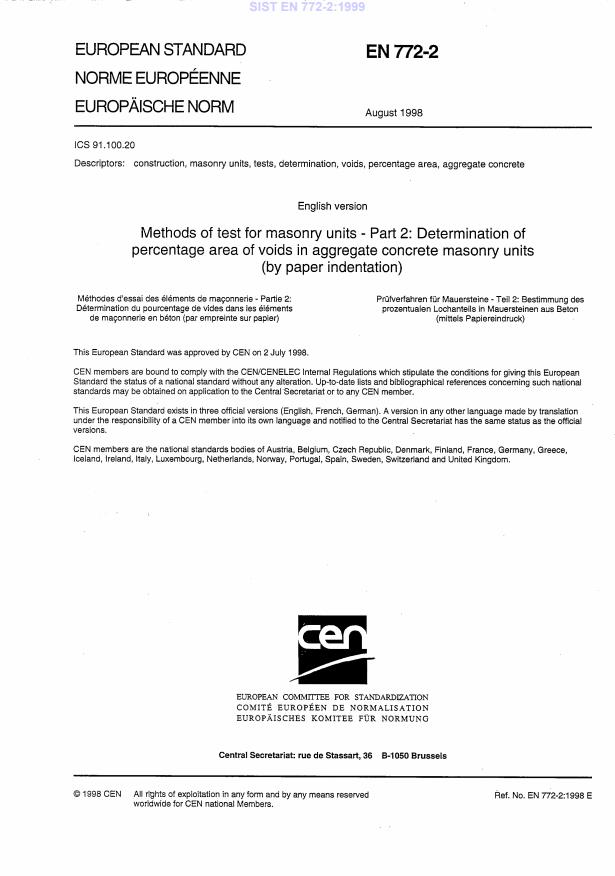
Methods of test for masonry units - Part 2: Determination of percentage area of voids in aggregate concrete masonry units (by paper indentation)

This European Standard specifies a method of determining the percentage area of voids in aggregate concrete masonry units.

Prüfverfahren für Mauersteine - Teil 2: Bestimmung des prozentualen Lochanteils in Mauersteinen aus Beton (mittels Papiereindruck)

Diese Europäische Norm legt ein Verfahren zur Bestimmung des prozentualen Lochanteils in Mauersteinen aus Beton fest.

Méthodes d'essai des éléments de maçonnerie - Partie 2: Détermination du pourcentage de vides dans les éléments de maçonnerie en béton (par empreinte sur papier)

La présente norme européenne prescrit une méthode de détermination du pourcentage de surfaces de vides dans les éléments de maçonnerie en béton.

Metode preskušanja zidakov - 2. del: Ugotavljanje odstotnega deleža lukenj v betonskih zidakih (z odtisom na papirju)

General Information

Status
Published
Publication Date
31-Dec-1998
Current Stage
6060 - National Implementation/Publication (Adopted Project)
Start Date
01-Jan-1999
Due Date
01-Jan-1999
Completion Date
01-Jan-1999

Relations

Effective Date
22-Dec-2008

Overview

EN 772-2:1998 - Methods of test for masonry units, Part 2 - specifies a standardized procedure for determining the percentage area of voids in aggregate concrete masonry units using the paper indentation technique. Published by CEN and adopted by national bodies (for example as SIST EN 772-2:1999), this European Standard provides a repeatable approach for quantifying open void area in concrete blocks and other aggregate concrete masonry units.

Key Topics and Requirements

  • Scope: Applies to aggregate concrete masonry units where the percentage area of voids is a relevant quality parameter.
  • Test principle: Uses a paper indentation method to obtain a two‑dimensional imprint of the unit’s void pattern; the imprint is then used to determine void area as a percentage of the unit’s face area.
  • Sample handling: Requires representative samples and defined preparation to ensure consistent imprints (clean, undamaged faces).
  • Measurement and calculation: Specifies how to derive the area of voids from the imprint and calculate the percentage area of voids relative to the unit face.
  • Reporting: Calls for clear reporting of test conditions, sample identification, measurement method, and results to ensure traceability and comparability.
  • Limitations: Intended for aggregate concrete masonry units and for two‑dimensional area assessment; it does not directly measure internal porosity or three‑dimensional pore volume.

Applications

  • Quality control in manufacturing of concrete masonry units: monitor consistency of block core/void patterns that affect weight, thermal properties, and material usage.
  • Design and specification verification: help specifiers and contractors confirm that units meet project or regulatory requirements relating to void area.
  • Comparative testing: provide a standardized basis for comparing products from different batches or suppliers.
  • Research and product development: support evaluation of new mixes, block geometries, or production processes with respect to void distribution.

Who Should Use This Standard

  • Masonry unit manufacturers and production quality teams
  • Construction materials testing laboratories
  • Structural and masonry engineers specifying or verifying block properties
  • Building inspectors and regulatory authorities assessing compliance

Related Standards

  • Other parts of the EN 772 series (methods of test for masonry units)
  • National adoptions and translations (e.g., SIST EN 772-2:1999)

Keywords: EN 772-2:1998, methods of test for masonry units, percentage area of voids, aggregate concrete masonry units, paper indentation, masonry testing, CEN, concrete block quality control.

Frequently Asked Questions

SIST EN 772-2:1999 is a standard published by the Slovenian Institute for Standardization (SIST). Its full title is "Methods of test for masonry units - Part 2: Determination of percentage area of voids in aggregate concrete masonry units (by paper indentation)". This standard covers: This European Standard specifies a method of determining the percentage area of voids in aggregate concrete masonry units.

This European Standard specifies a method of determining the percentage area of voids in aggregate concrete masonry units.

SIST EN 772-2:1999 is classified under the following ICS (International Classification for Standards) categories: 91.100.15 - Mineral materials and products; 91.100.30 - Concrete and concrete products. The ICS classification helps identify the subject area and facilitates finding related standards.

SIST EN 772-2:1999 has the following relationships with other standards: It is inter standard links to SIST EN 772-2:1999/A1:2005. Understanding these relationships helps ensure you are using the most current and applicable version of the standard.

SIST EN 772-2:1999 is associated with the following European legislation: EU Directives/Regulations: 305/2011, 89/106/EEC. When a standard is cited in the Official Journal of the European Union, products manufactured in conformity with it benefit from a presumption of conformity with the essential requirements of the corresponding EU directive or regulation.

You can purchase SIST EN 772-2:1999 directly from iTeh Standards. The document is available in PDF format and is delivered instantly after payment. Add the standard to your cart and complete the secure checkout process. iTeh Standards is an authorized distributor of SIST standards.

Standards Content (Sample)


2003-01.Slovenski inštitut za standardizacijo. Razmnoževanje celote ali delov tega standarda ni dovoljeno.Metode preskušanja zidakov - 2. del: Ugotavljanje odstotnega deleža lukenj v betonskih zidakih (z odtisom na papirju)Prüfverfahren für Mauersteine - Teil 2: Bestimmung des prozentualen Lochanteils in Mauersteinen aus Beton (mittels Papiereindruck)Méthodes d'essai des éléments de maçonnerie - Partie 2: Détermination du pourcentage de vides dans les éléments de maçonnerie en béton (par empreinte sur papier)Methods
...

Questions, Comments and Discussion

Ask us and Technical Secretary will try to provide an answer. You can facilitate discussion about the standard in here.

Loading comments...

The SIST EN 772-2:1999 standard is a pivotal European Standard that delineates a specific method for determining the percentage area of voids in aggregate concrete masonry units through paper indentation. This standard is crucial for manufacturers and quality control laboratories in the construction industry, enabling the assessment of the physical properties of masonry units. One of the primary strengths of this standard lies in its precise methodology, which provides a consistent approach for evaluating the porosity of aggregate concrete masonry units. By using paper indentation as a means to measure voids, the standard ensures accuracy and repeatability in results, which are essential for maintaining the quality and performance of masonry units. Moreover, the relevance of the SIST EN 772-2:1999 extends beyond compliance; it serves as a benchmark for innovation and improvement in masonry unit production. Understanding the void percentage is vital for optimizing thermal insulation, strength, and durability characteristics of masonry products. Consequently, adherence to this standard allows stakeholders to enhance product performance while meeting regulatory requirements. In addition to its application in manufacturing, the standard is also pertinent during the design phase of construction projects, ensuring that architects and engineers can select appropriate masonry solutions based on informed data about void percentages. Overall, the SIST EN 772-2:1999 standard not only reinforces quality assurance in the production of aggregate concrete masonry units but also supports the evolution of masonry construction practices aligned with modern performance expectations.

SIST EN 772-2:1999は、コンクリート製のブロックが持つ空隙率を評価するための標準化文書であり、特に骨材コンクリートブロックユニットにおける空隙面積の割合を定量化する方法を規定しています。この基準は、建築資材の品質を確保するための重要なツールであり、特に耐久性や強度に関連する目標に対して不可欠です。 この標準の主な強みは、紙押込み法というシンプルでありながら効果的な手法を採用している点です。この方法によって、材料の密度や性能を持続的に評価し、コンクリート製のブロックが持つ空隙の特性を正確に把握することが可能になります。また、SIST EN 772-2:1999は、材料の選定や建設プロジェクトにおける設計基準の策定に役立つ情報を提供するため、業界全体において非常に重要な基準です。 さらに、この標準は欧州規格であるため、EU域内で流通する建材において共通の指標として機能します。そのため、国際的な建材市場においても適合性が求められる際に、信頼性のある基準として広く受け入れられています。このように、SIST EN 772-2:1999は、コンクリート製ブロックの品質管理における不可欠な要素となっています。

Die SIST EN 772-2:1999 stellt eine wichtige europäische Norm dar, die sich mit den Methoden zur Prüfung von Mauerwerksprodukten beschäftigt, insbesondere mit der Bestimmung der prozentualen Fläche der Hohlräume in Mauersteinen aus Betonaggregate. Diese Norm bietet eine klare und präzise Vorgehensweise zur Ermittlung des Porenraums, der für die Beurteilung der Qualität und der physikalischen Eigenschaften von Betonmauerwerksblöcken von erheblicher Bedeutung ist. Ein wesentlicher Vorteil der SIST EN 772-2:1999 liegt in ihrer standardisierten Methodik, die eine konsistente und reproduzierbare Untersuchung der Hohlräume gewährleistet. Dies ist besonders relevant für Hersteller und Anwender von Mauerwerksstoffen, da die Ergebnisse der Tests direkten Einfluss auf die Nutzungseigenschaften der Betonmauerwerksprodukte haben können. Die Möglichkeit, den prozentualen Anteil der Hohlräume zu quantifizieren, ermöglicht es, fundierte Entscheidungen in der Materialauswahl und der Planung von Bauprojekten zu treffen. Darüber hinaus trägt die Anwendung dieser Norm zur Qualitätssicherung und -kontrolle in der Bauindustrie bei. Sie stellt sicher, dass die verwendeten Materialien den festgelegten Anforderungen entsprechen und unterstütz die Einhaltung von Bauvorschriften und Sicherheitsstandards. Die Relevanz der SIST EN 772-2:1999 erstreckt sich über die bloße Produktprüfung hinaus und schlägt eine Brücke zur gesamten Bauwirtschaft, indem sie eine gemeinsame Basis für Hersteller, Prüfinstitutionen und Bauunternehmen bietet. Zusammenfassend lässt sich sagen, dass die SIST EN 772-2:1999 sowohl in ihrer Methodik als auch in ihrer Anwendbarkeit ein unerlässliches Werkzeug zur Sicherstellung der Qualität von Mauerwerksprodukten darstellt.

La norme SIST EN 772-2:1999 définit une méthode essentielle pour la détermination du pourcentage de surface des vides dans les éléments de maçonnerie en béton agrégé. Ce document est particulièrement pertinent pour les professionnels du secteur de la construction, car il permet d'évaluer des caractéristiques clés des unités de maçonnerie, influençant directement la qualité et la durabilité des constructions. L'une des forces majeures de cette norme est sa méthodologie rigoureuse, qui utilise une technique de pénétration de papier pour mesurer avec précision les vides dans les unités de maçonnerie. Ce procédé offre une approche standardisée, garantissant des résultats cohérents et fiables, essentiels pour les fabricants et les utilisateurs de maçonnerie en béton. Grâce à cette méthode de test, les acteurs de l'industrie peuvent mieux comprendre les propriétés physiques des matériaux qu'ils utilisent, ce qui en facilite la sélection pour différents projets de construction. En termes de portée, la norme SIST EN 772-2:1999 est cruciale pour améliorer les standards de qualité dans le domaine de la maçonnerie. Elle est non seulement applicable aux unités de maçonnerie en béton agrégé, mais contribue également à la normalisation des tests dans l'ensemble de l'UE, promouvant ainsi l'harmonisation au sein du secteur de la construction européen. La pertinence de cette norme réside dans son application pratique, qui répond aux besoins croissants des industries de la construction en matière de durabilité et de performance des matériaux. En intégrant la norme SIST EN 772-2:1999 dans les processus d'assurance qualité, les entreprises peuvent s'assurer que leurs produits respectent les exigences réglementaires et les attentes des clients, ce qui en fait un élément clé pour toute stratégie de certification des matériaux de construction.

SIST EN 772-2:1999 표준은 집합 콘크리트 조적 블록의 기공 면적 비율을 측정하는 방법을 규정합니다. 이 표준의 주된 목적은 조적 유닛의 구조적 무결성을 평가하고, 재료의 품질을 향상시키기 위해 기공 면적을 정확하게 측정하는 것입니다. 이 표준의 주요 강점 중 하나는 사용하기 쉬운 종이 압입법을 통해 기공 면적을 측정할 수 있다는 점입니다. 이는 실험실 환경에서 반복적인 테스트를 가능하게 하여 조적 유닛의 품질 관리에 매우 유용합니다. 또한, 이 표준은 유럽 전역에서 적용될 수 있는 일관된 기준을 제공함으로써, 다양한 제조업체와 소비자 모두에 신뢰할 수 있는 데이터를 제공합니다. SIST EN 772-2:1999 표준은 건축 자재의 기능과 성능을 평가하는 데 있어 매우 중요한 역할을 합니다. 이 표준에 따라 테스트된 조적 유닛은 기공 특성을 명확히 파악할 수 있어, 건축 현장에서의 응용 가능성을 높이고, 최종 제품의 신뢰성을 증가시킵니다. 따라서 이 표준은 조적 유닛의 설계 및 제조 과정에서 필수적으로 고려해야 할 요소로, 현재 및 미래의 건축 프로젝트에 대한 매우 중요한 시사점을 제공합니다.