

SIST ISO 21542:2022
(Main)Building construction - Accessibility and usability of the built environment
General Information
- Abstract
This document specifies a range of requirements and recommendations for the elements of construction, building assemblies, components, fittings and products that relate to the design and constructional aspects of usability and accessibility of buildings, i.e. access to buildings, circulation within buildings, egress from buildings during normal conditions, and evacuation in the event of a fire.
This document also applies to the common spaces in multi-unit residential buildings. Recommendations regarding residential units are given in Annex A.
This document also contains provisions with respect to outdoor features directly concerned with access to a building or a group of buildings from a relevant site boundary, or between such a group of buildings within a common site. This document does not deal with elements of the external environment, such as public open spaces, whose function is self-contained and unrelated to the use of a specific building.
This document is applicable to new buildings and new work in existing buildings.
This document introduces the concept of ‘exceptional considerations for existing buildings’ for situations where it is exceptionally difficult to meet the requirements specified and, thus, impossible to provide full accessibility. By means of ‘exceptional considerations for existing buildings’, an acceptable, though restricted, level of accessibility is specified. An exceptional consideration for existing buildings is not to be applied in other situations or invoked in an unjustified manner, or as an excuse for not achieving a higher level of accessibility, where this is economically and/or technically feasible.
The dimensions stated in this document, relevant to the use of wheelchairs, are related to the footprint of commonly used wheelchair sizes and users as specified in ISO 7176-5 and ISO/TR 13570-2, 800 mm wide and 1 300 mm long.
This document is primarily written for adults with disabilities, but it includes some recommendations on specific accessibility needs of children.
- Status
- Published
- Publication Date
- 14-Mar-2022
- Technical Committee
- ISS SPL.GPO - Building construction
- Current Stage
- 6100 - Translation of adopted SIST standards (Adopted Project)
- Start Date
- 04-Apr-2023
- Due Date
- 02-Apr-2024
- Completion Date
- 20-Oct-2023
Buy Documents







ISO 21542:2021 - Building construction -- Accessibility and usability of the built environment

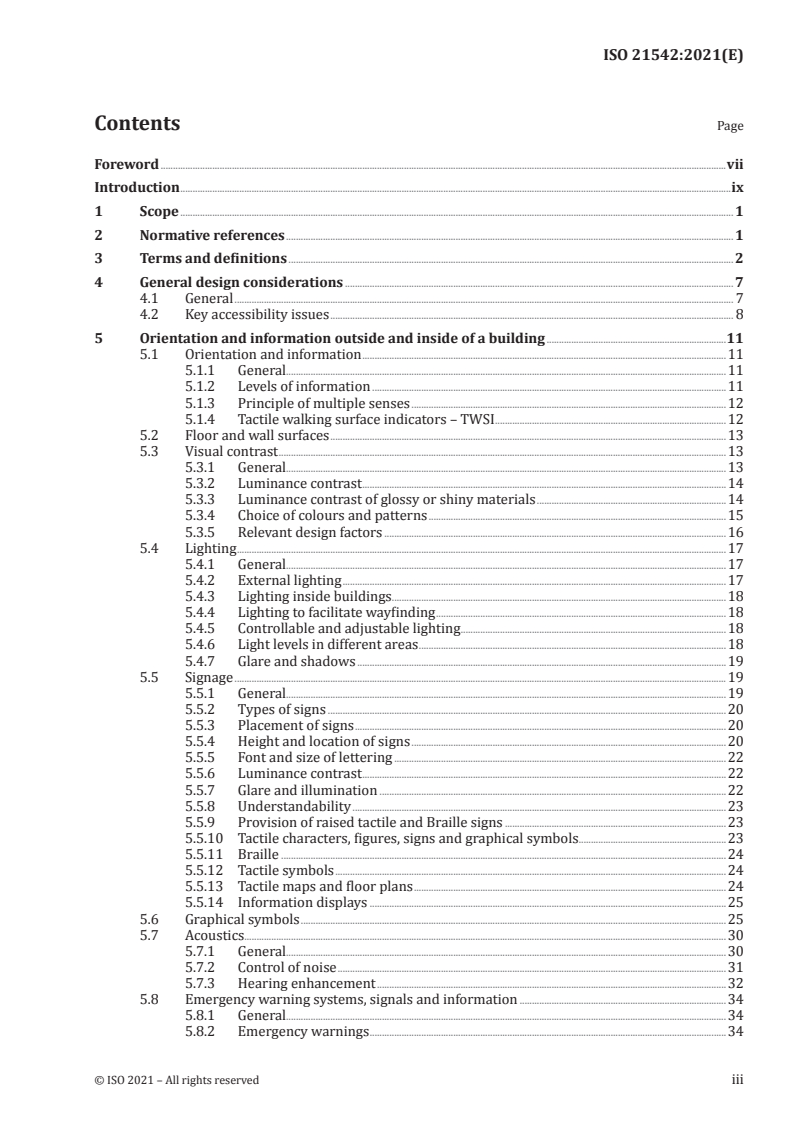
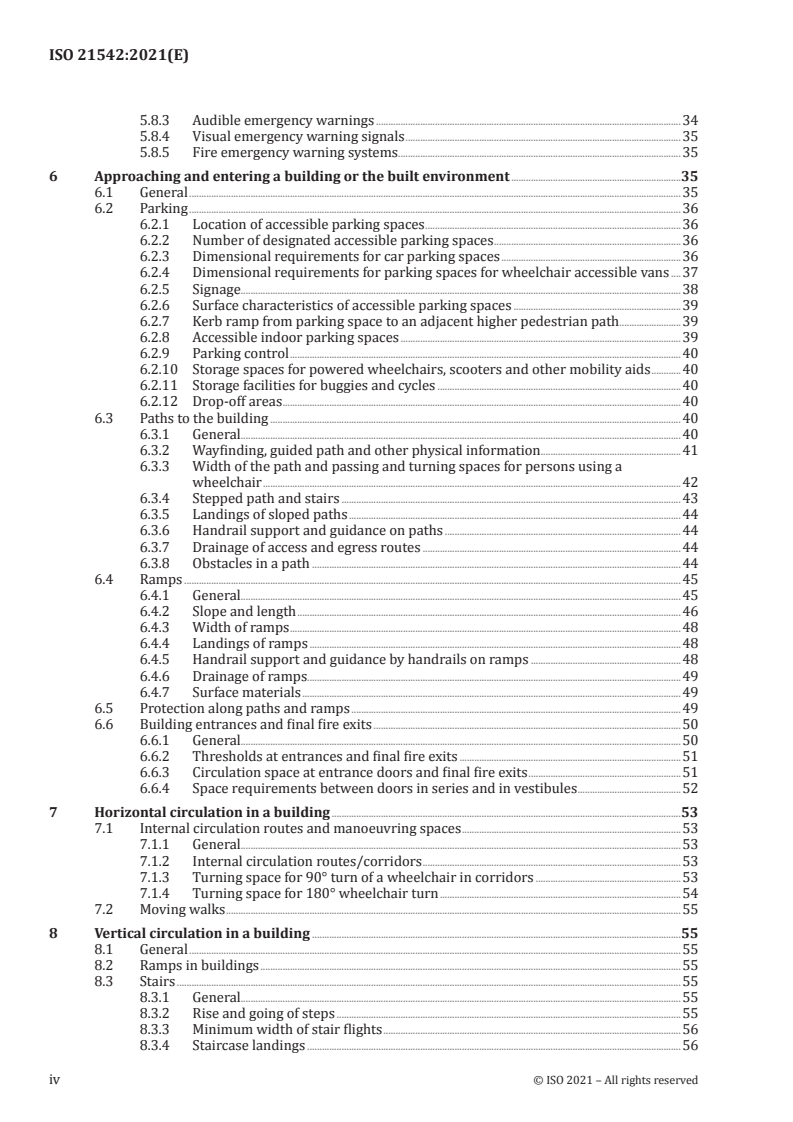
ISO 21542:2021 - Building construction — Accessibility and usability of the built environment/1/2021


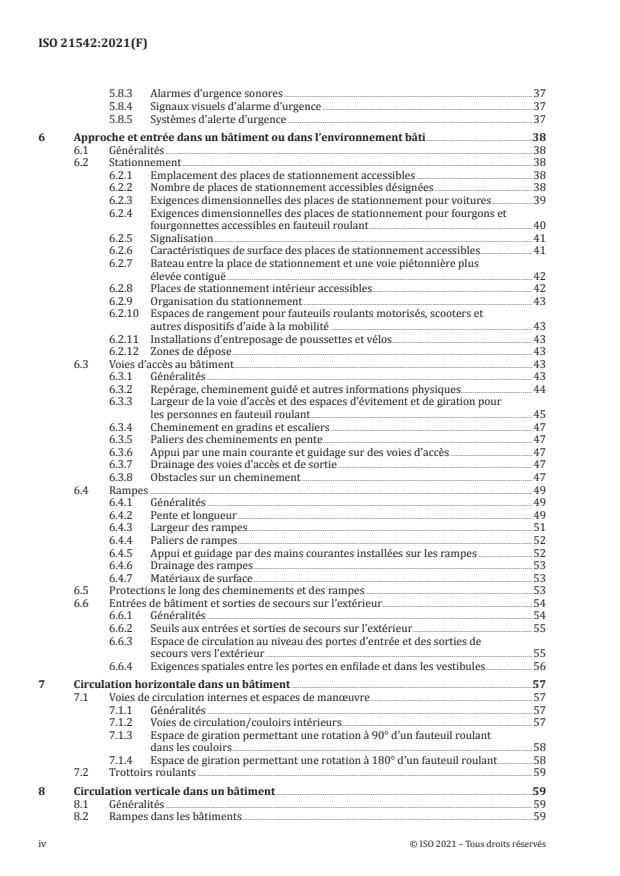
ISO 21542:2021 - Cadre bâti -- Accessibilité et usage de l’environnement bâti

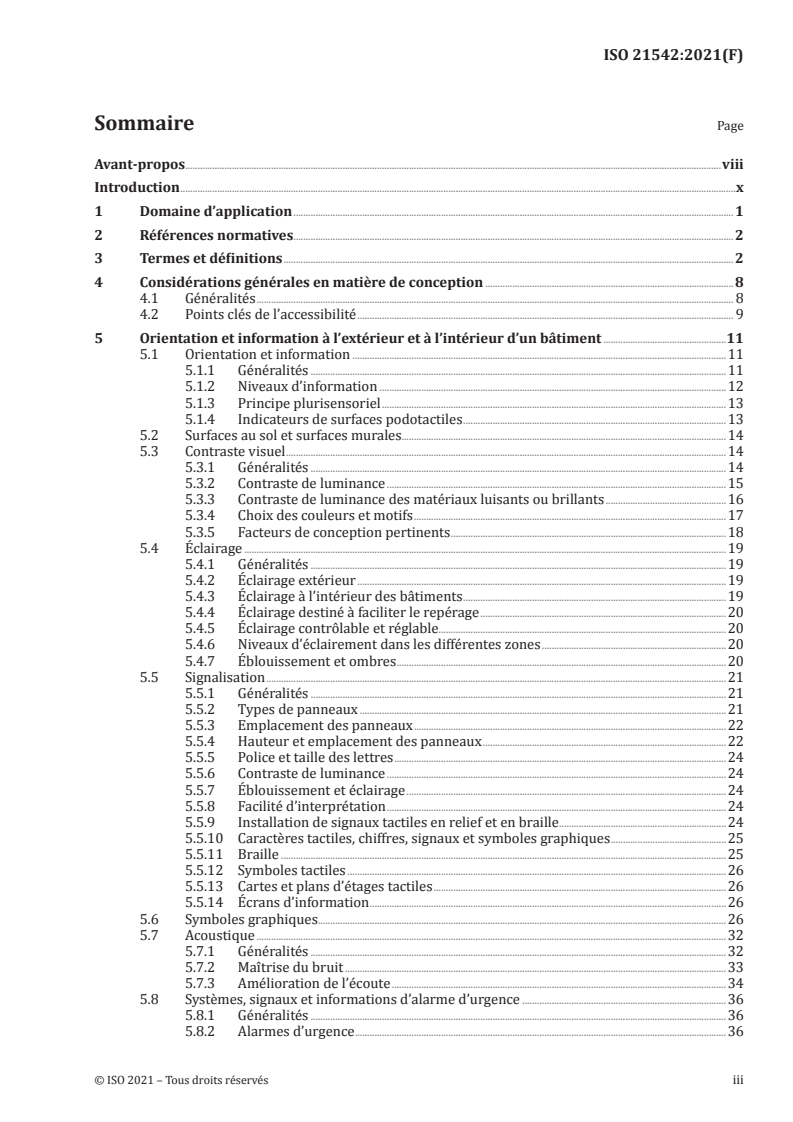
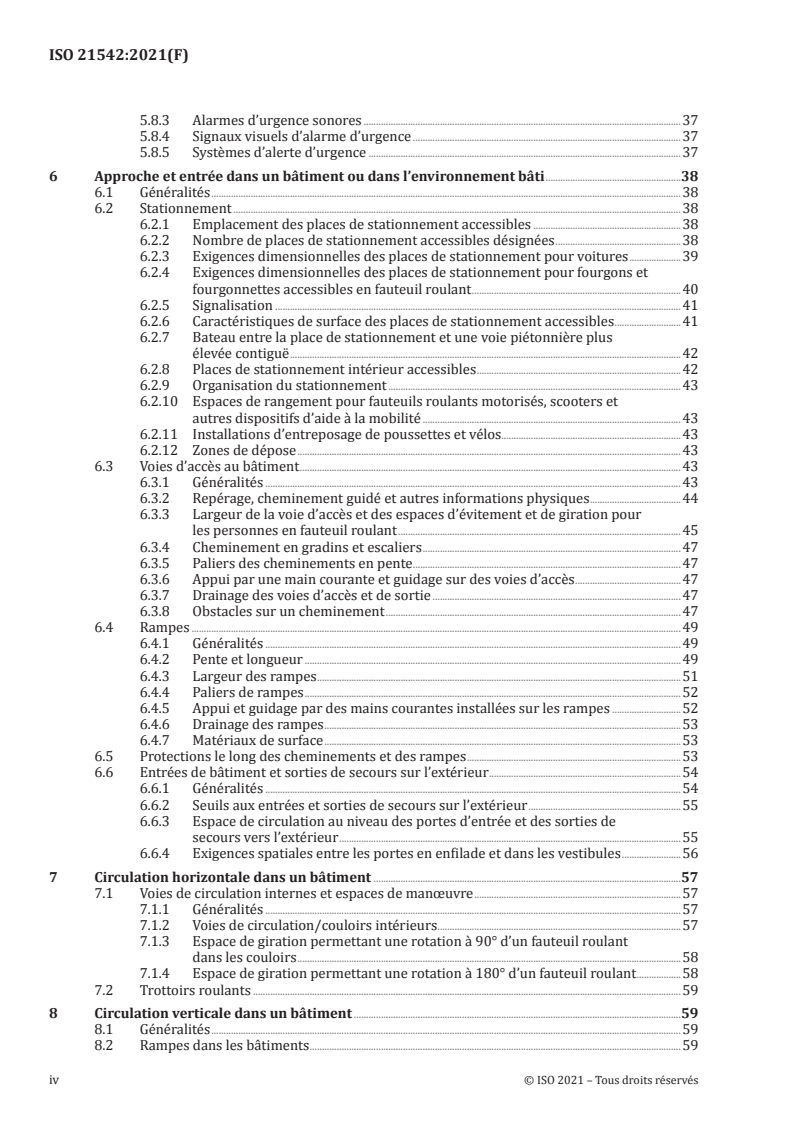
ISO 21542:2021 - Cadre bâti — Accessibilité et usage de l’environnement bâti/1/2021
Overview
SIST ISO 21542:2022 - Building construction: Accessibility and usability of the built environment - is the Slovenian adoption of ISO 21542:2021. It specifies requirements and recommendations for the design and construction of building elements, assemblies, components and fittings that affect access to buildings, circulation within buildings, egress under normal conditions, and evacuation in fire. The standard applies to new buildings and new work in existing buildings, and covers common spaces in multi‑unit residential buildings (with recommendations for residential units in Annex A). It also addresses outdoor features directly related to building access while excluding unrelated public open spaces.
Key topics and technical requirements
SIST ISO 21542:2022 covers a wide range of accessibility and usability issues, including:
- Approach and entry
- Accessible parking, drop‑off zones and signage
- Paths to buildings, ramps, kerb ramps and drainage
- Horizontal and vertical circulation
- Internal corridors, manoeuvring and turning spaces for wheelchairs
- Ramps, stair design, handrails, lifts and moving walks
- Entrances and thresholds
- Space and clearance requirements, vestibules, final fire exits
- Orientation, wayfinding and information
- Levels of information, tactile walking surface indicators (TWSI), tactile maps
- Signage, font sizes, placement, luminance contrast and Braille
- Visual and lighting considerations
- Surface finishes, visual contrast, glare control, light levels for wayfinding
- Acoustics and communication
- Noise control, hearing enhancement systems and emergency warnings (audible and visual)
- Emergency systems
- Audible and visual signals and information for evacuation and fire response
- Design assumptions
- Wheelchair footprint reference (800 mm wide × 1 300 mm long) based on ISO 7176‑5 and ISO/TR 13570‑2
- Existing buildings
- Concept of “exceptional considerations for existing buildings” to define acceptable, limited accessibility where full compliance is technically or economically infeasible - not to be overused.
Practical applications and who uses it
SIST ISO 21542:2022 is essential for:
- Architects, building designers and engineers specifying accessible layouts
- Accessibility consultants and universal design specialists
- Facility managers and building owners implementing retrofits
- Product manufacturers (doors, lifts, ramps, signage) ensuring usability compliance
- Regulators and code officials aligning national building codes with international accessibility standards
Use the standard to inform building specifications, tender documents, accessibility audits, and inclusive design strategies for the built environment.
Related standards
- ISO 21542:2021 (original international document)
- ISO 7176‑5 and ISO/TR 13570‑2 (wheelchair dimensions and user data)
- National building codes and accessibility legislation (for local compliance)
Keywords: SIST ISO 21542:2022, accessibility, built environment, usability, building construction, ramps, signage, tactile, wheelchair access, wayfinding, universal design.
Relations
- Replaces
SIST ISO 21542:2012 - Building construction - Accessibility and usability of the built environment - Effective Date
- 01-Apr-2022
- Effective Date
- 25-Aug-2026
- Effective Date
- 25-Aug-2026
- Effective Date
- 06-May-2026
- Effective Date
- 06-May-2026
- Effective Date
- 22-Apr-2026
- Effective Date
- 01-Apr-2026
- Effective Date
- 18-Mar-2026
Buy Documents
ISO 21542:2021 - Building construction -- Accessibility and usability of the built environment
ISO 21542:2021 - Building construction — Accessibility and usability of the built environment/1/2021
ISO 21542:2021 - Cadre bâti -- Accessibilité et usage de l’environnement bâti
ISO 21542:2021 - Cadre bâti — Accessibilité et usage de l’environnement bâti/1/2021
Get Certified
Connect with accredited certification bodies for this standard

BSI Group
BSI (British Standards Institution) is the business standards company that helps organizations make excellence a habit.

TÜV Rheinland
TÜV Rheinland is a leading international provider of technical services.

TÜV SÜD
TÜV SÜD is a trusted partner of choice for safety, security and sustainability solutions.
Sponsored listings
Frequently Asked Questions
SIST ISO 21542:2022 is a standard published by the Slovenian Institute for Standardization (SIST). Its full title is "Building construction - Accessibility and usability of the built environment". This standard covers: This document specifies a range of requirements and recommendations for the elements of construction, building assemblies, components, fittings and products that relate to the design and constructional aspects of usability and accessibility of buildings, i.e. access to buildings, circulation within buildings, egress from buildings during normal conditions, and evacuation in the event of a fire. This document also applies to the common spaces in multi-unit residential buildings. Recommendations regarding residential units are given in Annex A. This document also contains provisions with respect to outdoor features directly concerned with access to a building or a group of buildings from a relevant site boundary, or between such a group of buildings within a common site. This document does not deal with elements of the external environment, such as public open spaces, whose function is self-contained and unrelated to the use of a specific building. This document is applicable to new buildings and new work in existing buildings. This document introduces the concept of ‘exceptional considerations for existing buildings’ for situations where it is exceptionally difficult to meet the requirements specified and, thus, impossible to provide full accessibility. By means of ‘exceptional considerations for existing buildings’, an acceptable, though restricted, level of accessibility is specified. An exceptional consideration for existing buildings is not to be applied in other situations or invoked in an unjustified manner, or as an excuse for not achieving a higher level of accessibility, where this is economically and/or technically feasible. The dimensions stated in this document, relevant to the use of wheelchairs, are related to the footprint of commonly used wheelchair sizes and users as specified in ISO 7176-5 and ISO/TR 13570-2, 800 mm wide and 1 300 mm long. This document is primarily written for adults with disabilities, but it includes some recommendations on specific accessibility needs of children.
This document specifies a range of requirements and recommendations for the elements of construction, building assemblies, components, fittings and products that relate to the design and constructional aspects of usability and accessibility of buildings, i.e. access to buildings, circulation within buildings, egress from buildings during normal conditions, and evacuation in the event of a fire. This document also applies to the common spaces in multi-unit residential buildings. Recommendations regarding residential units are given in Annex A. This document also contains provisions with respect to outdoor features directly concerned with access to a building or a group of buildings from a relevant site boundary, or between such a group of buildings within a common site. This document does not deal with elements of the external environment, such as public open spaces, whose function is self-contained and unrelated to the use of a specific building. This document is applicable to new buildings and new work in existing buildings. This document introduces the concept of ‘exceptional considerations for existing buildings’ for situations where it is exceptionally difficult to meet the requirements specified and, thus, impossible to provide full accessibility. By means of ‘exceptional considerations for existing buildings’, an acceptable, though restricted, level of accessibility is specified. An exceptional consideration for existing buildings is not to be applied in other situations or invoked in an unjustified manner, or as an excuse for not achieving a higher level of accessibility, where this is economically and/or technically feasible. The dimensions stated in this document, relevant to the use of wheelchairs, are related to the footprint of commonly used wheelchair sizes and users as specified in ISO 7176-5 and ISO/TR 13570-2, 800 mm wide and 1 300 mm long. This document is primarily written for adults with disabilities, but it includes some recommendations on specific accessibility needs of children.
SIST ISO 21542:2022 is classified under the following ICS (International Classification for Standards) categories: 11.180.01 - Aids for disabled and handicapped persons in general; 91.060.01 - Elements of buildings in general. The ICS classification helps identify the subject area and facilitates finding related standards.
SIST ISO 21542:2022 has the following relationships with other standards: It is inter standard links to SIST ISO 21542:2012, SIST EN ISO 17651-2:2024, SIST EN ISO 17651-1:2024, SIST EN 16584-1:2025, SIST EN 16584-3:2025, SIST EN ISO 17651-3:2026, SIST EN 16587:2025, SIST EN 16584-2:2025. Understanding these relationships helps ensure you are using the most current and applicable version of the standard.
SIST ISO 21542:2022 is associated with the following European legislation: EU Directives/Regulations: 2004-01-4602, 2006-01-2889, 2018-01-2044, 2022-01-0641, TP271. When a standard is cited in the Official Journal of the European Union, products manufactured in conformity with it benefit from a presumption of conformity with the essential requirements of the corresponding EU directive or regulation.
SIST ISO 21542:2022 is available in PDF format for immediate download after purchase. The document can be added to your cart and obtained through the secure checkout process. Digital delivery ensures instant access to the complete standard document.
Standards Content (Sample)
SLOVENSKI STANDARD
01-april-2022
Gradnja stavb - Dostopnost in uporabnost grajenega okolja
Building construction - Accessibility and usability of the built environment
Cadre bâti - Accessibilité et usage de l’environnement bâti
Ta slovenski standard je istoveten z: ISO 21542:2021
ICS:
11.180.01 Pripomočki za Aids for disabled and
onesposobljene in handicapped persons in
hendikepirane osebe na general
splošno
91.060.01 Stavbni elementi na splošno Elements of buildings in
general
2003-01.Slovenski inštitut za standardizacijo. Razmnoževanje celote ali delov tega standarda ni dovoljeno.
INTERNATIONAL ISO
STANDARD 21542
Second edition
2021-06
Building construction — Accessibility
and usability of the built environment
Cadre bâti — Accessibilité et usage de l’environnement bâti
Reference number
©
ISO 2021
© ISO 2021
All rights reserved. Unless otherwise specified, or required in the context of its implementation, no part of this publication may
be reproduced or utilized otherwise in any form or by any means, electronic or mechanical, including photocopying, or posting
on the internet or an intranet, without prior written permission. Permission can be requested from either ISO at the address
below or ISO’s member body in the country of the requester.
ISO copyright office
CP 401 • Ch. de Blandonnet 8
CH-1214 Vernier, Geneva
Phone: +41 22 749 01 11
Email: copyright@iso.org
Website: www.iso.org
Published in Switzerland
ii © ISO 2021 – All rights reserved
Contents Page
Foreword .vii
Introduction .ix
1 Scope . 1
2 Normative references . 1
3 Terms and definitions . 2
4 General design considerations . 7
4.1 General . 7
4.2 Key accessibility issues . 8
5 Orientation and information outside and inside of a building .11
5.1 Orientation and information .11
5.1.1 General.11
5.1.2 Levels of information .11
5.1.3 Principle of multiple senses .12
5.1.4 Tactile walking surface indicators – TWSI .12
5.2 Floor and wall surfaces .13
5.3 Visual contrast .13
5.3.1 General.13
5.3.2 Luminance contrast .14
5.3.3 Luminance contrast of glossy or shiny materials .14
5.3.4 Choice of colours and patterns .15
5.3.5 Relevant design factors .16
5.4 Lighting .17
5.4.1 General.17
5.4.2 External lighting .17
5.4.3 Lighting inside buildings.18
5.4.4 Lighting to facilitate wayfinding .18
5.4.5 Controllable and adjustable lighting .18
5.4.6 Light levels in different areas .18
5.4.7 Glare and shadows .19
5.5 Signage .19
5.5.1 General.19
5.5.2 Types of signs .20
5.5.3 Placement of signs .20
5.5.4 Height and location of signs .20
5.5.5 Font and size of lettering .22
5.5.6 Luminance contrast .22
5.5.7 Glare and illumination .22
5.5.8 Understandability .23
5.5.9 Provision of raised tactile and Braille signs .23
5.5.10 Tactile characters, figures, signs and graphical symbols .23
5.5.11 Braille .24
5.5.12 Tactile symbols .24
5.5.13 Tactile maps and floor plans .24
5.5.14 Information displays .25
5.6 Graphical symbols .25
5.7 Acoustics.30
5.7.1 General.30
5.7.2 Control of noise .31
5.7.3 Hearing enhancement .32
5.8 Emergency warning systems, signals and information .34
5.8.1 General.34
5.8.2 Emergency warnings .34
5.8.3 Audible emergency warnings .34
5.8.4 Visual emergency warning signals .35
5.8.5 Fire emergency warning systems .35
6 Approaching and entering a building or the built environment .35
6.1 General .35
6.2 Parking .36
6.2.1 Location of accessible parking spaces .36
6.2.2 Number of designated accessible parking spaces .36
6.2.3 Dimensional requirements for car parking spaces .36
6.2.4 Dimensional requirements for parking spaces for wheelchair accessible vans .37
6.2.5 Signage.38
6.2.6 Surface characteristics of accessible parking spaces .39
6.2.7 Kerb ramp from parking space to an adjacent higher pedestrian path .39
6.2.8 Accessible indoor parking spaces .39
6.2.9 Parking control .40
6.2.10 Storage spaces for powered wheelchairs, scooters and other mobility aids .40
6.2.11 Storage facilities for buggies and cycles .40
6.2.12 Drop-off areas .40
6.3 Paths to the building .40
6.3.1 General.40
6.3.2 Wayfinding, guided path and other physical information . .41
6.3.3 Width of the path and passing and turning spaces for persons using a
wheelchair .42
6.3.4 Stepped path and stairs .43
6.3.5 Landings of sloped paths .44
6.3.6 Handrail support and guidance on paths .44
6.3.7 Drainage of access and egress routes .44
6.3.8 Obstacles in a path .44
6.4 Ramps .45
6.4.1 General.45
6.4.2 Slope and length .46
6.4.3 Width of ramps .48
6.4.4 Landings of ramps .48
6.4.5 Handrail support and guidance by handrails on ramps .48
6.4.6 Drainage of ramps.49
6.4.7 Surface materials .49
6.5 Protection along paths and ramps .49
6.6 Building entrances and final fire exits .50
6.6.1 General.50
6.6.2 Thresholds at entrances and final fire exits .51
6.6.3 Circulation space at entrance doors and final fire exits .51
6.6.4 Space requirements between doors in series and in vestibules .52
7 Horizontal circulation in a building .53
7.1 Internal circulation routes and manoeuvring spaces .53
7.1.1 General.53
7.1.2 Internal circulation routes/corridors .53
7.1.3 Turning space for 90° turn of a wheelchair in corridors .53
7.1.4 Turning space for 180° wheelchair turn .54
7.2 Moving walks .55
8 Vertical circulation in a building .55
8.1 General .55
8.2 Ramps in buildings .55
8.3 Stairs .55
8.3.1 General.55
8.3.2 Rise and going of steps .55
8.3.3 Minimum width of stair flights .56
8.3.4 Staircase landings .56
iv © ISO 2021 – All rights reserved
8.3.5 Head clearance .57
8.3.6 Visual and tactile warnings .58
8.3.7 Handrails and guards along stairs .60
8.4 Handrails .60
8.4.1 General.60
8.4.2 Characteristics of a handrail .60
8.4.3 Continuity of a handrail .61
8.4.4 Height of a handrail .61
8.4.5 Horizontal extension of a handrail .61
8.4.6 Visual and tactile information .61
8.4.7 Mechanical resistance .62
8.5 Lifts .62
8.5.1 General.62
8.5.2 Approach and access to the lift .63
8.5.3 Lift car entrance — Door opening .64
8.5.4 Entrance width and inner dimensions of cars .64
8.5.5 Equipment in the car .65
8.5.6 Stopping/Levelling accuracy .67
8.5.7 Control devices and signals .67
8.5.8 Lifts used for evacuation .70
8.6 Vertical and inclined lifting platforms .71
8.7 Escalators and moving walks .71
9 Components of a building and building equipment .72
9.1 Doorsets and windows .72
9.1.1 Doors and door furniture .72
9.1.2 Fire-resisting doorsets . .80
9.1.3 Windows and window furniture .81
9.2 Equipment, controls and switches .81
9.2.1 General.81
9.2.2 Location, heights and distances .82
9.2.3 Operation .83
9.2.4 Identification .83
9.2.5 Usability and consistency in design .83
9.2.6 Intercoms and telephones .83
9.2.7 Card and vending machines .84
9.2.8 Security access systems .86
9.2.9 Drinking fountains .86
9.2.10 Waste disposals and containers.86
9.3 Furnishing .86
9.3.1 General.86
9.3.2 Seating in waiting areas .86
9.3.3 Seating at desks or tables .87
10 Rooms and spaces within non-domestic buildings .88
10.1 Reception areas, counters, desks and ticket offices .88
10.1.1 General.88
10.1.2 Space to manoeuvre .88
10.1.3 Height .88
10.1.4 Lighting .89
10.1.5 Hearing and lipreading .89
10.1.6 Ticket systems .89
10.2 Cloakroom .90
10.3 Conference rooms and meeting rooms .90
10.4 Auditoriums, concert halls, sports arenas, viewing spaces in assembly areas and
similar .90
10.4.1 General.90
10.4.2 Hearing enhancement systems .90
10.4.3 Lighting for sign language interpretation .90
10.4.4 Designated seating spaces for persons using a wheelchair .90
10.4.5 Lines of sight over seated and standing spectators .91
10.4.6 Row and seat numbers .92
10.4.7 Access to stage and backstage .92
10.5 Toilet rooms, sanitary rooms and bathrooms .92
10.5.1 General.92
10.5.2 WC compartments for ambulant persons with disabilities .92
10.5.3 Dimensions for wheelchair accessible toilet rooms .93
10.5.4 Toilet room doors .98
10.5.5 Toilet seat .98
10.5.6 Grab rails .99
10.5.7 Toilet paper dispensers .99
10.5.8 Washbasin .99
10.5.9 Water supply .102
10.5.10 Taps .102
10.5.11 Urinals .102
10.5.12 Other fittings .103
10.5.13 Assistance alarm .103
10.5.14 Fire emergency warning devices .103
10.5.15 Showers .103
10.5.16 Bathrooms .105
10.6 Accessible bedrooms .108
10.7 Accessible changing rooms .109
10.8 Kitchen areas .110
10.9 Storage areas.110
10.10 Terraces, verandas and balconies .110
10.11 Bars, pubs and restaurants .110
10.12 Facilities for guide and other assistance dogs .111
10.12.1 General.111
10.12.2 Relief facilities for guide and assistance dogs .111
11 Fire safety and evacuation .111
11.1 General .111
11.2 Design objectives .112
11.3 Principles of fire evacuation .112
11.4 Emergency evacuation related building infrastructure .113
11.4.1 Overview on essential building infrastructure .113
11.4.2 Emergency evacuation routes .113
11.4.3 Places of relative safety .113
11.4.4 Lift evacuation systems .113
11.4.5 Areas of rescue assistance adjoining fire evacuation staircases.114
11.4.6 Fire evacuation staircases .115
11.4.7 Floors of temporary refuge .115
11.4.8 Final fire exit doors and fire-resisting doors .116
11.4.9 Fire safety plans . . .116
12 Management and maintenance issues .116
Annex A (informative) Housing .117
Annex B (informative) Tactile walking surface indicators (TWSI).125
Annex C (informative) Circulation spaces at doorways .129
Annex D (informative) Fire prevention, protection, safety and evacuation for all .142
Annex E (informative) Methods for the determination of the luminance contrast .146
Annex F (informative) Management and maintenance issues .153
Annex G (informative) Human abilities and associated design considerations .156
Bibliography .166
vi © ISO 2021 – All rights reserved
Foreword
ISO (the International Organization for Standardization) is a worldwide federation of national standards
bodies (ISO member bodies). The work of preparing International Standards is normally carried out
through ISO technical committees. Each member body interested in a subject for which a technical
committee has been established has the right to be represented on that committee. International
organizations, governmental and non-governmental, in liaison with ISO, also take part in the work.
ISO collaborates closely with the International Electrotechnical Commission (IEC) on all matters of
electrotechnical standardization.
The procedures used to develop this document and those intended for its further maintenance are
described in the ISO/IEC Directives, Part 1. In particular, the different approval criteria needed for the
different types of ISO documents should be noted. This document was drafted in accordance with the
editorial rules of the ISO/IEC Directives, Part 2 (see www .iso .org/ directives).
Attention is drawn to the possibility that some of the elements of this document may be the subject of
patent rights. ISO shall not be held responsible for identifying any or all such patent rights. Details of
any patent rights identified during the development of the document will be in the Introduction and/or
on the ISO list of patent declarations received (see www .iso .org/ patents).
Any trade name used in this document is information given for the convenience of users and does not
constitute an endorsement.
For an explanation of the voluntary nature of standards, the meaning of ISO specific terms and
expressions related to conformity assessment, as well as information about ISO's adherence to the
World Trade Organization (WTO) principles in the Technical Barriers to Trade (TBT), see www .iso .org/
iso/ foreword .html.
This document was prepared by Technical Committee ISO/TC 59, Buildings and civil engineering works,
Subcommittee SC 16, Accessibility and usability of the built environment.
This second edition cancels and replaces the first edition (ISO 21542:2011), which has been technically
revised.
The main changes compared to the previous edition are as follows:
a) document structure: a new hierarchy level has been introduced and the clauses have been assigned
accordingly and partly resorted (e.g. Clause 5);
b) editorial revision of the Introduction and the Scope;
c) modification of the approach of exceptional considerations, which now only apply to existing
buildings;
d) update of the normative references throughout the document;
e) revision of Clause 3 on terms and definitions according to the terminology used in the document
and update of the sources;
f) restructuring of several (sub)clauses, especially those on:
— orientation and information (5.1);
— lighting (5.4);
— acoustics (5.7);
— paths to the building (6.3);
— building entrances and final fire exits (6.5);
— vertical and inclined lifting platforms (8.6);
— doorsets and windows (9.1);
— rooms and space within non-domestic buildings (Clause 10);
g) the provisions regarding tactile walking surface indicators (TWSI) have been adapted:
— ISO 23599:2019 has been widely referenced;
— a new subclause on tactile walking surface indicators has been introduced to 5.1;
— the annex on tactile walking surface indicators was revised and shortened;
h) revision of the provisions regarding visual contrast:
— the specifications in 5.3 have been revised and the relevant design factors were moved from the
annex on human abilities and associated design considerations to it;
— a separate annex for the determination of the luminance contrast has been created;
i) complete revision and enlargement of the specifications on acoustics in 5.7 and emergency warning
systems, signals and information in 5.8;
j) clarification and enlargement of the specifications on solitary obstacles in a path in 6.3.8;
k) complete revision of 6.4 on ramps and 8.5 on lifts;
l) enlargement of the specifications on control devices and signals (9.2) and drinking fountains
(9.2.9);
m) revision of the clauses related to (fire) emergency evacuation:
— merger of the specifications related to (fire) emergency evacuation in Clause 11 but keeping the
specifications on emergency warning systems in 5.8, on lifts used for evacuation in 8.5.8 and on
fire-resisting doorsets 9.1.2;
— introduction of a subclause on emergency evacuation related building infrastructure;
— complete revision of the annex on fire prevent
...
INTERNATIONAL ISO
STANDARD 21542
Second edition
2021-06
Building construction — Accessibility
and usability of the built environment
Cadre bâti — Accessibilité et usage de l’environnement bâti
Reference number
©
ISO 2021
© ISO 2021
All rights reserved. Unless otherwise specified, or required in the context of its implementation, no part of this publication may
be reproduced or utilized otherwise in any form or by any means, electronic or mechanical, including photocopying, or posting
on the internet or an intranet, without prior written permission. Permission can be requested from either ISO at the address
below or ISO’s member body in the country of the requester.
ISO copyright office
CP 401 • Ch. de Blandonnet 8
CH-1214 Vernier, Geneva
Phone: +41 22 749 01 11
Email: copyright@iso.org
Website: www.iso.org
Published in Switzerland
ii © ISO 2021 – All rights reserved
Contents Page
Foreword .vii
Introduction .ix
1 Scope . 1
2 Normative references . 1
3 Terms and definitions . 2
4 General design considerations . 7
4.1 General . 7
4.2 Key accessibility issues . 8
5 Orientation and information outside and inside of a building .11
5.1 Orientation and information .11
5.1.1 General.11
5.1.2 Levels of information .11
5.1.3 Principle of multiple senses .12
5.1.4 Tactile walking surface indicators – TWSI .12
5.2 Floor and wall surfaces .13
5.3 Visual contrast .13
5.3.1 General.13
5.3.2 Luminance contrast .14
5.3.3 Luminance contrast of glossy or shiny materials .14
5.3.4 Choice of colours and patterns .15
5.3.5 Relevant design factors .16
5.4 Lighting .17
5.4.1 General.17
5.4.2 External lighting .17
5.4.3 Lighting inside buildings.18
5.4.4 Lighting to facilitate wayfinding .18
5.4.5 Controllable and adjustable lighting .18
5.4.6 Light levels in different areas .18
5.4.7 Glare and shadows .19
5.5 Signage .19
5.5.1 General.19
5.5.2 Types of signs .20
5.5.3 Placement of signs .20
5.5.4 Height and location of signs .20
5.5.5 Font and size of lettering .22
5.5.6 Luminance contrast .22
5.5.7 Glare and illumination .22
5.5.8 Understandability .23
5.5.9 Provision of raised tactile and Braille signs .23
5.5.10 Tactile characters, figures, signs and graphical symbols .23
5.5.11 Braille .24
5.5.12 Tactile symbols .24
5.5.13 Tactile maps and floor plans .24
5.5.14 Information displays .25
5.6 Graphical symbols .25
5.7 Acoustics.30
5.7.1 General.30
5.7.2 Control of noise .31
5.7.3 Hearing enhancement .32
5.8 Emergency warning systems, signals and information .34
5.8.1 General.34
5.8.2 Emergency warnings .34
5.8.3 Audible emergency warnings .34
5.8.4 Visual emergency warning signals .35
5.8.5 Fire emergency warning systems .35
6 Approaching and entering a building or the built environment .35
6.1 General .35
6.2 Parking .36
6.2.1 Location of accessible parking spaces .36
6.2.2 Number of designated accessible parking spaces .36
6.2.3 Dimensional requirements for car parking spaces .36
6.2.4 Dimensional requirements for parking spaces for wheelchair accessible vans .37
6.2.5 Signage.38
6.2.6 Surface characteristics of accessible parking spaces .39
6.2.7 Kerb ramp from parking space to an adjacent higher pedestrian path .39
6.2.8 Accessible indoor parking spaces .39
6.2.9 Parking control .40
6.2.10 Storage spaces for powered wheelchairs, scooters and other mobility aids .40
6.2.11 Storage facilities for buggies and cycles .40
6.2.12 Drop-off areas .40
6.3 Paths to the building .40
6.3.1 General.40
6.3.2 Wayfinding, guided path and other physical information . .41
6.3.3 Width of the path and passing and turning spaces for persons using a
wheelchair .42
6.3.4 Stepped path and stairs .43
6.3.5 Landings of sloped paths .44
6.3.6 Handrail support and guidance on paths .44
6.3.7 Drainage of access and egress routes .44
6.3.8 Obstacles in a path .44
6.4 Ramps .45
6.4.1 General.45
6.4.2 Slope and length .46
6.4.3 Width of ramps .48
6.4.4 Landings of ramps .48
6.4.5 Handrail support and guidance by handrails on ramps .48
6.4.6 Drainage of ramps.49
6.4.7 Surface materials .49
6.5 Protection along paths and ramps .49
6.6 Building entrances and final fire exits .50
6.6.1 General.50
6.6.2 Thresholds at entrances and final fire exits .51
6.6.3 Circulation space at entrance doors and final fire exits .51
6.6.4 Space requirements between doors in series and in vestibules .52
7 Horizontal circulation in a building .53
7.1 Internal circulation routes and manoeuvring spaces .53
7.1.1 General.53
7.1.2 Internal circulation routes/corridors .53
7.1.3 Turning space for 90° turn of a wheelchair in corridors .53
7.1.4 Turning space for 180° wheelchair turn .54
7.2 Moving walks .55
8 Vertical circulation in a building .55
8.1 General .55
8.2 Ramps in buildings .55
8.3 Stairs .55
8.3.1 General.55
8.3.2 Rise and going of steps .55
8.3.3 Minimum width of stair flights .56
8.3.4 Staircase landings .56
iv © ISO 2021 – All rights reserved
8.3.5 Head clearance .57
8.3.6 Visual and tactile warnings .58
8.3.7 Handrails and guards along stairs .60
8.4 Handrails .60
8.4.1 General.60
8.4.2 Characteristics of a handrail .60
8.4.3 Continuity of a handrail .61
8.4.4 Height of a handrail .61
8.4.5 Horizontal extension of a handrail .61
8.4.6 Visual and tactile information .61
8.4.7 Mechanical resistance .62
8.5 Lifts .62
8.5.1 General.62
8.5.2 Approach and access to the lift .63
8.5.3 Lift car entrance — Door opening .64
8.5.4 Entrance width and inner dimensions of cars .64
8.5.5 Equipment in the car .65
8.5.6 Stopping/Levelling accuracy .67
8.5.7 Control devices and signals .67
8.5.8 Lifts used for evacuation .70
8.6 Vertical and inclined lifting platforms .71
8.7 Escalators and moving walks .71
9 Components of a building and building equipment .72
9.1 Doorsets and windows .72
9.1.1 Doors and door furniture .72
9.1.2 Fire-resisting doorsets . .80
9.1.3 Windows and window furniture .81
9.2 Equipment, controls and switches .81
9.2.1 General.81
9.2.2 Location, heights and distances .82
9.2.3 Operation .83
9.2.4 Identification .83
9.2.5 Usability and consistency in design .83
9.2.6 Intercoms and telephones .83
9.2.7 Card and vending machines .84
9.2.8 Security access systems .86
9.2.9 Drinking fountains .86
9.2.10 Waste disposals and containers.86
9.3 Furnishing .86
9.3.1 General.86
9.3.2 Seating in waiting areas .86
9.3.3 Seating at desks or tables .87
10 Rooms and spaces within non-domestic buildings .88
10.1 Reception areas, counters, desks and ticket offices .88
10.1.1 General.88
10.1.2 Space to manoeuvre .88
10.1.3 Height .88
10.1.4 Lighting .89
10.1.5 Hearing and lipreading .89
10.1.6 Ticket systems .89
10.2 Cloakroom .90
10.3 Conference rooms and meeting rooms .90
10.4 Auditoriums, concert halls, sports arenas, viewing spaces in assembly areas and
similar .90
10.4.1 General.90
10.4.2 Hearing enhancement systems .90
10.4.3 Lighting for sign language interpretation .90
10.4.4 Designated seating spaces for persons using a wheelchair .90
10.4.5 Lines of sight over seated and standing spectators .91
10.4.6 Row and seat numbers .92
10.4.7 Access to stage and backstage .92
10.5 Toilet rooms, sanitary rooms and bathrooms .92
10.5.1 General.92
10.5.2 WC compartments for ambulant persons with disabilities .92
10.5.3 Dimensions for wheelchair accessible toilet rooms .93
10.5.4 Toilet room doors .98
10.5.5 Toilet seat .98
10.5.6 Grab rails .99
10.5.7 Toilet paper dispensers .99
10.5.8 Washbasin .99
10.5.9 Water supply .102
10.5.10 Taps .102
10.5.11 Urinals .102
10.5.12 Other fittings .103
10.5.13 Assistance alarm .103
10.5.14 Fire emergency warning devices .103
10.5.15 Showers .103
10.5.16 Bathrooms .105
10.6 Accessible bedrooms .108
10.7 Accessible changing rooms .109
10.8 Kitchen areas .110
10.9 Storage areas.110
10.10 Terraces, verandas and balconies .110
10.11 Bars, pubs and restaurants .110
10.12 Facilities for guide and other assistance dogs .111
10.12.1 General.111
10.12.2 Relief facilities for guide and assistance dogs .111
11 Fire safety and evacuation .111
11.1 General .111
11.2 Design objectives .112
11.3 Principles of fire evacuation .112
11.4 Emergency evacuation related building infrastructure .113
11.4.1 Overview on essential building infrastructure .113
11.4.2 Emergency evacuation routes .113
11.4.3 Places of relative safety .113
11.4.4 Lift evacuation systems .113
11.4.5 Areas of rescue assistance adjoining fire evacuation staircases.114
11.4.6 Fire evacuation staircases .115
11.4.7 Floors of temporary refuge .115
11.4.8 Final fire exit doors and fire-resisting doors .116
11.4.9 Fire safety plans . . .116
12 Management and maintenance issues .116
Annex A (informative) Housing .117
Annex B (informative) Tactile walking surface indicators (TWSI).125
Annex C (informative) Circulation spaces at doorways .129
Annex D (informative) Fire prevention, protection, safety and evacuation for all .142
Annex E (informative) Methods for the determination of the luminance contrast .146
Annex F (informative) Management and maintenance issues .153
Annex G (informative) Human abilities and associated design considerations .156
Bibliography .166
vi © ISO 2021 – All rights reserved
Foreword
ISO (the International Organization for Standardization) is a worldwide federation of national standards
bodies (ISO member bodies). The work of preparing International Standards is normally carried out
through ISO technical committees. Each member body interested in a subject for which a technical
committee has been established has the right to be represented on that committee. International
organizations, governmental and non-governmental, in liaison with ISO, also take part in the work.
ISO collaborates closely with the International Electrotechnical Commission (IEC) on all matters of
electrotechnical standardization.
The procedures used to develop this document and those intended for its further maintenance are
described in the ISO/IEC Directives, Part 1. In particular, the different approval criteria needed for the
different types of ISO documents should be noted. This document was drafted in accordance with the
editorial rules of the ISO/IEC Directives, Part 2 (see www .iso .org/ directives).
Attention is drawn to the possibility that some of the elements of this document may be the subject of
patent rights. ISO shall not be held responsible for identifying any or all such patent rights. Details of
any patent rights identified during the development of the document will be in the Introduction and/or
on the ISO list of patent declarations received (see www .iso .org/ patents).
Any trade name used in this document is information given for the convenience of users and does not
constitute an endorsement.
For an explanation of the voluntary nature of standards, the meaning of ISO specific terms and
expressions related to conformity assessment, as well as information about ISO's adherence to the
World Trade Organization (WTO) principles in the Technical Barriers to Trade (TBT), see www .iso .org/
iso/ foreword .html.
This document was prepared by Technical Committee ISO/TC 59, Buildings and civil engineering works,
Subcommittee SC 16, Accessibility and usability of the built environment.
This second edition cancels and replaces the first edition (ISO 21542:2011), which has been technically
revised.
The main changes compared to the previous edition are as follows:
a) document structure: a new hierarchy level has been introduced and the clauses have been assigned
accordingly and partly resorted (e.g. Clause 5);
b) editorial revision of the Introduction and the Scope;
c) modification of the approach of exceptional considerations, which now only apply to existing
buildings;
d) update of the normative references throughout the document;
e) revision of Clause 3 on terms and definitions according to the terminology used in the document
and update of the sources;
f) restructuring of several (sub)clauses, especially those on:
— orientation and information (5.1);
— lighting (5.4);
— acoustics (5.7);
— paths to the building (6.3);
— building entrances and final fire exits (6.5);
— vertical and inclined lifting platforms (8.6);
— doorsets and windows (9.1);
— rooms and space within non-domestic buildings (Clause 10);
g) the provisions regarding tactile walking surface indicators (TWSI) have been adapted:
— ISO 23599:2019 has been widely referenced;
— a new subclause on tactile walking surface indicators has been introduced to 5.1;
— the annex on tactile walking surface indicators was revised and shortened;
h) revision of the provisions regarding visual contrast:
— the specifications in 5.3 have been revised and the relevant design factors were moved from the
annex on human abilities and associated design considerations to it;
— a separate annex for the determination of the luminance contrast has been created;
i) complete revision and enlargement of the specifications on acoustics in 5.7 and emergency warning
systems, signals and information in 5.8;
j) clarification and enlargement of the specifications on solitary obstacles in a path in 6.3.8;
k) complete revision of 6.4 on ramps and 8.5 on lifts;
l) enlargement of the specifications on control devices and signals (9.2) and drinking fountains
(9.2.9);
m) revision of the clauses related to (fire) emergency evacuation:
— merger of the specifications related to (fire) emergency evacuation in Clause 11 but keeping the
specifications on emergency warning systems in 5.8, on lifts used for evacuation in 8.5.8 and on
fire-resisting doorsets 9.1.2;
— introduction of a subclause on emergency evacuation related building infrastructure;
— complete revision of the annex on fire prevention, protection, safety and evacuation (Annex D);
n) introduction of a new informative annex on housing (Annex A);
o) editorial revision of existing figures, removal of redundant figures and provision of new figures;
p) update of the Bibliography including the removal of national standards.
Any feedback or questions on this document should be directed to the user’s national standards body. A
complete listing of these bodies can be found at www .iso .org/ members .html.
viii © ISO 2021 – All rights reserved
Introduction
This document provides essential requirements and necessary recommendations for the realization of
a safe, inclusive, age-friendly and sustainable built environment that is accessible and usable by all.
The purpose of this document is to describe how a building should be designed, constructed, managed
and maintained in order to ena
...
INTERNATIONAL ISO
STANDARD 21542
Second edition
2021-06
Building construction — Accessibility
and usability of the built environment
Cadre bâti — Accessibilité et usage de l’environnement bâti
Reference number
©
ISO 2021
© ISO 2021
All rights reserved. Unless otherwise specified, or required in the context of its implementation, no part of this publication may
be reproduced or utilized otherwise in any form or by any means, electronic or mechanical, including photocopying, or posting
on the internet or an intranet, without prior written permission. Permission can be requested from either ISO at the address
below or ISO’s member body in the country of the requester.
ISO copyright office
CP 401 • Ch. de Blandonnet 8
CH-1214 Vernier, Geneva
Phone: +41 22 749 01 11
Email: copyright@iso.org
Website: www.iso.org
Published in Switzerland
ii © ISO 2021 – All rights reserved
Contents Page
Foreword .vii
Introduction .ix
1 Scope . 1
2 Normative references . 1
3 Terms and definitions . 2
4 General design considerations . 7
4.1 General . 7
4.2 Key accessibility issues . 8
5 Orientation and information outside and inside of a building .11
5.1 Orientation and information .11
5.1.1 General.11
5.1.2 Levels of information .11
5.1.3 Principle of multiple senses .12
5.1.4 Tactile walking surface indicators – TWSI .12
5.2 Floor and wall surfaces .13
5.3 Visual contrast .13
5.3.1 General.13
5.3.2 Luminance contrast .14
5.3.3 Luminance contrast of glossy or shiny materials .14
5.3.4 Choice of colours and patterns .15
5.3.5 Relevant design factors .16
5.4 Lighting .17
5.4.1 General.17
5.4.2 External lighting .17
5.4.3 Lighting inside buildings.18
5.4.4 Lighting to facilitate wayfinding .18
5.4.5 Controllable and adjustable lighting .18
5.4.6 Light levels in different areas .18
5.4.7 Glare and shadows .19
5.5 Signage .19
5.5.1 General.19
5.5.2 Types of signs .20
5.5.3 Placement of signs .20
5.5.4 Height and location of signs .20
5.5.5 Font and size of lettering .22
5.5.6 Luminance contrast .22
5.5.7 Glare and illumination .22
5.5.8 Understandability .23
5.5.9 Provision of raised tactile and Braille signs .23
5.5.10 Tactile characters, figures, signs and graphical symbols .23
5.5.11 Braille .24
5.5.12 Tactile symbols .24
5.5.13 Tactile maps and floor plans .24
5.5.14 Information displays .25
5.6 Graphical symbols .25
5.7 Acoustics.30
5.7.1 General.30
5.7.2 Control of noise .31
5.7.3 Hearing enhancement .32
5.8 Emergency warning systems, signals and information .34
5.8.1 General.34
5.8.2 Emergency warnings .34
5.8.3 Audible emergency warnings .34
5.8.4 Visual emergency warning signals .35
5.8.5 Fire emergency warning systems .35
6 Approaching and entering a building or the built environment .35
6.1 General .35
6.2 Parking .36
6.2.1 Location of accessible parking spaces .36
6.2.2 Number of designated accessible parking spaces .36
6.2.3 Dimensional requirements for car parking spaces .36
6.2.4 Dimensional requirements for parking spaces for wheelchair accessible vans .37
6.2.5 Signage.38
6.2.6 Surface characteristics of accessible parking spaces .39
6.2.7 Kerb ramp from parking space to an adjacent higher pedestrian path .39
6.2.8 Accessible indoor parking spaces .39
6.2.9 Parking control .40
6.2.10 Storage spaces for powered wheelchairs, scooters and other mobility aids .40
6.2.11 Storage facilities for buggies and cycles .40
6.2.12 Drop-off areas .40
6.3 Paths to the building .40
6.3.1 General.40
6.3.2 Wayfinding, guided path and other physical information . .41
6.3.3 Width of the path and passing and turning spaces for persons using a
wheelchair .42
6.3.4 Stepped path and stairs .43
6.3.5 Landings of sloped paths .44
6.3.6 Handrail support and guidance on paths .44
6.3.7 Drainage of access and egress routes .44
6.3.8 Obstacles in a path .44
6.4 Ramps .45
6.4.1 General.45
6.4.2 Slope and length .46
6.4.3 Width of ramps .48
6.4.4 Landings of ramps .48
6.4.5 Handrail support and guidance by handrails on ramps .48
6.4.6 Drainage of ramps.49
6.4.7 Surface materials .49
6.5 Protection along paths and ramps .49
6.6 Building entrances and final fire exits .50
6.6.1 General.50
6.6.2 Thresholds at entrances and final fire exits .51
6.6.3 Circulation space at entrance doors and final fire exits .51
6.6.4 Space requirements between doors in series and in vestibules .52
7 Horizontal circulation in a building .53
7.1 Internal circulation routes and manoeuvring spaces .53
7.1.1 General.53
7.1.2 Internal circulation routes/corridors .53
7.1.3 Turning space for 90° turn of a wheelchair in corridors .53
7.1.4 Turning space for 180° wheelchair turn .54
7.2 Moving walks .55
8 Vertical circulation in a building .55
8.1 General .55
8.2 Ramps in buildings .55
8.3 Stairs .55
8.3.1 General.55
8.3.2 Rise and going of steps .55
8.3.3 Minimum width of stair flights .56
8.3.4 Staircase landings .56
iv © ISO 2021 – All rights reserved
8.3.5 Head clearance .57
8.3.6 Visual and tactile warnings .58
8.3.7 Handrails and guards along stairs .60
8.4 Handrails .60
8.4.1 General.60
8.4.2 Characteristics of a handrail .60
8.4.3 Continuity of a handrail .61
8.4.4 Height of a handrail .61
8.4.5 Horizontal extension of a handrail .61
8.4.6 Visual and tactile information .61
8.4.7 Mechanical resistance .62
8.5 Lifts .62
8.5.1 General.62
8.5.2 Approach and access to the lift .63
8.5.3 Lift car entrance — Door opening .64
8.5.4 Entrance width and inner dimensions of cars .64
8.5.5 Equipment in the car .65
8.5.6 Stopping/Levelling accuracy .67
8.5.7 Control devices and signals .67
8.5.8 Lifts used for evacuation .70
8.6 Vertical and inclined lifting platforms .71
8.7 Escalators and moving walks .71
9 Components of a building and building equipment .72
9.1 Doorsets and windows .72
9.1.1 Doors and door furniture .72
9.1.2 Fire-resisting doorsets . .80
9.1.3 Windows and window furniture .81
9.2 Equipment, controls and switches .81
9.2.1 General.81
9.2.2 Location, heights and distances .82
9.2.3 Operation .83
9.2.4 Identification .83
9.2.5 Usability and consistency in design .83
9.2.6 Intercoms and telephones .83
9.2.7 Card and vending machines .84
9.2.8 Security access systems .86
9.2.9 Drinking fountains .86
9.2.10 Waste disposals and containers.86
9.3 Furnishing .86
9.3.1 General.86
9.3.2 Seating in waiting areas .86
9.3.3 Seating at desks or tables .87
10 Rooms and spaces within non-domestic buildings .88
10.1 Reception areas, counters, desks and ticket offices .88
10.1.1 General.88
10.1.2 Space to manoeuvre .88
10.1.3 Height .88
10.1.4 Lighting .89
10.1.5 Hearing and lipreading .89
10.1.6 Ticket systems .89
10.2 Cloakroom .90
10.3 Conference rooms and meeting rooms .90
10.4 Auditoriums, concert halls, sports arenas, viewing spaces in assembly areas and
similar .90
10.4.1 General.90
10.4.2 Hearing enhancement systems .90
10.4.3 Lighting for sign language interpretation .90
10.4.4 Designated seating spaces for persons using a wheelchair .90
10.4.5 Lines of sight over seated and standing spectators .91
10.4.6 Row and seat numbers .92
10.4.7 Access to stage and backstage .92
10.5 Toilet rooms, sanitary rooms and bathrooms .92
10.5.1 General.92
10.5.2 WC compartments for ambulant persons with disabilities .92
10.5.3 Dimensions for wheelchair accessible toilet rooms .93
10.5.4 Toilet room doors .98
10.5.5 Toilet seat .98
10.5.6 Grab rails .99
10.5.7 Toilet paper dispensers .99
10.5.8 Washbasin .99
10.5.9 Water supply .102
10.5.10 Taps .102
10.5.11 Urinals .102
10.5.12 Other fittings .103
10.5.13 Assistance alarm .103
10.5.14 Fire emergency warning devices .103
10.5.15 Showers .103
10.5.16 Bathrooms .105
10.6 Accessible bedrooms .108
10.7 Accessible changing rooms .109
10.8 Kitchen areas .110
10.9 Storage areas.110
10.10 Terraces, verandas and balconies .110
10.11 Bars, pubs and restaurants .110
10.12 Facilities for guide and other assistance dogs .111
10.12.1 General.111
10.12.2 Relief facilities for guide and assistance dogs .111
11 Fire safety and evacuation .111
11.1 General .111
11.2 Design objectives .112
11.3 Principles of fire evacuation .112
11.4 Emergency evacuation related building infrastructure .113
11.4.1 Overview on essential building infrastructure .113
11.4.2 Emergency evacuation routes .113
11.4.3 Places of relative safety .113
11.4.4 Lift evacuation systems .113
11.4.5 Areas of rescue assistance adjoining fire evacuation staircases.114
11.4.6 Fire evacuation staircases .115
11.4.7 Floors of temporary refuge .115
11.4.8 Final fire exit doors and fire-resisting doors .116
11.4.9 Fire safety plans . . .116
12 Management and maintenance issues .116
Annex A (informative) Housing .117
Annex B (informative) Tactile walking surface indicators (TWSI).125
Annex C (informative) Circulation spaces at doorways .129
Annex D (informative) Fire prevention, protection, safety and evacuation for all .142
Annex E (informative) Methods for the determination of the luminance contrast .146
Annex F (informative) Management and maintenance issues .153
Annex G (informative) Human abilities and associated design considerations .156
Bibliography .166
vi © ISO 2021 – All rights reserved
Foreword
ISO (the International Organization for Standardization) is a worldwide federation of national standards
bodies (ISO member bodies). The work of preparing International Standards is normally carried out
through ISO technical committees. Each member body interested in a subject for which a technical
committee has been established has the right to be represented on that committee. International
organizations, governmental and non-governmental, in liaison with ISO, also take part in the work.
ISO collaborates closely with the International Electrotechnical Commission (IEC) on all matters of
electrotechnical standardization.
The procedures used to develop this document and those intended for its further maintenance are
described in the ISO/IEC Directives, Part 1. In particular, the different approval criteria needed for the
different types of ISO documents should be noted. This document was drafted in accordance with the
editorial rules of the ISO/IEC Directives, Part 2 (see www .iso .org/ directives).
Attention is drawn to the possibility that some of the elements of this document may be the subject of
patent rights. ISO shall not be held responsible for identifying any or all such patent rights. Details of
any patent rights identified during the development of the document will be in the Introduction and/or
on the ISO list of patent declarations received (see www .iso .org/ patents).
Any trade name used in this document is information given for the convenience of users and does not
constitute an endorsement.
For an explanation of the voluntary nature of standards, the meaning of ISO specific terms and
expressions related to conformity assessment, as well as information about ISO's adherence to the
World Trade Organization (WTO) principles in the Technical Barriers to Trade (TBT), see www .iso .org/
iso/ foreword .html.
This document was prepared by Technical Committee ISO/TC 59, Buildings and civil engineering works,
Subcommittee SC 16, Accessibility and usability of the built environment.
This second edition cancels and replaces the first edition (ISO 21542:2011), which has been technically
revised.
The main changes compared to the previous edition are as follows:
a) document structure: a new hierarchy level has been introduced and the clauses have been assigned
accordingly and partly resorted (e.g. Clause 5);
b) editorial revision of the Introduction and the Scope;
c) modification of the approach of exceptional considerations, which now only apply to existing
buildings;
d) update of the normative references throughout the document;
e) revision of Clause 3 on terms and definitions according to the terminology used in the document
and update of the sources;
f) restructuring of several (sub)clauses, especially those on:
— orientation and information (5.1);
— lighting (5.4);
— acoustics (5.7);
— paths to the building (6.3);
— building entrances and final fire exits (6.5);
— vertical and inclined lifting platforms (8.6);
— doorsets and windows (9.1);
— rooms and space within non-domestic buildings (Clause 10);
g) the provisions regarding tactile walking surface indicators (TWSI) have been adapted:
— ISO 23599:2019 has been widely referenced;
— a new subclause on tactile walking surface indicators has been introduced to 5.1;
— the annex on tactile walking surface indicators was revised and shortened;
h) revision of the provisions regarding visual contrast:
— the specifications in 5.3 have been revised and the relevant design factors were moved from the
annex on human abilities and associated design considerations to it;
— a separate annex for the determination of the luminance contrast has been created;
i) complete revision and enlargement of the specifications on acoustics in 5.7 and emergency warning
systems, signals and information in 5.8;
j) clarification and enlargement of the specifications on solitary obstacles in a path in 6.3.8;
k) complete revision of 6.4 on ramps and 8.5 on lifts;
l) enlargement of the specifications on control devices and signals (9.2) and drinking fountains
(9.2.9);
m) revision of the clauses related to (fire) emergency evacuation:
— merger of the specifications related to (fire) emergency evacuation in Clause 11 but keeping the
specifications on emergency warning systems in 5.8, on lifts used for evacuation in 8.5.8 and on
fire-resisting doorsets 9.1.2;
— introduction of a subclause on emergency evacuation related building infrastructure;
— complete revision of the annex on fire prevention, protection, safety and evacuation (Annex D);
n) introduction of a new informative annex on housing (Annex A);
o) editorial revision of existing figures, removal of redundant figures and provision of new figures;
p) update of the Bibliography including the removal of national standards.
Any feedback or questions on this document should be directed to the user’s national standards body. A
complete listing of these bodies can be found at www .iso .org/ members .html.
viii © ISO 2021 – All rights reserved
Introduction
This document provides essential requirements and necessary recommendations for the realization of
a safe, inclusive, age-friendly and sustainable built environment that is accessible and usable by all.
The purpose of this document is to describe how a building should be designed, constructed, managed
and maintained in order to ena
...
NORME ISO
INTERNATIONALE 21542
Deuxième édition
2021-06
Cadre bâti — Accessibilité et usage de
l’environnement bâti
Building construction — Accessibility and usability of the built
environment
Numéro de référence
©
ISO 2021
DOCUMENT PROTÉGÉ PAR COPYRIGHT
© ISO 2021
Tous droits réservés. Sauf prescription différente ou nécessité dans le contexte de sa mise en œuvre, aucune partie de cette
publication ne peut être reproduite ni utilisée sous quelque forme que ce soit et par aucun procédé, électronique ou mécanique,
y compris la photocopie, ou la diffusion sur l’internet ou sur un intranet, sans autorisation écrite préalable. Une autorisation peut
être demandée à l’ISO à l’adresse ci-après ou au comité membre de l’ISO dans le pays du demandeur.
ISO copyright office
Case postale 401 • Ch. de Blandonnet 8
CH-1214 Vernier, Genève
Tél.: +41 22 749 01 11
E-mail: copyright@iso.org
Web: www.iso.org
Publié en Suisse
ii © ISO 2021 – Tous droits réservés
Sommaire Page
Avant-propos .viii
Introduction .x
1 Domaine d’application . 1
2 Références normatives . 2
3 Termes et définitions . 2
4 Considérations générales en matière de conception . 8
4.1 Généralités . 8
4.2 Points clés de l’accessibilité . 9
5 Orientation et information à l’extérieur et à l’intérieur d’un bâtiment .11
5.1 Orientation et information .11
5.1.1 Généralités .11
5.1.2 Niveaux d’information .12
5.1.3 Principe plurisensoriel .13
5.1.4 Indicateurs de surfaces podotactiles .13
5.2 Surfaces au sol et surfaces murales.14
5.3 Contraste visuel .14
5.3.1 Généralités .14
5.3.2 Contraste de luminance .15
5.3.3 Contraste de luminance des matériaux luisants ou brillants .16
5.3.4 Choix des couleurs et motifs .17
5.3.5 Facteurs de conception pertinents .18
5.4 Éclairage .19
5.4.1 Généralités .19
5.4.2 Éclairage extérieur .19
5.4.3 Éclairage à l’intérieur des bâtiments .19
5.4.4 Éclairage destiné à faciliter le repérage .20
5.4.5 Éclairage contrôlable et réglable.20
5.4.6 Niveaux d’éclairement dans les différentes zones .20
5.4.7 Éblouissement et ombres .20
5.5 Signalisation .21
5.5.1 Généralités .21
5.5.2 Types de panneaux .21
5.5.3 Emplacement des panneaux .22
5.5.4 Hauteur et emplacement des panneaux .22
5.5.5 Police et taille des lettres .24
5.5.6 Contraste de luminance .24
5.5.7 Éblouissement et éclairage .24
5.5.8 Facilité d’interprétation .24
5.5.9 Installation de signaux tactiles en relief et en braille.24
5.5.10 Caractères tactiles, chiffres, signaux et symboles graphiques .25
5.5.11 Braille .25
5.5.12 Symboles tactiles .26
5.5.13 Cartes et plans d’étages tactiles .26
5.5.14 Écrans d’information .26
5.6 Symboles graphiques .26
5.7 Acoustique .32
5.7.1 Généralités .32
5.7.2 Maîtrise du bruit .33
5.7.3 Amélioration de l’écoute .34
5.8 Systèmes, signaux et informations d’alarme d’urgence .36
5.8.1 Généralités .36
5.8.2 Alarmes d’urgence .36
5.8.3 Alarmes d’urgence sonores .37
5.8.4 Signaux visuels d’alarme d’urgence .37
5.8.5 Systèmes d’alerte d’urgence .37
6 Approche et entrée dans un bâtiment ou dans l’environnement bâti .38
6.1 Généralités .38
6.2 Stationnement .38
6.2.1 Emplacement des places de stationnement accessibles .38
6.2.2 Nombre de places de stationnement accessibles désignées .38
6.2.3 Exigences dimensionnelles des places de stationnement pour voitures .39
6.2.4 Exigences dimensionnelles des places de stationnement pour fourgons et
fourgonnettes accessibles en fauteuil roulant .40
6.2.5 Signalisation .41
6.2.6 Caractéristiques de surface des places de stationnement accessibles .41
6.2.7 Bateau entre la place de stationnement et une voie piétonnière plus
élevée contiguë .42
6.2.8 Places de stationnement intérieur accessibles .42
6.2.9 Organisation du stationnement .43
6.2.10 Espaces de rangement pour fauteuils roulants motorisés, scooters et
autres dispositifs d’aide à la mobilité .43
6.2.11 Installations d’entreposage de poussettes et vélos.43
6.2.12 Zones de dépose .43
6.3 Voies d’accès au bâtiment .43
6.3.1 Généralités .43
6.3.2 Repérage, cheminement guidé et autres informations physiques .44
6.3.3 Largeur de la voie d’accès et des espaces d’évitement et de giration pour
les personnes en fauteuil roulant .45
6.3.4 Cheminement en gradins et escaliers .47
6.3.5 Paliers des cheminements en pente .47
6.3.6 Appui par une main courante et guidage sur des voies d’accès .47
6.3.7 Drainage des voies d’accès et de sortie .47
6.3.8 Obstacles sur un cheminement .47
6.4 Rampes .49
6.4.1 Généralités .49
6.4.2 Pente et longueur .49
6.4.3 Largeur des rampes . .51
6.4.4 Paliers de rampes .52
6.4.5 Appui et guidage par des mains courantes installées sur les rampes .52
6.4.6 Drainage des rampes .53
6.4.7 Matériaux de surface .53
6.5 Protections le long des cheminements et des rampes .53
6.6 Entrées de bâtiment et sorties de secours sur l’extérieur .54
6.6.1 Généralités .54
6.6.2 Seuils aux entrées et sorties de secours sur l’extérieur .55
6.6.3 Espace de circulation au niveau des portes d’entrée et des sorties de
secours vers l’extérieur .55
6.6.4 Exigences spatiales entre les portes en enfilade et dans les vestibules .56
7 Circulation horizontale dans un bâtiment .57
7.1 Voies de circulation internes et espaces de manœuvre .57
7.1.1 Généralités .57
7.1.2 Voies de circulation/couloirs intérieurs .57
7.1.3 Espace de giration permettant une rotation à 90° d’un fauteuil roulant
dans les couloirs .58
7.1.4 Espace de giration permettant une rotation à 180° d’un fauteuil roulant .58
7.2 Trottoirs roulants .59
8 Circulation verticale dans un bâtiment .59
8.1 Généralités .59
8.2 Rampes dans les bâtiments .59
iv © ISO 2021 – Tous droits réservés
8.3 Escaliers .60
8.3.1 Généralités .60
8.3.2 Hauteur et giron des marches .60
8.3.3 Largeur minimale des volées d’escaliers .61
8.3.4 Paliers d’escaliers .61
8.3.5 Encombrement en hauteur .62
8.3.6 Avertissements visuels et tactiles .62
8.3.7 Mains courantes et protections le long des escaliers .64
8.4 Mains courantes .65
8.4.1 Généralités .65
8.4.2 Caractéristiques d’une main courante .65
8.4.3 Continuité d’une main courante .66
8.4.4 Hauteur d’une main courante .66
8.4.5 Extension horizontale d’une main courante .66
8.4.6 Informations visuelles et tactiles .66
8.4.7 Résistance mécanique .67
8.5 Ascenseurs .67
8.5.1 Généralités .67
8.5.2 Approche et accès à l’ascenseur .68
8.5.3 Entrée de cabine d’ascenseur — Ouverture des portes .69
8.5.4 Largeur d’entrée et dimensions intérieures des cabines .69
8.5.5 Équipement intérieur de la cabine .71
8.5.6 Précision d’arrêt/de nivelage .72
8.5.7 Commandes et signaux . .72
8.5.8 Ascenseurs utilisés pour l’évacuation .75
8.6 Plates-formes élévatrices verticales et plates-formes élévatrices sur un plan incliné .76
8.7 Escaliers mécaniques et trottoirs roulants .76
9 Composants et équipements d’un bâtiment .77
9.1 Blocs-portes et fenêtres .77
9.1.1 Portes et ferrures .77
9.1.2 Blocs-portes coupe-feu .85
9.1.3 Fenêtres et ferrures .86
9.2 Équipements, commandes et interrupteurs .86
9.2.1 Généralités .86
9.2.2 Emplacement, hauteurs et distances.87
9.2.3 Fonctionnement.88
9.2.4 Identification .88
9.2.5 Usage et cohérence de la conception.88
9.2.6 Interphones et téléphones.89
9.2.7 Accès par carte et distributeurs automatiques .89
9.2.8 Systèmes d’accès sécurisé .91
9.2.9 Fontaines à eau .91
9.2.10 Systèmes d’élimination et conteneurs de déchets .92
9.3 Mobilier .92
9.3.1 Généralités .92
9.3.2 Places assises dans les zones d’attente .92
9.3.3 Position assise devant des bureaux ou des tables . .93
10 Pièces et espaces à l’intérieur des bâtiments à usage non résidentiel .94
10.1 Zones d’accueil, guichets, réceptions et billetteries .94
10.1.1 Généralités .94
10.1.2 Espace de manœuvre .94
10.1.3 Hauteur .95
10.1.4 Éclairage .95
10.1.5 Audition et lecture labiale .95
10.1.6 Systèmes de billetterie .96
10.2 Vestiaires .96
10.3 Salles de conférence et salles de réunion .96
10.4 Auditoriums, salles de concert, stades, espaces d’observation dans les zones de
rassemblement et lieux similaires .96
10.4.1 Généralités .96
10.4.2 Systèmes d’amélioration de l’écoute .96
10.4.3 Éclairage pour l’interprétation gestuelle .96
10.4.4 Zones de places assises réservées aux personnes en fauteuil roulant .96
10.4.5 Lignes de visibilité au-dessus des spectateurs assis et debout .98
10.4.6 Numérotation des rangées et des sièges .98
10.4.7 Accès à la scène et aux coulisses .98
10.5 Cabinets d’aisance, sanitaires et salles de bain .98
10.5.1 Généralités .98
10.5.2 Cabinets d’aisance pour personnes handicapées autonomes .99
10.5.3 Dimensions des cabinets d’aisance accessibles aux personnes en fauteuil
roulant .100
10.5.4 Portes des cabinets d’aisance .105
10.5.5 Siège de toilette .105
10.5.6 Barres d’appui .106
10.5.7 Distributeurs de papier toilette .106
10.5.8 Lavabo .106
10.5.9 Alimentation en eau .110
10.5.10 Robinets .110
10.5.11 Urinoirs .110
10.5.12 Autres accessoires .111
10.5.13 Alarme d’assistance . .111
10.5.14 Dispositifs d’alarme incendie .111
10.5.15 Douches .111
10.5.16 Salles de bains .113
10.6 Chambres accessibles .116
10.7 Vestiaires accessibles .117
10.8 Coins cuisine .118
10.9 Zones de stockage.118
10.10 Terrasses, vérandas et balcons .118
10.11 Bars, cafés et restaurants .118
10.12 Aménagements pour les chiens-guides et autres chiens d’assistance .119
10.12.1 Généralités .119
10.12.2 Zones aménagées pour les chiens-guides et chiens d’assistance .119
11 Sécurité incendie et évacuation .119
11.1 Généralités .119
11.2 Objectifs de la conception .120
11.3 Principe d’évacuation en cas d’incendie .120
11.4 Évacuation d’urgence liée à l’infrastructure du bâtiment .121
11.4.1 Vue d’ensemble de l’infrastructure essentielle du bâtiment .121
11.4.2 Voies d’évacuation d’urgence .121
11.4.3 Zones de sécurité relative .122
11.4.4 Systèmes d’évacuation par ascenseur .122
11.4.5 Espaces d’attente sécurisés jouxtant les escaliers d’évacuation en cas
d’incendie .122
11.4.6 Escaliers d’évacuation en cas d’incendie .124
11.4.7 Étages de refuge temporaire.124
11.4.8 Portes de sortie de secours sur l’extérieur et portes coupe-feu .125
11.4.9 Plan de sécurité incendie .125
12 Questions liées à la gestion et à la maintenance .125
Annexe A (informative) Logements .126
Annexe B (informative) Indicateurs de surfaces podotactiles .134
Annexe C (informative) Espaces de circulation au niveau des entrées de portes .138
vi © ISO 2021 – Tous droits réservés
Annexe D (informative) Prévention des incendies, protection, sécurité et évacuation de
toutes les personnes .151
Annexe E (informative) Méthodes de détermination du contraste de luminance .156
Annexe F (informative) Questions liées à la gestion et à la maintenance .163
Annexe G (informative) Capacités humaines et aspects de conception associés .166
Bibliographie .176
Avant-propos
L'ISO (Organisation internationale de normalisation) est une fédération mondiale d'organismes
nationaux de normalisation (comités membres de l'ISO). L'élaboration des Normes internationales est
en général confiée aux comités techniques de l'ISO. Chaque comité membre intéressé par une étude
a le droit de faire partie du comité technique créé à cet effet. Les organisations internationales,
gouvernementales et non gouvernementales, en liaison avec l'ISO participent également aux travaux.
L'ISO collabore étroitement avec la Commission électrotechnique internationale (IEC) en ce qui
concerne la normalisation électrotechnique.
Les procédures utilisées pour élaborer le présent document et celles destinées à sa mise à jour sont
décrites dans les Directives ISO/IEC, Partie 1. Il convient, en particulier, de prendre note des différents
critères d'approbation requis pour les différents types de documents ISO. Le présent document a été
rédigé conformément aux règles de rédaction données dans les Directives ISO/IEC, Partie 2 (voir www
.iso .org/ directives).
L'attention est attirée sur le fait que certains des éléments du présent document peuvent faire l'objet de
droits de propriété intellectuelle ou de droits analogues. L'ISO ne saurait être tenue pour responsable
de ne pas avoir identifié de tels droits de propriété et averti de leur existence. Les détails concernant
les références aux droits de propriété intellectuelle ou autres droits analogues identifiés lors de
l'élaboration du document sont indiqués dans l'Introduction et/ou dans la liste des déclarations de
brevets reçues par l'ISO (voir www .iso .org/ brevets).
Les appellations commerciales éventuellement mentionnées dans le présent document sont données
pour information, par souci de commodité, à l’intention des utilisateurs et ne sauraient constituer un
engagement.
Pour une explication de la nature volontaire des normes, la signification des termes et expressions
spécifiques de l'ISO liés à l'évaluation de la conformité, ou pour toute information au sujet de l'adhésion
de l'ISO aux principes de l’Organisation mondiale du commerce (OMC) concernant les obstacles
techniques au commerce (OTC), voir www .iso .org/ avant -propos.
Le présent document a été élaboré par le comité technique ISO/TC 59, Bâtiments et ouvrages de génie
civil, sous-comité SC 16, Accessibilité et fonctionnalité des environnements construits.
Cette deuxième édition annule et remplace la première édition (ISO 21542:2011), qui a fait l’objet d’une
révision technique.
Les principales modifications par rapport à l’édition précédente sont les suivantes:
a) structure du document: un nouveau niveau hiérarchique a été introduit et les articles/paragraphes
ont été renumérotés en conséquence et en partie réorganisés (Article 5 par exemple);
b) révision rédactionnelle de l’Introduction et du Domaine d’application;
c) modification de l’approche relative aux éléments exceptionnels, qui ne s’appliquent désormais
qu’aux bâtiments existants;
d) mise à jour des références normatives dans tout le document;
e) révision de l’Article 3 relatif aux termes et définitions conformément à la terminologie employée
dans le document et mise à jour des sources;
f) restructuration de plusieurs paragraphes, portant notamment sur:
— l’orientation et les informations (5.1);
— l’éclairage (5.4);
— l’acoustique (5.7);
viii © ISO 2021 – Tous droits réservés
— les voies d’accès au bâtiment (6.3);
— les entrées de bâtiment et les sorties de secours sur l’extérieur (6.5);
— les plates-formes élévatrices verticales et les plates-formes élévatrices sur un plan incliné (8.6);
— les blocs-portes et les fenêtres (9.1);
— les pièces et les espaces à l’intérieur des bâtiments à usage non résidentiel (Article 10);
g) les dispositions concernant les indicateurs de surfaces podotactiles ont été adaptées:
— de nombreuses références ont été faites à l’ISO 23599:2019;
— un nouveau paragraphe sur les indicateurs de surfaces podotactiles a été introduit en 5.1;
— l’annexe relative aux indicateurs de surfaces podotactiles a fait l’objet d’une révision et a été
raccourcie;
h) révision des dispositions concernant le contraste visuel:
— les spécifications de 5.3 ont fait l’objet d’une révision et les facteurs de conception pertinents
de l’annexe sur les capacités humaines et les considérations de conception associées ont été
transférés dans ce paragraphe;
— une annexe séparée portant sur la détermination du contraste de luminance a été créée;
i) révision complète et élargissement des spécifications concernant l’acoustique en 5.7 ainsi que les
systèmes, signaux et informations d’alerte en situation d’urgence en 5.8;
j) clarification et élargissement des spécifications relatives aux obstacles isolés sur un cheminement
en 6.3.8;
k) révision complète des spécifications concernant les rampes en 6.4 et les ascenseurs en 8.5;
l) élargissement des spécifications relatives aux commandes et signaux (9.2) et aux fontaines
à eau (9.2.9);
m) révision des paragraphes liés à l’évacuation en cas d’urgence (incendie):
— regroupement des spécifications se rapportant à l’évacuation en cas d’urgence (incendie) de
l’Article 11 tout en conservant les spécifications concernant les systèmes d’alarme d’urgence
en 5.8, les ascenseurs utilisés pour l’évacuation en 8.5.8 et les blocs-portes coupe-feu en 9.1.2;
— introduction d’un paragraphe sur l’évacuation en cas d’urgence liée à l’infrastructure du
bâtiment;
— révision complète de l’annexe relative à la prévention des incendies, la protection, la sécurité et
l’évacuation (Annexe D);
n) introduction d’une nouvelle annexe informative relative aux logements (Annexe A);
o) révision rédactionnelle des figures existantes, suppression des figures redondantes et ajout de
nouvelles figures;
p) mise à jour de la Bibliographie incluant la suppression des normes nationales.
Il convient que l’utilisateur adresse tout retour d’information ou toute question concernant le présent
document à l’organisme national de normalisation de son pays. Une liste exhaustive desdits organismes
se trouve à l’adresse www
...
NORME ISO
INTERNATIONALE 21542
Deuxième édition
2021-06
Cadre bâti — Accessibilité et usage de
l’environnement bâti
Building construction — Accessibility and usability of the built
environment
Numéro de référence
©
ISO 2021
DOCUMENT PROTÉGÉ PAR COPYRIGHT
© ISO 2021
Tous droits réservés. Sauf prescription différente ou nécessité dans le contexte de sa mise en œuvre, aucune partie de cette
publication ne peut être reproduite ni utilisée sous quelque forme que ce soit et par aucun procédé, électronique ou mécanique,
y compris la photocopie, ou la diffusion sur l’internet ou sur un intranet, sans autorisation écrite préalable. Une autorisation peut
être demandée à l’ISO à l’adresse ci-après ou au comité membre de l’ISO dans le pays du demandeur.
ISO copyright office
Case postale 401 • Ch. de Blandonnet 8
CH-1214 Vernier, Genève
Tél.: +41 22 749 01 11
E-mail: copyright@iso.org
Web: www.iso.org
Publié en Suisse
ii © ISO 2021 – Tous droits réservés
Sommaire Page
Avant-propos .viii
Introduction .x
1 Domaine d’application . 1
2 Références normatives . 2
3 Termes et définitions . 2
4 Considérations générales en matière de conception . 8
4.1 Généralités . 8
4.2 Points clés de l’accessibilité . 9
5 Orientation et information à l’extérieur et à l’intérieur d’un bâtiment .11
5.1 Orientation et information .11
5.1.1 Généralités .11
5.1.2 Niveaux d’information .12
5.1.3 Principe plurisensoriel .13
5.1.4 Indicateurs de surfaces podotactiles .13
5.2 Surfaces au sol et surfaces murales.14
5.3 Contraste visuel .14
5.3.1 Généralités .14
5.3.2 Contraste de luminance .15
5.3.3 Contraste de luminance des matériaux luisants ou brillants .16
5.3.4 Choix des couleurs et motifs .17
5.3.5 Facteurs de conception pertinents .18
5.4 Éclairage .19
5.4.1 Généralités .19
5.4.2 Éclairage extérieur .19
5.4.3 Éclairage à l’intérieur des bâtiments .19
5.4.4 Éclairage destiné à faciliter le repérage .20
5.4.5 Éclairage contrôlable et réglable.20
5.4.6 Niveaux d’éclairement dans les différentes zones .20
5.4.7 Éblouissement et ombres .20
5.5 Signalisation .21
5.5.1 Généralités .21
5.5.2 Types de panneaux .21
5.5.3 Emplacement des panneaux .22
5.5.4 Hauteur et emplacement des panneaux .22
5.5.5 Police et taille des lettres .24
5.5.6 Contraste de luminance .24
5.5.7 Éblouissement et éclairage .24
5.5.8 Facilité d’interprétation .24
5.5.9 Installation de signaux tactiles en relief et en braille.24
5.5.10 Caractères tactiles, chiffres, signaux et symboles graphiques .25
5.5.11 Braille .25
5.5.12 Symboles tactiles .26
5.5.13 Cartes et plans d’étages tactiles .26
5.5.14 Écrans d’information .26
5.6 Symboles graphiques .26
5.7 Acoustique .32
5.7.1 Généralités .32
5.7.2 Maîtrise du bruit .33
5.7.3 Amélioration de l’écoute .34
5.8 Systèmes, signaux et informations d’alarme d’urgence .36
5.8.1 Généralités .36
5.8.2 Alarmes d’urgence .36
5.8.3 Alarmes d’urgence sonores .37
5.8.4 Signaux visuels d’alarme d’urgence .37
5.8.5 Systèmes d’alerte d’urgence .37
6 Approche et entrée dans un bâtiment ou dans l’environnement bâti .38
6.1 Généralités .38
6.2 Stationnement .38
6.2.1 Emplacement des places de stationnement accessibles .38
6.2.2 Nombre de places de stationnement accessibles désignées .38
6.2.3 Exigences dimensionnelles des places de stationnement pour voitures .39
6.2.4 Exigences dimensionnelles des places de stationnement pour fourgons et
fourgonnettes accessibles en fauteuil roulant .40
6.2.5 Signalisation .41
6.2.6 Caractéristiques de surface des places de stationnement accessibles .41
6.2.7 Bateau entre la place de stationnement et une voie piétonnière plus
élevée contiguë .42
6.2.8 Places de stationnement intérieur accessibles .42
6.2.9 Organisation du stationnement .43
6.2.10 Espaces de rangement pour fauteuils roulants motorisés, scooters et
autres dispositifs d’aide à la mobilité .43
6.2.11 Installations d’entreposage de poussettes et vélos.43
6.2.12 Zones de dépose .43
6.3 Voies d’accès au bâtiment .43
6.3.1 Généralités .43
6.3.2 Repérage, cheminement guidé et autres informations physiques .44
6.3.3 Largeur de la voie d’accès et des espaces d’évitement et de giration pour
les personnes en fauteuil roulant .45
6.3.4 Cheminement en gradins et escaliers .47
6.3.5 Paliers des cheminements en pente .47
6.3.6 Appui par une main courante et guidage sur des voies d’accès .47
6.3.7 Drainage des voies d’accès et de sortie .47
6.3.8 Obstacles sur un cheminement .47
6.4 Rampes .49
6.4.1 Généralités .49
6.4.2 Pente et longueur .49
6.4.3 Largeur des rampes . .51
6.4.4 Paliers de rampes .52
6.4.5 Appui et guidage par des mains courantes installées sur les rampes .52
6.4.6 Drainage des rampes .53
6.4.7 Matériaux de surface .53
6.5 Protections le long des cheminements et des rampes .53
6.6 Entrées de bâtiment et sorties de secours sur l’extérieur .54
6.6.1 Généralités .54
6.6.2 Seuils aux entrées et sorties de secours sur l’extérieur .55
6.6.3 Espace de circulation au niveau des portes d’entrée et des sorties de
secours vers l’extérieur .55
6.6.4 Exigences spatiales entre les portes en enfilade et dans les vestibules .56
7 Circulation horizontale dans un bâtiment .57
7.1 Voies de circulation internes et espaces de manœuvre .57
7.1.1 Généralités .57
7.1.2 Voies de circulation/couloirs intérieurs .57
7.1.3 Espace de giration permettant une rotation à 90° d’un fauteuil roulant
dans les couloirs .58
7.1.4 Espace de giration permettant une rotation à 180° d’un fauteuil roulant .58
7.2 Trottoirs roulants .59
8 Circulation verticale dans un bâtiment .59
8.1 Généralités .59
8.2 Rampes dans les bâtiments .59
iv © ISO 2021 – Tous droits réservés
8.3 Escaliers .60
8.3.1 Généralités .60
8.3.2 Hauteur et giron des marches .60
8.3.3 Largeur minimale des volées d’escaliers .61
8.3.4 Paliers d’escaliers .61
8.3.5 Encombrement en hauteur .62
8.3.6 Avertissements visuels et tactiles .62
8.3.7 Mains courantes et protections le long des escaliers .64
8.4 Mains courantes .65
8.4.1 Généralités .65
8.4.2 Caractéristiques d’une main courante .65
8.4.3 Continuité d’une main courante .66
8.4.4 Hauteur d’une main courante .66
8.4.5 Extension horizontale d’une main courante .66
8.4.6 Informations visuelles et tactiles .66
8.4.7 Résistance mécanique .67
8.5 Ascenseurs .67
8.5.1 Généralités .67
8.5.2 Approche et accès à l’ascenseur .68
8.5.3 Entrée de cabine d’ascenseur — Ouverture des portes .69
8.5.4 Largeur d’entrée et dimensions intérieures des cabines .69
8.5.5 Équipement intérieur de la cabine .71
8.5.6 Précision d’arrêt/de nivelage .72
8.5.7 Commandes et signaux . .72
8.5.8 Ascenseurs utilisés pour l’évacuation .75
8.6 Plates-formes élévatrices verticales et plates-formes élévatrices sur un plan incliné .76
8.7 Escaliers mécaniques et trottoirs roulants .76
9 Composants et équipements d’un bâtiment .77
9.1 Blocs-portes et fenêtres .77
9.1.1 Portes et ferrures .77
9.1.2 Blocs-portes coupe-feu .85
9.1.3 Fenêtres et ferrures .86
9.2 Équipements, commandes et interrupteurs .86
9.2.1 Généralités .86
9.2.2 Emplacement, hauteurs et distances.87
9.2.3 Fonctionnement.88
9.2.4 Identification .88
9.2.5 Usage et cohérence de la conception.88
9.2.6 Interphones et téléphones.89
9.2.7 Accès par carte et distributeurs automatiques .89
9.2.8 Systèmes d’accès sécurisé .91
9.2.9 Fontaines à eau .91
9.2.10 Systèmes d’élimination et conteneurs de déchets .92
9.3 Mobilier .92
9.3.1 Généralités .92
9.3.2 Places assises dans les zones d’attente .92
9.3.3 Position assise devant des bureaux ou des tables . .93
10 Pièces et espaces à l’intérieur des bâtiments à usage non résidentiel .94
10.1 Zones d’accueil, guichets, réceptions et billetteries .94
10.1.1 Généralités .94
10.1.2 Espace de manœuvre .94
10.1.3 Hauteur .95
10.1.4 Éclairage .95
10.1.5 Audition et lecture labiale .95
10.1.6 Systèmes de billetterie .96
10.2 Vestiaires .96
10.3 Salles de conférence et salles de réunion .96
10.4 Auditoriums, salles de concert, stades, espaces d’observation dans les zones de
rassemblement et lieux similaires .96
10.4.1 Généralités .96
10.4.2 Systèmes d’amélioration de l’écoute .96
10.4.3 Éclairage pour l’interprétation gestuelle .96
10.4.4 Zones de places assises réservées aux personnes en fauteuil roulant .96
10.4.5 Lignes de visibilité au-dessus des spectateurs assis et debout .98
10.4.6 Numérotation des rangées et des sièges .98
10.4.7 Accès à la scène et aux coulisses .98
10.5 Cabinets d’aisance, sanitaires et salles de bain .98
10.5.1 Généralités .98
10.5.2 Cabinets d’aisance pour personnes handicapées autonomes .99
10.5.3 Dimensions des cabinets d’aisance accessibles aux personnes en fauteuil
roulant .100
10.5.4 Portes des cabinets d’aisance .105
10.5.5 Siège de toilette .105
10.5.6 Barres d’appui .106
10.5.7 Distributeurs de papier toilette .106
10.5.8 Lavabo .106
10.5.9 Alimentation en eau .110
10.5.10 Robinets .110
10.5.11 Urinoirs .110
10.5.12 Autres accessoires .111
10.5.13 Alarme d’assistance . .111
10.5.14 Dispositifs d’alarme incendie .111
10.5.15 Douches .111
10.5.16 Salles de bains .113
10.6 Chambres accessibles .116
10.7 Vestiaires accessibles .117
10.8 Coins cuisine .118
10.9 Zones de stockage.118
10.10 Terrasses, vérandas et balcons .118
10.11 Bars, cafés et restaurants .118
10.12 Aménagements pour les chiens-guides et autres chiens d’assistance .119
10.12.1 Généralités .119
10.12.2 Zones aménagées pour les chiens-guides et chiens d’assistance .119
11 Sécurité incendie et évacuation .119
11.1 Généralités .119
11.2 Objectifs de la conception .120
11.3 Principe d’évacuation en cas d’incendie .120
11.4 Évacuation d’urgence liée à l’infrastructure du bâtiment .121
11.4.1 Vue d’ensemble de l’infrastructure essentielle du bâtiment .121
11.4.2 Voies d’évacuation d’urgence .121
11.4.3 Zones de sécurité relative .122
11.4.4 Systèmes d’évacuation par ascenseur .122
11.4.5 Espaces d’attente sécurisés jouxtant les escaliers d’évacuation en cas
d’incendie .122
11.4.6 Escaliers d’évacuation en cas d’incendie .124
11.4.7 Étages de refuge temporaire.124
11.4.8 Portes de sortie de secours sur l’extérieur et portes coupe-feu .125
11.4.9 Plan de sécurité incendie .125
12 Questions liées à la gestion et à la maintenance .125
Annexe A (informative) Logements .126
Annexe B (informative) Indicateurs de surfaces podotactiles .134
Annexe C (informative) Espaces de circulation au niveau des entrées de portes .138
vi © ISO 2021 – Tous droits réservés
Annexe D (informative) Prévention des incendies, protection, sécurité et évacuation de
toutes les personnes .151
Annexe E (informative) Méthodes de détermination du contraste de luminance .156
Annexe F (informative) Questions liées à la gestion et à la maintenance .163
Annexe G (informative) Capacités humaines et aspects de conception associés .166
Bibliographie .176
Avant-propos
L'ISO (Organisation internationale de normalisation) est une fédération mondiale d'organismes
nationaux de normalisation (comités membres de l'ISO). L'élaboration des Normes internationales est
en général confiée aux comités techniques de l'ISO. Chaque comité membre intéressé par une étude
a le droit de faire partie du comité technique créé à cet effet. Les organisations internationales,
gouvernementales et non gouvernementales, en liaison avec l'ISO participent également aux travaux.
L'ISO collabore étroitement avec la Commission électrotechnique internationale (IEC) en ce qui
concerne la normalisation électrotechnique.
Les procédures utilisées pour élaborer le présent document et celles destinées à sa mise à jour sont
décrites dans les Directives ISO/IEC, Partie 1. Il convient, en particulier, de prendre note des différents
critères d'approbation requis pour les différents types de documents ISO. Le présent document a été
rédigé conformément aux règles de rédaction données dans les Directives ISO/IEC, Partie 2 (voir www
.iso .org/ directives).
L'attention est attirée sur le fait que certains des éléments du présent document peuvent faire l'objet de
droits de propriété intellectuelle ou de droits analogues. L'ISO ne saurait être tenue pour responsable
de ne pas avoir identifié de tels droits de propriété et averti de leur existence. Les détails concernant
les références aux droits de propriété intellectuelle ou autres droits analogues identifiés lors de
l'élaboration du document sont indiqués dans l'Introduction et/ou dans la liste des déclarations de
brevets reçues par l'ISO (voir www .iso .org/ brevets).
Les appellations commerciales éventuellement mentionnées dans le présent document sont données
pour information, par souci de commodité, à l’intention des utilisateurs et ne sauraient constituer un
engagement.
Pour une explication de la nature volontaire des normes, la signification des termes et expressions
spécifiques de l'ISO liés à l'évaluation de la conformité, ou pour toute information au sujet de l'adhésion
de l'ISO aux principes de l’Organisation mondiale du commerce (OMC) concernant les obstacles
techniques au commerce (OTC), voir www .iso .org/ avant -propos.
Le présent document a été élaboré par le comité technique ISO/TC 59, Bâtiments et ouvrages de génie
civil, sous-comité SC 16, Accessibilité et fonctionnalité des environnements construits.
Cette deuxième édition annule et remplace la première édition (ISO 21542:2011), qui a fait l’objet d’une
révision technique.
Les principales modifications par rapport à l’édition précédente sont les suivantes:
a) structure du document: un nouveau niveau hiérarchique a été introduit et les articles/paragraphes
ont été renumérotés en conséquence et en partie réorganisés (Article 5 par exemple);
b) révision rédactionnelle de l’Introduction et du Domaine d’application;
c) modification de l’approche relative aux éléments exceptionnels, qui ne s’appliquent désormais
qu’aux bâtiments existants;
d) mise à jour des références normatives dans tout le document;
e) révision de l’Article 3 relatif aux termes et définitions conformément à la terminologie employée
dans le document et mise à jour des sources;
f) restructuration de plusieurs paragraphes, portant notamment sur:
— l’orientation et les informations (5.1);
— l’éclairage (5.4);
— l’acoustique (5.7);
viii © ISO 2021 – Tous droits réservés
— les voies d’accès au bâtiment (6.3);
— les entrées de bâtiment et les sorties de secours sur l’extérieur (6.5);
— les plates-formes élévatrices verticales et les plates-formes élévatrices sur un plan incliné (8.6);
— les blocs-portes et les fenêtres (9.1);
— les pièces et les espaces à l’intérieur des bâtiments à usage non résidentiel (Article 10);
g) les dispositions concernant les indicateurs de surfaces podotactiles ont été adaptées:
— de nombreuses références ont été faites à l’ISO 23599:2019;
— un nouveau paragraphe sur les indicateurs de surfaces podotactiles a été introduit en 5.1;
— l’annexe relative aux indicateurs de surfaces podotactiles a fait l’objet d’une révision et a été
raccourcie;
h) révision des dispositions concernant le contraste visuel:
— les spécifications de 5.3 ont fait l’objet d’une révision et les facteurs de conception pertinents
de l’annexe sur les capacités humaines et les considérations de conception associées ont été
transférés dans ce paragraphe;
— une annexe séparée portant sur la détermination du contraste de luminance a été créée;
i) révision complète et élargissement des spécifications concernant l’acoustique en 5.7 ainsi que les
systèmes, signaux et informations d’alerte en situation d’urgence en 5.8;
j) clarification et élargissement des spécifications relatives aux obstacles isolés sur un cheminement
en 6.3.8;
k) révision complète des spécifications concernant les rampes en 6.4 et les ascenseurs en 8.5;
l) élargissement des spécifications relatives aux commandes et signaux (9.2) et aux fontaines
à eau (9.2.9);
m) révision des paragraphes liés à l’évacuation en cas d’urgence (incendie):
— regroupement des spécifications se rapportant à l’évacuation en cas d’urgence (incendie) de
l’Article 11 tout en conservant les spécifications concernant les systèmes d’alarme d’urgence
en 5.8, les ascenseurs utilisés pour l’évacuation en 8.5.8 et les blocs-portes coupe-feu en 9.1.2;
— introduction d’un paragraphe sur l’évacuation en cas d’urgence liée à l’infrastructure du
bâtiment;
— révision complète de l’annexe relative à la prévention des incendies, la protection, la sécurité et
l’évacuation (Annexe D);
n) introduction d’une nouvelle annexe informative relative aux logements (Annexe A);
o) révision rédactionnelle des figures existantes, suppression des figures redondantes et ajout de
nouvelles figures;
p) mise à jour de la Bibliographie incluant la suppression des normes nationales.
Il convient que l’utilisateur adresse tout retour d’information ou toute question concernant le présent
document à l’organisme national de normalisation de son pays. Une liste exhaustive desdits organismes
se trouve à l’adresse www
...
SIST ISO 21542
SL O V EN S K I
S T ANDAR D april 2022
Gradnja stavb – Dostopnost in uporabnost grajenega okolja
Building construction – Accessibility and usability of the built environment
Cadre bâti – Accessibilité et usage de l’environnement bâti
Referenčna oznaka
ICS 11.180.01; 91.060.01 SIST ISO 21542:2022 (sl)
Nadaljevanje na straneh od 2 do 176
© 2023-11. Slovenski inštitut za standardizacijo. Razmnoževanje ali kopiranje celote ali delov tega standarda ni dovoljeno.
SIST ISO 21542 : 2022
NACIONALNI UVOD
Standard SIST ISO 21542 (sl), Gradnja stavb – Dostopnost in uporabnost grajenega okolja, 2022, ima
status slovenskega standarda in je istoveten mednarodnemu standardu ISO 21542 (en), Building
construction – Accessibility and usability of the built environment, 2021.
Ta standard nadomešča standard SIST ISO 21542:2012.
NACIONALNI PREDGOVOR
Mednarodni standard ISO 21542:2021 je pripravil tehnični odbor ISO/TC 59 Stavbe in gradbeni
inženirski objekti, pododbor SC 16 Dostopnost in uporabnost grajenega okolja. Slovenski standard SIST
ISO 21542:2022 je prevod mednarodnega standarda ISO 21542:2021. V primeru spora glede besedila
slovenskega prevoda v tem standardu je odločilen izvirni mednarodni standard v angleškem jeziku.
Odločitev za izdajo tega standarda je marca 2022 sprejel Strokovni svet SIST za splošno področje.
ZVEZA Z NACIONALNIMI STANDARDI
S privzemom tega mednarodnega standarda veljajo za omejeni namen referenčnih standardov vsi
standardi, navedeni v izvirniku, razen tistih, ki so že sprejeti v nacionalno standardizacijo:
SIST ISO 4190-5:2012 Dvigala (lifti) – 5. del: Krmilja, signali in pripadajoča oprema
SIST ISO 8100-30:2021 Dvigala za prevoz oseb in blaga – 30. del: Dvigala razredov I, II, III in VI
SIST EN 60118-4:2015 Elektroakustika – Slušni pripomočki – 4. del: Sistemi z indukcijsko zanko
za slušne pripomočke – Zahteve sistema
SIST EN IEC 60268-16:2021 Oprema za zvokovne sisteme – 16. del: Objektivno ocenjevanje govorne
razumljivosti z uporabo indeksa prenosa govora (IEC 60268-16:2020)
OSNOVA ZA IZDAJO STANDARDA
– privzem standarda ISO 21542:2021
PREDHODNA IZDAJA
‒ SIST ISO 21542:2012, Gradnja stavb – Dostopnost in uporabnost grajenega okolja
OPOMBI
‒ Povsod, kjer se v besedilu standarda uporablja izraz "mednarodni standard", v SIST ISO
21542:2022 to pomeni "slovenski standard".
‒ Nacionalni uvod in nacionalni predgovor nista sestavni del standarda.
POMEMBNO: Logotip "v barvah" na platnicah te publikacije opozarja, da vsebuje barve, ki so potrebne
za pravilno razumevanje njene vsebine. Uporabniki naj zato tiskajo ta dokument z barvnim tiskalnikom.
SIST ISO 21542 : 2022
VSEBINA . Stran
1 Področje uporabe .14
2 Zveze s standardi .14
3 Izrazi in definicije .15
4 Splošne smernice za projektiranje .20
4.1 Splošno . 20
4.2 Ključna vprašanja dostopnosti . 21
5 Orientacija in informacije zunaj in znotraj stavbe .23
5.1 Orientacija in informacije . 23
5.1.1 Splošno . 23
5.1.2 Ravni informacij . 24
5.1.3 Načelo več čutov . 25
5.1.4 Talni taktilni vodilni sistemi – TTVS. 25
5.2 Talne in stenske površine . 25
5.3 Vidni kontrast . 26
5.3.1 Splošno . 26
5.3.2 Svetlostni kontrast . 27
5.3.3 Svetlostni kontrast sijajnih in sijočih materialov . 27
5.3.4 Izbira barv in oznak . 28
5.3.5 Relevantni dejavniki za projektiranje . 29
5.4 Razsvetljava . 30
5.4.1 Splošno . 30
5.4.2 Zunanja razsvetljava . 30
5.4.3 Razsvetljava v stavbah . 31
5.4.4 Razsvetljava za lažje vodenje . 31
5.4.5 Krmiljena in nastavljiva razsvetljava. 31
5.4.6 Raven osvetljenosti različnih območij . 31
5.4.7 Bleščanje in sence . 32
5.5 Označevanje . 32
5.5.1 Splošno . 32
5.5.2 Vrste oznak . 33
5.5.3 Nameščanje oznak . 33
5.5.4 Višina in lokacija oznak . 33
5.5.5 Pisava in velikost črk . 35
5.5.6 Svetlostni kontrast . 35
5.5.7 Bleščanje in osvetlitev . 35
5.5.8 Razumljivost . 35
5.5.9 Izbočene taktilne in brajeve oznake . 35
5.5.10 Taktilne črke, številke, znaki in grafični simboli . 35
5.5.11 Brajica . 36
SIST ISO 21542 : 2022
5.5.12 Taktilni simboli . 36
5.5.13 Taktilni zemljevidi in tlorisi nadstropij . 37
5.5.14 Prikazovalniki informacij . 37
5.6 Grafični simboli . 37
5.7 Akustika . 42
5.7.1 Splošno . 42
5.7.2 Nadzor hrupa. 43
5.7.3 Sistem za lažje poslušanje . 44
5.8 Opozorilni sistemi, signali in informacije v sili . 46
5.8.1 Splošno . 46
5.8.2 Opozorila v sili . 46
5.8.3 Zvočna opozorila v sili . 46
5.8.4 Vizualni opozorilni signali v sili . 47
5.8.5 Požarni opozorilni sistemi . 47
6 Približevanje in vstop v stavbo ali grajeno okolje .47
6.1 Splošno . 47
6.2 Parkiranje . 48
6.2.1 Lokacija dostopnih parkirnih mest . 48
6.2.2 Število označenih dostopnih parkirnih mest . 48
6.2.4 Dimenzijske zahteve za parkirna mesta za kombije, dostopne z invalidskimi vozički . 50
6.2.5 Označevanje . 50
6.2.6 Značilnosti površine dostopnih parkirnih mest . 51
6.2.7 Klančina za povezavo parkirnega mesta s pločnikom . 51
6.2.8 Dostopna pokrita parkirna mesta . 51
6.2.9 Parkirni avtomati. 52
6.2.10 Prostori za shranjevanje motoriziranih invalidskih vozičkov, skuterjev in drugih pripomočkov
za mobilnost . 52
6.2.11 Prostori za shranjevanje vozičkov in koles . 52
6.2.12 Postajališča . 52
6.3 Poti do stavbe . 52
6.3.1 Splošno . 52
6.3.2 Pripomočki za vodenje, orientacijo in druge fizične informacije . 53
6.3.3 Širina poti ter prostori za umik in obračanje za osebe na invalidskih vozičkih . 54
6.3.4 Stopničaste poti in stopnišča . 55
6.3.5 Podesti na poševnih poteh . 56
6.3.6 Varovalne ograje in oprijemala ob poteh . 56
6.3.7 Odvodnjavanje dostopnih in izstopnih poti . 56
6.3.8 Ovire na poti . 56
6.4 Klančine . 57
6.4.1 Splošno . 57
6.4.2 Naklon in dolžina . 58
SIST ISO 21542 : 2022
6.4.3 Širina klančin . 60
6.4.4 Podesti na klančinah . 60
6.4.5 Varovalne ograje in oprijemala na klančinah . 61
6.4.6 Odvodnjavanje klančin . 61
6.4.7 Materiali za površino . 61
6.5 Zaščita vzdolž poti in klančin . 61
6.6 Vhodi v stavbo in končni požarni izhodi . 62
6.6.1 Splošno . 62
6.6.2 Pragovi na vhodih in končnih požarnih izhodih . 63
6.6.3 Dostopni prostor pri vhodnih vratih in končnih požarnih izhodih . 63
6.6.4 Zahteve za prostor med zaporednimi vrati in v preddverjih . 64
7 Vodoravno gibanje v stavbi .65
7.1 Notranje poti gibanja in manevrski prostori . 65
7.1.1 Splošno . 65
7.1.2 Notranje poti gibanja/hodniki . 65
7.1.3 Prostor za zavoj z invalidskim vozičkom za 90° v hodniku . 65
7.1.4 Prostor za zavoj z invalidskim vozičkom za 180°. 66
7.2 Tekoči trakovi . 67
8 Navpično gibanje v stavbi .67
8.1 Splošno . 67
8.2 Klančine v stavbah . 67
8.3 Stopnice . 67
8.3.1 Splošno . 67
8.3.2 Višina in globina stopnic . 67
8.3.3 Najmanjša širina stopniščne rame . 68
8.3.4 Podesti na stopniščih . 68
8.3.5 Svetla višina . 69
8.3.6 Vizualne in taktilne oznake . 70
8.3.7 Oprijemala in stopniščne ograje . 72
8.4 Oprijemala . 72
8.4.1 Splošno . 72
8.4.2 Značilnosti oprijemala . 72
8.4.3 Neprekinjenost oprijemala . 73
8.4.4 Višina oprijemala . 73
8.4.5 Vodoravni podaljšek oprijemala . 73
8.4.6 Vizualne in taktilne informacije . 73
8.4.7 Mehanska odpornost . 74
8.5 Dvigala . 74
8.5.1 Splošno . 74
8.5.2 Pristop in dostop do dvigala . 75
8.5.3 Vhod v kabino dvigala – vratna odprtina . 76
SIST ISO 21542 : 2022
8.5.4 Širina vhoda in notranja velikost kabine dvigal . 76
8.5.5 Oprema kabine dvigala . 77
8.5.6 Točnost zaustavitve/poravnanosti . 79
8.5.7 Naprave za upravljanje in signali . 79
8.5.8 Dvigala za evakuacijo . 81
8.6 Navpične in poševne dvižne ploščadi . 82
8.7 Tekoče stopnice in tekoči trakovi . 82
9 Sestavni deli stavbe in oprema stavbe .83
9.1 Vrata in okna . 83
9.1.1 Vrata in oprema za vrata . 83
9.1.2 Požarno odporna vrata . 91
9.1.3 Okna in oprema za okna . 92
9.2 Oprema, naprave za upravljanje in stikala. 92
9.2.1 Splošno . 92
9.2.2 Lokacije, višine in razdalje . 93
9.2.3 Delovanje . 94
9.2.4 Prepoznavanje . 94
9.2.5 Uporabnost in doslednost v projektiranju . 94
9.2.6 Domofoni in telefoni . 94
9.2.7 Kartični in izdajni avtomati . 95
9.2.8 Varnostni sistemi za dostopanje . 96
9.2.9 Fontane za pitje . 96
9.2.10 Odlagališča smeti in zabojniki . 97
9.3 Pohištvo . 97
9.3.1 Splošno . 97
9.3.2 Prostor za sedenje v čakalnicah . 97
9.3.3 Sedenje ob pultih ali mizah . 98
10 Sobe in prostori v nestanovanjskih stavbah .99
10.1 Sprejemni prostori, sprejemna okenca, informacijski pulti in mesta z upravljanjem čakanja . 99
10.1.1 Splošno . 99
10.1.2 Manevrski prostor . 99
10.1.3 Višina . 99
10.1.4 Razsvetljava . 100
10.1.5 Poslušanje in branje z ustnic . 100
10.1.6 Sistemi za upravljanje čakanja . 100
10.2 Garderoba . 100
10.3 Konferenčni in sejni prostori . 101
10.4 Avditoriji, koncertne dvorane, športne hale, sedežna mesta v konferenčnih prostorih itd. . 101
10.4.1 Splošno . 101
10.4.2 Sistemi za lažje poslušanje . 101
10.4.3 Razsvetljava za tolmača znakovnega jezika . 101
SIST ISO 21542 : 2022
10.4.4 Označena sedežna mesta za osebe na invalidskem vozičku . 101
10.4.5 Vidne linije nad sedečimi in stoječimi gledalci . 102
10.4.6 Številke vrst in sedežev . 102
10.4.7 Dostop do odra in zaodrja . 103
10.5 Toaletni prostori, sanitarije in kopalnice. 103
10.5.1 Splošno . 103
10.5.2 Straniščni prostori za gibalno ovirane ljudi . 103
10.5.3 Mere toaletnih prostorov, dostopnih za invalidske vozičke . 104
10.5.4 Vrata toaletnega prostora . 109
10.5.5 Straniščna školjka . 109
10.5.6 Oprijemala . 110
10.5.7 Podajalniki toaletnega papirja . 110
10.5.8 Umivalnik . 110
10.5.9 Oskrba z vodo . 113
10.5.10 Pipe . 113
10.5.11 Pisoarji . 113
10.5.12 Druga oprema . 114
10.5.13 Alarm za pomoč v sili . 114
10.5.14 Požarne opozorilne naprave . 114
10.5.15 Prhe . 114
10.5.16 Kopalnice . 116
10.6 Dostopne spalnice . 119
10.7 Prostori za preoblačenje . 120
10.8 Kuhinje . 121
10.9 Shrambe . 121
10.10 Terase, verande in balkoni . 121
10.11 Bari, gostilne in restavracije . 121
10.12 Prostor za pse vodnike in druge spremljevalne pse . 122
10.12.1 Splošno . 122
10.12.2 Prostor za olajšanje psov vodnikov in spremljevalnih psov . 122
11 Požarna varnost in evakuacija .122
11.1 Splošno . 122
11.2 Cilji projektiranja . 123
11.3 Načela evakuacije ob požaru . 123
11.4 Infrastruktura stavbe, povezana z evakuacijo v sili . 124
11.4.1 Pregled osnovne infrastrukture stavbe . 124
11.4.2 Evakuacijske poti . 124
11.4.3 Relativno varni prostori . 124
11.4.4 Sistemi za evakuacijo z dvigalom . 124
11.4.5 Območja za reševanje z asistenco, ki mejijo na požarna evakuacijska stopnišča . 125
11.4.6 Požarna evakuacijska stopnišča . 126
SIST ISO 21542 : 2022
11.4.7 Nadstropja z zbirnimi mesti . 126
11.4.8 Vrata za končni požarni izhod in požarno odporna vrata . 127
11.4.9 Načrti požarne varnosti . 127
12 Upravljanje in vzdrževanje .127
Dodatek A .128
A.1 Splošno .128
A.2 Dostopne poti do stanovanjskih objektov .128
A.3 Vhod v stavbo .129
A.3.1 Splošno . 129
A.3.2 Poštni nabiralniki . 129
A.3.3 Sistemi zvoncev in domofonov . 129
A.4 Postavitev stanovanj .129
A.4.1 Splošno . 129
A.4.2 Parkirna mesta . 129
A.4.3 Vhod . 129
A.4.4 Notranji hodniki . 129
A.4.5 Kuhinja . 130
A.4.6 Dnevna soba . 131
A.4.8 Kopalnica in pralnica . 133
A.4.9 Shrambe . 135
A.4.10 Balkoni, terase in zunanji prostori . 135
Dodatek B .136
B.1 Splošno .136
B.2 Funkcionalnost in uporaba sistemov TTVS .136
B.2.1 Splošno . 136
B.2.2 Okolje . 136
B.3 Zaznavanje elementov TTVS .136
B.3.1 Splošno . 136
B.3.2 Taktilni kontrast . 136
B.3.3 Vidni kontrast . 137
B.4 Uvedba oznak TTVS.137
B.4.1 Splošno . 137
B.4.2 Vodilne oznake . 137
B.4.3 Opozorilne oznake. 138
B.4.4 Dodatne informacije. 139
Dodatek C .140
C.1 Splošno .140
C.2 Krilna vrata .140
C.3 Drsna vrata .149
Dodatek D .153
SIST ISO 21542 : 2022
D.1 Splošno .153
D.1.1 Človekovo vedenje, zmožnosti in zaznavanje ob požarih. 153
D.1.2 Evakuacija ob požaru za vse . 153
D.2 Načrt požarne varnosti .153
D.2.1 Splošno . 153
D.2.2 Povzetek/načrt projekta – zahteve naročnika . 154
D.2.3 Požarna preventiva . 154
D.3 Samozaščita .154
D.4 Veščine za evakuacijo .154
D.5 Razvoj tehnologij, povezanih s požarno varnostjo .155
D.6 Požarne vaje z evakuacijo .155
D.6.1 Sistem prijateljev . 155
D.6.2 Osebni načrt evakuacije v sili (PEEP) . 155
D.6.3 Požarni redar . 155
D.6.4 Evakuacijski sedeži in podobni pripomočki . 155
D.6.5 Požarni načrti . 156
Dodatek E .157
E.1 Splošno določanje svetlostnega kontrasta .157
E.2 Določanje svetlostnega kontrasta mat/difuzno odsevnih površin .157
E.3 Določanje količnika odsevnosti svetlobe (Y-vrednost CIE) .162
F.1 Splošno .164
F.2 Zunanje območje .164
F.3 Notranje območje .164
F.4 Vzdrževanje .165
F.5 Komunikacija .165
F.6 Smernice za upravljanje .165
Dodatek G .167
G.1 Splošno .167
G.2 Gibalne zmožnosti .167
G.2.1 Splošno . 167
G.2.2 Hoja . 167
G.2.3 Ravnotežje . 168
G.2.4 Motorika rok . 168
G.2.5 Moč in vzdržljivost . 168
G.2.6 Dvigovanje . 168
G.2.7 Doseganje . 168
G.2.8 Govor . 169
G.3 Zmožnosti čutil .169
G.3.1 Splošno . 169
G.3.2 Vid . 169
SIST ISO 21542 : 2022
G.3.3 Sluh . 169
G.3.4 Tip . 170
G.4 Duševne zmožnosti .170
G.4.1 Splošno . 170
G.4.2 Spoznavanje . 170
G.4.3 Intelekt . 170
G.4.4 Interpretacija . 170
G.4.5 Učenje . 170
G.4.6 Spomin . 170
G.4.7 Smernice za projektiranje, ki upoštevajo duševne zmožnosti . 171
G.5 Dodatni de
...