

SIST ISO 19162:2024
(Main)Geographic information - Well-known text representation of coordinate reference systems
General Information
- Abstract
This document defines the structure and content of a text string implementation of the abstract model for coordinate reference systems described in ISO 19111. The string defines frequently needed types of coordinate reference systems and coordinate operations in a self-contained form that is easily readable by machines and by humans. The essence is its simplicity; as a consequence there are some constraints upon the more open content allowed in ISO 19111. To retain simplicity in the well-known text (WKT) description of coordinate reference systems and coordinate operations, the scope of this document excludes parameter grouping and pass-through coordinate operations. The text string provides a means for humans and machines to correctly and unambiguously interpret and utilise a coordinate reference system definition with look-ups or cross references only to define coordinate operation mathematics. A WKT string is not suitable for the storage of definitions of coordinate reference systems or coordinate operations because it omits metadata about the source of the data and may omit metadata about the applicability of the information.
- Status
- Published
- Publication Date
- 11-Aug-2024
- Technical Committee
- GIG - Geographic information
- Current Stage
- 6060 - National Implementation/Publication (Adopted Project)
- Start Date
- 22-Jul-2024
- Due Date
- 26-Sep-2024
- Completion Date
- 12-Aug-2024
Buy Documents


ISO 19162:2019 - Geographic information -- Well-known text representation of coordinate reference systems
ISO 19162:2019 - Geographic information — Well-known text representation of coordinate reference systems/11/2019
Overview
SIST ISO 19162:2024 - "Geographic information - Well-known text representation of coordinate reference systems" defines a standardized, human- and machine-readable WKT (Well-Known Text) string format for expressing coordinate reference systems (CRSs) and common coordinate operations. Built on the abstract CRS model of ISO 19111, the standard emphasizes simplicity and self-contained WKT strings that allow unambiguous interpretation without embedding metadata or full coordinate operation mathematics. By design, it excludes parameter grouping and pass‑through coordinate operations to retain clarity.
Key technical topics and requirements
- WKT string syntax and encoding
- Backus‑Naur Form (BNF) notation for formal syntax
- Character set, numeric formats, date/time rules, delimiters and case-sensitivity rules
- Reserved keywords and backward compatibility rules
- Conformance requirements
- Rules for compliant WKT producers and consumers to ensure interoperability
- Common attribute representation
- Name, scope/usage, extent, identifier and remarks
- Unit definitions and conversion factors (spatial, parametric, temporal)
- Coordinate system and axis rules
- Coordinate system types, dimensionality, axis names, directions, order and units
- CRS-specific WKT representations
- Geodetic and geographic CRSs (ellipsoid, prime meridian, datum)
- Projected CRSs (base CRS, projection methods and parameters)
- Vertical, engineering, parametric and temporal CRSs
- Derived CRSs and deriving conversions (parameter files and examples)
- Other topics
- Dynamic CRSs, datum ensembles, and examples illustrating common use cases
- Limitations
- Not intended for archival storage of CRS definitions because metadata about sources and applicability may be omitted
Practical applications
- Standardized WKT strings enable:
- Interoperable CRS exchange between GIS systems, mapping libraries and spatial databases
- Machine parsing and human inspection of CRS definitions for data integration and transformation
- Clear specification of projection methods and axis conventions for web mapping services and spatial APIs
- Common uses include CRS configuration files, service responses (WMS/WFS), coordinate transformation toolchains, and spatial metadata validation.
Who should use this standard
- GIS software developers and implementers (libraries, database engines)
- Geodesists and cartographers defining CRSs and projections
- Data integrators and spatial data infrastructure (SDI) operators
- Standards bodies and survey organizations aligning CRS exchange formats
Related standards
- ISO 19111 (Spatial referencing by coordinates) - abstract model of CRSs that WKT implements
- Other geospatial standards for metadata, transformations, and spatial services (refer to national adaptations like SIST)
SIST ISO 19162:2024 (WKT) is essential for anyone needing a concise, interoperable textual representation of coordinate reference systems for GIS interoperability, mapping, and coordinate transformations.
Relations
- Effective Date
- 01-Sep-2024
- Effective Date
- 09-Feb-2026
- Effective Date
- 01-Sep-2024
Buy Documents
ISO 19162:2019 - Geographic information -- Well-known text representation of coordinate reference systems
ISO 19162:2019 - Geographic information — Well-known text representation of coordinate reference systems/11/2019
Get Certified
Connect with accredited certification bodies for this standard

BSI Group
BSI (British Standards Institution) is the business standards company that helps organizations make excellence a habit.

NYCE
Mexican standards and certification body.
Sponsored listings
Frequently Asked Questions
SIST ISO 19162:2024 is a standard published by the Slovenian Institute for Standardization (SIST). Its full title is "Geographic information - Well-known text representation of coordinate reference systems". This standard covers: This document defines the structure and content of a text string implementation of the abstract model for coordinate reference systems described in ISO 19111. The string defines frequently needed types of coordinate reference systems and coordinate operations in a self-contained form that is easily readable by machines and by humans. The essence is its simplicity; as a consequence there are some constraints upon the more open content allowed in ISO 19111. To retain simplicity in the well-known text (WKT) description of coordinate reference systems and coordinate operations, the scope of this document excludes parameter grouping and pass-through coordinate operations. The text string provides a means for humans and machines to correctly and unambiguously interpret and utilise a coordinate reference system definition with look-ups or cross references only to define coordinate operation mathematics. A WKT string is not suitable for the storage of definitions of coordinate reference systems or coordinate operations because it omits metadata about the source of the data and may omit metadata about the applicability of the information.
This document defines the structure and content of a text string implementation of the abstract model for coordinate reference systems described in ISO 19111. The string defines frequently needed types of coordinate reference systems and coordinate operations in a self-contained form that is easily readable by machines and by humans. The essence is its simplicity; as a consequence there are some constraints upon the more open content allowed in ISO 19111. To retain simplicity in the well-known text (WKT) description of coordinate reference systems and coordinate operations, the scope of this document excludes parameter grouping and pass-through coordinate operations. The text string provides a means for humans and machines to correctly and unambiguously interpret and utilise a coordinate reference system definition with look-ups or cross references only to define coordinate operation mathematics. A WKT string is not suitable for the storage of definitions of coordinate reference systems or coordinate operations because it omits metadata about the source of the data and may omit metadata about the applicability of the information.
SIST ISO 19162:2024 is classified under the following ICS (International Classification for Standards) categories: 07.040 - Astronomy. Geodesy. Geography; 35.240.70 - IT applications in science. The ICS classification helps identify the subject area and facilitates finding related standards.
SIST ISO 19162:2024 has the following relationships with other standards: It is inter standard links to SIST ISO 19162:2017, SIST EN ISO 6709:2023, SIST ISO 19162:2024/Amd 1:2024. Understanding these relationships helps ensure you are using the most current and applicable version of the standard.
SIST ISO 19162:2024 is available in PDF format for immediate download after purchase. The document can be added to your cart and obtained through the secure checkout process. Digital delivery ensures instant access to the complete standard document.
Standards Content (Sample)
SLOVENSKI STANDARD
01-september-2024
Nadomešča:
SIST ISO 19162:2017
Geografske informacije - Koordinatni referenčni sistemi, podani kot tekst
Geographic information — Well-known text representation of coordinate reference
systems
Information géographique — Représentation textuelle bien lisible de systèmes de
référence par coordonnées
Ta slovenski standard je istoveten z: ISO 19162:2019
ICS:
07.040 Astronomija. Geodezija. Astronomy. Geodesy.
Geografija Geography
35.240.70 Uporabniške rešitve IT v IT applications in science
znanosti
2003-01.Slovenski inštitut za standardizacijo. Razmnoževanje celote ali delov tega standarda ni dovoljeno.
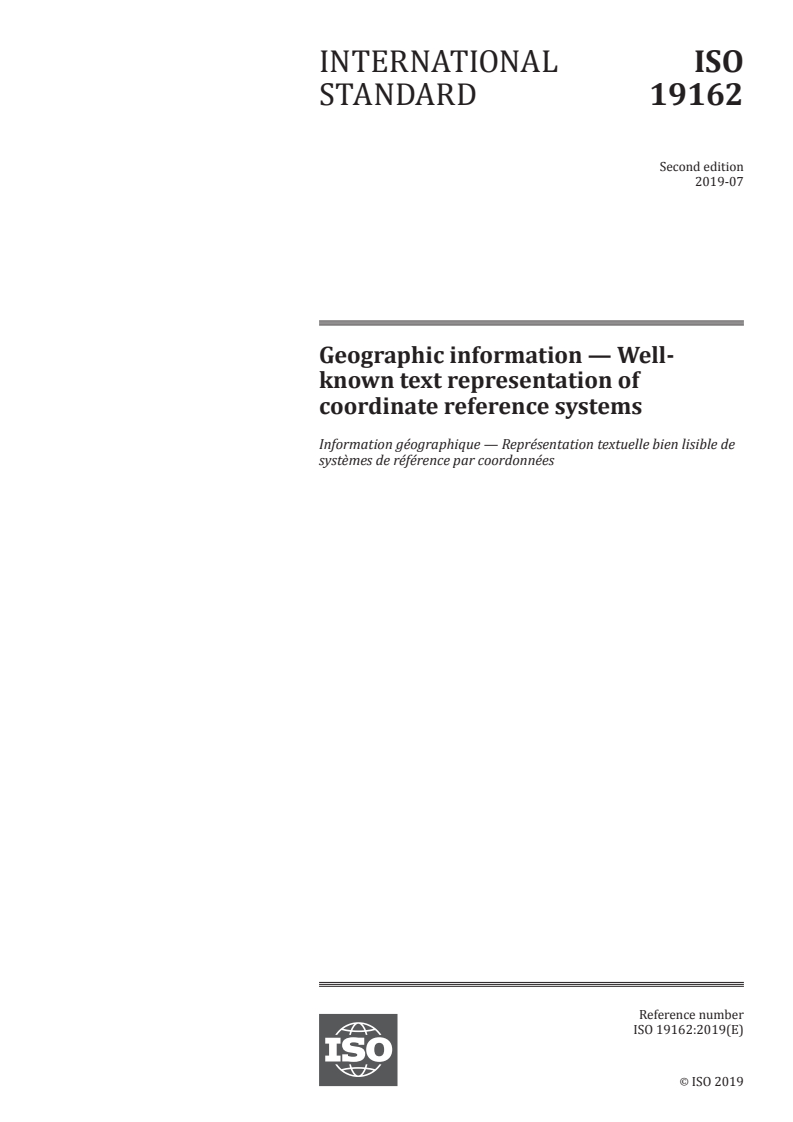
INTERNATIONAL ISO
STANDARD 19162
Second edition
2019-07
Geographic information — Well-
known text representation of
coordinate reference systems
Information géographique — Représentation textuelle bien lisible de
systèmes de référence par coordonnées
Reference number
©
ISO 2019
© ISO 2019
All rights reserved. Unless otherwise specified, or required in the context of its implementation, no part of this publication may
be reproduced or utilized otherwise in any form or by any means, electronic or mechanical, including photocopying, or posting
on the internet or an intranet, without prior written permission. Permission can be requested from either ISO at the address
below or ISO’s member body in the country of the requester.
ISO copyright office
CP 401 • Ch. de Blandonnet 8
CH-1214 Vernier, Geneva
Phone: +41 22 749 01 11
Fax: +41 22 749 09 47
Email: copyright@iso.org
Website: www.iso.org
Published in Switzerland
ii © ISO 2019 – All rights reserved
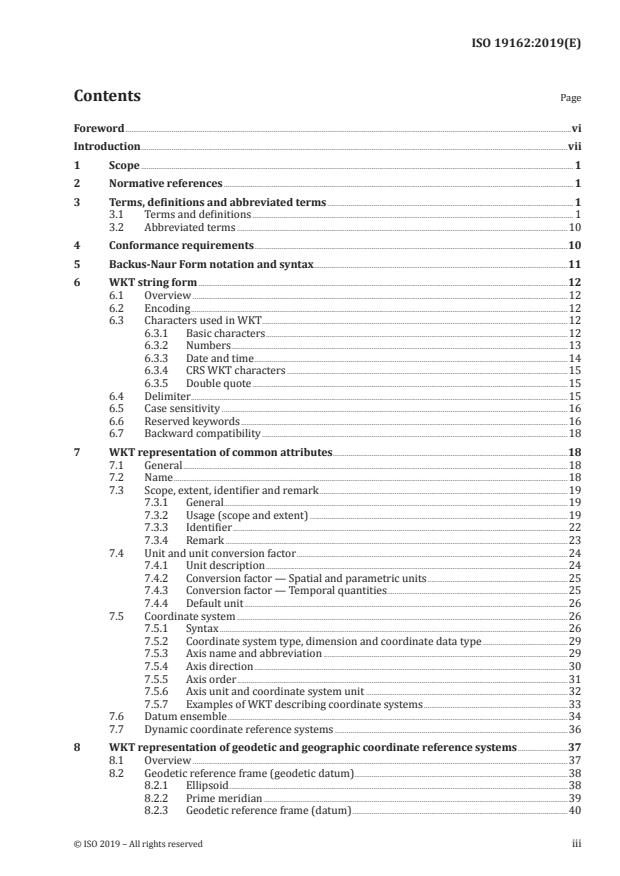
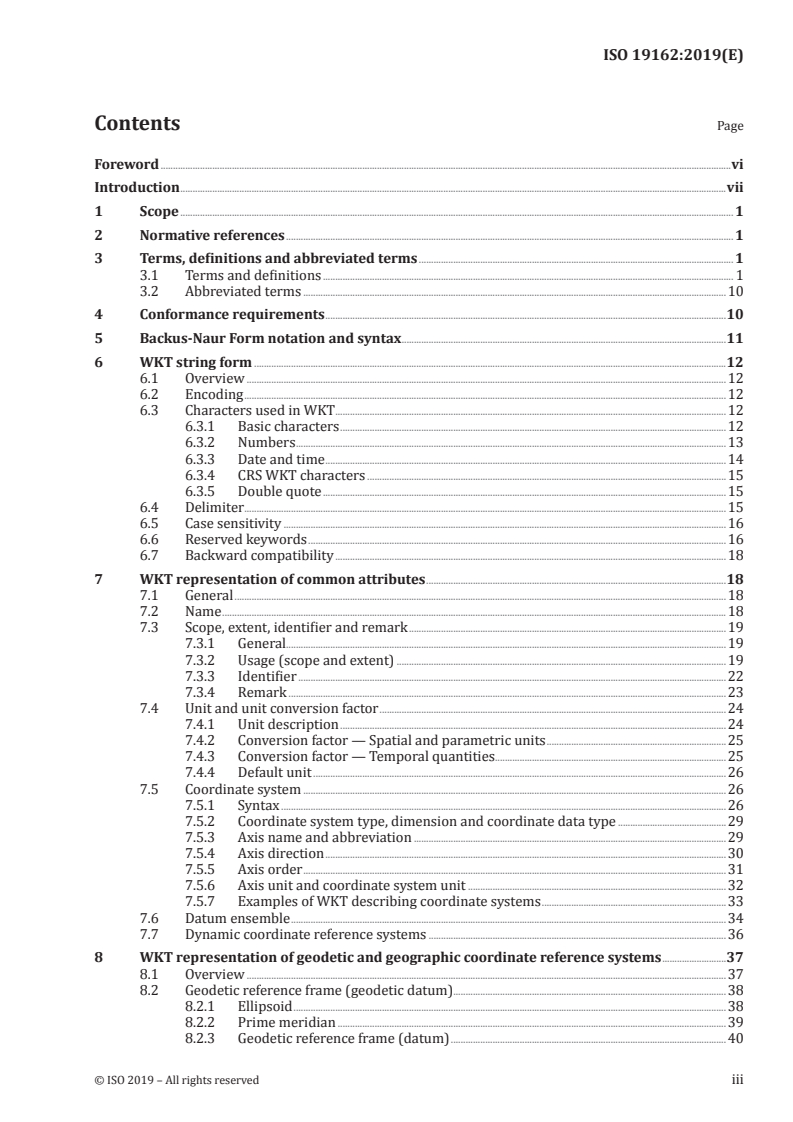
Contents Page
Foreword .vi
Introduction .vii
1 Scope . 1
2 Normative references . 1
3 Terms, definitions and abbreviated terms . 1
3.1 Terms and definitions . 1
3.2 Abbreviated terms .10
4 Conformance requirements .10
5 Backus-Naur Form notation and syntax .11
6 WKT string form .12
6.1 Overview .12
6.2 Encoding .12
6.3 Characters used in WKT .12
6.3.1 Basic characters .12
6.3.2 Numbers .13
6.3.3 Date and time .14
6.3.4 CRS WKT characters .15
6.3.5 Double quote .15
6.4 Delimiter .15
6.5 Case sensitivity .16
6.6 Reserved keywords .16
6.7 Backward compatibility .18
7 WKT representation of common attributes .18
7.1 General .18
7.2 Name .18
7.3 Scope, extent, identifier and remark .19
7.3.1 General.19
7.3.2 Usage (scope and extent) .19
7.3.3 Identifier .22
7.3.4 Remark .23
7.4 Unit and unit conversion factor .24
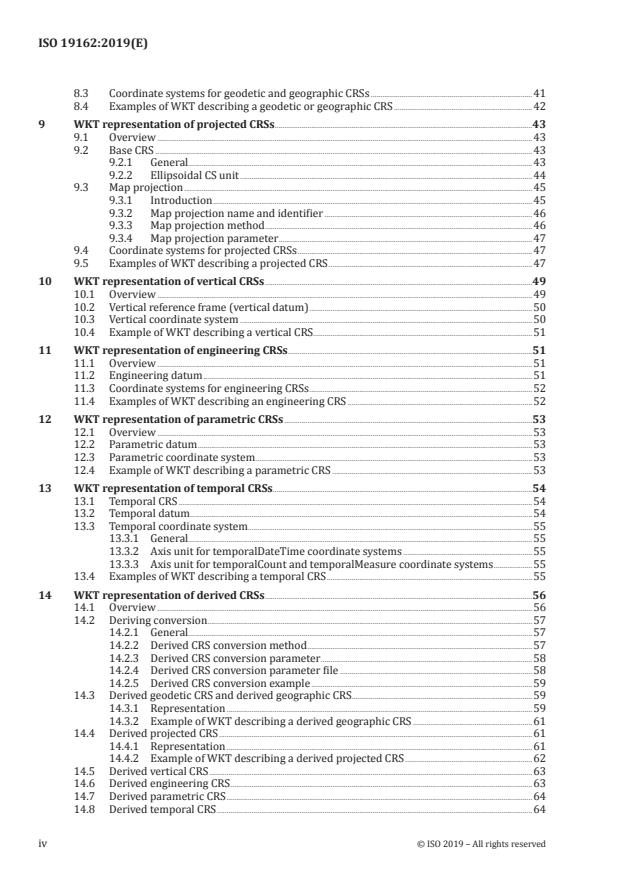
7.4.1 Unit description .24
7.4.2 Conversion factor — Spatial and parametric units .25
7.4.3 Conversion factor — Temporal quantities.25
7.4.4 Default unit .26
7.5 Coordinate system .26
7.5.1 Syntax .26
7.5.2 Coordinate system type, dimension and coordinate data type .29
7.5.3 Axis name and abbreviation .29
7.5.4 Axis direction .30
7.5.5 Axis order .31
7.5.6 Axis unit and coordinate system unit .32
7.5.7 Examples of WKT describing coordinate systems .33
7.6 Datum ensemble .34
7.7 Dynamic coordinate reference systems .36
8 WKT representation of geodetic and geographic coordinate reference systems .37
8.1 Overview .37
8.2 Geodetic reference frame (geodetic datum) . .38
8.2.1 Ellipsoid .38
8.2.2 Prime meridian .39
8.2.3 Geodetic reference frame (datum) .40
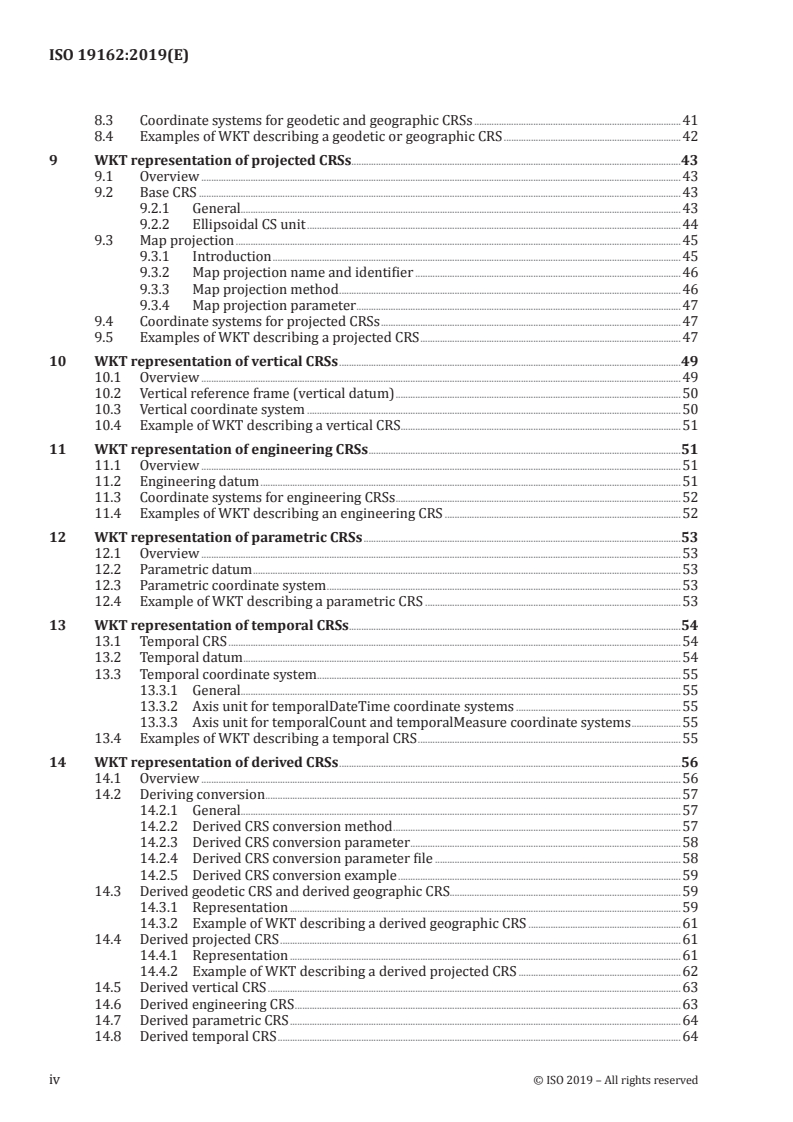
8.3 Coordinate systems for geodetic and geographic CRSs .41
8.4 Examples of WKT describing a geodetic or geographic CRS .42
9 WKT representation of projected CRSs .43
9.1 Overview .43
9.2 Base CRS .43
9.2.1 General.43
9.2.2 Ellipsoidal CS unit .44
9.3 Map projection .45
9.3.1 Introduction .45
9.3.2 Map projection name and identifier .46
9.3.3 Map projection method .46
9.3.4 Map projection parameter .47
9.4 Coordinate systems for projected CRSs .47
9.5 Examples of WKT describing a projected CRS .47
10 WKT representation of vertical CRSs .49
10.1 Overview .49
10.2 Vertical reference frame (vertical datum) .50
10.3 Vertical coordinate system .50
10.4 Example of WKT describing a vertical CRS.51
11 WKT representation of engineering CRSs .51
11.1 Overview .51
11.2 Engineering datum .51
11.3 Coordinate systems for engineering CRSs .52
11.4 Examples of WKT describing an engineering CRS .52
12 WKT representation of parametric CRSs .53
12.1 Overview .53
12.2 Parametric datum .53
12.3 Parametric coordinate system .53
12.4 Example of WKT describing a parametric CRS .53
13 WKT representation of temporal CRSs .54
13.1 Temporal CRS .54
13.2 Temporal datum .54
13.3 Temporal coordinate system.55
13.3.1 General.55
13.3.2 Axis unit for temporalDateTime coordinate systems .55
13.3.3 Axis unit for temporalCount and temporalMeasure coordinate systems .55
13.4 Examples of WKT describing a temporal CRS .55
14 WKT representation of derived CRSs .56
14.1 Overview .56
14.2 Deriving conversion .57
14.2.1 General.57
14.2.2 Derived CRS conversion method .57
14.2.3 Derived CRS conversion parameter .58
14.2.4 Derived CRS conversion parameter file .58
14.2.5 Derived CRS conversion example .59
14.3 Derived geodetic CRS and derived geographic CRS.59
14.3.1 Representation .59
14.3.2 Example of WKT describing a derived geographic CRS .61
14.4 Derived projected CRS .61
14.4.1 Representation .61
14.4.2 Example of WKT describing a derived projected CRS .62
14.5 Derived vertical CRS .63
14.6 Derived engineering CRS .63
14.7 Derived parametric CRS .64
14.8 Derived temporal CRS .64
iv © ISO 2019 – All rights reserved
15 WKT representation of compound coordinate reference systems .65
15.1 Overview .65
15.2 Examples of WKT describing a compound CRS .65
16 WKT representation of coordinate epoch and coordinate metadata .66
16.1 Coordinate epoch .66
16.2 Coordinate metadata .67
17 WKT representation of coordinate transformations and coordinate conversions
excluding map projections .68
17.1 Coordinate operations .68
17.2 Transformation and conversion components .68
17.2.1 Operation name and version .68
17.2.2 Source and target CRS .68
17.2.3 Transformation and conversion name and identifier .69
17.2.4 Coordinate operation method .69
17.2.5 Coordinate operation parameter .69
17.2.6 Coordinate operation parameter file .70
17.2.7 Interpolation CRS .70
17.2.8 Coordinate operation accuracy .70
17.2.9 Other coordinate operation attributes .71
17.3 Examples of WKT describing a coordinate transformation .71
18 WKT representation of point motion operations .72
19 WKT representation of concatenated coordinate operations.73
19.1 General .73
19.2 Examples of WKT describing a concatenated coordinate operation.75
20 WKT representation of CRS and coordinate operation couplets .76
20.1 Bound CRS .76
20.2 Bound CRS components .77
20.2.1 Abridged coordinate transformation .77
20.2.2 Coordinate operation method in abridged coordinate transformations .77
20.2.3 Abridged coordinate transformation parameter .77
20.2.4 Coordinate operation parameter file .78
20.3 Examples of WKT describing a bound CRS .78
Annex A (normative) Abstract test suite .80
Annex B (informative) Recommended practice for implementation .89
Annex C (informative) Mapping of concepts from previous versions of CRS WKT .92
Annex D (informative) Backward compatibility with ISO 19162:2015 .103
Annex E (normative) Triaxial ellipsoid .107
Annex F (informative) Identifiers for coordinate operation methods and parameters .108
Bibliography .113
Foreword
ISO (the International Organization for Standardization) is a worldwide federation of national standards
bodies (ISO member bodies). The work of preparing International Standards is normally carried out
through ISO technical committees. Each member body interested in a subject for which a technical
committee has been established has the right to be represented on that committee. International
organizations, governmental and non-governmental, in liaison with ISO, also take part in the work.
ISO collaborates closely with the International Electrotechnical Commission (IEC) on all matters of
electrotechnical standardization.
The procedures used to develop this document and those intended for its further maintenance are
described in the ISO/IEC Directives, Part 1. In particular, the different approval criteria needed for the
different types of ISO documents should be noted. This document was drafted in accordance with the
editorial rules of the ISO/IEC Directives, Part 2 (see www .iso .org/directives).
Attention is drawn to the possibility that some of the elements of this document may be the subject of
patent rights. ISO shall not be held responsible for identifying any or all such patent rights. Details of
any patent rights identified during the development of the document will be in the Introduction and/or
on the ISO list of patent declarations received (see www .iso .org/patents).
Any trade name used in this document is information given for the convenience of users and does not
constitute an endorsement.
For an explanation of the voluntary nature of standards, the meaning of ISO specific terms and
expressions related to conformity assessment, as well as information about ISO's adherence to the
World Trade Organization (WTO) principles in the Technical Barriers to Trade (TBT), see www .iso
.org/iso/foreword .html.
This document was prepared by Technical Committee ISO/TC 211, Geographic information/Geomatics in
close collaboration with the Open Geospatial Consortium (OGC).
This second edition cancels and replaces the first edition (ISO 19162:2015), which has been technically
revised.
The main changes compared to the previous edition are as follows:
— updates to reflect the changes made in ISO 19111:2019 from its previous edition ISO 19111:2007
to describe dynamic geodetic reference frames, three-dimensional projected coordinate reference
systems, datum ensembles and coordinate metadata;
— remodelling of the descriptions of temporal coordinate reference systems, to reflect the changes
made in ISO 19111:2019;
— the correction of minor errors.
Further details are given in Annex D.
In accordance with the ISO/IEC Directives, Part 2, 2018, Rules for the structure and drafting of
International Standards, in International Standards the decimal sign is a comma on the line. However,
the General Conference on Weights and Measures (Conférence Générale des Poids et Mesures) at its
meeting in 2003 passed unanimously the following resolution:
“The decimal marker shall be either a point on the line or a comma on the line.”
In practice, the choice between these alternatives depends on customary use in the language concerned.
In the technical areas of geodesy and geographic information it is customary for the decimal point
always to be used, for all languages. That practice is used throughout this document.
Any feedback or questions on this document should be directed to the user’s national standards body. A
complete listing of these bodies can be found at www .iso .org/members .html.
vi © ISO 2019 – All rights reserved
Introduction
Well-known text (WKT) offers a compact machine- and human-readable representation of geometric
objects. WKT may also be used for succinctly describing the critical elements of coordinate reference
system (CRS) definitions.
WKT was described in the Open Geospatial Consortium implementation specifications 99-036
through 06-103r4 and ISO 19125-1:2004. The WKT representation of coordinate reference systems
was subsequently extended in Open Geospatial Consortium implementation specification 01-009
"Coordinate Transformation Services" and this extension was later adopted in the Open Geospatial
Consortium GeoAPI 3.0 implementation standard 09-083r3 and GeoPackage 1.0 implementation
standard 12-128r10. The WKT representation of coordinate reference systems as defined in
ISO 19125-1:2004 and OGC specification 01-009 is inconsistent with the terminology and technical
provisions of ISO 19111:2007 and OGC Abstract Specification topic 2 (08-015r2), “Geographic
information — Spatial referencing by coordinates”.
The 2015 version of this document provided an updated version of WKT representation of coordinate
reference systems that follows the provisions of ISO 19111:2007 and ISO 19111-2:2009. It extended
earlier WKT to allow for the description of coordinate operations.
This document updates WKT for the extensions to ISO 19111 made through its 2019 revision:
— the description of dynamic geodetic and vertical coordinate reference systems;
— the change of coordinate values within a coordinate reference system due to point motion caused by
tectonic deformation;
— the description of geoid-based vertical coordinate reference systems;
— the description of datum ensembles, groups of realizations of one terrestrial or vertical reference
system that for low accuracy purposes may be merged ignoring coordinate transformation;
— a rigorous description of temporal coordinate reference systems;
— the removal (deprecation) of image coordinate reference systems; and
— the remodelling of scope and extent information.
This document defines the structure and content of well-known text strings. It does not prescribe how
implementations should read or write these strings.
INTERNATIONAL STANDARD ISO 19162:2019(E)
Geographic information — Well-known text representation
of coordinate reference systems
1 Scope
This document defines the structure and content of a text string implementation of the abstract model
for coordinate reference systems described in ISO 19111. The string defines frequently needed types of
coordinate reference systems and coordinate operations in a self-contained form that is easily readable
by machines and by humans. The essence is its simplicity; as a consequence there are some constraints
upon the more open content allowed in ISO 19111. To retain simplicity in the well-known text (WKT)
description of coordinate reference systems and coordinate operations, the scope of this document
excludes parameter grouping and pass-through coordinate operations. The text string provides a means
for humans and machines to correctly and unambiguously interpret and utilise a coordinate reference
system definition with look-ups or cross references only to define coordinate operation mathematics. A
WKT string is not suitable for the storage of definitions of coordinate reference systems or coordinate
operations because it omits metadata about the source of the data and may omit metadata about the
applicability of the information.
2 Normative references
The following documents are referred to in the text in such a way that some or all of their content
constitutes requirements of this document. For dated references, only the edition cited applies. For
undated references, the latest edition of the referenced document (including any amendments) applies.
ISO 8601-1, Date and time — Representations for information interchange — Part 1: Basic rules
ISO/IEC 10646, Information technology — Universal Coded Character Set (UCS)
ISO 19111:2019, Geographic information — Referencing by coordinates
3 Terms, definitions and abbreviated terms
3.1 Terms and definitions
For the purposes of this document, the following terms and definitions apply.
ISO and IEC maintain terminological databases for use in standardization at the following addresses:
— ISO Online browsing platform: available at https: //www .iso .org/obp
— IEC Electropedia: available at http: //www .electropedia .org/
3.1.1
affine coordinate system
coordinate system in Euclidean space with straight axes that are not necessarily mutually perpendicular
[SOURCE: ISO 19111:2019, 3.1.1]
3.1.2
bearing
horizontal angle at a point relative to a specified direction
Note 1 to entry: The direction is usually specified to be north. In some communities the term bearing refers
specifically to grid north and directions relative to true north are then termed ‘azimuth’; in other communities a
bearing refers specifically to true north. In this document bearing is used for any specified reference direction.
The angle may be reckoned positive clockwise or positive counter-clockwise depending upon the application.
3.1.3
Cartesian coordinate system
coordinate system in Euclidean space which gives the position of points relative to n mutually
perpendicular straight axes all having the same unit of measure
Note 1 to entry: n is 2 or 3 for the purposes of this document.
Note 2 to entry: A Cartesian coordinate system is a specialisation of an affine coordinate system.
[SOURCE: ISO 19111:2019, 3.1.2]
3.1.4
compound coordinate reference system
coordinate reference system using at least two independent coordinate reference systems
Note 1 to entry: Coordinate reference systems are independent of each other if coordinate values in one cannot
be converted or transformed into coordinate values in the other.
[SOURCE: ISO 19111:2019, 3.1.3]
3.1.5
coordinate conversion
coordinate operation that changes coordinates in a source coordinate reference system to coordinates
in a target coordinate reference system in which both coordinate reference systems are based on the
same datum
Note 1 to entry: A coordinate conversion uses parameters which have specified values.
EXAMPLE 1 A mapping of ellipsoidal coordinates to Cartesian coordinates using a map projection.
EXAMPLE 2 Change of units such as from radians to degrees or from feet to metres.
[SOURCE: ISO 19111:2019, 3.1.6]
3.1.6
coordinate epoch
epoch to which coordinates in a dynamic coordinate reference system are referenced
[SOURCE: ISO 19111:2019, 3.1.7]
3.1.7
coordinate operation
process using a mathematical model, based on a one-to-one relationship, that changes coordinates in
a source coordinate reference system to coordinates in a target coordinate reference system, or that
changes coordinates at a source coordinate epoch to coordinates at a target coordinate epoch within
the same coordinate reference system
[SOURCE: ISO 19111:2019, 3.1.8]
3.1.8
coordinate reference system
coordinate system that is related to an object by a datum
Note 1 to entry: Geodetic and vertical datums are referred to as reference frames.
2 © ISO 2019 – All rights reserved
Note 2 to entry: For geodetic and vertical reference frames, the object will be the Earth. In planetary applications,
geodetic and vertical reference frames may be applied to other celestial bodies.
[SOURCE: ISO 19111:2019, 3.1.9]
3.1.9
coordinate system
set of mathematical rules for specifying how coordinates are to be assigned to points
[SOURCE: ISO 19111:2019, 3.1.11]
3.1.10
coordinate transformation
coordinate operation that changes coordinates in a source coordinate reference system to coordinates
in a target coordinate reference system in which the source and target coordinate reference systems
are based on different datums
Note 1 to entry: A coordinate transformation uses parameters which are derived empirically. Any error in those
coordinates will be embedded in the coordinate transformation and when the coordinate transformation is
applied the embedded errors are transmitted to output coordinates.
Note 2 to entry: A coordinate transformation is colloquially sometimes referred to as a 'datum transformation'.
This is erroneous. A coordinate transformation changes coordinate values. It does not change the definition
of the datum. In this document coordinates are referenced to a coordinate reference system. A coordinate
transformation operates between two coordinate reference systems, not between two datums.
[SOURCE: ISO 19111:2019, 3.1.12]
3.1.11
cylindrical coordinate system
three-dimensional coordinate system in Euclidean space in which position is specified by two linear
coordinates and one angular coordinate
[SOURCE: ISO 19111:2019, 3.1.14]
3.1.12
datum
reference frame
parameter or set of parameters that realize the position of the origin, the scale, and the orientation of a
coordinate system
[SOURCE: ISO 19111:2019, 3.1.15]
3.1.13
datum ensemble
group of multiple realizations of the same terrestrial or vertical reference system that, for approximate
spatial referencing purposes, are not significantly different
Note 1 to entry: Datasets referenced to the different realizations within a datum ensemble may be merged
without coordinate transformation.
Note 2 to entry: ‘Approximate’ is for users to define but typically is in the order of under 1 decimetre but may be
up to 2 metres.
EXAMPLE “WGS 84” as an undifferentiated group of realizations including WGS 84 (TRANSIT), WGS 84
(G730), WGS 84 (G873), WGS 84 (G1150), WGS 84 (G1674) and WGS 84 (G1762). At the surface of the Earth these
have changed on average by 0.7 m between the TRANSIT and G730 realizations, a further 0.2 m between G730 and
G873, 0.06 m between G873 and G1150, 0.2 m between G1150 and G1674 and 0.02 m between G1674 and G1762.
[SOURCE: ISO 19111:2019, 3.1.16]
3.1.14
derived coordinate reference system
coordinate reference system that is defined through the application of a specified coordinate conversion
to the coordinates within a previously established coordinate reference system
Note 1 to entry: The previously established coordinate reference system is referred to as the base coordinate
reference system.
Note 2 to entry: A derived coordinate reference system inherits its datum or reference frame from its base
coordinate reference system.
Note 3 to entry: The coordinate conversion between the base and derived coordinate reference system is
implemented using the parameters and formula(s) specified in the definition of the coordinate conversion.
[SOURCE: ISO 19111:2019, 3.1.8]
3.1.15
dynamic coordinate reference system
coordinate reference system that has a dynamic reference frame
Note 1 to entry: Coordinates of points on or near the crust of the Earth that are referenced to a dynamic
coordinate reference system may change with time, usually due to crustal deformations such as tectonic motion
and glacial isostatic adjustment.
Note 2 to entry: Metadata for a dataset referenced to a dynamic coordinate reference system should include
coordinate epoch information.
[SOURCE: ISO 19111:2019, 3.1.9]
3.1.16
dynamic reference frame
dynamic datumreference frame in which the defining parameters include time evolution
Note 1 to entry: The defining parameters that have time evolution are usually a coordinate set.
[SOURCE: ISO 19111:2019, 3.1.20]
3.1.17
ellipsoid
reference ellipsoid
geometric reference surface embedded in 3D Euclidean space formed by an ellipse that is
rotated about a main axis
Note 1 to entry: For the Earth the ellipsoid is bi-axial with rotation about the polar axis. This results in an oblate
ellipsoid with the midpoint of the foci located at the nominal centre of the Earth.
[SOURCE: ISO 19111:2019, 3.1.22]
3.1.18
ellipsoidal coordinate system
geodetic coordinate system
coordinate system in which position is specified by geodetic latitude, geodetic longitude and (in the
three-dimensional case) ellipsoidal height
[SOURCE: ISO 19111:2019, 3.1.23]
4 © ISO 2019 – All rights reserved
3.1.19
ellipsoidal height
geodetic height
h
distance of a point from the reference ellipsoid along the perpendicular from the reference ellipsoid to
this point, positive if upwards or outside of the reference ellipsoid
Note 1 to entry: Only used as part of a three-dimensional ellipsoidal coordinate system or as part of a three-
dimensional Cartesian coordinate system in a three-dimensional projected coordinate reference system, but
never on its own.
[SOURCE: ISO 19111:2019, 3.1.24]
3.1.20
engineering coordinate reference system
coordinate reference system based on an engineering datum
EXAMPLE 1 System for identifying relative positions within a few kilometres of the reference point, such as a
building or construction site.
EXAMPLE 2 Coordinate reference system local to a moving objec
...
INTERNATIONAL ISO
STANDARD 19162
Second edition
2019-07
Geographic information — Well-
known text representation of
coordinate reference systems
Information géographique — Représentation textuelle bien lisible de
systèmes de référence par coordonnées
Reference number
©
ISO 2019
© ISO 2019
All rights reserved. Unless otherwise specified, or required in the context of its implementation, no part of this publication may
be reproduced or utilized otherwise in any form or by any means, electronic or mechanical, including photocopying, or posting
on the internet or an intranet, without prior written permission. Permission can be requested from either ISO at the address
below or ISO’s member body in the country of the requester.
ISO copyright office
CP 401 • Ch. de Blandonnet 8
CH-1214 Vernier, Geneva
Phone: +41 22 749 01 11
Fax: +41 22 749 09 47
Email: copyright@iso.org
Website: www.iso.org
Published in Switzerland
ii © ISO 2019 – All rights reserved
Contents Page
Foreword .vi
Introduction .vii
1 Scope . 1
2 Normative references . 1
3 Terms, definitions and abbreviated terms . 1
3.1 Terms and definitions . 1
3.2 Abbreviated terms .10
4 Conformance requirements .10
5 Backus-Naur Form notation and syntax .11
6 WKT string form .12
6.1 Overview .12
6.2 Encoding .12
6.3 Characters used in WKT .12
6.3.1 Basic characters .12
6.3.2 Numbers .13
6.3.3 Date and time .14
6.3.4 CRS WKT characters .15
6.3.5 Double quote .15
6.4 Delimiter .15
6.5 Case sensitivity .16
6.6 Reserved keywords .16
6.7 Backward compatibility .18
7 WKT representation of common attributes .18
7.1 General .18
7.2 Name .18
7.3 Scope, extent, identifier and remark .19
7.3.1 General.19
7.3.2 Usage (scope and extent) .19
7.3.3 Identifier .22
7.3.4 Remark .23
7.4 Unit and unit conversion factor .24
7.4.1 Unit description .24
7.4.2 Conversion factor — Spatial and parametric units .25
7.4.3 Conversion factor — Temporal quantities.25
7.4.4 Default unit .26
7.5 Coordinate system .26
7.5.1 Syntax .26
7.5.2 Coordinate system type, dimension and coordinate data type .29
7.5.3 Axis name and abbreviation .29
7.5.4 Axis direction .30
7.5.5 Axis order .31
7.5.6 Axis unit and coordinate system unit .32
7.5.7 Examples of WKT describing coordinate systems .33
7.6 Datum ensemble .34
7.7 Dynamic coordinate reference systems .36
8 WKT representation of geodetic and geographic coordinate reference systems .37
8.1 Overview .37
8.2 Geodetic reference frame (geodetic datum) . .38
8.2.1 Ellipsoid .38
8.2.2 Prime meridian .39
8.2.3 Geodetic reference frame (datum) .40
8.3 Coordinate systems for geodetic and geographic CRSs .41
8.4 Examples of WKT describing a geodetic or geographic CRS .42
9 WKT representation of projected CRSs .43
9.1 Overview .43
9.2 Base CRS .43
9.2.1 General.43
9.2.2 Ellipsoidal CS unit .44
9.3 Map projection .45
9.3.1 Introduction .45
9.3.2 Map projection name and identifier .46
9.3.3 Map projection method .46
9.3.4 Map projection parameter .47
9.4 Coordinate systems for projected CRSs .47
9.5 Examples of WKT describing a projected CRS .47
10 WKT representation of vertical CRSs .49
10.1 Overview .49
10.2 Vertical reference frame (vertical datum) .50
10.3 Vertical coordinate system .50
10.4 Example of WKT describing a vertical CRS.51
11 WKT representation of engineering CRSs .51
11.1 Overview .51
11.2 Engineering datum .51
11.3 Coordinate systems for engineering CRSs .52
11.4 Examples of WKT describing an engineering CRS .52
12 WKT representation of parametric CRSs .53
12.1 Overview .53
12.2 Parametric datum .53
12.3 Parametric coordinate system .53
12.4 Example of WKT describing a parametric CRS .53
13 WKT representation of temporal CRSs .54
13.1 Temporal CRS .54
13.2 Temporal datum .54
13.3 Temporal coordinate system.55
13.3.1 General.55
13.3.2 Axis unit for temporalDateTime coordinate systems .55
13.3.3 Axis unit for temporalCount and temporalMeasure coordinate systems .55
13.4 Examples of WKT describing a temporal CRS .55
14 WKT representation of derived CRSs .56
14.1 Overview .56
14.2 Deriving conversion .57
14.2.1 General.57
14.2.2 Derived CRS conversion method .57
14.2.3 Derived CRS conversion parameter .58
14.2.4 Derived CRS conversion parameter file .58
14.2.5 Derived CRS conversion example .59
14.3 Derived geodetic CRS and derived geographic CRS.59
14.3.1 Representation .59
14.3.2 Example of WKT describing a derived geographic CRS .61
14.4 Derived projected CRS .61
14.4.1 Representation .61
14.4.2 Example of WKT describing a derived projected CRS .62
14.5 Derived vertical CRS .63
14.6 Derived engineering CRS .63
14.7 Derived parametric CRS .64
14.8 Derived temporal CRS .64
iv © ISO 2019 – All rights reserved
15 WKT representation of compound coordinate reference systems .65
15.1 Overview .65
15.2 Examples of WKT describing a compound CRS .65
16 WKT representation of coordinate epoch and coordinate metadata .66
16.1 Coordinate epoch .66
16.2 Coordinate metadata .67
17 WKT representation of coordinate transformations and coordinate conversions
excluding map projections .68
17.1 Coordinate operations .68
17.2 Transformation and conversion components .68
17.2.1 Operation name and version .68
17.2.2 Source and target CRS .68
17.2.3 Transformation and conversion name and identifier .69
17.2.4 Coordinate operation method .69
17.2.5 Coordinate operation parameter .69
17.2.6 Coordinate operation parameter file .70
17.2.7 Interpolation CRS .70
17.2.8 Coordinate operation accuracy .70
17.2.9 Other coordinate operation attributes .71
17.3 Examples of WKT describing a coordinate transformation .71
18 WKT representation of point motion operations .72
19 WKT representation of concatenated coordinate operations.73
19.1 General .73
19.2 Examples of WKT describing a concatenated coordinate operation.75
20 WKT representation of CRS and coordinate operation couplets .76
20.1 Bound CRS .76
20.2 Bound CRS components .77
20.2.1 Abridged coordinate transformation .77
20.2.2 Coordinate operation method in abridged coordinate transformations .77
20.2.3 Abridged coordinate transformation parameter .77
20.2.4 Coordinate operation parameter file .78
20.3 Examples of WKT describing a bound CRS .78
Annex A (normative) Abstract test suite .80
Annex B (informative) Recommended practice for implementation .89
Annex C (informative) Mapping of concepts from previous versions of CRS WKT .92
Annex D (informative) Backward compatibility with ISO 19162:2015 .103
Annex E (normative) Triaxial ellipsoid .107
Annex F (informative) Identifiers for coordinate operation methods and parameters .108
Bibliography .113
Foreword
ISO (the International Organization for Standardization) is a worldwide federation of national standards
bodies (ISO member bodies). The work of preparing International Standards is normally carried out
through ISO technical committees. Each member body interested in a subject for which a technical
committee has been established has the right to be represented on that committee. International
organizations, governmental and non-governmental, in liaison with ISO, also take part in the work.
ISO collaborates closely with the International Electrotechnical Commission (IEC) on all matters of
electrotechnical standardization.
The procedures used to develop this document and those intended for its further maintenance are
described in the ISO/IEC Directives, Part 1. In particular, the different approval criteria needed for the
different types of ISO documents should be noted. This document was drafted in accordance with the
editorial rules of the ISO/IEC Directives, Part 2 (see www .iso .org/directives).
Attention is drawn to the possibility that some of the elements of this document may be the subject of
patent rights. ISO shall not be held responsible for identifying any or all such patent rights. Details of
any patent rights identified during the development of the document will be in the Introduction and/or
on the ISO list of patent declarations received (see www .iso .org/patents).
Any trade name used in this document is information given for the convenience of users and does not
constitute an endorsement.
For an explanation of the voluntary nature of standards, the meaning of ISO specific terms and
expressions related to conformity assessment, as well as information about ISO's adherence to the
World Trade Organization (WTO) principles in the Technical Barriers to Trade (TBT), see www .iso
.org/iso/foreword .html.
This document was prepared by Technical Committee ISO/TC 211, Geographic information/Geomatics in
close collaboration with the Open Geospatial Consortium (OGC).
This second edition cancels and replaces the first edition (ISO 19162:2015), which has been technically
revised.
The main changes compared to the previous edition are as follows:
— updates to reflect the changes made in ISO 19111:2019 from its previous edition ISO 19111:2007
to describe dynamic geodetic reference frames, three-dimensional projected coordinate reference
systems, datum ensembles and coordinate metadata;
— remodelling of the descriptions of temporal coordinate reference systems, to reflect the changes
made in ISO 19111:2019;
— the correction of minor errors.
Further details are given in Annex D.
In accordance with the ISO/IEC Directives, Part 2, 2018, Rules for the structure and drafting of
International Standards, in International Standards the decimal sign is a comma on the line. However,
the General Conference on Weights and Measures (Conférence Générale des Poids et Mesures) at its
meeting in 2003 passed unanimously the following resolution:
“The decimal marker shall be either a point on the line or a comma on the line.”
In practice, the choice between these alternatives depends on customary use in the language concerned.
In the technical areas of geodesy and geographic information it is customary for the decimal point
always to be used, for all languages. That practice is used throughout this document.
Any feedback or questions on this document should be directed to the user’s national standards body. A
complete listing of these bodies can be found at www .iso .org/members .html.
vi © ISO 2019 – All rights reserved
Introduction
Well-known text (WKT) offers a compact machine- and human-readable representation of geometric
objects. WKT may also be used for succinctly describing the critical elements of coordinate reference
system (CRS) definitions.
WKT was described in the Open Geospatial Consortium implementation specifications 99-036
through 06-103r4 and ISO 19125-1:2004. The WKT representation of coordinate reference systems
was subsequently extended in Open Geospatial Consortium implementation specification 01-009
"Coordinate Transformation Services" and this extension was later adopted in the Open Geospatial
Consortium GeoAPI 3.0 implementation standard 09-083r3 and GeoPackage 1.0 implementation
standard 12-128r10. The WKT representation of coordinate reference systems as defined in
ISO 19125-1:2004 and OGC specification 01-009 is inconsistent with the terminology and technical
provisions of ISO 19111:2007 and OGC Abstract Specification topic 2 (08-015r2), “Geographic
information — Spatial referencing by coordinates”.
The 2015 version of this document provided an updated version of WKT representation of coordinate
reference systems that follows the provisions of ISO 19111:2007 and ISO 19111-2:2009. It extended
earlier WKT to allow for the description of coordinate operations.
This document updates WKT for the extensions to ISO 19111 made through its 2019 revision:
— the description of dynamic geodetic and vertical coordinate reference systems;
— the change of coordinate values within a coordinate reference system due to point motion caused by
tectonic deformation;
— the description of geoid-based vertical coordinate reference systems;
— the description of datum ensembles, groups of realizations of one terrestrial or vertical reference
system that for low accuracy purposes may be merged ignoring coordinate transformation;
— a rigorous description of temporal coordinate reference systems;
— the removal (deprecation) of image coordinate reference systems; and
— the remodelling of scope and extent information.
This document defines the structure and content of well-known text strings. It does not prescribe how
implementations should read or write these strings.
INTERNATIONAL STANDARD ISO 19162:2019(E)
Geographic information — Well-known text representation
of coordinate reference systems
1 Scope
This document defines the structure and content of a text string implementation of the abstract model
for coordinate reference systems described in ISO 19111. The string defines frequently needed types of
coordinate reference systems and coordinate operations in a self-contained form that is easily readable
by machines and by humans. The essence is its simplicity; as a consequence there are some constraints
upon the more open content allowed in ISO 19111. To retain simplicity in the well-known text (WKT)
description of coordinate reference systems and coordinate operations, the scope of this document
excludes parameter grouping and pass-through coordinate operations. The text string provides a means
for humans and machines to correctly and unambiguously interpret and utilise a coordinate reference
system definition with look-ups or cross references only to define coordinate operation mathematics. A
WKT string is not suitable for the storage of definitions of coordinate reference systems or coordinate
operations because it omits metadata about the source of the data and may omit metadata about the
applicability of the information.
2 Normative references
The following documents are referred to in the text in such a way that some or all of their content
constitutes requirements of this document. For dated references, only the edition cited applies. For
undated references, the latest edition of the referenced document (including any amendments) applies.
ISO 8601-1, Date and time — Representations for information interchange — Part 1: Basic rules
ISO/IEC 10646, Information technology — Universal Coded Character Set (UCS)
ISO 19111:2019, Geographic information — Referencing by coordinates
3 Terms, definitions and abbreviated terms
3.1 Terms and definitions
For the purposes of this document, the following terms and definitions apply.
ISO and IEC maintain terminological databases for use in standardization at the following addresses:
— ISO Online browsing platform: available at https: //www .iso .org/obp
— IEC Electropedia: available at http: //www .electropedia .org/
3.1.1
affine coordinate system
coordinate system in Euclidean space with straight axes that are not necessarily mutually perpendicular
[SOURCE: ISO 19111:2019, 3.1.1]
3.1.2
bearing
horizontal angle at a point relative to a specified direction
Note 1 to entry: The direction is usually specified to be north. In some communities the term bearing refers
specifically to grid north and directions relative to true north are then termed ‘azimuth’; in other communities a
bearing refers specifically to true north. In this document bearing is used for any specified reference direction.
The angle may be reckoned positive clockwise or positive counter-clockwise depending upon the application.
3.1.3
Cartesian coordinate system
coordinate system in Euclidean space which gives the position of points relative to n mutually
perpendicular straight axes all having the same unit of measure
Note 1 to entry: n is 2 or 3 for the purposes of this document.
Note 2 to entry: A Cartesian coordinate system is a specialisation of an affine coordinate system.
[SOURCE: ISO 19111:2019, 3.1.2]
3.1.4
compound coordinate reference system
coordinate reference system using at least two independent coordinate reference systems
Note 1 to entry: Coordinate reference systems are independent of each other if coordinate values in one cannot
be converted or transformed into coordinate values in the other.
[SOURCE: ISO 19111:2019, 3.1.3]
3.1.5
coordinate conversion
coordinate operation that changes coordinates in a source coordinate reference system to coordinates
in a target coordinate reference system in which both coordinate reference systems are based on the
same datum
Note 1 to entry: A coordinate conversion uses parameters which have specified values.
EXAMPLE 1 A mapping of ellipsoidal coordinates to Cartesian coordinates using a map projection.
EXAMPLE 2 Change of units such as from radians to degrees or from feet to metres.
[SOURCE: ISO 19111:2019, 3.1.6]
3.1.6
coordinate epoch
epoch to which coordinates in a dynamic coordinate reference system are referenced
[SOURCE: ISO 19111:2019, 3.1.7]
3.1.7
coordinate operation
process using a mathematical model, based on a one-to-one relationship, that changes coordinates in
a source coordinate reference system to coordinates in a target coordinate reference system, or that
changes coordinates at a source coordinate epoch to coordinates at a target coordinate epoch within
the same coordinate reference system
[SOURCE: ISO 19111:2019, 3.1.8]
3.1.8
coordinate reference system
coordinate system that is related to an object by a datum
Note 1 to entry: Geodetic and vertical datums are referred to as reference frames.
2 © ISO 2019 – All rights reserved
Note 2 to entry: For geodetic and vertical reference frames, the object will be the Earth. In planetary applications,
geodetic and vertical reference frames may be applied to other celestial bodies.
[SOURCE: ISO 19111:2019, 3.1.9]
3.1.9
coordinate system
set of mathematical rules for specifying how coordinates are to be assigned to points
[SOURCE: ISO 19111:2019, 3.1.11]
3.1.10
coordinate transformation
coordinate operation that changes coordinates in a source coordinate reference system to coordinates
in a target coordinate reference system in which the source and target coordinate reference systems
are based on different datums
Note 1 to entry: A coordinate transformation uses parameters which are derived empirically. Any error in those
coordinates will be embedded in the coordinate transformation and when the coordinate transformation is
applied the embedded errors are transmitted to output coordinates.
Note 2 to entry: A coordinate transformation is colloquially sometimes referred to as a 'datum transformation'.
This is erroneous. A coordinate transformation changes coordinate values. It does not change the definition
of the datum. In this document coordinates are referenced to a coordinate reference system. A coordinate
transformation operates between two coordinate reference systems, not between two datums.
[SOURCE: ISO 19111:2019, 3.1.12]
3.1.11
cylindrical coordinate system
three-dimensional coordinate system in Euclidean space in which position is specified by two linear
coordinates and one angular coordinate
[SOURCE: ISO 19111:2019, 3.1.14]
3.1.12
datum
reference frame
parameter or set of parameters that realize the position of the origin, the scale, and the orientation of a
coordinate system
[SOURCE: ISO 19111:2019, 3.1.15]
3.1.13
datum ensemble
group of multiple realizations of the same terrestrial or vertical reference system that, for approximate
spatial referencing purposes, are not significantly different
Note 1 to entry: Datasets referenced to the different realizations within a datum ensemble may be merged
without coordinate transformation.
Note 2 to entry: ‘Approximate’ is for users to define but typically is in the order of under 1 decimetre but may be
up to 2 metres.
EXAMPLE “WGS 84” as an undifferentiated group of realizations including WGS 84 (TRANSIT), WGS 84
(G730), WGS 84 (G873), WGS 84 (G1150), WGS 84 (G1674) and WGS 84 (G1762). At the surface of the Earth these
have changed on average by 0.7 m between the TRANSIT and G730 realizations, a further 0.2 m between G730 and
G873, 0.06 m between G873 and G1150, 0.2 m between G1150 and G1674 and 0.02 m between G1674 and G1762.
[SOURCE: ISO 19111:2019, 3.1.16]
3.1.14
derived coordinate reference system
coordinate reference system that is defined through the application of a specified coordinate conversion
to the coordinates within a previously established coordinate reference system
Note 1 to entry: The previously established coordinate reference system is referred to as the base coordinate
reference system.
Note 2 to entry: A derived coordinate reference system inherits its datum or reference frame from its base
coordinate reference system.
Note 3 to entry: The coordinate conversion between the base and derived coordinate reference system is
implemented using the parameters and formula(s) specified in the definition of the coordinate conversion.
[SOURCE: ISO 19111:2019, 3.1.8]
3.1.15
dynamic coordinate reference system
coordinate reference system that has a dynamic reference frame
Note 1 to entry: Coordinates of points on or near the crust of the Earth that are referenced to a dynamic
coordinate reference system may change with time, usually due to crustal deformations such as tectonic motion
and glacial isostatic adjustment.
Note 2 to entry: Metadata for a dataset referenced to a dynamic coordinate reference system should include
coordinate epoch information.
[SOURCE: ISO 19111:2019, 3.1.9]
3.1.16
dynamic reference frame
dynamic datumreference frame in which the defining parameters include time evolution
Note 1 to entry: The defining parameters that have time evolution are usually a coordinate set.
[SOURCE: ISO 19111:2019, 3.1.20]
3.1.17
ellipsoid
reference ellipsoid
geometric reference surface embedded in 3D Euclidean space formed by an ellipse that is
rotated about a main axis
Note 1 to entry: For the Earth the ellipsoid is bi-axial with rotation about the polar axis. This results in an oblate
ellipsoid with the midpoint of the foci located at the nominal centre of the Earth.
[SOURCE: ISO 19111:2019, 3.1.22]
3.1.18
ellipsoidal coordinate system
geodetic coordinate system
coordinate system in which position is specified by geodetic latitude, geodetic longitude and (in the
three-dimensional case) ellipsoidal height
[SOURCE: ISO 19111:2019, 3.1.23]
4 © ISO 2019 – All rights reserved
3.1.19
ellipsoidal height
geodetic height
h
distance of a point from the reference ellipsoid along the perpendicular from the reference ellipsoid to
this point, positive if upwards or outside of the reference ellipsoid
Note 1 to entry: Only used as part of a three-dimensional ellipsoidal coordinate system or as part of a three-
dimensional Cartesian coordinate system in a three-dimensional projected coordinate reference system, but
never on its own.
[SOURCE: ISO 19111:2019, 3.1.24]
3.1.20
engineering coordinate reference system
coordinate reference system based on an engineering datum
EXAMPLE 1 System for identifying relative positions within a few kilometres of the reference point, such as a
building or construction site.
EXAMPLE 2 Coordinate reference system local to a moving object such as a ship or an orbiting spacecraft.
EXAMPLE 3 Internal coordinate reference system for an image. This has continuous axes. It may be the
foundation for a grid.
[SOURCE: ISO 19111:2019, 3.1.25]
3.1.21
engineering datum
local datum
datum describing the relationship of a coordinate system to a local reference
Note 1 to entry: Engineering datum excludes both geodetic and vertical reference frames.
[SOURCE: ISO 19111:2019, 3.1.26]
3.1.22
epoch
point in time
Note 1 to entry: In this document an epoch is expressed in the Gregorian calendar as a decimal year.
EXAMPLE 2017-03-25 in the Gregorian calendar is epoch 2017,23.
[SOURCE: ISO 19111:2019, 3.1.27]
3.1.23
flattening
f
ratio of the difference between the semi-major axis (a) and semi-minor axis (b) of an ellipsoid to the
semi-major axis: f = (a – b)/a
Note 1 to entry: Sometimes inverse flattening 1/f = a/(a − b) is given instead; 1/f is also known as reciprocal
flattening.
[SOURCE: ISO 19111:2019, 3.1.28]
3.1.24
frame reference epoch
epoch of coordinates that define a dynamic reference frame
[SOURCE: ISO 19111:2019, 3.1.29]
---
...
INTERNATIONAL ISO
STANDARD 19162
Second edition
2019-07
Geographic information — Well-
known text representation of
coordinate reference systems
Information géographique — Représentation textuelle bien lisible de
systèmes de référence par coordonnées
Reference number
©
ISO 2019
© ISO 2019
All rights reserved. Unless otherwise specified, or required in the context of its implementation, no part of this publication may
be reproduced or utilized otherwise in any form or by any means, electronic or mechanical, including photocopying, or posting
on the internet or an intranet, without prior written permission. Permission can be requested from either ISO at the address
below or ISO’s member body in the country of the requester.
ISO copyright office
CP 401 • Ch. de Blandonnet 8
CH-1214 Vernier, Geneva
Phone: +41 22 749 01 11
Fax: +41 22 749 09 47
Email: copyright@iso.org
Website: www.iso.org
Published in Switzerland
ii © ISO 2019 – All rights reserved
Contents Page
Foreword .vi
Introduction .vii
1 Scope . 1
2 Normative references . 1
3 Terms, definitions and abbreviated terms . 1
3.1 Terms and definitions . 1
3.2 Abbreviated terms .10
4 Conformance requirements .10
5 Backus-Naur Form notation and syntax .11
6 WKT string form .12
6.1 Overview .12
6.2 Encoding .12
6.3 Characters used in WKT .12
6.3.1 Basic characters .12
6.3.2 Numbers .13
6.3.3 Date and time .14
6.3.4 CRS WKT characters .15
6.3.5 Double quote .15
6.4 Delimiter .15
6.5 Case sensitivity .16
6.6 Reserved keywords .16
6.7 Backward compatibility .18
7 WKT representation of common attributes .18
7.1 General .18
7.2 Name .18
7.3 Scope, extent, identifier and remark .19
7.3.1 General.19
7.3.2 Usage (scope and extent) .19
7.3.3 Identifier .22
7.3.4 Remark .23
7.4 Unit and unit conversion factor .24
7.4.1 Unit description .24
7.4.2 Conversion factor — Spatial and parametric units .25
7.4.3 Conversion factor — Temporal quantities.25
7.4.4 Default unit .26
7.5 Coordinate system .26
7.5.1 Syntax .26
7.5.2 Coordinate system type, dimension and coordinate data type .29
7.5.3 Axis name and abbreviation .29
7.5.4 Axis direction .30
7.5.5 Axis order .31
7.5.6 Axis unit and coordinate system unit .32
7.5.7 Examples of WKT describing coordinate systems .33
7.6 Datum ensemble .34
7.7 Dynamic coordinate reference systems .36
8 WKT representation of geodetic and geographic coordinate reference systems .37
8.1 Overview .37
8.2 Geodetic reference frame (geodetic datum) . .38
8.2.1 Ellipsoid .38
8.2.2 Prime meridian .39
8.2.3 Geodetic reference frame (datum) .40
8.3 Coordinate systems for geodetic and geographic CRSs .41
8.4 Examples of WKT describing a geodetic or geographic CRS .42
9 WKT representation of projected CRSs .43
9.1 Overview .43
9.2 Base CRS .43
9.2.1 General.43
9.2.2 Ellipsoidal CS unit .44
9.3 Map projection .45
9.3.1 Introduction .45
9.3.2 Map projection name and identifier .46
9.3.3 Map projection method .46
9.3.4 Map projection parameter .47
9.4 Coordinate systems for projected CRSs .47
9.5 Examples of WKT describing a projected CRS .47
10 WKT representation of vertical CRSs .49
10.1 Overview .49
10.2 Vertical reference frame (vertical datum) .50
10.3 Vertical coordinate system .50
10.4 Example of WKT describing a vertical CRS.51
11 WKT representation of engineering CRSs .51
11.1 Overview .51
11.2 Engineering datum .51
11.3 Coordinate systems for engineering CRSs .52
11.4 Examples of WKT describing an engineering CRS .52
12 WKT representation of parametric CRSs .53
12.1 Overview .53
12.2 Parametric datum .53
12.3 Parametric coordinate system .53
12.4 Example of WKT describing a parametric CRS .53
13 WKT representation of temporal CRSs .54
13.1 Temporal CRS .54
13.2 Temporal datum .54
13.3 Temporal coordinate system.55
13.3.1 General.55
13.3.2 Axis unit for temporalDateTime coordinate systems .55
13.3.3 Axis unit for temporalCount and temporalMeasure coordinate systems .55
13.4 Examples of WKT describing a temporal CRS .55
14 WKT representation of derived CRSs .56
14.1 Overview .56
14.2 Deriving conversion .57
14.2.1 General.57
14.2.2 Derived CRS conversion method .57
14.2.3 Derived CRS conversion parameter .58
14.2.4 Derived CRS conversion parameter file .58
14.2.5 Derived CRS conversion example .59
14.3 Derived geodetic CRS and derived geographic CRS.59
14.3.1 Representation .59
14.3.2 Example of WKT describing a derived geographic CRS .61
14.4 Derived projected CRS .61
14.4.1 Representation .61
14.4.2 Example of WKT describing a derived projected CRS .62
14.5 Derived vertical CRS .63
14.6 Derived engineering CRS .63
14.7 Derived parametric CRS .64
14.8 Derived temporal CRS .64
iv © ISO 2019 – All rights reserved
15 WKT representation of compound coordinate reference systems .65
15.1 Overview .65
15.2 Examples of WKT describing a compound CRS .65
16 WKT representation of coordinate epoch and coordinate metadata .66
16.1 Coordinate epoch .66
16.2 Coordinate metadata .67
17 WKT representation of coordinate transformations and coordinate conversions
excluding map projections .68
17.1 Coordinate operations .68
17.2 Transformation and conversion components .68
17.2.1 Operation name and version .68
17.2.2 Source and target CRS .68
17.2.3 Transformation and conversion name and identifier .69
17.2.4 Coordinate operation method .69
17.2.5 Coordinate operation parameter .69
17.2.6 Coordinate operation parameter file .70
17.2.7 Interpolation CRS .70
17.2.8 Coordinate operation accuracy .70
17.2.9 Other coordinate operation attributes .71
17.3 Examples of WKT describing a coordinate transformation .71
18 WKT representation of point motion operations .72
19 WKT representation of concatenated coordinate operations.73
19.1 General .73
19.2 Examples of WKT describing a concatenated coordinate operation.75
20 WKT representation of CRS and coordinate operation couplets .76
20.1 Bound CRS .76
20.2 Bound CRS components .77
20.2.1 Abridged coordinate transformation .77
20.2.2 Coordinate operation method in abridged coordinate transformations .77
20.2.3 Abridged coordinate transformation parameter .77
20.2.4 Coordinate operation parameter file .78
20.3 Examples of WKT describing a bound CRS .78
Annex A (normative) Abstract test suite .80
Annex B (informative) Recommended practice for implementation .89
Annex C (informative) Mapping of concepts from previous versions of CRS WKT .92
Annex D (informative) Backward compatibility with ISO 19162:2015 .103
Annex E (normative) Triaxial ellipsoid .107
Annex F (informative) Identifiers for coordinate operation methods and parameters .108
Bibliography .113
Foreword
ISO (the International Organization for Standardization) is a worldwide federation of national standards
bodies (ISO member bodies). The work of preparing International Standards is normally carried out
through ISO technical committees. Each member body interested in a subject for which a technical
committee has been established has the right to be represented on that committee. International
organizations, governmental and non-governmental, in liaison with ISO, also take part in the work.
ISO collaborates closely with the International Electrotechnical Commission (IEC) on all matters of
electrotechnical standardization.
The procedures used to develop this document and those intended for its further maintenance are
described in the ISO/IEC Directives, Part 1. In particular, the different approval criteria needed for the
different types of ISO documents should be noted. This document was drafted in accordance with the
editorial rules of the ISO/IEC Directives, Part 2 (see www .iso .org/directives).
Attention is drawn to the possibility that some of the elements of this document may be the subject of
patent rights. ISO shall not be held responsible for identifying any or all such patent rights. Details of
any patent rights identified during the development of the document will be in the Introduction and/or
on the ISO list of patent declarations received (see www .iso .org/patents).
Any trade name used in this document is information given for the convenience of users and does not
constitute an endorsement.
For an explanation of the voluntary nature of standards, the meaning of ISO specific terms and
expressions related to conformity assessment, as well as information about ISO's adherence to the
World Trade Organization (WTO) principles in the Technical Barriers to Trade (TBT), see www .iso
.org/iso/foreword .html.
This document was prepared by Technical Committee ISO/TC 211, Geographic information/Geomatics in
close collaboration with the Open Geospatial Consortium (OGC).
This second edition cancels and replaces the first edition (ISO 19162:2015), which has been technically
revised.
The main changes compared to the previous edition are as follows:
— updates to reflect the changes made in ISO 19111:2019 from its previous edition ISO 19111:2007
to describe dynamic geodetic reference frames, three-dimensional projected coordinate reference
systems, datum ensembles and coordinate metadata;
— remodelling of the descriptions of temporal coordinate reference systems, to reflect the changes
made in ISO 19111:2019;
— the correction of minor errors.
Further details are given in Annex D.
In accordance with the ISO/IEC Directives, Part 2, 2018, Rules for the structure and drafting of
International Standards, in International Standards the decimal sign is a comma on the line. However,
the General Conference on Weights and Measures (Conférence Générale des Poids et Mesures) at its
meeting in 2003 passed unanimously the following resolution:
“The decimal marker shall be either a point on the line or a comma on the line.”
In practice, the choice between these alternatives depends on customary use in the language concerned.
In the technical areas of geodesy and geographic information it is customary for the decimal point
always to be used, for all languages. That practice is used throughout this document.
Any feedback or questions on this document should be directed to the user’s national standards body. A
complete listing of these bodies can be found at www .iso .org/members .html.
vi © ISO 2019 – All rights reserved
Introduction
Well-known text (WKT) offers a compact machine- and human-readable representation of geometric
objects. WKT may also be used for succinctly describing the critical elements of coordinate reference
system (CRS) definitions.
WKT was described in the Open Geospatial Consortium implementation specifications 99-036
through 06-103r4 and ISO 19125-1:2004. The WKT representation of coordinate reference systems
was subsequently extended in Open Geospatial Consortium implementation specification 01-009
"Coordinate Transformation Services" and this extension was later adopted in the Open Geospatial
Consortium GeoAPI 3.0 implementation standard 09-083r3 and GeoPackage 1.0 implementation
standard 12-128r10. The WKT representation of coordinate reference systems as defined in
ISO 19125-1:2004 and OGC specification 01-009 is inconsistent with the terminology and technical
provisions of ISO 19111:2007 and OGC Abstract Specification topic 2 (08-015r2), “Geographic
information — Spatial referencing by coordinates”.
The 2015 version of this document provided an updated version of WKT representation of coordinate
reference systems that follows the provisions of ISO 19111:2007 and ISO 19111-2:2009. It extended
earlier WKT to allow for the description of coordinate operations.
This document updates WKT for the extensions to ISO 19111 made through its 2019 revision:
— the description of dynamic geodetic and vertical coordinate reference systems;
— the change of coordinate values within a coordinate reference system due to point motion caused by
tectonic deformation;
— the description of geoid-based vertical coordinate reference systems;
— the description of datum ensembles, groups of realizations of one terrestrial or vertical reference
system that for low accuracy purposes may be merged ignoring coordinate transformation;
— a rigorous description of temporal coordinate reference systems;
— the removal (deprecation) of image coordinate reference systems; and
— the remodelling of scope and extent information.
This document defines the structure and content of well-known text strings. It does not prescribe how
implementations should read or write these strings.
INTERNATIONAL STANDARD ISO 19162:2019(E)
Geographic information — Well-known text representation
of coordinate reference systems
1 Scope
This document defines the structure and content of a text string implementation of the abstract model
for coordinate reference systems described in ISO 19111. The string defines frequently needed types of
coordinate reference systems and coordinate operations in a self-contained form that is easily readable
by machines and by humans. The essence is its simplicity; as a consequence there are some constraints
upon the more open content allowed in ISO 19111. To retain simplicity in the well-known text (WKT)
description of coordinate reference systems and coordinate operations, the scope of this document
excludes parameter grouping and pass-through coordinate operations. The text string provides a means
for humans and machines to correctly and unambiguously interpret and utilise a coordinate reference
system definition with look-ups or cross references only to define coordinate operation mathematics. A
WKT string is not suitable for the storage of definitions of coordinate reference systems or coordinate
operations because it omits metadata about the source of the data and may omit metadata about the
applicability of the information.
2 Normative references
The following documents are referred to in the text in such a way that some or all of their content
constitutes requirements of this document. For dated references, only the edition cited applies. For
undated references, the latest edition of the referenced document (including any amendments) applies.
ISO 8601-1, Date and time — Representations for information interchange — Part 1: Basic rules
ISO/IEC 10646, Information technology — Universal Coded Character Set (UCS)
ISO 19111:2019, Geographic information — Referencing by coordinates
3 Terms, definitions and abbreviated terms
3.1 Terms and definitions
For the purposes of this document, the following terms and definitions apply.
ISO and IEC maintain terminological databases for use in standardization at the following addresses:
— ISO Online browsing platform: available at https: //www .iso .org/obp
— IEC Electropedia: available at http: //www .electropedia .org/
3.1.1
affine coordinate system
coordinate system in Euclidean space with straight axes that are not necessarily mutually perpendicular
[SOURCE: ISO 19111:2019, 3.1.1]
3.1.2
bearing
horizontal angle at a point relative to a specified direction
Note 1 to entry: The direction is usually specified to be north. In some communities the term bearing refers
specifically to grid north and directions relative to true north are then termed ‘azimuth’; in other communities a
bearing refers specifically to true north. In this document bearing is used for any specified reference direction.
The angle may be reckoned positive clockwise or positive counter-clockwise depending upon the application.
3.1.3
Cartesian coordinate system
coordinate system in Euclidean space which gives the position of points relative to n mutually
perpendicular straight axes all having the same unit of measure
Note 1 to entry: n is 2 or 3 for the purposes of this document.
Note 2 to entry: A Cartesian coordinate system is a specialisation of an affine coordinate system.
[SOURCE: ISO 19111:2019, 3.1.2]
3.1.4
compound coordinate reference system
coordinate reference system using at least two independent coordinate reference systems
Note 1 to entry: Coordinate reference systems are independent of each other if coordinate values in one cannot
be converted or transformed into coordinate values in the other.
[SOURCE: ISO 19111:2019, 3.1.3]
3.1.5
coordinate conversion
coordinate operation that changes coordinates in a source coordinate reference system to coordinates
in a target coordinate reference system in which both coordinate reference systems are based on the
same datum
Note 1 to entry: A coordinate conversion uses parameters which have specified values.
EXAMPLE 1 A mapping of ellipsoidal coordinates to Cartesian coordinates using a map projection.
EXAMPLE 2 Change of units such as from radians to degrees or from feet to metres.
[SOURCE: ISO 19111:2019, 3.1.6]
3.1.6
coordinate epoch
epoch to which coordinates in a dynamic coordinate reference system are referenced
[SOURCE: ISO 19111:2019, 3.1.7]
3.1.7
coordinate operation
process using a mathematical model, based on a one-to-one relationship, that changes coordinates in
a source coordinate reference system to coordinates in a target coordinate reference system, or that
changes coordinates at a source coordinate epoch to coordinates at a target coordinate epoch within
the same coordinate reference system
[SOURCE: ISO 19111:2019, 3.1.8]
3.1.8
coordinate reference system
coordinate system that is related to an object by a datum
Note 1 to entry: Geodetic and vertical datums are referred to as reference frames.
2 © ISO 2019 – All rights reserved
Note 2 to entry: For geodetic and vertical reference frames, the object will be the Earth. In planetary applications,
geodetic and vertical reference frames may be applied to other celestial bodies.
[SOURCE: ISO 19111:2019, 3.1.9]
3.1.9
coordinate system
set of mathematical rules for specifying how coordinates are to be assigned to points
[SOURCE: ISO 19111:2019, 3.1.11]
3.1.10
coordinate transformation
coordinate operation that changes coordinates in a source coordinate reference system to coordinates
in a target coordinate reference system in which the source and target coordinate reference systems
are based on different datums
Note 1 to entry: A coordinate transformation uses parameters which are derived empirically. Any error in those
coordinates will be embedded in the coordinate transformation and when the coordinate transformation is
applied the embedded errors are transmitted to output coordinates.
Note 2 to entry: A coordinate transformation is colloquially sometimes referred to as a 'datum transformation'.
This is erroneous. A coordinate transformation changes coordinate values. It does not change the definition
of the datum. In this document coordinates are referenced to a coordinate reference system. A coordinate
transformation operates between two coordinate reference systems, not between two datums.
[SOURCE: ISO 19111:2019, 3.1.12]
3.1.11
cylindrical coordinate system
three-dimensional coordinate system in Euclidean space in which position is specified by two linear
coordinates and one angular coordinate
[SOURCE: ISO 19111:2019, 3.1.14]
3.1.12
datum
reference frame
parameter or set of parameters that realize the position of the origin, the scale, and the orientation of a
coordinate system
[SOURCE: ISO 19111:2019, 3.1.15]
3.1.13
datum ensemble
group of multiple realizations of the same terrestrial or vertical reference system that, for approximate
spatial referencing purposes, are not significantly different
Note 1 to entry: Datasets referenced to the different realizations within a datum ensemble may be merged
without coordinate transformation.
Note 2 to entry: ‘Approximate’ is for users to define but typically is in the order of under 1 decimetre but may be
up to 2 metres.
EXAMPLE “WGS 84” as an undifferentiated group of realizations including WGS 84 (TRANSIT), WGS 84
(G730), WGS 84 (G873), WGS 84 (G1150), WGS 84 (G1674) and WGS 84 (G1762). At the surface of the Earth these
have changed on average by 0.7 m between the TRANSIT and G730 realizations, a further 0.2 m between G730 and
G873, 0.06 m between G873 and G1150, 0.2 m between G1150 and G1674 and 0.02 m between G1674 and G1762.
[SOURCE: ISO 19111:2019, 3.1.16]
3.1.14
derived coordinate reference system
coordinate reference system that is defined through the application of a specified coordinate conversion
to the coordinates within a previously established coordinate reference system
Note 1 to entry: The previously established coordinate reference system is referred to as the base coordinate
reference system.
Note 2 to entry: A derived coordinate reference system inherits its datum or reference frame from its base
coordinate reference system.
Note 3 to entry: The coordinate conversion between the base and derived coordinate reference system is
implemented using the parameters and formula(s) specified in the definition of the coordinate conversion.
[SOURCE: ISO 19111:2019, 3.1.8]
3.1.15
dynamic coordinate reference system
coordinate reference system that has a dynamic reference frame
Note 1 to entry: Coordinates of points on or near the crust of the Earth that are referenced to a dynamic
coordinate reference system may change with time, usually due to crustal deformations such as tectonic motion
and glacial isostatic adjustment.
Note 2 to entry: Metadata for a dataset referenced to a dynamic coordinate reference system should include
coordinate epoch information.
[SOURCE: ISO 19111:2019, 3.1.9]
3.1.16
dynamic reference frame
dynamic datumreference frame in which the defining parameters include time evolution
Note 1 to entry: The defining parameters that have time evolution are usually a coordinate set.
[SOURCE: ISO 19111:2019, 3.1.20]
3.1.17
ellipsoid
reference ellipsoid
geometric reference surface embedded in 3D Euclidean space formed by an ellipse that is
rotated about a main axis
Note 1 to entry: For the Earth the ellipsoid is bi-axial with rotation about the polar axis. This results in an oblate
ellipsoid with the midpoint of the foci located at the nominal centre of the Earth.
[SOURCE: ISO 19111:2019, 3.1.22]
3.1.18
ellipsoidal coordinate system
geodetic coordinate system
coordinate system in which position is specified by geodetic latitude, geodetic longitude and (in the
three-dimensional case) ellipsoidal height
[SOURCE: ISO 19111:2019, 3.1.23]
4 © ISO 2019 – All rights reserved
3.1.19
ellipsoidal height
geodetic height
h
distance of a point from the reference ellipsoid along the perpendicular from the reference ellipsoid to
this point, positive if upwards or outside of the reference ellipsoid
Note 1 to entry: Only used as part of a three-dimensional ellipsoidal coordinate system or as part of a three-
dimensional Cartesian coordinate system in a three-dimensional projected coordinate reference system, but
never on its own.
[SOURCE: ISO 19111:2019, 3.1.24]
3.1.20
engineering coordinate reference system
coordinate reference system based on an engineering datum
EXAMPLE 1 System for identifying relative positions within a few kilometres of the reference point, such as a
building or construction site.
EXAMPLE 2 Coordinate reference system local to a moving object such as a ship or an orbiting spacecraft.
EXAMPLE 3 Internal coordinate reference system for an image. This has continuous axes. It may be the
foundation for a grid.
[SOURCE: ISO 19111:2019, 3.1.25]
3.1.21
engineering datum
local datum
datum describing the relationship of a coordinate system to a local reference
Note 1 to entry: Engineering datum excludes both geodetic and vertical reference frames.
[SOURCE: ISO 19111:2019, 3.1.26]
3.1.22
epoch
point in time
Note 1 to entry: In this document an epoch is expressed in the Gregorian calendar as a decimal year.
EXAMPLE 2017-03-25 in the Gregorian calendar is epoch 2017,23.
[SOURCE: ISO 19111:2019, 3.1.27]
3.1.23
flattening
f
ratio of the difference between the semi-major axis (a) and semi-minor axis (b) of an ellipsoid to the
semi-major axis: f = (a – b)/a
Note 1 to entry: Sometimes inverse flattening 1/f = a/(a − b) is given instead; 1/f is also known as reciprocal
flattening.
[SOURCE: ISO 19111:2019, 3.1.28]
3.1.24
frame reference epoch
epoch of coordinates that define a dynamic reference frame
[SOURCE: ISO 19111:2019, 3.1.29]
---
...