

SIST EN 13584:2003
(Main)Products and systems for the protection and repair of concrete structures - Test methods - Determination of creep in compression for repair products
- Abstract
This European Standard specifies a method for measuring creep under compressive load in products and systems for the repair of concrete structures, as defined in prEN 1504-3.The method is suitable for repair mortars and concretes with polymer binders (PC) and repair grouts, mortars and concretes with hydraulic binders (CC) and polymer cement binders (PCC).
- Status
- Published
- Publication Date
- 30-Nov-2003
- Technical Committee
- BBB - Concrete, reinforced concrete and prestressed concrete
- Current Stage
- 6060 - National Implementation/Publication (Adopted Project)
- Start Date
- 01-Dec-2003
- Due Date
- 01-Dec-2003
- Completion Date
- 01-Dec-2003

SIST EN 13584:2003 is the Slovenian standard identical to EN 13584:2003, published by SIST for testing creep in compression of repair products and systems for concrete structures. It specifies a laboratory method for grouts, mortars and concretes used in structural repair, so manufacturers, test laboratories and specifiers can measure long-term compressive deformation under load on the same basis.
What does SIST EN 13584:2003 specify?
SIST EN 13584:2003 specifies a test method for measuring creep under compressive load in products and systems for the repair of concrete structures, as defined in prEN 1504-3. The method is stated as suitable for repair mortars and concretes with polymer binders (PC), and for repair grouts, mortars and concretes with hydraulic binders (CC) and polymer cement binders (PCC).
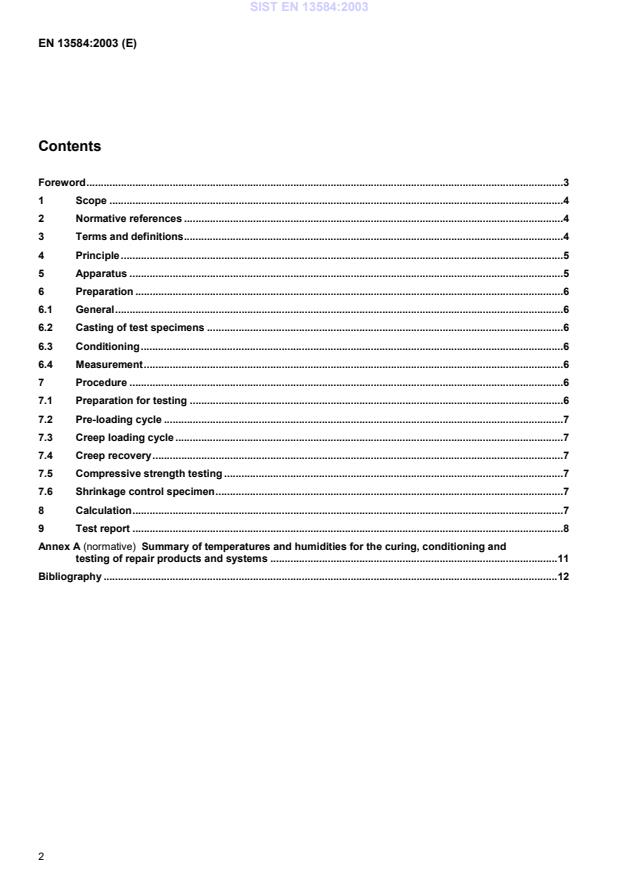
The document is organized into nine clauses:
- Scope
- Normative references
- Terms and definitions
- Principle
- Apparatus
- Preparation
- Procedure
- Calculation
- Test report
It also includes one normative annex.
| Annex | What it covers |
|---|---|
| Annex A | Summary of temperatures and humidities for curing, conditioning and testing of repair products and systems |
What are the key requirements of SIST EN 13584:2003?
Specimens, conditioning and curing
SIST EN 13584:2003 requires at least three prism specimens, conforming to EN 12390-1, for the test. The product components are kept at standard laboratory climate for at least 24 hours before mixing, mixed according to the manufacturer’s recommendations, and cured in accordance with Annex A. In practice, this means the test starts with controlled specimen preparation so the results can be compared between products and laboratories.
Annex A gives different curing paths for CC, PCC and PC products, plus standard laboratory climate conditioning and wet conditioning options. For a buyer or quality manager, that means the test result is tied to a defined climate history, not just the material itself.
Test rig, loading and measurement
The compressive creep rig must keep the creep load for at least 26 weeks and apply load at a controlled rate between 200 N/s and 1 000 N/s. The rig, platens, spacing blocks and strain gauges all have stiffness, flatness and calibration expectations, and the strain gauges must have a 100 mm gauge length and an error not exceeding 2 %. In practice, the apparatus requirements are there to prevent the equipment from contributing its own deformation to the measured creep.
The creep load P1 is defined as 25 % of the compressive strength of the product or system, measured in accordance with EN 12190. That gives a consistent loading level linked to the product strength.
Test procedure and duration
SIST EN 13584:2003 uses a pre-loading cycle to seat the specimen, then a creep loading phase, then a creep recovery phase after unloading. The loading phase includes readings hourly for the first six hours, then after 24 hours, then at regular intervals up to 26 weeks; recovery is then followed for 4 weeks. In practice, the method measures both how much the material creeps under sustained compression and how much strain it recovers when the load is removed.
A shrinkage control specimen is stored alongside the loaded specimens, and its strain is used to correct the measured creep strain. That matters because drying shrinkage can otherwise be mistaken for load-induced creep.
Calculations and reporting
The standard calculates creep strain by subtracting shrinkage strain from the measured strain of the loaded specimen. It also requires creep coefficients, creep recovery coefficients, compressive strength after the creep test, and the ratio of applied stress to final compressive strength. The test report must include the product identification, specimen dates, rig and strain system used, loading date, the creep and recovery coefficients, strength results, deviations and report signature.
What terms does SIST EN 13584:2003 define?
- Creep load (P1) - The applied load level, set at 25 % of the compressive strength measured in EN 12190.
- Compressive stress - Force per unit area based on the original cross section of the specimen.
- Compressive strain - The deformation under compressive stress, expressed relative to the original dimension.
- Elastic compressive strain - The strain measured immediately after loading up to the elastic limit.
- Shrinkage strain - The strain measured on the control specimen due to shrinkage rather than load.
- Creep strain - The time-dependent compressive strain above the elastic compressive strain under constant load.
- Creep coefficient - The ratio of creep strain to elastic compressive strain.
- Creep recovery coefficient - The ratio of creep recovery strain to elastic recovery strain.
Who uses SIST EN 13584:2003?
SIST EN 13584:2003 is used by testing laboratories, manufacturers and suppliers of concrete repair products, and organizations that specify or assess repair mortars, grouts and concretes. It is relevant to quality control, product characterization, conformity assessment and technical comparison of repair systems used in concrete structures.
Which standards are used with SIST EN 13584:2003?
The document cites these standards and parts:
- EN 196-1 - used for cement mortar mixing/testing reference equipment and procedures.
- EN 1504-1 - provides definitions used in the document.
- prEN 1504-3 - defines the repair products and systems covered by the scope.
- EN 12190 - used to determine the compressive strength from which P1 is derived.
- EN 12390-1 - used for specimen dimensions, moulds and related requirements.
- EN 12390-3 - used for the final compressive strength test after creep recovery.
- ISO 376 - mentioned for calibration of the load cell used in the rig.
What does the SIST EN 13584:2003 document contain?
SIST EN 13584:2003 contains the full laboratory method, from specimen casting and conditioning through long-duration loading and recovery, to calculation and reporting. It includes a typical strain-time curve in Figure 1 and a typical hydraulic compressive creep rig in Figure 2, which help explain the test setup and the interpretation of elastic, creep and recovery strain.
Annex A gives the curing, conditioning and testing climates for CC, PCC and PC products. The bibliography cites ISO 376 for force-proving instrument calibration.
Relations
- Effective Date
- 28-Jan-2026
- Effective Date
- 28-Jan-2026
- Effective Date
- 28-Jan-2026
- Effective Date
- 28-Jan-2026
- Refers
SIST EN 12390-3:2019 - Testing hardened concrete - Part 3: Compressive strength of test specimens - Effective Date
- 28-Jan-2026
- Effective Date
- 28-Jan-2026
Get Certified
Connect with accredited certification bodies for this standard

DIBt (Deutsches Institut für Bautechnik)
German Institute for Building Technology.
DIN CERTCO
DIN Group product certification.

Aboma Certification B.V.
Specialized in construction, metal, and transport sectors.
Sponsored listings
Frequently Asked Questions
SIST EN 13584:2003 is a standard published by the Slovenian Institute for Standardization (SIST). Its full title is "Products and systems for the protection and repair of concrete structures - Test methods - Determination of creep in compression for repair products". This standard covers: This European Standard specifies a method for measuring creep under compressive load in products and systems for the repair of concrete structures, as defined in prEN 1504-3.The method is suitable for repair mortars and concretes with polymer binders (PC) and repair grouts, mortars and concretes with hydraulic binders (CC) and polymer cement binders (PCC).
This European Standard specifies a method for measuring creep under compressive load in products and systems for the repair of concrete structures, as defined in prEN 1504-3.The method is suitable for repair mortars and concretes with polymer binders (PC) and repair grouts, mortars and concretes with hydraulic binders (CC) and polymer cement binders (PCC).
SIST EN 13584:2003 is classified under the following ICS (International Classification for Standards) categories: 91.080.40 - Concrete structures. The ICS classification helps identify the subject area and facilitates finding related standards.
SIST EN 13584:2003 has the following relationships with other standards: It is inter standard links to oSIST prEN 1504-3:2015, SIST EN 12390-1:2021, SIST EN 12190:2000, SIST EN 196-1:2016, SIST EN 12390-3:2019, SIST EN 1504-1:2005. Understanding these relationships helps ensure you are using the most current and applicable version of the standard.
SIST EN 13584:2003 is associated with the following European legislation: EU Directives/Regulations: 305/2011, 89/106/EEC. When a standard is cited in the Official Journal of the European Union, products manufactured in conformity with it benefit from a presumption of conformity with the essential requirements of the corresponding EU directive or regulation.
SIST EN 13584:2003 is available in PDF format for immediate download after purchase. The document can be added to your cart and obtained through the secure checkout process. Digital delivery ensures instant access to the complete standard document.
Standards Content (Sample)
2003-01.Slovenski inštitut za standardizacijo. Razmnoževanje celote ali delov tega standarda ni dovoljeno.RSUDYLORProdukte und Systeme für den Schutz und die Instandsetzung von Betontragwerken - Prüfverfahren - Bestimmung des Kriechens von Betonersatzsystemen im DruckversuchProduits et systemes pour la protection et la réparation des structures en béton - Méthodes d'essai - Détermination du fluage en compression des produits de réparationProducts and systems for the protection and repair of concrete structures - Test methods - Determination of creep in compression for repair products91.080.40Betonske konstrukcijeConcrete structuresICS:Ta slovenski standard je istoveten z:EN 13584:2003SIST EN 13584:2003en01-december-2003SIST EN 13584:2003SLOVENSKI
STANDARD
EUROPEAN STANDARDNORME EUROPÉENNEEUROPÄISCHE NORMEN 13584August 2003ICS 91.080.40English versionProducts and systems for the protection and repair of concretestructures - Test methods - Determination of creep incompression for repair productsProduits et systèmes pour la protection et la réparation desstructures en béton - Méthodes d'essai - Détermination dufluage en compression des produits de réparationProdukte und Systeme für den Schutz und dieInstandsetzung von Betontragwerken - Prüfverfahren -Bestimmung des Kriechens von Betonersatzsystemen imDruckversuchThis European Standard was approved by CEN on 12 June 2003.CEN members are bound to comply with the CEN/CENELEC Internal Regulations which stipulate the conditions for giving this EuropeanStandard the status of a national standard without any alteration. Up-to-date lists and bibliographical references concerning such nationalstandards may be obtained on application to the Management Centre or to any CEN member.This European Standard exists in three official versions (English, French, German). A version in any other language made by translationunder the responsibility of a CEN member into its own language and notified to the Management Centre has the same status as the officialversions.CEN members are the national standards bodies of Austria, Belgium, Czech Republic, Denmark, Finland, France, Germany, Greece,Hungary, Iceland, Ireland, Italy, Luxembourg, Malta, Netherlands, Norway, Portugal, Slovakia, Spain, Sweden, Switzerland and UnitedKingdom.EUROPEAN COMMITTEE FOR STANDARDIZATIONCOMITÉ EUROPÉEN DE NORMALISATIONEUROPÄISCHES KOMITEE FÜR NORMUNGManagement Centre: rue de Stassart, 36
B-1050 Brussels© 2003 CENAll rights of exploitation in any form and by any means reservedworldwide for CEN national Members.Ref. No. EN 13584:2003 ESIST EN 13584:2003
Summary of temperatures and humidities for the curing, conditioning andtesting of repair products and systems.11Bibliography.12SIST EN 13584:2003
...