

SIST EN 29241-2:2001
(Main)Ergonomic requirements for office work with visual display terminals (VDTs) - Part 2: Guidance on task requirements (ISO 9241-2:1992)
- Abstract
Guidance is relevant to both the organization implementing the system and the people using the equipment and should be applied in accordance with local, regional or national agreements and regulations. The objective is to enhance the efficiency and well-being of the individual user by applying ergonomics knowledge in the light of practical experience, to the design of tasks. The ergonomics principles concerned are set out in ISO 6385.
- Status
- Published
- Publication Date
- 31-May-2001
- Technical Committee
- VSN - Safety of machinery
- Current Stage
- 6060 - National Implementation/Publication (Adopted Project)
- Start Date
- 01-Jun-2001
- Due Date
- 01-Jun-2001
- Completion Date
- 01-Jun-2001

SIST EN 29241-2:2001 is a Slovenian standard published by SIST for ergonomic requirements in office work with visual display terminals (VDTs). It gives guidance on task requirements so that organizations and users can design work to improve individual efficiency and well-being. The guidance is intended to be applied alongside local, regional or national agreements and regulations, and it draws on the ergonomics principles of ISO 6385.
What does SIST EN 29241-2:2001 specify?
SIST EN 29241-2:2001 gives guidance on how to set up task requirements for office work with VDTs. It focuses on the design of work, not just the equipment, so that the task fits the user and the organization.
The standard is part 2 of the Ergonomic requirements for office work with VDTs series. In practice, that means it belongs to a broader family of guidance on office ergonomics, but this part is specifically about tasks.
The scope says the guidance is relevant both to the organization implementing the system and to the people using the equipment. It also says the guidance should be applied in line with local, regional or national agreements and regulations.
What are the key requirements of SIST EN 29241-2:2001?
SIST EN 29241-2:2001 is guidance-oriented, so its main message is how to think about VDT work rather than a list of technical test limits. The standard points decision-makers toward task design that supports both performance and user well-being.
The main points are:
Apply the guidance to both the organization and the user.
Task design is not only an IT or equipment issue. In practice, management, supervisors and users all need to consider how the work is structured.Use ergonomics knowledge together with practical experience.
The standard says task design should reflect ergonomics knowledge in the light of practical experience. That means organizations should combine theory with what actually works in day-to-day office work.Aim for both efficiency and well-being.
The objective is to improve the efficiency and well-being of the individual user. In practice, this means task arrangements should support productivity without creating avoidable strain.Base task design on ergonomics principles from ISO 6385.
The standard points to ISO 6385 for the underlying ergonomics principles. For users of the standard, this means task requirements should be read as part of a general ergonomics approach, not as isolated office rules.Apply the guidance within the legal and local framework.
The scope links the document to local, regional or national agreements and regulations. That matters because organizations need to align workplace design with the rules that govern their location.Treat VDT office work as a system of tasks, users and organization.
The standard is about office work with visual display terminals, so the task setup, work organization and user interaction all matter together. This helps buyers and managers evaluate whether a proposed system fits real office use.
What terms does SIST EN 29241-2:2001 define?
- Visual display terminals (VDTs) - display-based equipment used for office work, which is the workplace context covered by the standard.
- Ergonomics - the discipline of fitting work to people; here it guides how tasks should be designed for office users.
- Task requirements - the way the work is organized and demanded of the user, which is the main subject of this part.
- Efficiency - how effectively the work is carried out; the standard links this to task design.
- Well-being - the user’s comfort and overall condition at work; the standard says task design should support it.
- Agreements and regulations - the local, regional or national rules that shape how the guidance is applied.
- Organization - the employer or operating body responsible for implementing the system and arranging the work.
Who uses SIST EN 29241-2:2001?
SIST EN 29241-2:2001 is used by organizations that plan or operate office systems with VDTs, and by the people who use those systems. It is relevant where task design affects how office work is organized.
Typical users include ergonomists, occupational health and safety staff, HR and facility managers, quality managers, and buyers or specifiers of office equipment and work systems. It is also useful for managers who need to decide how office tasks should be structured for daily use.
The standard is relevant to office-based environments where people work at screens for extended periods and the task arrangement matters as much as the hardware.
Which standards are used with SIST EN 29241-2:2001?
- ISO 6385 - named in the scope as the source of the ergonomics principles used for this guidance.
- ISO 9241-2:1992 - the international designation named in the title; the Slovenian standard is presented as the corresponding part for task requirements in office work with VDTs.
What does the SIST EN 29241-2:2001 document contain?
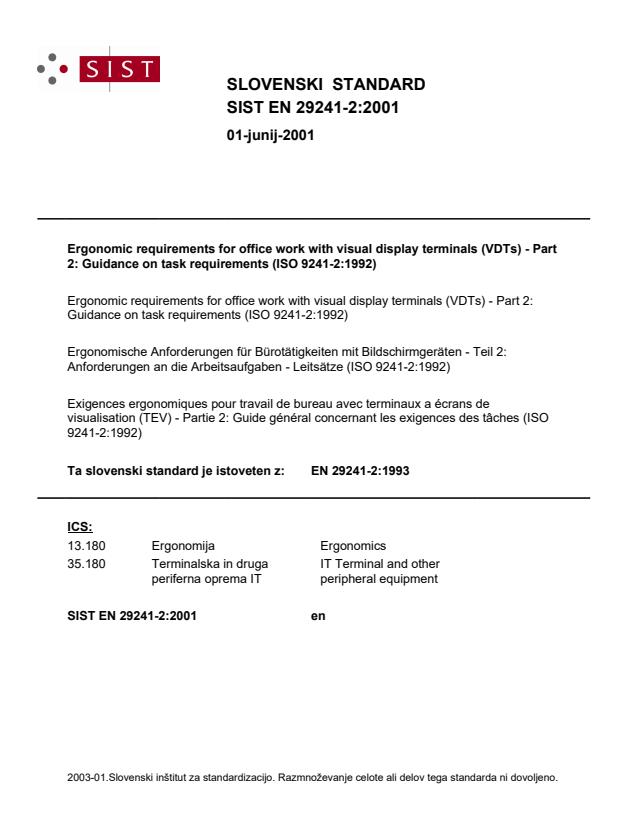
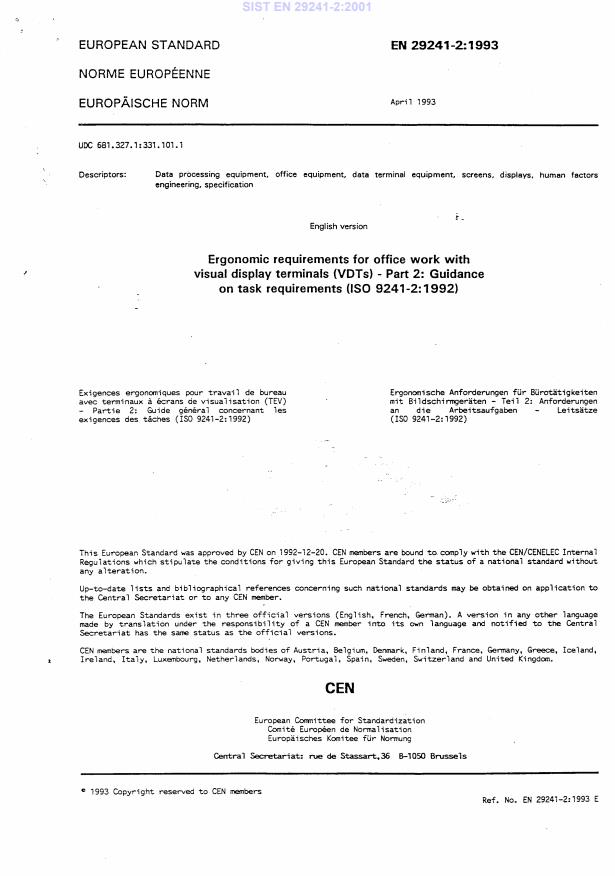
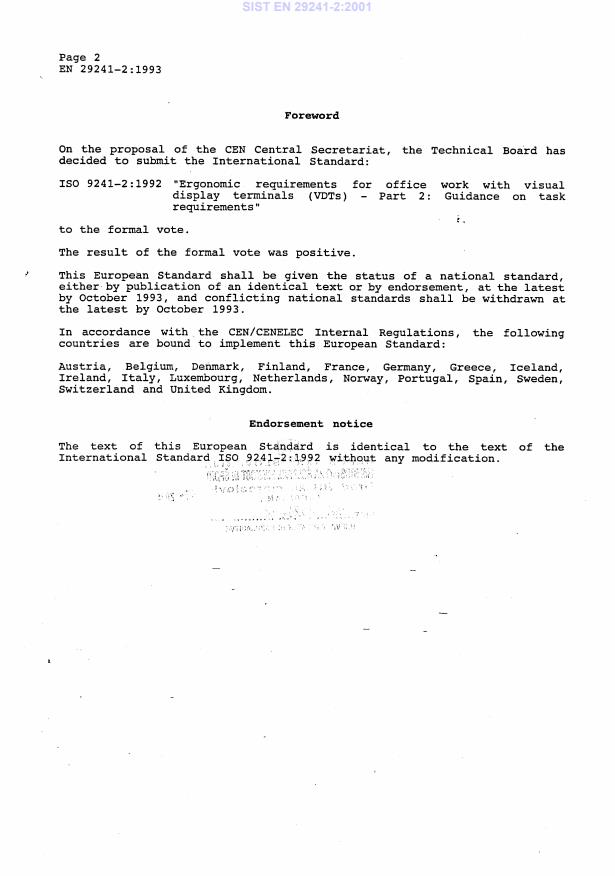
The published record identifies the standard in English, German and French and classifies it under ICS 35.180 and 13.180. It also states that the Slovenian standard is identical to EN 29241-2:1993.
For readers, the useful part is the scope statement on VDT office work, task requirements, and the link to ISO 6385. For cataloging and procurement, the front matter gives the standard reference, language versions and classification fields.
Relations
- Effective Date
- 28-Jan-2026
Get Certified
Connect with accredited certification bodies for this standard

BSI Group
BSI (British Standards Institution) is the business standards company that helps organizations make excellence a habit.

CIS Institut d.o.o.
Personal Protective Equipment (PPE) certification body. Notified Body NB-2890 for EU Regulation 2016/425 PPE.

Kiwa BDA Testing
Building and construction product certification.
Sponsored listings
Frequently Asked Questions
SIST EN 29241-2:2001 is a standard published by the Slovenian Institute for Standardization (SIST). Its full title is "Ergonomic requirements for office work with visual display terminals (VDTs) - Part 2: Guidance on task requirements (ISO 9241-2:1992)". This standard covers: Guidance is relevant to both the organization implementing the system and the people using the equipment and should be applied in accordance with local, regional or national agreements and regulations. The objective is to enhance the efficiency and well-being of the individual user by applying ergonomics knowledge in the light of practical experience, to the design of tasks. The ergonomics principles concerned are set out in ISO 6385.
Guidance is relevant to both the organization implementing the system and the people using the equipment and should be applied in accordance with local, regional or national agreements and regulations. The objective is to enhance the efficiency and well-being of the individual user by applying ergonomics knowledge in the light of practical experience, to the design of tasks. The ergonomics principles concerned are set out in ISO 6385.
SIST EN 29241-2:2001 is classified under the following ICS (International Classification for Standards) categories: 13.180 - Ergonomics; 35.180 - IT Terminal and other peripheral equipment. The ICS classification helps identify the subject area and facilitates finding related standards.
SIST EN 29241-2:2001 has the following relationships with other standards: It is inter standard links to SIST EN 13068-1:2000. Understanding these relationships helps ensure you are using the most current and applicable version of the standard.
SIST EN 29241-2:2001 is associated with the following European legislation: EU Directives/Regulations: 90/270/EEC. When a standard is cited in the Official Journal of the European Union, products manufactured in conformity with it benefit from a presumption of conformity with the essential requirements of the corresponding EU directive or regulation.
SIST EN 29241-2:2001 is available in PDF format for immediate download after purchase. The document can be added to your cart and obtained through the secure checkout process. Digital delivery ensures instant access to the complete standard document.
Standards Content (Sample)
2003-01.Slovenski inštitut za standardizacijo. Razmnoževanje celote ali delov tega standarda ni dovoljeno.Ergonomic requirements for office work with visual display terminals (VDTs) - Part 2: Guidance on task requirements (ISO 9241-2:1992)Ergonomische Anforderungen für Bürotätigkeiten mit Bildschirmgeräten - Teil 2: Anforderungen an die Arbeitsaufgaben - Leitsätze (ISO 9241-2:1992)Exigences ergonomiques pour travail de bureau avec terminaux a écrans de visualisation (TEV) - Partie 2: Guide général concernant les exigences des tâches (ISO 9241-2:1992)Ergonomic requirements for of
...