

oSIST prEN 12845-1:2026
(Main)Fixed firefighting systems - Automatic sprinkler systems - Part 1: Design, installation and maintenance
- Abstract
This European Standard specifies requirements and gives recommendations for the design, installation and maintenance of fixed fire sprinkler systems in buildings and industrial plants, and particular requirements for sprinkler systems that are integral to measures for the protection of life.
This European Standard covers only the types of sprinkler specified in EN 12259 1 (see Annex L).
The requirements and recommendations of this European Standard are also applicable to any addition, extension, repair or other modification to a sprinkler system. They are not applicable to water spray or deluge systems.
It covers the classification of hazards, provision of water supplies, components to be used, installation and testing of the system, maintenance, and the extension of existing systems, and identifies construction details of buildings which are the minimum necessary for satisfactory performance of sprinkler systems complying with this European Standard.
This European Standard does not cover water supplies to systems other than sprinklers. Its requirements can be used as guidance for other fixed firefighting extinguishing systems, provided that any specific requirements for other firefighting extinguishing supplies are taken into account.
This European Standard is intended for use by those concerned with purchasing, designing, installing, testing, inspecting, approving, operating and maintaining automatic sprinkler systems, in order that such equipment will function as intended throughout its life.
This European Standard is intended only for fixed fire sprinkler systems in buildings and other premises on land. Although the general principles might well apply to other uses (e.g. maritime use). For these other uses additional considerations should be taken into account.
The requirements are not valid for automatic sprinkler systems on ships, in aircraft, on vehicles and mobile fire appliances or for below ground systems in the mining industry.
Sprinkler system design deviations might be allowed when such deviations have been shown to provide a level of protection at least equivalent to this European Standard, for example by means of full-scale fire testing where appropriate, and where the design criteria have been fully documented.
- Status
- Not Published
- Public Enquiry End Date
- 30-Dec-2026
- Technical Committee
- POZ - Požarna varnost
- Current Stage
- 4020 - Public enquire (PE) (Adopted Project)
- Start Date
- 06-Nov-2026
- Due Date
- 26-Mar-2027

Relations
- Effective Date
- 04-Mar-2026
Get Certified
Connect with accredited certification bodies for this standard

CIS Institut d.o.o.
Personal Protective Equipment (PPE) certification body. Notified Body NB-2890 for EU Regulation 2016/425 PPE.

Kiwa BDA Testing
Building and construction product certification.
Kmetijski inštitut Slovenije
Agricultural Institute of Slovenia. Soil testing, plant health, agricultural product analysis.
Sponsored listings
Frequently Asked Questions
oSIST prEN 12845-1:2026 is a draft published by the Slovenian Institute for Standardization (SIST). Its full title is "Fixed firefighting systems - Automatic sprinkler systems - Part 1: Design, installation and maintenance". This standard covers: This European Standard specifies requirements and gives recommendations for the design, installation and maintenance of fixed fire sprinkler systems in buildings and industrial plants, and particular requirements for sprinkler systems that are integral to measures for the protection of life. This European Standard covers only the types of sprinkler specified in EN 12259 1 (see Annex L). The requirements and recommendations of this European Standard are also applicable to any addition, extension, repair or other modification to a sprinkler system. They are not applicable to water spray or deluge systems. It covers the classification of hazards, provision of water supplies, components to be used, installation and testing of the system, maintenance, and the extension of existing systems, and identifies construction details of buildings which are the minimum necessary for satisfactory performance of sprinkler systems complying with this European Standard. This European Standard does not cover water supplies to systems other than sprinklers. Its requirements can be used as guidance for other fixed firefighting extinguishing systems, provided that any specific requirements for other firefighting extinguishing supplies are taken into account. This European Standard is intended for use by those concerned with purchasing, designing, installing, testing, inspecting, approving, operating and maintaining automatic sprinkler systems, in order that such equipment will function as intended throughout its life. This European Standard is intended only for fixed fire sprinkler systems in buildings and other premises on land. Although the general principles might well apply to other uses (e.g. maritime use). For these other uses additional considerations should be taken into account. The requirements are not valid for automatic sprinkler systems on ships, in aircraft, on vehicles and mobile fire appliances or for below ground systems in the mining industry. Sprinkler system design deviations might be allowed when such deviations have been shown to provide a level of protection at least equivalent to this European Standard, for example by means of full-scale fire testing where appropriate, and where the design criteria have been fully documented.
This European Standard specifies requirements and gives recommendations for the design, installation and maintenance of fixed fire sprinkler systems in buildings and industrial plants, and particular requirements for sprinkler systems that are integral to measures for the protection of life. This European Standard covers only the types of sprinkler specified in EN 12259 1 (see Annex L). The requirements and recommendations of this European Standard are also applicable to any addition, extension, repair or other modification to a sprinkler system. They are not applicable to water spray or deluge systems. It covers the classification of hazards, provision of water supplies, components to be used, installation and testing of the system, maintenance, and the extension of existing systems, and identifies construction details of buildings which are the minimum necessary for satisfactory performance of sprinkler systems complying with this European Standard. This European Standard does not cover water supplies to systems other than sprinklers. Its requirements can be used as guidance for other fixed firefighting extinguishing systems, provided that any specific requirements for other firefighting extinguishing supplies are taken into account. This European Standard is intended for use by those concerned with purchasing, designing, installing, testing, inspecting, approving, operating and maintaining automatic sprinkler systems, in order that such equipment will function as intended throughout its life. This European Standard is intended only for fixed fire sprinkler systems in buildings and other premises on land. Although the general principles might well apply to other uses (e.g. maritime use). For these other uses additional considerations should be taken into account. The requirements are not valid for automatic sprinkler systems on ships, in aircraft, on vehicles and mobile fire appliances or for below ground systems in the mining industry. Sprinkler system design deviations might be allowed when such deviations have been shown to provide a level of protection at least equivalent to this European Standard, for example by means of full-scale fire testing where appropriate, and where the design criteria have been fully documented.
oSIST prEN 12845-1:2026 is classified under the following ICS (International Classification for Standards) categories: 13.220.10 - Fire-fighting; 13.220.20 - Fire protection. The ICS classification helps identify the subject area and facilitates finding related standards.
oSIST prEN 12845-1:2026 has the following relationships with other standards: It is inter standard links to SIST EN 12845:2015+A2:2026. Understanding these relationships helps ensure you are using the most current and applicable version of the standard.
oSIST prEN 12845-1:2026 is available in PDF format for immediate download after purchase. The document can be added to your cart and obtained through the secure checkout process. Digital delivery ensures instant access to the complete standard document.
Standards Content (Sample)
SLOVENSKI STANDARD
01-december-2026
Vgrajene naprave za gašenje - Avtomatski sprinklerski sistemi - 1. del:
Projektiranje, vgradnja in vzdrževanje
Fixed firefighting systems - Automatic sprinkler systems - Part 1: Design, installation and
maintenance
Ortsfeste Brandbekämpfungsanlagen - Automatische Sprinkleranlagen - Planung,
Installation und Instandhaltung
Installations fixes de lutte contre l‘incendie - Systèmes d’extinction automatique du type
sprinkleur - Conception, installation et maintenance
Ta slovenski standard je istoveten z: prEN 12845-1
ICS:
13.220.10 Gašenje požara Fire-fighting
13.220.20 Požarna zaščita Fire protection
2003-01.Slovenski inštitut za standardizacijo. Razmnoževanje celote ali delov tega standarda ni dovoljeno.
DRAFT
EUROPEAN STANDARD
prEN 12845
NORME EUROPÉENNE
EUROPÄISCHE NORM
October 2026
ICS Will supersede EN 12845:2015+A2:2026
English Version
Fixed firefighting systems - Automatic sprinkler systems -
Design, installation and maintenance
Installations fixes de lutte contre l'incendie - Systèmes Ortsfeste Brandbekämpfungsanlagen - Automatische
d'extinction automatique du type sprinkleur - Sprinkleranlagen - Planung, Installation und
Conception, installation et maintenance Instandhaltung
This draft European Standard is submitted to CEN members for enquiry. It has been drawn up by the Technical Committee
CEN/TC 191.
If this draft becomes a European Standard, CEN members are bound to comply with the CEN/CENELEC Internal Regulations
which stipulate the conditions for giving this European Standard the status of a national standard without any alteration.
This draft European Standard was established by CEN in three official versions (English, French, German). A version in any other
language made by translation under the responsibility of a CEN member into its own language and notified to the CEN-CENELEC
Management Centre has the same status as the official versions.
CEN members are the national standards bodies of Austria, Belgium, Bulgaria, Croatia, Cyprus, Czech Republic, Denmark, Estonia,
Finland, France, Germany, Greece, Hungary, Iceland, Ireland, Italy, Latvia, Lithuania, Luxembourg, Malta, Netherlands, Norway,
Poland, Portugal, Republic of North Macedonia, Romania, Serbia, Slovakia, Slovenia, Spain, Sweden, Switzerland, Türkiye and
United Kingdom.
Recipients of this draft are invited to submit, with their comments, notification of any relevant patent rights of which they are
aware and to provide supporting documentation.
Warning : This document is not a European Standard. It is distributed for review and comments. It is subject to change without
notice and shall not be referred to as a European Standard.
EUROPEAN COMMITTEE FOR STANDARDIZATION
COMITÉ EUROPÉEN DE NORMALISATION
EUROPÄISCHES KOMITEE FÜR NORMUNG
CEN-CENELEC Management Centre: Rue de la Science 23, B-1040 Brussels
© 2026 CEN All rights of exploitation in any form and by any means reserved Ref. No. prEN 12845:2026 E
worldwide for CEN national Members.
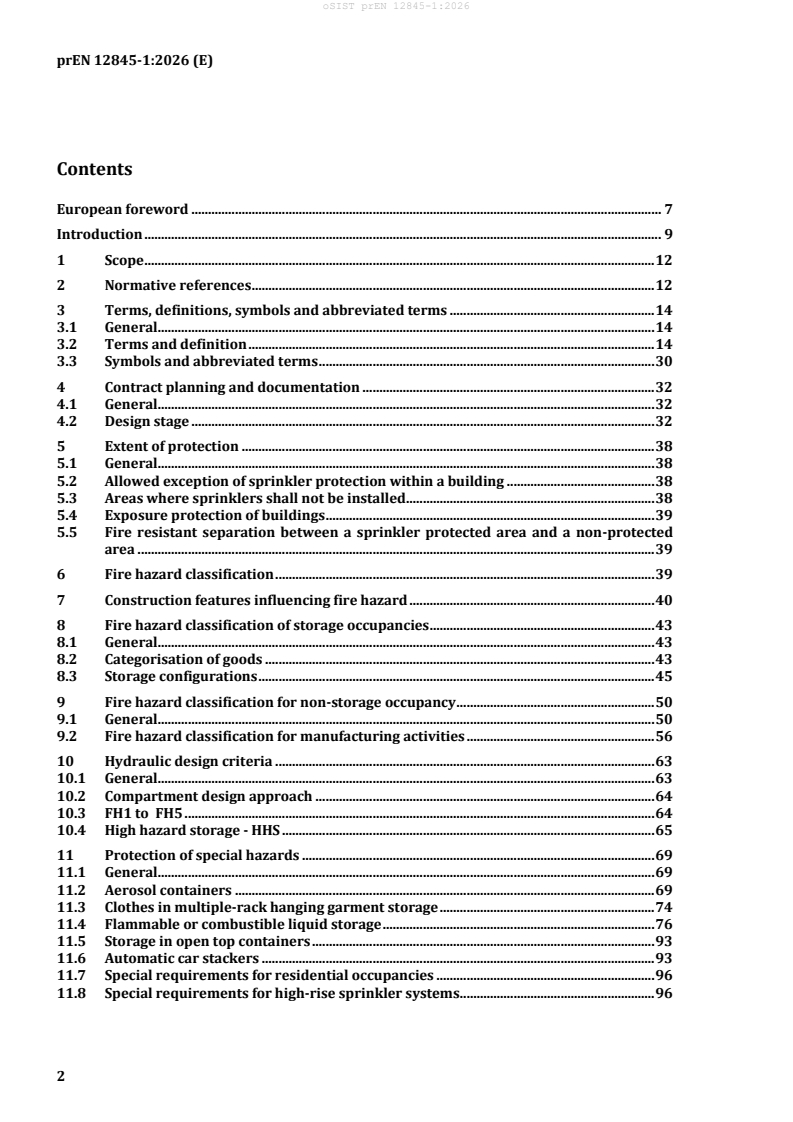
Contents
European foreword . 7
Introduction . 9
1 Scope . 12
2 Normative references . 12
3 Terms, definitions, symbols and abbreviated terms . 14
3.1 General. 14
3.2 Terms and definition . 14
3.3 Symbols and abbreviated terms . 30
4 Contract planning and documentation . 32
4.1 General. 32
4.2 Design stage . 32
5 Extent of protection . 38
5.1 General. 38
5.2 Allowed exception of sprinkler protection within a building . 38
5.3 Areas where sprinklers shall not be installed . 38
5.4 Exposure protection of buildings . 39
5.5 Fire resistant separation between a sprinkler protected area and a non-protected
area . 39
6 Fire hazard classification . 39
7 Construction features influencing fire hazard . 40
8 Fire hazard classification of storage occupancies . 43
8.1 General. 43
8.2 Categorisation of goods . 43
8.3 Storage configurations . 45
9 Fire hazard classification for non-storage occupancy . 50
9.1 General. 50
9.2 Fire hazard classification for manufacturing activities . 56
10 Hydraulic design criteria . 63
10.1 General. 63
10.2 Compartment design approach . 64
10.3 FH1 to FH5 . 64
10.4 High hazard storage - HHS . 65
11 Protection of special hazards . 69
11.1 General. 69
11.2 Aerosol containers . 69
11.3 Clothes in multiple-rack hanging garment storage . 74
11.4 Flammable or combustible liquid storage . 76
11.5 Storage in open top containers . 93
11.6 Automatic car stackers . 93
11.7 Special requirements for residential occupancies . 96
11.8 Special requirements for high-rise sprinkler systems . 96
11.9 Picking racks special protection concept for racks with solid shelves and walkways
for STC7 . 97
11.10 Distilled spirits in wooden barrels . 121
11.11 Top loading – automatic storage and retrieval system . 133
12 Pipe sizing, layout and hydraulic calculations . 134
12.1 Pipe sizing . 134
12.2 Calculation of pressure losses in pipework . 135
12.3 Fully calculated systems . 138
13 Sprinkler system components . 141
14 Installation type and size . 142
14.1 Wet pipe installation . 142
14.2 Dry installations . 149
14.3 Pre-action installations . 151
15 Spacing and location of sprinklers . 155
15.1 General . 155
15.2 Vertical clearance below sprinklers . 155
15.3 Installation of sprinklers . 156
15.4 Maximum area of coverage per sprinkler . 158
15.5 Minimum distance between sprinklers . 168
15.6 Location of sprinklers in relation to building construction . 168
15.7 In-rack sprinklers . 179
16 Sprinkler design characteristics and uses . 183
16.1 General . 183
16.2 Sprinkler types and application . 183
16.3 Flow from sprinklers . 185
16.4 Sprinkler nominal operating temperature . 185
16.5 Sprinkler thermal sensitivity . 186
16.6 Sprinkler guards . 188
16.7 Sprinkler water shields . 188
16.8 Sprinkler rosettes . 189
16.9 Corrosion protection of sprinklers . 189
17 Valves . 189
17.1 Alarm valve set . 189
17.2 Stop valves . 189
17.3 Ring main stop valves . 190
17.4 Drain valves . 190
17.5 Test valves . 191
17.6 Pressure gauges . 192
18 Pipework and pipe supports . 193
18.1 Underground piping . 193
18.2 Above ground piping . 193
18.3 Pipe supports . 201
18.4 Pipework in concealed spaces . 205
19 System monitoring, alarms and fault conditions . 206
19.1 General . 206
19.2 Electrical monitoring device and equipment . 206
19.3 Transmission of alarms and fault signals to remote locations . 206
19.4 Water flow alarms . 206
19.5 Electrical water flow alarm and pressure switches . 207
20 System alarm and fault conditions . 207
20.1 Alarm conditions . 207
20.2 Fault conditions . 208
21 Signs and notices . 209
21.1 General. 209
21.2 On site documentation, signs, and notices . 209
22 Water supplies . 211
22.1 General. 211
22.2 Required pressure, flow and water volume . 211
22.3 Maximum water pressure . 212
22.4 Connections for other services . 213
22.5 Housing of water supply equipment . 214
22.6 Test pressure and flow test devices and facility devices . 216
22.7 Optional fire brigade inlet connection . 217
23 Type of water supply . 218
23.1 General. 218
23.2 Town or service mains . 219
23.3 Water storage tanks . 219
23.4 Inexhaustible sources, settling and suction chambers . 223
23.5 Pressure tanks . 226
23.6 Types of water supply . 227
23.7 Isolation of water supply. 231
24 Pumps and pump sets . 231
24.1 General. 231
24.2 Multiple pump arrangements . 231
24.3 Maximum temperature of water supply . 232
24.4 Valves and accessories . 232
24.5 Pressure gauges in the pump room . 233
24.6 Pump set (s) . 233
24.7 Ensuring pump set performance . 237
24.8 Design for the electrical supply of electrical pump sets . 238
24.9 Diesel engine driven pump sets . 242
24.10 Site commissioning test . 242
24.11 Mechanical installation requirements for submersible pumps . 243
25 Commissioning and first inspection . 243
25.1 Pre-commissioning requirements . 243
25.2 Preparation for the commissioning . 244
25.3 Performing the commissioning . 244
25.4 Completion documents . 246
25.5 First inspection . 246
26 Maintenance and periodic inspection . 246
26.1 Periodic system inspection . 246
26.2 User control program . 247
26.3 Frequency of maintenance . 248
26.4 System impairment . 262
Annex A (normative) Overview of HHS category by goods/products . 263
Annex B (normative) Model maintenance report . 278
B.1 General. 278
B.2 General requirements of the model maintenance report . 278
B.3 Details of model maintenance report. 279
Annex C (informative) Hydraulic calculation according to the Darcy-Weisbach method . 291
C.1 General . 291
C.2 Calculation . 291
Annex D (normative) Pre-calculated systems – FH1 and FH2 . 293
D.1 General . 293
D.2 Risk evaluation . 293
D.3 Design of protection . 293
D.4 Installation . 296
D.5 Water supplies . 304
D.6 Special requirements for pre-calculated high-rise systems . 308
Annex E (normative) Precautions and procedures when a system is not fully operational
................................................................................................................................................................ 310
E.1 Minimizing the effects . 310
E.2 Planned shutdown . 310
E.3 Unplanned shutdown . 311
E.4 Action following sprinkler operation . 311
Annex F (normative) Additional measures to improve system reliability and availability
................................................................................................................................................................ 312
F.1 Applicability . 312
F.2 Subdivision into zones . 312
F.3 Type of acceptable installations . 312
F.4 Control valve set . 312
F.5 Water supplies . 312
F.6 Additional precautions for maintenance . 312
Annex G (normative) Testing of components from existing sprinkler installations. 313
G.1 General . 313
G.2 Visual inspection . 313
G.3 Test of nominal operating temperature . 314
G.4 Functional test and test of water flow (k-factor) . 316
G.5 ESFR sprinkler . 317
Annex H (normative) Measurement of wall thickness with ultrasound and endoscopy . 319
H.1 General . 319
H.2 Inspecting the wall thicknesses . 319
H.3 Assessing the wall thickness . 320
Annex I (normative) Modification of existing systems. 323
Bibliography . 324
European foreword
This document (prEN 12845-1:2026) has been prepared by Technical Committee CEN/TC 191 “Fixed
firefighting systems”, the secretariat of which is held by BSI.
This document is currently submitted to the CEN Enquiry.
This document will supersede EN 12845:2015+A1:2019+A2:2026.
This document is included in a series of European standards:
— CEN/TS 14816, Fixed firefighting systems - Water spray systems - Design, installation and maintenance;
— EN 671 (all parts), Fixed firefighting systems - Hose systems;
— EN 12094 (all parts), Fixed firefighting systems - Components for gas extinguishing systems;
— EN 12101 (all parts), Smoke and heat control systems;
— EN 12259 (all parts), Fixed firefighting systems - Components for sprinkler and water spray systems;
— EN 12416 (all parts), Fixed firefighting systems - Powder systems;
— EN 13565 (all parts), Fixed firefighting systems - Foam systems;
— EN 14972 (all parts), Fixed firefighting systems - Water mist systems;
— EN 12845-2, Fixed firefighting systems - Automatic sprinkler systems - Part 2: Design and installation
of ESFR and CMSA sprinkler systems;
— EN 12845-3, Fixed firefighting systems — Automatic sprinkler systems — Part 3: Guidance for
earthquake bracing.
The built environment continuously evolves. So do the fire protection challenges faced. This edition of
EN 12845 is a substantial revision. The objectives of the revision were to:
— provide the European market and users of EN 12845 with more up to date technologies; and
— preserve the excellent levels of performance (availability, reliability, and maintainability) of
automatic fire sprinkler systems.
The expert group responsible for drafting EN 12845 draw their expertise and knowledge from global fire
protection practices. Research and emerging best practice from around the world have been utilised in
this update.
The bibliography of this document identifies some of the sources of knowledge and research drawn upon
in the preparation of this document, and other sources of useful information in the sector. This list is not
intended to be exhaustive.
EN 12845-1:2025 includes the following significant technical changes with respect to
EN 12845:2015:
— the sequence of clauses has been revised to reflect the flow of work in the design and installation of a
sprinkler system;
— a new approach to hazard classification has been introduced to reduce the number of classifications,
give more guidance for common hazards and to assist designers to determine the correct hazard
classification and more closely align with other recognized standards;
— there are subdivisions of hazard classification to accommodate variables such as ceiling height;
— new names have been introduced for the hazard classifications along with new storage
configurations;
— additional design options have been added for many hazard classifications to offer more flexibility
and to introduce new technology;
— the design criteria for storage protection have been updated;
— new design criteria for sprinkler systems under high ceilings have been added;
— new design criteria to take account of the effect of combustible construction on sprinkler system
performance have been added;
— some previous annexes have been incorporated in the body of the standard;
— ESFR and CMSA solutions were separated into EN 12845-2;
— pre-calculated systems were consolidated into an annex;
— furthermore, considering the changes in fire risk profiles introduced by the extensive use of plastics
in many industrial manufacturing processes, in the building construction components as well as in
the packaging of goods, this revision has introduced special considerations to reflect these challenges
in the sprinkler protection design.
Introduction
This document covers the classification of hazards, provision of the water supply, components to be used,
installation and testing of the system, maintenance, and the extension of existing systems, and identifies
construction details of buildings which are the minimum necessary for satisfactory performance of
automatic sprinkler systems.
This document does not cover legislative requirements. In certain countries specific national regulations
apply and take precedence over this document. Users of this document are advised to inform themselves
of the applicability or non-applicability for this document by their national responsible authorities.
CMDA design approaches are covered in this document, while design approaches for ESFR and CMSA
designs are in EN 12845-2, which is to be used in conjunction with EN 12845-1. EN 12845-3 gives
guidance for earthquake bracing, where applicable.
Sprinkler systems according to this document provide protection of life and property, and mitigate
business interruption.
An automatic sprinkler system is designed to detect a fire and extinguish it with water in its early stages
or hold the fire in check so that extinguishment can be completed by other means. An automatic sprinkler
system consists of a water supply and one or more sprinkler installations; each installation consists of a
set of installation main alarm valves and a pipe array fitted with sprinklers. The sprinklers are fitted at
specified locations at the ceiling, and where necessary between racks, below shelves and inside casing or
equipment e.g. ovens or stoves. The main elements of a typical installation are shown in Figure 1.
Key
1 trunk main (see 3.2.123) 5 drop (see 3.2.33)
2 alarm valve set (see 3.2.28) 6 arm pipe (see 3.2.18)
3 riser (see 3.2.80) 7 range pipe (see 3.2.79)
4 distribution pipe (see 3.2.31) 8 sprinkler (see 3.2.81)
Figure 1 — Main elements of a sprinkler installation
The sprinklers operate at predetermined temperatures to discharge water over the affected part of the
area below. The flow of water through the alarm valve initiates a fire alarm. The sprinkler operating
temperature is generally selected to suit ambient temperature conditions.
Only sprinklers in the vicinity of the fire, i.e. those which become sufficiently heated, operate. The
sprinkler system is intended to extend throughout the premises with only limited exceptions.
In some applications additional measures to improve automatic sprinkler system reliability and
availability may be specified, such as where the automatic sprinkler system is part of the measures
designed to maintain safe conditions during evacuation.
It should not be assumed that the provision of an automatic sprinkler system eliminates the need for
other means of fighting fires and it is important to consider the fire precautions in the premises as a
whole.
Structural fire resistance, escape routes, fire detection and fire alarm systems, particular hazards needing
other fire protection methods, provision of hose reels and fire hydrants and portable fire extinguishers,
etc., safe working and goods handling methods, management supervision and good housekeeping all need
consideration.
Automatic sprinkler systems should be properly maintained to ensure they operate when required. This
routine is liable to be overlooked or given insufficient attention by supervisors. It is, however, neglected
at peril to the lives of occupants of the premises and at the risk of crippling financial loss. The importance
of proper maintenance cannot be too highly emphasised.
This document is intended for use by those concerned with specifying, purchasing, designing, installing,
testing, inspecting, approving, operating and maintaining automatic sprinkler systems, in order that such
a system will function as intended throughout its life.
It is a basic assumption that this standard is for the use of companies employing personnel competent in
the field of application with which it deals. Only trained and experienced personnel should undertake the
design, installation and maintenance of sprinkler systems (see 3.2.146). Similarly, competent technicians
should be used in the installation and testing of the equipment.
CMDA (control mode density area) sprinkler protection to this standard typically utilises sprinklers in
accordance with EN 12259-1 operating in control mode, i.e. which have the capability of controlling
(limiting the heat release rate) fires in residential, commercial, industrial or storage applications. CMDA
sprinkler protection tends to be used to good effect in a wide variety of built environment scenarios.
Designs are typically specified in terms of a minimum application rate of water “density” (mm/min) to
be applied over a specified area of operation “area”. ESFR (early suppression fast response) sprinkler
protection in accordance with EN 12845-2 utilises sprinklers in accordance with EN 12259-13 operating
in suppression mode, i.e. which have the capability of markedly suppressing (reducing the heat release
rate of) fires typically within storage risks. ESFR sprinkler protection tends to be used in high hazard
storage scenarios to provide effective ceiling-only sprinkler protection (although ESFR protection
schemes utilising in-rack sprinklers do also exist). Designs are typically specified in terms of numbers of
sprinklers operating and required sprinkler pressures.
CMSA (Control Mode Specific Application) sprinkler protection in accordance with EN 12845-2 utilises
sprinklers operating in control mode, i.e. which have the capability of controlling (limiting the heat
release rate) fires within storage risks. CMSA sprinkler protection tends to be used in a variety of
especially challenging high hazard storage scenarios, where alternative approaches are not considered
suitable. Designs are typically specified in terms of numbers of sprinklers operating and required
sprinkler pressures.
1 Scope
This document specifies requirements for the design, installation and maintenance of new automatic
sprinkler systems as well as any addition, extension or other modification of existing automatic sprinkler
systems.
NOTE For ESFR and CMSA solutions, some design and installation requirements are specified in EN 12845-2.
2 Normative references
The following documents are referenced in the text in such a way that some or all of their content
constitutes requirements of this document. For dated references, only the edition cited applies. For
undated references, the latest edition of the referenced document (including any amendments) applies.
CEN/TS 54-14, Guidelines for planning, design, installation, commissioning, use and maintenance
CEN/TS 14816:2008, Fixed firefighting systems — Water spray systems — Design, installation and
maintenance
EAD 330232-00-0601, Mechanical fasteners for use in concrete
EN 54-2, Fire detection and fire alarm systems — Part 2: Control and indicating equipment
EN 54-4, Fire detection and fire alarm systems — Part 4: Power supply equipment
EN 54-21, Fire detection and fire alarm systems — Part 21: Alarm transmission and fault warning routing
equipment
EN 837-1:1998, Pressure gauges — Part 1: Bourdon tube pressure gauges — Dimensions, metrology,
requirements and testing
EN 837-2, Pressure gauges — Part 2: Selection and installation recommendations for pressure gauges
EN 1057, Copper and copper alloys — Seamless, round copper tubes for water and gas in sanitary and
heating applications
EN 1092 (all parts), Flanges and their joints — Circular flanges for pipes, valves, fittings and accessories,
PN designated
EN 1254-1, Copper and copper alloys - Plumbing fittings - Part 1: Capillary fittings for soldering or brazing
to copper tubes
EN 1254-5, Copper and copper alloys - Plumbing fittings - Part 5: Capillary fittings with short ends for
brazing to copper tubes
EN 1568 (all parts), Fire extinguishing media — Foam concentrates
EN 10216-1, Seamless steel tubes for pressure purposes — Technical delivery conditions — Part 1: Non-
alloy steel tubes with specified room temperature properties
EN 10216-2, Seamless steel tubes for pressure purposes - Technical delivery conditions - Part 2: Non-alloy
and alloy steel tubes with specified elevated temperature properties
EN 10217-1, Welded steel tubes for pressure purposes — Technical delivery conditions — Part 1: Electric
welded and submerged arc welded non-alloy steel tubes with specified room temperature properties
EN 10217-2, Welded steel tubes for pressure purposes - Technical delivery conditions - Part 2: Electric
welded non-alloy and alloy steel tubes with specified elevated temperature properties
EN 10255, Non-alloy steel tubes suitable for welding and threading — Technical delivery conditions
EN 10312, Welded stainless steel tubes for the conveyance of aqueous liquids including water for human
consumption — Technical delivery conditions
EN 12259-1:1999, Fixed firefighting systems — Components for sprinkler and water spray systems —
Part 1: Sprinklers
EN 12259-2, Fixed firefighting systems — Components for sprinkler and water spray systems — Part 2: Wet
alarm valve assemblies
EN 12259-3, Fixed firefighting systems — Components for sprinkler and water spray systems — Part 3: Dry
alarm valve assemblies
EN 12259-4, Fixed firefighting systems — Components for sprinkler and water spray systems — Part 4:
Water motor alarms
EN 12259-5, Fixed firefighting systems — Components for sprinkler and water spray systems — Part 5:
Water flow detectors
EN 12259-12, Fixed firefighting systems — Components for sprinkler and water spray systems — Part 12:
Pumps
EN 12259-13, Fixed firefighting systems — Components for sprinkler and water spray systems — Part 13:
ESFR sprinklers
EN 12259-14, Fixed firefighting systems — Components for sprinkler and water spray systems — Part 14:
Sprinklers for residential applications
EN 12845-2, Fixed firefighting systems — Automatic sprinkler systems — Part 2: Design and installation of
ESFR and CMSA sprinkler systems
EN 13501–1, Fire classification of construction products and building elements — Part 1: Classification
using data from reaction to fire tests
EN 13501–2, Fire classification of construction products and building elements — Part 2: Classification
using data from fire resistance tests, excluding ventilation services
EN 13501–3, Fire classification of construction products and building elements — Part 3: Classification
using data from fire resistance tests on products and elements used in building service installations: fire
resisting ducts and fire dampers
EN 17451, Fixed firefighting systems — Automatic sprinkler systems — Design, assembly, installation and
commissioning of pump sets
EN 60332-1-2:2004/A12:2020, Tests on electric and optical fibre cables under fire conditions - Part 1-2:
Test for vertical flame propagation for a single insulated wire or cable - Procedure for 1 kW pre-mixed flame
EN 60332-2-2:2004, Tests on electric and optical fibre cables under fire conditions - Part 2-2: Test for
vertical flame propagation for a single small insulated wire or cable - Procedure for diffusion flame
Impacted by EN 12259-1:1999/A1:2001, EN 12259-1:1999/A2:2004 and EN 12259-1:1999/A3:2006
Impacted by EN 13501-3:2005+A1:2009
EN
...