

SIST EN 13877-2:2024
(Main)Concrete pavements - Part 2: Functional requirements for concrete pavements
General Information
- Abstract
This document specifies requirements for concrete pavements cast in situ. Concrete compacted by rollers is not covered by this document.
This document covers concrete pavements for roads and other traffic-bearing structures.
- Status
- Published
- Public Enquiry End Date
- 30-Mar-2022
- Publication Date
- 10-Jan-2024
- Technical Committee
- CES - Roads
- Current Stage
- 6060 - National Implementation/Publication (Adopted Project)
- Start Date
- 07-Dec-2023
- Due Date
- 11-Feb-2024
- Completion Date
- 11-Jan-2024

Overview
EN 13877-2:2023 - Concrete pavements - Part 2: Functional requirements for concrete pavements (CEN) specifies functional and acceptance requirements for cast in situ concrete pavements used on roads and other traffic-bearing structures. It does not cover concrete compacted by rollers. The standard updates and supersedes EN 13877-2:2013 and is intended to ensure pavement durability, safety and performance through defined testing and classification criteria.
Key topics and requirements
- Scope: Applies to in-situ concrete pavements for road and traffic-bearing structures; roller-compacted concrete is excluded.
- Strength evaluation: Multiple acceptable assessment methods:
- From cores drilled through the full pavement depth (compressive and tensile splitting strength).
- Alternative procedures such as specimens stored adjacent to the pavement.
- Maturity concept using temperature sensors.
- Strength classes: Predefined compressive (CC8–CC100) and tensile/tensile-splitting classes (SC1.3–SC6.0). Default core conditions include L/D = 1, minimum age for coring = 7 days, minimum testing age = 56 days.
- Core corrections: Correction factors for differing core length/diameter ratios are provided to enable comparison of strengths.
- Thickness measurement: Methods include core-based and non‑destructive techniques (see referenced test methods).
- Durability and performance:
- Freeze–thaw resistance and resistance to wear from studded tyres.
- Bond strength between concrete layers.
- Resistance to fuel and oil penetration (with specific provisions for high‑risk exposures in normative annex).
- Joints and reinforcement: Requirements for dowels and tie bars (specification updates compared to previous edition).
- Quality control categories: Defined levels for sampling and testing frequency during construction.
Practical applications and users
EN 13877-2:2023 is used to:
- Define contractual performance criteria for in-situ concrete pavements.
- Establish acceptance testing regimes and on-site quality control.
- Provide laboratory and field test guidance for pavement engineers and materials laboratories.
- Inform design decisions on slab thickness, jointing, dowel/tie-bar specification and durability measures. Typical users:
- Highway authorities and road owners
- Pavement and geotechnical engineers
- Contractors and site testing teams
- Materials and testing laboratories
- Consultants preparing specifications and compliance documentation
Related standards
- EN 13877-1:2023 (Concrete pavements - Part 1: Materials)
- EN 13877-3 (Specifications for dowels)
- EN 206 (Concrete - Specification, performance)
- Relevant test standards cited (EN 12390 series, EN 12504-1, EN 13863 series)
Keywords: EN 13877-2:2023, concrete pavements, functional requirements, cast in situ, core compressive strength, tensile splitting strength, pavement durability, CEN.
Relations
- Replaces
SIST EN 13877-2:2013 - Concrete pavements - Part 2: Functional requirements for concrete pavements - Effective Date
- 01-Feb-2024
- Effective Date
- 28-Jan-2026
- Effective Date
- 28-Jan-2026
- Effective Date
- 28-Jan-2026
- Effective Date
- 28-Jan-2026
- Effective Date
- 28-Jan-2026
- Effective Date
- 28-Jan-2026
- Refers
SIST EN 12390-3:2019 - Testing hardened concrete - Part 3: Compressive strength of test specimens - Effective Date
- 28-Jan-2026
- Effective Date
- 28-Jan-2026
- Effective Date
- 28-Jan-2026
- Effective Date
- 28-Jan-2026
- Effective Date
- 28-Jan-2026
- Referred By
SIST EN 16432-3:2022 - Railway applications - Ballastless track systems - Part 3: Acceptance - Effective Date
- 28-Jan-2026
Get Certified
Connect with accredited certification bodies for this standard

DIBt (Deutsches Institut für Bautechnik)
German Institute for Building Technology.
DIN CERTCO
DIN Group product certification.
Zavod za gradbeništvo Slovenije (ZAG) - Inšpekcija
ZAG inspection body for construction products, structures, and materials.
Sponsored listings
Frequently Asked Questions
SIST EN 13877-2:2024 is a standard published by the Slovenian Institute for Standardization (SIST). Its full title is "Concrete pavements - Part 2: Functional requirements for concrete pavements". This standard covers: This document specifies requirements for concrete pavements cast in situ. Concrete compacted by rollers is not covered by this document. This document covers concrete pavements for roads and other traffic-bearing structures.
This document specifies requirements for concrete pavements cast in situ. Concrete compacted by rollers is not covered by this document. This document covers concrete pavements for roads and other traffic-bearing structures.
SIST EN 13877-2:2024 is classified under the following ICS (International Classification for Standards) categories: 91.100.30 - Concrete and concrete products; 93.080.20 - Road construction materials. The ICS classification helps identify the subject area and facilitates finding related standards.
SIST EN 13877-2:2024 has the following relationships with other standards: It is inter standard links to SIST EN 13877-2:2013, SIST EN 12390-8:2019, SIST EN 12390-2:2019, SIST-TS CEN/TS 12390-9:2017, SIST EN 12504-1:2019, SIST EN 13863-6:2024, SIST EN 13877-1:2024, SIST EN 12390-3:2019, SIST EN 13863-4:2012, SIST EN 13863-3:2005, SIST EN 13877-3:2005, SIST EN 13863-2:2004, SIST EN 16432-3:2022. Understanding these relationships helps ensure you are using the most current and applicable version of the standard.
SIST EN 13877-2:2024 is available in PDF format for immediate download after purchase. The document can be added to your cart and obtained through the secure checkout process. Digital delivery ensures instant access to the complete standard document.
Standards Content (Sample)
SLOVENSKI STANDARD
01-februar-2024
Nadomešča:
SIST EN 13877-2:2013
Betonska vozišča - 2. del: Funkcionalne zahteve za betonska vozišča
Concrete pavements - Part 2: Functional requirements for concrete pavements
Fahrbahnbefestigungen aus Beton - Teil 2: Funktionale Anforderungen an
Fahrbahnbefestigungen aus Beton
Chaussées en béton - Partie 2 : Exigences fonctionnelles pour les chaussées en béton
Ta slovenski standard je istoveten z: EN 13877-2:2023
ICS:
91.100.30 Beton in betonski izdelki Concrete and concrete
products
93.080.20 Materiali za gradnjo cest Road construction materials
2003-01.Slovenski inštitut za standardizacijo. Razmnoževanje celote ali delov tega standarda ni dovoljeno.
EN 13877-2
EUROPEAN STANDARD
NORME EUROPÉENNE
November 2023
EUROPÄISCHE NORM
ICS 93.080.20 Supersedes EN 13877-2:2013
English Version
Concrete pavements - Part 2: Functional requirements for
concrete pavements
Chaussées en béton - Partie 2 : Exigences Fahrbahnbefestigungen aus Beton - Teil 2: Funktionale
fonctionnelles pour les chaussées en béton Anforderungen an Fahrbahnbefestigungen aus Beton
This European Standard was approved by CEN on 25 September 2023.
CEN members are bound to comply with the CEN/CENELEC Internal Regulations which stipulate the conditions for giving this
European Standard the status of a national standard without any alteration. Up-to-date lists and bibliographical references
concerning such national standards may be obtained on application to the CEN-CENELEC Management Centre or to any CEN
member.
This European Standard exists in three official versions (English, French, German). A version in any other language made by
translation under the responsibility of a CEN member into its own language and notified to the CEN-CENELEC Management
Centre has the same status as the official versions.
CEN members are the national standards bodies of Austria, Belgium, Bulgaria, Croatia, Cyprus, Czech Republic, Denmark, Estonia,
Finland, France, Germany, Greece, Hungary, Iceland, Ireland, Italy, Latvia, Lithuania, Luxembourg, Malta, Netherlands, Norway,
Poland, Portugal, Republic of North Macedonia, Romania, Serbia, Slovakia, Slovenia, Spain, Sweden, Switzerland, Türkiye and
United Kingdom.
EUROPEAN COMMITTEE FOR STANDARDIZATION
COMITÉ EUROPÉEN DE NORMALISATION
EUROPÄISCHES KOMITEE FÜR NORMUNG
CEN-CENELEC Management Centre: Rue de la Science 23, B-1040 Brussels
© 2023 CEN All rights of exploitation in any form and by any means reserved Ref. No. EN 13877-2:2023 E
worldwide for CEN national Members.
Contents Page
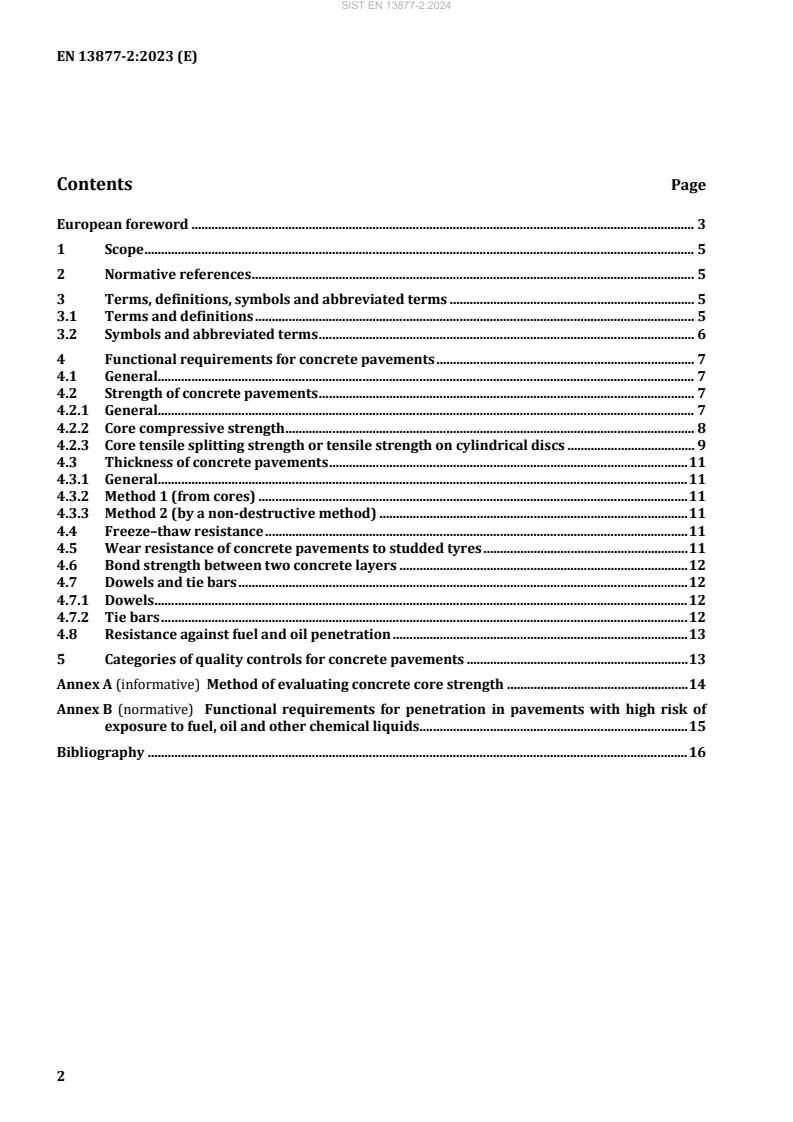
European foreword . 3
1 Scope . 5
2 Normative references . 5
3 Terms, definitions, symbols and abbreviated terms . 5
3.1 Terms and definitions . 5
3.2 Symbols and abbreviated terms . 6
4 Functional requirements for concrete pavements . 7
4.1 General. 7
4.2 Strength of concrete pavements . 7
4.2.1 General. 7
4.2.2 Core compressive strength . 8
4.2.3 Core tensile splitting strength or tensile strength on cylindrical discs . 9
4.3 Thickness of concrete pavements . 11
4.3.1 General. 11
4.3.2 Method 1 (from cores) . 11
4.3.3 Method 2 (by a non-destructive method) . 11
4.4 Freeze–thaw resistance . 11
4.5 Wear resistance of concrete pavements to studded tyres . 11
4.6 Bond strength between two concrete layers . 12
4.7 Dowels and tie bars . 12
4.7.1 Dowels . 12
4.7.2 Tie bars . 12
4.8 Resistance against fuel and oil penetration . 13
5 Categories of quality controls for concrete pavements . 13
Annex A (informative) Method of evaluating concrete core strength . 14
Annex B (normative) Functional requirements for penetration in pavements with high risk of
exposure to fuel, oil and other chemical liquids. 15
Bibliography . 16
European foreword
This document (EN 13877-2:2023) has been prepared by Technical Committee CEN/TC 227 “Road
materials”, the secretariat of which is held by BSI.
This European Standard shall be given the status of a national standard, either by publication of an
identical text or by endorsement, at the latest by May 2024, and conflicting national standards shall be
withdrawn at the latest by May 2024.
Attention is drawn to the possibility that some of the elements of this document may be the subject of
patent rights. CEN shall not be held responsible for identifying any or all such patent rights.
This document supersedes EN 13877-2:2013.
— the normative references have been updated;
— alternative evaluation methods for the strength of concrete pavements have been added;
— default conditions have been specified for the determination of the strength classes;
— the tensile strength of concrete on cylindrical discs has been introduced;
— the table on tolerances of thickness has been replaced by a text with new specifications;
— the clauses on the density of concrete pavements have been deleted;
— the categories for freeze–thaw resistance have been deleted;
— the specifications for dowels and tie-bars have been updated;
— the Bibliography has been updated.
EN 13877, Concrete pavements, is currently composed with the following parts:
— Part 1: Materials
— Part 2: Functional requirements for concrete pavements
— Part 3: Specifications for dowels to be used in concrete pavements
This document refers to EN 206. In accordance with the scope of EN 206, some additional or different
requirements are necessary for pavements, particularly to comply with safety of users, durability,
environment and health.
Any feedback and questions on this document should be directed to the users’ national standards body.
A complete listing of these bodies can be found on the CEN website.
According to the CEN-CENELEC Internal Regulations, the national standards organisations of the
following countries are bound to implement this European Standard: Austria, Belgium, Bulgaria, Croatia,
Cyprus, Czech Republic, Denmark, Estonia, Finland, France, Germany, Greece, Hungary, Iceland, Ireland,
Italy, Latvia, Lithuania, Luxembourg, Malta, Netherlands, Norway, Poland, Portugal, Republic of North
Macedonia, Romania, Serbia, Slovakia, Slovenia, Spain, Sweden, Switzerland, Türkiye and the United
Kingdom.
1 Scope
This document specifies requirements for concrete pavements cast in situ. Concrete compacted by rollers
is not covered by this document.
This document covers concrete pavements for roads and other traffic-bearing structures.
2 Normative references
The following documents are referred to in the text in such a way that some or all of their content
constitutes requirements of this document. For dated references, only the edition cited applies. For
undated references, the latest edition of the referenced document (including any amendments) applies.
CEN/TS 12390-9, Testing hardened concrete — Part 9: Freeze-thaw resistance with de-icing salts —
Scaling
EN 12390-2, Testing hardened concrete — Part 2: Making and curing specimens for strength tests
EN 12390-3, Testing hardened concrete — Part 3: Compressive strength of test specimens
EN 12390-8, Testing hardened concrete — Part 8: Depth of penetration of water under pressure
EN 12504-1, Testing concrete in structures — Part 1: Cored specimens — Taking, examining and testing in
compression
EN 13863-2, Concrete pavements — Part 2: Test method for the determination of the bond between two
layers
EN 13863-3, Concrete pavements — Part 3: Test methods for the determination of the thickness of a
concrete pavement from cores
EN 13863-4, Concrete pavements — Part 4: Test methods for the determination of wear resistance of
concrete pavements to studded tyres
EN 13863-6, Concrete pavements — Part 6: Test method for the determination of the tensile strength of
concrete on cylindrical discs
EN 13877-1:2023, Concrete pavements — Part 1: Materials
EN 13877-3, Concrete pavements — Part 3: Specifications for dowels to be used in concrete pavements
3 Terms, definitions, symbols and abbreviated terms
3.1 Terms and definitions
For the purposes of this document, the following terms and definitions apply.
ISO and IEC maintain terminological databases for use in standardization at the following addresses:
— IEC Electropedia: available at https://www.electropedia.org/
— ISO Online browsing platform: available at https://www.iso.org/obp
3.1.1
maturity concept
measure of strength gain of concrete as a function of the product of temperature and length of a specific
time interval
[SOURCE: EN 1992-1-1:2004, 3.1.2]
3.1.2
characteristic strength
value of strength above which 95 % of the population of all possible strength determinations of the
volume of concrete under consideration are expected to fall
3.1.3
functional requirements
properties of a concrete pavement that ensure compliance with the design requirements
3.1.4
jointed unreinforced concrete pavement
concrete pavement with transverse and longitudinal joints at intervals generally from 3,0 m to 7,5 m
Note 1 to entry: The slabs are not reinforced and the load transfer across transverse joints is provided either by
dowels (dowelled) or by aggregate interlock only (undowelled). The longitudinal joints can be provided with tie
bars.
3.1.5
jointed reinforced concrete pavement
concrete pavement with transverse joints at intervals generally from 8 m to 25 m
Note 1 to entry: The pavement slabs contain reinforcement in the longitudinal and/or transverse directions. The
longitudinal reinforcement does not cross the transverse joints, which are usually dowelled.
3.1.6
continuously reinforced concrete pavement
CRCP
concrete pavement with continuous longitudinal reinforcement in the upper half of the slab and no
transverse expansion or contraction joints
3.1.7
contraction joint
sawn, tooled or formed grooves in a concrete pavement to create a weakened cross section to control the
location of cracking resulting from the dimensional change of the structure
Note 1 to entry: The contraction joints can be transverse or longitudinal.
3.1.8
expansion joint
separation over the total cross section between pavement slabs filled with a compressible material
3.2 Symbols and abbreviated terms
For the purposes of this document, the following symbols (see Table 1) and abbreviations (see Table 2)
apply.
Table 1 — Symbols
Symbol Signification Dimension
characteristic compressive strength of concrete determined from
f
MPa
ck,core
cores
characteristic tensile splitting strength of concrete determined
f
MPa
ctk,core
from cores
f
characteristic tensile strength of concrete on cylindrical discs MPa
ctk,cd
f
the required bond strength MPa
v
s the standard deviation, a value of 0,4 shall be used if s < 0,4
MPa
n n
X
mean value of bond strength between two concrete layers MPa
m
individual result for compressive or tensile splitting strength
x
MPa
i
determined from cores or for tensile strength on cylindrical discs
mean value of 4 consecutive results of compressive or te
...