

SIST EN 17092-1:2020
(Main)Protective garments for motorcycle riders - Part 1: Test methods
General Information
- Abstract
This document describes some of the test methods for use with EN 17092 protective garments for motorcycle riders (Part 2 and following parts). It describes the appropriate test methods for zoning, ergonomics, mechanical properties and impact abrasion resistance.
- Status
- Published
- Public Enquiry End Date
- 19-May-2017
- Publication Date
- 29-Mar-2020
- Technical Committee
- OVP - Personal protecting equipment
- Current Stage
- 6060 - National Implementation/Publication (Adopted Project)
- Start Date
- 05-Mar-2020
- Due Date
- 10-May-2020
- Completion Date
- 30-Mar-2020



Overview
EN 17092-1:2020 - "Protective garments for motorcycle riders - Part 1: Test methods" (CEN) specifies the test methods used to verify protective motorcycle garments against the performance requirements defined in EN 17092 Parts 2–6. Published March 2020, it supersedes the EN 13595 series and forms the test-method foundation for classifying garments (Classes AAA, AA, A, B, C).
Key topics and technical scope
- Zoning and risk categories: procedures for determining and demarcating risk zones on jackets, trousers and suits (Zones 1, 2 and 3) to identify areas requiring different protection levels.
- Impact abrasion resistance (Darmstadt method): standardized test apparatus and procedure (rotor, sample carrier, mass carrier), test cycles, criteria for holes and stopping distance/time for abrasion on concrete tiles.
- Impact protectors & restraint: tests for impact protector performance and for the restraint (retention) of protectors within the garment (references to EN 1621 series).
- Mechanical properties and construction checks: requirements for structural strong layers (SSL), tear and seam behaviour, and garment construction checks.
- Ergonomics and fit: methods to determine fit, freedom of movement and garment ergonomics under use conditions.
- Test samples & conditioning: requirement to test complete garments or representative specimens, cleaning according to manufacturer instructions, and conditioning at (23 ± 2) °C and (50 ± 5) % RH (with acceptable alternate ranges noted). Tolerances for test sample dimensions are typically ±5 %.
- Normative references: integrates other standards such as EN 1621-1/2/3/4, EN 13594, EN ISO 13688 and textile/leather/plastics test methods.
Practical applications and users
Who uses EN 17092-1:2020:
- Manufacturers and product designers developing motorcycle jackets, trousers, suits and integrated protector assemblies - to validate design and select materials/constructive solutions.
- Test laboratories and certification bodies performing mandated performance tests for CE marking and classification to EN 17092 Parts 2–6.
- Safety engineers, procurement teams and fleet managers selecting protective garments for riders based on verified test methods and class performance.
- Regulators and standards committees harmonizing national implementation and compliance.
Practical value:
- Ensures repeatable, reproducible test methods for abrasion, impact and ergonomic evaluation.
- Enables consistent product classification (AAA → C) when paired with the corresponding requirements parts.
- Supports product claims and market access across CEN member countries.
Related standards
- EN 17092 series (Parts 2–6): garment requirements for Classes AAA, AA, A, B, C.
- EN 1621-1/2/3/4: motorcyclists’ impact protectors test methods.
- EN ISO 13688: general protective clothing requirements.
- EN 13594: protective gloves for motorcycle riders.
Keywords: EN 17092-1:2020, motorcycle protective garments, test methods, Darmstadt method, impact abrasion resistance, zoning, ergonomics, EN 1621.
Relations
- Effective Date
- 01-May-2020
- Effective Date
- 01-May-2020
- Effective Date
- 01-May-2020
- Effective Date
- 01-May-2020
- Effective Date
- 28-Jan-2026
- Effective Date
- 28-Jan-2026
- Effective Date
- 28-Jan-2026
- Effective Date
- 28-Jan-2026
- Effective Date
- 28-Jan-2026
- Effective Date
- 28-Jan-2026
- Effective Date
- 28-Jan-2026
- Effective Date
- 28-Jan-2026
- Effective Date
- 28-Jan-2026
- Effective Date
- 28-Jan-2026
- Effective Date
- 28-Jan-2026
Get Certified
Connect with accredited certification bodies for this standard

TÜV Rheinland
TÜV Rheinland is a leading international provider of technical services.

TÜV SÜD
TÜV SÜD is a trusted partner of choice for safety, security and sustainability solutions.

DEKRA Certification Inc.
DEKRA US certification services.
Sponsored listings
Frequently Asked Questions
SIST EN 17092-1:2020 is a standard published by the Slovenian Institute for Standardization (SIST). Its full title is "Protective garments for motorcycle riders - Part 1: Test methods". This standard covers: This document describes some of the test methods for use with EN 17092 protective garments for motorcycle riders (Part 2 and following parts). It describes the appropriate test methods for zoning, ergonomics, mechanical properties and impact abrasion resistance.
This document describes some of the test methods for use with EN 17092 protective garments for motorcycle riders (Part 2 and following parts). It describes the appropriate test methods for zoning, ergonomics, mechanical properties and impact abrasion resistance.
SIST EN 17092-1:2020 is classified under the following ICS (International Classification for Standards) categories: 13.340.10 - Protective clothing; 43.140 - Motorcycles and mopeds. The ICS classification helps identify the subject area and facilitates finding related standards.
SIST EN 17092-1:2020 has the following relationships with other standards: It is inter standard links to SIST EN 13595-3:2002, SIST EN 13595-2:2003, SIST EN 13595-4:2002, SIST EN 13595-1:2002, SIST EN ISO 5077:2009, SIST EN ISO 4674-1:2017, SIST EN ISO 3377-1:2012, SIST EN ISO 13688:2013, SIST EN 388:2016+A1:2019, SIST EN 13594:2015, SIST EN 1621-3:2019, SIST EN 1621-4:2013, SIST EN 1621-2:2014, SIST EN 1621-1:2013, SIST EN 17092-4:2020. Understanding these relationships helps ensure you are using the most current and applicable version of the standard.
SIST EN 17092-1:2020 is associated with the following European legislation: EU Directives/Regulations: 2016/425, 89/686/EEC; Standardization Mandates: M/031. When a standard is cited in the Official Journal of the European Union, products manufactured in conformity with it benefit from a presumption of conformity with the essential requirements of the corresponding EU directive or regulation.
SIST EN 17092-1:2020 is available in PDF format for immediate download after purchase. The document can be added to your cart and obtained through the secure checkout process. Digital delivery ensures instant access to the complete standard document.
Standards Content (Sample)
SLOVENSKI STANDARD
01-maj-2020
Nadomešča:
SIST EN 13595-1:2002
SIST EN 13595-2:2003
SIST EN 13595-3:2002
SIST EN 13595-4:2002
Varovalna obleka za voznike motornih koles - 1. del: Preskusne metode
Protective garments for motorcycle riders - Part 1: Test methods
Motorradfahrerschutzkleidung - Teil 1: Prüfmethoden
Vêtements de protection pour les motocyclistes - Partie 1 : Méthodes d’essai
Ta slovenski standard je istoveten z: EN 17092-1:2020
ICS:
13.340.10 Varovalna obleka Protective clothing
43.140 Motorna kolesa in mopedi Motorcycles and mopeds
2003-01.Slovenski inštitut za standardizacijo. Razmnoževanje celote ali delov tega standarda ni dovoljeno.
EN 17092-1
EUROPEAN STANDARD
NORME EUROPÉENNE
March 2020
EUROPÄISCHE NORM
ICS 13.340.10 Supersedes EN 13595-1:2002, EN 13595-2:2002, EN
13595-3:2002, EN 13595-4:2002
English Version
Protective garments for motorcycle riders - Part 1: Test
methods
Vêtements de protection pour les motocyclistes - Partie Motorradfahrerschutzkleidung - Teil 1: Prüfmethoden
1 : Méthodes d'essai
This European Standard was approved by CEN on 25 November 2019.
CEN members are bound to comply with the CEN/CENELEC Internal Regulations which stipulate the conditions for giving this
European Standard the status of a national standard without any alteration. Up-to-date lists and bibliographical references
concerning such national standards may be obtained on application to the CEN-CENELEC Management Centre or to any CEN
member.
This European Standard exists in three official versions (English, French, German). A version in any other language made by
translation under the responsibility of a CEN member into its own language and notified to the CEN-CENELEC Management
Centre has the same status as the official versions.
CEN members are the national standards bodies of Austria, Belgium, Bulgaria, Croatia, Cyprus, Czech Republic, Denmark, Estonia,
Finland, France, Germany, Greece, Hungary, Iceland, Ireland, Italy, Latvia, Lithuania, Luxembourg, Malta, Netherlands, Norway,
Poland, Portugal, Republic of North Macedonia, Romania, Serbia, Slovakia, Slovenia, Spain, Sweden, Switzerland, Turkey and
United Kingdom.
EUROPEAN COMMITTEE FOR STANDARDIZATION
COMITÉ EUROPÉEN DE NORMALISATION
EUROPÄISCHES KOMITEE FÜR NORMUNG
CEN-CENELEC Management Centre: Rue de la Science 23, B-1040 Brussels
© 2020 CEN All rights of exploitation in any form and by any means reserved Ref. No. EN 17092-1:2020 E
worldwide for CEN national Members.
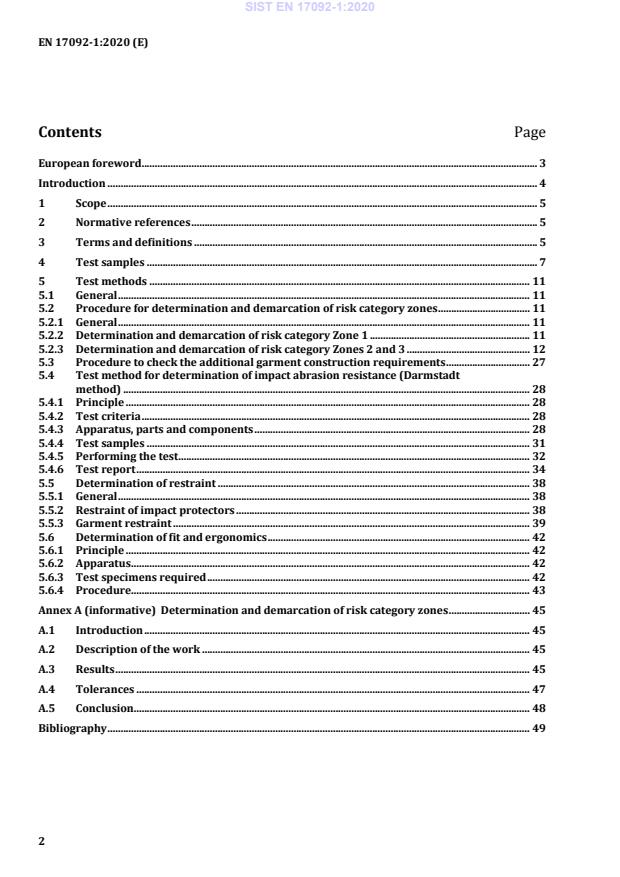
Contents Page
European foreword . 3
Introduction . 4
1 Scope . 5
2 Normative references . 5
3 Terms and definitions . 5
4 Test samples . 7
5 Test methods . 11
5.1 General . 11
5.2 Procedure for determination and demarcation of risk category zones . 11
5.2.1 General . 11
5.2.2 Determination and demarcation of risk category Zone 1 . 11
5.2.3 Determination and demarcation of risk category Zones 2 and 3 . 12
5.3 Procedure to check the additional garment construction requirements . 27
5.4 Test method for determination of impact abrasion resistance (Darmstadt
method) . 28
5.4.1 Principle . 28
5.4.2 Test criteria . 28
5.4.3 Apparatus, parts and components . 28
5.4.4 Test samples . 31
5.4.5 Performing the test . 32
5.4.6 Test report . 34
5.5 Determination of restraint . 38
5.5.1 General . 38
5.5.2 Restraint of impact protectors . 38
5.5.3 Garment restraint . 39
5.6 Determination of fit and ergonomics . 42
5.6.1 Principle . 42
5.6.2 Apparatus . 42
5.6.3 Test specimens required . 42
5.6.4 Procedure. 43
Annex A (informative) Determination and demarcation of risk category zones . 45
A.1 Introduction . 45
A.2 Description of the work . 45
A.3 Results . 45
A.4 Tolerances . 47
A.5 Conclusion. 48
Bibliography . 49
European foreword
This document (EN 17092-1:2020) has been prepared by Technical Committee CEN/TC 162
“Protective clothing including hand and arm protection and lifejackets”, the secretariat of which is
held by DIN.
This European Standard shall be given the status of a national standard, either by publication of
an identical text or by endorsement, at the latest by September 2020, and conflicting national
standards shall be withdrawn at the latest by March 2023.
Attention is drawn to the possibility that some of the elements of this document may be the
subject of patent rights. CEN shall not be held responsible for identifying any or all such patent
rights.
This document, together with EN 17092-2:2020, EN 17092-3:2020, EN 17092-4:2020,
17092-5:2020 and EN 17092-6:2020, supersedes EN 13595-4:2002, EN 13595-3:2002,
EN 13595-2:2002 and EN 13595-1:2002.
This standard is part of a series of standards specifying test methods and requirements for
motorcyclists’ protective garments. EN 17092 comprises multiple parts:
— Part 1: Test methods
— Part 2: Class AAA garments — Requirements
— Part 3: Class AA garments — Requirements
— Part 4: Class A garments — Requirements
— Part 5: Class B garments — Requirements
— Part 6: Class C garments — Requirements
According to the CEN-CENELEC Internal Regulations, the national standards organisations of the
following countries are bound to implement this European Standard: Austria, Belgium, Bulgaria,
Croatia, Cyprus, Czech Republic, Denmark, Estonia, Finland, France, Germany, Greece, Hungary,
Iceland, Ireland, Italy, Latvia, Lithuania, Luxembourg, Malta, Netherlands, Norway, Poland,
Portugal, Republic of North Macedonia, Romania, Serbia, Slovakia, Slovenia, Spain, Sweden,
Switzerland, Turkey and the United Kingdom.
Introduction
This document is a part of a series of standards including EN 17092-2, EN 17092-3, EN 17092-4,
EN 17092-5 and EN 17092-6, which describe the requirements for motorcyclists’ protective
garments according to the various classes of protection offered. EN 17092-1 specifies test
methods to be used to test motorcyclists’ protective garments to confirm that they meet the
requirements of the EN 17092-2 and following parts.
1 Scope
This document describes some of the test methods for use with EN 17092 protective garments for
motorcycle riders (Part 2 and following parts). It describes the appropriate test methods for
zoning, ergonomics, mechanical properties and impact abrasion resistance.
2 Normative references
The following documents are referred to in the text in such a way that some or all of their content
constitutes requirements of this document. For dated references, only the edition cited applies.
For undated references, the latest edition of the referenced document (including any
amendments) applies.
EN 388:2016+A1:2018, Protective gloves against mechanical risks
EN 1621-1:2012, Motorcyclists' protective clothing against mechanical impact — Part 1:
Motorcyclists' limb joint impact protectors — Requirements and test methods
EN 1621-2:2014, Motorcyclists' protective clothing against mechanical impact — Part 2:
Motorcyclists' back protectors — Requirements and test methods
EN 1621-3:2018, Motorcyclists' protective clothing against mechanical impact — Part 3:
Motorcyclists' chest protectors — Requirements and test methods
EN 1621-4:2013, Motorcyclists' protective clothing against mechanical impact — Part 4:
Motorcyclists' inflatable protectors — Requirements and test methods
EN 13594:2015, Protective gloves for motorcycle riders — Requirements and test methods
EN ISO 3377-1:2011, Leather — Physical and mechanical tests - Determination of tear load —
Part 1: Single edge tear (ISO 3377-1:2011)
EN ISO 4674-1:2016, Rubber- or plastics-coated fabrics — Determination of tear resistance —
Part 1: Constant rate of tear methods (ISO 4674-1:2016)
EN ISO 5077:2008, Textiles — Determination of dimensional change in washing and drying
(ISO 5077:2007)
EN ISO 13688:2013, Protective clothing — General requirements (ISO 13688:2013)
3 Terms and definitions
For the purposes of this document, the following terms and definitions apply.
ISO and IEC maintain terminological databases for use in standardization at the following
addresses:
• IEC Electropedia: available at http://www.electropedia.org/
• ISO Online browsing platform: available at http://www.iso.org/obp
3.1
garment
jacket or trouser separate, one-piece or two-piece suit, impact protector ensemble clothing, and
other protective motorcycle rider clothing types excluding protective motorcycle rider clothing
for the head, neck, hands, or feet
3.2
waistline
line in the horizontal plane of the waist, at the level of the highest points of the iliac crests on a
subject standing upright
3.3
beltline
line in a horizontal plane, at the level of the bottom seam, or 4 cm down from the top of the
waistband, at the centre front of the trousers on a subject standing upright
3.4
loop restraint
mechanism whereby a loop of material attached to or a part of a garment limb passes around a
digit of the hand
3.5
rotor
complete assembly, which spins in a clockwise rotation, comprised of the 3 arms of the sample
carrier and the 3 arms of the mass carrier, also including the axle and optionally the electric
motor
3.6
sample carrier
three arms of the rotor, on which the sample holders are mounted
3.7
mass carrier
three additional arms, containing the masses needed to adjust the required total rotational mass
inertia of the rotor
3.8
time to stop
time between the release of the rotor and the end of the sliding of the samples on the concrete tile
3.9
distance to stop
calculated rotational distance travelled by the sample carriers, between the release of the rotor
and the end of the sliding of the samples on the concrete tile
3.10
structural strong layer(s)
SSL
layer of material or combination of layers of materials that confer the mechanical properties on a
garment that allows it to resist damage and mechanical stress and thereby provide protection in
an accident. The layer or layers may be of leather, fabric, or other materials individually or in
combination and may or may not include the outermost layer
3.11
hole
break in a test sample, in any dimension, caused by abrasion
Note 1 to entry: see 5.4.5.3.
3.12
test run
single test at a predetermined revolutions per minute, executed on three test samples
3.13
test cycle
three successive test runs (see 3.12 and 5.4.5.1) to test a material or a combination of materials
3.14
overgarment
clothing designed to be worn over a suit, jacket or trousers
3.15
undergarment
clothing designed to be worn under a suit, jacket or trousers
4 Test samples
Samples shall be provided for examination and testing according to Table 1.
Tests shall be performed on complete garments and specimens obtained from them. If it is not
possible to perform any required test using an actual test sample garment, the test may be
performed using a representative sample of same materials and construction as found in the
complete garment.
In the case of garments with pockets or other provisions for removable impact protectors, the
manufacturer shall submit for testing, samples of all impact protectors appropriate for the
garment as listed in the information notice for users.
Before testing, garments and samples shall be cleaned according to the manufacturer instructions.
It is not necessary to clean garments before testing where only trivial surface cleaning treatments
are recommended, for example wiping with a damp sponge (see EN ISO 13688:2013, 5.2). Test
samples shall be conditioned in an atmosphere of (23 ± 2) °C and (50 ± 5) % relative humidity for
a minimum period of 24 h before testing.
Testing shall either be carried out in the conditioning environment or shall be started within
30 min of the removal of the test samples from that environment.
It is recommended to perform the tests in the above conditioning atmosphere; if not possible, the
test atmosphere shall not exceed the temperature of (23 ± 5) °C and a relative humidity of 15 % to
75 %.
The dimensions given in the following Table 1 are intended with a tolerance of ± 5 % unless
specified by the cited method.
Table 1 — Minimum testing samples quantities
EN 17092-2:2020 Test Test method Test piece Samples quantity Samples quantity Samples quantity
and following necessary for necessary for necessary for class C
parts clause classes AAA, AA, A class B
4.1.1 Innocuousness EN ISO 13688:2013, one garment or one sample of each material equivalent to an area of
4.2 two A4 sheets and one sample of each metallic material which could
come into prolonged contact with the skin
4.1.2 Dimensional EN ISO 5077:2008; one garment one garment one garment one garment
stability of
EN ISO 13688:2013,
garments
5.2 (for garment
preparation)
4.2.1 Impact energy EN 1621-1:2012, One garment and, if See the relevant part Not applicable See the relevant part
absorption EN 1621-2:2014, applicable, all of EN 1621 series of EN 1621 series
(not relevant for
EN 1621-3:2018, mandatory and
part 5) (general)
EN 1621-4:2013 optional impact
according to the protectors specified
type and location by the manufacturer
in the garment’s
of the protector
information notice
4.2.2 Impact 5.5.2 One garment with all mandatory and Not applicable one garment with all
protector mandatory and
(not relevant for optional impact protectors specified
location and optional impact
part 5)
by the manufacturer in the garment’s
fixation protectors specified
information notice
by the manufacturer
in the garment’s
information notice
EN 17092-2:2020 Test Test method Test piece Samples quantity Samples quantity Samples quantity
and following necessary for necessary for necessary for class C
parts clause classes AAA, AA, A class B
4.3 Impact 5.4 9 test pieces with one garment,
abrasion diameter ≥ 125 mm of
(4.2 in part 5) alternatively an assembly at least (600 × 600) mm having the same
resistance each material layer or
combination of materials as found in the garment with all materials
combination of layers
oriented in the same warp or machine direction (alternatively weft or
with all materials
cross direction) and also with an indication of the direction and outside
oriented in the same
face. If the manufacturer has declared the specific orientation of the
direction (machine /
layers is essential, then the sample layers shall be oriented as in the
warp / weft / cross)
garment
and also with an
Not applicable for Class C under garments.
indication of the
direction and outside
face. If the
manufacturer has
declared the specific
orientation of the
layers is essential, then
the sample layers shall
be oriented as in the
garment.
4.4.2 Seam strength EN 13594:2015, 6.7 3 test pieces of each one garment
and Annex B seam type or joint
(4.3.2 in part 5) alternatively one sample of each SSL construction made with same
between materials
materials, and with the same type of seam as it is in the garment and
forming the SSL
with the dimension of at least 40 cm length and 20 cm width and with
Regular test pieces: the seam placed lengthwise in the sample.
(50 × 80) mm
minimum dimensions:
(30 × 60) mm
EN 17092-2:2020 Test Test method Test piece Samples quantity Samples quantity Samples quantity
and following necessary for necessary for necessary for class C
parts clause classes AAA, AA, A class B
4.5 Tear strength EN ISO 3377-1:2011 leather: 6 test pieces one garment or one sample of each material in leather or in textile
(40 × 70) mm equivalent with an area of (320 × 320) mm
(4.4 in part 5) EN ISO 4674-1:2016,
method B textile: 6 test pieces
(50 × 200) mm.
Strongest layer to be
tested
4.6.2 Two-piece suit 5.5.3.1 upper part and lower one two-piece suit one two-piece suit not applicable
requirements part of the two-piece garment garment
(4.5.2 in part 5)
for joint suit
between the
upper and the
lower part
4.6.3 Garment 5.5.3.2 2 sleeves one garment one garment one garment, if
sleeve
(4.5.3 in part 5) it has sleeves
restraint
4.7 Risk category 5.2 one garment one garment with all one garment one garment with all
zoning mandatory impact appropriate impact
(4.6 in part 5)
protectors protectors
4.8 Fit and 5.6 one garment one garment with all one garment one garment with all
ergonomics mandatory and mandatory and
(4.7 in part 5)
optional impact optional impact
protectors protectors
NOTE All specimens can be taken from one single garment, if technically possible. Generally it is sufficient to carry out each test on specimens taken from one single size
garment.
EN 17092-1:2019 (E)
5 Test methods
5.1 General
Dimensions and other data are subjected to a tolerance of ±3 % unless specified otherwise
5.2 Procedure for determination and demarcation of risk category zones
5.2.1 General
The determination and marking of risk category zones (see Figures 1 to 11) is carried out in steps:
1) Zone 1 areas are located by placing the impact protector area templates of the shoulder, elbow,
knee, or hip impact protectors, as appropriate according to the mandatory protector requirements
for the Class of the garment, on the corresponding locations of the garment, and then marking
around the outside edges of said templates.
2) Zone 2 and zone 3 are then located as follows:
a) primary reference points at the neck, waistline or beltline (as appropriate), crotch, shoulders,
elbows, wrists, knees, and ankles are located and marked;
b) each of the primary reference points is used to determine the location of a specific cross section
of the body and to determine the starting point for measurements around the circumference
that is described by that cross section;
c) the locations of two secondary reference points along each circumference are determined using
two percentages of the measure of that circumference. (These secondary reference points
describe points where the boundaries of the risk category zones intersect the circumferences.);
d) the secondary reference points of each circumference are then linked to the secondary
reference points on the other circumferences with flexible tape and by marking, creating lines
that describe the complete boundaries of the risk category zones across the entire garment.
For all procedures in 5.2.2 and 5.2.3, all mandatory impact protectors to be provided with the garment
(see also Clause 4) shall be in their installed or attached positions and all adjustment straps, devices or
fit adjusting systems shall be adjusted to their maximum looseness so that the garment may be at its
maximum expansion. All vents, pockets, and other external openings shall be closed.
5.2.2 Determination and demarcation of risk category Zone 1
Select the appropriate templates (as described in EN 1621-1:2012, 6.3.1.5.2 and 6.3.1.5.3) for the
mandatory impact protectors, according to the type of protectors (Type A or B) supplied with the
garment and EN 1621-1:2012, 5.3. Position the protectors and templates as described in
EN 1621-1:2012, 6.3.1.5.4, with the exception that the template shall be placed directly on the exterior
of the garment, over the corresponding protector locations, and then mark the boundaries of the
templates on the garment. All areas inside these boundaries are considered Zone 1. See Figure 1 for an
illustration of typical Zone 1 template placement.
Only for Class B or Class C garments without pockets for impact protectors (EN 17092-4:2020): using
Type A impact protector templates (as described in EN 1621-1:2012, 6.3.1.5.2 and 6.3.1.5.3), position
the protector templates as described in EN 1621-1:2012, 6.3.1.5.4, with the exception that the template
shall be placed directly on the exterior of the garment, over the corresponding body joint, and then
mark the boundaries of the templates on the garment. This step is not required for the hip protectors of
class AAA garments (see 5.2.3.5). All areas inside these boundaries are considered Zone 1. See Figure 1
for an illustration of typical Zone 1 template placement.
As class C garments may be partial garments i.e. short trousers or short sleeved shirts or vests, in those
cases the zoning procedure is performed on the available area of the garment.
Key
zone 1
Figure 1 — Typical placement of Zone 1 templates
5.2.3 Determination and demarcation of risk category Zones 2 and 3
5.2.3.1 Confirmation of primary reference point locations
Using Figures 1 and 2 as a guide, mark the primary reference points according to Table 2. To accomplish
this have a person of suitable size as described in the manufacturer's information notice for users, don
the garment and assume a natural standing position, as permitted by the garment, and then mark the
EN 17092-1:2019 (E)
location of primary reference points A through E and G through H as appropriate on the outside of the
garment. Reference point F is then marked while the assessor is sitting upright with a 90 ° bend at the
knees and hip.
The reference point for the “waist” and subsequent measurements for garments (except trouser
separates) are based on locating the “waistline”, whereas, the reference point for the “waist” and
subsequent measurements for trouser separates (only) are based on locating the “beltline”. See the
definitions at 3.2 and 3.3.
NOTE See Annex A for additional information with regard to the location of the primary reference points and
tolerances.
Table 2 — Location of the primary reference points
Primary Location shall correspond to:
Reference
Point
A The centre of the neck (suprasternal point, anterior)
B The centre of the shoulder articulation (the centre of “r1” of the relevant
EN 1621-1:2012 impact protector template).
C The centre of the elbow articulation (point of elbow)
D The terminal point, at the wrist, of a line which is drawn from the centre of the larger
radius of the installed EN 1621-1:2012 elbow template (“r1”), when positioned
according to 5.2.2, and which intersects “r2” of the elbow impact protector template.
E For garments (except trouser separates) The centre of the waistline (anterior).
For trouser separates (only) The centre of the beltline (anterior).
F The centre of the knee articulation (anterior - the centre of “r1” of the relevant
EN 1621-1:2012 impact protector template)
G The centre of ankle articulation (point of ankle bone at outside of the ankle)
H The centre of the crotch.
In the case of suit legs or trouser legs, with or without cuffs, that do not reach the ankles because they
are designed to be worn inside of boots, reference point G is located on the assessor’s body and a
vertical line, perpendicular to the floor, is projected upwards to the edge of the trouser leg or cuff and
the reference point is marked at this location on the trouser leg or cuff.
Key
primary reference points
secondary reference points
Figure 2 — Locations of reference points
5.2.3.2 Marking and measuring the circumferences of the cross sections
a) In order to measure the circumferences of the cross sections the garment shall be mounted on a
mannequin or stuffed with a suitable material. In all cases, the garment shall be expanded to its
maximum dimensions. Care should be taken to assure that the garment is not under such pressure
that the mannequin or stuffing distort the garment, e.g. in areas with stretch panels.
EN 17092-1:2019 (E)
b) Using Figure 2 and Table 3 as guides and starting at primary reference points A, B, C, D, E, F, G,
mark, measure and record the circumferences A, B, C, D, E, F, G on the garment. All circumferences
except for the neck circumference (circumference A) shall be marked in a flat plane.
Circumference measurements shall be to the nearest 0,5 cm. For the neck circumference, the marked
and measured circumference shall follow an approximate circular pathway marked by the anterior and
posterior intersections of the sagittal plane with a transverse plane, passing through the C7 neck
vertebra, and the intersection of the clavicle and sternum.
In the case of suit legs or trouser legs or cuffs where the leg or cuff does not reach the ankles the
circumference is marked on the lowest edge of the leg or cuff.
Table 3 — Marking the circumferences
Circumference Instructions for marking the circumference and for measuring along the
circumference to locate the secondary reference points
A (Neck) Starting at primary reference point A at the centre of the neck on front of the
garment, the line moves over the right shoulder around the back of the neck,
over the left shoulder and continues on to the primary reference point.
B (Shoulder) Starting at the primary reference point B, the line wraps around the front of the
body towards chest, then under arm, up the back of the arm, and continues on
to the primary reference point.
C (Elbow) Arm should be down and to the side. Starting at primary reference point C on
the elbow protector longitudinal centreline, the line wraps forward around
outside/top of arm, around to the inside/underside of arm and continues on to
the primary reference point.
D (Wrist) Arm should be down and to the side. Starting at primary reference point D, the
line wraps forward over the top of wrist, around inside/underside of wrist, and
continues on to the primary reference point.
E Waistline Starting at primary reference point E on the waistline, at the front of the
(Waist) garment, the line moves to the right around the waist, behind the back, and then
around the left of the waist and continues on around the front of the torso to the
primary reference point, in a horizontal plane.
Beltline For trouser separates only - Starting at primary reference point E on the
beltline, at the front of the garment, the line moves to the right around the body,
behind the back, and then around the left of the body and continues on around
the front of the torso to the primary reference point, in a horizontal plane.
F (Knee) Starting at primary reference point F on the knee protector longitudinal
centreline, the line wraps around the leg towards the outside of the leg, around
behind the leg, to the inside of the leg and then continues on to the primary
reference point.
G (Ankle) Starting at primary reference point G the line moves along the outside of the leg,
behind the leg, to the inside of the leg and continues on across the front of the
leg to the primary reference point.
5.2.3.3 Location and marking of secondary reference points (risk zone boundary intersection
points)
Using Figures 3 to 10 and Tables 3 and 4 as guides:
a) Starting with the neck (circumference A) calculate the locations of the secondary reference points
A1 and A2 according to the percentages in Table 4. Then following around circumference A as
described in Table 3, mark points A1 and A2 as shown in the cross-sectional diagram Figure 3.
b) The procedure used for circumference A is then repeated for circumference E (waistline or beltline,
as appropriate) marking points E1 and E2 (see Figure 4).
c) The procedure used for circumference A is repeated for circumferences B, C, D, F, and G on the
RIGHT hand side of the garment marking reference points B1, B2, C1, C2 and so on (see Figures 5, 6,
7, 8, and 9).
d) If the garment's SSL is of asymmetric design the procedure used for circumference A is then
repeated for circumferences B, C, D, F, and G on the LEFT hand side of the garment marking
reference points B1, B2, C1, C2 and so on.
Measurements for the location of secondary reference points and the marking of zone borders shall be
based on the circumference of the garment in its “stuffed form” not the circumference of the wearer’s
body.
Table 4 — Calculation and location of the secondary reference points
Secondary reference point 1 Secondary reference point 2
measured from primary measured from primary
reference point reference point
Circumference Reference Point Located at % of Point Located at % of
Point circumference circumference
A (Neck) A A1 20 % A2 80 %
B (Shoulder) B B1 24 % B2 64 %
C (Elbow) C C1 40 % C2 60 %
D (Wrist) D D1 50 % D2 70 %
E (Waistline or E E1 12,5 % E2 87,5 %
Beltline)
F (Knee) F F1 35 % F2 80 %
G (Ankle) G G1 20 % G2 45 %
The calculation of secondary reference points shall be to the nearest 0,5 cm.
EN 17092-1:2019 (E)
Key
primary reference point
secondary reference points (approximate locations)
zone 2
zone 3
arrow indicates the direction of measurement starting at the primary reference point (0 % of
the circumference)
Figure 3 —Location of the secondary reference points along circumferences: Neck
Key
primary reference point
secondary reference points (approximate locations)
zone 2
zone 3
arrow indicates the direction of measurement starting at the primary reference point (0 % of the
circumference)
Figure 4 — Location of the secondary reference points along circumferences: Waistline or
Beltline
EN 17092-1:2019 (E)
Key
primary reference point
secondary reference points (approximate locations)
zone 2
zone 3
arrow indicates the direction of measurement starting at the primary reference point (0 % of the
circumference)
Figure 5 — Location of the secondary reference points along circumferences: Shoulder
Key
primary reference point
secondary reference points (approximate locations)
zone 2
zone 3
arrow indicates the direction of measurement starting at the primary reference point (0 % of the
circumference)
Figure 6 — Location of the secondary reference points along circumferences: Elbow
EN 17092-1:2019 (E)
Key
primary reference point
secondary reference points (approximate locations)
zone 2
zone 3
arrow indicates the direction of measurement starting at the primary reference point (0 % of the
circumference)
Figure 7 — Location of the secondary reference points along circumferences: Wrist
Key
primary reference point
secondary reference points (approximate locations)
zone 2
zone 3
arrow indicates the direction of measurement starting at the primary reference point (0 % of the
circumference)
Figure 8 — Location of the secondary reference points along circumferences: Knee
EN 17092-1:2019 (E)
Key
primary reference point
secondary reference points (approximate locations)
zone 2
zone 3
arrow indicates the direction of measurement starting at the primary reference point (0 % of the
circumference)
Figure 9 — Location of the secondary reference points along circumferences: Ankle
Refer to Table 3 for specific instructions on the direction of measurement.
5.2.3.4 Connection of secondary reference points to demarcate zone boundaries
Using Figures 3 to 10 as guides:
a) Connect the secondary reference points to demarcate the zone boundaries;
b) To do this, draw connecting lines on the right hand side of the garment:
1) A1-B1-C1-D1
2) D2-C2-B2
3) B2-E1
4) E1-F2-G2
5) G1-F1-H
c) If the garment is of asymmetric design, draw connecting lines on the left hand side of the garment
from
1) A2-B1-C1-D1
2) D2-C2-B2
3) B2-E2
4) E2-F2-G2
5) G1-F1-H
Demarcation of the zone boundaries shall be accomplished using flexible tape and using a marker
following the line of a flexible tape between reference points.
For jackets that are not a component of a two-piece suit, it is not possible to connect secondary
reference points E1-F2 or E2-F2 to demarcate the zone boundaries. In such cases, the jacket shall be
donned by a person of suitable size, who assumes a natural standing position as permitted by the
garment, with arms down and to the side. The zone boundary line is then projected downward from E1
(and E2, as necessary) in a straight line, which is perpendicular to the floor.
For trousers separates begin boundary demarcation with secondary reference points E1 and E2 (as
necessary).
EN 17092-1:2019 (E)
Key
secondary reference point (see 5.2.3.3)
zone 2
zone 3
Figure 10— Typical example of the final Zone boundaries determined using the procedure for
determination and demarcation of risk category zones
5.2.3.5 Demarcation of Zone 1 buttock
Applicable to EN 17092-2 class AAA garments only.
The buttocks area described in this demarcation procedure is considered Zone 1 and not Zone 2.
For two-piece suits and jacket separates, no part of the jacket is considered part of Zone 1 buttock.
Zone 1 Buttock includes the area of the right and left hip and buttocks (see Figure 11). It is bounded as
follows:
a) on the sides, by vertical lines projected downward from the waistline circumference secondary
reference points or, in the case of trouser separates, by vertical lines projected downward from the
beltline circumference secondary reference points;
b) on the top, by a horizontal line, which extends around the back of the body, intersecting secondary
reference point Y1 above the buttocks and the right and left vertical boundary lines;
c) on the bottom, by a horizontal line which extends around the back of the body, intersecting
secondary reference point Y2 below the buttocks and the right and left vertical boundary lines.
Using Figures 2 to 9 and Figure 11 as guides, mark the boundaries of Zone 1 Buttock according to the
following steps:
a) starting at primary reference point E, on the waistline (for most garments) or on the beltline (for
trouser separates only) mark a vertical line down the front of the torso, under the crotch
intersecting primary reference point H and then up and over the buttocks to a point that is directly
opposite reference point E in a horizontal plane. Mark this as primary reference point Y;
b) measure the distance between primary reference points Y and E along this line (Y-E);
c) calculate the location of secondary reference points Y1 and Y2;
d) Y1 = 15 % of Y-E;
e) Y2 = 40 % of Y-E;
f) starting at primary reference point Y measure down along line Y-E and mark secondary reference
points Y1 and Y2;
g) project vertical lines down from E1 and E2 past the bottoms of the buttocks;
h) mark a horizontal line intersecting the projected line from E2, the secondary reference point Y1 and
the projected line from E1;
i) mark a horizontal line intersecting the projected line from E2, the secondary reference point Y2 and
the projected line from E1.
EN 17092-1:2019 (E)
Key
primary reference point E (waistline or beltline as appropriate)
primary reference point Y
secondary reference point Y1
secondary reference point Y2
zone 1
Figure 11 — Demarcation of Zone 1 buttock
5.3 Procedure to check the additional garment construction requirements
Inspect structural closures, vents, and pockets to confirm that they meet the relevant requirements.
5.4 Test method for determination of impact abrasion resistance (Darmstadt method)
5.4.1 Principle
The test procedure simulates the stress that is put on the protective garments of an average rider with a
body mass of 75 kg and height of 1,75 m when sliding from variable initial speeds to standstill on a real
concrete road surface.
The translational sliding process is transferred into a scaled rotational system. Three samples of the
material to be tested are mounted in sample holders attached to three arms of a rotating sample carrier
positioned above a concrete tile (road surface). An electric motor accelerates the rotor to which the
sample carrier is attached to a pre-selected number of revolutions per minute, with the samples not yet
touching the concrete tile. After reaching the target velocity, the motor is switched off and the rotor is
released to fall onto the concrete tile. As in a real accident, after touching the concrete tile surface,
friction forces between the test samples and concrete tile decelerate the rotor until it stops. In order to
implement an empirically determined real surface pressure of 18,75 kPa, the test apparatus uses a
smaller total contact area in conjunction with an equivalent reduced inertia in the rotating parts.
Nine identical material test samples are tested during three test runs, completing one test cycle. After
each test run of the test cycle, the samples are assessed for hole formation.
5.4.2 Test criteria
When tested in accordance with the method described in 5.4.5 using the zone dependant speeds listed
in EN 17092-2:2020 and following parts, Table 2 as appropriate, the test samples shall receive a
pass/fail evaluation according to the procedure in 5.4.5.3.
5.4.3 Apparatus, parts and components
5.4.3.1 Apparatus conforming to the following characteristics
Sample carrier number of samples: 3
Static pressure on sample: (18,75 ± 0,2) kPa
Sample holders and sample holder rings: see Figures 13 and 14
Sample holder sliding surface: a SBR (styrene butadiene rubber)
pad
(the same dimension pad shall be used in each sample holder) diameter (48 ± 1)mm
Height (12 ± 1) mm, after running
in procedure (see Clause 5.4.3.3)
shore A hardness (65 ± 5)
density (1,4 ± 0,1) g/cm
Rubbers are known to degrade. Storage should be done at or below normal room temperature and
avoiding UV rays.
This results in:
Moment of rotational mass inertia of the rotor: (2,95 ± 0,05) kgm
Rotational system losses: At a speed of 354 rpm (rotations per minute) ± 3% and on free rotation of the
rotor without contact to the road tile the system shall cover a distance of at least 400 m of the sample
holder.
SIST EN 17092-1:
...