

SIST ISO 9239-2:2002:2011
Reaction to fire tests for floorings -- Part 2: Determination of flame spread at a heat flux level of 25 kW/m2
General Information
- Abstract
ISO 9239-2 specifies a method for assessing the burning behaviour of horizontally mounted flooring systems exposed to a heat flux gradient in a test chamber, when ignited with pilot flames. The radiant heat gradient is higher than the one described in ISO 9239-1 in order to simulate conditions in a corridor adjacent to a room containing a fully developed fire (post-flashover).
This method is applicable to all types of flooring such as textile carpets, cork, wood, rubber and plastic coverings as well as coatings. Results obtained by this method reflect the performance of the flooring, including any substrate if used. Modifications of the backing, bonding to a substrate, underlay, or other changes of the flooring may affect test results.
This part of ISO 9239 is applicable to the measurement and description of the properties of floorings in response to heat and flame under controlled laboratory conditions. It should not be used alone to describe or appraise the fire hazard or fire risk of floorings under actual fire conditions.
- Status
- Not Published
- Technical Committee
- POZ - Požarna varnost
- Current Stage
- 98 - Abandoned project (Adopted Project)
- Start Date
- 07-Jun-2024
- Due Date
- 12-Jun-2024
- Completion Date
- 07-Jun-2024

Overview
SIST ISO 9239-2:2002:2011 is an international standard developed by SIST that specifies a laboratory test method for assessing the burning behaviour of flooring materials. This standard focuses on the determination of flame spread for horizontally mounted flooring systems when exposed to a heat flux level of 25 kW/m². The test simulates conditions found in corridors adjacent to rooms with fully developed fires, offering essential information about the performance of flooring materials under elevated fire exposure.
This method is applicable to all flooring types, including textile carpets, cork, wood, rubber and plastic coverings, as well as coatings. By evaluating flooring, including any substrates, adhesives, or underlays used in actual installation, the standard provides comparative data on flame spread potential in a controlled environment.
Key Topics
- Fire Testing of Floorings: The core of the standard is the procedure for exposing flooring specimens to a controlled radiant heat source and igniting them with pilot flames. The test measures how far and how quickly the flames spread across the sample.
- Simulated Post-Flashover Conditions: The higher heat flux gradient of 25 kW/m² represents severe fire exposure, simulating a corridor near a room with an ongoing fire.
- Specimen Preparation: The standard prescribes preparation and mounting methods for specimens, ensuring they reflect real-world installations as closely as possible, including all layers such as adhesives, substrates, and underlays.
- Measurement and Reporting: Detailed instructions are provided for test conditions, calibration, flame spread measurement, and test reporting, ensuring repeatability and reliability of results.
- Test Limitations: Results reflect performance under laboratory conditions and should not be used as sole evidence for assessing fire hazard or risk in actual fire scenarios.
Applications
The procedures and data produced under SIST ISO 9239-2 are relevant for multiple stakeholders in the building and construction sector:
- Manufacturers: Obtain standardized, comparative data for new or existing flooring products regarding their reaction to fire and flame spread behaviour.
- Building Designers and Architects: Use test results to inform specifications for fire-safe floor coverings, particularly in corridors and escape routes.
- Regulatory Authorities: Reference the standard for compliance and certification purposes, ensuring flooring materials meet fire safety requirements for certain building types or applications.
- Research and Quality Control: Laboratories and research institutes utilize this standard to conduct repeatable, verifiable fire tests during product development or quality assurance processes.
Typical materials tested include textile carpets, resilient floor coverings, wooden parquet, and various laminate types, with or without underlayments or adhesives, mimicking actual installation conditions.
Related Standards
Understanding SIST ISO 9239-2 is enhanced by familiarity with other relevant standards and guidance documents:
- ISO 9239-1: Reaction to fire tests for floorings - Part 1 focuses on burning behaviour under a lower heat flux.
- ISO 13943: Provides the vocabulary and definitions for fire safety, vital for interpreting results.
- ISO/TR 14697: Offers guidance on substrate selection for building product fire tests.
- ISO/TR 5658-1 & ISO/TR 3814: Discuss theoretical backgrounds and test development for flame spread and reaction to fire of building materials.
- ISO 2424: Defines terms for textile floor coverings.
These standards form a comprehensive framework for reaction to fire testing and classification of flooring systems, supporting improved fire safety across the built environment.
Keywords: reaction to fire tests, flame spread, flooring fire performance, ISO 9239-2, building materials fire test, radiant heat source, heat flux, fire safety standards, flooring compliance, laboratory testing, flooring manufacturers, fire safety regulations
Get Certified
Connect with accredited certification bodies for this standard

CIS Institut d.o.o.
Personal Protective Equipment (PPE) certification body. Notified Body NB-2890 for EU Regulation 2016/425 PPE.

Kiwa BDA Testing
Building and construction product certification.
Kmetijski inštitut Slovenije
Agricultural Institute of Slovenia. Soil testing, plant health, agricultural product analysis.
Sponsored listings
Frequently Asked Questions
SIST ISO 9239-2:2002:2011 is a standard published by the Slovenian Institute for Standardization (SIST). Its full title is "Reaction to fire tests for floorings -- Part 2: Determination of flame spread at a heat flux level of 25 kW/m2". This standard covers: ISO 9239-2 specifies a method for assessing the burning behaviour of horizontally mounted flooring systems exposed to a heat flux gradient in a test chamber, when ignited with pilot flames. The radiant heat gradient is higher than the one described in ISO 9239-1 in order to simulate conditions in a corridor adjacent to a room containing a fully developed fire (post-flashover). This method is applicable to all types of flooring such as textile carpets, cork, wood, rubber and plastic coverings as well as coatings. Results obtained by this method reflect the performance of the flooring, including any substrate if used. Modifications of the backing, bonding to a substrate, underlay, or other changes of the flooring may affect test results. This part of ISO 9239 is applicable to the measurement and description of the properties of floorings in response to heat and flame under controlled laboratory conditions. It should not be used alone to describe or appraise the fire hazard or fire risk of floorings under actual fire conditions.
ISO 9239-2 specifies a method for assessing the burning behaviour of horizontally mounted flooring systems exposed to a heat flux gradient in a test chamber, when ignited with pilot flames. The radiant heat gradient is higher than the one described in ISO 9239-1 in order to simulate conditions in a corridor adjacent to a room containing a fully developed fire (post-flashover). This method is applicable to all types of flooring such as textile carpets, cork, wood, rubber and plastic coverings as well as coatings. Results obtained by this method reflect the performance of the flooring, including any substrate if used. Modifications of the backing, bonding to a substrate, underlay, or other changes of the flooring may affect test results. This part of ISO 9239 is applicable to the measurement and description of the properties of floorings in response to heat and flame under controlled laboratory conditions. It should not be used alone to describe or appraise the fire hazard or fire risk of floorings under actual fire conditions.
SIST ISO 9239-2:2002:2011 is classified under the following ICS (International Classification for Standards) categories: 13.220.40 - Ignitability and burning behaviour of materials and products; 97.150 - Floor coverings. The ICS classification helps identify the subject area and facilitates finding related standards.
SIST ISO 9239-2:2002:2011 is available in PDF format for immediate download after purchase. The document can be added to your cart and obtained through the secure checkout process. Digital delivery ensures instant access to the complete standard document.
Standards Content (Sample)
INTERNATIONAL ISO
STANDARD 9239-2
First edition
2002-12-15
Reaction to fire tests for floorings —
Part 2:
Determination of flame spread at a heat
flux level of 25 kW/m
Essais de réaction au feu des revêtements de sol —
Partie 2: Détermination de la propagation de flamme à un niveau de
flux énergétique de 25 kW/m
Reference number
©
ISO 2002
PDF disclaimer
This PDF file may contain embedded typefaces. In accordance with Adobe's licensing policy, this file may be printed or viewed but
shall not be edited unless the typefaces which are embedded are licensed to and installed on the computer performing the editing. In
downloading this file, parties accept therein the responsibility of not infringing Adobe's licensing policy. The ISO Central Secretariat
accepts no liability in this area.
Adobe is a trademark of Adobe Systems Incorporated.
Details of the software products used to create this PDF file can be found in the General Info relative to the file; the PDF-creation
parameters were optimized for printing. Every care has been taken to ensure that the file is suitable for use by ISO member bodies. In
the unlikely event that a problem relating to it is found, please inform the Central Secretariat at the address given below.
© ISO 2002
All rights reserved. Unless otherwise specified, no part of this publication may be reproduced or utilized in any form or by any means,
electronic or mechanical, including photocopying and microfilm, without permission in writing from either ISO at the address below or
ISO's member body in the country of the requester.
ISO copyright office
Case postale 56 • CH-1211 Geneva 20
Tel. + 41 22 749 01 11
Fax + 41 22 749 09 47
E-mail copyright@iso.org
Web www.iso.org
Published in Switzerland
ii © ISO 2002 — All rights reserved
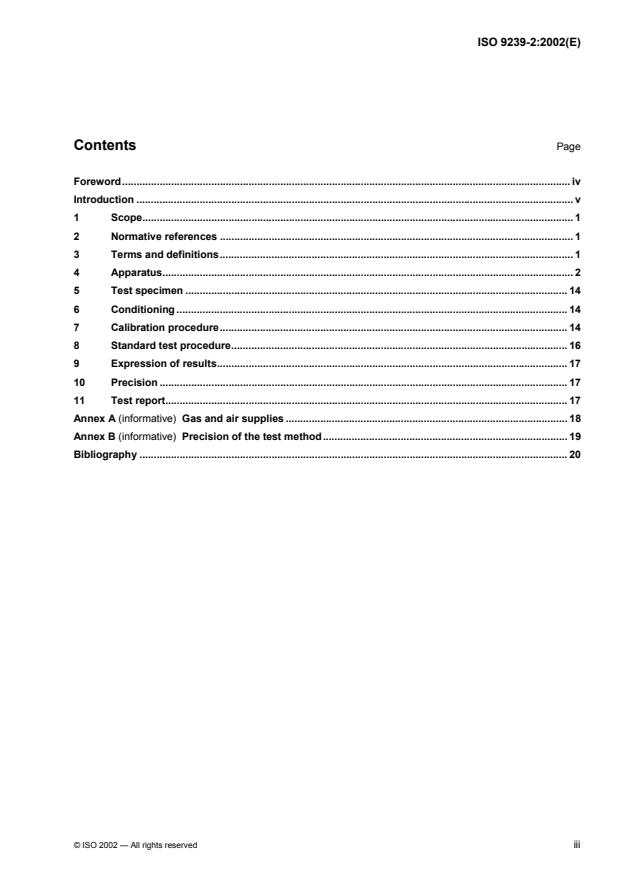
Contents Page
Foreword. iv
Introduction . v
1 Scope. 1
2 Normative references . 1
3 Terms and definitions. 1
4 Apparatus. 2
5 Test specimen . 14
6 Conditioning . 14
7 Calibration procedure. 14
8 Standard test procedure. 16
9 Expression of results. 17
10 Precision . 17
11 Test report. 17
Annex A (informative) Gas and air supplies . 18
Annex B (informative) Precision of the test method. 19
Bibliography . 20
Foreword
ISO (the International Organization for Standardization) is a worldwide federation of national standards bodies
(ISO member bodies). The work of preparing International Standards is normally carried out through ISO
technical committees. Each member body interested in a subject for which a technical committee has been
established has the right to be represented on that committee. International organizations, governmental and
non-governmental, in liaison with ISO, also take part in the work. ISO collaborates closely with the
International Electrotechnical Commission (IEC) on all matters of electrotechnical standardization.
International Standards are drafted in accordance with the rules given in the ISO/IEC Directives, Part 2.
The main task of technical committees is to prepare International Standards. Draft International Standards
adopted by the technical committees are circulated to the member bodies for voting. Publication as an
International Standard requires approval by at least 75 % of the member bodies casting a vote.
Attention is drawn to the possibility that some of the elements of this document may be the subject of patent
rights. ISO shall not be held responsible for identifying any or all such patent rights.
ISO 9239-2 was prepared by Technical Committee ISO/TC 92, Fire safety, Subcommittee SC 1, Fire initiation
and growth.
ISO 9239 consists of the following parts, under the general title Reaction to fire tests for floorings:
Part 1: Determination of the burning behaviour using a radiant heat source
Part 2: Determination of flame spread at a heat flux level of 25 kW/m
iv © ISO 2002 — All rights reserved
Introduction
ISO/TR 5658-1 describes the development of standard tests for flame spread and explains the theory of flame
spread, including horizontal flame spread over floorings.
Floorings are not readily involved in fires but if fire develops due to other contents of a building burning, then
floorings may ignite and it is necessary to be able to determine whether the flooring will propagate flames.
This part of ISO 9239 provides a simple method by which horizontal surface spread of flame on a horizontal
specimen can be determined for comparative purposes.
Fire is a complex phenomenon: its behaviour and its effects depend upon a number of interrelated factors.
The behaviour of materials and products depends upon the characteristics of the fire, the method of the use of
the materials and the environment in which they are exposed. The philosophy of “reaction to fire” tests is
explained in ISO/TR 3814.
A test such as is specified in this part of ISO 9239 deals only with a simple representation of a particular
aspect of the potential fire situation typified by a radiant heat source and flame; it cannot alone provide any
direct guidance on behaviour or safety in fire.
CAUTION:
The possibility of a gas-air fuel explosion in the test chamber should be recognized. Suitable safeguards
consistent with sound engineering practice should be installed in the panel fuel supply system. These should
include at least the following:
a gas feed cut-off which is immediately activated when air and/or gas supply fail;
a temperature sensor or a flame detection unit directed at the panel surface that stops fuel flow when the
panel flame goes out.
Attention is drawn to the possibility that toxic or harmful gases may be produced during exposure of the
specimens. In view of the potential hazard from products of combustion, the exhaust system shall be designed
and operated so that the laboratory environment is protected from smoke and gas. The operator shall be
instructed to minimize his exposure to combustion products by following sound safety practice, e.g., ensuring
that the exhaust system is working properly, wearing appropriate clothing etc. The operator should also be
aware that the walls and fittings of the test chamber become hot during the test and gloves should be worn to
avoid burns.
INTERNATIONAL STANDARD ISO 9239-2:2002(E)
Reaction to fire tests for floorings —
Part 2:
Determination of flame spread at a heat flux level of 25 kW/m
1 Scope
This part of ISO 9239 specifies a method for assessing the burning behaviour of horizontally mounted flooring
systems exposed to a heat flux gradient in a test chamber, when ignited with pilot flames. The radiant heat
gradient is higher than the one described in ISO 9239-1 in order to simulate conditions in a corridor adjacent
to a room containing a fully developed fire (post-flashover).
This method is applicable to all types of flooring such as textile carpets, cork, wood, rubber and plastic
coverings as well as coatings. Results obtained by this method reflect the performance of the flooring,
including any substrate if used. Modifications of the backing, bonding to a substrate, underlay, or other
changes of the flooring may affect test results.
This part of ISO 9239 is applicable to the measurement and description of the properties of floorings in
response to heat and flame under controlled laboratory conditions. It should not be used alone to describe or
appraise the fire hazard or fire risk of floorings under actual fire conditions.
2 Normative references
The following referenced documents are indispensable for the application of this document. For dated
references, only the edition cited applies. For undated references, the latest edition of the referenced
document (including any amendments) applies.
ISO 13943:2000, Fire safety — Vocabulary
ISO/TR 14697:1997, Fire tests — Guidance on the choice of substrates for building products
3 Terms and definitions
For the purposes of this document, the definitions given in ISO 13943, together with the following apply.
3.1
heat flux
incident heat energy (both radiant and convective) per unit area (kW/m )
3.2
critical heat flux at extinguishment
CHF
incident heat flux at the surface of a specimen at the point where the flame ceases to advance and may
subsequently go out
3.3
heat flux at X min
HF-X
total heat flux received by the specimen at the most distant spread of flame position after X min of testing
3.4
flux profile
curve relating radiant flux on the specimen plane to distance from the zero point
NOTE The zero point of the radiant flux profile is specified as the inner edge of the hottest side of the specimen
holder.
3.5
flashing
existence of flame on or over the surface of the specimen for periods of less than 1 s
3.6
transitory flaming
existence of flame on or over the surface of the specimen for periods of between 1 s and 4 s
3.7
sustained flaming
existence of flame on or over the surface of the specimen for periods of more than 4 s
3.8
flame front
furthest extent of flame spread of a sustained flame along the length of the test specimen within a given time
3.9
flooring
upper layer of a floor, comprising any surface finish, with or without attached backing and with any
accompanying underlay, interlayment and adhesive
3.10
substrate
floor on which the flooring is mounted or the material that represents the floor
4 Apparatus
4.1 Test chamber
4.1.1 Location of chamber
The test apparatus shall be placed in a room with a clearance of at least 0,4 m to the walls and the ceiling.
4.1.2 Construction of chamber
The test chamber shall have the dimensions shown in Figures 1 to 4. The chamber shall be made of calcium
silicate boards of (13 ± 1) mm thickness and 650 kg/m nominal density, with a tightly fitting panel of fire-
resistant glass of dimensions (110 ± 10) mm × (1 100 ± 100) mm situated at the front, so that the whole length
of the specimen can be observed during the test. The chamber may have an outside metal cladding. Below
this observation window, a tightly closing door shall be provided through which the test specimen platform can
be moved in and out.
2 © ISO 2002 — All rights reserved
Dimensions in millimetres
Key
1 exhaust duct 6 observation window 11 light receiver (optional)
2 exhaust hood 7 door for insertion and removal of specimen 12 exhaust stack
3 test chamber 8 pyrometer 13 tubes for purging air supply
4 gas-fired radiant panel 9 illumination unit (optional)
5 specimen holder with specimen
10 slot for calibration filters
Figure 1 — Side and plan view of test equipment
Dimensions in millimetres
Key
1 exhaust duct 7 exhaust hood
2 illumination unit (optional) 8 specimen holder with specimen
3 steel tubes for light measuring system (optional) 9 test chamber
4 light receiver (optional) 10 door for insertion and removal of specimen
5 collar or rubber rings 11 tubes for purging air supply
6 slot for calibration filters
Figure 2 — End view of test equipment
4 © ISO 2002 — All rights reserved
Dimensions in millimetres
Key
1 position for anemometer 6 gas-fired radiant panel
2 light measuring beam (optional) 7 radiating surface
3 exhaust stack 8 pilot burner
4 thermocouples 9 specimen holder with specimen
5 test chamber 10 pyrometer
a
Dimension measured from the exposed surface of the specimen to the bottom edge of the radiating panel.
Figure 3 — Section A–A of test equipment
Dimensions in millimetres
Key
1 opening for light measuring system (optional) 6 radiating surface
2 exhaust stack 7 scale
3 thermocouples 8 specimen holder with specimen
4 test chamber 9 specimen transport system
5 gas-fired radiant panel 10 pyrometer
a
Dimension measured from the zero point (the inner edge of the specimen holder) to the inner surface of the chamber
wall.
b
Dimension measured from the bottom edge of the radiating panel to the inner surface of the chamber wall.
Figure 4 — Section B–B of test equipment
6 © ISO 2002 — All rights reserved
4.1.3 Ventilation into chamber
The bottom of the chamber shall consist of a sliding platform, which shall have provision for rigidly securing
the test specimen holder in a fixed and level position (see Figure 5). The total air access area between the
chamber and the test specimen holder shall be (0,06 ± 0,02) m and the base of the chamber shall be
constructed so that the air enters at the hotter end of the exposed specimen. A ventilation control board, cut
from (13 ± 1) mm thick and 650 kg/m nominal density calcium silicate board, shall be inserted from the side
of the chamber (see Figure 6). Other materials such as 1 mm thick steel sheet have also proved to be suitable
for construction of the ventilation control board.
An alternative way of creating a suitable air inlet is to fix calcium silicate boards to the sides of the specimen
tray (see Figure 7). This arrangement has the advantage that the black body temperature of the panel may be
measured using the radiation pyrometer in its normal position.
Key
1 illumination unit (optional) 6 gas-fired radiant panel
2 exhaust duct 7 pilot flames from line burner
3 light receiver (optional) 8 scale
4 exhaust hood 9 specimen holder with specimen and with sliding platform
5 test chamber 10 air inlet at hotter end of specimen at bottom of chamber
Figure 5 — Perspective view showing test principle
Dimensions in millimetres
Key
1 exhaust stack 5 ventilation control board attached to underside of supporting framework
2 test chamber 6 air inlet
3 specimen holder 7 supporting framework
4 radiant panel 8 position of specimen holder
a
Dimension is approximately 170 mm.
b
Air.
c 2 2
L and W dimensions are dependant upon specific apparatus construction such that W × L = 0,06 m ± 0,01 m .
Figure 6 — Typical location of ventilation control board for air inlet
8 © ISO 2002 — All rights reserved
Key
1 chamber walls 4 air inlet 0,06 m
2 fill boards (to block air) 5 fill boards the same thickness and density as chamber walls
3 sliding specimen tray 6 fill boards fastened to specimen tray with angle iron and fasteners
Figure 7 — Air inlet configuration with calcium silicate boards fastened to the sides of the
specimen tray
4.2 Radiant panel
The source of radiant heat energy shall be a panel of porous refractory material mounted in a cast iron frame,
with a radiation surface of (300 ± 10) mm × (450 ± 10) mm.
The panel shall be capable of withstanding temperatures of up to 900 °C and use a fuel gas/air mixing system
with suitable instrumentation (see annex A) to ensure consistent and repeatable operation.
The radiant heat panel shall be mounted in the chamber with its longer dimension at (30 ± 1)° to the horizontal
plane (see Figure 4).
Propane/air mixtures have been proved to be suitable but other fuel gas/air mixtures can be utilised as well.
4.3 Test specimen holder
The test specimen holder is fabricated from heat resistant L-profile stainless steel of (2,0 ± 0,1) mm
thickness to the dimensions shown on Figure 8. The test specimen is exposed through an opening
(200 ± 3) mm × (1 015 ± 10) mm. The test specimen holder is fastened to the sliding steel platform by means
of two bolts on each end.
The test specimen holder shall be provided with means to secure the specimen (e.g. steel bar clamps).
The overall thickness of the holder is (22 ± 2) mm.
A steel scale marked with 10 mm and 50 mm interv
...