

SIST EN 15870:2009
(Main)Adhesives - Determination of tensile strength of butt joints (ISO 6922:1987 modified)
- Abstract
This European Standard specifies a method for determining the bond strength of a butt joint when subjected
to tensile force. The method can be applied to all types of adhesives. Although primarily intended for use
under ambient conditions, the basic method can also be applied to testing under a wide range of temperature
and other environmental conditions. The method requires rigid adherends that can be produced to the
required dimensional tolerances and that will withstand the forces applied to them during the test.
- Status
- Published
- Publication Date
- 09-Jun-2009
- Technical Committee
- IPMA - Polimer materials and products
- Current Stage
- 6060 - National Implementation/Publication (Adopted Project)
- Start Date
- 27-May-2009
- Due Date
- 01-Aug-2009
- Completion Date
- 10-Jun-2009

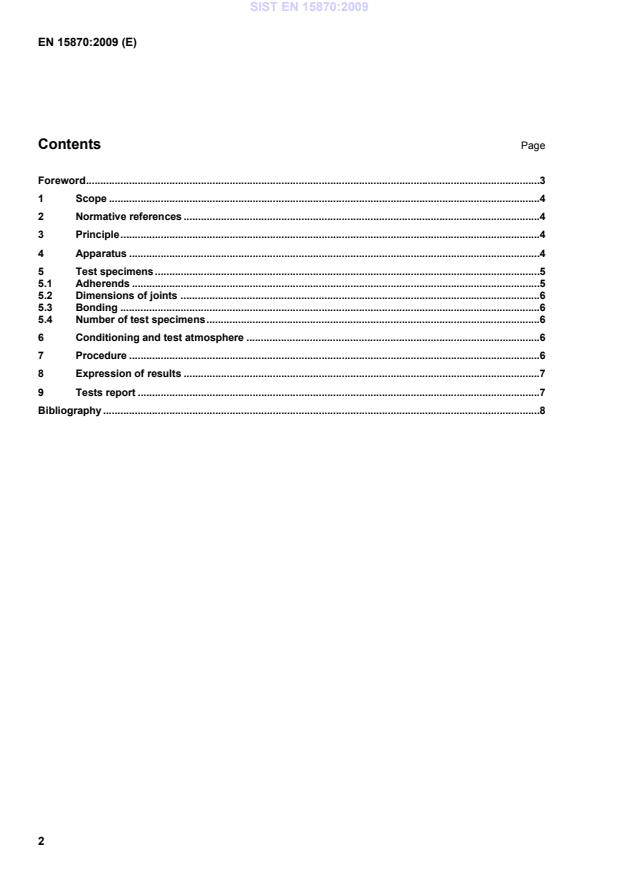
SIST EN 15870:2009 is the Slovenian standard that adopts EN 15870:2009 from CEN. It specifies a laboratory method for determining the tensile strength, or bond strength, of adhesive butt joints by pulling a bonded specimen apart in tension. The method is used for all types of adhesives, especially when comparing products, checking performance, or testing under ambient and other environmental conditions.
What does SIST EN 15870:2009 specify?
SIST EN 15870:2009 specifies how to prepare, load, and report a butt-joint tensile test for adhesives. The document is built around the test principle, apparatus, specimen preparation, conditioning, procedure, result expression, and test report.
The standard is mainly intended for ambient laboratory testing, but the same basic method can also be used over a wider range of temperatures and environmental conditions. It requires rigid adherends that can be made to the required tolerances and that can withstand the test force.
The document is organized into these main clauses:
- Clause 1 - Scope
- Clause 2 - Normative references
- Clause 3 - Principle
- Clause 4 - Apparatus
- Clause 5 - Test specimens
- Clause 6 - Conditioning and test atmosphere
- Clause 7 - Procedure
- Clause 8 - Expression of results
- Clause 9 - Tests report
- Bibliography
What are the key requirements of SIST EN 15870:2009?
SIST EN 15870:2009 gives a controlled tensile test so that different adhesives can be compared on the same basis. The main requirements focus on machine accuracy, specimen geometry, conditioning, loading rate, and how to record the result.
Apparatus and alignment
Clause 4 requires a testing machine that complies with Class 1 of EN ISO 7500-1 and measures force with an error of no more than 1 %. In practice, that means the force reading must be accurate enough to trust the rupture value.
The machine also needs self-aligning grips so the specimen is loaded along its axis. This matters because bending or misalignment can distort the measured tensile strength. Clause 4 also includes a jig for aligning the adherends during bonding, and Figure 1 gives a simple example.
Test specimens
Clause 5 requires rigid adherends. For comparison work and inter-laboratory testing, the two adherends shall be identical and strong enough not to deform appreciably.
Clause 5 also gives preferred sizes for circular and square sections and a tight dimensional tolerance of ± 0,1 mm. That makes the test repeatable and helps ensure that strength differences come from the adhesive, not from specimen shape.
The bonding surfaces shall be plane and normal to the specimen axis, and surface preparation shall follow the adhesive manufacturer’s recommendation or EN 13887. Clause 5 also calls for enough adhesive to avoid a starved joint and for a small surplus at the edge.
Conditioning and test atmosphere
Clause 6 requires preparation, storage, bonding, conditioning, and testing under standard temperature and humidity conditions. If no other conditions are specified, the recommended atmosphere is that of EN ISO 291.
For users, this means the specimen history has to be controlled, because moisture and temperature can change adhesive performance before the test even begins.
Procedure, result, and report
Clause 7 requires the specimen to be loaded symmetrically and at a constant rate so that rupture occurs in about 60 s. The highest force during rupture is recorded as the breaking force.
Clause 7 also requires the failure type to be recorded according to EN ISO 10365. Clause 8 says the result is normally the arithmetic mean of five valid test results. Clause 9 lists the information that must appear in the test report, including adhesive identification, adherend details, bonding conditions, specimen thickness or adhesive usage, number of specimens, breaking force data, and failure type.
What terms does SIST EN 15870:2009 define?
SIST EN 15870:2009 uses a small set of terms that matter in test work.
- Butt joint - a joint made by bonding the end faces of two adherends together, with the bond face normal to the length of the specimen.
- Adherends - the two pieces of material being bonded and then pulled apart in the test.
- Breaking force - the highest force observed during rupture of the test specimen.
- Starved joint - a joint with too little adhesive to form a satisfactory bond.
- Conditioning - holding the prepared and bonded specimens under the specified temperature and humidity before testing.
- Failure pattern - the observed way the specimen fails, recorded using EN ISO 10365.
Who uses SIST EN 15870:2009?
SIST EN 15870:2009 is used by adhesive manufacturers, test laboratories, quality control teams, and materials engineers. It is relevant when they need to compare adhesive products, qualify a bonding process, or document performance under defined test conditions.
It is also useful for purchasers and specifiers who need a common tensile test method for rigid bonded joints. Inter-laboratory testing and product specification work are typical uses because the method defines specimen geometry, conditioning, loading rate, and reporting.
What changed in SIST EN 15870:2009 from the previous edition?
SIST EN 15870:2009 supersedes EN 26922:1993.
Which standards are used with SIST EN 15870:2009?
SIST EN 15870:2009 directly references these standards:
- EN 13887 - gives guidance for surface preparation of metals and plastics before adhesive bonding.
- EN ISO 291 - defines standard atmospheres for conditioning and testing plastics, used here for temperature and humidity control.
- EN ISO 7500-1 - specifies verification and calibration of the force-measuring system in the testing machine.
- EN ISO 10365 - provides the designation of main failure patterns to record how the specimen failed.
The bibliography also points to related standards:
- EN ISO 527 - cited for tensile testing practice and rate of jaw separation when constant load rate equipment is not available.
- ISO 3534 - used for the statistical terms repeatability and reproducibility.
- ISO 5893 - gives equipment guidance for constant-rate traverse test machines.
- EN ISO 472 - provides the vocabulary used for the term starved joint.
What does the SIST EN 15870:2009 document contain?
SIST EN 15870:2009 contains a worked test sequence rather than formulas. It shows an example jig in Figure 1, which helps users align the adherends during bonding.
The document also contains the detailed specimen requirements in Clause 5, the force application method in Clause 7, and the result calculation rule in Clause 8. The reporting clause in Clause 9 turns the test into a documented laboratory record, which is useful for quality control, specification checks, and comparisons between laboratories.
Relations
- Replaces
SIST EN 26922:1998 - Adhesives - Determination of tensile strength of butt joints (ISO 6922:1987) - Effective Date
- 01-Jul-2009
- Refers
SIST EN ISO 291:2009 - Plastics - Standard atmospheres for conditioning and testing (ISO 291:2008) - Effective Date
- 28-Jan-2026
- Effective Date
- 28-Jan-2026
- Effective Date
- 28-Jan-2026
- Effective Date
- 28-Jan-2026
- Effective Date
- 28-Jan-2026
Get Certified
Connect with accredited certification bodies for this standard

DIN CERTCO
DIN Group product certification.

Smithers Quality Assessments
US management systems and product certification.
Sponsored listings
Frequently Asked Questions
SIST EN 15870:2009 is a standard published by the Slovenian Institute for Standardization (SIST). Its full title is "Adhesives - Determination of tensile strength of butt joints (ISO 6922:1987 modified)". This standard covers: This European Standard specifies a method for determining the bond strength of a butt joint when subjected to tensile force. The method can be applied to all types of adhesives. Although primarily intended for use under ambient conditions, the basic method can also be applied to testing under a wide range of temperature and other environmental conditions. The method requires rigid adherends that can be produced to the required dimensional tolerances and that will withstand the forces applied to them during the test.
This European Standard specifies a method for determining the bond strength of a butt joint when subjected to tensile force. The method can be applied to all types of adhesives. Although primarily intended for use under ambient conditions, the basic method can also be applied to testing under a wide range of temperature and other environmental conditions. The method requires rigid adherends that can be produced to the required dimensional tolerances and that will withstand the forces applied to them during the test.
SIST EN 15870:2009 is classified under the following ICS (International Classification for Standards) categories: 83.180 - Adhesives. The ICS classification helps identify the subject area and facilitates finding related standards.
SIST EN 15870:2009 has the following relationships with other standards: It is inter standard links to SIST EN 26922:1998, SIST EN ISO 291:2009, SIST EN ISO 7500-1:2018, SIST EN ISO 10365:2022, SIST EN 13887:2003, SIST EN 13144:2019. Understanding these relationships helps ensure you are using the most current and applicable version of the standard.
SIST EN 15870:2009 is available in PDF format for immediate download after purchase. The document can be added to your cart and obtained through the secure checkout process. Digital delivery ensures instant access to the complete standard document.
Standards Content (Sample)
2003-01.Slovenski inštitut za standardizacijo. Razmnoževanje celote ali delov tega standarda ni dovoljeno.Klebstoffe - Bestimmung der Zugfestigkeit von Stumpfklebungen (ISO 6922:1987 modifiziert)Adhésifs - Détermination de la résistance en traction des joints bout à bout (ISO 6922:1987 modifiée)Adhesives - Determination of tensile strength of butt joints (ISO 6922:1987 modified)83.180LepilaAdhesivesICS:Ta slovenski standard je istoveten z:EN 15870:2009SIST EN 15870:2009en,fr,de01-julij-2009SIST EN 15870:2009SLOVENSKI
STANDARDSIST EN 26922:19981DGRPHãþD
EUROPEAN STANDARDNORME EUROPÉENNEEUROPÄISCHE NORMEN 15870April 2009ICS 83.180Supersedes EN 26922:1993
English VersionAdhesives - Determination of tensile strength of butt joints (ISO6922:1987 modified)Adhésifs - Détermination de la résistance en traction desjoints bout à bout (ISO 6922:1987 modifiée)Klebstoffe - Bestimmung der Zugfestigkeit vonStumpfklebungen (ISO 6922:1987 modifiziert)This European Standard was approved by CEN on 26 March 2009.CEN members are bound to comply with the CEN/CENELEC Internal Regulations which stipulate the conditions for giving this EuropeanStandard the status of a national standard without any alteration. Up-to-date lists and bibliographical references concerning such nationalstandards may be obtained on application to the CEN Management Centre or to any CEN member.This European Standard exists in three official versions (English, French, German). A version in any other language made by translationunder the responsibility of a CEN member into its own language and notified to the CEN Management Centre has the same status as theofficial versions.CEN members are the national standards bodies of Austria, Belgium, Bulgaria, Cyprus, Czech Republic, Denmark, Estonia, Finland,France, Germany, Greece, Hungary, Iceland, Ireland, Italy, Latvia, Lithuania, Luxembourg, Malta, Netherlands, Norway, Poland, Portugal,Romania, Slovakia, Slovenia, Spain, Sweden, Switzerland and United Kingdom.EUROPEAN COMMITTEE FOR STANDARDIZATIONCOMITÉ EUROPÉEN DE NORMALISATIONEUROPÄISCHES KOMITEE FÜR NORMUNGManagement Centre:
Avenue Marnix 17,
B-1000 Brussels© 2009 CENAll rights of exploitation in any form and by any means reservedworldwide for CEN national Members.Ref. No. EN 15870:2009: ESIST EN 15870:2009
...