


SIST EN 1359:2017
(Main)Gas meters - Diaphragm gas meters
Gas meters - Diaphragm gas meters
This European Standard specifies the requirements and tests for the construction, performance, safety and production of class 1,5 diaphragm gas meters (referred to as meters). This applies to meters with co-axial single pipe, or two pipe connections, that are used to measure volumes of fuel gases, which are within the limits of test gases of the 1st, 2nd and 3rd families described in EN 437. The meters have maximum working pressures not exceeding 0,5 bar and maximum actual flow rates not exceeding 160 m3.h−1 over a minimum ambient temperature range of −10 °C to 40 °C and a gas temperature range as specified by the manufacturer with a minimum range of 40 K.
This standard applies to meters with and without built-in temperature conversion that are installed in locations with vibration and shocks of low significance (see MID Annex 1 Chapter 1.3.2 (a), class M1). It also applies to meters in:
- closed locations (indoor or outdoor with protection as specified by the manufacturer) both with condensing humidity or with non-condensing humidity;
or, if specified by the manufacturer:
- open locations (outdoor without any covering) both with condensing humidity and with non-condensing humidity;
- in locations with electromagnetic disturbances corresponding to those likely to be found in residential, commercial and light industrial buildings (see MID Annex 1 Chapter 1.3.3 (a), class E1).
Unless otherwise stated, all pressures given in this document are gauge pressure.
Requirements for electronic indexes, batteries, valves incorporated in the meter and other additional functionalities are given in EN 16314.
Unless otherwise stated in a particular test, the tests are carried out on meters that include additional functionality devices intended by the manufacturer.
Clauses 1 to 9 and Annexes B and C are for design and type testing only.
NOTE The content of OIML Publication 'International Recommendation R 137' has been taken into account in the drafting of this standard.
If no specific requirements are given for test equipment, the instruments used should be traceable to a national or international reference standard and the uncertainty (2σ) should be better than 1/5 of the maximum value of the parameter to be tested. For differential results the repeatability (2σ)/resolution should be better than 1/5 of the maximum value of the parameter to be tested.
Gaszähler - Balgengaszähler
Diese Europäische Norm legt die Anforderungen und Prüfungen für den Bau, den Betrieb, die Sicherheit und die Herstellung von Balgengaszählern der Genauigkeitsklasse 1,5 (im weiteren Zähler genannt) fest. Sie gilt für Zähler mit koaxialen Einstutzen- oder Zweistutzenanschlüssen zur Volumenmessung von Brenngasen aus der Gruppe der Prüfgase der 1., 2. und 3. Familie nach EN 437. Die Zähler weisen maximale Betriebsdrücke bis 0,5 bar und einen maximalen Durchfluss bis 160 m3∙h−1 über einen Umgebungstemperaturbereich von mindestens −10 °C bis 40 °C auf, sowie einen Gastemperaturbereich, der den Spezifikationen des Herstellers entspricht, jedoch mindestens 40 K umfasst.
Die vorliegende Norm gilt für Zähler mit und ohne eingebaute Temperaturumwerter an Standorten mit nicht signifikanten Schwingungs- und Stoßbelastungen (siehe Messgeräte-Richtlinie, Anhang 1, Kapitel 1.3.2 (a), Klasse M1). Sie gilt weiterhin für Zähler an:
- geschlossenen Standorten (innen oder außen mit dem vom Hersteller vorgeschriebenen Schutz) mit kondensierender Feuchtigkeit oder nicht kondensierender Feuchtigkeit;
oder, bei entsprechender Angabe durch den Hersteller an:
- offenen Standorten (außen ohne Abdeckung) mit kondensierender Feuchtigkeit und nicht kondensierender Feuchtigkeit;
- sowie an Standorten mit elektromagnetischen Störungen, wie sie in Wohn- und Gewerbegebäuden sowie Gebäuden der Leichtindustrie auftreten können (siehe Messgeräte-Richtlinie, Anhang 1, Kapitel 1.3.3 (a), Klasse E1).
Soweit in dieser Norm nicht anders angegeben, sind alle dargestellten Drücke als Überdrücke zu verstehen.
Anforderungen an elektronische Zählwerke, Batterien, in den Zähler integrierte Ventile und andere Zusatzfunktionen sind in EN 16314 angegeben.
Sofern für einen bestimmten Test nicht anderweitig angegeben, werden die Tests mit Zählern durchgeführt, die vom Hersteller vorgesehene Zusatzfunktionsgeräte besitzen.
Die Abschnitte 1 bis 9 und die Anhänge B und C beziehen sich nur auf die Konstruktion und Typprüfung.
ANMERKUNG Beim Entwurf dieser Norm wurden die Inhalte der OIML-Veröffentlichung "Internationale Empfehlung R 137" berücksichtigt.
Falls keine spezifischen Anforderungen an die Prüfeinrichtung angegeben sind, sollten die verwendeten Geräte auf ein nationales oder internationales Bezugsnormal rückführbar sein und die Unsicherheit (2σ) sollte besser als 1/5 des Höchstwerts des zu prüfenden Parameters sein. Bei unterschiedlichen Ergebnissen sollte die Wiederholbarkeit (2σ)/Auflösung besser sein als 1/5 des Höchstwerts des zu prüfenden Parameters.
Compteurs de gaz - Compteurs de volume de gaz à parois déformables
La présente Norme européenne spécifie les exigences et les essais pour la fabrication, la performance, la sécurité et la production des compteurs de volume de gaz à parois déformables de classe 1,5 (ci-dessous désignés compteurs) mono-tubulaires co-axiaux ou bi-tubulaires utilisés pour mesurer des volumes de gaz combustibles de la 1ère, la 2ème ou la 3ème famille, conformément à l’EN 437:2003+A1:2009, à des pressions maximales de service ne dépassant pas 0,5 bar et à des débits maximum mesurés ne dépassant pas 160 m³/h, dans une plage minimum de température ambiante et de température du gaz allant de - 10 °C à +40 °C.
Cette norme s’applique aux compteurs avec et sans compensation de température intégrée, qui sont installés dans des lieux avec vibrations et chocs de peu d’importance et dans
des lieux fermés (à l’intérieur ou à l’extérieur avec une protection spécifiée par le fabricant) dans des conditions d’humidité avec ou sans condensation
ou, si cela est spécifié par le fabricant,
des lieux ouverts (à l’extérieur sans aucune protection) dans des conditions d’humidité avec ou sans condensation
dans des lieux à perturbations électromagnétiques correspondant à celles susceptibles de se trouver dans les bâtiments résidentiels, commerciaux et de l’industrie légère.
Sauf indication contraire, toutes les pressions indiquées dans ce document sont des pressions relatives.
Les Articles 1 à 9 et les Annexes B et D concernent seulement la conception et les essais d’approbation de type.
Les exigences relatives aux totalisateurs électroniques, aux batteries, aux vannes intégrés dans le compteur, et aux fonctionnalités supplémentaires, sont indiquées dans l’EN 16314.
NOTE Le contenu de la publication OIML « Recommandation Internationale R 137 » a été pris en compte lors de l’élaboration de cette norme.
Les changements significatifs par rapport aux éditions précédentes comprennent ce qui suit :
conformité à la MID 2009/137/CE concernant les erreurs déclarées du même signe et l’essai de Qmin aux températures du gaz minimale et maximale déclarées ;
restructuration de la section sur la protection contre la corrosion ;
révision de l’essai d’endurance afin de refléter plus précisément les conditions de fonctionnement courantes ;
ajout d’exigences relatives aux compteurs non métalliques pour usage extérieur pour la prise en compte des différentes caractéristiques de matériaux ;
disposition relative aux compteurs avec totalisateurs électroniques et vannes d’arrêt intégrés ;
essai d’adhérence des étiquettes.
L’Annexe A a été restructurée afin de stipuler des exigences supplémentaires pour les compteurs équipés d’un dispositif de compensation de température du gaz intégré.
Lorsqu’aucune exigence spécifique n’est stipulée pour un équipement d’essai, il convient que les instruments utilisés soient référencés par rapport à une norme de référence nationale ou internationale et que l’incertitude (2 s) soit supérieure à 1/5e de la valeur maximale du paramètre à soumettre à l’essai. Pour les résultats différentiels, il convient que la répétabilité (2 s)/la résolution soit supérieure à 1/5e de la valeur maximale du paramètre à soumettre à l’essai.
Plinomeri - Mehovni plinomeri
Ta evropski standard določa zahteve in preskuse za konstrukcijo, delovanje, varnost ter proizvodnjo mehovnih plinomerov razreda 1,5 (v nadaljevanju »merilnikov«) z enojno koaksialno cevjo ali dvema cevnima priključkoma, ki se uporabljajo za merjenje prostornine gorivnih plinov prve, druge in tretje skupine v skladu s standardom EN 437:2003+A1:2009, pri največjem delovnem tlaku 0,5 bara in največji dejanski hitrosti pretoka 160 m3/h ter najnižjem območju temperature okolja in plina od −10 °C do 40 °C.
Ta standard se uporablja za merilnike z vgrajenim pretvornikom temperature (ali brez njega), ki so nameščeni na mestih, kjer so prisotni tresljaji in sunki majhnega pomena in na:
– zaprtih lokacijah (znotraj ali na prostem z zaščito, kot jo določa proizvajalec) s kondenzirano ali nekondenzirano vlago,
ali, če je tako določil proizvajalec:
– odprtih lokacijah (na prostem brez kakršnega koli prekritja) s kondenzirano ali nekondenzirano vlago,
– lokacijah z elektromagnetnimi motnjami, ki ustrezajo običajnim motnjam v stanovanjskih, komercialnih in manj zahtevnih industrijskih zgradbah.
Vse vrste tlaka, navedene v tem dokumentu, so tlak v merilniku, razen če ni navedeno drugače.
Točke 1–9 ter dodatka B in D so samo za namene načrtovanja in tipskega preskušanja.
Zahteve glede elektronskih indeksov, akumulatorjev, ventilov merilnika in dodatnih funkcionalnosti so podane v standardu EN 16314.
OPOMBA: Pri oblikovanju tega standarda je bila upoštevana vsebina »Mednarodnega priporočila R 137« v okviru publikacij OIML.
Bistvene spremembe v primerjavi s prejšnjo izdajo vključujejo:
– skladnost z Direktivo MID 2009/137/ES v zvezi z navedenimi napakami pri uporabi istih oznak in preskušanja Qmin pri navedeni najnižji in najvišji temperaturi plina;
– preoblikovano zaščito proti koroziji;
– revidiran preskus vzdržljivosti, da bi natančneje odražal trenutne pogoje delovanja;
– zahteve za nekovinske merilnike za zunanjo uporabo, ki se dodajo zaradi upoštevanja različnih značilnosti materiala;
– določilo glede merilnikov z elektronskimi indeksi in integriranimi zapornimi ventili;
– preskušanje pritrditve nalepk.
Dodatek A je bil preoblikovan tako, da podaja dodatne zahteve za merilnike, opremljene z vgrajeno napravo za pretvorbo temperature plina.
Če za preskusno opremo niso podane posebne zahteve, morajo biti uporabljeni instrumenti izsledljivi v nacionalnem ali mednarodnem referenčnem standardu, negotovost (2s) pa mora biti boljša od 1/5 največje vrednosti parametra za preskušanje. Za diferenčne rezultate mora biti ponovljivost (2s)/rešitev boljša od 1/5 največje vrednosti zadeve za preskušanje.
General Information
- Status
- Published
- Public Enquiry End Date
- 04-Dec-2014
- Publication Date
- 16-Nov-2017
- Technical Committee
- DPL - Gas supply
- Current Stage
- 6060 - National Implementation/Publication (Adopted Project)
- Start Date
- 15-Nov-2017
- Due Date
- 20-Jan-2018
- Completion Date
- 17-Nov-2017
Relations
- Effective Date
- 01-Dec-2017
- Effective Date
- 01-Dec-2017
Overview
SIST EN 1359:2017 - "Gas meters - Diaphragm gas meters" - is the European standard that specifies requirements and tests for the design, construction, performance, safety and production of class 1.5 diaphragm gas meters. It covers meters with co‑axial single‑pipe or two‑pipe connections used to measure volumes of fuel gases in the 1st, 2nd and 3rd gas families defined by EN 437. Key operating limits defined in the standard include a maximum working (gauge) pressure of 0.5 bar, maximum actual flow rates up to 160 m3·h−1, and an ambient temperature range of −10 °C to 40 °C with a minimum declared gas temperature range of 40 K.
Key topics and technical requirements
- Scope of testing: Requirements and tests for construction, metrological performance, safety and production. Clauses 1–9 and Annexes B and C address design and type testing; Annex A covers production requirements.
- Metrological performance: Error of indication, starting flow, overload performance, pressure absorption, metrological stability and cyclic volume.
- Environmental and installation conditions: Indoor/closed locations (condensing or non‑condensing humidity); optional requirements for open (outdoor) locations and electromagnetic immunity for residential, commercial and light industrial environments (class E1). Installation vibration class M1 as per MID Annex 1.
- Mechanical and material requirements: Robustness, case sealing, connections, resistance to vibration/impact, corrosion protection, diaphragm materials and ageing, and durability tests.
- Marking and index requirements: Legibility, durability and required identification details for two‑pipe and single‑pipe meters.
- Additional functionalities: Built‑in temperature conversion, electronic indexes, batteries and valves are referenced to EN 16314 and tested when included.
- Traceability and test uncertainty: Test instruments should be traceable to national/international reference standards; uncertainty (2σ) should be better than 1/5 of the maximum value of the tested parameter.
Practical applications and who uses this standard
SIST EN 1359:2017 is used by:
- Meter manufacturers for design, type testing and production conformity.
- Testing laboratories and metrology institutes for performance verification and type approval.
- Gas utilities and distributors when specifying or procuring diaphragm meters.
- Regulators and conformity assessment bodies implementing the Measuring Instruments Directive (MID 2014/32/EU).
- Installers and system integrators to ensure correct selection for site conditions (indoor/outdoor, vibration, electromagnetic environment).
Benefits include ensuring meter accuracy, durability, safety and regulatory compliance in residential, commercial and light industrial gas supply systems.
Related standards and references
- EN 437 (gas families and test gases)
- EN 16314 (requirements for electronic indexes, batteries, valves)
- MID 2014/32/EU (Measuring Instruments Directive) - referenced in Annex ZA
- OIML R 137 (considered in drafting)
Keywords: SIST EN 1359:2017, diaphragm gas meters, gas meters standard, meter testing, class 1.5, EN 437, EN 16314, MID 2014/32/EU.



Frequently Asked Questions
SIST EN 1359:2017 is a standard published by the Slovenian Institute for Standardization (SIST). Its full title is "Gas meters - Diaphragm gas meters". This standard covers: This European Standard specifies the requirements and tests for the construction, performance, safety and production of class 1,5 diaphragm gas meters (referred to as meters). This applies to meters with co-axial single pipe, or two pipe connections, that are used to measure volumes of fuel gases, which are within the limits of test gases of the 1st, 2nd and 3rd families described in EN 437. The meters have maximum working pressures not exceeding 0,5 bar and maximum actual flow rates not exceeding 160 m3.h−1 over a minimum ambient temperature range of −10 °C to 40 °C and a gas temperature range as specified by the manufacturer with a minimum range of 40 K. This standard applies to meters with and without built-in temperature conversion that are installed in locations with vibration and shocks of low significance (see MID Annex 1 Chapter 1.3.2 (a), class M1). It also applies to meters in: - closed locations (indoor or outdoor with protection as specified by the manufacturer) both with condensing humidity or with non-condensing humidity; or, if specified by the manufacturer: - open locations (outdoor without any covering) both with condensing humidity and with non-condensing humidity; - in locations with electromagnetic disturbances corresponding to those likely to be found in residential, commercial and light industrial buildings (see MID Annex 1 Chapter 1.3.3 (a), class E1). Unless otherwise stated, all pressures given in this document are gauge pressure. Requirements for electronic indexes, batteries, valves incorporated in the meter and other additional functionalities are given in EN 16314. Unless otherwise stated in a particular test, the tests are carried out on meters that include additional functionality devices intended by the manufacturer. Clauses 1 to 9 and Annexes B and C are for design and type testing only. NOTE The content of OIML Publication 'International Recommendation R 137' has been taken into account in the drafting of this standard. If no specific requirements are given for test equipment, the instruments used should be traceable to a national or international reference standard and the uncertainty (2σ) should be better than 1/5 of the maximum value of the parameter to be tested. For differential results the repeatability (2σ)/resolution should be better than 1/5 of the maximum value of the parameter to be tested.
This European Standard specifies the requirements and tests for the construction, performance, safety and production of class 1,5 diaphragm gas meters (referred to as meters). This applies to meters with co-axial single pipe, or two pipe connections, that are used to measure volumes of fuel gases, which are within the limits of test gases of the 1st, 2nd and 3rd families described in EN 437. The meters have maximum working pressures not exceeding 0,5 bar and maximum actual flow rates not exceeding 160 m3.h−1 over a minimum ambient temperature range of −10 °C to 40 °C and a gas temperature range as specified by the manufacturer with a minimum range of 40 K. This standard applies to meters with and without built-in temperature conversion that are installed in locations with vibration and shocks of low significance (see MID Annex 1 Chapter 1.3.2 (a), class M1). It also applies to meters in: - closed locations (indoor or outdoor with protection as specified by the manufacturer) both with condensing humidity or with non-condensing humidity; or, if specified by the manufacturer: - open locations (outdoor without any covering) both with condensing humidity and with non-condensing humidity; - in locations with electromagnetic disturbances corresponding to those likely to be found in residential, commercial and light industrial buildings (see MID Annex 1 Chapter 1.3.3 (a), class E1). Unless otherwise stated, all pressures given in this document are gauge pressure. Requirements for electronic indexes, batteries, valves incorporated in the meter and other additional functionalities are given in EN 16314. Unless otherwise stated in a particular test, the tests are carried out on meters that include additional functionality devices intended by the manufacturer. Clauses 1 to 9 and Annexes B and C are for design and type testing only. NOTE The content of OIML Publication 'International Recommendation R 137' has been taken into account in the drafting of this standard. If no specific requirements are given for test equipment, the instruments used should be traceable to a national or international reference standard and the uncertainty (2σ) should be better than 1/5 of the maximum value of the parameter to be tested. For differential results the repeatability (2σ)/resolution should be better than 1/5 of the maximum value of the parameter to be tested.
SIST EN 1359:2017 is classified under the following ICS (International Classification for Standards) categories: 91.140.40 - Gas supply systems. The ICS classification helps identify the subject area and facilitates finding related standards.
SIST EN 1359:2017 has the following relationships with other standards: It is inter standard links to SIST EN 1359:2004/A1:2006, SIST EN 1359:2004. Understanding these relationships helps ensure you are using the most current and applicable version of the standard.
SIST EN 1359:2017 is associated with the following European legislation: EU Directives/Regulations: 2004/22/EC, 2014/32/EU; Standardization Mandates: M/347, M/541. When a standard is cited in the Official Journal of the European Union, products manufactured in conformity with it benefit from a presumption of conformity with the essential requirements of the corresponding EU directive or regulation.
SIST EN 1359:2017 is available in PDF format for immediate download after purchase. The document can be added to your cart and obtained through the secure checkout process. Digital delivery ensures instant access to the complete standard document.
Standards Content (Sample)
2003-01.Slovenski inštitut za standardizacijo. Razmnoževanje celote ali delov tega standarda ni dovoljeno.Plinomeri - Mehovni plinomeriGaszähler - BalgengaszählerCompteurs de gaz - Compteurs de volume de gaz à parois déformablesGas meters - Diaphragm gas meters91.140.40Sistemi za oskrbo s plinomGas supply systemsICS:Ta slovenski standard je istoveten z:EN 1359:2017SIST EN 1359:2017en,fr,de01-december-2017SIST EN 1359:2017SLOVENSKI
STANDARDSIST EN 1359:2004/A1:2006SIST EN 1359:20041DGRPHãþD
EUROPEAN STANDARD NORME EUROPÉENNE EUROPÄISCHE NORM
EN 1359
July
t r s y ICS
{ sä s v rä v r Supersedes EN
s u w {ã s { { zEnglish Version
Gas meters æ Diaphragm gas meters Compteurs de gaz æ Compteurs de volume de gaz à parois déformables
Gaszähler æ Balgengaszähler This European Standard was approved by CEN on
s v May
t r s yä
egulations which stipulate the conditions for giving this European Standard the status of a national standard without any alterationä Upætoædate lists and bibliographical references concerning such national standards may be obtained on application to the CENæCENELEC Management Centre or to any CEN memberä
translation under the responsibility of a CEN member into its own language and notified to the CENæCENELEC Management Centre has the same status as the official versionsä
CEN members are the national standards bodies of Austriaá Belgiumá Bulgariaá Croatiaá Cyprusá Czech Republicá Denmarká Estoniaá Finlandá Former Yugoslav Republic of Macedoniaá Franceá Germanyá Greeceá Hungaryá Icelandá Irelandá Italyá Latviaá Lithuaniaá Luxembourgá Maltaá Netherlandsá Norwayá Polandá Portugalá Romaniaá Serbiaá Slovakiaá Sloveniaá Spainá Swedená Switzerlandá Turkey and United Kingdomä
EUROPEAN COMMITTEE FOR STANDARDIZATION COMITÉ EUROPÉEN DE NORMALISATION EUROPÄISCHES KOMITEE FÜR NORMUNG
CEN-CENELEC Management Centre:
Avenue Marnix 17,
B-1000 Brussels
t r s y CEN All rights of exploitation in any form and by any means reserved worldwide for CEN national Membersä Refä Noä EN
s u w {ã t r s y ESIST EN 1359:2017
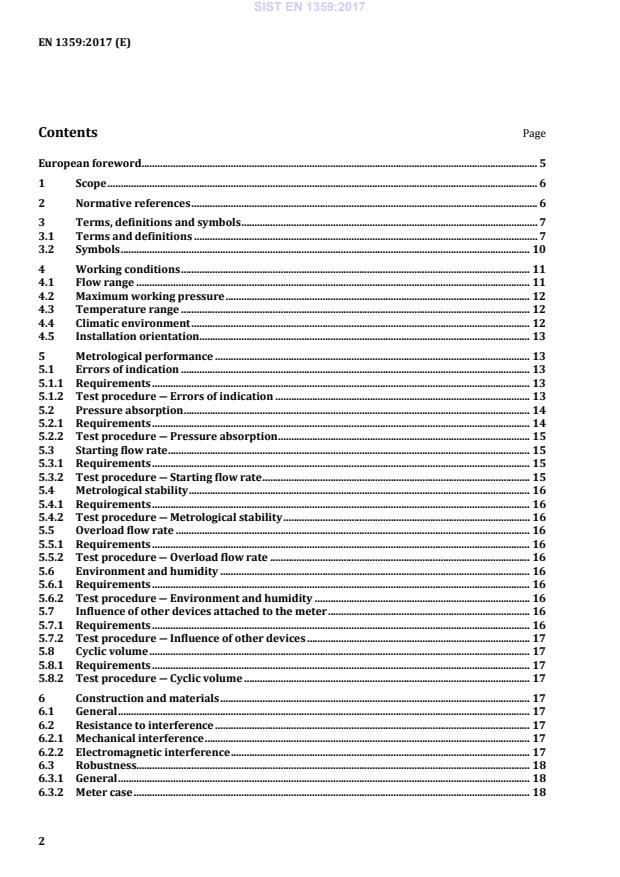
................................................................................................. 13 5.2 Pressure absorption .................................................................................................................................... 14 5.2.1 Requirements ................................................................................................................................................ 14 5.2.2
................................................................................................ 15 5.3 Starting flow rate .......................................................................................................................................... 15 5.3.1 Requirements ................................................................................................................................................ 15 5.3.2
...................................................................................................... 15 5.4 Metrological stability .................................................................................................................................. 16 5.4.1 Requirements ................................................................................................................................................ 16 5.4.2
.............................................................................................. 16 5.5 Overload flow rate ....................................................................................................................................... 16 5.5.1 Requirements ................................................................................................................................................ 16 5.5.2
................................................................................................... 16 5.6 Environment and humidity ...................................................................................................................... 16 5.6.1 Requirements ................................................................................................................................................ 16 5.6.2 t and humidity .................................................................................. 16 5.7 Influence of other devices attached to the meter ............................................................................. 16 5.7.1 Requirements ................................................................................................................................................ 16 5.7.2
..................................................................................... 17 5.8 Cyclic volume ................................................................................................................................................. 17 5.8.1 Requirements ................................................................................................................................................ 17 5.8.2
............................................................................................................. 17 6 Construction and materials ...................................................................................................................... 17 6.1 General ............................................................................................................................................................. 17 6.2 Resistance to interference ........................................................................................................................ 17 6.2.1 Mechanical interference ............................................................................................................................ 17 6.2.2 Electromagnetic interference .................................................................................................................. 17 6.3 Robustness...................................................................................................................................................... 18 6.3.1 General ............................................................................................................................................................. 18 6.3.2 Meter case ....................................................................................................................................................... 18 SIST EN 1359:2017
3 6.3.3 External leak tightness . 18 6.3.4 Resistance to internal pressure. 18 6.3.5 Meter case sealing . 19 6.3.6 Connections . 19 6.3.7 Resistance to vibration . 23 6.3.8 Resistance to impact . 25 6.3.9 Resistance to mishandling . 27 6.4 Corrosion protection . 28 6.4.1 General . 28 6.4.2 External corrosion . 29 6.4.3 Internal corrosion . 30 6.5 Resistance to storage temperature range . 30 6.5.1 Requirements . 30 6.5.2
........................................................ 30 6.6 Optional features .......................................................................................................................................... 31 6.6.1 Pressure measuring point ......................................................................................................................... 31 6.6.2 Electrical insulating feet ............................................................................................................................ 31 6.6.3 Magnetic index drive ................................................................................................................................... 31 6.6.4 Devices to prevent the registration of reverse flow ......................................................................... 32 6.6.5 Devices to prevent reverse flow .............................................................................................................. 32 6.6.6 Resistance to high temperatures ............................................................................................................ 32 6.6.7 Diaphragm gas meters provided with a built-in gas temperature conversion device ........ 34 6.6.8 Additional functionalities .......................................................................................................................... 34 7 Mechanical performance ........................................................................................................................... 34 7.1 Meter assembly ............................................................................................................................................. 34 7.1.1 General ............................................................................................................................................................. 34 7.1.2 Durability......................................................................................................................................................... 34 7.1.3 Meter error of indication at declared gas temperature limits ..................................................... 39 7.1.4 Error of indication subject to declared ambient temperature limits ........................................ 40 7.2 Index .................................................................................................................................................................. 41 7.2.1 Construction details ..................................................................................................................................... 41 7.2.2 Index windows and surround .................................................................................................................. 42 7.3 Diaphragms and components in the gas path .................................................................................... 43 7.3.1 Requirements for diaphragms and non-rubber components in the gas path ........................ 43 7.3.2 Requirements for rubber components in the gas path ................................................................... 43 7.3.3 Toluene/iso-octane vapour test .............................................................................................................. 43 7.3.4 Water vapour test ......................................................................................................................................... 45 7.3.5 Ageing ............................................................................................................................................................... 47 8 Marking ............................................................................................................................................................ 47 8.1 All meters......................................................................................................................................................... 47 8.2 Two-pipe meters ........................................................................................................................................... 48 8.3 Durability and legibility of marking ...................................................................................................... 48 8.3.1 Requirements ................................................................................................................................................. 48 8.3.2 Ultraviolet exposure test ........................................................................................................................... 48 8.3.3 Indelibility ....................................................................................................................................................... 48 8.3.4 Adhesion .......................................................................................................................................................... 49 9 Meters supplied for testing ....................................................................................................................... 49 9.1 General ............................................................................................................................................................. 49 Annex A (normative)
Production requirements for gas meters . 53 A.1 General . 53 SIST EN 1359:2017
Diaphragm gas meters provided with a built-in gas temperature conversion device . 56 B.1 Scope . 56 B.2 Metrological performance . 56 B.3 Marking . 62 Annex C (normative)
Tests for meters to be used in open locations . 63 C.1 Humidity . 63 C.2 Weathering . 63 Annex ZA (informative)
Relationship between this European Standard and the Essential Requirements of EU Directive 2014/32/EU Measuring Instruments Directive aimed to be covered . 65 Bibliography . 71
5 European foreword This document (EN 1359:2017) has been prepared by Technical Committee CEN/TC 237 “Gas meters”, the secretariat of which is held by BSI. This European Standard shall be given the status of a national standard, either by publication of an identical text or by endorsement, at the latest by January 2018, and conflicting national standards shall be withdrawn at the latest by January 2018. Attention is drawn to the possibility that some of the elements of this document may be the subject of patent rights. CEN shall not be held responsible for identifying any or all such patent rights. This document supersedes EN 1359:1998. This document has been prepared under a mandate given to CEN by the European Commission and the European Free Trade Association, and supports essential requirements of EU Directive. For relationship with EU Directive, see informative Annex ZA, which is an integral part of this document. Significant changes from the previous editions include: — conformity with the MID 2014/32/EU regarding declared errors of the same sign and testing Qmin at the minimum and maximum declared gas temperatures; — corrosion protection restructured; — endurance testing for residential meters revised to reflect better the in-service life; — provision for meters with electronic indexes and integrated valves, and requirements for additional functionalities as given in EN 16314; — adhesion testing of labels. Annex B has been restructured to give additional requirements for meters provided with a built-in gas temperature conversion device. According to the CEN-CENELEC Internal Regulations, the national standards organisations of the following countries are bound to implement this European Standard: Austria, Belgium, Bulgaria, Croatia, Cyprus, Czech Republic, Denmark, Estonia, Finland, Former Yugoslav Republic of Macedonia, France, Germany, Greece, Hungary, Iceland, Ireland, Italy, Latvia, Lithuania, Luxembourg, Malta, Netherlands, Norway, Poland, Portugal, Romania, Serbia, Slovakia, Slovenia, Spain, Sweden, Switzerland, Turkey and the United Kingdom. SIST EN 1359:2017
« s r °C to 40 °C and a gas temperature range as specified by the manufacturer with a minimum range of 40 K. This standard applies to meters with and without built-in temperature conversion that are installed in locations with vibration and shocks of low significance (see MID Annex 1 Chapter 1.3.2 (a), class M1). It also applies to meters in: — closed locations (indoor or outdoor with protection as specified by the manufacturer) both with condensing humidity, or with non-condensing humidity; or, if specified by the manufacturer: — open locations (outdoor without any covering) both with condensing humidity and with non-condensing humidity; — in locations with electromagnetic disturbances corresponding to those likely to be found in residential, commercial and light industrial buildings (see MID Annex 1 Chapter 1.3.3 (a), class E1). Unless otherwise stated, all pressures given in this document are gauge pressure. Requirements for electronic indexes, batteries, valves incorporated in the meter and other additional functionalities are given in EN 16314. Unless otherwise stated in a particular test, the tests are carried out on meters that include additional functionality devices intended by the manufacturer. Clauses 1 to 9 and Annexes B and C are for design and type testing only. NOTE The content of OIML Publication 'International Recommendation R 137' has been taken into account in the drafting of this standard. If no specific requirements are given for test equipment, the instruments used should be traceable to a nationashould be better than 1/5 of the maximum value of the parameter to be tested. 2 Normative references The following documents, in whole or in part, are normatively referenced in this document and are indispensable for its application. For dated references, only the edition cited applies. For undated references, the latest edition of the referenced document (including any amendments) applies. EN 549, Rubber materials for seals and diaphragms for gas appliances and gas equipment EN 16314:2013, Gas meters - Additional functionalities EN 60730-1:2011, Automatic electrical controls for household and similar use - Part 1: General requirements (IEC 60730-1:2011) EN ISO 228-1, Pipe threads where pressure-tight joints are not made on the threads - Part 1: Dimensions, tolerances and designation (ISO 228-1) SIST EN 1359:2017
7 EN ISO 1518-1, Paints and varnishes - Determination of scratch resistance - Part 1: Constant-loading method (ISO 1518-1) EN ISO 2409, Paints and varnishes - Cross-cut test (ISO 2409) EN ISO 2812-1:2007, Paints and varnishes - Determination of resistance to liquids - Part 1: Immersion in liquids other than water (ISO 2812-1:2007) EN ISO 4628-2, Paints and varnishes - Evaluation of degradation of coatings - Designation of quantity and size of defects, and of intensity of uniform changes in appearance - Part 2: Assessment of degree of blistering (ISO 4628-2) EN ISO 4628-3:2016, Paints and varnishes - Evaluation of degradation of coatings - Designation of quantity and size of defects, and of intensity of uniform changes in appearance - Part 3: Assessment of degree of rusting (ISO 4628-3:2016) EN ISO 4892-2:2013, Plastics - Methods of exposure to laboratory light sources - Part 2: Xenon-arc lamps (ISO 4892-2:2013) EN ISO 6270-1, Paints and varnishes - Determination of resistance to humidity - Part 1: Continuous condensation (ISO 6270-1) EN ISO 6272-2, Paints and varnishes - Rapid-deformation (impact resistance) tests - Part 2: Falling-weight test, small-area indenter (ISO 6272-2) EN ISO 9227:2012, Corrosion tests in artificial atmospheres — Salt spray tests (ISO 9227) EN ISO 11664-4, Colorimetry - Part 4: CIE 1976 L*a*b* Colour space (ISO 11664-4) ISO 834-1, Fire-resistance tests — Elements of building construction — Part 1: General requirements ISO 5168, Measurement of fluid flow — Procedures for the evaluation of uncertainties ISO 7005-1:2011, Pipe flanges — Part 1: Steel flanges for industrial and general service piping systems ASTM D1003, Standard Test Method for Haze and Luminous Transmittance of Transparent Plastics 3 Terms, definitions and symbols 3.1 Terms and definitions For the purposes of this document, the following terms and definitions apply. 3.1.1 air air of density approximately 1,2 kgm «3 3.1.2 gas volume meter instrument designed to measure, memorize and display the volume of a fuel gas that has passed through it SIST EN 1359:2017
9 3.1.10 normal condition of use condition referring to the meter operating: — at a pressure up to the maximum working pressure (with or without a flow of gas); — within the range of flow rates; — within the ambient and gas temperature range; — with the distributed gas 3.1.11 base condition fixed condition (temperature and pressure) to which a volume of gas is converted 3.1.12 cyclic volume volume of gas corresponding to the working cycle of the gas meter Note 1 to entry: This means that all the moving components, except for the indicating device and the intermediate transmissions, resume for the first time the position they occupied at the beginning of the cycle. 3.1.13 distributed gas gas locally available 3.1.14 metering conditions condition of the gas at the point of measurement Note 1 to entry: E.g. temperature and pressure of the measured gas. 3.1.15 temperature conversion device device which converts the volume measured to a corresponding volume at the base gas temperature Note 1 to entry: The volume at base gas temperature, Vb in cubic metres (m3) is given by the equation =×bbTVVT
(2) where V is the volume at metering conditions, in cubic metres (m3); T is the gas temperature at metering conditions, in Kelvin (K); Tb is the base gas temperature, in Kelvin (K). 3.1.16 meter error curve plot of average error of indication against actual flow rate SIST EN 1359:2017
¶ Q < Qt and ±1,5 % where Qt
¶ Q
¶ Qmax 3.1.18 MPE maximum permissible error for a class 1,5 diaphragm gas meter 3.1.19 MPE-Initial maximum permissible error for a Class 1,5 diaphragm gas meter before testing in accordance with this standard 3.1.20 MPE-Subsequent maximum permissible error for a Class 1,5 diaphragm gas meter following the completion of specific individual tests within this standard 3.2 Symbols For the purposes of this document, the following symbols and definitions apply. 3.2.1 Q volume flowrate actual flow of gas passing through the diaphragm gas meter 3.2.2 Qmin minimum flowrate lowest flowrate at which the gas meter provides indications that satisfy the requirements regarding MPE 3.2.3 Qt transitional flowrate flowrate occurring between the maximum and minimum flowrates at which the flowrate range is divided into two zones, the 'upper zone' and the 'lower zone', each zone having a characteristic MPE 3.2.4 Qmax maximum flowrate highest flowrate at which the gas meter provides indications that satisfy the requirements regarding MPE SIST EN 1359:2017
11 3.2.5 Qr overload flowrate highest flowrate at which the meter operates for a short period of time without deteriorating 3.2.6 V cyclic volume 3.2.7 pmax maximum working pressure 3.2.8 tb base gas temperature 3.2.9 tm ambient temperature 3.2.10 tg gas temperature 3.2.11 tsp specified centre temperature for meters with temperature conversion 3.2.12 gn nominal gravitational acceleration 4 Working conditions 4.1 Flow range The flow rate range shall be one of those given in Table 1. SIST EN 1359:2017
«10 °C to 40 °C and a minimum gas temperature range of 40 K (see 7.1.3) and a minimum storage temperature range of
« t r °C to 60 °C (see 6.5). The gas temperature range shall be within the ambient temperature range. The gas temperature range and the ambient temperature range shall be declared and shall be marked on the index plate of the meter. The manufacturer may declare a wider ambient temperature range using a minimum temperature of
«10
¹Cá
« t w
¹C or
« v r °C and a maximum temperature of 40 °C, 55 °C or 70 °C and/or a wider storage temperature range. The meter shall be capable of meeting the requirements over this declared wider range. 4.4 Climatic environment Meters that conform to the requirements of this standard are deemed suitable for installation in closed locations (indoor or outdoor with protection as specified by the manufacturer) with condensing or non-condensing humidity. If the manufacturer declares that the meter is also suitable for installation in open locations (outdoor without any protection) with condensing or non-condensing humidity, it shall meet the requirements of Annex C. SIST EN 1359:2017
13 4.5 Installation orientation The meter shall be designed for installation upright as specified by the manufacturer. 5 Metrological performance 5.1 Errors of indication 5.1.1 Requirements When tested by the method given in 5.1.2 a) the individual errors of indication of the meter shall be within the initial permissible error (MPE-Initial) limits specified in Table 2. Table 2 — Maximum permissible errors Flow rate m3h «1 Maximum permissible errors Initial Subsequent Qmin
¶ Q < Qt ±3 % ±6 % Qt
¶ Q
¶ Qmax ±1,5 % ±3 % The meter, including any additional functionality devices intended by the manufacturer, shall have the error adjusted as close to zero as the adjustments allow, without systematically favouring any party. After the meter has been subjected to other influences, given in the individual clauses of this standard, the average of the errors of indication of the meter shall either: — not vary from the average of the initial errors of indication by more than that allowed by those clauses or; — be within the error limits specified within those clauses; whichever is applicable, when tested by the methods given in 5.1.2 b), 5.1.2 c or 5.1.2 d). 5.1.2 Test procedure
a) Thermally stabilize the meter to be tested for a minimum of 4 h at the temperature of the test laboratory and carry out the error of indication test using air at laboratory temperature. Immediately before commencing the test, pass a quantity of air equal to at least 50 cyclic volumes of the meter under test, through the meter under test at a flow rate of Qmax. Carry out this test six times at each of the flow rates Qmin, 3 Qmin, 0,1 Qmax, 0,2 Qmax, 0,4 Qmax, 0,7 Qmax and Qmax, ensuring that the flow rates between each individual test are different (i.e. it is not permissible to carry out consecutive tests at the same flow rate). Pass a volume of air, the actual volume of which is measured by a traceable standard, through the meter under test and note the volume indicated by the meter index. The minimum volume of air to be passed through the meter under test is specified by the manufacturer and agreed with the Accredited test house. Calculate the six errors of indication at each of the flow rates using the equation given in 3.1.9. Calculate the mean of each of the six errors of indication and record the results as the meter error curve. SIST EN 1359:2017
15 Table 3 — Pressure absorption Qmax m3h «1 Maximum permissible values for mean pressure absorption Initial mbar Subsequent mbar 2,5 to 16 inclusive 2 2,2 25 to 65 inclusive 3 3,3 100 and 160 4 4,4 5.2.2 T Supply the meter under test with a flow of air at a flow rate equal to Qmax for a minimum of 10 cycles. Measure the differential pressure across the meter for at least one cyclic volume using a suitable measuring instrument, accurate to 0,1 mbar. The distance between the pressure test points and the meter connections shall not exceed three times the nominal connection diameter. Record the differential pressures over at least one measuring cycle, and calculate the mean value. 5.3 Starting flow rate 5.3.1 Requirements When tested by the method given in 5.3.2, the starting flow rate shall not be greater than those specified in Table 4. Table 4 — Starting flow rates Qmax m3h «1 Maximum starting flow rate dm3h «1 2,5 3 4 and 6 5 10 8 16 and 25 13 40 20 65 and 100 32 160 50 5.3.2 T Run the meter under test at Qmax for 10 min, using air at laboratory temperature. NOTE This test does not check the metrological characteristics of the meter. Leave the meter under test at rest for a period of 2 h to 4 h. Do not add lubricant for the test. Connect the meter under test in series with, and upstream of, a flow measuring instrument of known accuracy and traceability, and a flow regulating device accurate to two decimal places. SIST EN 1359:2017
Using the calculated errors of indication, obtained when carrying out the initial error of indication test in 5.1.2 a) at flowrates 0,1 Qmax, 0,2 Qmax, 0,4 Qmax, 0,7 Qmax and Qmax, check that for each flowrate the spread of the six individual results is within 0,6 %. Record the result as a pass or fail. 5.5 Overload flow rate 5.5.1 Requirements After exposure to an overload flow rate of Qr as given in Table 1, the error of indication shall remain within the MPE-Initial limits specified in Table 2. 5.5.2 Test procedure
Supply 1 meter with air for 1 h at a flow rate of Qr. Determine the error of indication as specified in 5.1.2 c). Record the result as a pass or fail. 5.6 Environment and humidity 5.6.1 Requirements NOTE Test methods for meters suitable for use in open locations are given in Annex C. After testing in accordance with 5.6.2, the error of indication shall remain within the MPE-Initial limits as specified in Table 2 and the index and markings shall remain legible. 5.6.2 idity Test one meter for error of indication in accordance with 5.1.2 c) and then in accordance with EN ISO 6270-1 for a duration of 120 h. Then retest the meter for error of indication in accordance with 5.1.2 c) and visually inspect it for legibility of the index and the markings. Record the result as a pass or fail. 5.7 Influence of other devices attached to the meter 5.7.1 Requirements If any device (e.g. an additional functionality device covered by EN 16314) that the manufacturer permits to be connected to the meter influences its metrological performance, then this influence shall be less than 1/5th MPE. SIST EN 1359:2017
17 5.7.2
Test 1 meter 10 times for error of indication at Qt, varying the flow rate between each test by at least 0,05 Qmax. Then attach the influencing device to the meter and determine the error of indication at Qt again 10 times. Calculate the mean of each set of results. The difference between the means of the 2 errors of indication shall be less than 1/5th MPE. Report the result as pass or fail. 5.8 Cyclic volume 5.8.1 Requirements The cyclic volume of any meter at base conditions shall be within ± 5 % of the cyclic volume indicated on the index plate. 5.8.2 Test procedure
The possible range of cyclic volume is determined by multiplying the value of the volume corresponding to one complete revolution of the test element, or the value of the smallest scale interval, by the transmission ratio of the measuring device to the indicating device, at the extreme of the transmission gear ratios. Report the result as pass or fail. 6 Construction and materials 6.1 General No additional lubricants shall be required during the life of the meter. The meter connections shall be fitted with suitable non-sealing plugs or covers to prevent the entry of foreign matter during transit and storage. Production requirements for the meter are given in Annex A. 6.2 Resistance to interference 6.2.1 Mechanical interference 6.2.1.1 Requirement The meter shall be constructed in such a way that any mechanical interference capable of affecting the measuring accuracy causes permanently visible damage to the meter or the verification or protection marks. 6.2.1.2 Test By visual inspection. Report the result as pass or fail. 6.2.2 Electromagnetic interference The meter shall conform to the requirements of EN 16314:2013, 4.1.2. SIST EN 1359:2017
Test the meter in three stages as follows: a) Pressurize the meter under test, at normal laboratory temperature, with air to 25 mbar and carry out the test given in either 6.3.3.2 a) or 6.3.3.2 b). b) Then pressurize the meter under test, at normal laboratory temperature, with air to a minimum of 1,5 times the declared maximum working pressure and not less than 350 mbar and carry out the test given in either 6.3.3.2 a) or 6.3.3.2 b). c) Then allow the pressure to red
...
Questions, Comments and Discussion
Ask us and Technical Secretary will try to provide an answer. You can facilitate discussion about the standard in here.
Loading comments...