

SIST EN 301 357-1 V1.2.1:2003
(Main)ElectroMagnetic Compatibility and Radio Spectrum Matters (ERM); Cordless audio devices in the range 25 MHz to 2 000 MHz; Consumer radio microphones and in-ear monitoring systems operating in the CEPT harmonized band 863 MHz to 865 MHz; Part 1: Technical characteristics and test methods
General Information
- Abstract
To bring the published EN 301 357 in line with the R&TTE Directive. To expand the EN 301 357 to the use of digital audio.
- Status
- Published
- Publication Date
- 30-Nov-2003
- Current Stage
- 6060 - National Implementation/Publication (Adopted Project)
- Start Date
- 01-Dec-2003
- Due Date
- 01-Dec-2003
- Completion Date
- 01-Dec-2003

Overview
SIST EN 301 357-1 V1.2.1:2003 addresses the minimum technical requirements and test methods for cordless audio devices-including consumer radio microphones and in-ear monitoring systems-operating within the CEPT harmonized band of 863 MHz to 865 MHz. Developed by SIST to align with the R&TTE Directive, this European standard encompasses both analogue and digital audio technologies, ensuring devices comply with electromagnetic compatibility (EMC) and efficient use of the radio spectrum. Ensuring low interference and harmonized use across Europe, it helps manufacturers achieve conformity and market access for their consumer audio devices.
Key Topics
- Device Scope: Covers cordless audio systems such as headphones, loudspeakers, radio microphones, and in-ear monitors used by consumers.
- Frequency Range: Focuses especially on equipment using the 863 MHz to 865 MHz band, within the broader 25 MHz to 2,000 MHz range.
- Technical Requirements:
- Minimum performance characteristics for analogue (300 kHz) and digital (up to 1200 kHz) modulation types.
- Use of integral antennas, designed as an indispensable device part.
- Test Methods: Details procedures for frequency accuracy, carrier power, channel bandwidth, spurious emissions, and shutoff mechanisms.
- Equipment Design:
- Marking and identification requirements for devices.
- Mandatory testing procedures, including conditions for channels, alignment, and switching ranges.
- EMC Compliance: References EN 301 489-9 for EMC requirements specific to wireless microphones and similar RF audio devices.
- Conformity Assessment: Supports mutual recognition, test lab accreditation, and national regulatory approval, aiding compliance with European regulations.
Applications
- Consumer Audio: Ensures cordless headphones, microphones, and in-ear monitors meet consistent standards for safety and performance, minimizing interference.
- Music and Performance: Provides reliable operation standards for in-ear monitoring systems widely used on-stage and in studios.
- Transportation and Mobility: Specifies requirements for in-vehicle cordless audio systems, enhancing user experience in automotive environments.
- Wireless Audio Innovation: Supports adoption of digital audio technologies and broadband multichannel systems for high-quality, interference-free transmission.
- Manufacturing and Market Access: Assists manufacturers in achieving harmonized certification, expediting product entry into European and international markets.
Related Standards
For comprehensive compliance and implementation, refer also to:
- EN 301 357-2: Harmonized standard under Article 3.2 of the R&TTE Directive, focusing on essential radio test requirements.
- EN 300 422: Pertains to wireless microphones using less than 200 kHz bandwidth in the 25 MHz to 3 GHz range.
- EN 301 489-9: Electromagnetic compatibility (EMC) standard for wireless microphones and similar RF audio link equipment.
- EN 300 220: For audio and voice devices below 50 MHz using narrowband modulation.
- CEPT/ERC/REC70-03: Covers regulatory conditions for short-range devices, including power limits and frequency bands.
- IEC 60244-13 & IEC 60489-3: International test methods for FM broadcasting and mobile radio equipment.
Keywords: cordless audio devices, radio microphones, in-ear monitoring, CEPT band 863-865 MHz, EMC, technical specifications, test methods, digital audio, consumer electronics standard, SIST EN 301 357-1, R&TTE Directive compliance.
Get Certified
Connect with accredited certification bodies for this standard

ANCE
Mexican certification and testing association.

Intertek Slovenia
Intertek testing, inspection, and certification services in Slovenia.

LNE (Laboratoire National de Métrologie et d'Essais)
French national laboratory for metrology and testing.
Sponsored listings
Frequently Asked Questions
SIST EN 301 357-1 V1.2.1:2003 is a standard published by the Slovenian Institute for Standardization (SIST). Its full title is "ElectroMagnetic Compatibility and Radio Spectrum Matters (ERM); Cordless audio devices in the range 25 MHz to 2 000 MHz; Consumer radio microphones and in-ear monitoring systems operating in the CEPT harmonized band 863 MHz to 865 MHz; Part 1: Technical characteristics and test methods". This standard covers: To bring the published EN 301 357 in line with the R&TTE Directive. To expand the EN 301 357 to the use of digital audio.
To bring the published EN 301 357 in line with the R&TTE Directive. To expand the EN 301 357 to the use of digital audio.
SIST EN 301 357-1 V1.2.1:2003 is classified under the following ICS (International Classification for Standards) categories: 33.060.99 - Other equipment for radiocommunications; 33.100.01 - Electromagnetic compatibility in general. The ICS classification helps identify the subject area and facilitates finding related standards.
SIST EN 301 357-1 V1.2.1:2003 is available in PDF format for immediate download after purchase. The document can be added to your cart and obtained through the secure checkout process. Digital delivery ensures instant access to the complete standard document.
Standards Content (Sample)
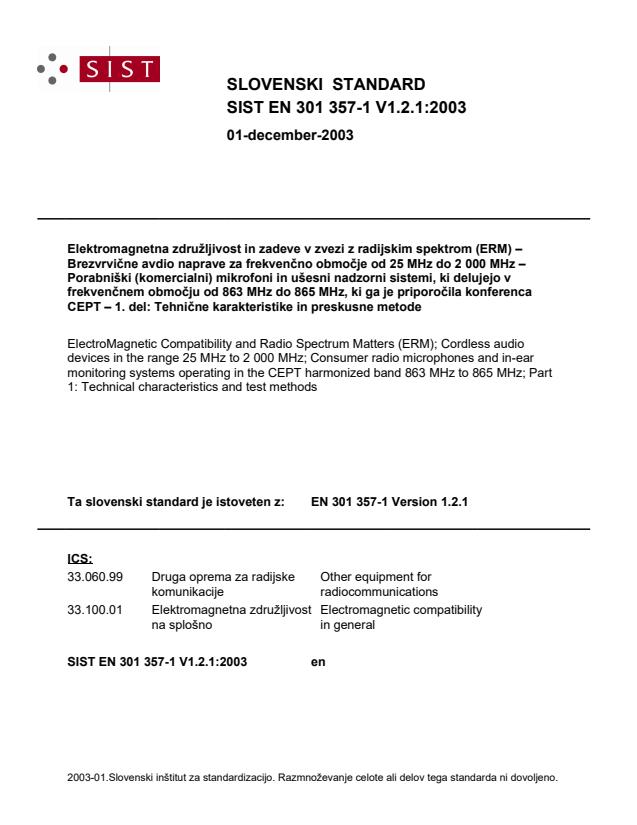
2003-01.Slovenski inštitut za standardizacijo. Razmnoževanje celote ali delov tega standarda ni dovoljeno.RQIHUHQFDElectroMagnetic Compatibility and Radio Spectrum Matters (ERM); Cordless audio devices in the range 25 MHz to 2 000 MHz; Consumer radio microphones and in-ear monitoring systems operating in the CEPT harmonized band 863 MHz to 865 MHz; Part 1: Technical characteristics and test methods33.100.01Elektromagnetna združljivost na splošnoElectromagnetic compatibility in general33.060.99Druga oprema za radijske komunikacijeOther equipment for radiocommunicationsICS:Ta slovenski standard je istoveten z:EN 301 357-1 Version 1.2.1SIST EN 301 357-1 V1.2.1:2003en01-december-2003SIST EN 301 357-1 V1.2.1:2003SLOVENSKI
STANDARD
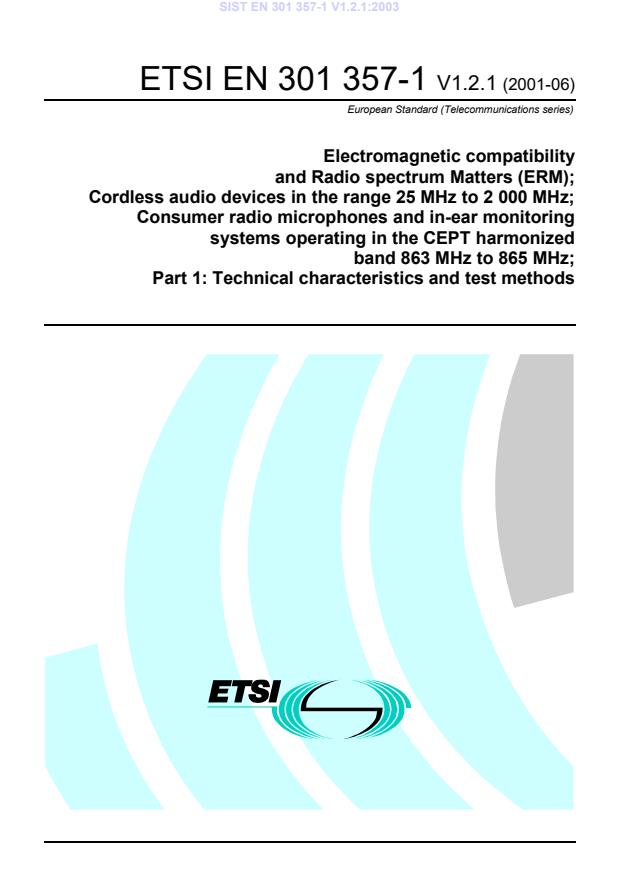
ETSIEN301357-1V1.2.1(2001-06)EuropeanStandard(Telecommunicationsseries)ElectromagneticcompatibilityandRadiospectrumMatters(ERM);Cordlessaudiodevicesintherange25MHzto2000MHz;Consumerradiomicrophonesandin-earmonitoringsystemsoperatingintheCEPTharmonizedband863MHzto865MHz;Part1:TechnicalcharacteristicsandtestmethodsSIST EN 301 357-1 V1.2.1:2003
ETSIETSIEN301357-1V1.2.1(2001-06)2ReferenceREN/ERM-RP08-0309-3Keywordsaudio,radio,radiomic,testingETSI650RoutedesLuciolesF-06921SophiaAntipolisCedex-FRANCETel.:+33492944200Fax:+33493654716SiretN°34862356200017-NAF742CAssociationàbutnonlucratifenregistréeàlaSous-PréfecturedeGrasse(06)N°7803/88ImportantnoticeIndividualcopiesofthepresentdocumentcanbedownloadedfrom:http://www.etsi.orgThepresentdocumentmaybemadeavailableinmorethanoneelectronicversionorinprint.Inanycaseofexistingorperceiveddifferenceincontentsbetweensuchversions,thereferenceversionisthePortableDocumentFormat(PDF).Incaseofdispute,thereferenceshallbetheprintingonETSIprintersofthePDFversionkeptonaspecificnetworkdrivewithinETSISecretariat.Usersofthepresentdocumentshouldbeawarethatthedocumentmaybesubjecttorevisionorchangeofstatus.InformationonthecurrentstatusofthisandotherETSIdocumentsisavailableathttp://www.etsi.org/tb/status/Ifyoufinderrorsinthepresentdocument,sendyourcommentto:editor@etsi.frCopyrightNotificationNopartmaybereproducedexceptasauthorizedbywrittenpermission.Thecopyrightandtheforegoingrestrictionextendtoreproductioninallmedia.©EuropeanTelecommunicationsStandardsInstitute2001.Allrightsreserved.SIST EN 301 357-1 V1.2.1:2003
ETSIETSIEN301357-1V1.2.1(2001-06)3ContentsIntellectualPropertyRights.6Foreword.6Introduction.71Scope.82References.83Definitions,symbolsandabbreviations.93.1Definitions.93.2Symbols.103.3Abbreviations.104Functionalcharacteristics.104.1Cordlessaudio.104.2Consumerradiomicrophones.114.3In-earmonitoring.114.4In-vehiclecordless.114.5Personalcordless.114.6Broadbandmultichannelsystems.115General.115.1Presentationofequipmentfortestingpurposes.115.1.1Choiceofmodelforperformancetesting.125.1.2Definitionsofalignmentandswitchingranges.125.1.3AlignmentRange.125.1.4Choiceoffrequencies.125.1.5Testingofsinglechannelequipment.125.1.6Testingoftwochannelequipment.125.1.7Testingofmulti-channelequipment(morethantwochannels).125.1.8Testingofequipmentwithanexternalfrequencycontrol.135.1.9Testingofequipmentwithanintegralantenna.135.1.9.1EquipmentwithapermanentinternalRFport.135.1.9.2EquipmentwithatemporaryRFport.135.2Mechanicalandelectricaldesign.135.2.1General.135.2.2Controls.135.2.3Integralantenna.135.2.4Marking.145.2.4.1Equipmentidentification.145.2.4.2Regulatorymarking.145.3Interpretationofthemeasurementresults.146Testconditions,powersourcesandambientconditions.146.1Normalandextremetest-conditions.146.2Testpowersource.146.3Normaltestconditions.156.3.1Normaltemperatureandhumidity.156.3.2Normaltestpowersourcevoltage.156.3.2.1Mainsvoltage.156.3.2.2Nickel-cadmiumcells.156.3.2.3Otherpowersources.156.4Extremetestconditions.156.4.1Extremetemperatures.156.4.1.1Proceduresfortestsatextremetemperatures.166.4.2Extremetestpowersourcevoltages.166.4.2.1Mainsvoltage.166.4.2.2Re-chargeablebatterypowersources.16SIST EN 301 357-1 V1.2.1:2003
ETSIETSIEN301357-1V1.2.1(2001-06)46.4.2.3Powersourcesusingothertypesofbatteries.166.4.2.4Otherpowersources.167Generalconditions.177.1Normaltestmodulation.177.2Testfixture.187.3Testsiteandgeneralarrangementsforradiatedmeasurements.187.4Modesofoperationofthetransmitter.187.5Arrangementfortestsignalsattheinputofthetransmitter.198Methodsofmeasurementandlimitsfortransmitterparameters.198.1Frequencyerror.198.1.1Definition.198.1.2Methodofmeasurement.198.1.3Limit.198.2Carrierpower.198.2.1Definition.198.2.2Methodofmeasurementforequipmentwithintegralantenna.208.2.2.1Methodofmeasurementundernormaltestconditions.208.2.2.2Methodofmeasurementunderextremetestconditions.208.2.3Limit.218.3Channelbandwidth.218.3.1Definition.218.3.2MeasurementofNecessaryBandwidth(BN).218.3.3Limits.228.3.4EdgeofBandLimits.228.4Spuriousemissions.238.4.1Definitions.238.4.2Methodofmeasuringtheeffectiveradiatedpower.238.4.3Limits.248.4.4Measuringreceiver.248.5Cordlessaudiotransmittershutoff.248.5.1Definition.248.5.2Methodofmeasurement.248.5.3Limits.249Receiver.259.1Spuriousemissions.259.1.1Definitions.259.1.2Methodofmeasuringthepowerlevelinaspecifiedload.259.1.3Methodofmeasuringtheeffectiveradiatedpoweroftheenclosure.259.1.4Methodofmeasuringtheeffectiveradiatedpower.269.1.5Limits.2610Measurementuncertainty.26AnnexA(normative):Radiatedmeasurement.28A.1Testsitesandgeneralarrangementsformeasurementsinvolvingtheuseofradiatedfields.28A.1.1AnechoicChamber.28A.1.2AnechoicChamberwithaconductivegroundplane.29A.1.3OpenAreaTestSite(OATS).30A.1.4Testantenna.31A.1.5Substitutionantenna.31A.1.6Measuringantenna.32A.1.7Striplinearrangement.32A.1.7.1General.32A.1.7.2Description.32A.1.7.3Calibration.32A.1.7.4Modeofuse.32A.2Guidanceontheuseofradiationtestsites.32A.2.1Verificationofthetestsite.33A.2.2PreparationoftheEUT.33SIST EN 301 357-1 V1.2.1:2003
ETSIETSIEN301357-1V1.2.1(2001-06)5A.2.3PowersuppliestotheEUT.33A.2.4Volumecontrolsettingforanaloguespeechtests.33A.2.5Rangelength.33A.2.6Sitepreparation.34A.3Couplingofsignals.34A.3.1General.34A.3.2DataSignals.35A.3.3Speechandanaloguesignals.35A.3.3.1Acousticcouplerdescription.35A.3.3.2Calibration.35A.4Standardtestposition.35A.5Testfixture.36A.5.1Description.36A.5.2Calibration.37A.5.3Modeofuse.37AnnexB(normative):MeasurementofNecessaryBandwidth(BN).38AnnexC(informative):Receiverparameters.39C.1Blockingordesensitisation.39C.1.1Definition.39C.1.2Methodofmeasurement.39C.1.2.1Measurementprocedure.39C.1.2.2Definitions.39C.1.2.3Limitsforapplicationsbelow1GHz.40C.1.2.4Limitsforapplicationsabove1GHz.40C.2Frequencymaskforthereceiverpart.40C.2.1Definition.40C.2.2Methodofmeasurement.40C.2.3Typicalvaluesforreceivers.41C.2.3.1Typicalvaluesforreceiverswithanaloguemodulation.41C.2.3.2Typicalvaluesforreceiverswithdigitalmodulation.41History.42SIST EN 301 357-1 V1.2.1:2003
ETSIETSIEN301357-1V1.2.1(2001-06)6IntellectualPropertyRightsIPRsessentialorpotentiallyessentialtothepresentdocumentmayhavebeendeclaredtoETSI.TheinformationpertainingtotheseessentialIPRs,ifany,ispubliclyavailableforETSImembersandnon-members,andcanbefoundinETSISR000314:"IntellectualPropertyRights(IPRs);Essential,orpotentiallyEssential,IPRsnotifiedtoETSIinrespectofETSIstandards",whichisavailablefromtheETSISecretariat.LatestupdatesareavailableontheETSIWebserver(http://www.etsi.org/ipr).PursuanttotheETSIIPRPolicy,noinvestigation,includingIPRsearches,hasbeencarriedoutbyETSI.NoguaranteecanbegivenastotheexistenceofotherIPRsnotreferencedinETSISR000314(ortheupdatesontheETSIWebserver)whichare,ormaybe,ormaybecome,essentialtothepresentdocument.ForewordThisEuropeanStandard(Telecommunicationsseries)hasbeenproducedbyETSITechnicalCommitteeElectromagneticcompatibilityandRadiospectrumMatters(ERM).EveryENpreparedbyETSIisavoluntarystandard.Thepresentdocumentmaycontaintextconcerningconformancetestingoftheequipmenttowhichitrelates.Thistextshouldbeconsideredasguidanceonlyanddoesnotmakethepresentdocumentmandatory.AnnexAprovidesnormativespecificationsconcerningradiatedmeasurements.AnnexBprovidesagraphicrepresentationoftheequipmentandfrequenciesforthetestingofsingleandmultifrequencyequipment.AnnexCprovidesinformativeparametersonthereceiverpart,whichareintendedtogiveguidancetomanufacturers.Thepresentdocumentispart1ofamulti-partdeliverablecoveringCordlessaudiodevicesintherange25MHzto2000MHz;Consumerradiomicrophonesandin-earmonitoringsystemsoperatingintheCEPTharmonizedband863MHzto865MHz,asidentifiedbelow:Part1:"Technicalcharacteristicsandtestmethods";Part2:"HarmonizedENunderarticle3.2oftheR&TTEDirective".NationaltranspositiondatesDateofadoptionofthisEN:15June2001DateoflatestannouncementofthisEN(doa):30September2001DateoflatestpublicationofnewNationalStandardorendorsementofthisEN(dop/e):31March2002DateofwithdrawalofanyconflictingNationalStandard(dow):31March2002SIST EN 301 357-1 V1.2.1:2003
ETSIETSIEN301357-1V1.2.1(2001-06)7IntroductionInpreparingthepresentdocument,muchattentionhasbeengiventoassurealowinterferenceprobability,whileatthesametimeallowingamaximumflexibilityandservicetotheend-user.ThepresentdocumentprovidesthenecessaryparametersforequipmenttoobtaincommonapprovalthroughoutEurope.Commontechnicalspecificationsandharmonizedfrequencyallocationsareexpectedtoreducethepresentproblemsofinterferenceandillegaluse.Thepresentdocumentisusedforconformitytestingbasedonspectrumutilisationparametersanddoesnotincludeperformancecharacteristicsthatmayberequiredbytheuserorrequirementsforinterfacingequipment.ThepresentdocumentisintendedtospecifytheminimumperformanceandthemethodsofmeasurementofCordlessaudioequipmentintherange25MHzto2000MHz,Consumerradiomicrophonesandinearmonitoringequipmentintherange863MHzto865MHz,asspecifiedinthescope.ConsumerradiomicrophonesandinearmonitoringequipmentmaybetestedtoeitherEN300422[8]forequipmentwithmaximumoccupiedbandwidth<200kHzortothepresentdocumentforequipmentwithmaximumoccupiedbandwidth>200kHzwithdueconsiderationofpowerandoperatingfrequency.Testmeasurementsshouldbeperformedinoneoftheaccreditedtestlaboratories,acceptedbythevariousnationalregulatoryauthoritiesinordertograntconformityapproval,providedthenationalregulatoryrequirementsaremet.ThisisincompliancewithCEPT/ERC/REC01-06[1]andCEPT/ERC/DEC(97)10[2].Inaddition,nationaladministrationsmayaccepta"certificateofconformity"basedonatypetestreport,ifrequired.Ifequipmentavailableonthemarketisrequiredtobechecked,itshouldbetestedinaccordancewiththemethodsofmeasurementspecifiedinthepresentdocument.SIST EN 301 357-1 V1.2.1:2003
ETSIETSIEN301357-1V1.2.1(2001-06)81ScopeThepresentdocumentcoverstheminimumcharacteristicsconsiderednecessaryinordertomakethebestuseoftheavailablefrequencies.Itdoesnotnecessarilyincludeallthecharacteristicsthatmayberequiredbyauser,nordoesitnecessarilyrepresenttheoptimumperformanceachievable.Cordlessaudiodevicescoveredwithinthepresentdocumentareconsideredbydefinitionshort-rangedevices,thepowerlimitsforfrequencybandswillbefoundinthecurrentversionofCEPT/ERC/REC70-03[6](ornationalregulations).Thepresentdocumentappliestocordlessaudio,consumerradiomicrophonesandinearmonitoringequipmentusingeither300kHzbandwidthanaloguemodulationor300kHz,600kHzor1200kHzdigitalFDMAmodulation.Thefrequencybandsforthisequipmentmaydifferfromcountrytocountryasspecifiedintheirnationalregulations.Allequipmentisintendedtobeusedwithintegralantennas.Consumeraudioequipmentintendedforaudioandvoiceoperatingbelow50MHzandusingnarrowbandmodulationareconsideredandtestedaccordingtoEN300220[10].ElectromagneticCompatibility(EMC)requirementsarecoveredbyEN301489-9[7].Thetypesofequipmentcoveredbythepresentdocumentareasfollows:-cordlessheadphones;-cordlessloudspeakers;-consumerradiomicrophones;-in-earmonitoring;-in-vehiclecordless;personalcordless;-broadbandmultichannelaudiosystems.2ReferencesThefollowingdocumentscontainprovisionswhich,throughreferenceinthistext,constituteprovisionsofthepresentdocument.• Referencesareeitherspecific(identifiedbydateofpublicationand/oreditionnumberorversionnumber)ornon-specific.• Foraspecificreference,subsequentrevisionsdonotapply.• Foranon-specificreference,thelatestversionapplies.[1]CEPT/ERC/REC01-06:"Procedureformutualrecognitionoftypetestingandtypeapprovalforradioequipment".[2]CEPT/ERC/DEC(97)10:"ERCDecisionof30June1997onthemutualrecognitionofconformityassessmentproceduresincludingmarkingofradioequipmentandradioterminalequipment".[3]ITU-RRecommendationBS.559-2:"Objectivemeasurementofradio-frequencyprotectionratiosinLF,MFandHFbroadcasting".[4]ETSIETR028:"RadioEquipmentandSystems(RES);Uncertaintiesinthemeasurementofmobileradioequipmentcharacteristics".[5]IEC60244-13:"Methodsofmeasurementforradiotransmitters-Part13:PerformancecharacteristicsforFMsoundbroadcasting".[6]CEPT/ERC/REC70-03:"RelatingtotheuseofShortRangeDevices(SRD)".SIST EN 301 357-1 V1.2.1:2003
ETSIETSIEN301357-1V1.2.1(2001-06)9[7]ETSIEN301489-9:"ElectroMagneticcompatibilityandRadiospectrumMatters(ERM);ElectroMagneticCompatibility(EMC)standardforradioequipmentandservices;Part9:SpecificconditionsforwirelessmicrophonesandsimilarRadioFrequency(RF)audiolinkequipment".[8]ETSIEN300422:"ElectromagneticcompatibilityandRadiospectrumMatters(ERM);Technicalcharacteristicsandtestmethodsforwirelessmicrophonesinthe25MHzto3GHzfrequencyrange".[9]ETSIETR027:"RadioEquipmentandSystems(RES);Methodsofmeasurementforprivatemobileradioequipment".[10]ETSIEN300220:"ElectromagneticcompatibilityandRadiospectrummatters(ERM);Short-rangedevices;Radioequipmenttobeusedinthe25MHzto1000MHzfrequencyrangewithpowerlevelsrangingupto500mW".[11]ETSIETR273:"ElectromagneticcompatibilityandRadiospectrumMatters(ERM);Improvementofradiatedmethodsofmeasurement(usingtestsites)andevaluationofthecorrespondingmeasurementuncertainties".[12]ANSIC63.5:"AmericanNationalStandardforCalibrationofAntennasUsedforRadiatedEmissionMeasurementsinElectromagneticInterference(EMI)ControlCalibrationofAntennas(9kHzto40GHz)".[13]IEC60489-3:"Methodsofmeasurementforradioequipmentusedinthemobileservices.Part3:ReceiversforA3EorF3Eemissions".3Definitions,symbolsandabbreviations3.1DefinitionsForthepurposesofthepresentdocument,thefollowingtermsanddefinitionsapply:integralantenna:antenna,withorwithoutaconnector,designedas,anddeclaredasbythemanufacturer,anindispensablepartoftheequipmentartificialantenna:tunedreduced-radiatingdummyloadequaltothenominalimpedancespecifiedbytheapplicantradiatedmeasurements:measurementsthatinvolvetheabsolutemeasurementofaradiatedelectromagneticfieldchannelbandwidth:frequencybandofdefinedwidthincludingsafetymarginforoperationonadjacentchannels,locatedsymmetricallyaroundthecarrierfrequencyport:anyconnectionpointonorwithintheEquipmentUnderTest(EUT)intendedfortheconnectionofcablestoorfromthatequipmentnecessarybandwidth:is,foragivenclassofemission,thewidthofthefrequencybandwhichisjustsufficienttoensurethetransmissionofinformationattherateandwiththequalityrequiredunderspecifiedconditions.However,thenecessarybandwidthsofmostdigitalmodulationformatsarepresentlynotreferredtoITU-RRecommendationsofSMseries.spuriousemissionlimits:applyatfrequenciesaboveandbelowthefundamentaltransmittingfrequencybutseparatedfromthecenterfrequencyoftheemissionby250%ofthenecessarybandwidth.However,thisfrequencyseparationmaybedependentonthetypeofmodulationused,themaximumbitrateinthecaseofdigitalmodulation,thetypeoftransmitter,andfrequencycoordinationfactors.Forexample,wherepracticalthe± 250%oftherelevantChannelSeparation(CS)maybeused.SIST EN 301 357-1 V1.2.1:2003
ETSIETSIEN301357-1V1.2.1(2001-06)103.2SymbolsForthepurposesofthepresentdocument,thefollowingsymbolsapply:λwavelengthinmetresµFmicroFaradµWmicroWattΩohmdBcdBrelativetothecarrierlevelEfieldstrengthEoreferencefieldstrength(seeannexA)fccarrierfrequencyfooperatingfrequencyGHzGigaHertzkHzkiloHertzMHzMegaHertzmWmilliWattnWnanoWattRdistance(seeannexA)Roreferencedistance(seeannexA)3.3AbbreviationsForthepurposesofthepresentdocument,thefollowingabbreviationsapply:acalternatingcurrentBChannelBandwidthBNNecessaryBandwidthCWcontinuouswavedcdirectcurrenterpeffectiveradiatedpowerEUTEquipmentUnderTestFDMAFrequencydivisionmultipleaccessHFHighFrequencyLFLowFrequencyMFMediumFrequencyRBWResolutionBandwidthRFRadioFrequencySRDShortRangeDevicesTDMATimeDivisionMultipleAccessTxTransmitterVBWVideoBandwidth4Functionalcharacteristics4.1CordlessaudioCordlessaudioequipmentencompassese.g.radiolinkedheadphonesandloudspeakers.Thetransmittersmaybeinstalledinabuilding,fittedinavehicleorbodyworn.Thetermcordlessisalsousedtodescribeinfraredandothernon-RF"wireless"links,butinthecontextofthepresentdocumentitisrestrictedtoRFoperatingsystemsonly.Stereoequipmentcanbedesignedforrequiredchannelbandwidthsof200kHzorlessbutonlywithahighcostpenalty,howeverconsumerwideband(multichannel)audioequipmentandstereoequipmentusinge.g.Zenith-GEpilottonesystemsordigitalmodulationmayneedwiderbandwidthsasdefinedinthepresentdocument.Otherequipmentthatmaybeconnectedtocordlessaudioequipmentshallfulfilthestandardsapplicabletothatequipment(ifany).SIST EN 301 357-1 V1.2.1:2003
ETSIETSIEN301357-1V1.2.1(2001-06)114.2ConsumerradiomicrophonesConsumerradiomicrophonesareintendedfornon-professionalapplications.4.3In-earmonitoringIn-earmonitoringequipmentisusedbystageandstudioperformerstoreceivepersonalfoldback(monitoring)oftheperformance.Thiscanbejusttheirownvoiceoracomplexmixofsources.Thisequipmentisusuallystereoor2channelaudio.Otherequipmentthatmaybeconnectedtoin-earmonitoringequipmentshallfulfilthestandardsapplicabletothatequipment(ifany).4.4In-vehiclecordlessIn-vehiclesystemsareusedforprivatelisteninginautomobilesandothermethodsoftransport(wherepermitted).4.5PersonalcordlessPersonalcordlesstransmittersaretoenablethebodywornpersonalstereoequipmenttobewirefree.4.6BroadbandmultichannelsystemsBroadbandmultichannelsystemsareusedforthetransmissionofhighqualitydigitalaudio.Thesecanbee.g.surroundsoundsystemsoruncompressedaudio.Theyareintendedtobeusedinspectrumabove1GHz.5General5.1PresentationofequipmentfortestingpurposesEachequipmentsubmittedforperformancetestingshallfulfiltherequirementsofthepresentdocumentonallchannelsoverwhichitisintendedtooperate.Theapplicantshallcompletetheappropriateapplicationformwhensubmittingequipmentfortesting.Theapplicantshallstatethechannelbandwidth(s)withinwhichtheequipmentisdesignedtooperate.Theapplicantshallalsosupplyallrelevantinterfaceinformationandanytoolsandtestfixturestoallow:-directcurrent(dc)powerconnection;-analogueaudioconnection;-thedeviationlimitingofthetransmitter;and-thesettingofanyinputaudiolevelcontrolsandinputsignallevelfornormaloperation,forasinusoidalinputsignalof500Hz.Themanufacturershallspecifythesettingsofanyothercontrolsnecessarytoavoidinvalidatingthetestmeasurements.Besidesthetechnicaldocumentation,theapplicantshouldalsosupplyanoperatingmanual,identicalincontenttothatsuppliedwiththeproductionmodel(s)availabletothepublic,forthedevice(s).Tosimplifyandharmonizethetestingproceduresbetweenmanufacturersandtestlaboratories,measurementsshallbeperformed,accordingtothepresentdocument,onsamplesofequipmentdefinedinclauses5.1.1to5.1.9.2.Theseclausesareintendedtogiveconfidencethattherequirementssetoutinthepresentdocumenthavebeenmetwithoutthenecessityofperformingmeasurementsonallchannels.SIST EN 301 357-1 V1.2.1:2003
ETSIETSIEN301357-1V1.2.1(2001-06)125.1.1ChoiceofmodelforperformancetestingTheapplicantshallprovideonesampleofeachmodeltobetested.Theequipmenttestedshallberepresentativeinalltechnicalrespectsofaproductionmodel.5.1.2DefinitionsofalignmentandswitchingrangesThealignmentrangeisdefinedasthefrequencyrangeoverwhichthereceiverandthetransmittercanbeprogrammedand/orre-alignedtooperatewithasingleoscillatorfrequencymultiplication,withoutanyphysicalchangeofcomponentsotherthan:-programmablereadonlymemoriessuppliedbythemanufacturerorthemanufacturer'snominee;-crystals;-frequencysettingelements(forthereceiverandtransmitter).Theseelementsshallnotbeaccessibletotheenduserandshallbedeclaredbytheapplicantintheapplicationform.Theswitchingrangeisthemaximumfrequencyrangeoverwhichthereceiverorthetransmittercanbeoperatedwithoutre-programmingorrealignment.Theapplicantshall,whensubmittingequipmentfortest,statethealignmentrangesforthereceiverandtransmitter.Theapplicantshallalsostatetheswitchingrangeofthereceiverandthetransmitter(whichmaydiffer).5.1.3AlignmentRangeThealignmentrangeforthereceiverandtransmitter,whichmaybedifferent,shallbewithintheapplicableband.5.1.4ChoiceoffrequenciesThefrequenciesfortestingshallbechosenbytheapplicant,inaccordancewithclauses5.1.5to5.1.7.5.1.5TestingofsinglechannelequipmentFulltestsshallbecarriedoutonachannelwithinB/2ofthecentrefrequencyofthealignmentrangeononesampleoftheequipment(B=declaredchannelbandwidth).5.1.6TestingoftwochannelequipmentOnesampleshallbesubmittedtoenableteststobecarriedoutonbothchannels.ThefrequencyoftheupperchannelshallbewithinB/2ofthehighestfrequencyoftheswitchingrange.ThefrequencyofthelowerchannelshallbewithinB/2ofthelowestfrequencyoftheswitchingrange.Inaddition,theaverageofthefrequenciesofthetwochannelsshallbewithinB/2ofthecentrefrequencyofthealignmentrange.Fulltestsshallbecarriedoutonbothchannels.5.1.7Testingofmulti-channelequipment(morethantwochannels)Onesampleoftheequipmentshallbesubmittedtoenableteststobecarriedoutonthreechannels.Thecentrefrequencyoftheswitchingrangeofthesampleshallcorrespondtothecentrefrequencyofthealignmentrange.FulltestsshallbecarriedoutonafrequencywithinB/2ofthecentre,lowestandhighestfrequenciesoftheswitchingrange.SIST EN 301 357-1 V1.2.1:2003
ETSIETSIEN301357-1V1.2.1(2001-06)135.1.8TestingofequipmentwithanexternalfrequencycontrolOnesampleshallbesubmittedtoenableteststobeperformedacrosstheentirefrequencybandallowedbythefrequencycontrolsetting.Thefollowingtestsshallbeperformedateitheredgeofthetuneablerangeoftheequipment:-clause8.1:Frequencyerror;-clause8.2:Carrierpower;-clause8.3:Channelbandwidth.Thefollowingtestsshallbeperformedwiththefrequencysettothemiddleofthetuneablerangeoftheequipment:-clause8.4:Spuriousemissions;-clause8.5:Transmittershutoff.5.1.9TestingofequipmentwithanintegralantennaTofacilitaterelativemeasurements,usemaybemadeofatestfixtureasdescribedinclause7.2,ortheequipmentmaybesuppliedwithapermanentinternalortemporaryinternal/externalRFport.5.1.9.1EquipmentwithapermanentinternalRFportThewaytoaccessapermanentinternalRFportshallbestatedbytheapplicantwiththeaidofadiagram.ThefactthatusehasbeenmadeofapermanentinternalRFportshallberecordedinthetestreport.5.1.9.2EquipmentwithatemporaryRFportTheapplicantshallsubmittwosetsofequipmenttothetestlaboratory,onefittedwithatemporary50ΩRFconnectorwiththeantennadisconnectedandtheotherwiththeantennaconnected.Eachequipmentshallbeusedfortheappropriatetests.ThewaythetemporaryRFportisimplementedshallbestatedbytheapplicantwiththeaidofadiagram.ThefactthatusehasbeenmadeofthetemporaryRFporttofacilitatemeasurementsshallbestatedinthetestreport.TheadditionofatemporaryRFportshouldnotinfluencetheperformanceoftheEUT.5.2Mechanicalandelectricaldesign5.2.1GeneralTheequipmentsubmittedbytheapplicantshallbedesigned,constructedandmanufacturedinaccordancewithsoundengineeringpractice,andwiththeaimofminimizingharmfulinterferencetootherequipmentandservicesandminimizingriskofphysicalinjurytotheuserwheninuseorhavingtogainaccesstobatteriesorcontrols.5.2.2ControlsThosecontrolsthat,ifmaladjusted,mightincreasetheinterferingpotentialitiesoftheequipmentshallonlybeaccessiblebypartialorcompletedisassemblyofthedeviceandrequiringtheuseofspecialtools.5.2.3IntegralantennaConformitytestingofequipmentwithintegralantennaonlyappliestothatequipmenttogetherwiththeantennaoriginallyprovidedbythemanufacturerfortypetesting.SIST EN 301 357-1 V1.2.1:2003
ETSIETSIEN301357-1V1.2.1(2001-06)145.2.4MarkingTheequipmentshallbemarkedinavisibleplace.Thismarkingshallbelegibleanddurable.5.2.4.1EquipmentidentificationThemarkingshallincludeasaminimum:-thenameoftheapplicantorhistrademark;-thetypedesignation.5.2.4.2RegulatorymarkingTheequipmentshallbemarked,whereapplicable,inaccordancewithCEPT/ERC/REC70-03[6].WherethisisnotapplicabletheequipmentshallbemarkedinaccordancewithnationalorEUregulatoryrequirements.5.3InterpretationofthemeasurementresultsTheinterpretationoftheresultsrecordedintheappropriatetestreportforthemeasurementsdescribedinthepresentdocumentshallbeasfollows:-themeasuredvaluerelatedtothecorrespondinglimitshallbeusedtodecidewhetheranequipmentmeetstherequirementsofthepresentdocument;-themeasurementuncertaintyvalueforthemeasurementofeachparametershallbeseparatelyincludedinthetestreport;-therecordedvalueofthemeasurementuncertaintyshallbe,foreachmeasurement,equaltoorlowerthanthefiguresinthetableofmeasurementuncertaintyasinclause10.6Testconditions,powersourcesandambientconditions6.1Normalandextremetest-conditionsPerformancetestsshallbemadeundernormaltestconditions,andalso,wherestated,underextremetestconditions.Thetestconditionsandproceduresshallbeasspecifiedinclauses6.2to6.4.2.4.6.2TestpowersourceDuringperformanceteststhepowersourceoftheequipmentshallbereplacedbyatestpowersource,capableofproducingnormalandextremetestvoltagesasspecifiedinclauses6.3.2and6.4.2.Theinternalimpedanceofthetestpowersourceshallbelowenoughforitseffectonthetestresultstobenegligible.Forthepurposeofthetests,thevoltageofthepowersourceshallbemeasuredattheinputterminalsoftheequipment.Forbattery-operatedequipment,thebatteryshallberemovedandthetestpowersourceshallbesuitablydecoupledandappliedasclosetotheequipmentbatteryterminalsaspracticable.Forradiatedmeasurementsanyexternalpowerleadsshouldbearrangedsoasnottoaffectthemeasurements.Ifnecessarytheexternalpowersupplymaybereplacedwiththeequipment'sowninternalbatteriesattherequiredvoltage,thisshallbestatedonthetestreport.Iftheequipmentisprovidedwithapowercableorpowersocket,thetestvoltageshallbethatmeasuredatthepointofconnectionofthepowercabletotheequipment.SIST EN 301 357-1 V1.2.1:2003
ETSIETSIEN301357-1V1.2.1(2001-06)15Duringteststhepowersourcevoltagesshallbewithinatoleranceof<±1%relativetothevoltageatthebeginningofeachtest.Thevalueofthistolerancecanbecriticalforcertainmeasurements.Usingasmallertoleranceprovidesabetteruncertaintyvalueforthesemeasurements.Ifinternalbatteriesareused,attheendofeachtestthevoltageshallbewithinatoleranceof<±1%relativetothevoltageatthebeginningofeachtest.6.3Normaltestconditions6.3.1NormaltemperatureandhumidityThenormaltemperatureandhumidityconditionsfortestsshallbeanyconvenientcombinationoftemperatureandhumiditywithinthefollowingranges:-temperature:+15°Cto+35°C;-relativehumidity:20%to75%.Whenitisimpracticabletocarryoutthetestsundertheconditionsstatedabove,anotetothiseffect,statingtheactualtemperatureandrelativehumidityduringthetests,shallbeaddedtothetestreport.6.3.2Normaltestpowersourcevoltage6.3.2.1MainsvoltageThenormaltestvoltageforequipmenttobeconnectedtothemainsshallbethenominalmainsvoltage.Forthepurposeofthepresentdocument,thenominalvoltageshallbethedeclaredmainsvoltage,oranyofthedeclaredmainsvoltages,forwhichtheequipmentwasdesigned.Thefrequencyofthetestpowersourcecorrespondingtothealternatingcurrent(ac)mainsshallbebetween49Hzand51Hz.6.3.2.2Nickel-cadmiumcellsWhentheradioequipmentisintendedforoperationfromtheusualtypesofnickel-cadmiumcellthenominaltestvoltageshallbe1,2Vpercell.6.3.2.3OtherpowersourcesForoperationfromotherpowersourcesortypesofbattery(primaryorsecondary),thenormaltestvoltageshallbethatdeclaredbytheequipmentmanufacturer,inequipmenthandbookandapprovedbythetestlaboratory.Thevaluesshallbestatedinthetestreport.6.4Extremetestconditions6.4.1ExtremetemperaturesFortestsatextremetemperatures,measurementsshallbemadeinaccordancewiththeproceduresspecifiedinclause6.4.1.1,at:a)-10°Cand+45°C,forin-vehicleequipment;b)+5°Cand+45°C,forallothertypesofequipment.SIST EN 301 357-1 V1.2.1:2003
ETSIETSIEN301357-1V1.2.1(2001-06)166.4.1.1ProceduresfortestsatextremetemperaturesBeforemeasurementsaremadetheequipmentshallhavereachedthermalbalanceinthetestchamber.Theequipmentshallbeswitchedoffduringthetemperaturestabilizingperiod.Ifthethermalbalanceisnotcheckedbymeasurements,atemperature-stabilizingperiodofatleastonehourshallbeallowed.Thesequenceofmeasurementsshallbechosenandthehumiditycontentinthetestchambershallbecontrolledsothatexcessivecondensationdoesnotoccur.Beforetestsatthehighertemperatures,theequipmentshallbeplacedinthetestchamberandleftuntilthermalbalanceisattained.Theequipmentshallthenbeswitchedonforoneminuteinthetransmitcondition,afterwhichtheequipmentshallmeetthespecifiedrequirements.Fortestsatthelowerextremetemperaturetheequipmentshallbeleftinthetestchamberuntilthermalbalanceisattained,thenswitchedtothestandbyorreceiveconditionforoneminuteafterwhichtheequipmentshallmeetthespecifiedrequirements.6.4.2Extremetestpowersourcevoltages6.4.2.1MainsvoltageTheextremetestvoltagesforequipmenttobeconnectedtoanacmainssourceshallbethenominalmainsvoltage±10%.Thefrequencyofthetestpowersourcecorrespondingtotheacmainsshallbebetween49Hzand51Hz.6.4.2.2Re-chargeablebatterypowersourcesWhentheradioequipmentisintendedforoperationfromnickel-cadmiumcells,theextremetestvoltageshallbe1,3and0,9timest
...