

SIST EN 13165:2013+A2:2016
(Main)Thermal insulation products for buildings - Factory made rigid polyurethane foam (PU) products - Specification
General Information
- Abstract
This European Standard specifies the requirements for factory made rigid polyurethane foam (PU) products, with or without facings or coatings, which are used for the thermal insulation of buildings. PU includes both PIR and PUR products. The products are manufactured in the form of boards.
This European Standard includes PU multi-layered insulation products, see Annex D.
Products covered by this standard are also used in prefabricated thermal insulation systems and composite insulation products; the performance of systems incorporating these products is not covered.
This standard describes product characteristics and includes procedures for testing, evaluation of conformity, marking and labelling.
This standard does not specify the required level of a given property to be achieved by a product to demonstrate fitness for purpose in a particular application. The levels required for a given application are to be found in regulations or non-conflicting standards.
Products with a declared thermal resistance lower than 0,25 m2⋅K/W or a declared thermal conductivity greater than 0,060 W/(m⋅K) at 10 °C are not covered by this European Standard.
This standard does not cover in situ insulation products and products intended to be used for the insulation of building equipment and industrial installations (covered by EN 14308).
- Status
- Published
- Publication Date
- 16-Aug-2016
- Technical Committee
- TOP - Thermal insulation
- Current Stage
- 6060 - National Implementation/Publication (Adopted Project)
- Start Date
- 22-Jun-2016
- Due Date
- 27-Aug-2016
- Completion Date
- 17-Aug-2016



Overview
EN 13165:2012+A2:2016 - "Thermal insulation products for buildings - Factory made rigid polyurethane foam (PU) products - Specification" is the CEN standard that defines requirements and conformity procedures for factory‑made rigid polyurethane (PU) insulation boards (including PUR and PIR), with or without facings/coatings. The standard covers product characteristics, test methods, designation codes, factory production control and marking & labelling. It includes provisions for multi‑layered PU products (Annex D) and guidance on determining aged thermal performance (Annex C). EN 13165 does not set application‑specific performance levels (those are defined by regulations or other standards) and excludes in‑situ products and equipment/industrial insulation (see EN 14308).
Key topics and technical requirements
- Scope limits: excludes products with declared thermal resistance < 0.25 m2·K/W or declared thermal conductivity > 0.060 W/(m·K) at 10 °C.
- Product form: factory‑made rigid PU boards, optionally faced or coated; multi‑layered products addressed in Annex D.
- Thermal properties: procedures for declaring thermal conductivity and thermal resistance, including accelerated ageing to determine long‑term values (Annexes A and C).
- Mechanical and physical properties: dimensional tolerances, dimensional stability, compressive strength/stress, tensile strength perpendicular to faces, bending, water absorption, water vapour transmission and freeze‑thaw behaviour (tests and classification levels are specified).
- Assessment and Verification of Constancy of Performance (AVCP): defines systems for factory production control (FPC), product testing frequencies and third‑party tasks; includes CE marking requirements and Annex ZA for Construction Products Regulation (CPR) relationships.
- Testing & labelling: lists normative test methods, sample preparation and rules for marking, designation codes and labelling information for traceability and compliance.
Practical applications
- Specification and quality assurance for rigid PU insulation boards used in:
- External wall, roof and floor insulation systems
- Prefabricated insulation elements and composite insulation products (product performance only)
- Building retrofit and new construction projects where consistent thermal performance is required
- Basis for product declaration, CE marking and compliance documentation required under EU CPR for building products.
Who uses this standard
- Manufacturers of rigid PU insulation boards (PUR/PIR)
- Testing laboratories and certification bodies performing AVCP and FPC checks
- Architects, specifiers and consultants selecting insulation products by declared thermal and mechanical properties
- Regulators and procurers ensuring conformity with building regulations and CE marking requirements
- System integrators and prefab manufacturers using PU boards in composite products (system performance evaluated separately)
Related standards
- EN 14308 (equipment/industrial insulation)
- EN 15715 (mounting/fixing instructions for reaction to fire testing)
- Other EN 1316x series for factory‑made thermal insulation (e.g., EN 13162, EN 13163, EN 13164, EN 13171) - forming the thermal insulation product family.
Keywords: EN 13165, rigid polyurethane foam, PUR, PIR, thermal insulation boards, thermal conductivity, thermal resistance, AVCP, CE marking, factory production control.
Relations
- Effective Date
- 01-Sep-2016
- Effective Date
- 09-Feb-2026
- Effective Date
- 04-Feb-2026
- Effective Date
- 28-Jan-2026
- Effective Date
- 28-Jan-2026
- Effective Date
- 28-Jan-2026
- Effective Date
- 28-Jan-2026
- Effective Date
- 28-Jan-2026
- Effective Date
- 28-Jan-2026
- Effective Date
- 28-Jan-2026
- Effective Date
- 28-Jan-2026
- Effective Date
- 28-Jan-2026
- Effective Date
- 28-Jan-2026
- Effective Date
- 28-Jan-2026
- Effective Date
- 28-Jan-2026
Get Certified
Connect with accredited certification bodies for this standard

DIBt (Deutsches Institut für Bautechnik)
German Institute for Building Technology.
DIN CERTCO
DIN Group product certification.

Aboma Certification B.V.
Specialized in construction, metal, and transport sectors.
Sponsored listings
Frequently Asked Questions
SIST EN 13165:2013+A2:2016 is a standard published by the Slovenian Institute for Standardization (SIST). Its full title is "Thermal insulation products for buildings - Factory made rigid polyurethane foam (PU) products - Specification". This standard covers: This European Standard specifies the requirements for factory made rigid polyurethane foam (PU) products, with or without facings or coatings, which are used for the thermal insulation of buildings. PU includes both PIR and PUR products. The products are manufactured in the form of boards. This European Standard includes PU multi-layered insulation products, see Annex D. Products covered by this standard are also used in prefabricated thermal insulation systems and composite insulation products; the performance of systems incorporating these products is not covered. This standard describes product characteristics and includes procedures for testing, evaluation of conformity, marking and labelling. This standard does not specify the required level of a given property to be achieved by a product to demonstrate fitness for purpose in a particular application. The levels required for a given application are to be found in regulations or non-conflicting standards. Products with a declared thermal resistance lower than 0,25 m2⋅K/W or a declared thermal conductivity greater than 0,060 W/(m⋅K) at 10 °C are not covered by this European Standard. This standard does not cover in situ insulation products and products intended to be used for the insulation of building equipment and industrial installations (covered by EN 14308).
This European Standard specifies the requirements for factory made rigid polyurethane foam (PU) products, with or without facings or coatings, which are used for the thermal insulation of buildings. PU includes both PIR and PUR products. The products are manufactured in the form of boards. This European Standard includes PU multi-layered insulation products, see Annex D. Products covered by this standard are also used in prefabricated thermal insulation systems and composite insulation products; the performance of systems incorporating these products is not covered. This standard describes product characteristics and includes procedures for testing, evaluation of conformity, marking and labelling. This standard does not specify the required level of a given property to be achieved by a product to demonstrate fitness for purpose in a particular application. The levels required for a given application are to be found in regulations or non-conflicting standards. Products with a declared thermal resistance lower than 0,25 m2⋅K/W or a declared thermal conductivity greater than 0,060 W/(m⋅K) at 10 °C are not covered by this European Standard. This standard does not cover in situ insulation products and products intended to be used for the insulation of building equipment and industrial installations (covered by EN 14308).
SIST EN 13165:2013+A2:2016 is classified under the following ICS (International Classification for Standards) categories: 91.100.60 - Thermal and sound insulating materials. The ICS classification helps identify the subject area and facilitates finding related standards.
SIST EN 13165:2013+A2:2016 has the following relationships with other standards: It is inter standard links to SIST EN 13165:2013+A1:2015, SIST ISO 16269-6:2006, SIST EN ISO 11925-2:2026, SIST EN ISO 29466:2023, SIST EN ISO 29767:2019, SIST EN 13501-1:2019, SIST EN ISO 1716:2018, SIST EN ISO 354:2004, SIST EN 1607:2013, SIST EN ISO 4590:2016, SIST EN ISO 9229:2008, SIST EN 13820:2004, SIST EN 13172:2012, SIST EN 15715:2010, SIST EN 1605:2013. Understanding these relationships helps ensure you are using the most current and applicable version of the standard.
SIST EN 13165:2013+A2:2016 is associated with the following European legislation: EU Directives/Regulations: 305/2011; Standardization Mandates: M/103. When a standard is cited in the Official Journal of the European Union, products manufactured in conformity with it benefit from a presumption of conformity with the essential requirements of the corresponding EU directive or regulation.
SIST EN 13165:2013+A2:2016 is available in PDF format for immediate download after purchase. The document can be added to your cart and obtained through the secure checkout process. Digital delivery ensures instant access to the complete standard document.
Standards Content (Sample)
2003-01.Slovenski inštitut za standardizacijo. Razmnoževanje celote ali delov tega standarda ni dovoljeno.Toplotnoizolacijski proizvodi za stavbe - Proizvodi iz trde poliuretanske pene (PUR) - SpecifikacijaWärmedämmstoffe für Gebäude - Werkmäßig hergestellte Produkte aus Polyurethan-Hartschaum (PU) - SpezifikationProduits isolants thermiques pour le bâtiment - Produits manufacturés en mousse rigide de polyuréthane (PU) - SpécificationThermal insulation products for buildings - Factory made rigid polyurethane foam (PU) products - Specification91.100.60Thermal and sound insulating materialsICS:Ta slovenski standard je istoveten z:EN 13165:2012+A2:2016SIST EN 13165:2013+A2:2016en,fr,de01-september-2016SIST EN 13165:2013+A2:2016SLOVENSKI
STANDARDSIST EN 13165:2013+A1:20151DGRPHãþD
EUROPEAN STANDARD NORME EUROPÉENNE EUROPÄISCHE NORM
EN 13165:2012+A2
June 2016 ICS 91.100.60 Supersedes EN 13165:2012+A1:2015
English Version
Thermal insulation products for buildings - Factory made rigid polyurethane foam (PU) products - Specification
Produits isolants thermiques pour le bâtiment - Produits manufacturés en mousse rigide de polyuréthane (PU) - Spécification
Wärmedämmstoffe für Gebäude - Werkmäßig hergestellte Produkte aus Polyurethan-Hartschaum (PU) - Spezifikation This European Standard was approved by CEN on 6 October 2012 and includes Amendment 1 approved by CEN on 15 December 2014 and Amendment 2 approved by CEN on 23 February 2016.
CEN members are bound to comply with the CEN/CENELEC Internal Regulations which stipulate the conditions for giving this European Standard the status of a national standard without any alteration. Up-to-date lists and bibliographical references concerning such national standards may be obtained on application to the CEN-CENELEC Management Centre or to any CEN member.
This European Standard exists in three official versions (English, French, German). A version in any other language made by translation under the responsibility of a CEN member into its own language and notified to the CEN-CENELEC Management Centre has the same status as the official versions.
CEN members are the national standards bodies of Austria, Belgium, Bulgaria, Croatia, Cyprus, Czech Republic, Denmark, Estonia, Finland, Former Yugoslav Republic of Macedonia, France, Germany, Greece, Hungary, Iceland, Ireland, Italy, Latvia, Lithuania, Luxembourg, Malta, Netherlands, Norway, Poland, Portugal, Romania, Slovakia, Slovenia, Spain, Sweden, Switzerland, Turkey and United Kingdom.
EUROPEAN COMMITTEE FOR STANDARDIZATION
COMITÉ EUROPÉEN DE NORMALISATION
EUROPÄISCHES KOMITEE FÜR NORMUNG
CEN-CENELEC Management Centre:
Avenue Marnix 17,
B-1000 Brussels © 2016 CEN All rights of exploitation in any form and by any means reserved worldwide for CEN national Members. Ref. No. EN 13165:2012+A2:2016 E SIST EN 13165:2013+A2:2016
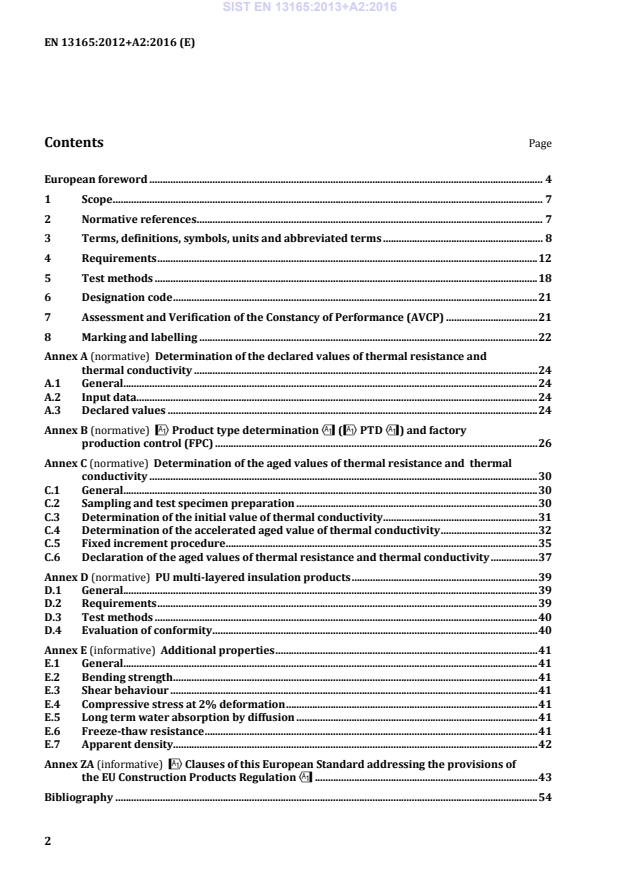
Determination of the declared values of thermal resistance and thermal conductivity . 24 A.1 General . 24 A.2 Input data. 24 A.3 Declared values . 24 Annex B (normative)
!Product type determination" (!PTD") and factory production control (FPC) . 26 Annex C (normative)
Determination of the aged values of thermal resistance and
thermal conductivity . 30 C.1 General . 30 C.2 Sampling and test specimen preparation . 30 C.3 Determination of the initial value of thermal conductivity . 31 C.4 Determination of the accelerated aged value of thermal conductivity . 32 C.5 Fixed increment procedure . 35 C.6 Declaration of the aged values of thermal resistance and thermal conductivity . 37 Annex D (normative)
PU multi-layered insulation products . 39 D.1 General . 39 D.2 Requirements . 39 D.3 Test methods . 40 D.4 Evaluation of conformity . 40 Annex E (informative)
Additional properties . 41 E.1 General . 41 E.2 Bending strength . 41 E.3 Shear behaviour . 41 E.4 Compressive stress at 2% deformation . 41 E.5 Long term water absorption by diffusion . 41 E.6 Freeze-thaw resistance . 41 E.7 Apparent density . 42 Annex ZA (informative)
!Clauses of this European Standard addressing the provisions of the EU Construction Products Regulation" . 43 Bibliography . 54 SIST EN 13165:2013+A2:2016
Tables Table 1 — Tolerances on length and width . 13 Table 2 — Classes for thickness tolerances . 13 Table 3 — Deviation from flatness . 13 Table 4 — Test conditions for dimensional stability under specified temperature and humidity conditions . 14 Table 5 — Levels for dimensional stability for test conditions 1, 2, 3 . 15 Table 6 — Levels for dimensional stability for test condition 4 . 15 Table 7 — Levels for deformation under specified compressive load and temperature conditions . 15 Table 8 — Levels for compressive stress or compressive strength . 16 Table 9 — Levels for tensile strength perpendicular to faces . 16 Table 10 — Levels for one sided wetting behaviour . 17 Table 11 — Test methods, test specimens and conditions . 20 Table A.1 — Values for k for one sided 90 % tolerance interval with a confidence level of 90 % . 25 Table B.1 — Minimum number of tests for !PTD" and minimum product testing frequencies . 26 Table B.2 — Minimum product testing frequencies for the reaction to fire characteristics . 28 Table C.1 — #Safety increments to be added to the measured accelerated aged value of thermal conductivity$ . 33 Table C.2 — #Increments for calculating the aged value of thermal conductivity$. 37 Table E.1 — Test methods, test specimens, conditions and minimum testing frequencies . 42 Table ZA.1 — Relevant clauses for factory made rigid polyurethane foam and intended use . 44 Table ZA.2 — Systems of AVCP . 45 Table ZA.3.1 — Assignment of AVCP tasks for factory made rigid polyurethane foam products under system 1 for reaction to fire and system 3 (see Table ZA.2) . 46 Table ZA.3.2 — Assignment of AVCP tasks for factory made rigid polyurethane foam products under system 3 (see Table ZA.2) . 47 Table ZA.3.3 — Assignment of AVCP tasks for factory made rigid polyurethane foam products under combined system 4 for reaction to fire and system 3 (see Table ZA.2). 47
Figures Figure C.1 — Flow chart of the alternative ageing procedures . 31 Figure C.2 — Illustration of the acceleration test . 34 Figure ZA.1 — !Example CE marking information of products under AVCP system 1 and system 3" . 53
is the water vapour diffusion resistance factor – n is the number of test results – R90/90 is the 90 % fractile with a confidence level of 90 % for the thermal resistance m2„K/W RD is the declared thermal resistance m2„K/W Ri is one test result of thermal resistance m2„K/W Rmean is the mean thermal resistance m2„K/W RU is the design thermal resistance m2„K/W Sb is the deviation from squareness on length and width mm/m Smax is the deviation from flatness mm sR is the estimate of the standard deviation of the thermal resistance m2„K/W s is the estimate of the standard deviation of the thermal conductivity W/(m„K) s is the estimate of the standard deviation of the aged values of the thermal conductivity W/(m„K) SIST EN 13165:2013+A2:2016
AP is the symbol of the declared value of practical sound absorption coefficient AW is the symbol of the declared value of weighted sound absorption coefficient CC(i1/i2c is the symbol of the declared level for compressive creep CS(10\Y) is the symbol of the declared level for compressive stress or strength DLT(i)5 DS(23,90)or DS(70,90) is the symbol of the declared level for deformation under load and temperature at conditions set with a maximum of 5 % deformation is the symbol of the declared level for dimensional stability under specified temperature and humidity DS(70,-)or DS(20,-) is the symbol of the declared level for dimensional stability under specified temperature MU is the symbol of the declared value for the water vapour diffusion resistance factor FW is the symbol of the declared level for change in deviation from flatness after one-sided wetting T is the symbol of the declared class for thickness tolerances TR is the symbol of the declared level for tensile strength perpendicular to faces WL (T) is the symbol of the declared value for long term water absorption by total immersion WS (P) WL (P) is the symbol of the declared value for short term water absorption by partial immersion is the symbol of the declared value for long term water absorption by partial immersion Z is the symbol of the declared value for water vapour resistance
Abbreviated terms used in this standard PU is rigid PolyUrethane foam including PIR and PUR !PTD is Product Type Determination (previously named ITT for Initial Type Test)" FPC is Factory Production Control MLn is Multi-Layered product (n for number of layers) RtF is Reaction to Fire !AVCP is Assessment and Verification of Constancy of Performance (previously named attestation of conformity) DoP is Declaration of Performance ThIB is Thermal Insulation for Buildings VCP is Verification of Constancy of Performance (previously named evaluation of conformity)" SIST EN 13165:2013+A2:2016
¶ 2,50
¶ 0,75
¶ 5 > 0,75
¶ 10 A specimen of maximum 2,50 m length shall be cut from longer products. 4.2.6 Reaction to fire of the product as placed on the market Reaction to fire classification of the product as placed on the market shall be determined in accordance with EN 13501-1 and the mounting and fixing rules given in EN 15715. NOTE This classification is compulsory and always included in the CE Marking label. SIST EN 13165:2013+A2:2016
1 2 3 4 No.1, 2, 3 l, b %
¶ w
¶ u
¶ t
¶ s
d %
¶ s r
¶ z
¶ x
¶ v Table 6 — Levels for dimensional stability for test condition 4 Test condition Relative changes Level DS (-20,-)
1 2
No. 4 lb %
¶ s
¶ rá w
d %
¶ t
¶ t 4.3.3 Deformation under specified compressive load and temperature conditions Deformation under specified compressive load and temperature conditions shall be determined in accordance with EN 1605d, shall not exceed the values, given in Table 7, for the declared level. Table 7 — Levels for deformation under specified compressive load and temperature conditions Level Test conditions Requirement % DLT(1)5 load: 20 kPa
¶ 5 temperature: (80 ± 1) °C time: (48 ± 1) h DLT(2)5 load: 40 kPa temperature: (70 ± 1) °C time: (168 ± 1) h DLT(3)5 load: 80 kPa temperature: (60 ± 1) °C time: (168 ± 1) h 4.3.4 Compressive stress or compressive strength Compressive stress at 10 % deformation, 10, or the compressive strength, m, shall be determined in accordance with EN 826. No test result for either the compressive stress at 10 % deformation or the compressive strength, whichever is the smaller, shall be less than the value, given in Table 8, for the declared level. SIST EN 13165:2013+A2:2016
·
t w CS(10\Y)50
·
w r CS(10\Y)100
·
s r r CS(10\Y)120
·
s t r CS(10\Y)130
·
s u r CS(10\Y)140
·
s v r CS(10\Y)150
·
s w r CS(10\Y)175
·
s y w CS(10\Y)200
·
t r r CS(10\Y)225
·
t t w CS(10\Y)250
·
t w r Values higher than 250 kPa can be declared in steps of 50 kPa. " 4.3.5 Tensile strength perpendicular to faces Tensile strength perpendicular to faces, mt, shall be determined in accordance with EN 1607. No test result shall be less than the value, given in Table 9, for the declared level. Table 9 — Levels for tensile strength perpendicular to faces Level Requirement kPa TR40
·
v r TR50
·
w r TR60
·
x r TR70
·
y r TR80
·
z r TR90
·
{ r TR100
·
s r r TR150
·
s w r 4.3.6 Compressive creep Compressive creep, Xct, and total thickness reduction, t, shall be determined after at least one hundred twenty two days of testing at a declared compressive stress, c, given in steps of at least 1 kPa, and the results extrapolated thirty times, corresponding to ten years, to obtain the declared levels in accordance with EN 1606. Compressive creep shall be declared in levels, i2, and the total thickness reduction shall be declared in levels i1, with steps of 0,5 %, at the declared stress. No test result shall exceed the declared levels at the declared stress. SIST EN 13165:2013+A2:2016

t r FW2

s r 4.3.9 Water vapour transmission Water vapour transmission properties of the product including facings or coatings shall be determined in accordance with EN 12086 and declared as the water vapour diffusion resistance factor, , for homogeneous products and as the water vapour resistance, Z, for faced or non-homogeneous products. All test results of
and/or all test results of Z shall be within the range declared by the manufacturer. Alternatively, for the declaration of the water vapour diffusion resistance factor,
of PU products, the value quoted in EN ISO 10456 may be used. 4.3.10 Sound absorption Sound absorption coefficient shall be determined in accordance with EN ISO 354. The sound absorption characteristics shall be calculated in accordance with EN ISO 11654 using the values for the practical sound absorption coefficient, p, at the frequencies: 125 Hz, 250 Hz, 500 Hz, 1 000 Hz, 2 000 Hz and 4 000 Hz and the single number value for the weighted sound absorption coefficient, w. SIST EN 13165:2013+A2:2016
...