

SIST EN 14258:2005
(Main)Structural adhesives - Mechanical behaviour of bonded joints subjected to short and long terms exposure at specified conditions of temperature
- Abstract
This standard describes methods to determine the ability of structural (thermoplastics, thermosetting) adhesives to resist to heat (temperature, continuously or temporarily).
- Status
- Published
- Publication Date
- 28-Feb-2005
- Technical Committee
- IPMA - Polimer materials and products
- Current Stage
- 6060 - National Implementation/Publication (Adopted Project)
- Start Date
- 01-Mar-2005
- Due Date
- 01-Mar-2005
- Completion Date
- 01-Mar-2005

SIST EN 14258:2005 is the Slovenian standard aligned with EN 14258:2004, published by SIST and prepared within CEN. It specifies methods for assessing how structural adhesives behave mechanically when bonded joints are exposed to selected temperatures for short or long periods. Engineers, laboratories, quality teams, and adhesive users use it to compare heat resistance and to generate data for design or product selection.
What does SIST EN 14258:2005 specify?
SIST EN 14258:2005 specifies guidelines for evaluating the mechanical behaviour of structural adhesively bonded joints subjected to short-term and long-term exposure at specified temperature conditions. The document focuses on heat resistance as measured through the shear properties of bonded joints.
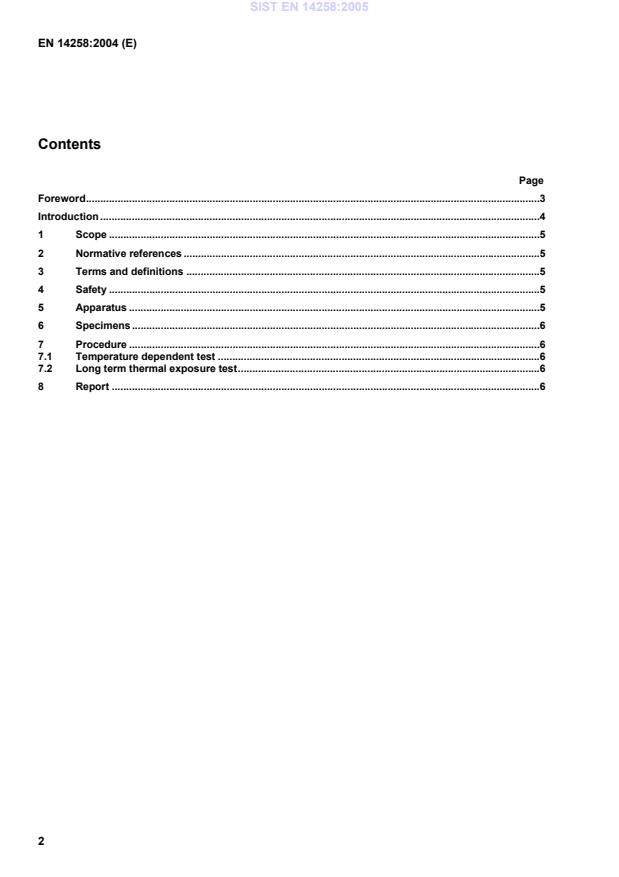
The standard is organized into clauses on scope, normative references, terms and definitions, safety, apparatus, specimens, procedure, and report. In practice, that means the document tells the user what to test, how to prepare the specimens, which test methods to use for different adhesive types, and what information to record.
What are the key requirements of SIST EN 14258:2005?
SIST EN 14258:2005 bases the evaluation on shear properties of bonded joints. That matters because the method looks at joint performance under heat rather than at adhesive chemistry alone.
Clause 5, apparatus - The standard requires room-temperature test equipment matching the referenced test method, a tensile test machine with an environmental chamber for short-term testing, and a chamber for thermal ageing. In practice, the test setup must be able to control temperature during both exposure and measurement.
Clause 6, specimens - Specimens are prepared according to EN 1465, ISO 10123, or EN 14869-2, as appropriate, and conditioned for 1 day at (23 ± 2) °C and (50 ± 5) % relative humidity before testing or ageing. This gives a common starting condition so results are comparable.
Clause 7.1, temperature dependent test - For design purposes, only EN 14869-2 is used; anaerobic adhesives are assessed only with ISO 10123; all other adhesives are assessed with EN 1465. The test temperature is chosen for the intended application and the specimen is held until temperature equilibrium is reached. This links the method to the adhesive type and the real service temperature.
Clause 7.2, long term thermal exposure test - For design purposes, only EN 14869-2 is used. For comparison purposes, anaerobic adhesives are assessed with ISO 10123 and all other adhesives with EN 1465. The standard also requires unaged reference specimens tested at (23 ± 2) °C, so the effect of ageing can be judged against a baseline.
Clause 7.2, ageing and reconditioning - Specimens are exposed at the selected temperature for the chosen time in a controlled environmental chamber, then conditioned for 24 h at (23 ± 2) °C and (50 ± 5) % relative humidity before final testing. This makes the ageing step repeatable and the post-ageing test consistent.
Clause 4, safety - Users must work with normal laboratory practice and establish their own health and safety measures. That means the standard supports testing practice but leaves site safety control to the organization.
Clause 8, report - The report must include the test temperature for temperature-dependent tests, or the exposure time and temperature for long-term exposure tests, together with the reporting items required by the underlying test method. This is important for traceability and comparison.
What terms does SIST EN 14258:2005 define?
SIST EN 14258:2005 uses the terms and definitions from EN 923:1998. The key terms in the standard’s context are:
- Structural adhesive - an adhesive intended for load-bearing bonded joints, which is the material being evaluated here.
- Bonded joint - the assembly formed when adherends are joined by adhesive, and whose shear behaviour is measured.
- Thermal ageing - exposure to specified temperature for a specified time before testing, used to simulate service heat exposure.
- Temperature-dependent test - a test performed at selected temperatures to see how shear behaviour changes with heat.
- Long-term thermal exposure test - a test after sustained exposure at temperature, followed by reconditioning and measurement.
- Environmental chamber - equipment that maintains the selected temperature during testing or ageing.
- Temperature equilibrium - the condition reached when the specimen has stabilized at the chamber temperature before testing.
Who uses SIST EN 14258:2005?
SIST EN 14258:2005 is used by adhesive laboratories, manufacturers of structural adhesives, and users who need to compare bonded-joint performance at temperature. It is also relevant to engineers and quality managers who need data for design decisions, product comparison, or specification of thermal exposure tests. Because the standard separates design use from comparison use, it is useful both in development work and in controlled evaluation of adhesive systems.
Which standards are used with SIST EN 14258:2005?
SIST EN 14258:2005 relies on these referenced standards:
- EN 923:1998 - provides the terms and definitions used in the document.
- EN 1465 - supplies the tensile lap-shear test method for rigid-to-rigid bonded assemblies, used for many adhesives in this standard.
- EN 14869-2 - supplies the shear test for structural bonds and is the method required for design purposes.
- EN ISO 9142 - guides the selection of laboratory ageing conditions and supports the choice of temperature and conditioning.
- ISO 10123 - provides the shear-strength method for anaerobic adhesives using pin-and-collar specimens.
What does the SIST EN 14258:2005 document contain?
SIST EN 14258:2005 contains the test framework for evaluating heat resistance of structural adhesive joints through shear testing. It gives the apparatus needed for room-temperature and temperature-controlled testing, the specimen preparation and conditioning rules, and two procedures: a temperature-dependent test and a long-term thermal exposure test.
The document also tells the user when to use EN 1465, EN 14869-2, or ISO 10123, depending on the adhesive and whether the purpose is design or comparison. It finishes with reporting requirements so the exposure temperature, exposure time, and related test details are recorded consistently.
Relations
- Effective Date
- 28-Jan-2026
- Effective Date
- 28-Jan-2026
- Effective Date
- 28-Jan-2026
- Effective Date
- 28-Jan-2026
- Refers
SIST EN 1465:2009 - Adhesives - Determination of tensile lap-shear strength of bonded assemblies - Effective Date
- 28-Jan-2026
- Effective Date
- 28-Jan-2026
- Effective Date
- 28-Jan-2026
- Effective Date
- 28-Jan-2026
Get Certified
Connect with accredited certification bodies for this standard

DIN CERTCO
DIN Group product certification.

Smithers Quality Assessments
US management systems and product certification.
Sponsored listings
Frequently Asked Questions
SIST EN 14258:2005 is a standard published by the Slovenian Institute for Standardization (SIST). Its full title is "Structural adhesives - Mechanical behaviour of bonded joints subjected to short and long terms exposure at specified conditions of temperature". This standard covers: This standard describes methods to determine the ability of structural (thermoplastics, thermosetting) adhesives to resist to heat (temperature, continuously or temporarily).
This standard describes methods to determine the ability of structural (thermoplastics, thermosetting) adhesives to resist to heat (temperature, continuously or temporarily).
SIST EN 14258:2005 is classified under the following ICS (International Classification for Standards) categories: 83.180 - Adhesives. The ICS classification helps identify the subject area and facilitates finding related standards.
SIST EN 14258:2005 has the following relationships with other standards: It is inter standard links to SIST EN 923:1999, SIST EN ISO 9142:2004, SIST EN 14869-2:2011, SIST EN 29592-1:1998, SIST EN 1465:2009, SIST EN ISO 15750-2:2008, SIST EN ISO 15750-1:2008, SIST EN ISO 9455-13:2001. Understanding these relationships helps ensure you are using the most current and applicable version of the standard.
SIST EN 14258:2005 is associated with the following European legislation: EU Directives/Regulations: 305/2011, 89/106/EEC; Standardization Mandates: M/127. When a standard is cited in the Official Journal of the European Union, products manufactured in conformity with it benefit from a presumption of conformity with the essential requirements of the corresponding EU directive or regulation.
SIST EN 14258:2005 is available in PDF format for immediate download after purchase. The document can be added to your cart and obtained through the secure checkout process. Digital delivery ensures instant access to the complete standard document.
Standards Content (Sample)
2003-01.Slovenski inštitut za standardizacijo. Razmnoževanje celote ali delov tega standarda ni dovoljeno.Konstrukcijska lepila - Mehansko obnašanje lepljenih spojev ob kratkotrajni ali dolgotrajni izpostavitvi temperaturni obremenitviStrukturklebstoffe - Mechanisches Verhalten von Klebverbindungen bei kurzzeitiger oder langzeitiger Beanspruchung bei festgelegter TemperaturAdhésifs structuraux - Comportement mécanique des assemblages collés soumis a une exposition a court et long termes a des conditions de température spécifiéesStructural adhesives - Mechanical behaviour of bonded joints subjected to short and long terms exposure at specified conditions of temperature83.180LepilaAdhesivesICS:Ta slovenski standard je istoveten z:EN 14258:2004SIST EN 14258:2005en01-marec-2005SIST EN 14258:2005SLOVENSKI
STANDARD
EUROPEAN STANDARDNORME EUROPÉENNEEUROPÄISCHE NORMEN 14258November 2004ICS 83.180English versionStructural adhesives - Mechanical behaviour of bonded jointssubjected to short and long terms exposure at specifiedconditions of temperatureAdhésifs structuraux - Comportement mécanique desassemblages collés soumis à une exposition à court et longtermes à des conditions de température spécifiéesStrukturklebstoffe - Mechanisches Verhalten vonKlebverbindungen bei kurzzeitiger oder langzeitigerBeanspruchung bei festgelegter TemperaturThis European Standard was approved by CEN on 2 September 2004.CEN members are bound to comply with the CEN/CENELEC Internal Regulations which stipulate the conditions for giving this EuropeanStandard the status of a national standard without any alteration. Up-to-date lists and bibliographical references concerning such nationalstandards may be obtained on application to the Central Secretariat or to any CEN member.This European Standard exists in three official versions (English, French, German). A version in any other language made by translationunder the responsibility of a CEN member into its own language and notified to the Central Secretariat has the same status as the officialversions.CEN members are the national standards bodies of Austria, Belgium, Cyprus, Czech Republic, Denmark, Estonia, Finland, France,Germany, Greece, Hungary, Iceland, Ireland, Italy, Latvia, Lithuania, Luxembourg, Malta, Netherlands, Norway, Poland, Portugal, Slovakia,Slovenia, Spain, Sweden, Switzerland and United Kingdom.EUROPEAN COMMITTEE FOR STANDARDIZATIONCOMITÉ EUROPÉEN DE NORMALISATIONEUROPÄISCHES KOMITEE FÜR NORMUNGManagement Centre: rue de Stassart, 36
B-1050 Brussels© 2004 CENAll rights of exploitation in any form and by any means reservedworldwide for CEN national Members.Ref. No. EN 14258:2004: ESIST EN 14258:2005
...