


SIST EN 18210:2026
(Main)Algae and algae Products - Determination of the fatty acid composition
Algae and algae Products - Determination of the fatty acid composition
This document encompasses the determination of the fatty acid profile in algae and algae products, thereby including micro- and macroalgae, according to the definitions adopted by CEN. This determination enables that all fatty acids present at a significant level (> 1 % of the total fatty acids) in the algal matrix are quantified in an accurate and reproducible way. The concentration of each fatty acid will be available in relative (in %) and, by means of an appropriate internal standard, absolute (mg/g dw) terms. Moreover, the method described in this standard ensures a practical and safe technical approach, whose protocol details and all related know-how will be easily and economically transferrable to all the sector stakeholders. This document ensures this objective by a comprehensive and fully detailed description of all technical steps from the sample itself (including its state and form) to the gas chromatographic technique and the calculation of the fatty acid content. The wording avoids any risk of ambiguity or wrong interpretation. Finally, this methodological standard will be informed by other equivalent standards applied to other matrices and will take into account other standards concerning specific treatment or extractive procedure of the sample prior to the fatty acid analysis itself.
Algen und Algenprodukte - Bestimmung der Fettsäurezusammensetzung
Dieses Dokument umfasst die Bestimmung des Fettsäurenprofils von Algen und Algenprodukten, was nach den vom CEN verabschiedeten Definitionen Mikro- und Makroalgen einschließt. Diese Bestimmung ermöglicht, dass alle in einer maßgeblichen Menge (> 1 % der gesamten Fettsäuren) in der Algenmatrix enthaltenen Fettsäuren auf eine genaue und reproduzierbare Weise quantifiziert werden. Die Konzentration von jeder Fettsäure wird in relativen (in %) und, durch eine geeignete interne Standardlösung, absoluten (mg/g Trockenmasse) Werten verfügbar sein. Darüber hinaus stellt das in dieser Norm beschriebene Verfahren einen praktischen und sicheren technischen Ansatz sicher, dessen Protokolldetails und gesamtes damit verbundenes Anwendungswissen einfach und in wirtschaftlicher Weise auf alle Stakeholder im Sektor übertragbar sein werden. Dieses Dokument stellt dieses Ziel durch eine umfassende und ausführliche Beschreibung aller technischen Schritte von der Probe an sich (einschließlich Zustand und Form) bis zum gaschromatographischen Verfahren und zur Berechnung des Fettsäurengehalts sicher. Die Formulierungen bergen keine Risiken für Mehrdeutigkeiten oder Fehlinterpretationen. Schließlich bezieht diese Verfahrensnorm Informationen aus anderen äquivalenten Normen, die auf andere Matrices angewendet werden, ein und berücksichtigt andere Normen, die die spezifische Behandlung oder das Extraktionsverfahren für die Probe vor der eigentlichen Fettsäurenanalyse betreffen.
Algues et produits à base d'algues - Détermination de la composition en acides gras
Le présent document couvre la détermination du profil en acides gras des algues et des produits à base d’algues, en incluant donc les microalgues et les macroalgues, conformément aux définitions adoptées par le CEN. Cette détermination permet de quantifier de manière précise et reproductible tous les acides gras présents à un niveau significatif (> 1 % du total des acides gras) dans la matrice algale. La concentration de chaque acide gras sera disponible en termes relatifs (en %) et, au moyen d’un étalon interne approprié, en termes absolus (mg/g de poids sec). De plus, la méthode décrite dans la présente norme garantit une approche technique pratique et sûre, dont les détails du protocole et l’ensemble du savoir-faire associé seront facilement et économiquement transférables à toutes les parties prenantes du secteur. Ce document veille à cet objectif par une description complète et entièrement détaillée de toutes les étapes techniques, depuis l’échantillon lui-même (y compris son état et sa forme) jusqu’à la technique de chromatographie en phase gazeuse et le calcul de la teneur en acides gras. La formulation évite tout risque d’ambiguïté ou d’interprétation erronée. Enfin, cette norme méthodologique sera éclairée par d’autres normes équivalentes appliquées à d’autres matrices et prendra en compte d’autres normes concernant le traitement spécifique ou la procédure d’extraction de l’échantillon avant l’analyse des acides gras elle-même.
Alge in izdelki iz alg - Določanje sestave maščobnih kislin
Ta dokument zajema določanje profila maščobnih kislin v algah in izdelkih iz alg, vključno z mikro- in makroalgami, v skladu z definicijami, ki jih je sprejel CEN. To določanje omogoča, da so vse maščobne kisline, ki so prisotne v pomembni količini (> 1 % vseh maščobnih kislin) v algni matrici, kvantificirane na natančen in ponovljiv način. Koncentracija vsake maščobne kisline bo na voljo v relativnih (v %) in, s pomočjo ustreznega notranjega standarda, absolutnih (mg/g suhe teže) enotah. Poleg tega metoda, opisana v tem standardu, zagotavlja praktičen in varen tehnični pristop, katerega protokol in vse povezano znanje bo enostavno in ekonomsko prenosljivo na vse deležnike v sektorju. Ta dokument zagotavlja ta cilj z obsežnim in popolnoma podrobnim opisom vseh tehničnih korakov od samega vzorca (vključno z njegovim stanjem in obliko) do plinske kromatografske tehnike in izračuna vsebnosti maščobnih kislin. Besedilo se izogiba kakršnemu koli tveganju dvoumnosti ali napačne interpretacije. Nazadnje, ta metodološki standard bo obveščen z drugimi enakovrednimi standardi, ki se uporabljajo za druge matrice, in bo upošteval druge standarde, ki se nanašajo na specifično obdelavo ali ekstrakcijski postopek vzorca pred samo analizo maščobnih kislin.
General Information
- Status
- Published
- Public Enquiry End Date
- 29-Sep-2025
- Publication Date
- 15-Jun-2026
- Technical Committee
- I13 - Imaginarni 13
- Current Stage
- 6060 - National Implementation/Publication (Adopted Project)
- Start Date
- 02-Jun-2026
- Due Date
- 07-Aug-2026
- Completion Date
- 16-Jun-2026

Overview
SIST EN 18210:2026 - Algae and Algae Products: Determination of the Fatty Acid Composition is a comprehensive European standard developed by SIST, aligning with the work of CEN/TC 454 “Algae and Algae Products.” This standard specifies methods to accurately determine the fatty acid profile in algae and algae-based products, covering both microalgae and macroalgae. The protocol facilitates quantification of all significant fatty acids (those exceeding 1% of total fatty acids), providing both relative (%) and absolute (mg/g dry weight) concentrations. The methodologies outlined ensure accuracy, reproducibility, and safety, making them suitable for diverse industrial and research applications.
Key Topics
Scope and Purpose:
- Focuses on the standardized determination of fatty acid composition in algae and algae-derived products.
- Applies to both microalgae and macroalgae for comprehensive sector coverage.
Analytical Methods:
- Indirect method: Fatty acids are analyzed after oil extraction (Ryckebosch-Foubert method), followed by acid-catalyzed transesterification.
- Direct method: Fatty acids are directly transesterified in the freeze-dried algal biomass, eliminating the separate oil extraction step.
- Both approaches use gas chromatography for quantification.
Calculation and Reporting:
- Results are expressed in percentage of total fatty acids and/or in mg/g dry weight using internal standards.
- A clear, stepwise approach minimizes ambiguity, supporting methodological consistency across laboratories.
Sample Handling and Quality Control:
- Detailed procedures for sample collection, transport (on dry ice), storage (at -80°C), and preparation (freeze-drying, grinding).
- Emphasizes cleanliness, prevention of contamination, and reproducible results through interlaboratory comparisons.
Applications
Nutritional Profiling:
- Essential for assessing the value of algae as food or feed sources by quantifying beneficial fatty acids such as omega-3 and omega-6.
Pharmaceuticals and Cosmeceuticals:
- Precise fatty acid composition supports formulation and claims validation for health supplements, cosmetics, and therapeutic products.
Biofuels and Biopolymers:
- Helps determine feedstock suitability for biofuel production based on lipid content and fatty acid spectrum.
Quality Assurance in Production Chains:
- Facilitates traceability and compliance in the algae industry, providing stakeholders with reliable, standardized data.
Research and Development:
- Universally applicable protocols enhance comparability of data and foster innovation in algae biotechnology and processing sectors.
Related Standards
- EN 17399: Algae and algae products - Terms and definitions; provides standardized terminology for the sector.
- EN 17605:2022: Algae and algae products - Sample treatment methods; complements sampling and preparation steps prior to fatty acid analysis.
- EN 17908: Algae and algae products - Determination of total lipid content using the Ryckebosch-Foubert method; establishes the technique referenced for oil extraction in the indirect method.
Practical Value
Adopting SIST EN 18210:2026 assures stakeholders throughout the algae supply chain-from cultivators and processors to end-users and regulators-that the fatty acid composition of algae and algae products is measured with accuracy, consistency, and international comparability. Reliable fatty acid profiling enhances product labeling, supports claims for nutritional and functional properties, and streamlines regulatory compliance across food, feed, biofuel, and other algae-based sectors. The standard’s robust methodology and detail-oriented approach empower laboratories and producers with cost-effective, reproducible, and transferrable protocols.
Get Certified
Connect with accredited certification bodies for this standard

BSI Group
BSI (British Standards Institution) is the business standards company that helps organizations make excellence a habit.

Bureau Veritas
Bureau Veritas is a world leader in laboratory testing, inspection and certification services.

DNV
DNV is an independent assurance and risk management provider.
Sponsored listings
Frequently Asked Questions
SIST EN 18210:2026 is a standard published by the Slovenian Institute for Standardization (SIST). Its full title is "Algae and algae Products - Determination of the fatty acid composition". This standard covers: This document encompasses the determination of the fatty acid profile in algae and algae products, thereby including micro- and macroalgae, according to the definitions adopted by CEN. This determination enables that all fatty acids present at a significant level (> 1 % of the total fatty acids) in the algal matrix are quantified in an accurate and reproducible way. The concentration of each fatty acid will be available in relative (in %) and, by means of an appropriate internal standard, absolute (mg/g dw) terms. Moreover, the method described in this standard ensures a practical and safe technical approach, whose protocol details and all related know-how will be easily and economically transferrable to all the sector stakeholders. This document ensures this objective by a comprehensive and fully detailed description of all technical steps from the sample itself (including its state and form) to the gas chromatographic technique and the calculation of the fatty acid content. The wording avoids any risk of ambiguity or wrong interpretation. Finally, this methodological standard will be informed by other equivalent standards applied to other matrices and will take into account other standards concerning specific treatment or extractive procedure of the sample prior to the fatty acid analysis itself.
This document encompasses the determination of the fatty acid profile in algae and algae products, thereby including micro- and macroalgae, according to the definitions adopted by CEN. This determination enables that all fatty acids present at a significant level (> 1 % of the total fatty acids) in the algal matrix are quantified in an accurate and reproducible way. The concentration of each fatty acid will be available in relative (in %) and, by means of an appropriate internal standard, absolute (mg/g dw) terms. Moreover, the method described in this standard ensures a practical and safe technical approach, whose protocol details and all related know-how will be easily and economically transferrable to all the sector stakeholders. This document ensures this objective by a comprehensive and fully detailed description of all technical steps from the sample itself (including its state and form) to the gas chromatographic technique and the calculation of the fatty acid content. The wording avoids any risk of ambiguity or wrong interpretation. Finally, this methodological standard will be informed by other equivalent standards applied to other matrices and will take into account other standards concerning specific treatment or extractive procedure of the sample prior to the fatty acid analysis itself.
SIST EN 18210:2026 is classified under the following ICS (International Classification for Standards) categories: 13.020.55 - Biobased products. The ICS classification helps identify the subject area and facilitates finding related standards.
SIST EN 18210:2026 is associated with the following European legislation: Standardization Mandates: M/547. When a standard is cited in the Official Journal of the European Union, products manufactured in conformity with it benefit from a presumption of conformity with the essential requirements of the corresponding EU directive or regulation.
SIST EN 18210:2026 is available in PDF format for immediate download after purchase. The document can be added to your cart and obtained through the secure checkout process. Digital delivery ensures instant access to the complete standard document.
Standards Content (Sample)
SLOVENSKI STANDARD
01-julij-2026
Alge in izdelki iz alg - Ugotavljanje sestave maščobnih kislin
Algae and algae Products - Determination of the fatty acid composition
Algen und Algenprodukte - Bestimmung der Fettsäurezusammensetzung
Algues et produits à base d'algues - Détermination de la composition en acides gras
Ta slovenski standard je istoveten z: EN 18210:2026
ICS:
13.020.55 Biološki izdelki Biobased products
2003-01.Slovenski inštitut za standardizacijo. Razmnoževanje celote ali delov tega standarda ni dovoljeno.
EN 18210
EUROPEAN STANDARD
NORME EUROPÉENNE
May 2026
EUROPÄISCHE NORM
ICS 13.020.55
English Version
Algae and algae products - Determination of the fatty acid
composition
Algues et produits à base d'algues - Détermination de Algen und Algenprodukte - Bestimmung der
la composition en acides gras Fettsäurezusammensetzung
This European Standard was approved by CEN on 13 April 2026.
CEN members are bound to comply with the CEN/CENELEC Internal Regulations which stipulate the conditions for giving this
European Standard the status of a national standard without any alteration. Up-to-date lists and bibliographical references
concerning such national standards may be obtained on application to the CEN-CENELEC Management Centre or to any CEN
member.
This European Standard exists in three official versions (English, French, German). A version in any other language made by
translation under the responsibility of a CEN member into its own language and notified to the CEN-CENELEC Management
Centre has the same status as the official versions.
CEN members are the national standards bodies of Austria, Belgium, Bulgaria, Croatia, Cyprus, Czech Republic, Denmark, Estonia,
Finland, France, Germany, Greece, Hungary, Iceland, Ireland, Italy, Latvia, Lithuania, Luxembourg, Malta, Netherlands, Norway,
Poland, Portugal, Republic of North Macedonia, Romania, Serbia, Slovakia, Slovenia, Spain, Sweden, Switzerland, Türkiye and
United Kingdom.
EUROPEAN COMMITTEE FOR STANDARDIZATION
COMITÉ EUROPÉEN DE NORMALISATION
EUROPÄISCHES KOMITEE FÜR NORMUNG
CEN-CENELEC Management Centre: Rue de la Science 23, B-1040 Brussels
© 2026 CEN All rights of exploitation in any form and by any means reserved Ref. No. EN 18210:2026 E
worldwide for CEN national Members.
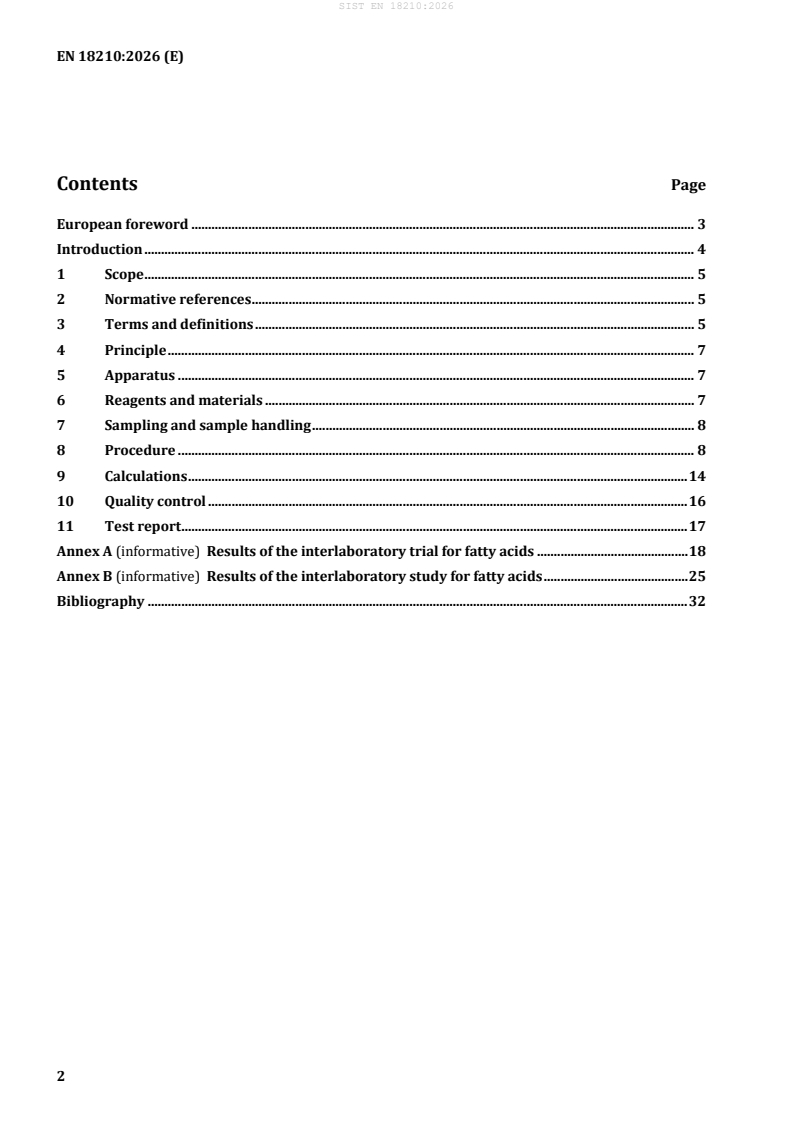
Contents Page
European foreword . 3
Introduction . 4
1 Scope . 5
2 Normative references . 5
3 Terms and definitions . 5
4 Principle . 7
5 Apparatus . 7
6 Reagents and materials . 7
7 Sampling and sample handling . 8
8 Procedure . 8
9 Calculations . 14
10 Quality control . 16
11 Test report . 17
Annex A (informative) Results of the interlaboratory trial for fatty acids . 18
Annex B (informative) Results of the interlaboratory study for fatty acids . 25
Bibliography . 32
European foreword
This document (EN 18210:2026) has been prepared by Technical Committee CEN/TC 454 “Algae and
algae products”, the secretariat of which is held by NEN.
This European Standard shall be given the status of a national standard, either by publication of an
identical text or by endorsement, at the latest by November 2026, and conflicting national standards shall
be withdrawn at the latest by November 2026.
Attention is drawn to the possibility that some of the elements of this document may be the subject of
patent rights. CEN shall not be held responsible for identifying any or all such patent rights.
This document has been prepared under a standardization request addressed to CEN by the European
Commission. The Standing Committee of the EFTA States subsequently approves these requests for its
Member States.
Any feedback and questions on this document should be directed to the users’ national standards body.
A complete listing of these bodies can be found on the CEN website.
According to the CEN-CENELEC Internal Regulations, the national standards organisations of the
following countries are bound to implement this European Standard: Austria, Belgium, Bulgaria, Croatia,
Cyprus, Czech Republic, Denmark, Estonia, Finland, France, Germany, Greece, Hungary, Iceland, Ireland,
Italy, Latvia, Lithuania, Luxembourg, Malta, Netherlands, Norway, Poland, Portugal, Republic of North
Macedonia, Romania, Serbia, Slovakia, Slovenia, Spain, Sweden, Switzerland, Türkiye and the United
Kingdom.
Introduction
The European Commission (EC) has requested the European Committee for Standardization (CEN) to
draft European standards or European standardization deliverables to support the implementation of
Article 3 of Directive 2009/28/EC for algae and algae-based products or intermediates. This request,
presented as Mandate M/547, also contributes to the Communication on “Innovating for Sustainable
Growth: A Bio Economy for Europe”.
The former working group CEN Technical Board Working Group 218 “Algae” was created in 2016 to
develop a work programme as part of this Mandate. The technical committee CEN/TC 454 'Algae and
algae products' was established to carry out the work programme that will prepare a series of standards.
The importance of algae and algae-based products or intermediates has increased significantly in Europe
as these products have been shown to be a valuable source, including but not limited to, of carbohydrates
(comprising, in particular, hydrocolloids with a large commercial importance, such as agar, alginate or
carrageenan), proteins, lipids, and several pigments. These materials are suitable for use in a wide range
of applications from food and feed purposes to other sectors, such as textiles, cosmetics, cosmeceuticals,
pharmaceuticals, biopolymers, biofuel, and fertilizer/biostimulants. Standardization of analytical
methods has been highlighted as having an important role in promoting the use of algae and algae
products.
The work of CEN/TC 454 should contribute to the reliability of the supply chain, thereby improving the
confidence of industry and consumers in algae, which include macroalgae, microalgae, cyanobacteria,
Labyrinthulomycetes, algae-based products or intermediates and should promote and support
commercialization of products of the European algae industry.
In this context, the fatty acid profile of algae and algal products is an important aspect for assessing the
potential nutritional quality and biological activity of algal biomass, thus paving the way for multiple
relevant and high added-value applications.
1 Scope
This document encompasses the determination of the fatty acid profile in algae and algae products,
thereby including micro- and macroalgae, according to the definitions adopted by CEN. This
determination enables that all fatty acids present at a significant level (>1 % of the total fatty acids) in
the algal matrix are quantified in an accurate and reproducible way. The concentration of each fatty acid
will be available in relative (in %) and, by means of an appropriate internal standard, absolute (mg/g dw)
terms. Moreover, the method described in this standard ensures a practical and safe technical approach,
whose protocol details and all related know-how will be easily and economically transferrable to all the
sector stakeholders. This document ensures this objective by a comprehensive and fully detailed
description of all technical steps from the sample itself (including its state and form) to the gas
chromatographic technique and the calculation of the fatty acid content. The wording avoids any risk of
ambiguity or wrong interpretation. Finally, this methodological standard will be informed by other
equivalent standards applied to other matrices and will take into account other standards concerning
specific treatment or extractive procedure of the sample prior to the fatty acid analysis itself.
2 Normative references
The following documents are referred to in the text in such a way that some or all of their content
constitutes requirements of this document. For dated references, only the edition cited applies. For
undated references, the latest edition of the referenced document (including any amendments) applies.
EN 17399, Algae and algae products — Vocabulary
EN 17605:2022, Algae and algae products — Methods of sampling and analysis — Sample treatment
EN 17908, Algae and algae products — Methods of sampling and analysis — Determination of total lipids
content using the Ryckebosch-Foubert method
3 Terms and definitions
For the purposes of this document, the terms and definitions given in EN 17399 and the following apply.
ISO and IEC maintain terminology databases for use in standardization at the following addresses:
— ISO Online browsing platform: available at https://www.iso.org/obp/
— IEC Electropedia: available at https://www.electropedia.org/
3.1
lipid content
all lipid substances extracted from the test portion under the operating conditions specified, expressed
in mg/g or g/kg or percentage relative to dry weight
3.2
transesterification
chemical reaction involving the conversion of fatty acid constituents regardless of their specific chemical
form (triacylglycerols, free fatty acids, phospholipids, etc.) into fatty acid methyl esters
3.3
direct transesterification
methodological approach consisting of the transesterification of all fatty acid constituents present in the
sample regardless of their specific chemical form (triacylglycerols, free fatty acids, phospholipids, etc.)
3.4
indirect transesterification
methodological approach consisting of the transesterification of all fatty acid constituents present in the
oil extracted from the sample by the Ryckebosch method regardless of their specific chemical form
(triacylglycerols, free fatty acids, phospholipids, etc.)
3.5
derivatization
first part of the process of preparing samples to be analysed by Gas Chromatography and comprising the
steps of sample preparation for transesterification and those corresponding to the transesterification
reaction itself
3.6
fatty acid methyl ester extraction
second part of the process of preparing samples to be analysed by Gas Chromatography and comprising
the steps of extracting the fatty acid methyl esters from the transesterification reaction mixture into an
organic phase and the purification of this phase
3.7
fatty acid methyl ester analysis
final part of the analytical method corresponding to the injection of the prepared fatty acid methyl esters
in a Gas Chromatography system for detection, identification, and quantification
3.8
internal standard
fatty acid that is chemically similar to the fatty acids in algae, but it is not present in the sample, being
added in the form of methyl ester in a constant known amount to every sample prior to the derivatization
process
3.9
fatty acid methyl ester peak area
area of a specific fatty acid methyl ester in a Gas Chromatography chromatogram
3.10
relative fatty acid methyl ester peak area
share in percentage of the area of a specific fatty acid methyl ester within the sum of the areas of all
identified fatty acid methyl esters in a Gas Chromatography chromatogram
3.11
total relative fatty acid content
sum of all identified and significant (significant meaning > 1 % of the sum of the areas of all fatty acid
methyl esters) relative fatty acid methyl ester peak areas in a Gas Chromatography chromatogram
Note 1 to entry: The significance threshold of 1 % is given as a recommendation according to the chromatographic
sensitivity. Relative fatty acid contents below 1 % can still be used but will entail a large error.
3.12
relative fatty acid content
share in percentage of a particular relative fatty acid methyl ester peak area in the total relative fatty acid
content in the test portion under the specified operating conditions
3.13
absolute fatty acid content
concentration of a specific fatty acid constituent in the algal sample corresponding to a fatty acid methyl
ester identified by Gas Chromatography and expressed in mg of fatty acid methyl ester/g of sample or g
fatty acid methyl ester/kg of sample in dry weight terms
4 Principle
The determination of the fatty acid composition (in relative and absolute terms) has two main phases: (i)
derivatization and fatty acid methyl ester extraction and (ii) chromatographic separation and
quantification. For the first phase, the fatty acids present within larger molecules (such as triacylglycerols
and phospholipids) in the sample are trans esterified, thereby forming fatty acid methyl esters (FAMEs).
Afterwards, these FAMEs are extracted with an adequate solvent (such as n-heptane), producing an
organic solution. In the second phase, this solution in injected and volatilized in a system of gas
chromatography with a suitable detector. The interaction of the FAMEs in the gas phase with the inner
filling of a specific chromatographic column enables separation of them. Finally, each separated FAME is
detected and a detection signal proportional to its amount is proportionately transformed into a
chromatogram peak area, enabling quantification.
5 Apparatus
5.1 Analytical balance, with a readability of 0,1 mg and preferably 0,01 mg
5.2 Water bath, with temperature control and, preferably, high resistance to corrosion
5.3 Vortex, with velocity regulation
5.4 Centrifuge, with cooling and rotor for tubes
5.5 Gas chromatograph, with auto-sampler and an adequate detector presenting signal transduction
into a parameter enabling FAME quantification, such as flame ionization detector
6 Reagents and materials
6.1 Tube rack for holding 20 ml tubes or comparable glassware
6.2 Pyrex screw capped tubes, 20 ml (one unit per 1/test portion) or comparable glassware
6.3 Beaker with adequate volumetry for containing the transesterification reagent
6.4 Bowl or tray to hold ice slurry used to cool transesterification reagent
6.5 Measurement cylinder for measuring necessary amount of reagent
6.6 Micropipettes with the necessary volumetric ranges and respective tips
6.7 Pasteur pipettes, disposable, 2 ml (one unit per test portion)
6.8 Pipette tips, disposable, 5 ml (for cotton and sodium sulphate column preparation)
6.9 Glass vials for gas chromatography, preferably amber, 1,5-2,0 ml
6.10 Methanol (with a purity not less than a volume fraction of 99,0 %, v/v)
6.11 Catalyst, hydrochloric acid in methanol (formed in situ from acetyl chloride and methanol, mixed
in a volumetric ratio 1:19, respectively)
6.12 Water, demineralized
6.13 n-Heptane, gas chromatography grade
6.14 Hydrophilic cotton
6.15 Sodium sulphate, anhydrous solvent
6.16 Internal standard, C21:0 (methyl ester form, 10 mg/ml concentration)
7 Sampling and sample handling
Sampling shall be performed according to the sampling standard EN 17605:2022, with the following
adaptations / additions:
— fine grinding to achieve a homogeneous sample shall be conducted as defined in 3.13 in
EN 17605:2022;
— transport shall be performed on dry ice;
— storage shall be at −80 °C.
It is advisable that extensive storage times of the test sample are avoided. In case this could not be
avoided, it is advisable that the test sample is freeze-dried again before usage.
Three test portions from the test sample shall be analysed as to be able to calculate the mean and standard
deviation.
8 Procedure
8.1 General
The starting point for all possible procedures described is a freeze-dried sample that has been prepared
according to EN 17605:2022.
Determination of the total fatty acid content can be performed by two different approaches:
— The indirect (two step) method, by which the fatty acid profile can be determined with FAME
formation and extraction after having extracting the oil first.
— The direct method, involving a direct transesterification of the fatty acids in the algal biomass [1].
8.2 Indirect method
8.2.1 General
The indirect method shall be performed with hydrochloric acid (formed from acetyl chloride and
methanol) as catalyst [2]. The complete procedure, except for the weighing, shall be conducted in the
fume hood.
8.2.2 Objective and field of application
This method has as its main objective to describe the protocol used in the determination of the fatty acid
profile by acid catalysis (using hydrochloric acid as catalyst formed from acetyl chloride and methanol as
catalyst) in algal matrices after oil extraction according to EN 17908.
8.2.3 Definition and process summary
The different fatty acids that compose many of the main lipid classes can be separated in saturated
(palmitic, stearic, arachidic acids, etc.), monounsaturated (palmitoleic, oleic acids, etc.), and
polyunsaturated fatty acids (linoleic, alpha-linolenic, eicosapentaenoic, docosahexaenoic acids, etc.).
Their separation and identification is possible by gaseous chromatography [3].
8.2.4 Methodological description
8.2.4.1 Reagents
All reagents shall be of analytical or chromatographic grade:
a) Ultrapure water
b) Acetyl chloride
c) Methanol
d) n-Heptane p.a.
e) Anhydrous sodium sulphate
8.2.4.2 Equipment and tools
a) Glass tubes with screwcap of 15 ml
b) Graduated cylinder
c) Micropipette tips of 5 ml
d) Hydrophilic cotton
e) Glass rod
f) Pasteur pipette
g) 2 ml Vials
h) Vortex agitator
i) Water bath
j) Bench centrifuge
k) Gas chromatograph
8.2.4.3 Sample preparation
For the performance of the analysis and achieving the determination of the fatty acid profile, oil shall be
previously extracted by the Ryckebosch-Foubert method, EN 17908, from a previously freeze-dried
sample.
8.2.4.4 Procedure for oil extraction
First apply the oil extraction method for algae and algae products to the freeze-dried sample according
to EN 17908.
8.2.4.5 Procedure for esterification
Depending on the type of technique used for the fatty acid methyl ester analysis (GC-FID vs GC-MS or
cold-on-column vs split-splitless), a different amount of internal standard and different quantities of
chemicals can be required for the analysis (recommended amounts are shown in Table 1). Dilution or
concentration of the n-heptane phase might still be necessary. The specific chromatographic conditions
for performing GC-FID or GC-MS analysis are shown in Table 2.
Table 1 — Amounts of internal standard and chemicals as a function of oil quantity available for
transesterification with hydrochloric acid as catalyst
Amount of oil Internal Acetyl
(mg) standard (mg) chloride:methanol
(ml)
150 3,0 5
50 1,0 5
20 0,4 5
10 0,2 5
5 0,1 5
Table 2 — Specific operational conditions and parameters for the determination of the fatty acid
composition through either GC-FID or GC-MS
Operational GC-FID GC-MS
conditions/parameters
Injection type Split/splitless Splitless
Injector temperature 250 °C 220 °C
Carrier gas Helium Helium
Type of column High polarity polyethilene High polarity polyethilene
glycol glycol
Column length 30 m 30 m
Column inner diameter 0,25 mm 0,32 mm
Column film thickness 0,25 μm 0,25 μm
Oven temperature program Starting at 180 °C and Starting at 58 °C for 2 min,
increasing to 200 °C at increasing to 160 °C at
4 °C/min, holding for 10 25 °C/min, to 210 °C at
min at 200 °C, heating to 2 °C/min, and to 225 °C at
210 °C at the same rate, 20 °C/min, holding at this
and holding at this temperature for 15 min
temperature for 14,5 min
Detector temperature 250 °C 230 °C
Electron impact ionization 70 eV
a) Weigh adequate amount of oil (extracted by the Ryckebosch-Foubert method, EN 17908) into
15 ml volume glass tubes with screwcap in, at least, triplicate.
b) In the case of using internal standard (for the case of being required the calculation of absolute
fatty acid content), add an adequate internal standard (e.g. C21:0) in the form of methyl ester and
in concentration of 10 mg/ml (in an adequate solvent, such as n-heptane).
c) Add 5 ml of a mixture of acetyl chloride:methanol (1:19).
d) This shall be prepared at low temperature (the container with the mixture shall be immersed in
an ice water slurry) and with dropwise addition of the acetyl chloride to the methanol.
e) Stir the tubes in the vortex for 30 s (all samples shall be thoroughly homogenized).
f) Put the tubes (closed with their screwcaps) in an 80 °C bath for 1 h (no agitation needed), take
out and let cool at room temperature during 30 min.
g) Add 1 ml of ultra-pure water (ultrapure water) to each tube as well as 2 ml of n-heptane p.a. and
stir vigorously.
h) Let it rest for 10 min and centrifuge for 3 min at 3 000 × g at room temperature.
i) Collect the organic phase (superior phase) for a 15 ml glass tube, taking care to filtrate through a
prepared column with cotton (1 cm thickness layer) and anhydrous sodium sulphate (1 cm
thickness layer).
j) In order to prepare the column: use a 5 ml micropipette tip. Put cotton with the help of a glass
rod. Then add the anhydrous sodium sulphate.
k) Wash the column thrice with 2 ml of n-heptane p.a. (total volume of 6 ml).
l) Concentrate the filtrated n-heptane solution to approximately 1 ml under a nitrogen stream at
room temperature and transfer with a Pasteur pipette to a 2 ml vial. Take care to wash the glass
tube with 500 µl of n-heptane using the vortex.
m) Inject 2,0 µl of sample in the GC chromatograph or store at −20 °C (for up to a month) until its
determination.
After injection in the chromatograph, verify the resultant chromatogram, taking attention to the retention
time of each fatty acid peak.
If the sample is too diluted (dependent on evaluation of chromatogram), it is necessary to concentrate it.
All solvent present in the vial is evaporated under nitrogen stream and 200 µl of n-heptane is added and
stirred, being afterwards transferred to a new vial with insert. Another chromatographic injection is then
performed.
8.3 Direct method
8.3.1 General
The direct method shall be performed with the direct transesterification method with acid catalysis [1].
The direct method shall be performed with hydrochloric acid (formed from acetyl chloride and methanol)
as catalyst [2]. The complete procedure, except for the weighing, shall be conducted in the fume hood.
8.3.2 Objective and field of application
This document has as its main objective to describe the protocol used in the determination of the fatty
acid profile by acid catalysis (using hydrochloric acid as catalyst formed from acetyl chloride and
methanol as catalyst) in algal matrices directly.
8.3.3 Definition and process summary
The different fatty acids that compose many of the main lipid classes can be separated in saturated
(palmitic, stearic, arachidic acids, etc.), monounsaturated (palmitoleic, oleic acids, etc.) and
polyunsaturated fatty acids (linoleic, alpha-linolenic, eicosapentaenoic, docosahexaenoic acids, etc.).
Their separation and identification is possible by gaseous chromatography [1].
8.3.4 Methodological description
8.3.4.1 Reagents
All reagents shall be of analytical or chromatographic grade.
a) Ultrapure water
b) Acetyl chloride
c) Methanol
d) n-Heptane p.a.
e) Anhydrous sodium sulphate
8.3.4.2 Equipment and tools
a) Usual laboratory material
b) Glass tubes with screwcap of 15 ml
c) Graduated cylinder
d) Micropipette tips of 5 ml
e) Hydrophilic cotton
f) Glass rod
g) Pasteur pipette
h) 2 ml Vials
i) Vortex agitator
j) Water bath
k) Bench centrifuge
l) Gas chromatograph
8.3.4.3 Sample preparation
For the performance of the analysis and achieving the determination of the fatty acid profile, it is possible
to apply directly the method described below to the freeze-dried sample.
8.3.4.4 Procedure
Depending on the type of technique used for the fatty acid methyl ester analysis (GC-FID vs GC-MS or
cold-on-column vs split-splitless), a different amount of starting material might be needed. A guideline
with recommendations concerning sample weight and quantities of chemicals required for the analysis
can be found in Table 3. Dilution or concentration of the n-heptane phase might still be necessary.
Table 3 — Sample weight and related quantities of internal standard and chemicals as a function
of lipid content for the direct transesterification with hydrochloric acid as catalyst
Lipid content (%, Weight of sample Internal Acetyl
w/dw) (mg) standard (mg) chloride:methanol
(ml)
> 20 50 0,5 5
10–20 75 0,5 5
5–10 150 0,5 5
1–5 300 0,2 5
< 1 500 0,1 5
a) Weigh the adequate amount of freeze-dried and ground sample into 15 ml volume glass tubes with
screwcap in, at least, triplicate.
b) In the case of using internal standard (for the case of being required the calculation of absolute fatty
acid content), add an adequate internal standard (e.g. C21:0) in the form of methyl ester and in the
concentration of 10 mg/ml (in an adequate solvent, such as n-heptane), taking the lipid content (%)
in the sample as a guide for choosing the amount of internal standard.
c) Add 5 ml of a mixture of acetyl chloride:methanol (1:19). This shall be prepared at low temperature
(the container with the mixture shall be immersed in an ice water slurry) and with dropwise addition
of the acetyl chloride to the methanol.
d) Stir the tubes in the vortex for 30 s (all samples shall be thoroughly homogenized).
e) Put the tubes (closed with their screwcaps) in an 80 °C bath for 1 h (no agitation needed), take out
and let cool at room temperature during 30 min.
f) Add 1 ml of ultra-pure water (ultrapure water) to each tube as well as 2 ml of n-heptane p.a. and stir
vigorously.
g) Let it rest for 10 min and centrifuge for 3 min at 3 000 × g at room temperature.
h) Collect the organic phase (superior phase) for a 15 ml glass tube, taking care to filtrate through a
prepared column with cotton (1 cm thickness layer) and anhydrous sodium sulphate (1 cm thickness
layer).
i) In order to prepare the column- use a 5 ml micropipette tip. Put cotton with the help of a glass rod,
then add the anhydrous sodium sulphate.
j) Wash the column thrice with 2 ml of n-heptane p.a. (total volume of 6 ml).
k) Concentrate the filtrated n-heptane solution to approximately 1 ml under a nitrogen stream at room
temperature and transfer with a Pasteur pipette to a 2 ml vial. Take care to wash the glass tube with
500 µl of n-heptane using the vortex.
l) Inject 2,0 µl of sample in the GC chromatograph
...