


SIST EN 16602-60-15:2015
(Main)Space product assurance - Radiation hardness assurance - EEE components
Space product assurance - Radiation hardness assurance - EEE components
This standard specifies the requirements for ensuring radiation hardness assurance (RHA) of space projects. These requirements form the basis for a RHA program that is required for all space projects in conformance to ECSS-Q-ST-60. RHA program is project specific. This standard addresses the three main radiation effects on electronic components: Total Ionizing Dose (TID), Displacement Damage or Total
Non-Ionizing Dose (TNID), and Single event Effects (SEE).
Spacecraft charging effects are out of the scope of this standard.
In this standard the word “component” refers to Electrical, Electronic, and Electromechanical (EEE) components only. Other fundamental constituents of space hardware units and sub-systems such as solar cells, optical materials, adhesives, polymers, and any other material
are not covered by this standard.
This standard may be tailored for the specific characteristic and constrains of a space project in conformance with ECSS-S-ST-00.
Raumfahrtproduktsicherung - Sicherung der Strahlungshärte für EEE-Komponenten
Assurance produit des projets spatiaux - Assurance radiation - Composants EEE
Zagotavljanje varnih proizvodov v vesoljski tehniki - Zagotavljanje sevalne odpornosti komponent EEE
Ta standard določa zahteve za doseganje zagotavljanja sevalne odpornosti (RHA) vesoljskih projektov. Te zahteve predstavljajo podlago za program RHA, ki je zahtevan za vse vesoljske projekte v skladu s standardom ECSS-Q-ST-60. Program RHA je specifičen za projekt. Ta standard obravnava tri glavne učinke sevanja na elektronske komponente: skupni ionizirajoči odmerek (TID), poškodbe zaradi izpodrivanja ali skupni neionizirajoči odmerek (TNID) in posamezni sevalni dogodki (SEE). Učinki napajanja vesoljskih plovil so zunaj področja uporabe tega standarda. V tem standardu se beseda »komponenta« nanaša le na električne, elektronske in elektromehanske (EEE) komponente. Druge temeljne sestavine enot vesoljske strojne opreme in podsistemov, kot so sončne celice, optični materiali, lepila, polimeri in vsi drugi materiali, niso obravnavani v tem standardu. Ta standard se lahko prilagodi posameznim lastnostim in omejitvam vesoljskega projekta v skladu s standardom ECSS-S-ST-00.
General Information
- Status
- Published
- Publication Date
- 01-Dec-2014
- Technical Committee
- I13 - Imaginarni 13
- Current Stage
- 6060 - National Implementation/Publication (Adopted Project)
- Start Date
- 06-Nov-2014
- Due Date
- 11-Jan-2015
- Completion Date
- 02-Dec-2014
Overview
EN 16602-60-15:2014 - Space product assurance: Radiation hardness assurance (RHA) for EEE components - is a CEN-adopted European standard that defines requirements for radiation hardness assurance of space projects. Aligned with ECSS‑Q‑ST‑60, it establishes a project‑specific RHA program addressing the three principal radiation effects on Electronic, Electrical and Electromechanical (EEE) components: Total Ionizing Dose (TID), Total Non‑Ionizing Dose / Displacement Damage (TNID / NIEL / DDD), and Single Event Effects (SEE). The standard excludes spacecraft charging effects and materials such as solar cells, optics, adhesives and polymers.
Key Topics and Requirements
- RHA program basis: Defines the top‑down, iterative RHA process from mission radiation environment to component and equipment validation. RHA must be tailored per project and in conformance with ECSS‑S‑ST‑00.
- Radiation environment definition: Requires mission radiation environment specification and quantitative analyses (sector or Monte Carlo methods) using ECSS environment models.
- Three focus areas:
- TID - cumulative ionizing dose effects (parametric shifts, leakage, timing) and shielding considerations.
- TNID / DDD - displacement damage especially critical for optoelectronics (CCD, APS).
- SEE - single event upsets, latch‑ups, transients, gate/destruction modes and their mitigation.
- Verification and testing:
- Radiation verification tests (RVT / RADLAT) on parts from flight diffusion lots.
- Use of mission TIDL/TNIDL, sensitivity thresholds (TIDS/TNIDS), and radiation design margin (RDM) to ensure margins between environment and component capability.
- Statistical tolerance factors (K values) referenced from MIL‑HDBK‑814 for lot/sample confidence; a 3σ approach is commonly cited.
- Phasing with project lifecycle: RHA activities mapped to project phases (Phase 0/A - mission analysis; B - preliminary definition; C - detailed definition; D - qualification/production) and periodic radiation reviews.
- Documentation: Normative annexes include Mission Radiation Environment Specification and Radiation Analysis Report.
Applications and Users
EN 16602-60-15:2014 is essential for:
- Space systems and spacecraft design teams (system, electrical and circuit designers)
- Component engineers and procurement (DPL, part selection)
- QA, reliability and test laboratories performing radiation tests (RVT / RADLAT)
- Program managers and integrators ensuring ECSS compliance and mission assurance
Practical uses include defining RHA plans, specifying radiation test requirements, selecting rad‑tolerant parts, sizing radiation design margins, and documenting compliance for flight hardware.
Related Standards
- ECSS‑Q‑ST‑60 (EEE components)
- ECSS‑E‑ST‑10‑04 (Space environment)
- ECSS‑E‑ST‑10‑12 (Radiation calculation methods)
- MIL‑HDBK‑814, ESCC 22900 / 25100, MIL‑STD test methods (referenced for test procedures)
Keywords: EN 16602-60-15:2014, radiation hardness assurance, RHA, EEE components, TID, TNID, SEE, radiation verification test, RADLAT, radiation design margin.

Frequently Asked Questions
SIST EN 16602-60-15:2015 is a standard published by the Slovenian Institute for Standardization (SIST). Its full title is "Space product assurance - Radiation hardness assurance - EEE components". This standard covers: This standard specifies the requirements for ensuring radiation hardness assurance (RHA) of space projects. These requirements form the basis for a RHA program that is required for all space projects in conformance to ECSS-Q-ST-60. RHA program is project specific. This standard addresses the three main radiation effects on electronic components: Total Ionizing Dose (TID), Displacement Damage or Total Non-Ionizing Dose (TNID), and Single event Effects (SEE). Spacecraft charging effects are out of the scope of this standard. In this standard the word “component” refers to Electrical, Electronic, and Electromechanical (EEE) components only. Other fundamental constituents of space hardware units and sub-systems such as solar cells, optical materials, adhesives, polymers, and any other material are not covered by this standard. This standard may be tailored for the specific characteristic and constrains of a space project in conformance with ECSS-S-ST-00.
This standard specifies the requirements for ensuring radiation hardness assurance (RHA) of space projects. These requirements form the basis for a RHA program that is required for all space projects in conformance to ECSS-Q-ST-60. RHA program is project specific. This standard addresses the three main radiation effects on electronic components: Total Ionizing Dose (TID), Displacement Damage or Total Non-Ionizing Dose (TNID), and Single event Effects (SEE). Spacecraft charging effects are out of the scope of this standard. In this standard the word “component” refers to Electrical, Electronic, and Electromechanical (EEE) components only. Other fundamental constituents of space hardware units and sub-systems such as solar cells, optical materials, adhesives, polymers, and any other material are not covered by this standard. This standard may be tailored for the specific characteristic and constrains of a space project in conformance with ECSS-S-ST-00.
SIST EN 16602-60-15:2015 is classified under the following ICS (International Classification for Standards) categories: 49.140 - Space systems and operations. The ICS classification helps identify the subject area and facilitates finding related standards.
SIST EN 16602-60-15:2015 is associated with the following European legislation: Standardization Mandates: M/496. When a standard is cited in the Official Journal of the European Union, products manufactured in conformity with it benefit from a presumption of conformity with the essential requirements of the corresponding EU directive or regulation.
SIST EN 16602-60-15:2015 is available in PDF format for immediate download after purchase. The document can be added to your cart and obtained through the secure checkout process. Digital delivery ensures instant access to the complete standard document.
Standards Content (Sample)
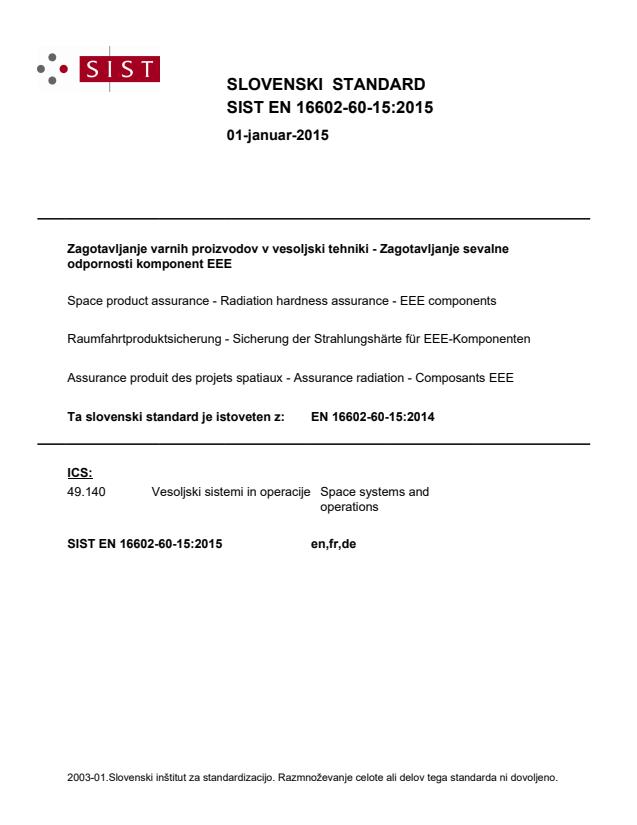
2003-01.Slovenski inštitut za standardizacijo. Razmnoževanje celote ali delov tega standarda ni dovoljeno.Zagotavljanje varnih proizvodov v vesoljski tehniki - Zagotavljanje sevalne odpornosti komponent EEERaumfahrtproduktsicherung - Sicherung der Strahlungshärte für EEE-KomponentenAssurance produit des projets spatiaux - Assurance radiation - Composants EEESpace product assurance - Radiation hardness assurance - EEE components49.140Vesoljski sistemi in operacijeSpace systems and operationsICS:Ta slovenski standard je istoveten z:EN 16602-60-15:2014SIST EN 16602-60-15:2015en,fr,de01-januar-2015SIST EN 16602-60-15:2015SLOVENSKI
STANDARD
EUROPEAN STANDARD NORME EUROPÉENNE EUROPÄISCHE NORM
EN 16602-60-15
September 2014 ICS 49.140
English version
Space product assurance - Radiation hardness assurance - EEE components
Assurance produit des projets spatiaux - Assurance radiation - Composants EEE
Raumfahrtproduktsicherung - Sicherung der Strahlungshärte für EEE-Komponenten This European Standard was approved by CEN on 13 March 2014.
CEN and CENELEC members are bound to comply with the CEN/CENELEC Internal Regulations which stipulate the conditions for giving this European Standard the status of a national standard without any alteration. Up-to-date lists and bibliographical references concerning such national standards may be obtained on application to the CEN-CENELEC Management Centre or to any CEN and CENELEC member.
This European Standard exists in three official versions (English, French, German). A version in any other language made by translation under the responsibility of a CEN and CENELEC member into its own language and notified to the CEN-CENELEC Management Centre has the same status as the official versions.
CEN and CENELEC members are the national standards bodies and national electrotechnical committees of Austria, Belgium, Bulgaria, Croatia, Cyprus, Czech Republic, Denmark, Estonia, Finland, Former Yugoslav Republic of Macedonia, France, Germany, Greece, Hungary, Iceland, Ireland, Italy, Latvia, Lithuania, Luxembourg, Malta, Netherlands, Norway, Poland, Portugal, Romania, Slovakia, Slovenia, Spain, Sweden, Switzerland, Turkey and United Kingdom.
CEN-CENELEC Management Centre: Avenue Marnix 17, B-1000 Brussels © 2014 CEN/CENELEC All rights of exploitation in any form and by any means reserved worldwide for CEN national Members and for CENELEC Members. Ref. No. EN 16602-60-15:2014 E SIST EN 16602-60-15:2015
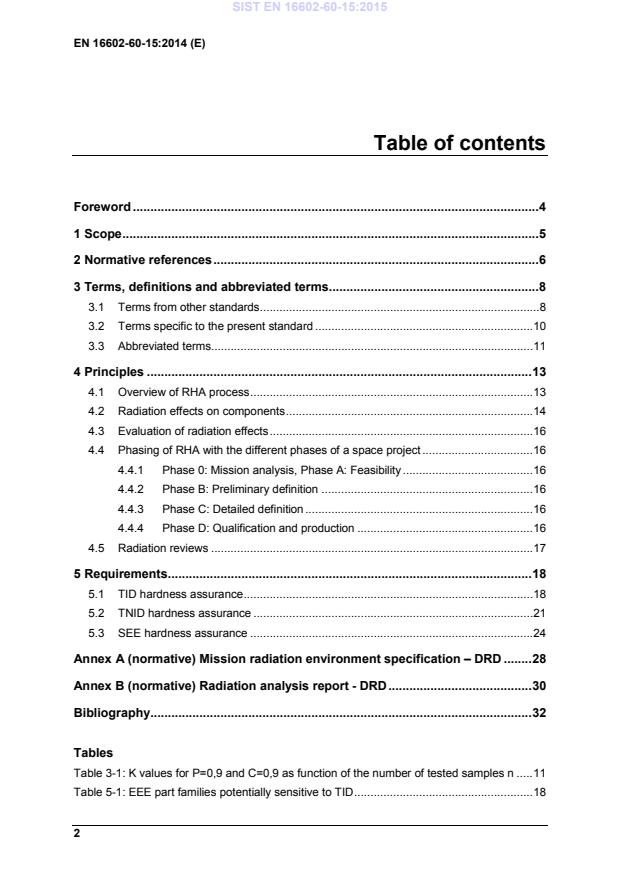
Tables Table 3-1: K values for P=0,9 and C=0,9 as function of the number of tested samples n . 11 Table 5-1: EEE part families potentially sensitive to TID . 18 SIST EN 16602-60-15:2015
Spacecraft charging effects are out of the scope of this standard. In this standard the word “component” refers to Electrical, Electronic, and Electromechanical (EEE) components only. Other fundamental constituents of space hardware units and sub-systems such as solar cells, optical materials, adhesives, polymers, and any other material are not covered by this standard. This standard may be tailored for the specific characteristic and constrains of a space project in conformance with ECSS-S-ST-00. SIST EN 16602-60-15:2015
EN reference Reference in text Title EN 16601-00-01 ECSS-S-ST-00-01 ECSS system - Glossary of terms EN 16602-10-09 ECSS-Q-ST-10-09 Space product assurance - Nonconformance control system EN 16602-30 ECSS-Q-ST-30 Space product assurance - Dependability
EN 16602-30-11 ECSS-Q-ST-30-11 Space product assurance - Derating - EEE components EN 16602-60 ECSS-Q-ST-60 Space product assurance - Electrical, electronic, and electromechanical (EEE) components EN 16603-10-04 ECSS-E-ST-10-04 Space engineering - Space environment EN 16603-10-12 ECSS-E-ST-10-12 Space engineering - Methods for the calculation of radiation received and its erects, and a policy for design margins
ESCC 22900 ESCC Basic Specification: Total dose steady state irradiation test method
ESCC 25100 ESCC Basic Specification: Single Event Effect Test Method and Guidelines
MIL-STD-750E
method 1080
(20 Nov. 2006) Test methods for semiconductor devices - Single event burnout and single event gate rupture test
MIL-STD-750E
method 1019 (20 Nov. 2006) Test methods for semiconductor devices - Steady-state total dose irradiation procedure
MIL-STD-883G
method 1019 Microcircuits - Ionizing radiation (total dose) test procedure SIST EN 16602-60-15:2015
MIL-HDBK-814
(8 Feb. 1994) Military Handbook: Ionizing dose and neutron hardness Assurance guidelines for microcircuits and semiconductor devices
For the purpose of this Standard, the terms and definitions from ECSS-E-ST-10-04 apply, in particular for the following terms: dose equivalent fluence fluence flux linear energy transfer (let)
For the purpose of this Standard, the terms and definitions from ECSS-E-ST-10-12 apply, in particular for the following terms: cross-section displacement damage LET threshold multiple cell upset (MCU) (total) non-ionizing dose, (T)NID, or non-ionizing energy loss (NIEL) dose NIEL projected range radiation design margin (RDM) sensitive volume (SV) single event burnout (SEB) single event dielectric rupture (SEDR) single event effect (SEE) single event functional interrupt (SEFI) single event gate rupture (SEGR) single event latch-up (SEL) single event transient (SET) single event upset (SEU) solar energetic particle event (SEPE) total ionizing dose (TID) SIST EN 16602-60-15:2015
If is the mean shift among tested population of n samples, σ is the standard deviation of the shift, and K is the one sided tolerance limit factor, then: • ing total dose shift • Delta XL = -
total dose shift • K depends on the number of tested samples n, the probability of success P and the confidence limit C. K values are available in MIL-HDBK-814. A 3 sigma (K=3) approach is often used. With 10 samples tested it gives a probability of success P of 90% with a confidence level C of 99%. Table 3-1 gives the values of K as a function of the number of tested samples n for P=0,9 and C=0,9 SIST EN 16602-60-15:2015
3.2.6 radiation design margin (RDM) ratio of TIDS over TIDL for TID and ratio of TNIDS over TNIDL for TNID 3.2.7 radiation lot acceptance test (RADLAT) see “radiation verification test” 3.2.8 radiation verification test (RVT) radiation test performed on sample coming from the same diffusion lot as the flight parts NOTE
This test is also known as “radiation lot acceptance test (RADLAT)”. 3.2.9 total ionizing dose level (TIDL) calculated TID level received by the part at the end of the mission 3.2.10 total non-ionizing dose level (TNIDL) calculated TNID level received by the part at the end of the mission 3.3 Abbreviated terms For the purpose of this Standard, the abbreviated terms from ECSS-S-ST-00-01 and the following apply:
Abbreviation Meaning APS active pixel sensor ASIC application specific integrated circuit CCD charge coupled device CDR critical design review DCL declared part list SIST EN 16602-60-15:2015
4.2 Radiation effects on components A comprehensive compendium of radiation effects is provided in ECSS-E-HB-10-12A section 3. Radiation effects that are important to be considered for instrument and spacecraft design fall roughly into three categories: degradation from TID, degradation from TNID, or NIEL or DDD, and SEE. Degradation from TID in electronics is a cumulative, long term degradation mechanism due to ionizing radiation—mainly primary protons and electrons and secondary particles arising from interactions between these primary particles and spacecraft materials. It causes threshold shifts, leakage current and timing skews. The effect first appears as parametric degradation of the device and ultimately results in functional failure. It is possible to reduce TID with shielding material that absorbs most electrons and lower energy protons. As shielding is increased, shielding effectiveness decreases because of the difficulty in slowing down the higher energy protons. When a manufacturer advertises a part as “rad-hard”, he is almost always referring to its total ionizing dose characteristics. Rad-hard does not usually imply that the part is hard to non-ionizing dose or single event effects. In some cases, a “rad-hard” part can perform significantly worse in the space radiation environment if unrepresentative ground irradiation tests were performed by the manufacturer in the qualification process (e.g. Enhanced Low Dose Rate Sensitivity in linear bipolar devices). Degradation form TNID or displacement damage is cumulative, long-term non-ionizing damage due to protons, electrons, and neutrons. These particles produce defects mainly in optoelectronics components such as APS, CCDs, and SIST EN 16602-60-15:2015
SEE are generally analyzed during Failure Mode Effects and Criticality Analysis (FMECA) as defined in ECSS-Q-ST-30 clause 6.4.2.2. Operational impact of each single individual component SEE is analyzed and its criticality is assessed based on the SEE rate of occurrence with an appropriate RDM. Rationale for establishing RDM for SEE is provided in ECSS-E-ST-10-12. 4.4 Phasing of RHA with the different phases of a space project 4.4.1 Phase 0: Mission analysis, Phase A: Feasibility Mission environment is defined and top level radiation requirements can be derived. RHA requirements (e.g. RDM) are tailored to the specific project needs. Preliminary radiation characterization studies can be started to help technology selection and design trade-off activities.
4.4.2 Phase B: Preliminary definition For SRR, Mission environment and RHA requirements are finalized. Electronic design and spacecraft layout are defined. Preliminary shielding analyses can be started as well as radiation characterization activities. 4.4.3 Phase C: Detailed definition Radiation characterization tests are performed. Equipment shielding analyses , equipment circuit design analyses (e.g. WCA, SEE analysis) are performed. Radiation analysis and WCA reports are provided in equipment CDR data package. When necessary, impact of radiation effect at
...
Questions, Comments and Discussion
Ask us and Technical Secretary will try to provide an answer. You can facilitate discussion about the standard in here.
Loading comments...